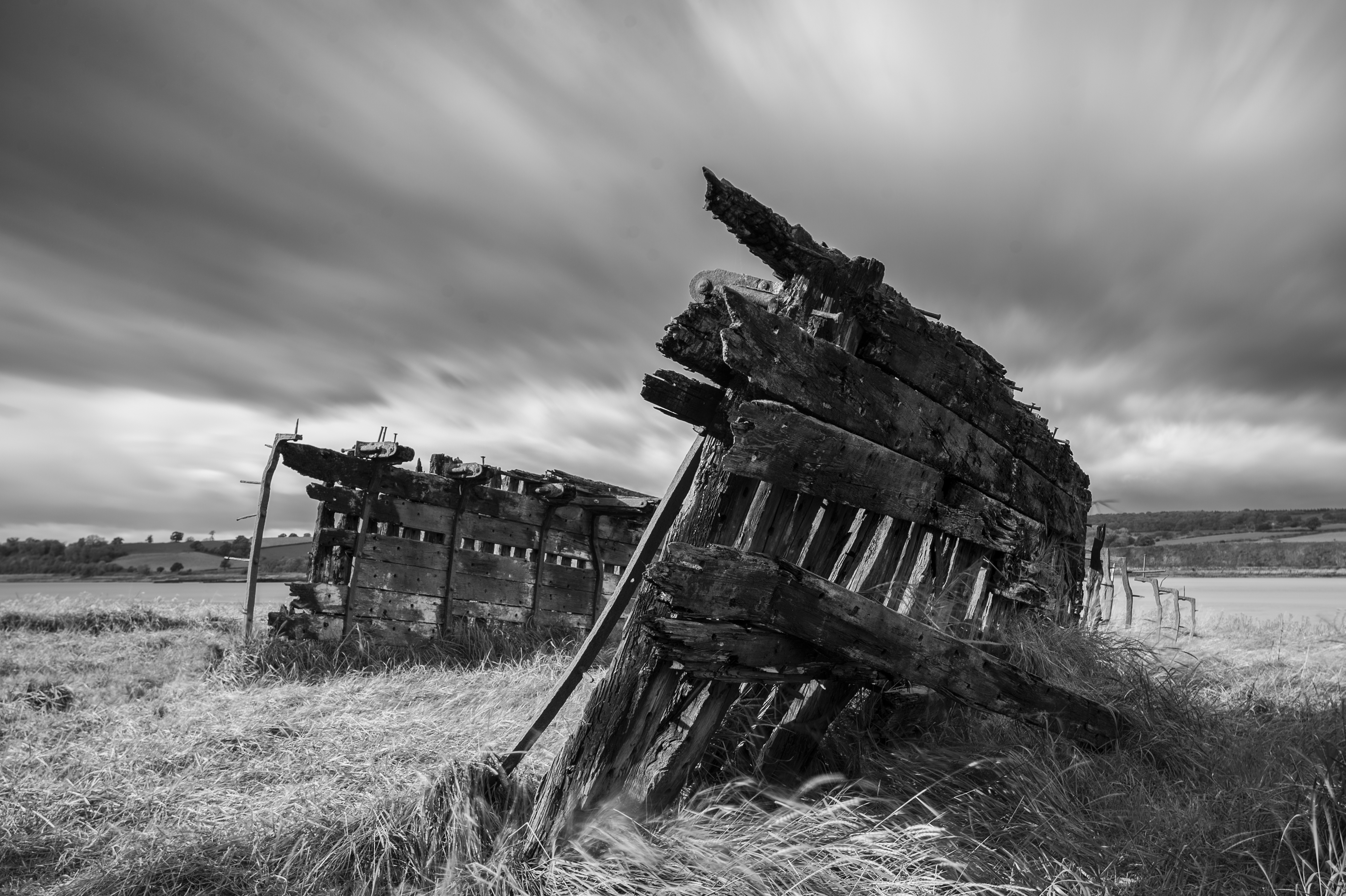
The Brief
Your first assignment is to make five portraits of five different people from your local area who were previously unknown to you.
You will almost certainly find it challenging to take photographs of people you don’t know; it’s often much easier to photograph somebody you’re already familiar with.This could be referred to as the ‘comfort zone’ – and for the purposes of this assignment you will be specifically required to leave it!
Leaving technical photographic considerations aside, there are a whole range of issues to deal with in making a portrait of somebody you don’t know. This additional skill set should arguably be in every photographer’s kitbag, regardless of what genre of photography they end up working in. The ability to concentrate on technical and aesthetic considerations whilst engaging with a complete stranger brings a plethora of difficulties. Added to the fact that most people aren’t that comfortable with having their photograph taken anyway, then you can see why this could become a minefield!
Just as you learn the techniques behind how your photographic equipment works, there are techniques you can learn about how to photograph people you’ve never met before. Many historical and contemporary portrait photographers have written about this and one piece of advice stands out:
Tip
If it is at all possible, spend time with your subject, getting to know them and triggering a dialogue with them, prior to even showing them your camera.
“A portrait by photography needs more collaboration between the sitter and the artist than a painted portrait. To make satisfactory portraits of persons it is necessary for me to like them, to admire them, or at least to be interested in them. It is rather curious and difficult to explain exactly, but if I dislike my subject it is sure to come out in the resulting portrait. The camera is all recording and very sensitive to the slightest graduation of expression of the personality before it. Also the impression that I make on my sitter is as important as the effect he has on me. I make friends quickly and am interested in the mental alertness of the people I meet. You can know an artist or an author, to a certain extent, from his pictures or books before you meet him in the flesh, and I always try to acquire as much of this previous information as possible before venturing in the quest of great ones.”
Alvin Langdon Coburn
Who you photograph is entirely your choice but don’t give in to the temptation to photograph people you know!
Approaching strangers can be daunting at the best of times, let alone with a camera in your hands. But it doesn’t have to be. If you are really terrified, consider asking a friend or relative to be your assistant.
You may want to explore the idea of types, thus sticking to a theme. Or the sitters could be very disparate, linked only by the fact that they come from your local area. Give consideration to this and also how and where you photograph your sitters. Bearing in mind the strategies and techniques discussed in Part One, keep your set of images consistent and choose a technique that complements your conceptual approach. For example, do you want a series of location-based portraits? Do you want the portraits to be situated inside? If so, drawing on your experience in Exercise 2, how will you select your backgrounds in order to give context?
Reflection
Before you send your work to your tutor, check it against the assessment criteria listed in the introduction to this course guide and make sure it meets all the criteria. Make your evaluation available to your tutor.
Your tutor may take a while to get back to you. Carry on with the course while you are waiting, but please don’t attempt the next assignment until you’ve received your tutor’s feedback on this one.
Reworking your assignment
Following feedback from your tutor, you may wish to rework some of your assignment, especially if you plan to submit your work for formal assessment. If you do this, make sure you reflect on what you’ve done, and why, in your learning log.
Introduction
I first read the brief for this assignment when I enrolled on the course and was looking through the material for Part 1. My initial reaction, like those of many students I would suspect, was complete terror. As the brief suggests, this idea of approaching a complete stranger for their portrait feels unnatural. In my case however, I have done this before, most notably when on holiday in Canada in 2016 [1]. On the vineyard tour, I elected to photograph the people involved rather than simply documenting the surroundings because one field of vines is very much like another. I continued this theme when I visited California in 2019, photographing the people involved in making and selling wine during each visit.

The first issue I wanted to explore with his assignment was why did I feel that terror if I had already done something similar in the past? The first consideration was that although unknown to me, my subjects and I were introduced to each other in a transactional way. I had paid for a tour of the vineyards and they were providing a service to me. The step from engaging on the tour and asking specifically for a portrait of them was not as great as it would have been with no connection at all. Coupled with this transaction was the fact that by profession, they were used to engaging with the public and therefore most likely more comfortable with having their picture taken. I certainly remember their reactions being more ‘surprise at being asked’ than any awkwardness over the act itself. In the case of the photograph above, both men were not comfortable with being photographed initially, but by talking to them about their passion for their boutique winery they lightened up for the shot itself.
The next consideration with regard to my discomfort was related to starting conversations that turn into an opportunity to take a portrait. Since leaving my job in engineering in January, I have walked to my local park to shoot photographs of the wildlife as part of my daily morning exercise. While shooting, I am regularly approached by other visitors to the park who are curious as to what I am doing. We usually have a brief chat about the animals that I’ve seen and how they behave and then go our separate ways. If I could chat to complete strangers in this context, why was I worried about approaching on this subject? I wondered whether that kind of conversation might be the way to introduce the idea of asking for a portrait. I tested this theory with one of the people that I regularly see in the park one morning. We had been talking about the elusive kingfisher that had been spotted at the lake. After about 5 minutes, I steered the conversation around to my redundancy and photographic studies. She was really interested in what I was doing and my plans for the future, but when I brought up the subject of the assignment, her reaction was “Oh, I wouldn’t let you take my picture”. After some exploring of the reasons why, she pointed to lockdown and how it had affected her appearance. I didn’t push this conversation further, but what understood Coburn was referring to in the quotation in the brief. The camera or the idea of it being used can affect the mood of the engagement, however brief. If the effect is received positively, the relationship is built between photographer and subject and the expression should be more natural in the portrait. However if there is some tension or awkwardness between photographer and subject, the resulting image will include that to some degree. With strangers, the amount of ‘stage management’ of the portrait is significantly lower than if the subject is paid to sit or has commissioned the picture. When we looked at traditional portraiture in Part 1, this context determines how much influence both photographer and subject have over the resulting portrait, set against the other elements in the frame. For this series, there is no real choice but to build some form of relationship with the subject before thinking of how to photograph them in a meaningful way.
My Theme
The COVID-19 pandemic has made meeting people more difficult that normal. Not only have the opportunities varied through multiple lockdowns, even when allowed out people are wary of getting too close to each other. The adoption of face coverings to protect from infection have added to the difficulties in getting people talking to each other, which presented challenges with how I approached this assignment. I decided to stick with where I had encountered the most people in the past year, the park in my home town. The central theme would be the people who visit and their stories about why they visit.
Approach
I used my Nikon D4 DSLR with an 85mm f/1.4 prime lens for all of the shots. This focal length is widely regarded as ideal for portraiture owing to the depth of field and subsequent ability to isolate the subject from the background. I shot each portrait at f/8 which is the sharpness sweet spot for the lens while maintaining subject separation through relatively shallow depth of focus. At this aperture, the subjects were isolated from the background but there was sufficient ‘sharpness’ behind them to provide context.
The downside of this combination of camera and lens is the physical size, which meant that I really needed to follow the advice in the brief about not introducing it too quickly to the conversation with my subjects. I composed the photographs to allow for a 8×10 crop, which for me gives a traditional feel to the shots; this format was popular in early portraiture with the development of 4×5 and 8×10 film cameras. The only other adjustments to the images were contrast, some highlight ‘dodging’ where the lighting conditions were harsh and tweaks to the white balance.
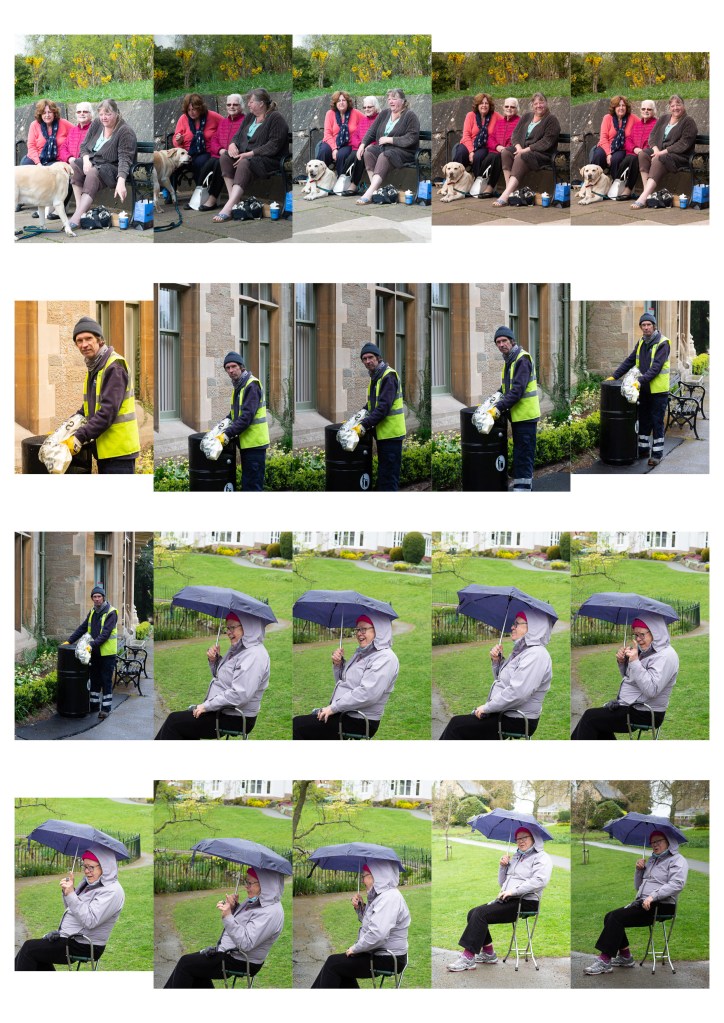
When it came to approaching subjects, I started a conversation with them about something that we might have both observed, such as wildlife behaviour, a rapid change in the weather etc. I would then steer them around to why they come to the park and make mental notes that I wrote up after the conversation. The only other information that I asked for was their first name. I then shot a number of portraits from different angles and distances, letting the subject relax into whatever expression they wanted to give me. I was inspired to do this by the Double Take work [2] where the photographer shot two portraits on one glass plate that resulted in subtle changes to the subject’s pose or expression as they relaxed into it.
The Series – People of the Park

The Photographs
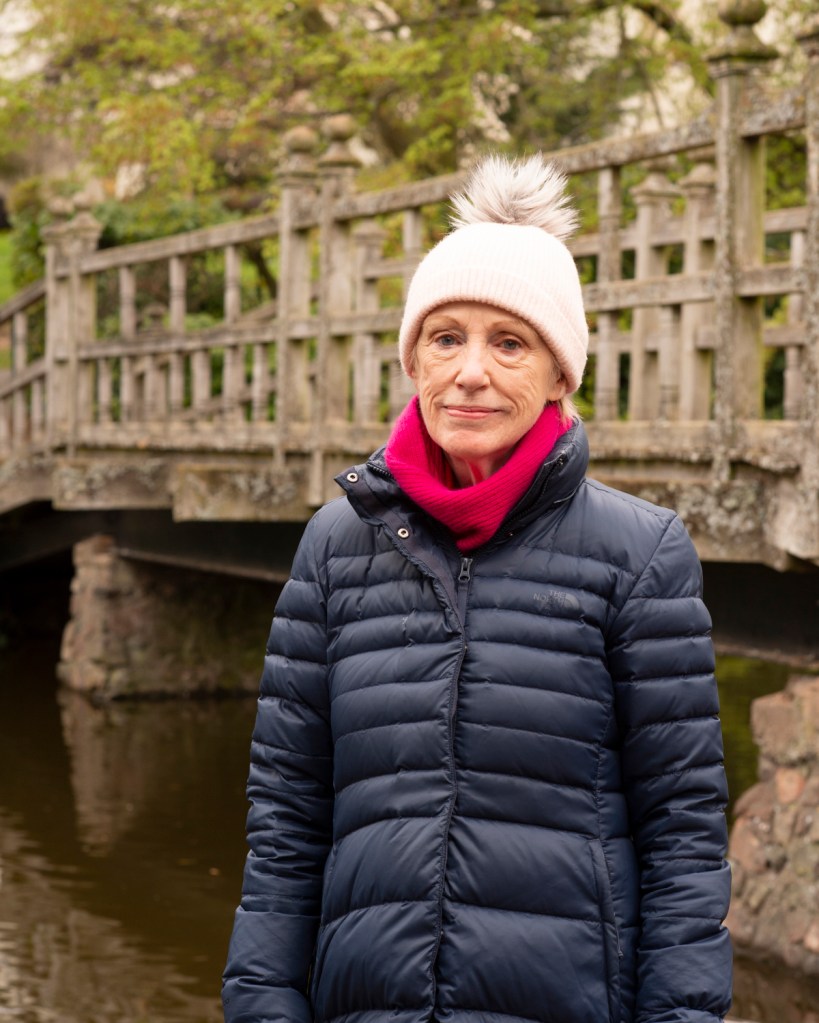
“I tend to come out on my own now as my husband can’t walk at my pace anymore”
Janet walks through the park on her morning walk. She enjoys the fresh air and exercise that she often has to get for herself as her husband suffers ill-health. She is looking forward to group exercise starting up again for the social interaction.
I met Janet when she had stopped to look at a tribute to Sarah Everard, who was murdered on her way home in London recently. I was immediately struck by the poignancy of the situation (the park was pretty much deserted) and nearly didn’t approach her for a portrait because of it. However, she was very chatty with a great sense of humour. She referring to considering herself fortunate to have worn a hat as she couldn’t yet visit the hairdresser. When she told me her story, particularly the part about her husband’s health, she did so without being melancholy but with a sense of needing to grab opportunities to take care of her own wellbeing whenever she could.
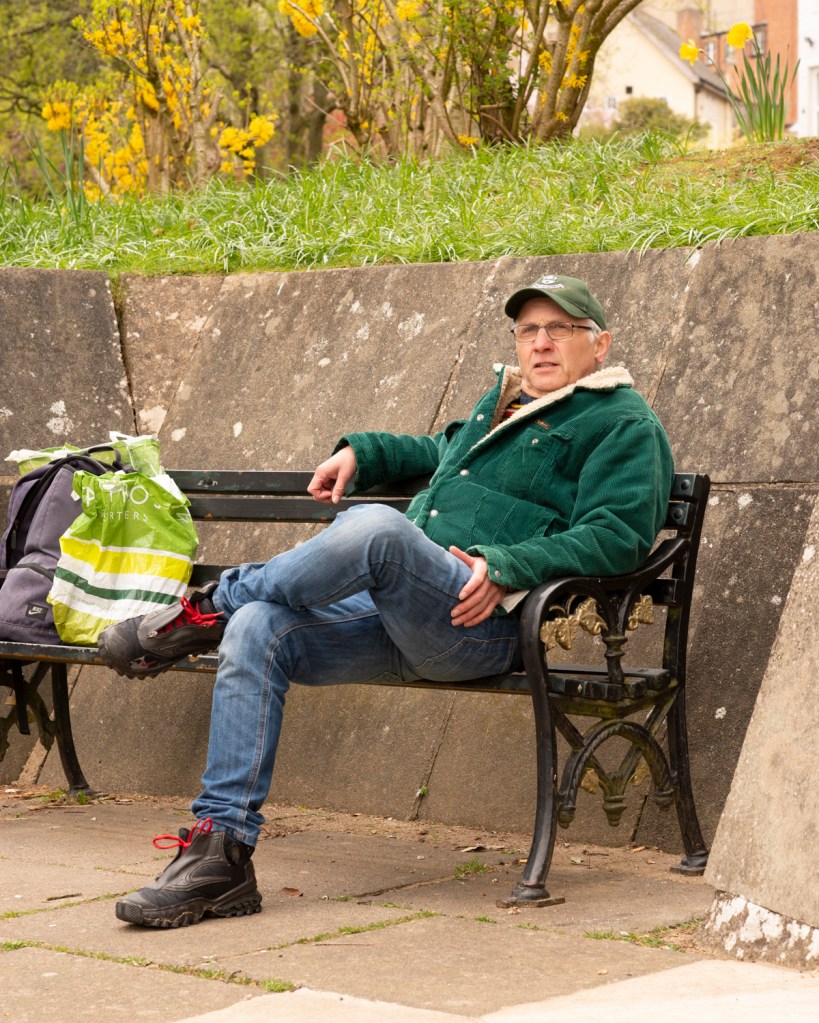
“I thought you might get around to asking me…either that or you wanted to borrow some money”
Steve has only recently started visiting the park as a change from sitting on a bench in the town centre. His routine includes buying his morning coffee and then transferring it into a rival chain’s reusable mug, which he hides in his carrier bag.
I met Steve when I sat on a nearby bench, elsewhere in the park, to drink my coffee. He was drinking out of a huge, battered reusable mug from one of the well-known café chains and delighted in telling me that he actually bought his coffee from a rival. We talked about everything from COVID vaccinations, camper vans and cricket (we are both huge fans) to music, photography and my studies. When it came to having his portrait taken, nearly an hour had passed. He chose this bench for the portrait as he felt it was a nicer background than where we were sitting.

“I come to the park at the moment because I’m really pissed off…ooh, pardon my French”
Wendy drives to the park every day with her dog, Alf. She has a challenging job in social care and within the past few days has suffered a bereavement and one of her nephews having major heart surgery. The park gives her a chance to relax and talk to other people as she throws Alf’s ball for him to fetch.
I had said hello to Wendy and Alf a few times over the past weeks when I’d been photographing the wildlife. On this particular morning, she was very stressed about what had happened to her in the past 48 hours. What concerned her more, as she told me her story, was the need to apologise for her language which seemed the least important thing to me. We talked at length about the discomfort of asking to photograph a stranger in the current social climate. COVID and the recent fears over women and children’s safety had made people more concerned about being approached by people they don’t know in any context, but particularly when that person is carrying a camera. Wendy assured me that ‘I didn’t come across as a weirdo’, which I really appreciated.
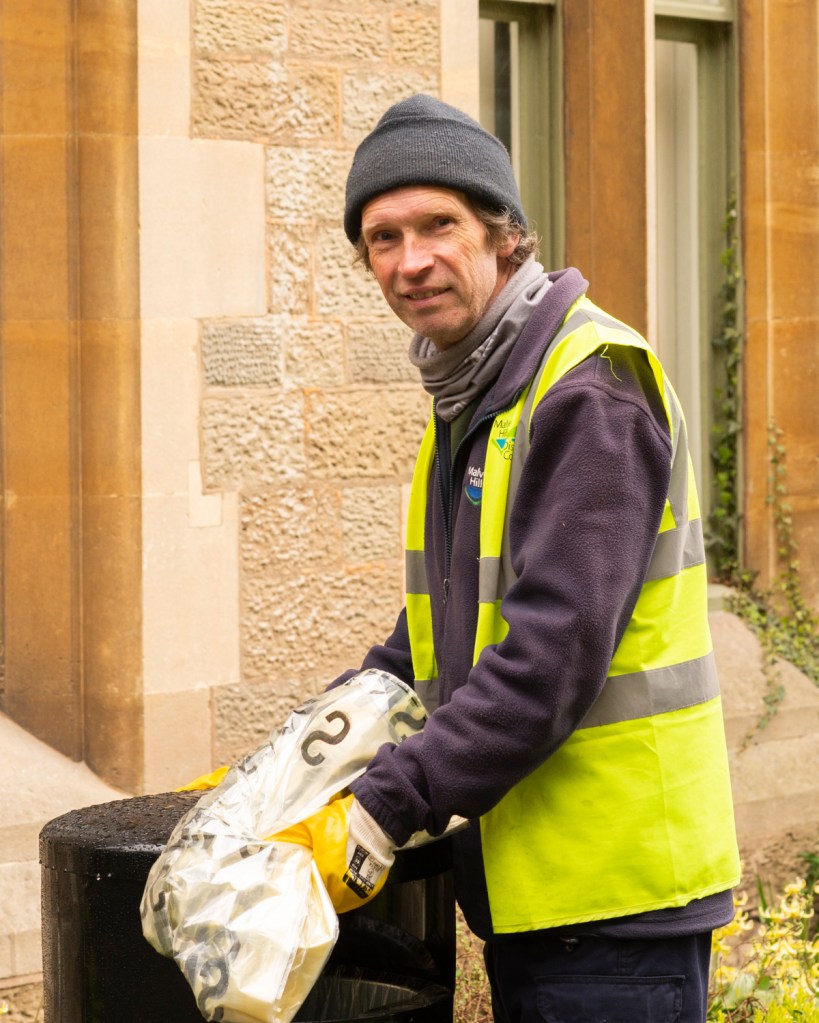
“I feel sorry for these people who only have a concrete play park with those markings for games, you know like basketball or something – we are really lucky”
Les has worked for the Malvern Hills District Council for over 20 years and he loves his job. He takes great pride in how it helps keep the park looking good throughout the year. He’s very aware of how lucky we are to have such a beautiful green space.
I met Les as he was emptying the recycling bin next to my bench. In true British tradition we started to discuss the inclement weather and how much we were looking forward to emerging from lockdown. Les had seen me in the park before and asked if I had been lucky in photographing the resident kingfisher. I said that I hadn’t, but had been enjoying the other wildlife that could be more readily seen. When I described this assignment to him, he said that he could never do that. I initially mistook this for not wanting his photograph taken, but he was actually more than happy to help as long as he could continue on his rounds while we shot the picture.
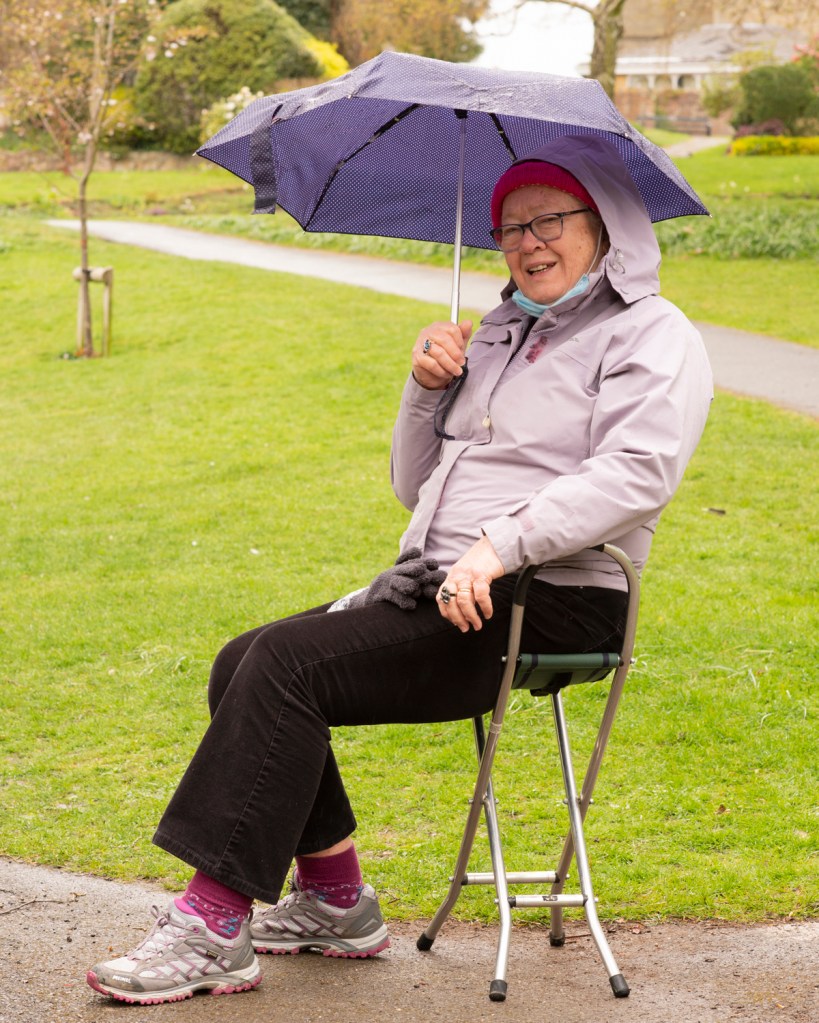
“I like all my clothes to be colour coordinated… shame about this blessed mask. Shall I remove it?”
Judith retired to Malvern 5 years ago and lives in one of the smart new retirement developments near the park. She regularly walks around the park for fresh air and exercise, taking her shooting stool with her for when she wants to pause to take in the beauty of the scenery and its wildlife.
I met Judith when I was on my way home having shot what I thought were my 5 portraits. We started chatting about her ability to stop wherever she liked with her shooting stool. She moved to after over 50 year living in Somerset and said that she loved her new home. When we got around to discussing my assignment, she cheekily suggested how people might question my motives, acknowledging the difficulty in making an approach. For her shots, she played to the camera by shaking her finger at me in a mock outrage etc. I chose this one because it reflected her wonderful sense of humour and fashion without being too obvious. As we finished, she said “Might I know your name so I that may tell everyone about this when you are famous?”
The Rejected Image
To give myself some flexibility in assembling the series, I approached 6 people for their portraits during my time in the park. The sixth image was ultimately rejected because it was a group portrait. Until that point in the work, I was considering having mixed subjects, e.g couples, families, age groups etc, to be more reflective of the variety of people who visit the park. Malvern is a culturally diverse town, but for some reason I didn’t observe many people from those different cultures out walking or sitting in the park. This is something that could have multiple reasons, which I could explore further in other portraiture series in future. When it came to approaching families, I was extremely uncomfortable. There have been some fairly high profile cases of crimes against children in the county recently and I just felt approaching them was a step too far – this of course reflects more on my insecurities than it specifically being a bad idea. When it came to couples, they were the ones who rejected the approach, perhaps as one was more uncomfortable than the other which made ‘no’ an easier response. The shot I did get though, was an encounter with a group of ladies eating cake in the sunshine.
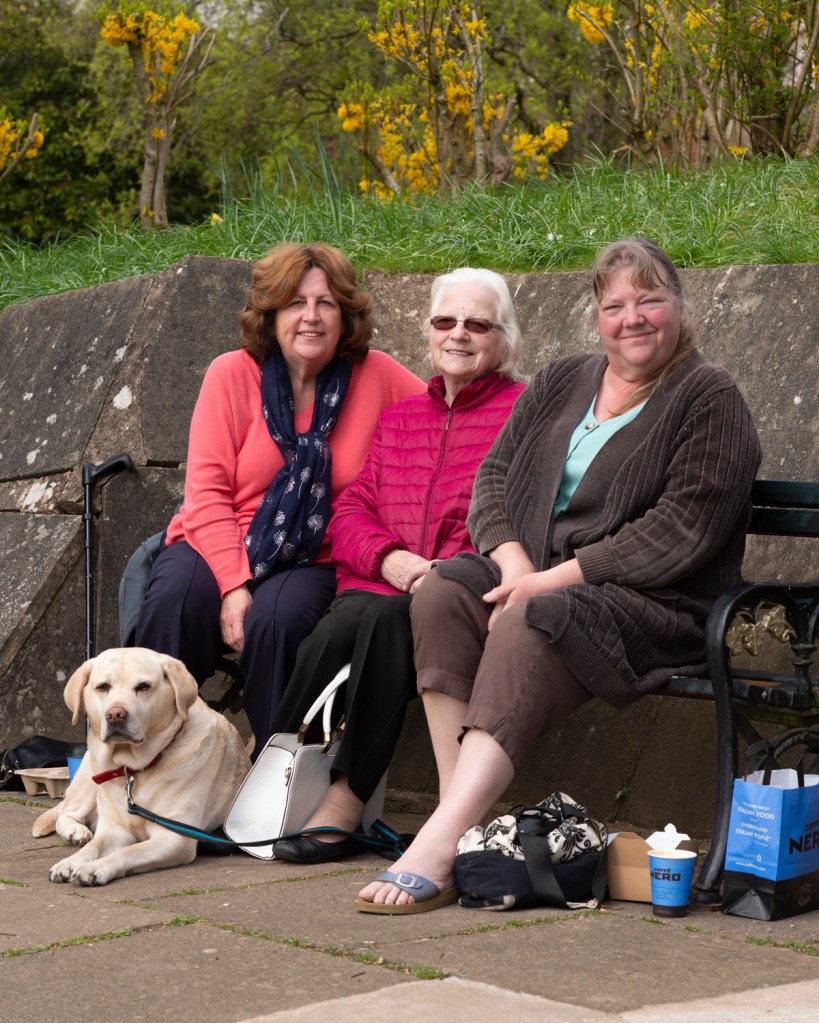
These ladies referred to themselves as The Merry Widows and were mother, daughter and close friend. They had been visiting the park to keep each other company, walk one of their many dogs (they were dog breeders) and each cake in the sunshine. I had a great conversation with them and they were the only people that volunteered to be part of this assignment without me actually asking them. I really liked this image as it had the contextual elements that supported happy ladies enjoying their treat in the park (their smiles, the bag and coffee mug being the main ones). The added bonus of the dog that sat patiently for the shot, reminded me of a portrait of my own family that I used in Exercise 4 [4]. Although I liked this shot, it didn’t fit with the rest of the series so was rejected in favour of Steve. Not only does the latter have a single subject, it also meant that I only had one shot at this same location within the park. Over the previous course units, I had learned the benefits of being self-critical and making tough edits, so this wasn’t really an issue for me.
Reflection
This assignment has undoubtedly been difficult because of the reasons mentioned previously. The most stressful part of the experience was finding an entry into a conversation with someone, however this wasn’t as bad as I had imagined. As suggested by Coburn, the establishment of some form of relationship is crucial to setting the tone of the resulting portrait. I have learned that this is also crucial in reducing any internal tensions that photographer and subject may have that are not necessarily obvious at the outset. With Janet for example, she may have been nervous about the approaching man in a fairly deserted park first, then anxious about where our conversation started to lead. By encouraging her to tell her story, almost in a ‘chat show host’ style, we both started to relax. At one point I told her that she was much more photogenic than she might have thought, to which she replied “you really know how to say the right things, don’t you?” with a big smile on her face. In the portrait that resulted, Janet’s discomfort at posing for the camera can still be seen, but it is combined with a wistful half smile which leads the viewer to ask what she is actually thinking about. When paired with the accompanying text, we see a woman who has a lot to deal with, but takes these moments in the park to seek some peace. Janet was the first person I approached and hers is my favourite of the series because I believe I’ve represented her both physically, but also how she came across emotionally.
With the others, our conversations varied in length from the 5 minutes or so chatting to Les as he worked, to the hour with Steve. In each case, I looked for something that described them but also their experience at the time I asked them to be my subject. This part of the assignment was the most rewarding as I felt that I had met some really interesting people who shared my passion for the park, but like me also used it to escape their complex, challenging lives. When we set the series agains the context of the national lockdown, the relationships between the subjects, the park and me take on a sense of ‘thanks for noticing me’. That sense comes through strongly with Judith and Les, the former because where she was sitting was blocking a footpath which would have been potentially been merely a nuisance to other people. With the latter, though there is a feeling that Les is almost invisible to other park users as it is his place of work. On reflection, I would have liked more background context with Les’s portrait his ‘props’ work well with his expression to represent the pride he has in his job which makes up for that.
When I consider my initial thoughts on this assignment right at the beginning of Part 1, I am surprised at the outcome. I didn’t take an easy route like advertising that I needed help or using interesting-looking cameras to lure people to me. Instead, I just showed some interest in them and introduced the idea of being photographed when we were both comfortable. On reflection, this was always the best way to approach this and I am happy to have conquered my anxieties about adopting it.
Against the Assessment Criteria
Demonstration of Technical and Visual Skills
All of the images are correctly exposed, sharp and the subjects are isolated from their background through the use of the lens focal length and aperture. Visually they all have good contrast between highlight and shadow, although the shot of Wendy had very challenging lighting conditions. The adjustments in post have reduced the high contrast on her face, but I would have preferred it to have been overcast. Each portrait includes background context that suggests a park and contextual links or props that support the context that is added by the supporting text.
Quality of Outcome
The series is presented in chronological order because that suited evolution of the assignment, starting with my initially awkward encounter with Janet and concluding with my very relaxed time with Judith. I believe the engagement between photographer and subject comes through in each photograph, particularly because I asked them not to adopt a what they might consider to be a traditional pose for me. It comes through most strongly in ‘Les’ and ‘Wendy’, both of which were shot as they were doing a specific activity. I asked them to carry on as normal and only got them to look at the camera when I saw the moment I wanted to capture. With Judith and Steve, I continued our conversation and shot them when I saw a moment that best represented our encounter. In terms of balance of subject selection, I tried to include both sexes as well as varying the age group where possible. The challenge here was that during a working week, the majority of visitors to the park are retired which resulted in all of them being older than me.
Demonstration of Creativity
I believe the series works in terms of revealing the people of the park in my town. Each story is different and by including a quotation and short commentary from each subject, I believe the personal connection between them and I is stronger. Each shot has different views of the park, from the bridge over the lake (Janet) to the elegant Victorian building that serves as the council offices (Les). Although I controlled the background and composition, I left the expression to the subject but prompted reactions from them by continuing our conversations. I believe this makes each as natural as possible. Finally, as I shot the series over 3 days, I was able to shoot under a variety of light conditions, weather and temperature which meant that each portrait has a different feel to it, despite them being shot in the same environment.
Context
I was heavily influenced by series Double Take[2] and the work of Sander[3] for this series. I set out to look for subtle changes in the expressions of the subjects by reading their reaction to our conversation, much like a studio portrait photographer would do. In Double Take, I was drawn to the way that the original photographer Keith Medley, shot two images per plate which elicited changes in the sitter during the process. The way that some shots were subsequently defaced because of some technical issue makes those differences intriguing when we look beyond the damage. In my case, I didn’t make many technical mistakes but still wanted to ‘watch and shoot’ rather than simply set up something static; I believe this comes through in the photographs. With Sander’s use of props and background, I was inspired to include just enough to ask questions about the subject and then add context with the inclusion of the few lines of their story and the quote. Sander caused me to think carefully about what to include and what to leave out. For example, I wanted to include the dog lead around Wendy’s neck because it contrasted with the other context of Alf being off the lead and ‘controlled’ by her having his ball. This creates a sense that the park is a place where dogs can run freely and that Wendy didn’t really need to use the lead. With Les there was plenty of context to suggest that he emptied the bins, but that isn’t his only job. The composition contains the obvious bin references but the inclusion of his MHDC fleece jacket suggests that he is not limited to this kind of work. With Steve, I had the story of his mug and how hid it in the bag and I wanted to avoid any really obvious context, such as asking him to hold the mug, that supported that narrative. The inclusion of the carrier bag coupled with Steve’s relaxed, inclined posture creates the narrative that here is a man who’s gotten away with something.
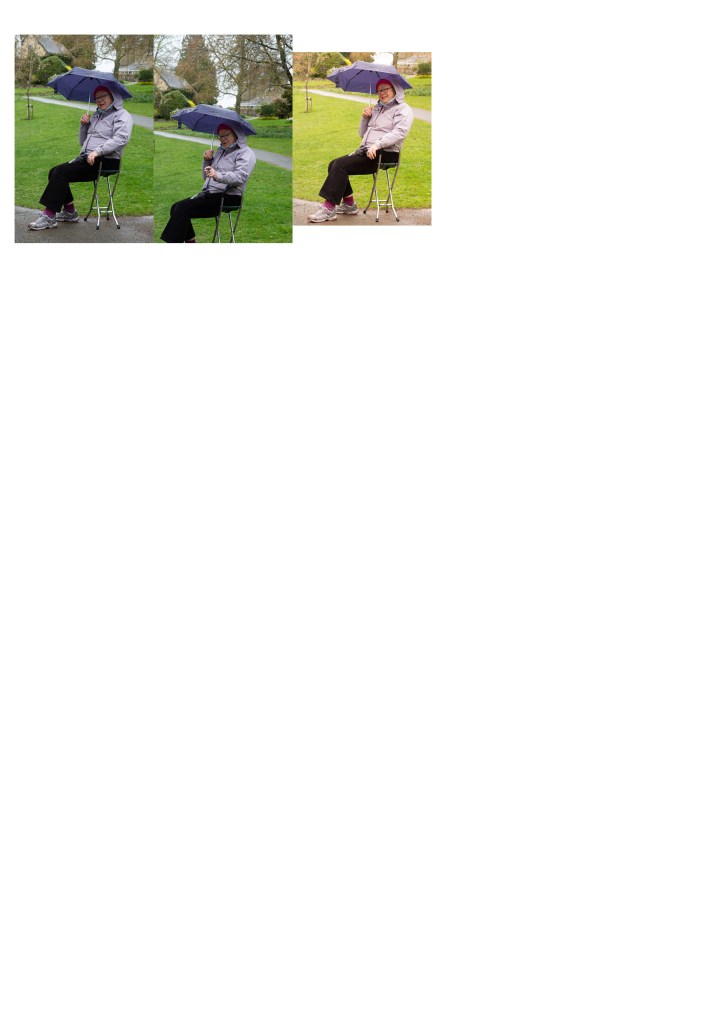
Contact Sheets

References
[1] Fletcher R, 2021, “Initial Meeting with My Tutor”, OCA Blog Post, https://richardfletcherphotography.photo.blog/2021/02/16/initial-meeting-with-my-tutor/
[2] Fletcher R, 2021, “Project 3 – Portraiture and the Archive”, OCA Blog Post, https://richardfletcherphotography.photo.blog/2021/04/10/1-project-3-portraiture-and-the-archive/
[3] Fletcher R, 2021, “Exercise 2: Background as Context”, OCA Blog Post, https://richardfletcherphotography.photo.blog/2021/03/16/1-exercise-2-background-as-context/
[4] Fletcher R, 2021, “Exercise 4 – Archival Intervention”, OCA Blog Post, https://richardfletcherphotography.photo.blog/2021/04/05/1-exercise-4-archival-intervention/
 Richard Fletcher OCA Photography Blog
Great work Richard, as you mention in the write up about your confidence growing you can see that as you progress through the images. Les, Judith and Wendy are my favourites because even though you can see in your contact sheets that you tried different poses, you ended up with images that appear natural and situational. I like that you included your conversations and also your won thoughts, I’d love to see how you would present them all together.
My only critique, and I’m being nit picky, is the colour temperature is a little warm/pink and I perhaps sense a little use of the texture slider to soften/flatter the skin, that’s just my taste though.
Look forward to hearing your thoughts hopefully on Friday
LikeLike
Thanks Harley. It was quite an experience in the end. Rather enjoyed it and have seen some of the people since. WRT the colour temperature, I did what I generally do which is to choose the LR preset and wind back to something that feels about right. To be honest, like you said it’s down to personal preference. Will see what the tutor says. I definitely see what you mean, though.
Thanks for the feedback as always.
R
LikeLike
Pingback: 2) Exercise 1: Individual spaces | Richard Fletcher OCA Photography Blog
Pingback: 5) Exercise 2: Georges Perec | Richard Fletcher OCA Photography Blog
Pingback: Project 1, Exercise 2: Identifying Ethical Principles | Richard Fletcher OCA Photography Blog