Introduction
Following the feedback from my tutor on Assignment 5 and the subsequent research into other contemporary portrait artists, I decided to review my submission again with a view to improving the series. There were clear indications in the feedback that some images were stronger that others, so that was where my review began. The intention for the series was to take my continued theme of revelation and apply it to me as the subject. While it was accepted that each image revealed new information about the me as per the brief, the intent behind each one and its impact was not thought to come through. It was immediately clear on reflection that Seven (the guitar shot) didn’t really say anything about me at all, so this would be the first image I would seek to replace. The other images that came in for criticism in the feedback were One and Ten, which were likened to a publicity photograph, again not really telling the viewer much about the subject. I had created an aesthetic using Bailey as an inspiration to effectively start and finish the series the same way, but on reflection this was more a technical choice than a creative one. The rest of the images still worked for me, though with each saying something about me that was intentional. Without external contextual information, they offer a variety of different perspectives that I touched on in my Feedback essay and with the addition of context, the people I have shown then too have understood what I’m trying to say with them.
Back to Basics
Having decided to rework One, Seven and Ten, I went back to what I had originally intended for each.
One
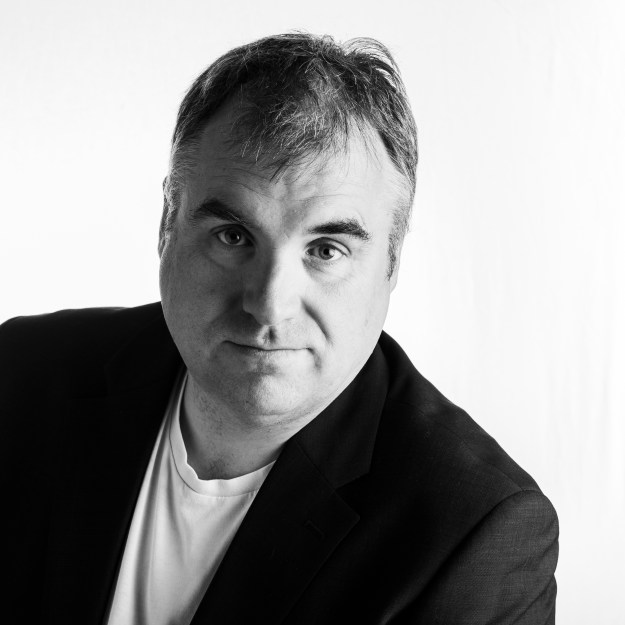
One was supposed to show me as a professional and somewhat serious man. The resulting image shows me with a fairly blank expression, which some of the people who’ve seen it refer to as my ‘resting angry face’. I wouldn’t describe myself as a miserable or sad person, but when I relax my face, that is what many people see. With this first image in the series, I had wanted to portray my total discomfort at being in front of the camera. I had believed that my natural expression of impassive, borderline grumpy would reveal that to the viewer, but instead I understand now that the result is a very formal photograph of me. I could indeed use this as a profile photograph in my company because it is formal and well executed. During my research into the portrait artists, I became interested in Edvard Munch’s work. Munch painted what he felt about a subject rather than strictly what he saw, with The Scream as his most famous example. In a similar vein, Eikoh Hosoe works in the surreal, combining contrasting but related subjects in his photographs. Hosoe’s work excited me because there were so many elements that contributed to the different perspectives the viewer could adopt. He also used photography to challenge realism by his use of technique; over and underexposure, unconventional composition and in the case of his portraits, real drama in the subject’s expressions [1]. If I wanted to portray my discomfort, One needed to be more about how I felt as I made the difficult decision to photograph myself. I needed to say more about my starting point and my lack of confidence in approaching the assignment. I actually really like the original One and am sad to be replacing it. However, it appeals because it’s comfortable which is something I’ve had to remind myself during the latter stages of this course.
Seven
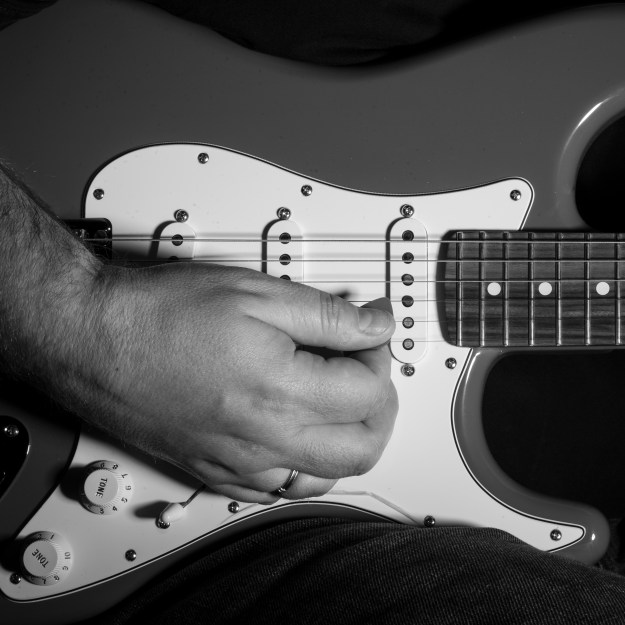
Seven was supposed to reveal my recent interest in learning the guitar and how it helps me to relax. The strength in the image is purely technical and at the time I was happy with the balance of the lighting, the guitar and how my hand was positioned in a ‘mid pick’. The bonus of the subtle obscuring of the volume control was also something I was happy with, but unless the viewer knows the layout of the Fender Stratocaster, this is probably lost on them. The image could be of anyone and there is little to describe the sense of relaxation that I was trying to portray. On reflection, the guitar doesn’t relax me. Instead, it offers a similar form of escapism that photography does and the reason I took it up was because of the time pressures I now place on myself with my work and this course. The guitar needs to be practiced little and often, so is perfect for brief interlude of escape. None of that context come across in this image though, so my new photograph would need to address the missing elements. I still like the photograph and would have enjoyed the result a great deal when I was first experimenting with studio lighting. However, it doesn’t work in the series so the decision to replace it was the right one.
Ten
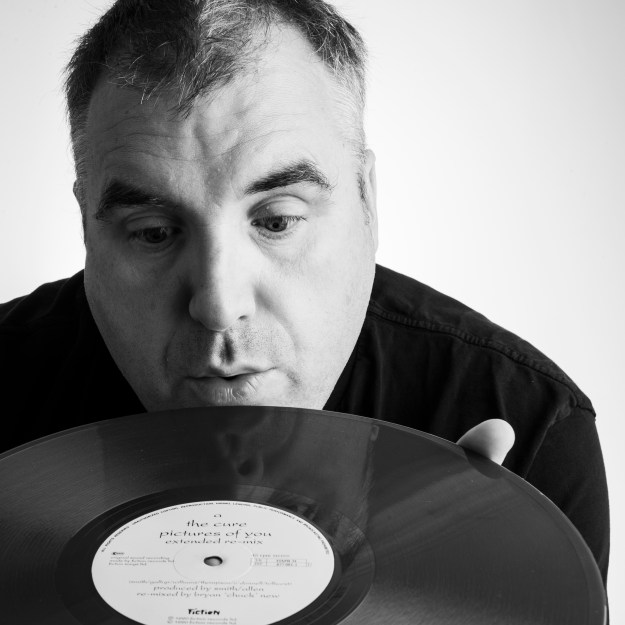
Ten was intended to reveal how my love of music has become an important and private place to retreat into. While Seven deals with my desire to learn how to play, Ten was intended to draw the series to a close with the tie-back to The Cure who were one of my favourite bands as a teenager. The idea of using the rare vinyl version of Pictures of You came about because I struggle to put on a relaxed expression without actually being relaxed. Blowing the dust of a record would eliminate any sense of my expression being forced, while the special vinyl record and the way I carefully handle it would show how much I care about music. Sadly, none of this really comes out in the photograph as again, the result could almost be a public relations shot for a radio DJ (this is the image my tutor conjured during our call). When I reflected on the intended reveal, I questioned the connections between the elements. Vinyl is something I’ve rediscovered in the past couple of years because I had completed the restoration of my parents old turntable. The turntable itself has great sentimental value as well as offering the opportunity to collect records in the same way I collect cameras. In reality, this image came about as a comfortable set of connections between collecting, a retro-aesthetic and my pride in re-discovering something that has previously fallen from fashion. Of my camera collection, 85% of them are old film cameras that are over 40 years old so it wasn’t a surprise that this is what I naturally fell back on as a context for the image. Also, the fact that the record is actually a translucent red, made the technical aspects of lighting the image more straightforward, again pointing to something I felt comfortable with. What I actually see music as, is a private escape where I can focus purely on the listening. I don’t have to be social if I don’t wish to be and similarly don’t have to care if other people like the same music as me. It offers a place to hide and relax when I need it. These elements are what needed to be impactful in the new version of Ten.
The New Images
Revised One
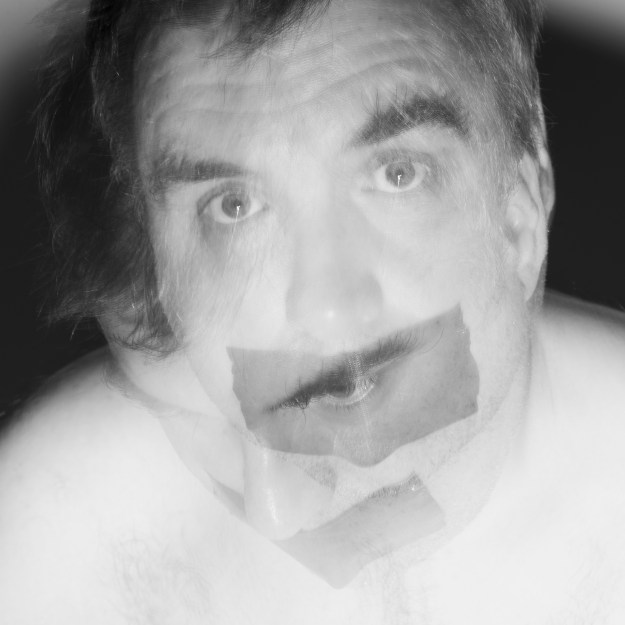
The new version of One was inspired by Munch and describes my total discomfort at being the subject of the photograph and indeed the series. I use a movement in a similar way to Francesca Woodman to portray the surprise realisation at what is happening. The tape across my mouth symbolises my feeling that I have nothing to say as a subject, while my lack of clothing was inspired by the recurring nightmare that is fairly common when insecure people are struggling with life; that is turning up to a public gathering (birthday party, work presentation, school etc) and slowly realising that you are completely naked. I wanted to include that fear in this photograph. I was inspired by Hosoe to venture outside of the ‘perfect exposure’ and sought to create a visual where the subject’s discomfort comes from being under the spotlight.
The final photograph was made by using an exposure of 2 seconds using the continuous ‘modelling light’ function on my studio strobe. As the exposure started, I flashed the strobe using the remote trigger with my head looking down. I then flashed the strobe again just before the shutter closed to capture the second face. I liked the accidental placement of the eye from the first face over the tape across the mouth of the second, as it adds the element of passively observing rather than speaking out. No other photographs I took during the shoot had this element in them, which made the task of selection a great deal easier once I had noticed it.
Revised Seven
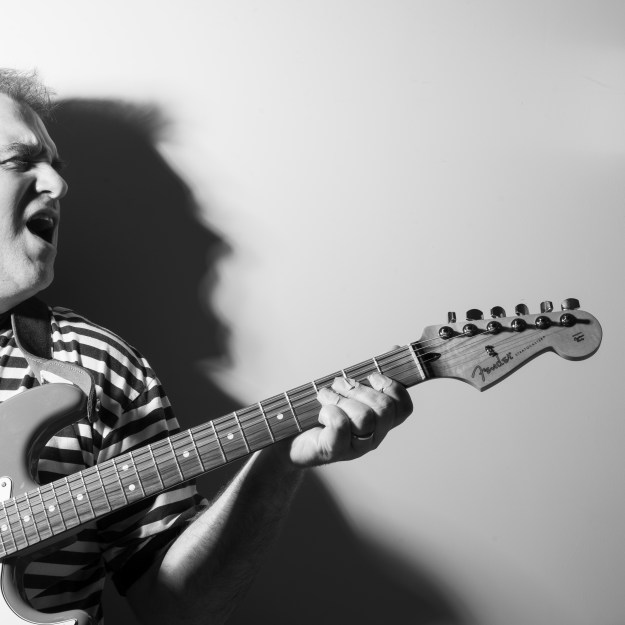
For Seven, I was inspired by Woodman’s unusual compositions. This image needed to show me with the guitar, something that the first version didn’t do. In this image, I am seen emerging from the edge of the frame as a nod to just starting out with the instrument. This is further emphasised by the plasters on three of my fingers; injury to the skin being a common occurrence when starting out with this instrument. Finally, and the main element to the image is my shadow which looks like a more ‘established’ rock star profile than the actual enthusiastic expression on my face. I used conventional elements such as the striped shirt to tie in with the guitar’s fret board and to contrast with the plain background. I’ve tried, like Woodman to include me in the subject of the photograph without actually being the main focus of it. In my image, the guitar and shadow are for me the dominant elements. Unlike Woodman’s ghostly presence in her photographs, there is no movement in Seven. Instead, my position in the image defies the convention by being right on the edge of the frame, with my index finger being on the right-hand ‘thirds’ line. I shot this photograph against a wall my living room rather than a photographic backdrop and used only one strobe to create the harsh shadow on the wall. I’m much happier with what this photograph says about my desire to be a musician and how that ambition would naturally outweigh my talent at this stage of learning.
Revised Ten
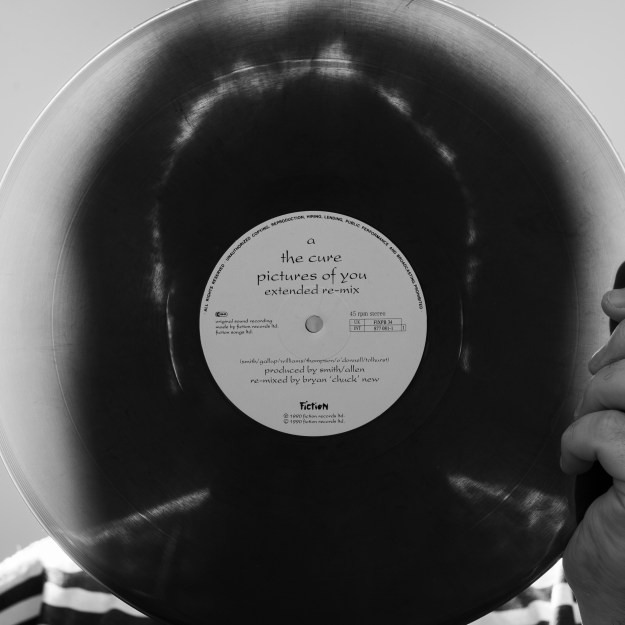
For Ten, I was inspired by Hosoe’s work in Ordeal by Roses. He often juxtaposed the subject with the roses or something that was symbolic of the rose in an abstract composition. For this, I wanted to keep the link back to The Cure. The translucent property of the record meant that I could effectively be seen through it which would maintain my theme of retreating into music. I used a bright and harsh flash to both back-light my head and create the halo as it passes through the record. The contrasty aesthetic that Hosoe created with his portrait series is echoed here with the only middle tones being my hand holding the record and the background. I like this image because it makes music the obvious subject but looking more closely shows my relationship to it. The vinyl is still present, but the way that I am holding the record removes my precious feeling toward the object itself (although I was naturally very careful). For me, the context of the image is changed by the elements in the photograph more than in the previous, which relied on my describing what I was trying to say with it in words.
Another Change
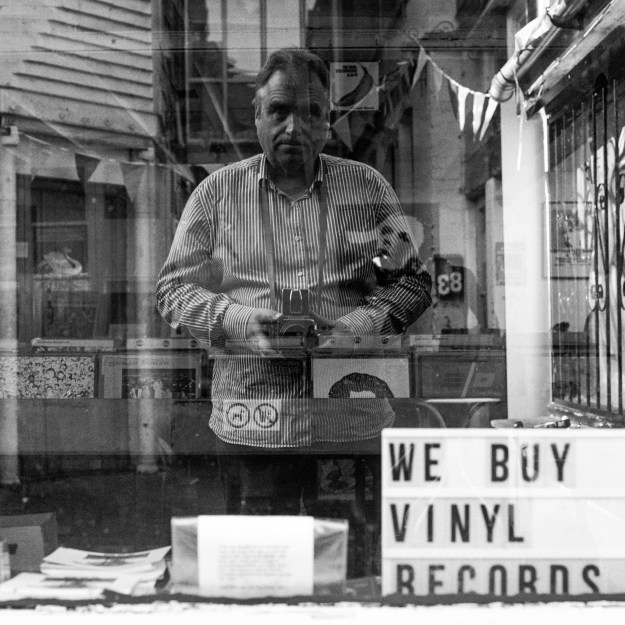
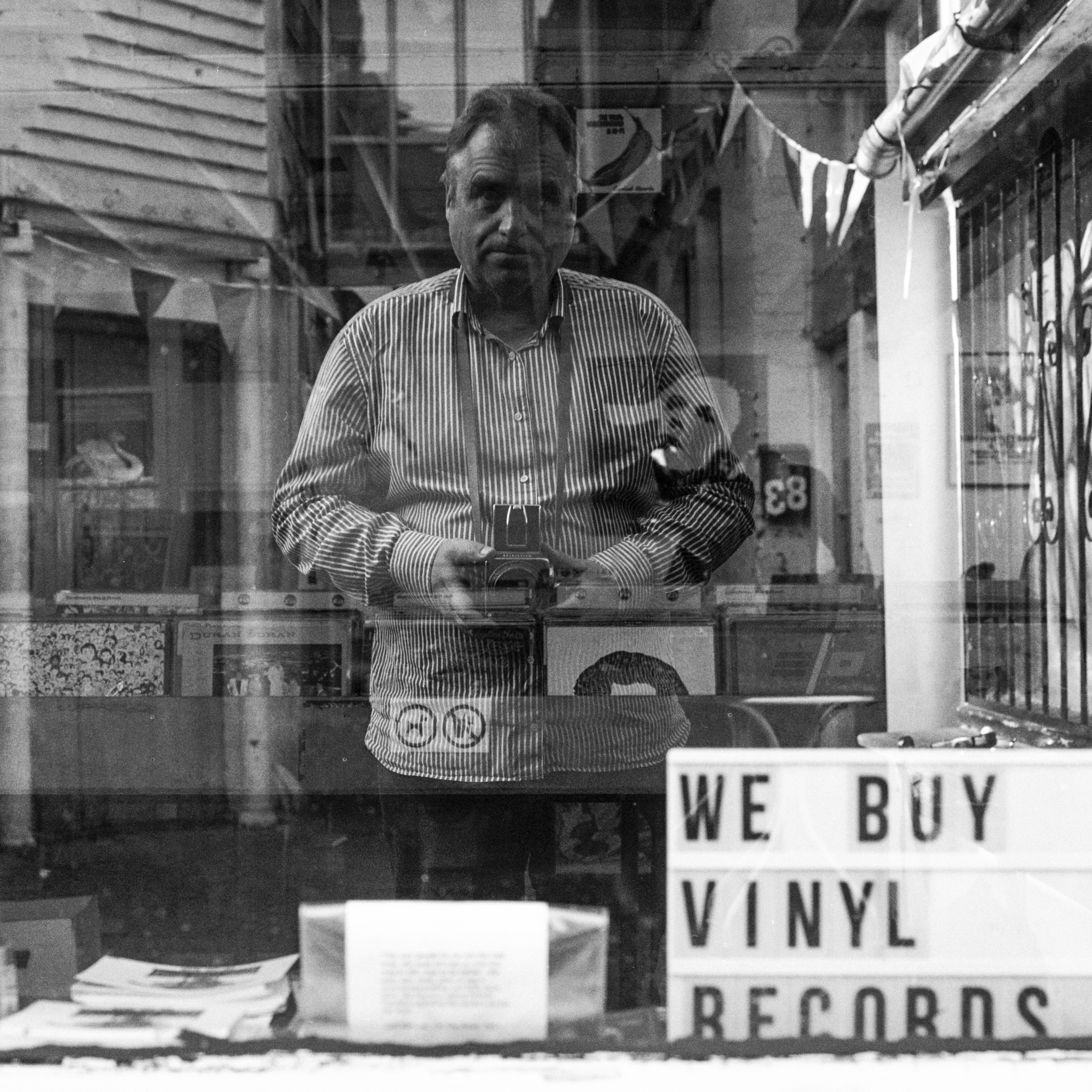
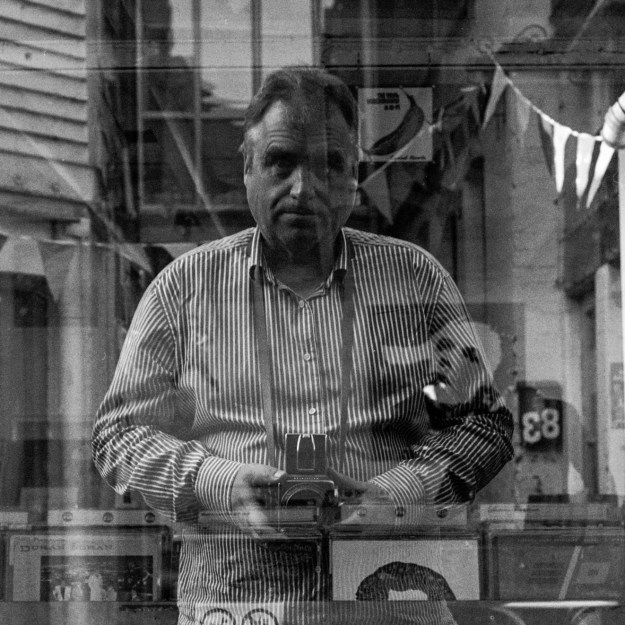
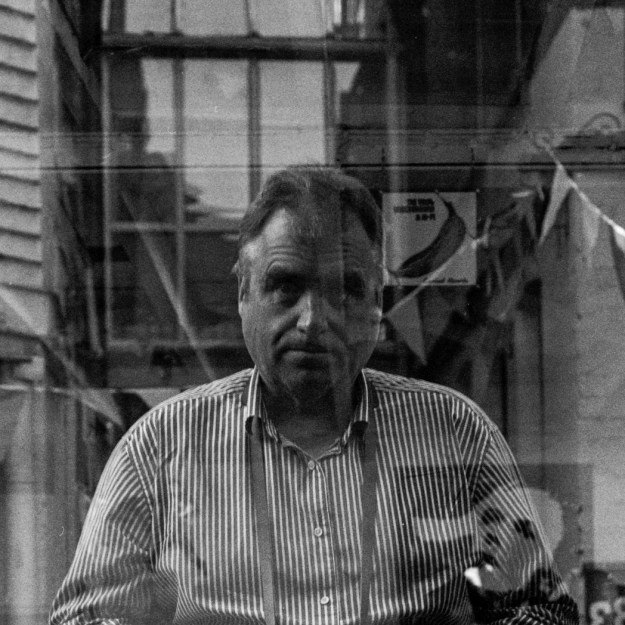
Another point raised during the feedback conversation with my tutor was that Nine might be a little too obvious in its composition. The photograph is inspired by Vivien Maier’s self-portraits in shop windows with her Rolleiflex. I had chosen to tie in my love of photography with music by shooting something similar with my friend’s record shop window. The resulting image had very obvious pointers to what the photograph was about and my tutor suggested a more extreme crop to make the composition more interesting. I made two crop attempts, one that followed his suggestion and one in between it and my original version. All three can be seen below.
-
- Original Nine
-
- Nine

-
- Tutor Crop
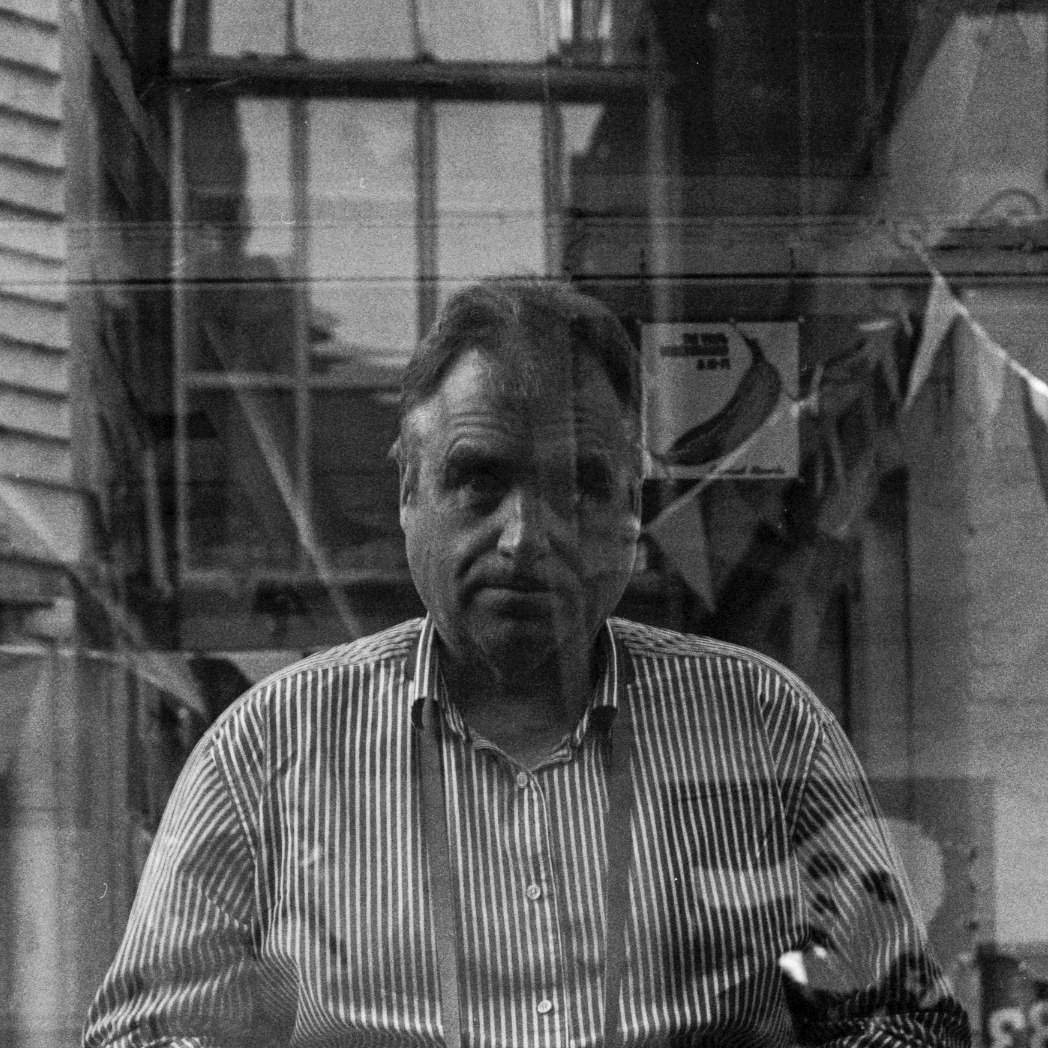
My tutor suggested removing the obvious elements of the image (the camera, the sign, the record racks in the shop etc) and leave the subtle music references like the portrait of Ian Curtis and the distinctive Velvet Underground album with its iconic Warhol banana painting in the cover. This crop can be seen on the right. When I looked at this image again, I felt that removing the camera and the record racks took away too much from the photograph but that it was definitely more interesting without the window sign, My crop in the centre image is a less extreme version of what my tutor was describing. I kept the camera because my original concept for the image linked photography with music – losing the camera broke that connection for me. I also felt that by keeping the record racks, there was more for the viewer to explore in the photograph than in the tighter crop. The moody exposure with my shadow emerging from a dark background still works in all three, but I prefer the way that my version looks, so I included it as a revision to the series.
Re-ordering the Series
Having elected to shoot three of the photographs, I now had to consider how the series looked in sequence. My original concept was to reveal a man with challenges in his life and show how he has responded to them through passions and coping strategies. The questions now were whether that concept still worked with the image sequence and if it could be improved by shuffling the order. The original sequence with the new images added can be seen below.


My first impression was that I should swap Three and Four in order to separate the two pictures with movement in them. The result can be seen below.


What I realised with this sequence was that the ‘tension – depression – comfort’ theme of the original order was lost this way, so I discounted this as a change to make to the series. The other change I considered making was to move the much stronger Seven to the Nine position as it now combined and contrasted my enthusiasm with wanting to learn music with the sanctuary that listening to music gives me. The revised sequence can be seen below.
Now the series flowed how I wanted it to. Starting with discomfort, moving through my mental health issues, my re-emergence and the challenges of open-water swimming and the peaceful solitude it provides. Then onto my love of photography as an opportunity to understand the craft, in particular film photography and on to how music affects me as both a budding musician and as a place of sanctuary. This is the order of the series that I decided to submit for assessment.
Conclusions
It’s fair to conclude that this assignment pushed me harder than the other four, which makes sense as it comes at the end of the course. I worked hard enough to create the first submission and some of the feedback was difficult to accept at the time because of that. In trying to address it however, I’ve learned that being uncomfortable with my art is not a negative thing. Being uncomfortable has led me to shoot pictures that I would not have ordinarily considered. When I showed One to my wife, her reaction was that it certainly said something powerfully and added that it was probably the most abstractly creative thing I’d ever produced. In creating it, I experimented with the composition and lighting but wasn’t focused on creating the classical portrait. Two of my experiments can be seen below.


The left hand one was my establishing movement to create an almost ethereal impression of a man surprised by something, in this case the idea that he would be the subject of a photographic series. I wasn’t using the strobes at this point, just the modelling lamp function that they have and while I liked the definition that face had, the idea of discomfort still didn’t come through. The right hand image was using more extreme exposure and a longer exposure time, resulting in some detail in one eye. I liked this effect too, but it felt more like chaos than surprise. Both images are far away from what I usually shoot and I enjoyed not really knowing whether the effect would grab me or not when it came to review. It was a challenging shoot to do because I was both operating the shutter and the strobe trigger while trying to keep the natural flow of my movement through the frame. When I finally realised I could partially freeze the movement this way, I thought carefully about what I was saying here. The other elements added to the composition resulted in the final image which I think works well in the series as well as on its own.
As well as the realisation that moving away from what’s comfortable can be positive, I learned also that I don’t really care if people ‘like’ my photographs, only that they react to them in some way, whether seeing my perspective or creating their own. This was reinforced during a conversation with our cleaner who came to look at the prints I was doing for assessment. She said that with Assignment 2 (my collection of emotions through eyes), she didn’t want to look at them closely as they were unsettling to her. We discussed why that was and she was reluctant to elaborate, simply stating that she didn’t like the set. My conclusion was that that was perfectly alright by me.
References
[1] Article 2016, “The school of flesh: erotic portraits of Yukio Mishima, The Guardian, https://www.theguardian.com/artanddesign/gallery/2016/nov/03/yukio-mishima-erotic-portraits-eikoh-hosoe-ordeal-by-roses-in-pictures
 Richard Fletcher OCA Photography Blog
Cracking series and really like the reworked images much stronger for them 💪🏻
LikeLike
Thank you, Harley. Can’t tell you how hard I found that assignment. Hope the course is going well for you.
LikeLike