Introduction
With the end of Expressing Your Vision in sight, I was fortunate to travel to New York to celebrate my birthday. As with almost everywhere I go, I took a camera with me but instead of simply taking holiday photographs as souvenirs of the visit, I decided to practice the whole concept of EYV. Prior to this course, I had prepared for a holiday by assembling my camera gear from my large collection which was driven by a whole host of potential ideas of what I might shoot while there. What I’d learned by Assignment 5 of the course was that the equipment is actually not all that important unless there is a specific project or genre that we have in mind. My desire to use as much of my collection of cameras as possible on a trip was both tiresome from a carriage point of view and wasteful as much of it went unused. For this trip, I decided to take a single, simple camera system that I could easily carry around the city and by limiting the equipment choices I could make while there, I was able to start thinking about what I wanted to practice photographing instead. In the end, I took my Nikon D300 with a 35mm prime and a pair of zoom lenses (one tele and one wide angle).
Once in the city, I started to think about how I felt about the place. This was the fourth time I would be visiting New York, so the usual tourist stuff had already been more than covered. For this trip, I wanted to explore the way of life and create photographs that reflected how I see New Yorkers in their environment. I also wanted to take conventional scenes that ‘everyone shoots’ and seek an alternative way of looking at them.
The first experience when we landed was the traditional New York winter weather, very cold and for one day only, snow. We took a walk up to Times Square from our hotel in lower Manhattan and I took my camera with the 35mm lens attached. I shot the following images.
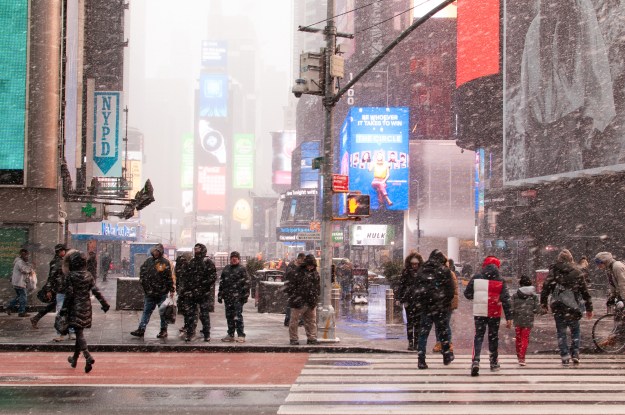
Photo 1
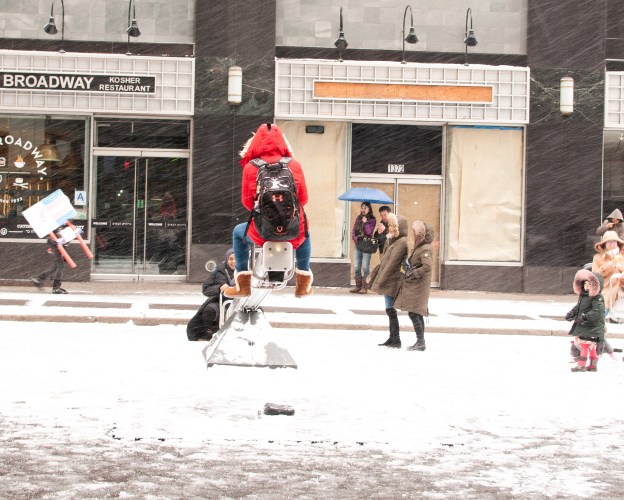
Photo 2
In Photo 1, I saw the blizzard of sleet ahead of us with Times Square emerging from the gloom and what struck me was the way that New Yorkers take this weather in their stride. We were tourists so we had to go out exploring, but these people were just going about their business and were prepared for the conditions. It contrasted with my own experiences of similar weather in the UK, where the place almost shuts down at the first sight of snow. What made this image for me was it being set against the bustling Times Square, which was a destination for these people in midtown Manhattan.
Photo 2 was a scene we came across in the street as we approached Times Square. The see-saws were a permanent fixture in the pedestrian zone and I guess popular during the rest of the year. The weather wasn’t stopping these girls from enjoying them and the contrast of the struggling man carrying the sign against the snow, with the spectators set this image off for me. In both photographs, I was practicing looking and seeing, which is something I wasn’t really actively doing before I started EYV.
The next day, the snow had disappeared completely and we woke to the weather we would have for the rest of the trip; very cold but sunny with clear skies. The danger here would be that I could fall back into shooting ‘nice’ exposures of interesting subjects, rather than creating something different. I decided to simplify my shooting workflow by using just the 35mm lens with the camera set to 400 ISO, and to leave the lens at its widest aperture, which was f/1.8. This meant that I was setting boundaries for the camera (and for me) where I could only achieve a perfect exposure if the camera could adequately control the shutter speed. Given the brightness of the day, it could easily be the case that the shutter wouldn’t go fast enough and overexpose. I was curious to see what the photographs would look like if that happened as well as how my own intervention with the shutter speed might impact the final image. I had been used to shooting manually, but this could be interesting. To make things more so, I switched off the automatic preview display on the back of the camera so I couldn’t ‘chimp’; an expression for pawing at the screen to see what you’ve shot. Now, my DSLR would behave more like my older mechanical film cameras.
The next sequence of shots show the result of taking this approach.
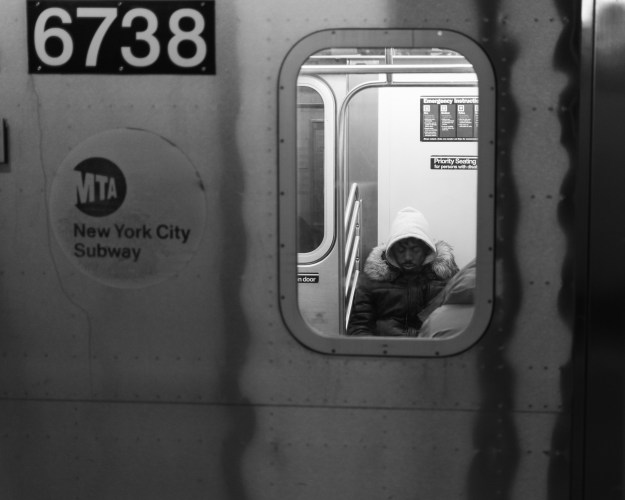
Photo 3
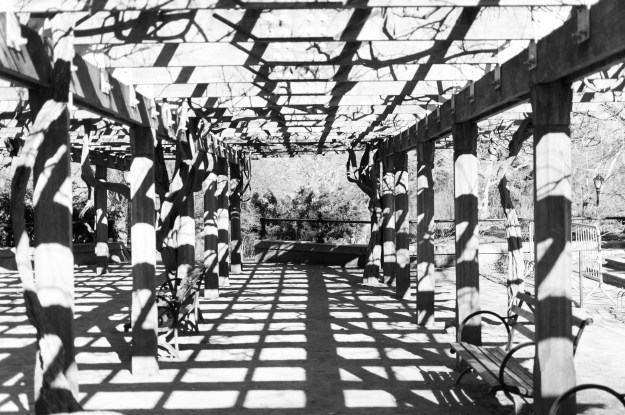
Photo 4
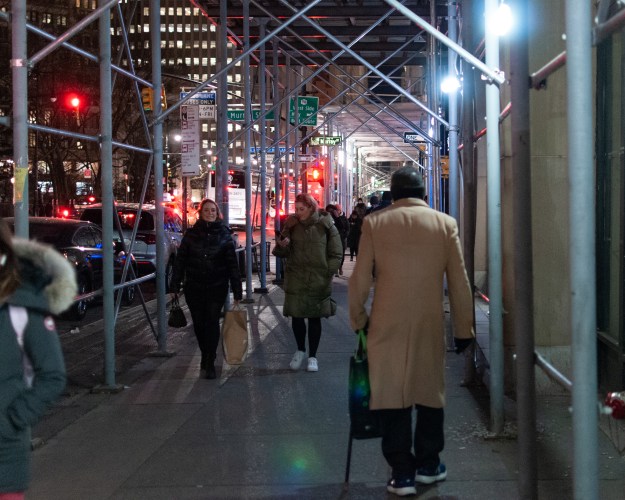
Photo 5
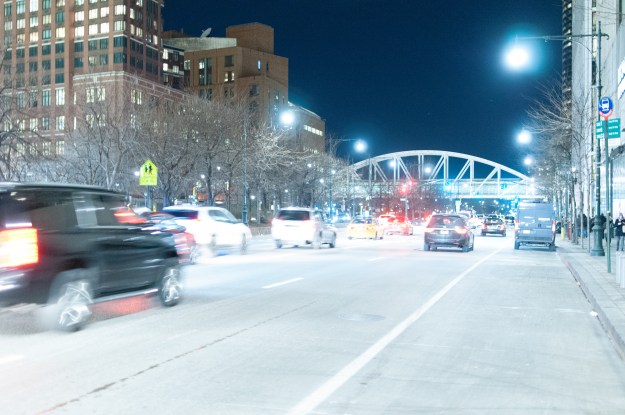
Photo 6
Photo 3 was shot quickly in the subway station after I saw the guy framed alone in the train window. His impassive expression as he looks at his phone, sums up what taking an underground train means to me. People are isolated from each other, even though they all share the same tiny space.
Photo 4 was a pagoda in Central Park. I was struck by the symmetry of the composition and the harshness of the light as it streamed through the gaps in the structure. The camera overexposed this image which made it even more dramatic.
Photo 5 was as the sun went down in the late afternoon. I saw the gentleman walking slowly ahead of me and the two women approaching, seemingly engaged in conversation but with one distracted by her phone. The complete disconnect between the characters in this photograph appealed to me in that it reinforced how disconnected city life is. The whole scene is framed by the scaffolding of the building which reminded me of Lorca DiCorcia’s work when shooting Heads.
Photo 6 was in the evening on the way back to the hotel. The city comes alive in artificial light at this time, so I wanted to emphasise the clinical use of it to light the roads. It reminded me of my Assignment 4 submission, which had the theme of revealing dark corners. I manually opened up the shutter for this image which created the movement and brightness contrasted against the blue sky of the early evening.
I had certainly moved away from what I was used to with this series of shots. I quickly got into the rhythm of trying to say something as I saw a composition and then trying to make the message have impact. My wife was recently describing the shooting of Assignment 5 to a friend of ours and she said that once I had the idea for an image, I could then fall back on my technical knowledge to make the picture look how I wanted. The main challenge was to understand what I wanted to create rather than how to create it. The next series of images show how my thinking has changed over the course of EYV.
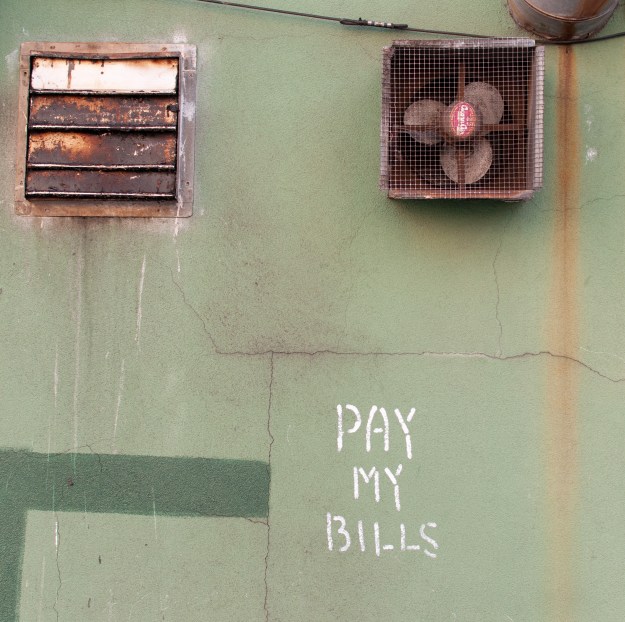
Photo 7
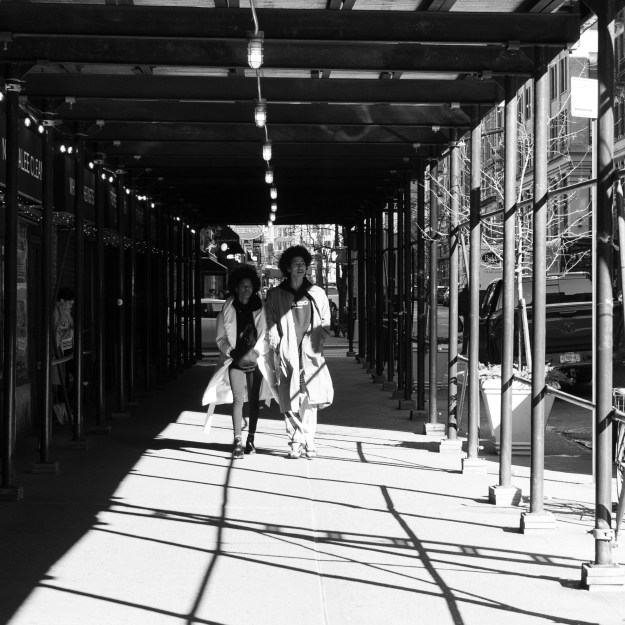
Photo 8
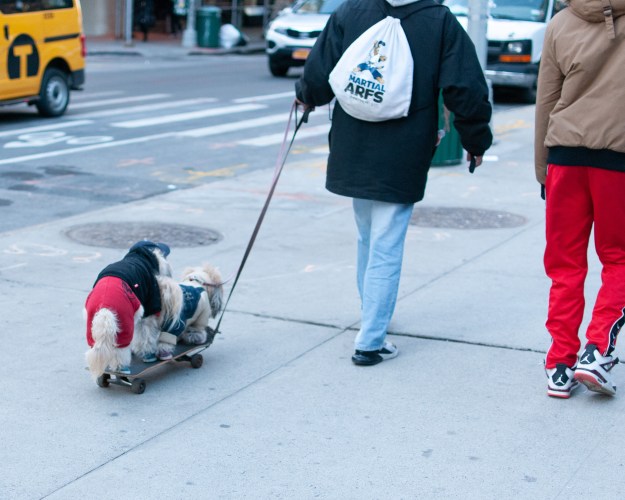
Photo 9
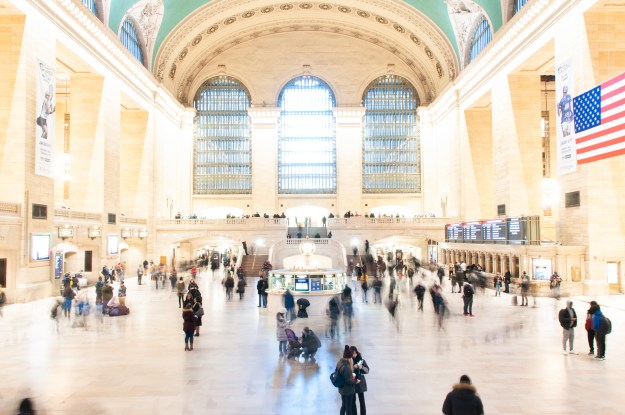
Photo 10
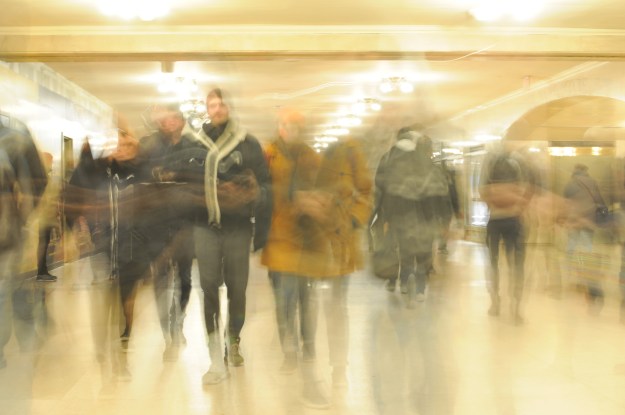
Photo 11
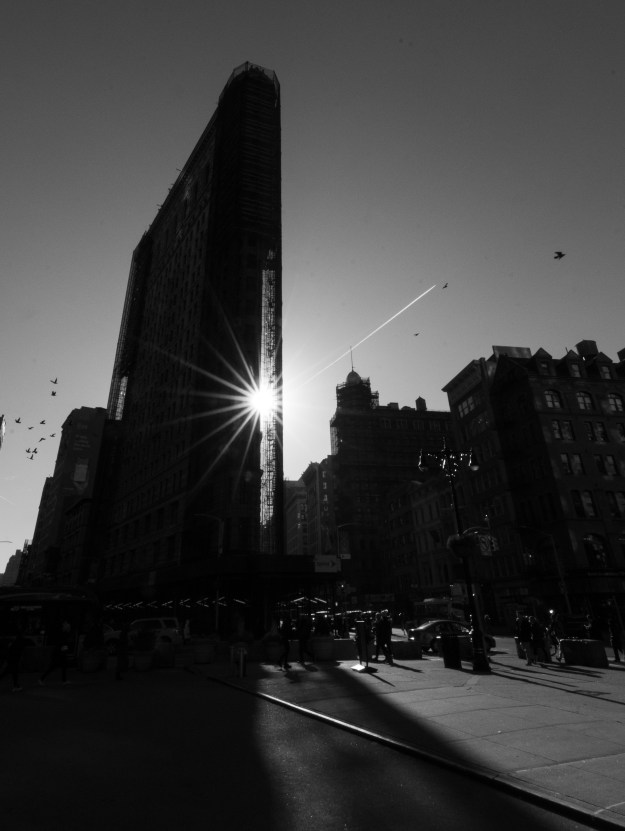
Photo 12
Photo 7 was a piece of graffiti that made me smile when I saw it. It’s a humorous take on ‘Post No Bills’ that is often painted on walls of building sites in New York in an effort to stop posters or advertising. When I looked at the area around the writing, I saw that some bills certainly needed paying. The complimentary colours of the wall and the rust also made the image pleasing on the eye.
Photo 8 was one of a number of shots I took when I saw this attractive young couple emerging from the shadows. I had first noticed the high contrast between light and shadow and hoped that I could achieve the symmetry when cropping square. This was the moment that worked as they are slowly being revealed by the sun.
Photo 9 was another scene that could be described as ‘only in New York’. The two dogs riding the skateboard seemed like the most natural thing in the world, but the other people on the sidewalk were amused by the sight. I didn’t have a composition that included them, but I noted the comedic slogan on the backpack of the dog-walker which created the impression of humour that I was looking for.
Photos 10 and 11 were shot in the iconic Grand Central Terminus. I’ve seen thousands of pictures of the main hall, so I thought about how I could shoot it differently. I’ve seen the room many times and it always has a cathedral feel to me. The huge windows that Berenice Abbott famously photographed in the 1930s, stream light into the space, supplemented by the artificial lighting. Oddly, the beautiful ceiling is often left dark when the whole room is photographed, which I’ve always felt was a shame. This magnificent building is to me then, a cathedral for the traveller. My photographs show the movement of people through the terminus as they pass through an almost divine light.
Photo 12 was taken when we went to see the iconic Flatiron Building which again has been photographed many times. Disappointingly, the building was undergoing a huge amount of renovation work, which meant that it was entirely covered in scaffolding. I decided that a conventional image of the building would look boring or worse still, not easily identifiable as being of the beautiful wedge shape. I elected to shoot into the sun and capture it in starburst as it edges past the building’s knife-like prow. This composition reminded me of Brassaï’s shots of Paris where light was used to envelope the subject rather than simply light it. I was particularly happy to capture the birds in flight, which contrasted with the aircraft vapour trail.
Conclusion
In seeking to shoot differently on this trip, I rediscovered my love of photography that had been dented slightly during Assignment 5. I feel as though I’m getting better at letting go of my preconceived ideas of what photography is and what photographs mean to me. Although I appreciate that I’ve only really just begun to develop as an artist and that there is a great deal more of this degree ahead of me, I’ve had a lot of feedback from friends and family. The majority of it centres on how I’ve started to chose different subjects in a less obvious way, adding visual tension as well as humour when able. It’s clear to me that the influence of the artists researched and the feedback from my tutor has begun to shape who I want to be as a photographer.
 Richard Fletcher OCA Photography Blog