Category Archives: Photography 1 – Context and Narrative

3) Project 1 – Autobiographical self-portraiture

Research Task – Francesca Woodman

Part 3 introduces us to Francesca Woodman, an American photographer whose work extensively incorporated self-portraiture.  This is not the first time that Woodman has been discussed since beginning this degree course.  In Expressing Your Vision, she was introduced to me during the feedback on assignment 5 [1] because my theme had been self-portraiture.  She was interesting to me because she used her body, often nude, as a contextual element in a broader story without really making the literal connection with the viewer that it was self-portraiture.  Her story was tragic, committing suicide in her early twenties which has been the external context that many people have used since to explain her photographs.   In the course notes, we are presented with S Bright’s quotation:

“It is difficult not to read Woodman’s many self-portraits – she produced over five hundred during her short lifetime – as alluding to a troubled state of mind.  She committed suicide at the age of twenty-two”

In my previous work, I raised the question of whether this common interpretation was accurate.  Woodman’s parents have subsequently denied that she was a consistently sad person [2], which seems at odds with her premature death.  However, mania is now a more recognised mental illness that affect millions of people worldwide (some 46m cases alone in 2017)[3].   If we separate Woodman’s suicide and perception of her mental state from her work and try not to use it as contextual information, her photographs for me take on a different feeling.    Consider the two images below:

16WOOD-jumbo

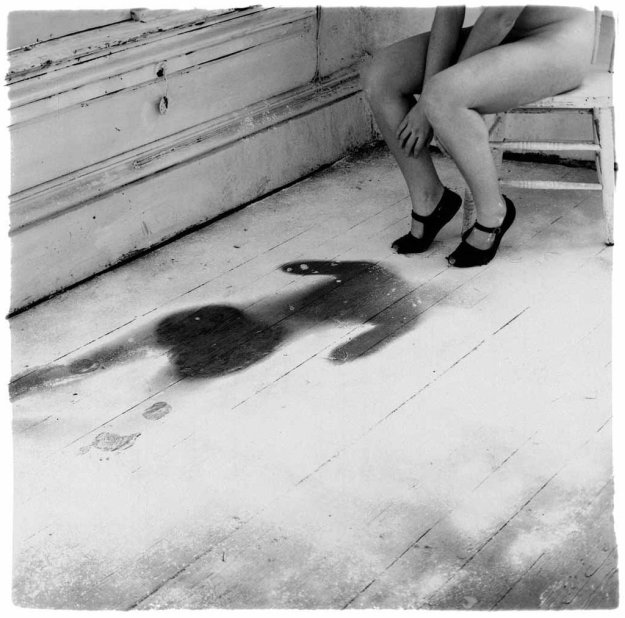
“Untitled, Providence, Rhode Island, 1976”, by Francesca Woodman [4]

Here we have one of Woodman’s nudes, shot in an abandoned house in Providence where she frequently worked.  The unusual composition focuses on the imprint of a body in the dust on the floor, which is clearly female and assumed to be the artist; an actual figure is seen in the top right hand corner of the frame.  For me, the image describes the fleeting trace of a woman in a place where the slow passage of time is clear.  The inclusion of the actual figure suggests observing the impact that one makes on the world in a physical sense while the brightly exposed dust contrasting with the imprint suggests conflict between us and our environment.  The fact that the figure is that of a nude woman further emphasises the contrast by introducing beauty but also vulnerability in the pose.  For me, as a photograph on its own this doesn’t lend itself to Bright’s analysis of Woodman’s mental state but does suggest that she saw human life and that of femininity to be fleeting when compared to the environment around us.

francesca-woodman-01

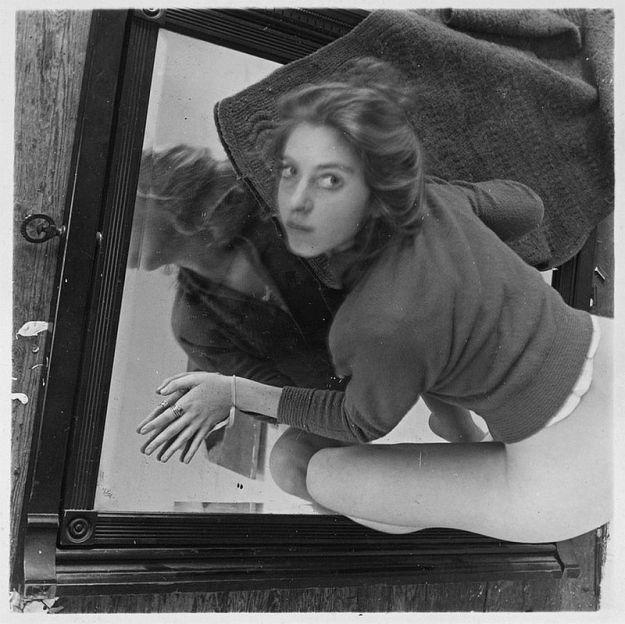
Untitled (self-portrait kneeling on a mirror), 1975 by Francesca Woodman [5]

This image for me does support the statement made by Bright.  Here we have the artist kneeling over a mirror looking up into the camera.  She is nude from the waist down and at first glance, this photograph has an erotic sense to it.  The young woman kneeling in an almost yogic pose in a way that would normally result in us seeing her nudity reflected in the glass.  However, her arm obscures any view of her which creates a sense of playfulness and almost teasing.  It’s when we look into Woodman’s eyes that the narrative changes.  Her expression for me is one of sad resignation rather than erotic invitation.  For me, the image tells the story of the way that Woodman feels that people look at her.  There is an intrusiveness to the pose with very little to hide her modesty.  The position of her hands and knees is more submission than eroticism and the way that she looks at the camera suggests someone who is suffering from the feelings of being exposed.   Mirrors featured heavily in Woodman’s work (I looked at another image in EYV that suggested that she had a view of herself that contrasted with how others saw her).  To this end, what I take from this image is a relationship to Woodman’s fragility even when I try to ignore the knowledge of her tragic demise.  This remains one of my favourite of her images, perhaps because it sums up a struggle with mental illness and self-perception with a combination of subtle and conflicting contextual references.

In terms of supporting evidence of Bright’s comment, I think that the retrospective analysis of her work after her death has done a great deal to drive the narrative of her life.  Her photographs range from the playful (Me and my Roommate, Boulder, 1976) to the darker Untitled, Rome, 1977-78 in which she is shown hanging from a door frame in a crucifixion pose.  Her images suggest contrast between young and old, beauty and ugliness and to feminine exploitation, but if we didn’t know how her life ended I’m not convinced that we can interpret her as disturbed without that external context.

Elina Brotherus

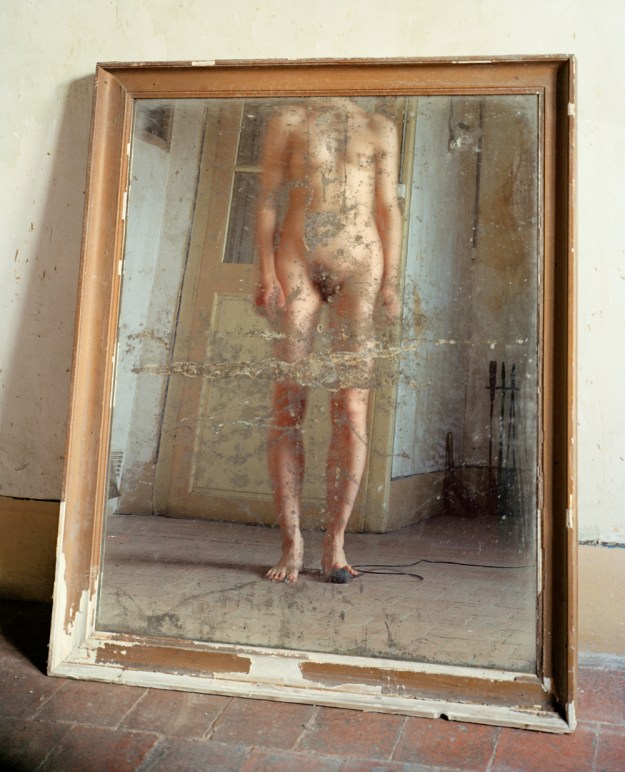
The work of Elina Brotherus takes as similar form to Woodman’s in that she frequently uses her nude body as a contextual element in her photographs.   In her work Model Studies, she builds a series of photographs that explore the relationship between the artist and the model as two separate people, despite her being in both roles.  She uses light, colour and the natural world to draw the viewer in to looking more thoughtfully at her body and how it relates to her environment.  Like Woodman, she uses long exposure and contrasts her subject from the background using mirrors and other props.  What I immediately noticed about the series was the lack of actual contact between artist and model; even in the shots where she is looking at the camera, there is no obvious connection.  Brotherus herself refers to it on her website[6], claiming the detachment to be inviting the viewer to look on the figure without anything that could be interpreted as confrontational.  The series is beautifully shot with the themes of ‘everyday beauty’ and vulnerability standing out for me.  There is also a humour in several of the images, where the single physical connection between artist and model is the remote trigger cable for her camera.  Rather than trying to hide it, Brotherus reminds the viewer that she is both people.

Model-Study-6

Model Study 6 by Elina Brotherus, 2008[6]

The second series we are directed to is Annunciation, which is much more like the storytelling that we’ve looked at so far.  It tells the story of the Brotherus’ unsuccessful attempts at becoming pregnant through IVF treatment.  This is a tragic series, dominated by images of Brotherus and her partner seemingly waiting for good news that looks unlikely to come.  A combination of empty spaces with Brotherus staring blankly into space, create the sense of loneliness and isolation, but not just for her but also her partner who appears as a helpless actor in the story.  The series blends other context too in the form of a calendar for 2008, a message note left on a blank wall and a collection of rubber bath ducks signifying parents and a child.   One of the most powerful images for me is also one of the simplest.

19_Annonciation+12

Number 19 from the series Annunciation, by Elina Brotherus, 2012[7]

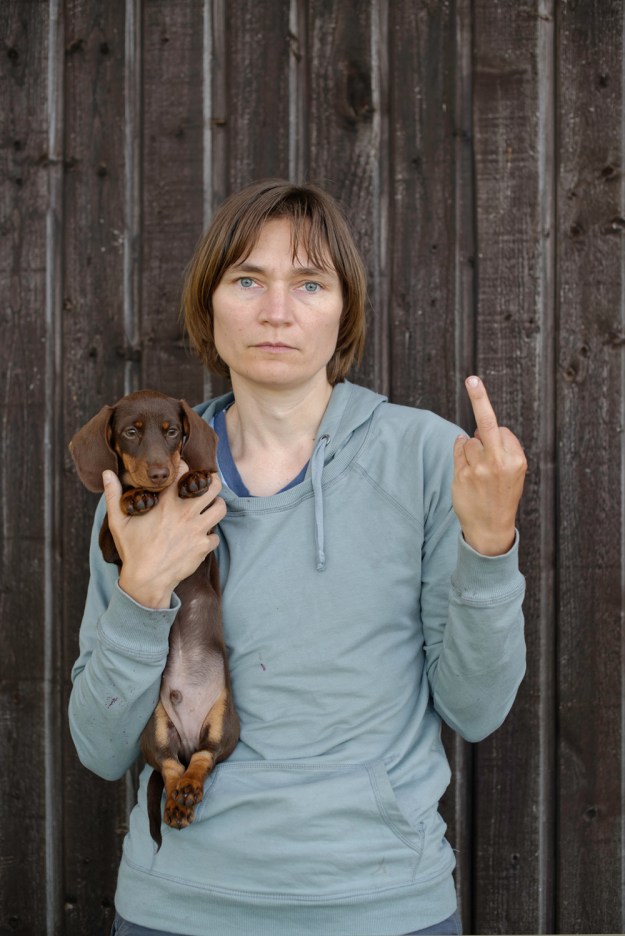
Here we have Brotherus clearly very upset, looking away from the camera as if to someone else in the room.  This photograph actually made me cry as the contextual elements and its position in the series reinforce the utter frustration and sadness that often accompanies something like fertility treatment.  Her nudity suggests a woman desperate to be a mother and the absence of a child in the image, which would tend to a more conventional visual of motherhood is for me, the most powerful part of the photograph.  The combination of her expression and tears asks “why me?” and suggests clearly that the news has been bad.  I loved this series for the linear and non-linear elements to the story-telling.  The use of props along with her relationship work perfectly.   Brotherus followed up this series with another called Carpe Fucking Diem in 2016.  This story documents her realisation and acceptance that she would not become a mother.  Her photographs for this series tackle the themes of life going on, the natural attempts to improve fertility and the realisation that it’s a futile effort as well as a defiant lashing out at the rest of the world who seemingly can have children.  She uses strong metaphors like a snow-covered children’s horse ride and a bowl of rotten tomatoes that invoke a sense of finality to both the dream and the biology.  She uses her partner again, but this time including a child substitute in the form of a small puppy.    While this work still has a sadness, it’s title and some of the more defiant images describe someone who is regaining strength and humour after this miserable series of events.  My favourite image of the collection is shown below:

25+My+Dog+Is+Cuter+Than+Your+Ugly+Baby

‘My Dog is Cuter than Your Ugly Baby’, by Elina Brotherus, from the series Carpe Fucking Diem, 2013 to 2016 [8]

This image shows a defiant Brotherus who, by her own admission abandoned the preconception of having to act like an adult following her unsuccessful attempts to become a mother.  Her expression and gesture as well as the title, inject a dark humour to the image, which is included towards the end of the series and part of her re-evaluation of the future.

Gillian Wearing

The final artist presented in Project 1 is Gillian Wearing.  Her series Album is a remarkable piece of work whose origins may be in photography in terms of the reference images, but the execution also incorporates sculpture.  Wearing used reference photographs from her family album to create latex masks.  She then used the masks to ‘become’ her family members, photographing herself in similar poses to the original.  What is special for me about this work, apart from the technical challenge, is the way that Wearing connects with her family.  The study of historical pictures and then the painstaking act of ‘becoming’ points strongly to how our families are the origins of who we are.  By deliberately leaving traces in the photographs that indicate that it is her, Wearing plays on the viewer’s double-take and subsequent questioning about genetic similarity.  My favourite from the series is described in an interview Wearing gave to The Guardian[9] where she ‘became’ her brother using a snapshot from their growing up. The double take is even stronger with the conflict of gender as well as the carefully staged setting making it difficult to age the photograph.

Self-Portrait-as-my-Broth-002

Self-portrait as my brother Richard Wearing, by Gillian Wearing, 2003[9]

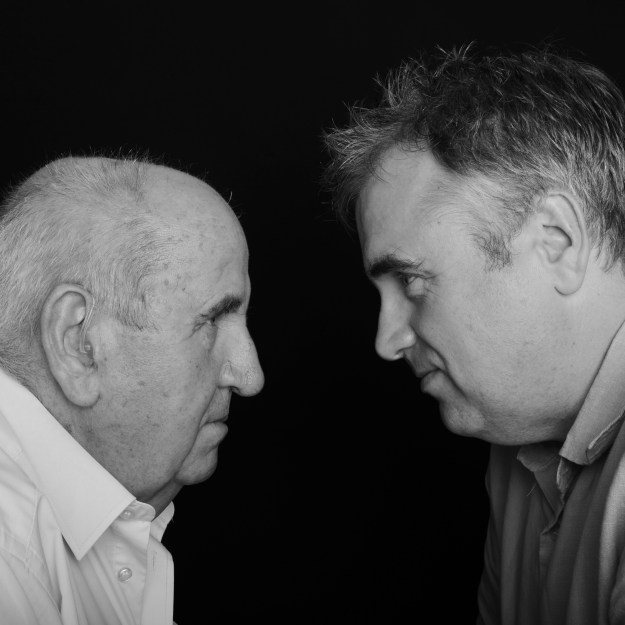
It resonated with me because of the strong family resemblance between my father and I, which I’ve been reminded of throughout my life.  That reminder had a variety of impacts and reactions through my growing up, ranging from not understanding through teenage resentment to more recent pride in my later life.  The thing that struck me about the telltale signs in Wearing’s photograph is the fact that while we look like and are shaped by our families, we are not copies of them.  I tried to capture this in Assignment 5 of EYV with the image below:

DSC_3554

Two, from the series ‘Pictures of You’, Assignment 5 of EYV, 2020

Conclusion

This project has dealt with the works of three very different artists.  Woodman and Brotherus share some similarities at face value, but Brotherus’ work feels more of a focused set of stories that are perhaps more obvious than Woodman’s.   Woodman has been associated with physical and mental frailty in some quarters and strong feminist expression in others, but we cannot really be certain of her intention for her art.

“Am I in the picture? Am I getting in or out of it? I could be a ghost, an animal or a dead body, not just this girl standing on the corner?” – Francesca Woodman

When I first read this quote, my immediate reaction was that it was a deliberately obscure explanation of her intent, leaving the viewer with any interpretation that they wished for.  We know that too much space to create narrative can be problematic in the appreciation of the photograph, so why even say it?  On reflection, I think that Woodman was actually being all of those things at the same time.  Perhaps her emotional state oscillated between these self-images; we will never really know.  With Brotherus, her projects feel much more signposted without the narrative being spoiled by the more obvious contextual elements.  She uses her body very deliberately in a completely non-sexual and non-sensual way, something that cannot be said about some of Woodman’s work.  Brotherus is the central element of her stories, but using her body and sense of self-image as a mere tool to strengthen the feelings around the subject.  It is rare for an image to prove a tearful response in me, but the shot from Annunciation did just that.

In contrast to the other two, Wearing’s series was using the sense of self but also disguise.  Her strong connection to her family is reinforced by the dedication shown to create the photographs, while the questions raised about family genetics and how people are shaped by their growing up are also powerful.

There are definitely some interesting perspectives here that will help with my preparation for Assignment 3.

References

[1] Fletcher R, 2020, “Looking at Contemporary Portrait Artists”, EYV Blog Post, https://wordpress.com/post/richardfletcherphotography.photo.blog/1420

[2] Cooke R, 2014, “Searching for the real Francesca Woodman”, The Guardian, https://www.theguardian.com/artanddesign/2014/aug/31/searching-for-the-real-francesca-woodman

[3] Ritchie H & Roser M, 2018, “Mental Health”, Our World in Data webpage, https://ourworldindata.org/mental-health

[4] Johnson K, 2012, “Exposing the Body, Baring the Soul”, The New York Times, https://www.nytimes.com/2012/03/16/arts/design/francesca-woodman-at-guggenheim-museum.html

[5] Artist Profile, 2016, “Francesca Woodman”, ND Magazine, http://ndmagazine.net/photographer/francesca-woodman/

[6] Brotherus E, 2008, “Model Studies”, Artist Website,  http://www.elinabrotherus.com/photography#/model-studies/

[7] Brotherus E, 2012, “Annunciation”, Artist Website, http://www.elinabrotherus.com/photography#/annonciation/

[8] Brotherus, E, 2016, “Carpe Fucking Diem”, Artist Website, http://www.elinabrotherus.com/photography#/carpe-fucking-diem/

[9] Unknown, 2012, “Gillian Wearing takeover:behind the mask – the self-portraits, The Guardian, https://www.theguardian.com/artanddesign/gallery/2012/mar/27/gillian-wearing-takeover-mask

Assignment 2: Narrative

The Brief

Choose between the following two assignments:

Photographing the Unseen

Start by doing some reflecting in your learning log.  What kinds of subjects might be seen as unphotographable? How might you go about portraying them using photography? List a few examples of things you’re experiencing now or have been recently thinking about. This doesn’t have to be too in-depth or revealing, but can be if you want.  Equally, it might be something as apparently trivial as you are going to fit everything into your busy day.  At first you may come up with literal examples, but the more you think about them the more those ideas will develop into specific and more original ones.  Make a list of at least seven ideas.  Trust to keep to things you have a personal interest in or curiosity about.

Implement one of your ideas.  Aim for a tightly edited and visually consistent series of 7-10 photographs.

Using Props

This option is about photographing an object to suggest a narrative.

Choose between a white shirt and a hankerchief for your subject. Once you’ve decided, make a series of 7-10 photographs which tell a story about or including you object.

You can make your photographic style anything you like.  You may wish to include the prop in all of your series or just some of the images, depending on the narrative.  Bear in mind that the story is being alluded to through the use of the prop and its location – and characters should you choose to include them.

Draw a storyboard before you start to help you consider the progression of the plot and how you’ll use the shots.

Now implement one of your ideas.  Aim for a tightly edited and visually consistent series of 7-10 images.

Initial Thoughts

In this assignment, we were presented with two different takes on narrative; one that explores what isn’t obviously visual and one using a visual prop around which a narrative is created.  When I first looked at the two topics, I was immediately drawn to thinking about something that isn’t a subject that is traditionally photographed or represented through visual media.  The reason was largely found in the feedback that I received for Assignment 1.  That work was aimed at describing something with more than one interpretation, where the viewer drew conclusions from the contextual elements in the individual images as to the meaning.  I really enjoyed the challenge of this duality and when working through Part 2, considered photographing the unseen as an interesting challenge.

In my consideration of the Props topic, I started to think about storytelling in the more traditional sense.  Written stories are created in a fairly linear fashion, resulting in a defined ‘beginning’, ‘middle’ and ‘end’.  As Barthes mentioned [1], the author of a story takes familiar or established cultural texts and stitches them together in a way that leads the reader through the narrative.  The nuances of the story, internal visuals and intents are created by the reader with the author as the guide; the point being that the reader never really understands the real intention of the author.  We know that this linearity is not always present in photographic stories, but the for me the idea of ‘storyboarding’ links back to that more traditional storytelling approach.  While the individual images can be created out of sequence, a storyboard brings back that sense of linear timeline when the collection is assembled, e.g. when a movie is shot, the takes are done out of sequence because of environmental factors, availability of the set etc. and it only truly becomes a story when assembled in edit.    As my natural tendency is to the literal (something I’m trying to break away from here), I felt the Props topic would be dangerously close to what I am comfortable with.   For this reason, I decided to choose ‘Photographing the Unseen’ as my assignment topic.

Ideas

I first started to think about the unseen in general terms.  What does it actually mean?  As sight is just one of the senses, the unseen could anything related to the other four.  I started to recall the recent lockdown challenge that I took part in with some photographer friends where we started with the obvious subjects.  These included The Decisive Moment, leading lines, macro etc., but we then moved to more obscure subjects, one of which was ‘the senses’.

The five senses

Taking a photograph that evokes the sense of a smell turned out to be a challenge with some creating images with broad ideas of the theme while others went for something more specific.  In the case of the former, flowers can be said to have a scent, but the viewer may not necessarily know the specifics of it, whereas in the case of the latter, a cup of steaming coffee is a smell familiar to almost everybody.  I then considered the other senses and how they might ‘be photographed’.  For all of them, there were subjects that could convey what we understand to be the senses, however my initial thinking about what I would shoot felt to be too literal.  An idea for working with the senses would be to contrast the obvious scent with an anchoring reference that completely contradicts it.  For example, there have been intelligence tests for pattern recognition that use the names of colours but using a different coloured font.  For example, RED might be written in a blue font.  When presented with this, the viewer has to quickly say what the colour is.  Many people react to the word before the colour, so will get the answer wrong.   The same thing could be done here with the other senses.  While this was an interesting idea for a project, the brief (and feedback so far) pointed towards something I had a personal connection or interest with.  I didn’t feel at this point that I wanted to use this for the assignment.

Depression and its many effects

Over many years I have suffered with my mental health for a variety of reasons, most of which relate to the loss of my mother when I was in my early twenties.  The struggle to keep this condition at bay continues to this day, so would work as a project or series of separate ideas.  Within depression there is an innate sense of loneliness (even when not alone), coupled with a constant anxiety  around the speed of recovery and, in fact whether recovery will ever happen.  There is also the damage done to the people around the sufferer and in some cases (not mine) addiction to alcohol or medication that makes the whole situation worse.   There is a very unhelpful expression that people use with depression sufferers that talks of the illness as being less obvious to others than a broken leg, which is something I’ve had said to me over the past 20 years.  This got me thinking that the condition and the secondary effects are indeed unseen, so this could make a good subject for the assignment.   What prevented me from pursing this further was twofold.  Firstly, my last assignment in Expressing Your Vision was about my struggles with depression, so it felt too soon to be looking at this subject again even though the two objectives for the work were different.  Secondly, while it’s very personal to me I have learned not to dwell on my experiences too much.  Rather than be a catharsis, the subject doesn’t really interest me that much and I’ve never really seen my photography as an expression of that pain; quite the opposite, it serves as an escape from it.

Ageing

Something that became more obvious to me during lockdown is the way that people’s quality of life varies with their age.  We have been surrounded by commentary about the effect of self-imposed isolation on the elderly in terms of their struggles to get food, loneliness and often concerns about how the virus may be more lethal to them than the younger generation.  This suffering, similar to my thoughts above is largely unseen.  Ageing itself has obvious physical effects that we can all see, but the decline in confidence and acceptance that physical ability are not what they once were, are largely unseen.  My idea here was to contrast images of youth with the thoughts of the elderly.  This idea was my favourite so far and would have been the subject for Assignment 2 if I had not connected it with an event that occurred during my time reflecting ahead of starting the work.

Evolution of the Idea

My previous ideas broke down into the following themes:

  1. Sensory – the senses that are not specifically sight
  2. Suffering –  Depression and the long road out of it
  3. Anxiety – that things won’t get better, linked to depression, but also the heightened focus on trivial issues during the current pandemic
  4. Loss – related to control when suffering from mental illness, but also the loss of faculties with ageing
  5. Loneliness – the isolation of suffering in general
  6. Ageing – the change in outlook and many challenges that come with ageing
  7. Acceptance – also related to ageing, the slow process that many go through of accepting that they are old.

Yes, the brief talks about 7 ideas but it became apparent that these were all related to each other in some way and, unfortunately most having largely negative connotations.  While these things were of interest, I wanted to explore something that wasn’t just another documentary of something bad happening.  I thought back to Campbell’s Dad Project, which was a sad but heartwarming story of the evolving relationship between father and daughter.  It’s underlying theme of coming to terms with his terminal illness was offset by the sense of warmth and love within the family,  The supporting context which included her father’s views added his personality to the images.  This was something I wanted to bring into this series; something unseen but a contrast of an experience with a situation.  One of these could be positive or humorous and the other something sad or contemplative.

It was at this point that the 25th anniversary of the death of my mother occurred.  It’s naturally always been a sad and contemplative day, but always with a ‘happy’  remembrance of a very special member of our family.  This year had a particular poignancy for me as I am now the same age as she was when she died.  One of the experiences I always have on this day is a replaying of her final moments in my mind – I had never seen death happen in front of me before.  One thing that struck me about the immediate aftermath was a random, bizarre thought that I had as I left the hospital.  My world had just seemingly collapsed and as I waited to pull out into the traffic, I asked out loud “Where are all these people going right now?”  Of course, bereavement is personal and naturally the commuters going home from work weren’t aware of or part of the recent events.  It was the randomness of the thought that gave me the idea for this assignment.  I began asking around and realised that these thoughts occur with pretty much any serious trauma, from bereavement and loss to illness and injury.  The situations themselves were serious, but the thoughts were often fairly banal.  My idea formed around contrasting the randomness of the thought with something that metaphorically represents the sadness or negativity of the event.

Planning

The first task in planning was to seek random thoughts.  I polled my friends and connections on social media to see if they would be prepared to share some thoughts with me.  This would be a challenge in terms of asking people to re-visit traumatic events in their lives, but I assured them that the thoughts would be used, but not the detailed context (in fact, I stated that they didn’t need to share the context with me at all).  The use of the thoughts would take the form of a single sentence and would be completely anonymous.   Using a single sentence would be an open enough contextual element to create a narrative without the photograph, e.g. my thought “where are all these people going right now?” could relate to anything from being stuck in traffic to being at the scene of a major terror incident.  The reader can build their own narrative from a sentence that is not too prescriptive.

I then considered what would sum up the types of trauma that would be experienced. People suffer serious problems every day that can be considered traumatic. What I wanted to do here was to focus on the type of problems that people are most familiar.  As I was going to ask people for their random thoughts, I similarly didn’t want to predict or limit the range of traumas.  However, I started to work on the assumptions that they would fall into categories of loss, bereavement, serious illness, the breakdown of a relationship or some shock that provokes a negative emotion such as fear or disgust.

The next area I focused on was the theme for the photographs.  I started with the idea that people with obviously contrasting expressions or facial features could be the focus of the images.  I quickly dismissed this when re-visiting the works of the photographers in Parts 1 and 2.  For example, Public Order[2] features the real but fake scenes from a police training facility which, while telling the seemingly believable story of the environment during the photographer’s early life, is contrasted with the emerging knowledge that the scenes themselves are an interpretation of that environment.  The contrast is subtle rather than literal; by using people as the centre of my series, I was in danger of falling into old habits.   I started instead to think about how trauma makes us feel.  For me personally, the overwhelming sense of isolation and the temporary broken patterns of normal life are the key feelings.  Although I’m no psychologist, I believe the randomness of our thoughts when we suffer something serious is our brains connecting to what we recognise as normal life.  In my case, wondering where everyone was going when my world had collapsed was simply a question prompted by the sight of life going on as normal.   I considered what represents isolation to me and concluded that large, open, derelict or abandoned spaces sum up those sensations of being alone and also fairly unimportant to the rest of the world. By presenting an object or even a single person in the space, I could use the commonality of empty spaces with a connection to the words that wasn’t too obvious to the viewer.

The Words

After asking my social media friends and some of my family for their help, I received the following random thoughts.  I was really happy with the variety of the thoughts and the circumstances during which they occurred.  I combined them with my own thought which was the basis of this idea.

  1. “Where are all these people going?”
  2. “I hope the paramedics don’t traipse dog mess through the house”
  3. “I’ll have to make my own dinner tonight”
  4. “How am I going to teach them what I know?”
  5. “I won’t know anyone there”
  6. “Tell them I may be late to teach the class tonight”
  7. “Did I eat too many of the wrong foods”
  8. “Must remember the right way out”
  9. “Are we the only entry in the phone book now?”
  10. “I’m glad my parents aren’t alive to see this”
  11. “I hope my cat hasn’t got into any fights”
  12. “I could murder one of those chocolate biscuits”

The challenge was to now represent these unseen thoughts in photographs of spaces and objects that metaphorically represent them with the trauma.  The variety of the thoughts I received led me to call the series ‘Random Access Memories”, a reference to the ordered but unstructured way that information is retrieved in computer hardware.

But wait…

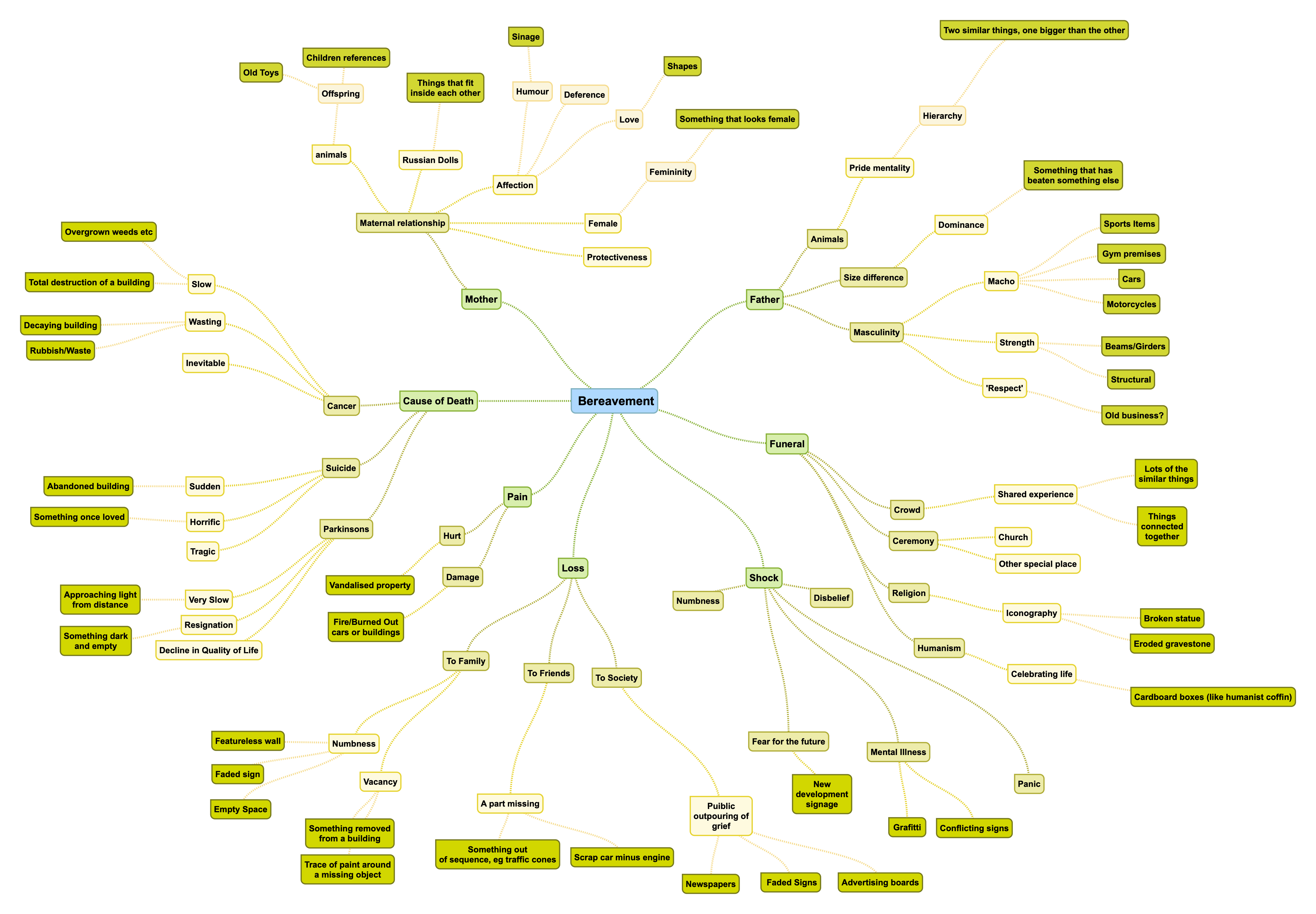
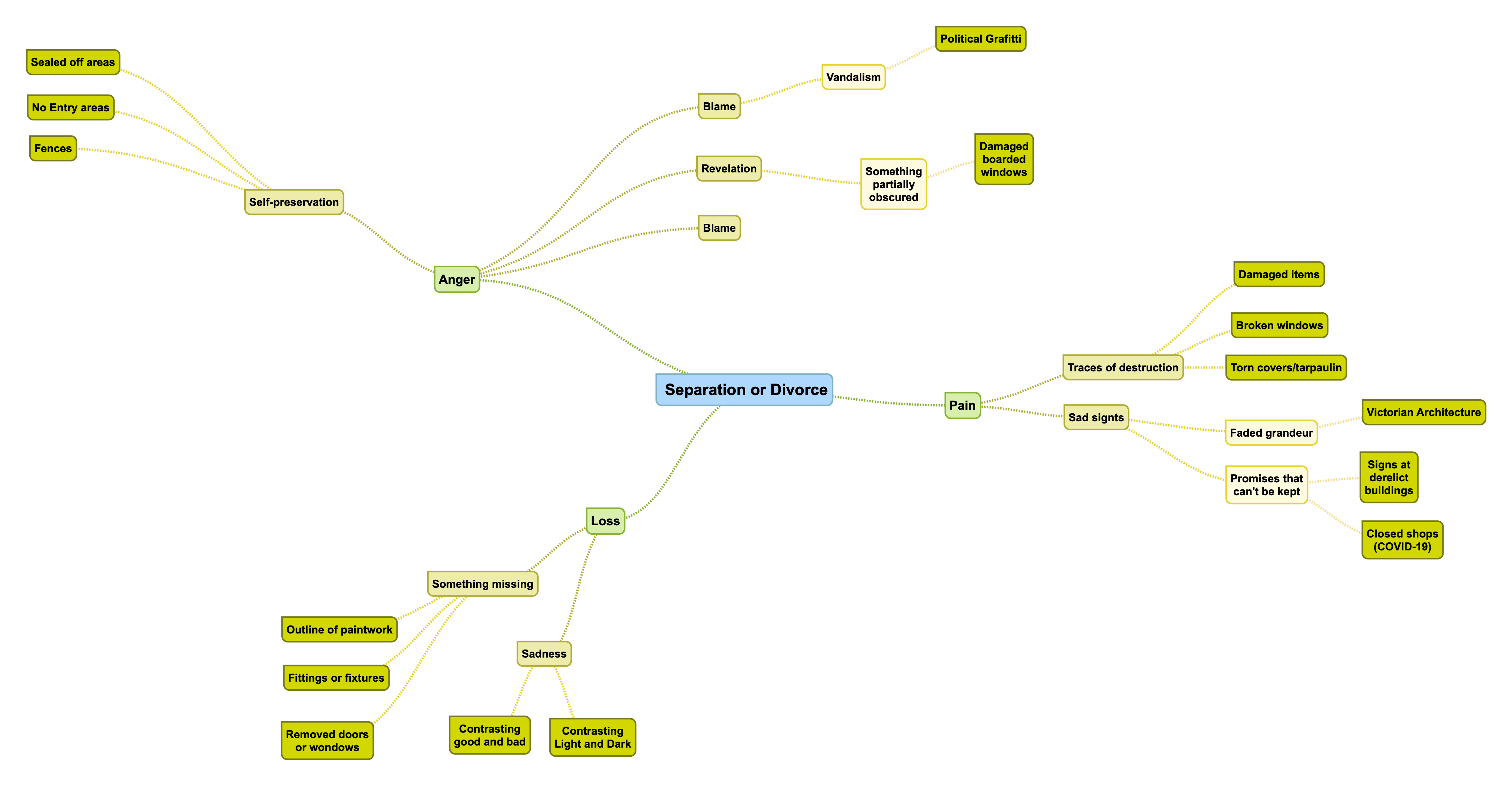
I started to consider how I would photograph subjects that documented the thoughts of the people I had spoken to.  It was at this point that I realised that I had lost sight of what the unseen element in this story is.  Indeed the thoughts were random and unseen, probably not ever discussed with anyone before I had asked for them.  However, they were a response to something terrible happening in the lives of the people concerned.  It is actually the trauma and the response that make up the unseen that I needed to document.  This was a serious turning point for me during this assignment for reasons that I will discuss later.  For now, I had to find subjects that suggested the trauma being experienced and marry the words to the photographs to help support the narrative.  This required returning to the beginning and thinking carefully about metaphors for trauma. I created the mind-maps below to help steer the project, which I found to be useful in what was becoming an increasingly difficult challenge.  Based on the types of traumas that my friends suffered, I created maps for Bereavement, Illness/Injury and Separation/Divorce to cover them all.  The maps show my thought processes and ideas for subjects to shoot as metaphors for aspects of the trauma rather than just describing the event itself.  These were ideas that I took forward into shooting.

As I mentioned previously, I don’t find metaphor easy to deal with partly because I’ve never considered myself particularly creative.  The act of ‘engineering’ the ideas into potential subjects was falling back on what I’ve known throughout my career.  What I wasn’t prepared for was the challenge of seeing those subjects and photographing them.

Shooting

I had settled on the idea of trauma being isolating and lonely on a personal level; even a shared event impacting people differently and in a way that makes them feel like they are the only people involved.  I looked for subjects that contained visual elements that suggested but didn’t point to the trauma being experienced, taking the cue to leave as much room in the image for the viewer to make up their own mind.   To this end, I also elected to leave out the idea of a single person in the frame, which felt a little too obvious to me.  Unlike Sank’s lockdown story [3], which was about the people she met on her walks and their outlook on life during COVID-19, my story was about the speaker of the words. I felt that adding people into the photographs would distract from the anonymity of the speakers that had shared their thoughts with me.

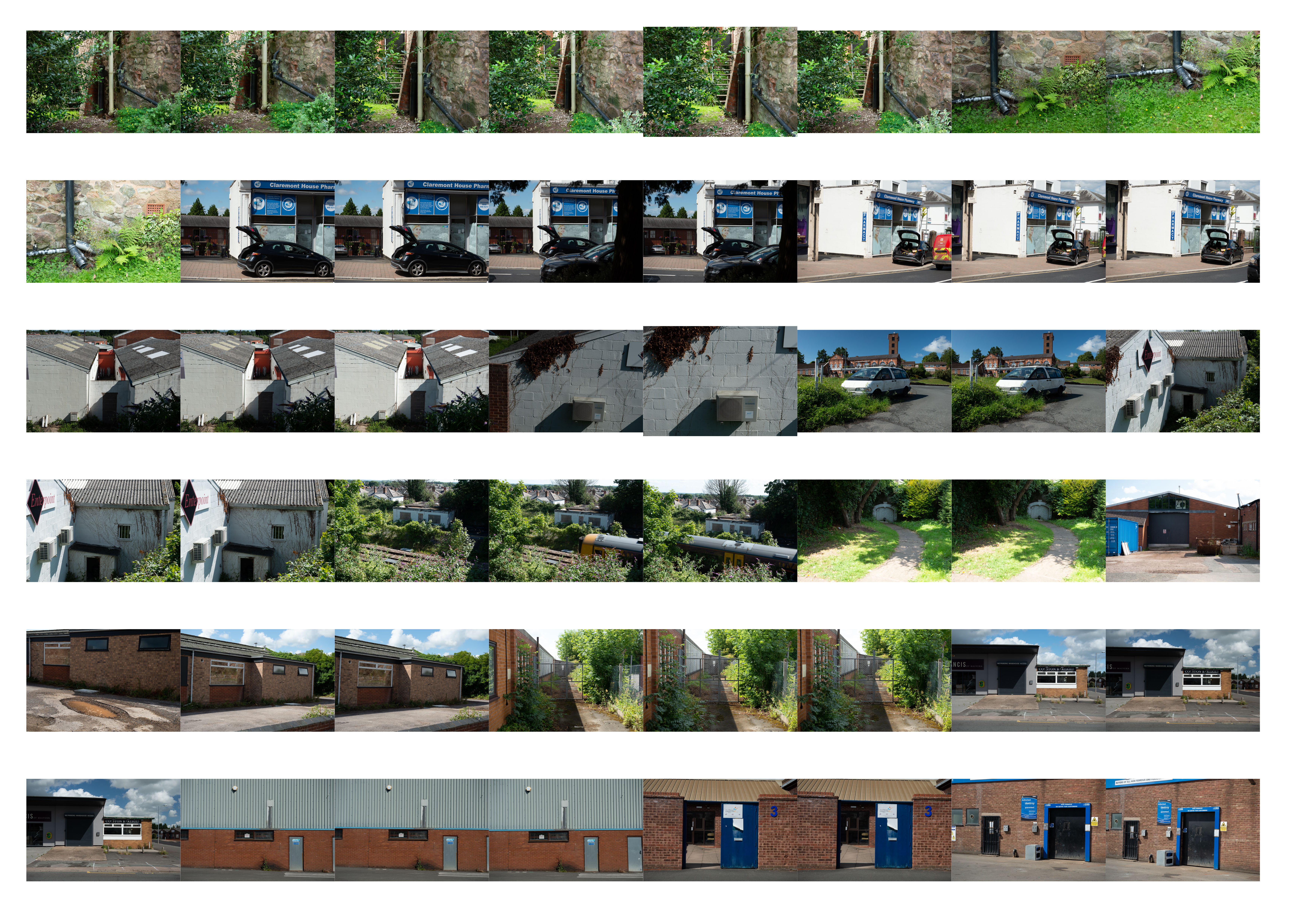
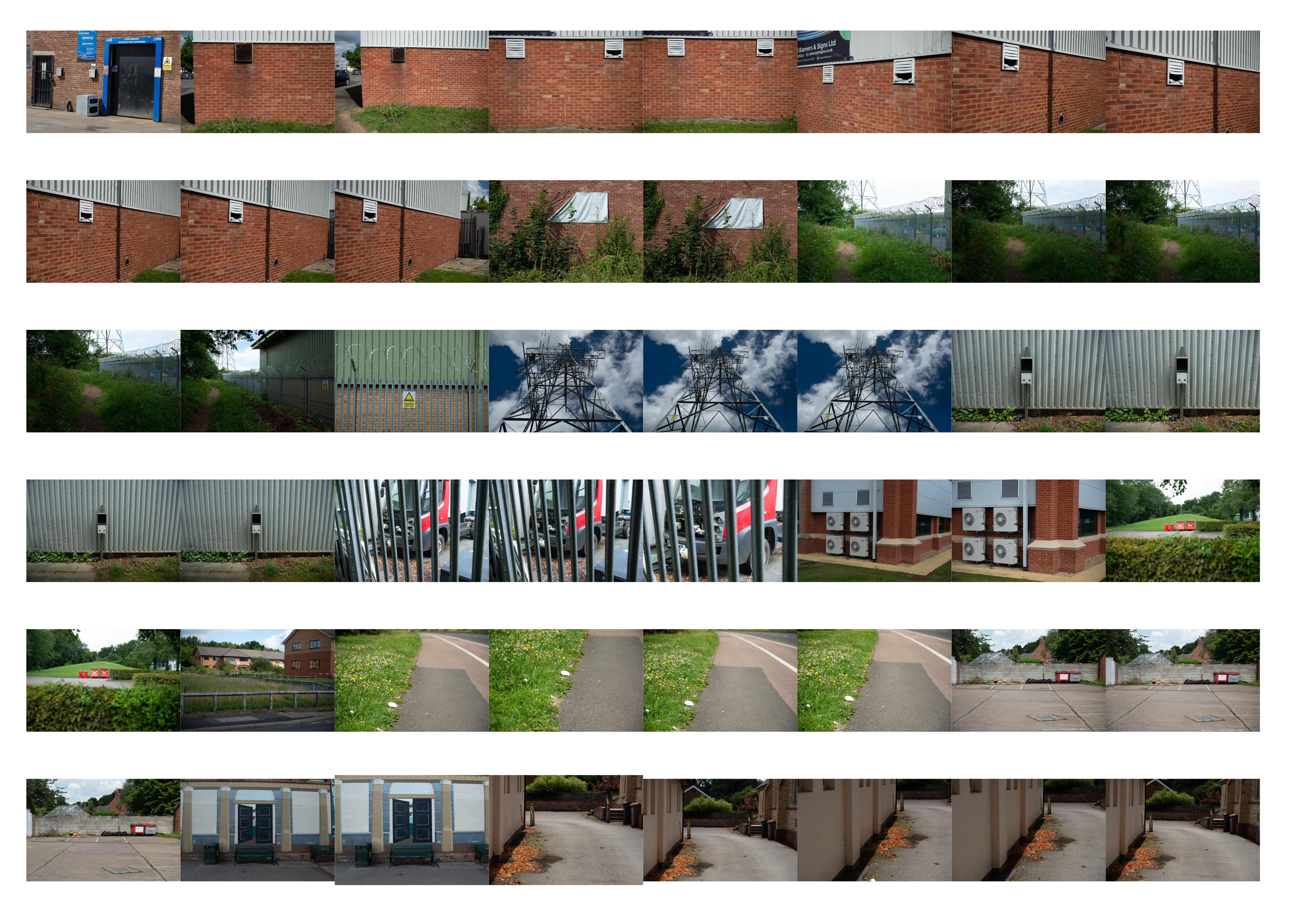
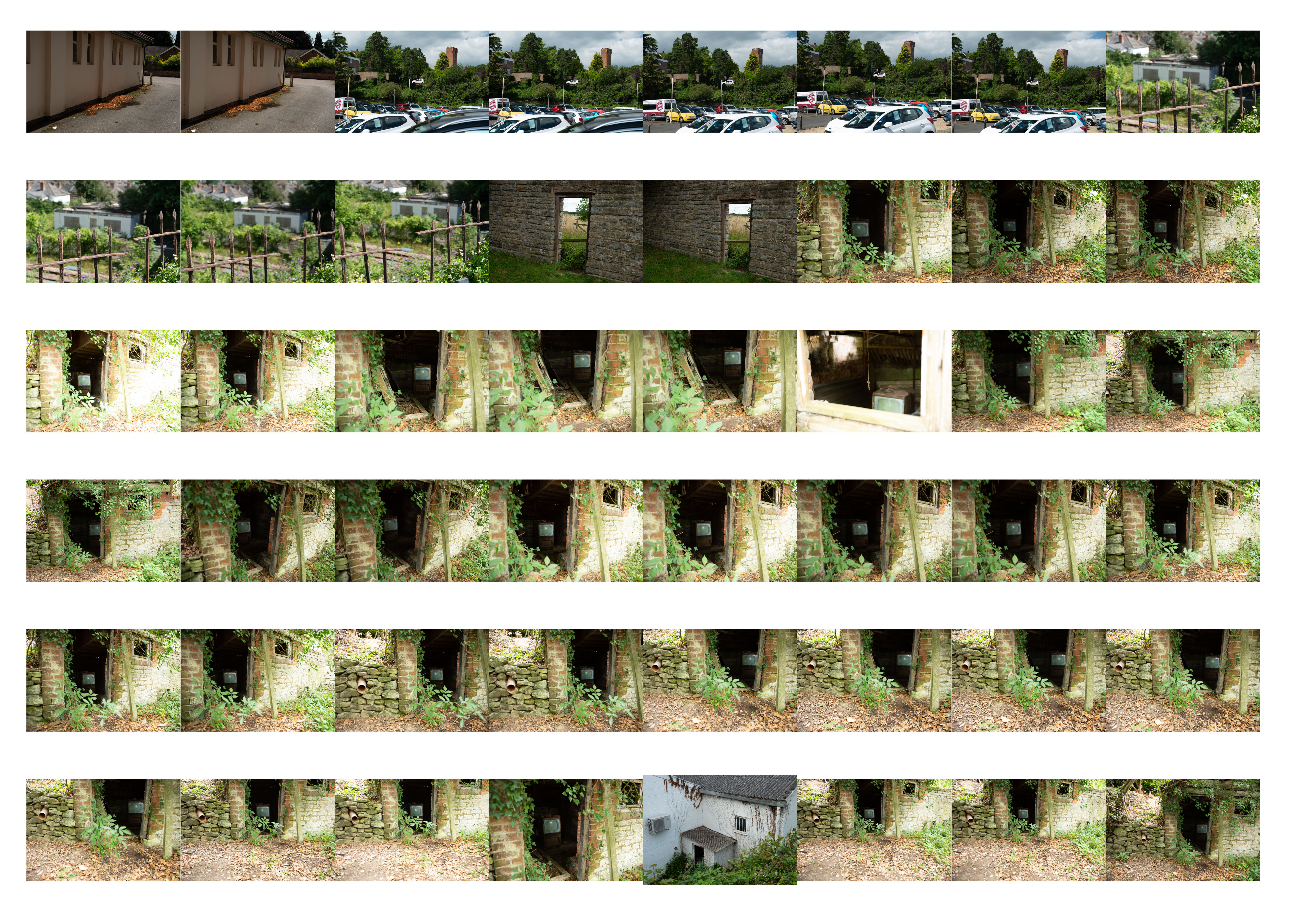
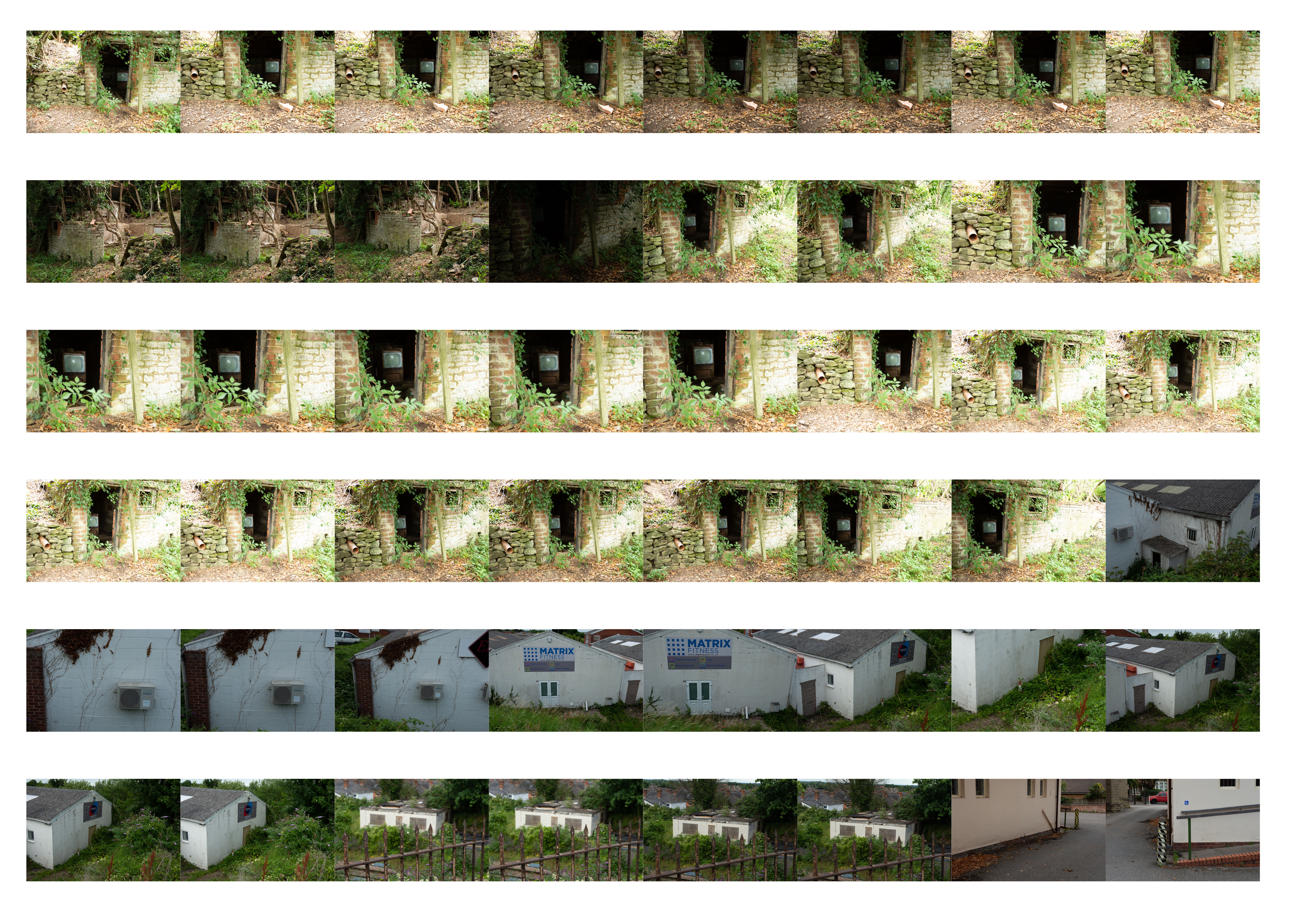
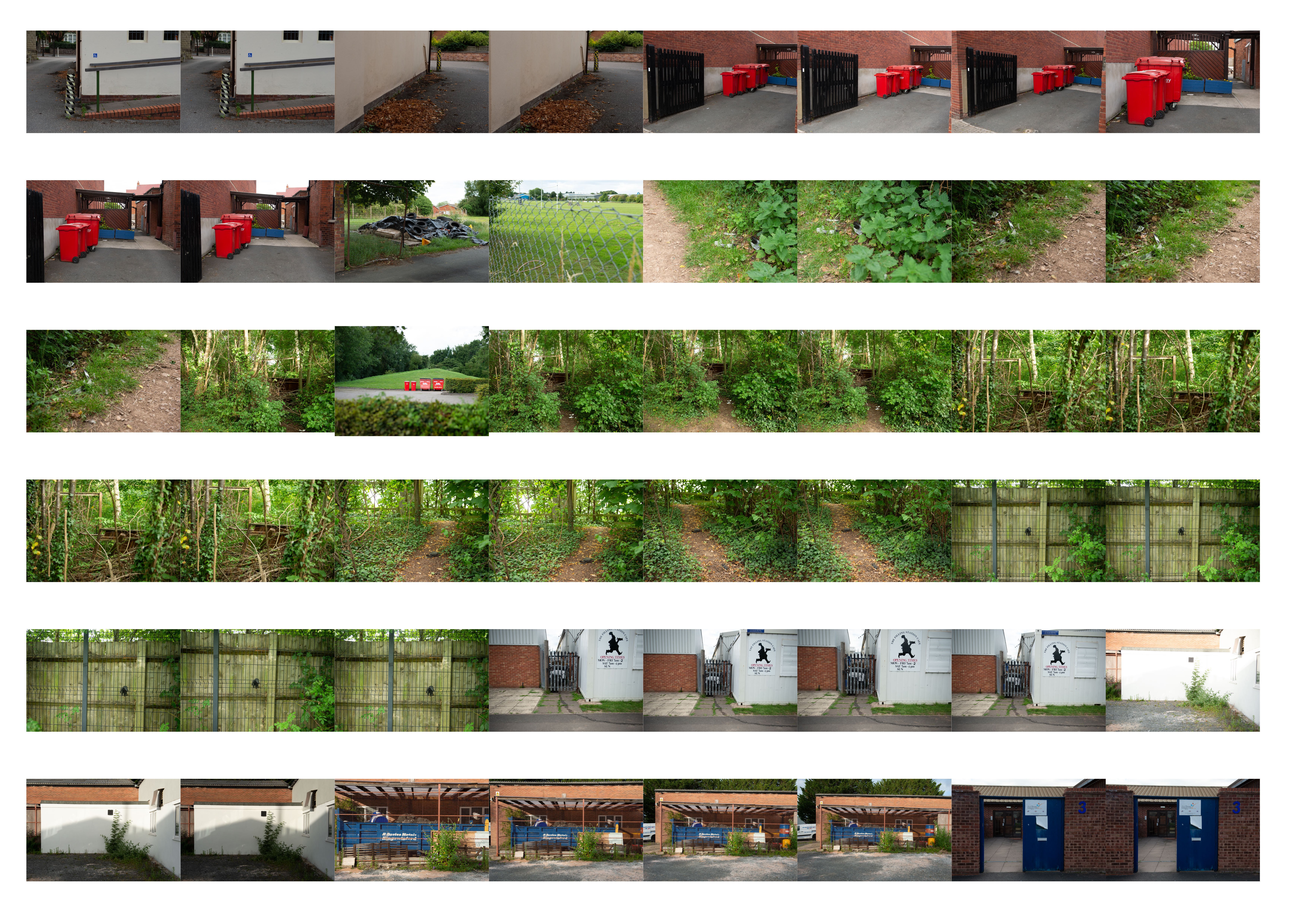
What I found really difficult with my project was to look for the metaphorical, despite having the mind-maps to help me.  I took my camera everywhere I walked and changed routes to take in industrial areas and secret footpaths through them.  However, I found myself shooting anything and everything that may support my story.  This was a departure from what I’d believed to be the way these photo stories were created.  I’ve strived to be more clinical in my approach to shooting, tending towards fewer images of my subject than taking lots of pictures.  For this assignment, the editing process was much more pronounced than it had been previously.  From a total collection of 288 photographs, I created the collection of 10 photographs that I then matched to a selection of texts.

Random Access Memories
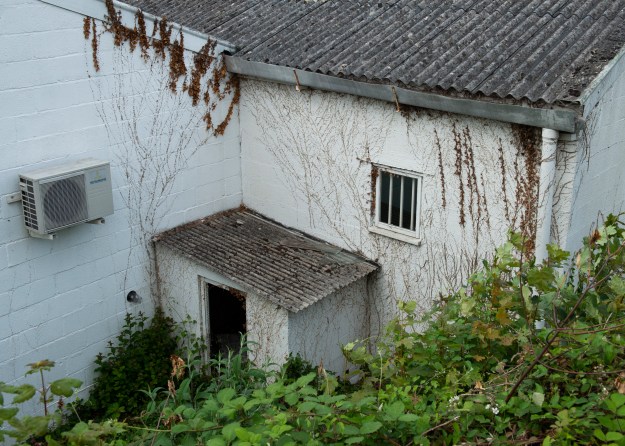
DSC_9201

“Did I eat too many of the wrong foods?”
DSC_9070

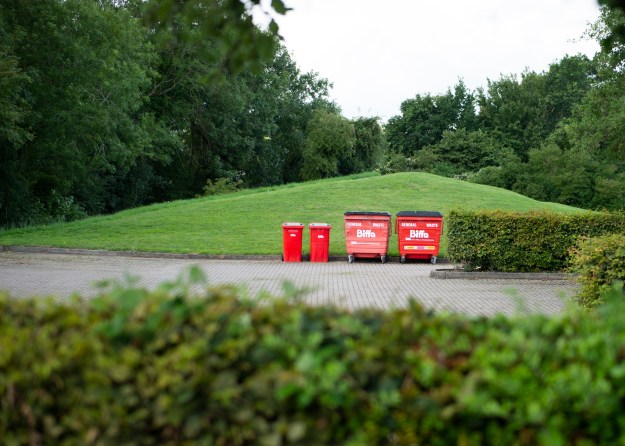
“I could murder one of those chocolate biscuits”
DSC_9280

“I’ll have to make my own dinner tonight”
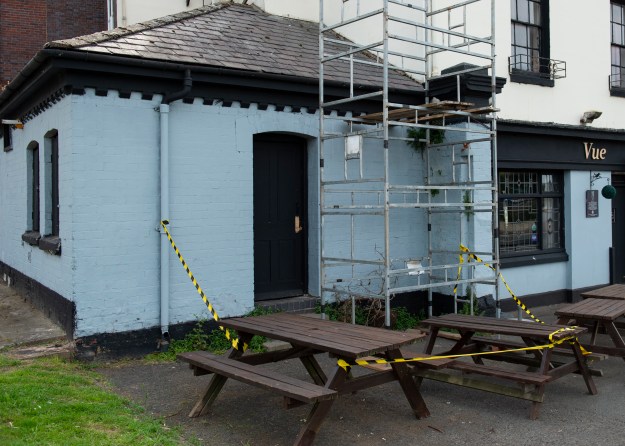
DSC_9231

“Tell them I may be late to teach the class tonight”
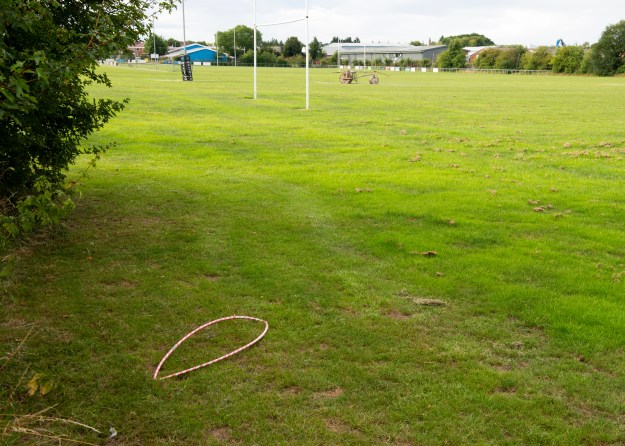
DSC_9197

“I hope the paramedics don’t traipse dog mess through the house”
DSC_9054

“I’m glad my parents aren’t alive to see this”
DSC_9015

“Where are all these people going?”

DSC_3075

“Must remember the right way out”

DSC_9222

“Are we the only entry in the phone book now?”
DSC_9268

“How am I going to teach them what I know?”

Reflection: Photographing the Unseen

In keeping with the anonymity and not wanting to steer the narrative, I elected to not describe in detail my intentions for each image in this section.  Instead, I’ve included the themes and how intended the images to work together in the series.

As described previously, my theme was trauma which takes many forms.  The series starts with ill health and injury, which can be debilitating, frustrating and of course life-threatening.  The reactions of the people here were focused primarily on the disturbance to their routines or daily lives, but also including self-doubt.  The questions around whether the situation could have been avoided were powerful.  Similarly the denial in the fourth photograph was something most people could relate to as we never really want to have a change of circumstances forced upon us.

The series then moves to loss, both in terms of a relationships and death.  Here we have people having to cope with trauma that is happening to them almost indirectly.  I was fascinated by the randomness of thoughts had by the people who had just lost something or someone dear to them.

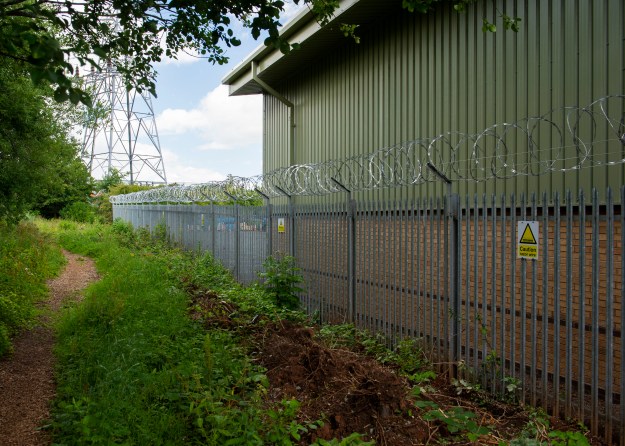
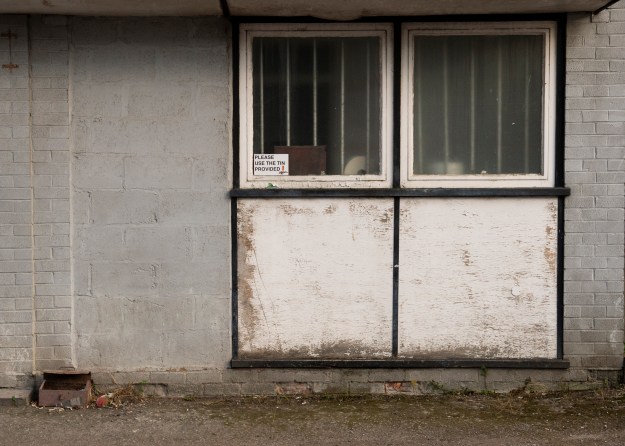
For me, the strongest image is the last one.  My friend had that thought upon learning of the suicide of a family member and went into automatic pilot; one responsibility was to hand over her work to her colleagues.  Such a simple statement contrasting with the horror of the event needed a simple composition with the evidence of the bleakness of the trauma clearly represented.   For me, the dull grey walls and barred windows give the sense of a world less colourful; the simple instruction to use the dilapidated tin and the discarded cigarettes suggested a lack of understanding of how awful suicide is to those affected by it.

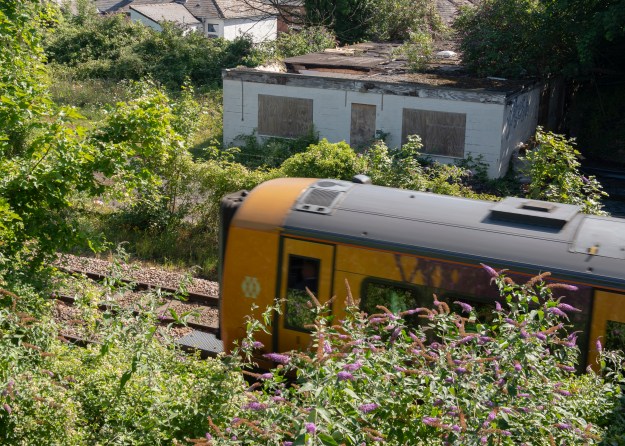
For me, the weakest image is number 7, which is actually the trauma that I experienced.  I found it extremely difficult to express the pain of losing my mother through a photograph, irrespective of where it sat in a series.   Throughout this assignment, I struggled significantly with metaphor and inspiration.  I’m not surprised that my own experience would be the biggest challenge and I believe this to by why I don’t like this image as much as the others.   What I ended up with was a representation of my world collapsing while people went about their business.  However, the composition and lighting aren’t what I wanted for the series; harsh direct sunlight that I toned down with a filter, but still leaving the highlights a little jarring.

Overall, I believe that this series meets the brief.  The unseen elements are represented metaphorically and the words add context to the images in changing the way the viewer interprets them.

Against the Assessment Criteria

Demonstration of Technical and Visual Skills

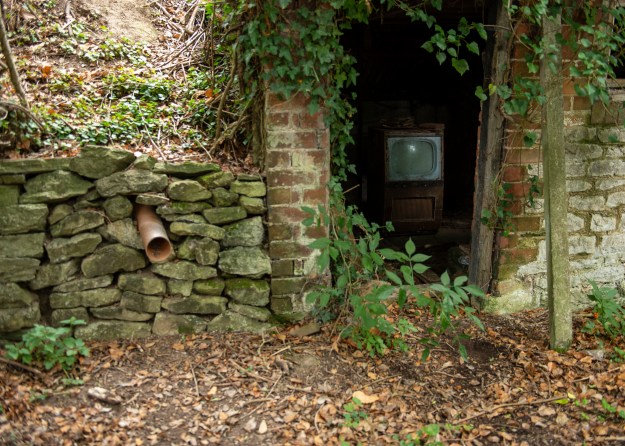
My intention was to shoot the images in a way that connected them together, but without relying on a simple visual to link them.  The compositions largely follow conventional techniques but I’ve used focal length, depth of focus and leading lines to draw attention to the key elements in each photograph.  An example would be number 5, where the short focal length and wide aperture allow for metering on the point of focus (the TV screen) as well as keeping everything relatively sharp around it.  What this achieves is the viewer seeing the TV before exploring the rest of the composition to see the other key elements (the pipe, the disturbed earth in front of the building and its general state of decay. I’ve also tried to use colour to draw out key features, such as the hazard tape and dead leaves in number 9.  Overall, the photographs work as a series without any significant clashes in colour, light or composition.

Quality of Outcome

As described above, I believe the images to be technically good quality.  In terms of the use of elements within the images, I believe there to be enough to raise questions in the viewer’s mind as to what the series is about.  At the heart of the story, is the contrast between the effect of trauma and our less obvious reaction to it.  I feel that I’ve taken on board my tutor’s comments about the strength of words when added to the pictures.  The texts here add information that supports the narrative (relay) rather than being a direct route to a meaning (anchor).

Demonstration of Creativity

This assignment has pushed me to be much more creative than any of my previous work on the course.  I believe that I have successfully fought my natural instinct to be literal and achieved a series that has enough scope for variety in its interpretation.  Using almost empty space and derelict buildings to represent the trauma and contrasting with the random memories was inspired by Fox’s work, with nods to Botha’s Ring Road.  What I set out to achieve was to work on  a subject that really interests me and that I have my own relationship with and perspective on.  It has been a significant challenge but I am  happy with the resulting demonstration of my creativity.

Context

In the context of the learning, I’ve demonstrated that I understand how stories can be non-linear and that photography can be used to visually represent an idea, feeling or unseen element without having a subject that links directly to it.  This has been a tough part of this unit, but I believe that I have demonstrated my understanding and, hopefully my new interest in this genre of photography.

References

[1] Nicholas, T, 2019, “The Death of the Author: WTF? Roland Barthes’ Death of the Author Explained, Youtube, https://www.youtube.com/watch?v=B9iMgtfp484

[2] Pickering S, “Public Order”, artist website, https://www.sarahpickering.co.uk/works/public-order/

[3] Sank M, 2020, “Portraits from a Distance”, Wellcome Collection, https://wellcomecollection.org/articles/Xsd98hAAACIAhct_

[4] Botha  D, 2013, “Ring Road”, Artist Website, https://www.dewaldbotha.net/ring-road.html

Contact Sheets
2) Project 3 – Photographing the Unseen

Introduction

For most of my life I have seen photography as a medium for capturing visual memories.  My early photographs were all snapshots of a moment I was experiencing, whether a family event, holiday or school trip.  Little care or attention was taken in how they were framed or to the lighting conditions, as I wasn’t skilled in any of the technical aspects of the craft.  Latterly through, my studies with OCA and through researching the works of Parr, Goldin and others, I’ve appreciated the difference between capturing my own memories and evoking them in others.  If I show my past photographs to other people, they may well react in some way, but it’s not really explored through their engagement with the image or in any way by my design.  With the artists I’ve looked at, there is something relatable in some cases and shocking in others, but the thing they have in common is that they allow the viewer to make up their own mind as to what the image means.  In this course unit, documentary series’, such as Lixenburg’s Imperial Courts that we studied earlier  [2], show us things that we have no personal references to, but seek to tell an informed story about the important issues of people’s lives whether they be socio-economic or cultural.  Along with the literal and perhaps obvious, they leave room for a narrative to be created, the contextual elements being visual, but often using metaphor.

Metaphor

an expression, often found in literature, that describes a person or object by referring to something that is considered to have similar characteristics to that person or object, Cambridge English Dictionary [1]

Metaphor wasn’t something I was really familiar with outside of its meaning in the English language.  In exploring how a visual medium like photography can be metaphorical, I’ve begun to let my imagination run more wildly than before.  Visual cues are still needed, but I’ve really started to work hard to move away from the literal signposting of my earlier work.  As I prepare for Assignment 2, the course notes lead me to how other students and artists have approached photographing the unseen.  We are presented with two case studies.

Two Case Studies

Peter Mansell

Mansell suffered a major spinal injury when he was as younger man and the interview with him in the notes explores how his photography evolved to tell the hidden story of the effect of his disability on his life.   What I found interesting in his answers to the interview questions was how he had started in a similar way to me; photography as a technical competence for creating visually appealing images.  His studies too started with the need to meet a brief and evolved into story-telling through photographing whatever had metaphorical meaning.  Mansell’s realisation that the subject matter itself wasn’t the point of the photograph hasn’t happened with me yet; I still struggle to pull away from stating the obvious using what is in the frame.

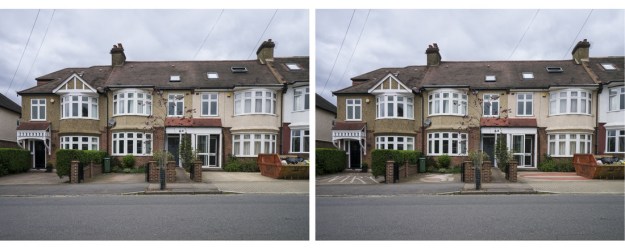
In his later work for his MA degree, Mansell tells a story of his life as it is now [3].  Factual and matter-of-fact in the way it is presented, Paralysis Unseen: Pictures and Words deals with the unseen management of Peter’s condition, the way the obvious impacts are missed by those who are not experiencing something similar and how his outlook on life is impacted by his environment.  The two images that struck me from the series are shown below:

7400986_orig

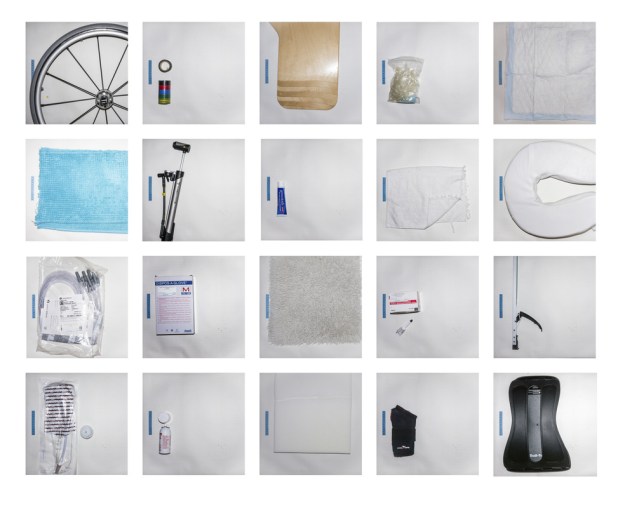
‘My Kit’, from the series ‘Paralysis Unseen: Pictures and Words’, by Peter Mansell [3]

In ‘My Kit’, Mansell arranges the equipment he needs to function in the world in an almost forensic layout of photographs.  The items are a variety of shapes and sizes and Mansell links them together with a single measuring ruler in the same position in each frame.  The sense of order needed to prepare to be in the world as a disabled person is overwhelming.  The factual presentation shows that it’s something that has to happen almost automatically, but the complexity of the gathering of equipment is the unseen element. I have no concept of how difficult this is to manage, but find myself asking how Peter doesn’t forget something important.  Does it come naturally after all these years or is he facing risk to his life everyday?

9021751_orig

‘My Street’, from the series ‘Paralysis Unseen: Pictures and Words, by Peter Mansell [3]

In ‘My Street’, duplicated images of the front of two houses are shown.  However, Peter has manipulated the second image to include signage that we might expect to see on any street or facility while out and about.  Here Peter’s unseen element of the implied restrictions on his movement comes through. It suggests that this is the mental appraisal of his environment as he moves through it.  The No Entry area with the clear step up into the porch of the house is a telling sign of how people in wheelchairs must feel when they realise that they cannot get into a space.  It also serves as a message about the lack of consideration shown by able-bodied people to those with physical disability.  Later in the series, there is an image of a disabled parking space sign set against a beautiful landscape.  The title is ‘Your rules’, which I interpret as a protest against being told where  the disabled can be parked so that they can look at the view but not be part of it.

I really loved this series of images.  Mansell’s developed skill at metaphorically suggesting a story is something I aspire to as I work through this course.

Dewald Botha – Ring Road

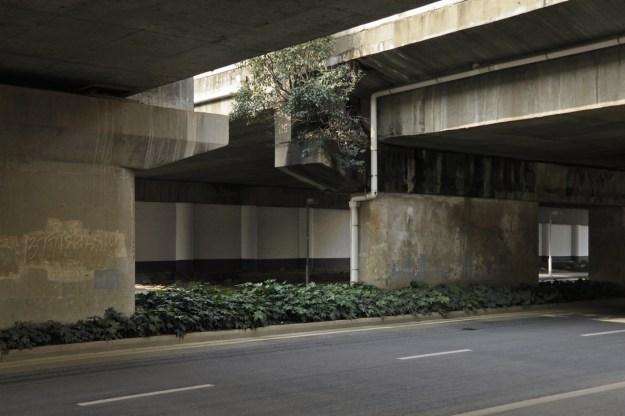
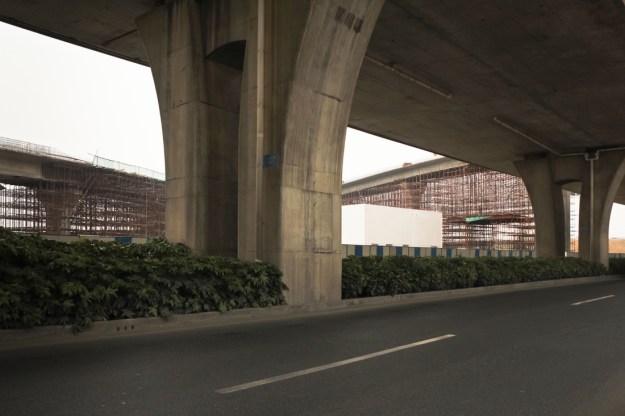
The series Ring Road deals with a very modern struggle for people who live in urban areas.  Botha had the challenge of fitting into a different culture as well as the contrast of his new, chaotic environment to what he was used to previously.  His use of photography as a documentary tool while looking for places to escape his busy environment, is something I’ve done when I’m under significant pressure.  Walking with the camera and looking for things that interest me has always been a way of relaxing.  What Botha has done here though, is to take a physical object that represents his difficulties and sense of isolation and use it to explore his reaction to his new life in terms of limitations and loneliness.  I found this series to be very thought provoking.  Botha uses the ring road to frame his photographs as well as be a key visual element.  The outside world peaks through the darkness created by the bridges of the road and he frequently contrasts the natural world with the man-made.  The two images that struck me from the series are shown below:

2625760_orig

Untitled (number 3) from the series ‘Ring Road’, by Dewald Botha, 2013 [4]

In this photograph, the ever-present road cuts across the frame while the structure of the bridge dominates.  The small amount of natural light that enters the scene contrasts with the very oppressive man-made structures.  Nature is taking back some of the space with the tree going from the concrete, but the gloom is overwhelming.  The metaphor for me is that there may be glimmers of hope beyond the limitation of the experience, almost a sense of ‘don’t give up, it’ll all get better’.  The inclusion of the pipe that runs from the ground up around the structure and out of the frame suggests potential escape from these limitations.

6597446_orig

Untitled (number 7) from the series ‘Ring Road’, by Dewald Botha, 2013 [4]

In this photograph, the relentlessness of the road is still present but now we also have the opposite feeling to the previous frame.  The building works that are represented by the scaffolding suggest a narrative where the road is getting bigger and potential worse. The light in the shot is subdued as to hide the natural world.  In contrast to the previous image, this photograph evokes a sense of depression in me rather than optimism.

This series had as great an impact on me as Mansell’s work in that the images describe the mixture of emotions that Botha was experiencing through a much more visually connected series.  The light and composition are similar from shot to shot, with more traditional styles being used.  However, while they have consistent elements (the road, the contrast between the manmade and natural worlds, the sense of restriction etc), the feelings evoked by the series as we move through them vary considerably.  I find myself unable to see the series as a linear sequence in that it’s not obvious to me when my emotional reaction changes.

Conclusion

I’ve enjoyed looking at these two different artists.  Their work definitely captures and represents the unseen and although both deal with personal struggle, their approach is very different.  Where Mansell includes himself in some shots and uses digital manipulation to add the visual pointers to disability, Botha uses just one of the sources of his struggle in what appears to be, but isn’t an obvious way.  Botha’s narrative of isolation, difference and the effect on his sense of self comes through even though there is not physical reference to him or any other human being.

I am about to start Assignment 2 – Photographing the Unseen, so this has given me a great deal to think about.  I want to combine words with the images as with Mansell, but want to represent my subject with what appears to be completely unrelated or disconnected.  It will be an interesting challenge.

References

[1] Unknown, ‘Meaning of Metaphor in English’, Dictionary Definition, Cambridge English Dictionary, https://dictionary.cambridge.org/dictionary/english/metaphor

[2] Fletcher, R, 2020, “Case Study – Dana Lixenburg – Imperial Courts”, OCA Context & Narrative blog post, https://wordpress.com/post/richardfletcherphotography.photo.blog/2043

[3], Mansell, P, 2016, “Paralysis Unseen: Pictures and Words”, Artist Website, https://petermansell.weebly.com

[4], Botha, D, 2013, “Ring Road”, Artist Website, https://www.dewaldbotha.net/ring-road.html


Preparing for Assignment 2

Introduction

While completing Exercise 3 of Part 2, I received feedback on my submission for Assignment 1 from my tutor.  For a variety of reasons, there was a delay in having the one to one call with her which allowed me to progress with the work in Part 2 in the meantime.  Generally, the feedback was positive about how I’d approached the assignment, whose brief was to tell two sides of a story.  I had chosen the effects of lockdown, making the assertion that it would have a positive impact on society overall and then using the images to both support and contradict that position.   The resulting set were said to work, but that they were perhaps a little limited in the perspectives that I’d shot from and lighting that I’d used.  The images were shot during the most severe conditions of the lockdown, where only short periods of exercise were allowed and, mercifully we had a spell of bright, sunny weather.  Nevertheless, this was the first thing that I needed to address when embarking on this assignment.  I could not afford to lose the balance of technical skill (light) and freeform creativity (my tutor referred to it as ‘experimentation through the viewfinder’, which perfectly describes it) because I’m trying to tell a story of something that is not obvious imagery.    The second piece of feedback that resonated with me was how the titles that I added to the pictures didn’t really emphasise the subject and hence, served to steer the viewer rather than enhance the message.  Since progressing to Part 2, I’ve learned about the use of text more specifically to enhance the narrative of the series and how that differs greatly from signposting the viewer to its heart.   For Assignment 2, where the brief is to photograph the unseen, I needed to think about how the text might support the series more as Barthes’ relay rather than anchor if I was to use it more effectively.  The images also needed to be more metaphorical than literal, something that engineers find a little difficult generally; reasoning being firmly entrenched in the latter.

Further Research

As well as looking at the case studies in Project 3 [1], my tutor suggested a number of photographer’s works to look at before starting Assignment 2.  These were Chloe Matthews, Michelle Sank and Anna Fox, all of which have created powerful documentary series of interesting, but not necessarily obvious subjects.

Chloe Matthews – Shot at Dawn (2014)

Shot at Dawn was a commissioned work to commemorate the 100th anniversary of the Great War 1914 to 1918.  Matthews’ choice of subject was one that had remained largely hidden and not discussed for most of the intervening century; the men of the British, French and Belgian armies who were executed for desertion.  In her treatment of the subject, Matthews elected to research the cases of a number of these soldiers, many of whom are now recognised to have suffered from severe mental trauma on the frontline, but at the time were considered cowards.  She used the historical records of the executions to identify the locations  and visited them at the approximate time of year and day that they took place.  Like Seawright, Matthews’s images are of features of the landscape that in some cases retain a link to the history of the events, but in others are seemingly unrelated to anything having happened there.  However, with the addition of the factual detail of the execution from the records, which often was simply the date, time and location, they take on a more powerful meaning.  I was directed at this work in response to the comment by my tutor about the use of the same period of the day in my Assignment 1.  By making the time of day part of her work, Matthews creates a sense of sombre reflection in her series, which takes the viewer back to the day of the execution.  She also shot the series on medium format film, making use of the response of the film stock to bring out the colour temperature of the early morning sunrise.  When interviewed about the series [2], Matthews added that the narrative of the series could be seen as broader than the victims of the firing squads, instead including the men who were tasked to pull the trigger.   They had been suddenly asked to pause in their fighting of the enemy and instead kill one of their own.  Even though this is an unsaid aspect of the work, the sombre feel to the photographs really evokes that sense of awful duality of the role of the soldier of that time.

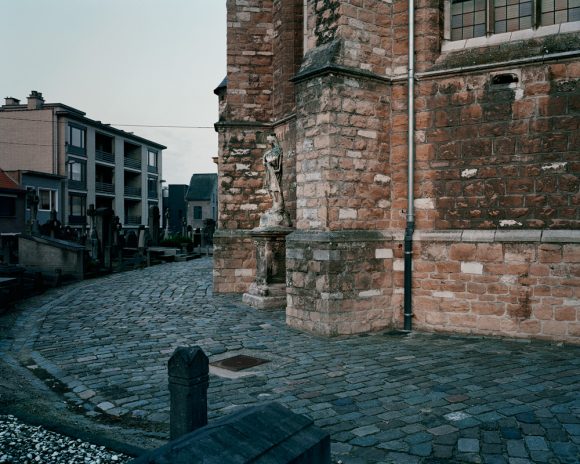
My favourite image from the series is one of a street corner in Antwerp.

CDM_Shot_at_Dawn_003_web-580x464

From the series ‘Shot and Dawn’, by Chloe Matthews, 2014 [3]

 The image contrasts the architecture of the old town with the newer post-war developments, shot at around the end of the blue hour, when the sun is just about to rise above the horizon.  In itself, the image is aesthetically pleasing, but when the supporting text is added, it becomes much more poignant.  The text reads:

Walem, Mechelen, Vlaanderen, Antwerpen

time unknown / date 21.09.1914

Soldaat Jean Raes

Soldaat Alphonse Verdickt

When I look at these together, I’m struck by the beauty of the cobbled street and the corner of the building, but also the terrible sadness that two soldiers, undoubtedly young men, were killed so early in a war that would rage across Europe for the next 4 years. A mixture of the photograph, the text and my own knowledge of the Great War, come together in this work to create the narrative.

Michelle Sank – Portraits from a Distance (2020)

The next photographer was Michelle Sank who like many, found herself in isolation during the COVID-19 pandemic.  Her situation was made worse by the fact that she had to ‘shield’, which effectively meant that she had to also be isolated from her loved ones.   Sank decided to document how the people in her local area were coping with lockdown by shooting portraits of them in their space.  As the distancing rules prevented her from getting close to here subjects, the portraits take on their own situational aesthetic because of the physical distance between them.  Sank was also limited in the time during which she could shoot her project, as the government instructions were to spend just one hour exercising outside.  When I first looked at this series, I was immediately struck by the similarity in the conditions that Sank was under to my own project for Assignment 1.  The obvious differences were that I was focussed on the dual interpretations of COVID lockdown, with the virus at the centre of the story being told.  Sank’s work was more a document of the unseen coping of the people she encountered when out walking.  She shot her series as pairs of images, one of the person in some everyday context (walking the dog, looking after children etc) and the other being a more static image of their surroundings.  The pairing produces a view of the ordinary (the environment) and the extraordinary (the people) which creates the narrative.  Here are people going about their lives under unprecedented, difficult times which can be seen alongside the seemingly unchanged environment in which they live. Sank adds text to her images to describe what her subjects are experiencing but I quickly realised that we could simply view them with the time and date captions that Sank uses as titles.  My favourite example is shown below:

f05809f6-2c3b-4cc3-abc9-64d46d6c2b3d_Pairs-06-2

From the series ‘Portraits, from a distance’, by Michelle Sank, 2020 [4]

Here we have a young man holding a hedge trimmer, standing in front of a half finished hedge.  The paired image is of an untidy front garden and window with a picture of Christ fixed to it.   The photograph contains references to the natural world with the greenery and the man’s machine for controlling its growth.  The religious iconography speaks to the love in the house, but there is something not quite right about the stance and expression of the man.  When we look at the text that goes with the picture.

“Kyle has cystic fibrosis. His job is in a packing warehouse, but as he is very vulnerable he cannot be at work. His mother said they had moved down to this area in the South West as it was better for his health. I remarked that he looked very well and he said that his mother makes sure to look after him and prepare healthy food. He felt frustrated at the moment with the lack of structure in his life because of the virus, and didn’t know when he could return to work”

Now the photographs have a new dimension to them.  The love and care is there, but now we know it’s his mother looking after a boy with a disability.  The greenery now takes on the notion that moving to the area would help with his health and the serious nature of his expression is perhaps a response to the lockdown affecting the normality of his life.   This image appealed to me because of the careful composition of both photographs and how they leave enough clues for the viewer to create the narrative.  The addition of the text offers some adjustment to the assumptions that I had as a viewer, but didn’t change my narrative completely.

I really like this series as my tutor suggested this was a way to look at how a story can be told with common and contrasting elements.  The underlying theme for the series is perhaps not as established as in Matthew’s Shot at Dawn, i.e. the subject is the more broad in its documentary of COVID-19 and the impact on people’s lives, but I think the power of the series comes from the fact that it was created by a photographer who was experiencing her own hardships in lockdown.

Anna Fox –  My Mother’s Cupboards and My Father’s Words (1999)

The final photographer that was suggested to me was Anna Fox.  She had created two works that made some of the points in my tutor’s feedback.  The first was My Mother’s Cupboards and My Father’s Words.  Described as a “an unusual story about family relationships”[5], the series pairs the violent verbal outbursts of Fox’s father as he suffered from serious illness at the end of his life, with seemingly ordinary images of her mother’s neatly organised cupboards.  The contrast of the two components is immediate; the obvious struggle to maintain some order in the face of someone threatening you and the sense that the comments are so outrageous that it can only be from an ill person.  With this series, the imagery is very similar from cupboard to cupboard but there are lots of subtle references to help create the narrative.  My personal favourite is shown below:

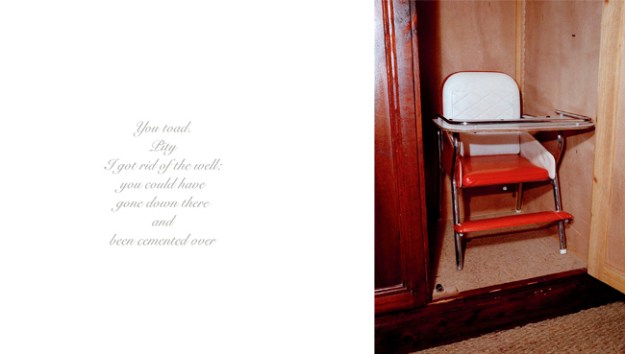
FS_10326

From the series ‘My Mother’s Cupboards and My Father’s Words’, by Anna Fox, 1999 [5]

Here we have the threat of throwing Fox’s mother down an old well that he regretted removing.  The words are harrowing but in the context of a frail old man, faintly ridiculous.  What is most powerful is the picture of the chair.  It is stored in its own cupboard and looks like a children’s high chair at first glance.  For me, the immediate narrative created by both components is ‘witch trial’.  Medieval history tells us that witches were something feared by all God-fearing people and their detection and destruction was a serious activity across the UK.  Detection often included dropping the accused into a river to test for them being a witch; a floating woman was guilty and subsequently executed, while a drowned woman was innocent (and dead).  This juxtaposition of an ordinary household item and the threat of something almost medieval is very powerful in this series and is one of many subtle but strong story elements.

What I found interesting about this series is that the links between the photographs are more explicit than in the other two described previously.  The way that Matthews took her photographs at the approximate time and date of the executions links her series together and has the added visual anchor of the light being very similar in each shot.  In Sank’s work, the links are more subtle in the time of day and environment.  She had the same challenge that I did with Assignment 1, where the government sanctioned exercise of the time limited the radius of the area that could be covered on foot.  In my case, I found myself walking in the afternoon after work and because of the weather at the time, the sunlight was pretty much the same in every picture.   In Fox’s series, however the link is really obvious in the shooting of the cupboards.  It feels as though the pictures were snapshots of her mother’s cupboards for a simple record; all shot with flash and all tight compositions so that nothing else is visible other than the contents.  This snapshot style really drives home the simple order of her mother’s life without using any clever technical techniques to get the point across.  What makes the series really powerful is that the banality of the subject is raised up by the conflicting aggression of her father’s words.

The second Fox series Work Stations was shot in the 1980s and is focused on the financial trading industry that was central to the ‘yuppie’ culture of the time.  Here we have a series of photographs shot in a similar style as her other series; brightly lit and using flash.  It’s not really a surprise as Fox studied under Martin Parr, who is well known for his candid shots of people living their lives while being watched almost voyeuristically by the photographer.  In Work Stations, Fox combines the imagery with quotations from people in the business, which have a sense of the motivational quotes that were also popular at the time.  My personal favourite is shown below:

itemsfs_6407

From the series ‘Work Stations’ by Anna Fox, 1987-88 [6]

What I love about this photograph is the simplicity of the subject.  The space has no people in it and the only real visual reference is the sign on the door that indicates it is a women’s toilet.  The caption beneath reads.

“Typical working situation, female workers rabbitting away”, Company Manager

For me, the brilliance of this is the layers of narrative that the combination introduces when the two elements are brought together.  The first thing that struck me was that there were probably women in the toilet gossiping in some way.  Otherwise, they are likely to be behind the slightly open door.  However, the big impact on me (being a child of the 1970s) is the attitude to women in the workplace during the 1980s.  The image is both satirical and a statement of how ridiculous a notion it is that female workers are somehow more chatty and by implication, less focused than their male colleagues.  This image takes on new meaning with the passing of time.  Fox shot it during the 1980s, so it is most likely a subliminal protest, which has moved more to parody in the 2000s.  The rest of the series portrays the financial traders as being hard working, ruthless and hard partying men with their own sense of self importance.  Again, the whole series has shifted in meaning with the passing of time.  Since the 2008 financial crash, the finance industry has been regarded with more suspicion, derision and more closely monitored than in the heyday of the yuppies.  As well as parody, the series provokes a sense of disgust when I look at it.  I was reminded of the mixed feelings of fun and disgust I experienced when I first saw Scorsese’s Wolf of Wall Street a few years ago.  The combination of pompous quotes and indulged trading staff is certainly a powerful one.

Conclusion

What I’ve learned from this research is that a series of photographs that tell a story, needn’t be obvious in the way it goes about it.  Bringing all of the elements of Part 2 together is one thing, but the key message of leaving enough room to create the narrative is the most important learning.  All three of these artists have chosen something strong to base the series on and then backed away from the obvious.  My natural tendency has been to think of a message and then find an element that can easily be interpreted as that message.  Fox’s combination of a high chair and the words that went with it, was the best example I’ve seen of just letting the viewer run with it.  In my case, my interest in history led me to witchcraft trials and the medieval treatment of women by men who had some sort of problem with them.  Fox’s other example of the women’s toilet door further emphasised to me that simple compositions of open spaces with the smallest symbolic component can also be really powerful when combined with the right words.

In terms of Assignment 2, my ideas are revolving around things I am really interested in that are completely unseen.  Where I felt that Exercise 3 was still too signposted despite my best efforts, I am determined to be completely open-minded in my selection of subjects for the assignment.

References

[1] Fletcher, R, 2020, “Part 2 – Project 3 – Photographing the Unseen”, Context and Narrative, <insert link>

[2] O’Hagen, S, 2014, “Shot by their own side”, The Guardian, https://www.theguardian.com/artanddesign/video/2014/jun/29/chloe-dewe-mathews-shot-at-dawn-first-world-war-video

[3] Matthews, C, 2014, “Shot at Dawn”, image resource, http://shotatdawn.photography/work/

[4] Sank, M, 2020, “Portraits from a Distance”, Wellcome Collection, https://wellcomecollection.org/articles/Xsd98hAAACIAhct_

[5] Unknown, 2020, “Anna Fox – Anna Fox. My Mother’s Cupboards and My Father’s Words. The Hyman Collection website, http://www.britishphotography.org/artists/15795/ei/1916/anna-fox-anna-fox-my-mothers-cupboards-and-my-fathers-words-1999

[6] Fox, A, 1988, “Work Stations”, The Hyman Collection website, http://www.britishphotography.org/artists/15795/ei/1170/anna-fox-anna-fox-work-stations-1987-88


Exercise 3: Poetry Interpretation

The Brief

The aim of this exercise (and Assignment 2) is to encourage you to develop metaphorical and visceral interpretations rather than obvious and literal ones, to give a sense of something rather than a record of it.

Choose a poem that resonates with you and then interpret it through photographs. Don’t attempt to describe the poem but instead give a sense of the feeling of the poem and the essence that it exudes. Start by reading the poem a few times (perhaps aloud) and making a note of the feelings and ideas it promotes, how you respond to it, what it means to you and the mental images it raises in your mind.

Next, think about how you’re going to interpret this visually and not down your ideas in your learning log.

You may choose to develop this idea into creating a short series of images reflecting your personal response to the poem (or another poem). Write some reflective notes about how you would move the above exercise on. The number of pictures you choose to produce for the exercises and assignments in the course, including this one, is up to you.Initial thoughts

The Exercise

Poetry isn’t an artistic medium that I’ve been interested in or appreciative of in the past. At school it felt like a chore rather than something to emotionally react to or enjoy in some way.  Throughout my life, though there has been one poem that has resonated with me whenever I’ve heard it read aloud or seen it written down. That poem is ‘ Do Not go Gentle into that Good Night’ by Dylan Thomas. It has always provoked strong emotions and visuals in my interpretation, even if I’ve never really studied it. My first thought was to use this poem for the exercise.

The Poem

Do not go gentle into that good night,
Old age should burn and rave at close of day;
Rage, rage against the dying of the light.

Though wise men at their end know dark is right,
Because their words had forked no lightning they
Do not go gentle into that good night.

Good men, the last wave by, crying how bright
Their frail deeds might have danced in a green bay,
Rage, rage against the dying of the light.

Wild men who caught and sang the sun in flight,
And learn, too late, they grieved it on its way,
Do not go gentle into that good night.

Grave men, near death, who see with blinding sight
Blind eyes could blaze like meteors and be gay,
Rage, rage against the dying of the light.

And you, my father, there on the sad height,
Curse, bless, me now with your fierce tears, I pray.
Do not go gentle into that good night.
Rage, rage against the dying of the light.

The poem is written as a plea to Thomas’ dying father to not give  up on his life and quietly accept death. The  stanzas build by describing how men from all walks of life do not simply give up, irrespective of their achievements or character traits. Thomas’s final comment to his father is that he prays that he too will fight for every last moment of life before the inevitable happens.

When first reading the poem, the language used points to obvious emotions if interpreted literally. “Rage, rage against the dying of the light’ evokes the sense of anger at oncoming darkness. The pain of “Curse, bless, me now with your fierce tears, I pray” comes through clearly also, with the final plea suggesting that the end is near for his father. However, when I read the lines a few times, I got sense of Thomas comforting his father and found myself wondering which one of the men described in the stanzas he best identified with. Perhaps Thomas was trying to ease his father’s anxiety about dying by pointing out that it wasn’t his fault, but that he should hang on to every last moment of life and savour it. So, for me, the themes I believe I should pick out for my interpretation are as follows:

Anger – even disregarding the use of ‘rage’, there is a sense of frustration about the way the poem flows. When Dylan read the poem for a recording by the BBC [1] not long before his own death, his use of volume and pitch further emphasise the frustration that he shouldn’t really have to tell his father these things. Perhaps the anger element is something we all recognise as we get older and our parents become less the role models they once were.

Love – almost hand in hand with the anger is the clear love he had for his father. Thomas’ father had a great appreciation for his son’s poetry and regretted not having pursued the same sort of path in his own life[2]

Fight – the determination to not go quietly. The idea that we can stretch time to get the most from it through our own will. This is one of the reasons the poem resonates with me and is likely to be the subject of my Assignment 2. For many years I have suffered with my mental health and the determination to get better coupled with the support from my loved ones, gradually brought me out of the depression. The determination was to enjoy life rather than be afraid of it.

Time – the poem dwells on the end of a story, in this case the life of Thomas’ father. The sense of the passing of time is very evident in the build up of the stanzas with Thomas describing the lives of the different men, all with the end in common.

Potential Subjects and Ideas

For emotions, there are plenty of different subject types that I can include. During EYV there were a number of times where I looked to capture emotion but they were more literal than interpreted. For this exercise, I am considering the emotional trace left after an event in a similar way to the documentary work of Meyerowitz in Part 1. Subjects need not include people to convey emotion, so I will be looking at inanimate objects that evoke emotion as well as subjects that we project our emotional reactions onto, e.g. pets or family heirlooms.

Determination and fight are slightly different from Anger and Love as there is unseen intent to interpret with the photographs. Determination in a literal sense could be a visual involving a challenge such as sport or some form of competition. However, I want determination to be much more subtly implied in the pictures, so the struggle could be more cryptic in its representation, such as the struggle to overcome loss or economic problems.
For Time, I’m considering the how we react to how time passes, whether recognising it for what it is or trying to mitigate for the effects of it. 

I’ve always thought that human beings express their emotions using certain body language.  In Expressing Your Vision, I focused one of the assignments on the way that we read the expressions of eyes.  I learned a lot about observation during that assignment as the photographs were shot as I talked to my subjects.   In this series, I wanted to incorporate body language into the image in someway to help create the sense of emotion that the poem invokes.  As we interact with world with our hands more than most other parts of the body, I chose to shoot use hands as a linking element in the set.   The primary consideration was not to be too literal in my interpretation of the text. 

The Images

IMG_0495

One

IMG_0494

Two

DSC_8948

Three

IMG_0496

Four

DSC_8921

Five

IMG_0498

Six

IMG_0497

Seven

Analysis

With this set, I’ve been very conscious of not wanting to ‘read out the poem’ through the images themselves.  This presented me with a really big challenge in the first instance because, while I’ve appreciate the metaphorical works of Seawright [3], Campbell [4] and Boothroyd [5], my natural instinct is to be literal.  I think this explains my stopping at 7 photographs – it was more about struggling with inspiration than 

My aims for this series were to portray the emotions that I encounter when reading Thomas’ poem through the use of hands.  I wanted to avoid the series being sequential and ‘signposting’ the viewer to the story I was trying to tell.  The following is an analysis of the themes I intended to get across for the poem and an appraisal of how successful I was through the questions posed in the course notes.

One

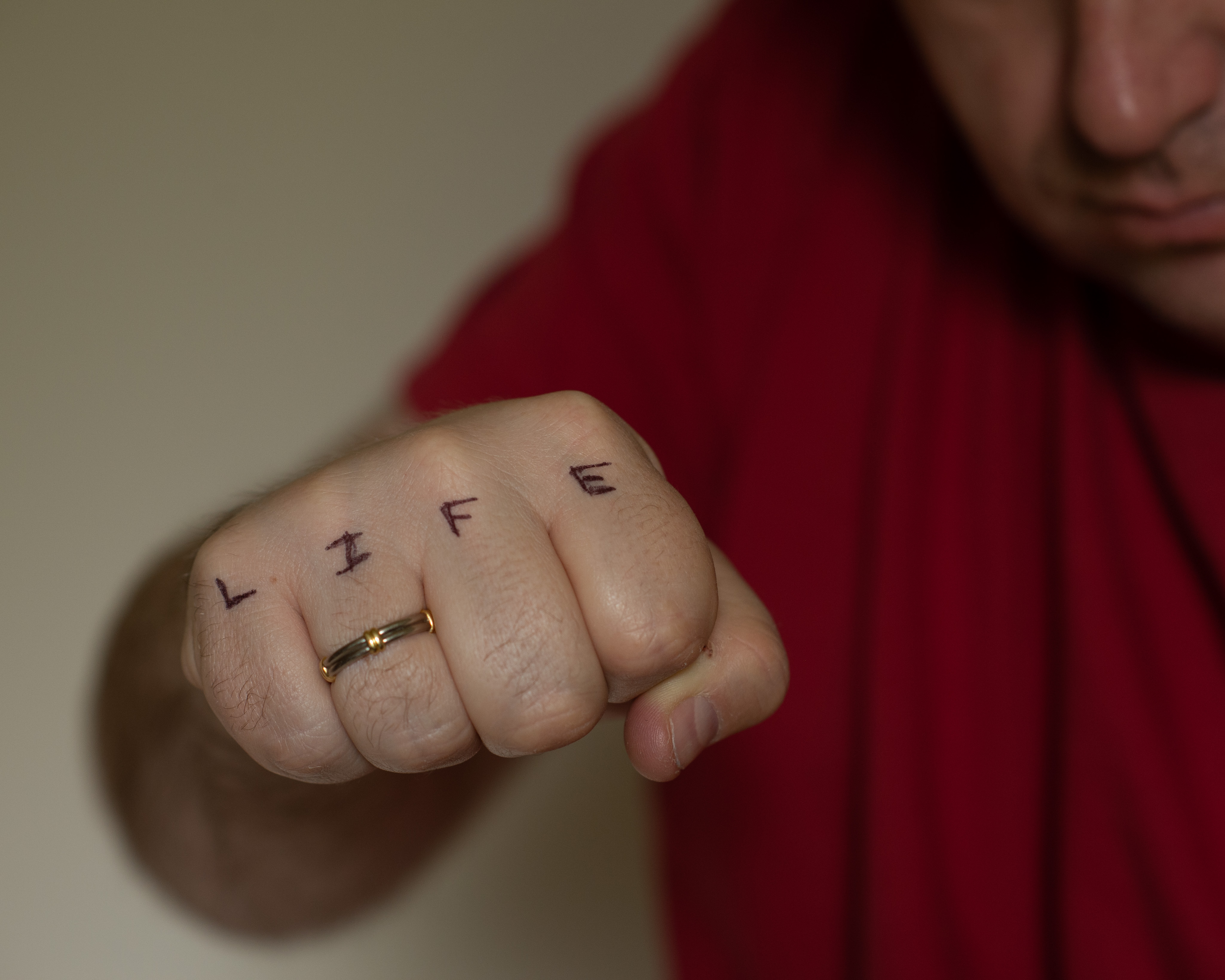
This image was intended to evoke the sense of fight, with the tattooed knuckles being traditionally associated with the punk era of the 1970s. In this case, the text is different, with ‘life’ being the fight instead of ‘love’ or ‘hate’ and the combination of the gesture of the hand, signals a focus of fighting an unseen assailant.  The final element is the red shirt, which is intended to be one of rage or passion.

Two

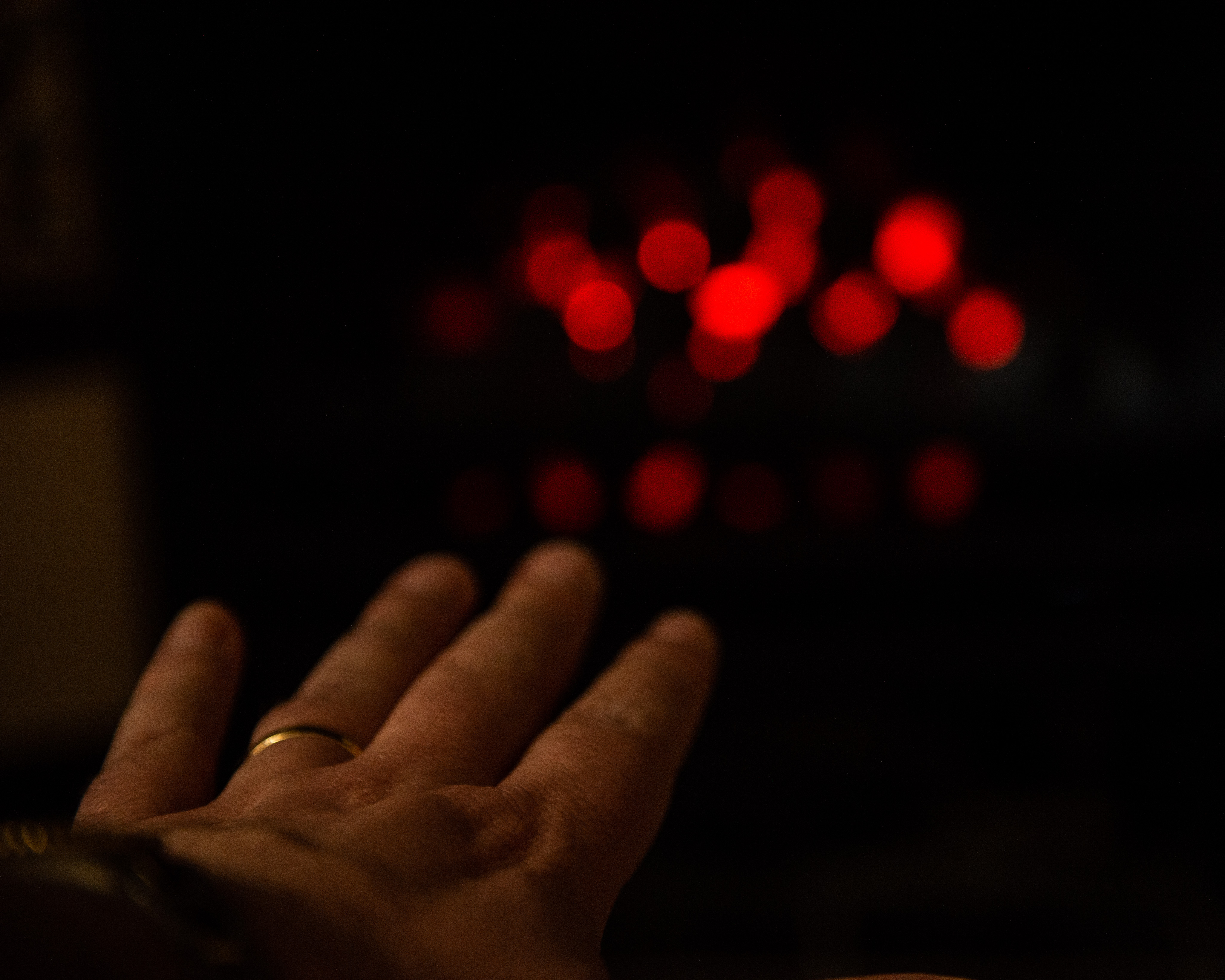
This photograph was intended to be more representative of the feeling of a dying light in a more literal way.  The dying embers of the fire are deliberately bokeh, while the hand is only lit by the dying light.  The way the hand is stretching toward the light signifies the desire to have the light as it dies.  Now, instead of the theme of raging against the light in the poem, the feeling is one of wanting to hang on. 

Three

This image plays on the stanza that talks about wise men.  The poem discusses the quiet nature of the contribution of wise men contrasted with the fact that they do not simply acquiesce to the end of their lives.  What I tried to create here was the sense of the learned man, or writer.  The pen gives the sense of success in life, but the word being written suggests ‘hold’.  I used this word because of the many possibilities of what would follow it.  Hold on, hold tight, hold together – any of these suggest the urge to simply stop something, perhaps worrying about life or perhaps an instruction to death to stay back.  The use of the hashtag is intended to signify the wider reaches of whatever is being stopped, deliberately used because of its modern connotations. 

Four

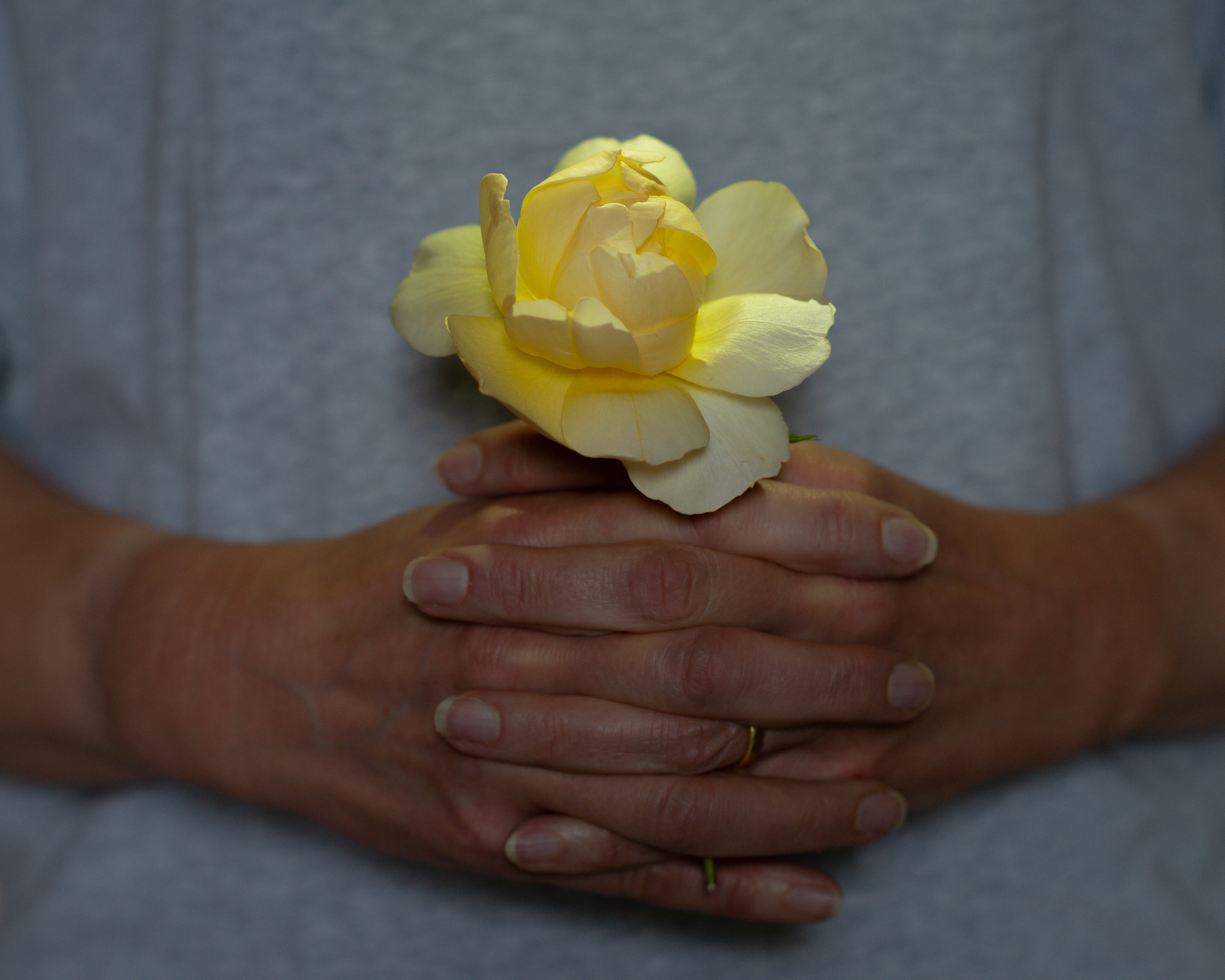
This shot was intended to pick up on the theme of living, or burning and blazing as a repeated theme throughout the poem.  I wanted to light the flower but not the hands to suggest that there is something burning what we should hold onto.  The underexposure is deliberately forcing the viewer to look at the brightness of the flower.  Set against a neutral grey background, the flower is the the focal point, but the shape of the hands in clasping prayer also signal the desire to hang on to the brightness.

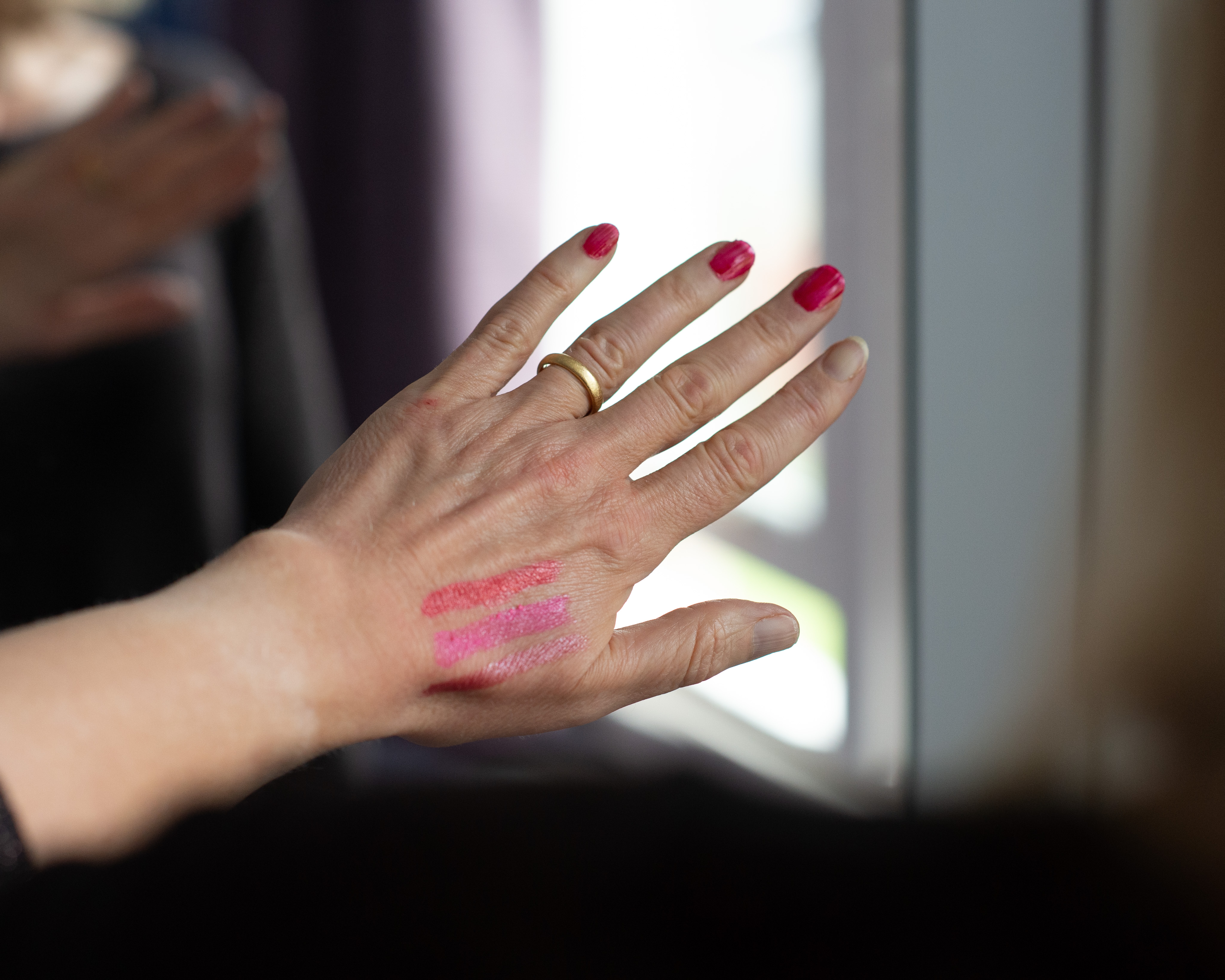
Five

With this image, I was trying to emphasise the passing of time but also the feeling of not being finished.  Thomas’ poem is written for his father at the end of his life, so I wanted to portray a sense of ageing while not being ready for the end.  This image of my wife’s hand signifies the incomplete through the unfinished fingernails and the indecision in choosing a lipstick colour.  The sense of not finished comes through against the feeling of applying makeup as being a cover-up, perhaps of ageing. 

Six

With this photograph, I wanted to play with the idea of wild behaviour as in the third stanza of the poem.  The unfinished wine and position of the hand from the bottom part of the frame suggest some form of celebration or self destruction is taking place.  The use of the television and its message suggests the party is over, but the determination of the hand reaching up with the remote control could suggest either acceptance of fate or the raging against the end of the programme. I only noticed after the shot that the additional choice on the screen of moving on or going back might suggest regret as well as acceptance of what comes next.

Seven

The final image in the series is supposed to convey love and the pain of loss.  Where Thomas was speaking to his dying father, I am cradling a portrait of my late mother that was taken when she was a teenager.  The pose and position of the portrait in the image is supposed to signify the love and longing I still have for my mother, despite it being a quarter of a century since I lost her.  The juxtaposition with the text on the t-shirt is a little signposted, but further emphasises the power of loss.  In the poem, Thomas pleads with his father not to go gently to his death, while my interpretation is more of past memory.  They both have the strong emotion of love as the centre of their narrative.

Conclusion

My overall conclusion from this exercise is that telling the ‘story’ of something like a poem without actually re-telling the text is a real challenge to me.  I don’t naturally think or speak in metaphor and it’s not really a language tool that I have used much in my career.  Engineers tend to use simile much more in their explanation of a technical problem to a student or third party.  In the case of the poem I chose, the photographs in the series do conjure the emotions and sentiments I was looking for.  

In answer to the questions posed in the notes:-

  1. Are the images repeating themselves? Are there three versions of the same picture for example?  Can you take two out?
  2. Does each image give a different point of view or emphasise a point you want to make?
  3. Do the images sit well together visually?
  4. Have you given the viewer enough information?  Would another picture help?

The series doesn’t have any images that repeat themselves, probably because I had seen this question as part of the brief.  I consciously avoid taking too many shots, which has been raised as part of the feedback to my recent Assignment 1.  Perhaps if I had shot more from different perspectives, I would have had repeats.  However, I had planned this exercise carefully around the themes mentioned previously, so that risk was reduced. I am happy that the images all convey differing points of view, although I am aware that the messages in the images are a little too obvious in places.  Again, I recently received the feedback on Assignment 1 that my use of text was a little too prescriptive (anchor) than supportive (relay) and that the viewer is signposted to what the series is about.  Although I haven’t included the poem text specifically with the images, I realise that the themes are probably a little too obvious as to be interesting.

Visually, I was trying something different.  The images were simple in composition and clearly staged.  However, I wanted them to have a certain feel of dimming light to them, which is why the exposures use soft natural light in addition to the LED key lighting that I’ve favoured over flash recently.   I do believe that each image contains enough information in more layers than I am used to shooting, to get the messages across.  However, I struggled for ideas by naturally limiting myself subconsciously to the more literal interpretation over the metaphorical.  This resulted in my running out of ideas for the series sooner than I would have expected.  Feedback on my first assignment pointed out that I hadn’t really experimented with the subject and composition, which has happened here also. 

Key Learning Points

From this exercise, I’ve learned that I need to think more laterally than with the traditional subject portraying the message.  The photographers I have studied thus far have been working metaphorically with text used to add context rather than lend weight to what is in front of the viewer.  My mind works logically and sequentially, so this is a significant challenge for me ahead of Assignment 2.  

In addition, I’ve subconsciously built in rules before I started the series (using hands, being too literal etc), which stifles the freedom to go with how the text makes me feel.  My approach to the exercise was perhaps too robotic, which I think comes through in the images.

In conclusion, I think the timing of this exercise and the feedback I’ve received from my tutor means that I have something very different in mind for Assignment 2. 

References

[1] 2011, “Dylan Thomas reads “Do Not Go Gentle Into That Good Night”, blogaboutpoetry, Youtube, https://www.youtube.com/watch?v=1mRec3VbH3w

[2] Robinson, A, 2019, “Full Expert Analysis: “Do not go gentle into that good night” by Dylan Thomas”, PrepScholar blog, https://blog.prepscholar.com/do-not-go-gentle-into-that-good-night-meaning-dylan-thomas

[3] 2014, “Catalyst:Paul Seawright”, https://vimeo.com/76940827

[4] Campbell, B, 2011, “The Dad Project, Artist Website, http://www.brionycampbell.com/wp-content/uploads/2013/03/The_Dad_Project_Briony_Campbell.pdf

[5] Boothroyd, S, 2012, “Disrupted Vision”, Artist’s Website, http://sharonboothroyd.com/index.php?/disrupted-vision/

2) Exercise 2: Newspaper Analysis

The Brief

Cut out some pictures from a newspaper and write your own captions.

  1. How do the words you put next to the image contextualise/re-contextualise it?
  2. How many meanings can you give to the same picture?

Try the same exercise for both anchoring and relaying.  Blog about it.

The Pictures

I cut these three photographs out of the The Times newspaper and removed the text that went with them.  They were taken from different sections of the newspaper that cover different types of story.

Exercise 2 Photos01 copy
We are brave

I chose this photograph for its powerful imagery but also for the lack of any textual messages within it.  I wanted there to be no distractions from the visual messages in the picture, that is the woman and what is assumed to be her child in a classical protest pose.  I added the words ‘We are brave’ to contextualise the image as a rally against struggle.  The image is actually taken from a recent protest at the senseless killing of George Floyd in the US, which has vastly increased the racial tension across the country.  When I consider my caption, it is firstly a much shorter and ambiguous text to accompany a news item.  It suggests a brave struggle against something, but not what specifically isn’t made clear.  The subjects both appear to be of African descent, but with part of their faces obscured by the medical masks, it is difficult to be sure.  The raised arms speak to the Black Power movement of the 1960s, which famously had John Carlos using this gesture at the 1968 Olympics to protest the treatment of black people across the world, in particular in his home country of the United States.  The actual photograph caption was:

Hundreds of people lined a rally in Barcelona in support of protests in the United States where activists have called for the abolition of the police departments

Now we have the specific context in the form of an anchor.  We now know that this is a rally in solidarity with the US, rather than a protest itself.  We know that it is in Barcelona rather than the US and the extra information about the demand to abolish police departments sets the political backdrop to the image.  If the viewer has similar or contrary political opinions about the police, the photograph is intended to put only one side of the argument through its anchoring caption.  By contrast, my caption could be referring to COVID-19, which is the currently the dominant news story in the world.  It finds its way into this photograph because of the medical masks, so this image could have other meanings through my caption.  It could be interpreted as a defiance of lockdown rules, families determined to conquer the virus or a show of unity with the rest crowd that can be seen in the background.  The general narratives are similar, though, but my caption doesn’t seek to constrain the viewer in the same way as the newspaper.

Exercise 2 Photos03 copy
The biker bar that delivers

I chose this image because there is something obvious about it, but without the caption that the newspaper used, it could be interpreted in different ways.  For my caption, I wanted to be more descriptive in explaining the scene than in the previous photograph.  Here we see a man with a heavily modified motorcycle that holds kegs of beer and he is serving a very happy looking customer.   In the foreground there is further evidence of the delivery being made by the biker with the wine adding something different to the beer being poured.   This photograph is actually of a landlord who’s novel way of staying in business during COVID-19 is shown in the newspaper as testimony to the resilience of the British people in times of crisis.  The original caption was:

Rob Galvin, landlord of The Feather Star in Wirksworth, Derbyshire, serves a happy customer

Now we have lots of information about the picture that we didn’t have before.  The caption is similar to mine, in that it is a mobile bar but where there are no real pointers to where the picture was taken added by my caption, now we know that it is a place in Derbyshire.  If the viewer knows about Derbyshire, they may know that Wirksworth is a very small market town in the Derbyshire Dales National Park, so this is a service to a remote part of the country.  The use of the landlord’s name is almost a tribute to him, where my caption keeps the anonymity of the principle subject.

We can interpret this image in a number of ways ranging from the intended show of inventiveness during COVID-19 to a crackpot inventor’s money-making scheme.  What is clear, though is that the messages within the image are positive ones. The expressions of both men and the implied transaction point to this being part of a ‘feel good’ piece.

Exercise 2 Photos02 copy
Looking for the right size

This photograph was taken from another story but is aesthetically similar to the previous shot.  This time, I wanted to lead the viewer away from the story by adding an unrelated caption.  Here we see a man sorting through the clothes on the rack whilst wearing a medical mask.   The caption suggests that this is a shopper, although the clothes appear to be very different from what the man is wearing.  Perhaps he is shopping for someone else, or perhaps he’s the proprietor.  The visual signs are of an outside street market illustrated by the bright light, the building exterior and the price tag on the rack that has the appearance of being handmade as opposed to a professional ticket.  The inclusion of the face mask points to the story of the moment, COVID-19.  The recent announcement that some business can reopen with protective measures in place.  The caption that accompanied this photograph was:

A seller takes stock at Petticoat Lane market in London

Now we have confirmation that the man is the seller of the clothing and we know his location.  My interpretation of the image now shifts away from buyer to someone trying to overcome the effect of COVID-19 on his business.  The inclusion of the location could almost be and advertisement for the market or simply an indication of the vulnerability of open-air markets in a normally bustling city such as London.

Research Task:  Relay

We’ve had the concept of relay introduced through the writings of Barthes, but this task is to explore it further using examples in contemporary photography.

Sophie Calle – ‘Take Care of Yourself’

Calle’s work begins with a letter from her boyfriend informing her that their relationship  was over.  This letter, which has been translated from her native French into English, is to begin with an anchor that directs the reader to a state of confused, negative emotions. The sender begins with his own self-pity, explaining to Calle that he’s throughout his recent malaise, he has acted honourably.  The references to ‘the others’ suggests that he had more relationships than just Calle’s during their time together.  His noble gestures of not having seen them, but instead to do the right thing by her are interpreted by me as a warm up to blaming her for the break-up.  The letter goes on to suggest that Calle had precluded any notion of them remaining friends which effectively made the break up and the need for the formality of writing, her fault.

Little wonder then, that the letter left Calle in a state of shock.  Her reaction, that she states was an idea that came within days of receiving the email [1], was to create an artwork that addressed the sender through the eyes of women.  She asked 107 women to read the letter and respond in some way, which Calle captured using mixed media.  The reactions ranged from the letter being reimagined as a crossword puzzle to the more extreme shooting of a copy by a professional sports markswoman.  Each woman brought their own perspective through the context of their professional lives as well as their emotional response to the words.  The result is a curation of many cultural narratives, with no guidance through them by the artist with the exception the initial text of the letter itself.  The viewer joins the narratives together by bringing their own feelings toward the events and the players.  As the subject matter is something we all encounter at some point in our lives, the effect of parallel experiences further enhance the meaning of the works.  For me, it aligns with the post-modern narrative that Barthes was referring to in Death of the Author.  On the surface, it appears as lazy, almost getting other people to create the piece for her.  However, the use of the mixed media to draw attention to and enhance the reactions of her women, make it an impressive piece of work.

Sophy Rickett- Objects in the Field (2012)

Rickett’s work is different but similar to Calle’s. Here we have an artist telling the story of her encounter with a renowned astrophysicist and the way she purloined his photographic documents of celestial bodies for her art. The project seeks to explore the relationship between what is created and what is appropriated [2], namely Rickett’s use of Dr Wilstrop’s old negatives to create her story. The collection is brought together by a written essay that walks the viewer through Rickett’s relationship with Wilstrop. For me, perhaps the most compelling use of media to support Rickett’s work is her video [3]. The video is a loop of Wilstrop polishing the optics for the telescope that he pioneered in a small workshop at his observatory. The audio track that is dubbed over the video is of Wilstrop reading Rickett’s essay account of their meeting and subsequent ‘collaboration’. When we are first presented with the video, it is difficult to understand how the words align with what we are seeing. As it becomes clearer, the impact of Wilstrop speaking the artist’s words is evident. His belief that his negatives taken through his telescope had no intrinsic value outside of his scientific field is contradicted by what he is saying. At no point does the video show his images or how Rickett worked them through her own use of photographic process, but it does in its own right offer a big contextual point to the narrative. Like Calle, this additional information in video and text doesn’t support the image series but works equally to tell the story. In the case of Rickett, her decision to use someone else’s photographs rather than her own may appear controversial, but the piece is as original as the previous examples of non-sequential story telling we have encountered so far.

Duane Michals – This photograph is my proof (1974)

This image is a further example of how the additional information can have an equal standing to the image, but in this case the wider interpretation of the photograph leads us to something almost unrelated to the subject.

‘This photograph is my proof (1974)’, by Duane Michals [4]

Michals presents us with a photograph of a couple in embrace, sat on bed and obviously posing for the camera. This then is a self-portrait similar to the sort that we see everywhere with the advent of ‘the selfie’. There is clear affection in the way the couple are connected in the image, but the accompanying text seeks to steer us to a situation; the affection that was once there but no longer. In this sense, the text has a feeling of ‘anchor’ about it; directing the viewer to a certain conclusion. However, the text also offers something more broad than the instant conclusion that we may have already reached:

“This photograph is my proof. There was that afternoon, when things were still good between us, and she embraced me, and we were so happy. It did happen, she did love me. Look and see for yourself.”

The text starts with a suggestion of dishonesty. The photograph is ‘my’ proof, as if it has been suggested that the claim was false. It then proceeds to describe a point in time when things were good between the couple, clearly not the current situation. The relationship could have ended for a number of reasons, but I naturally find myself assuming an acrimonious split. The element of disbelief continues with the claim that it was real; it DID happen. The last sentence invites the viewer to see for themselves. This is perhaps the most interesting element of the text, because it now asserts that the photograph must be telling the truth. We already know that the truth of an image is entirely subjective as opposed to objective, so what the photographer is saying here is that this proof cannot be challenged by the viewer. It could almost be seen as the evidence in a court case, perhaps even a divorce proceeding. What I see when I put the image and the text together is someone daring me to disagree. As the photograph was taken in 1967, the additional context of the time that has passed suggests to me that perhaps this is a take on ambivalence in a relationship, a taking for granted of the people we love. Perhaps this is supposed to be a warning to me and my generation that love is something that evolves in a way that we don’t necessarily expect, the longer we have it in our lives. I guess that depending on our own life experiences, each viewer is going to be inclined to either agree or disagree with Michals’ version of events.

In a similar vein, I was drawn to the other work in the course notes but Sharon Boothroyd. The series Disrupted Vision tells a story of clashing perspectives through a series of instant photographs. Boothroyd asks her subjects for their perspective on the picture that she has just shot of them, which in itself is a major advantage of using instant film. The immediate reaction of the subject is more often than not contrary to the intentions of the photographer. There were three images from that series that I wanted to discuss here. Unfortunately, I am unable to find the series on Boothroyd’s website (or anywhere else online) to include here.

The first is of a man standing in front of a fairground stall, holding his bag of chips. His reaction, written a on the bottom of the photograph is his commentary on his appearance rather than anything to do with the setting of the photograph. It’s undoubtedly not what Boothroyd had in mind with the selection of subject, background and his relaxed pose for the portrait. However, like the other examples of Relay, the inclusion of the text gives alternative meaning to the image. The subject has a voice with regard to his appearance in the shot that he agreed to and we are going to hear it.

The second image is of a man standing in front of a leafy background, holding some flowers. Again, the pose is simple enough and again the subject offers their opinion on the image but this time its about how to improve the picture. His reaction that it would have been better without his coat suggests that there was something more interesting in his clothing underneath or that the picture is fairly dark already; his coat doesn’t really contrast with the scene. The viewer can decide for themselves whether they agree with the sentiment which leaves plenty of ‘space’ for the narrative to be created.

The final image is of a man seated on a park bench. This time, the text is a very pointed question of the artist’s photographic skills and knowledge. His reaction is potentially based in some knowledge of the medium and rather than being a passive voice in the final result, is vocal is what appears to be disagreement. When the text is used with the picture, instead of a clash of meanings we have something that is almost in agreement. The subject’s expression is uncomfortable, his agreement to be photographed looks like it was more of an inconvenience than the other two shots and the whole demeanour of the image lends itself nicely to the text. The ironic inclusion of the criticism of the lack of the use of the rule of thirds is contrasted with the use of a Polaroid camera, which in itself is more artistic than of technical photography.

Conclusion

This exercise has been very interesting. We have the contrasting use of additional media that supports or contrasts with the seemingly obvious interpretations. We have the very specific Anchor text that leads us straight to the predetermined meaning, such as the traditional addition of photographs to written journalism. We then have the interesting takes on how media can be used and where it can be sourced from. I liked the way that Rickett had the subject of her work read her description of their encounter and subsequent collaboration over footage of him at work. That video highlighted the difference in their perspectives on his scientific work, while showing her clear respect of his achievements. The series of reproduced photographs are uplifted from their original context to be part of Rickett’s narrative. It’s a fascinating piece of work. I also loved the way that Boothroyd included the perspectives of her subjects to challenge the obvious imagery in her Polaroid photographs. I’m reminded of the reactions of some people to my use of film in my photography, which on occaision poses the question “why would you use that? It’s not as ‘good’ as digital”. The ‘goodness’ being referred to is their perspective on what makes a good photograph rather than what the artistic message may be. Boothroyd’s subject who challenges her for not following the rule of thirds is a powerful statement on photographer vs. subject vs. viewer and it’s my favourite of the series.

References

[1] Fisher C, 2009, “Sophie Calle: Take Care of Yourself, The Brooklyn Rail, https://brooklynrail.org/2009/06/artseen/take-care-of-yourself

[2] Ricket S, 2012, “Objects in the Field”, Artist Website, https://sophyrickett.com/work#/objects-in-the-field-1/

[3] Rickett S, 2013, “Moving Image: Afterword (Polishing, Not Grinding), Artist Website, https://sophyrickett.com/afterword-polishing-not-grinding/

[4]Carnghie Museum of Art, Unknown date, “This Photograph is My Proof”, CMOA Collection, https://collection.cmoa.org/objects/83a3b886-95ca-4456-8e68-946ebdaba2cc

Project 2: Image and Text

Introduction

The two photo essays we have looked at so far draw on other media to enhance the strength of their messages.  In the case of Smith’s work for LIFE magazine, the pictures were set against a written text, mainly because of that was the way the stories were being consumed by the readers.  In the case of Briony Campbell, the text was also accompanied by a video that contained interview segments with her father.  During the video, he doesn’t once refer to the work itself either as individual images or as a series.  His testimony of sorts, seeks to add the context that begins the project and his wishes for its purpose as a father-daughter bond and catharsis for his family upon his death.  In both cases, I find that the supporting media adds to, but does not detract from the ability of the images to tell the story on their own.  This is my starting position in entering this project.

Roland Barthes (1915 to 1980)

Barthes was a literary theorist and philosopher who’s two works Death of the Author and Rhetoric of the Image are presented to us.  The former asserted that the author was not some creative genius that should be lauded for their own original ideas; that their work was in fact an assembly of ideas that span a huge range and variety of cultural references.  The ideas of structuralism with its categories and classifications was said by Barthes to lead the reader through the story aligned with conventional signposts with the result that the reader believes they understand the original intention of the work.  Barthes encouraged the reader to stop being so passive in the way that they consumed the story, picture or artwork, instead encouraging them to apply their own experiences as if they were completing the narrative.  The effect of Death of the Author was to create more challenging and obscure work that demanded the viewer to work harder to gain a sense of the story.

The second essay introduced the concept of Anchor and Relay to describe the purpose of accompanying text.  Anchor being more akin to the news media, where the text controls the narrative in a very specific way in order to avoid any misunderstanding.  This description matched my view of Paul Seawright’s Sectarian Murders that we studied in Part 1 [1].  The application of very specific text lead the viewer to see the work and all of its cleverly applied layers to the narrative that this was all about murder.  In the case of the image that I looked at in the series, the blended use of the factual statement of what occurred in the drive-by shooting and the emotive sadness of the way the boy died, leave the viewer in no doubt that something terrible happened in the scene.  Without the accompanying text, the photograph has multiple meanings that I could bring my own experiences and political viewpoints to when looking at it.  However, I don’t because of the very specific nature of the Anchor text.

For me, the Relay is how I would describe the use of the video in The Dad Project.  It seeks to almost lead the viewer away of the sadness of losing someone to a long, debilitating disease and leave enough space to interpret as a testimonial.  The interview with her father looks at his letting go of the idea of being the provider of the family and he desire to explore a slightly different relationship with his daughter while he has time.  In this case, some of the imagery that is included in The Dad Project isn’t just about the sadness of the subject.  The  image below is an example of the effect of Relay for me.

BrionyCampbell_0215-1000x667

‘Family Portrait’, by Briony Campbell (from The Dad Project) [2]

Here we have a slightly abstract portrait of her father and brother in conversation in the kitchen of their home, shot through the window glass.  The composition is interesting enough with Campbell and her camera being visible in the frame as well as the reflected outside detail overlaid on the kitchen items (such as the refrigerator).  Campbell’s father is clearly ill, but the image doesn’t speak to me of sadness, but much along the sentiments of the video that accompanies the series. However, it is the title that goes with this image that invites interpretation without being constrained by Campbell’s intentions for the image.  ‘Family Portrait’ is a simple setting of the scene.  It’s up to the viewer to judge the mood of the image for themselves.  To me, this is a happy exchange between father and son, being observed from outside the relationship by the daughter. She is both insider and outsider to the scene and the jumbled effect of the inside and outside elements in the frame further enhance that.

Conclusion

I read both of Barthes’ texts and, like many found them difficult to grasp in their entirety.  From my understanding of the essays, I believe that in the case of Death of the Author Barthes began by challenging the traditional notions of originality in writing and asked the reader or viewer to take focus instead on what they bring to the understanding of a piece of work rather than trying to get to the ‘true intent’ of its creator.  The idea that we can never know what the original intent of a work is, but instead bring our own completing piece of a narrative through our understanding and experience, makes sense. However, I can well believe that this was considered a controversial shift in thinking at the time of its publication, particularly with the literary authors of that age.  In his video explaining the essay [3], Tom Nicholas refers to the way that J K Rowling continues to re-visit her Harry Potter series, perhaps to increase the volume of information that supports her original intent for the characters and the story.  Far from being a straight-forward embellishment, the effect on the readers could be a sense of distrust of Rowling, brought about by her intrusion on their narrative, created over a number of years and readings of the texts.  When I reconsider The Dad Project with this in mind, I then start to recognise myself trying to interpret what the purpose of the essay was.  As I ‘consumed’ the information as laid out on Campbell’s website, I was directed away from how the series made me feel and more onto how she felt.  Perhaps there is such as a thing as too much information.

When presented by Barthes’ analysis of the messages in advertising, I understood the way that text with an image could control the narrative in a recognisable way.  In the case of the Panzani advertisement, the idea of Italianicity is created through the eyes of the French culture through the mix of native language and label names.  Barthes points out that an Italian wouldn’t have necessarily observed the impact of the labels as the image of what ‘looks Italian’ is different within the culture from outside of it.  The concepts of Anchor and Relay made sense to me in that we see examples of both in everyday life without ever noticing them.

References

[1] Fletcher, R, 2020, “Project 4: The Gallery Wall – Documentary as Art, OCA Blog Post, https://richardfletcherphotography.photo.blog/2020/05/12/project-4-the-gallery-wall-documentary-as-art/

[2] Campbell, B, 2011, “The Dad Project, Artist Website, http://www.brionycampbell.com/wp-content/uploads/2013/03/The_Dad_Project_Briony_Campbell.pdf

[3] Nicholas, T, 2019, “The Death of the Author: WTF? Roland Barthes’ Death of the Author Explained, Youtube, https://www.youtube.com/watch?v=B9iMgtfp484


Exercise 2.1: The Dad Project

The Brief

  1. How does Bryony Campbell’s The Dad Project compare to Country Doctor
  2. What do you think she means by ‘an ending without an ending’


In Project 1 I discussed the two photographic essays Country Doctor and The Dad Project [1].  This exercise reviews the differences between them.

Similar But Different

I think the first fundamental difference in the two series’ is how they came about in the first place.  In the case of Country Doctor, we have an assignment for LIFE magazine and although we cannot be sure how the subject was chosen or how much of it was Smith’s natural observation, there is an element of editorial motive in the series.  The story being told is a remote perspective of life in a rural community and the hard work of the local physician.  The documentary style of the story is clearly aimed at informing an audience that is not all that familiar with the subject with a feel-good element of knowing that such heroic people exist in the country.  The audience then is perhaps akin to a collection of movie-goers who bring to it little or no predetermined knowledge of the story before it is told.  The series is powerful and it is shot as if a window on the doctor’s working life, but Smith put himself in the environment to such an extent that he was a silent participant in the events that make up the story.  It is clear from the photographs that he would have reacted to the situations both as the photographer and as the audience.  From a narrative perspective, Smith builds complex layers in the sequence by including elements that are obvious to the viewer and those that need more thought.  In the shots where the doctor is not the central focal point of the composition, the viewer has to reach their own conclusion as to what is going on, e.g. the doctor treating the little girl’s broken arm [1].

In Campbell’s essay, we have a much more intimate story being told.  This time, Campbell includes herself in the story, both as daughter and photographer.  The story is about her saying goodbye to her dad, which meant that she had to capture the relationship as if she wasn’t the photographer.  This ‘insider’ perspective is the first difference between the two stories.  The second is that her father actively participated in the story.  Some of the shots in the series had his direct engagement, something that wasn’t present at any time in Smith’s work.  The accompanying video to the series further emphasises this point and perhaps a very obvious difference in the use of mixed media.  Technology allowed Campbell’s father to describe what the project would mean to him in a contextual way that was not available to Smith in 1948.   Campbell’s use of subjects other than her father is similar to Smith’s in making the viewer look for the meaning rather than being signposted to it. She also uses compositions of seemingly unconnected subjects, such as the spilled milkshake alongside more obvious imagery.  In the case of the milkshake, Campbell’s father had dropped it on the floor in a minor accident caused by his declining strength.  Alone the shot doesn’t tell us much, but woven into the sequence, it gently points us to the shift in what is normal.  Campbell describes the series as gentle and quiet, which comes through strongly as the the story progresses.  Contrasting with Smith’s often dramatic images of surgery and the doctor’s exhausting work, Campbell’s work doesn’t set out to make us feel a particular way.  Instead it relies on the viewer knowing enough about the pain of losing someone to cancer as a backdrop.  With the current pressures of daily life with COVID-19 and my own personal experience of losing my mother to cancer, I procrastinated about completing this research work and writing because it was just too hard.  While Smith’s work won acclaim for its clever storytelling, Campbell’s has been praised for offering comfort to people who are experiencing similar losses.

An Ending without an Ending

The second part of this exercise asks about the statement made by Campbell in The Dad Project.  My thoughts on what she meant by this centre around the way that the narrative doesn’t end with the photographs themselves.  This series walks the viewer through the final months of her Dad’s life from the perspective of him fading away, but also the struggle of his family to adapt to the dynamic nature of his decline.  Campbell states that it was a way of saying goodbye to him with the help of her camera, but his death in many ways was the start of the project.  What I mean by this is in the same way that a death begins the process of mourning, it is also in this case the beginning of the response to the work.  In her appraisal of the project Campbell writes as a retrospective some 3 months after his death.  The ending without an ending for me is the ongoing story of Campbell coming to terms with her loss through reflecting on both the work and the way people respond to it.  As Campbell states in her writing, the effect of the project of spreading her grief out means that it takes on different meaning with the passing of time.  In the short term, the story would be raw and painful but with the gathering interest in the work it would become more of a celebration of her father. She writes that she wishes he could read the letters she had received in response to the project’s publication, because it would have given him a sense of pride.

When compared to Country Doctor, which documented a slice of the life of someone fairly anonymous to the photographer, The Dad Project is clearly acting as a catharsis for Campbell many years after it notionally ended.

References

[1] Fletcher, R, 2020, “Project 1: Telling a Story”, C&N Blog Post, https://richardfletcherphotography.photo.blog/2020/05/29/project-1-telling-a-story/


Project 1: Telling a Story

Introduction

We are introduced to W. Eugene Smith’s 1948 photo essay called Country Doctor, which was published by LIFE magazine.  It is a series of photographs of a rural physician called Dr Ernest Ceriani, who allowed Smith to follow him around his daily life treating his patients.  The course notes refer to Smith having shot without film in his camera in the early stages while Ceriani became comfortable with his presence.   There are many stories of photographers using such techniques to relax their subjects; I am reminded of the story of Tony Vacarro, another photographer who worked for LIFE at the same time as Smith, who outsmarted Picasso during a shoot [1].  Picasso had a tendency to pose for photographers that  Vacarro didn’t want in his images.  In order to catch him off-guard, Vacarro pretended not be working, instead relaxing with Picasso as friends would.  Once he saw his subject off-guard, he shot his portrait.  What I see when I look at Smith’s Country Doctor is a man who is completely undistracted by the presence of the photographer and his camera.  In every shot, Ceriani is pictured focusing on the job at hand, which his patients more interested in the attention from the doctor than the photographer documenting their treatment.

The Series

I’ve picked out a few of the images that stood out for me in Country Doctor and describe here why they had an impact on my from a story-telling perspective.  These are part of the linear sequence as published by LIFE Magazine.

w-eugene-smith-country-doctor-10-1024x848

Two friends transported Dr. Ceriani to Gore Canyon so he could enjoy a few hours of recreational fishing, a rare treat for the hard-working physician. [2]

05538633.TIF

Dr. Ceriani fly-fished on the Colorado River. [2]

w-eugene-smith-country-doctor-12-1024x748

Thirty minutes into his fishing excursion, Dr. Ceriani was called to an emergency: A young girl has been kicked in the head by a horse and was badly injured. [2]

w-eugene-smith-country-doctor-13-1024x726

The child’s worried parents looked on as Dr. Ceriani, surrounded by nurses, examined their two-year-old daughter. [2]

Analysis

In this sequence, which is shown in its chronological order as published, we see Dr Ceriani heading along a railway track with two people and fishing equipment.  The caption informs us that this is a rare and well-earned break for the doctor, which fits with the photographs of him working hard that precede it in the series.  The caption adds some context to the photograph.  The next shot is of the doctor enjoying his fishing trip in a simple composition by the Colorado river.  The next photograph is of the doctor back at the rail car, this time with a policeman in attendance.  The caption tells us that there has been an accident where an little girl has been badly injured.  The doctor is being interrupted from his trip to attend to the little girl.  The final image shows the doctor tending the girl’s injuries as the anxious parents look on.

What struck me about this sequence was the way that there are sufficient elements within the frame to tell the story without the captions being added.  The inclusion of the details such as the fishing rods in the first photograph and the policeman in the third suggest recreation that is being disturbed for some serious reason.  The shift from a man enjoying his break to the professional working on his patient is made more obvious by the way that Smith makes him a non-essential part of the final frame (in fact we can barely see him).  The drama first introduced by the policeman in number 3 is increased with the worried expressions on the faces of the girl’s parents and the activity going on at the right hand side of the frame.  The layers of the sequence build with the increasing number of elements included in the compositions.  The emphasis moves away from the doctor as the main subject and the addition of the text narrative in order to tell the story, which has the little girl treated successfully in the subsequent frames.  However, this is only a small part of the essay that Smith created.  He shot the doctor making house calls for minor ailments, building relationships with this patients and moving on to facing increasingly challenging situations with more serious illnesses.  The story that LIFE published, highlighted through Smith’s essay the challenges of living in rural America and the dedication of the care services that are at the heart of the community.  However, Smith regularly had disagreements with the way that LIFE presented his work because he had carefully crafted the linear sequence, which they regularly ignored [3]. In Cosgrove’s article [2]  there are a number of photographs that depict the doctor in a less dramatic situations, such as delivering a baby, that were not published by LIFE at the time.  While Smith would have undoubtedly wanted to portray Dr Ceriani’s more routine activities, perhaps LIFE felt that it diluted the impact of the story.  With editorial control, they would have published what they thought would be more impactful to their readers.

Smith’s series is considered a landmark in photojournalism and it easy to see why.  The contextual elements in the pictures and the layered stories that play out in the sequence make it a powerful collection that is still relatable nearly 70 years later.

Bryony Campbells’s The Dad Project (2009)

The second photo essay we were introduced to was Bryony Campbell’s ‘The Dad Project”, which told the story of the final months of her father’s life suffering with cancer.  I found this photo essay particularly difficult to look at as it mirrors my own experience of the death of my mother 25 years ago.  I think the reason it was so difficult is the way that Campbell approached the project.  In the video that accompanies the work [4], we first see an interview with her dad in which he describes the thought processes and emotions surrounding the original request to shoot the project.  Campbell’s father talks about the opportunity the project offered for him to learn more about what his illness meant for his daughter and in a way understand her more.  He also wrestled with the idea of not being the main source of care and support to his family as he saw his health decline.  The project would be something for the family to collectively focus on instead of the awful nature of his illness.

The series itself tells a number of stories through the use of a different subjects.  The first layer is obviously pictures of her father.  He appears as one would expect, to decline in health as the series progresses with the obvious physical effects coming out in the images.  The next layer is his family.  Campbell uses images of her family and self portraits to describe the more mundane acts of looking after her father as well as the intense emotional reactions to his condition.  One of my favourite shots from from the accompanying video is a shot of her parents in conversation (below).

Screenshot 2020-05-29 at 10.48.43

Screenshot of The Dad Project by Bryony Campbell [4]

Campbells father is talking but the point of interest in the photograph is her mother who has a distant, almost vacant stare.  The expression on her face reinforces some of the earlier imagery and the video in which the positivity of Campbell’s dad comes through.  My own experience echoed this narrative as my mother was optimistic and practical throughout, while her family around her struggled to keep it together.  The final layer for me is the use of the inanimate but related objects.  There are photographs of the sun shining through trees, empty glasses and milk bottles that emphasise the normality surrounding the family while the story plays out.

What struck me about Campbell’s description of how she went about the project [5] was her initial reluctance and discomfort about whether to tackle her father’s illness using photography.  Like most people she continued to doubt her decision to start the project as it progressed and only when it became an established part of her family’s experience did she start to appreciate the part that her photography was taking in her coping with the situation.  One telling moment in the text is after her dad had passed away when her mother asked if she had enough photographs.  Perhaps the most powerful image in the series was taken after his death (below)

BrionyCampbell_0238-1000x666

Me and Dad, 2009 by Bryony Campbell [5]

Here we have Campbell holding her dad’s lifeless hand, which shows the dramatic change in appearance when a body is no longer living.  I love this photograph because of the stark contrast and obvious statement that here is a man who has gone, but also because it serves as a loving close of the series, with the comforting way Campbell cradles her dad’s hand.

Overall, this project has looked at two very similar but different photographic essays, both in subject matter but also approach.   Exercise 2.1 explores The Dad Project further in relation to Smith’s Country Doctor.

References

[1] Kasfikis, P, 2016, “The life of Tony Vaccaro: A Lens into Modern History, Medium Magazine, https://medium.com/vantage/the-life-of-tony-vaccaro-a-lens-into-modern-history-4d0e422b73eb

[2] Cosgrove, B, 2012 “W. Eugene Smith’s Country Doctor: Revisiting a Landmark Photo Essay”, LIFE Magazine, https://www.life.com/history/w-eugene-smiths-landmark-photo-essay-country-doctor/

[3] Abel-Hirsh, H, 2017, “Social Issues – Country Doctor”, Magnum Photos, https://wordpress.com/post/richardfletcherphotography.photo.blog/2126

[4] Campbell, B, 2011, “The Dad Project – Video”, The Guardian, https://vimeo.com/12600297

[5] Campbell, B, 2011, “The Dad Project, Artist Website, http://www.brionycampbell.com/wp-content/uploads/2013/03/The_Dad_Project_Briony_Campbell.pdf


Case Study 2: Imperial Courts – Dana Lixenberg

Imperial Courts – Dana Lixenberg

With Lixenberg’s Imperial Courts, we see another subtly different approach to documentary photography.  Here, the photographer spends a long time becoming an insider in the community she is photographing.  Unlike previous examples where images have been shot of subjects either without them knowing or being aware of the implications of being photographed, Lixenberg used a 4×5 camera.  My own experiences of the two cameras that I own are that they take a longer time to set up for a shoot and cannot be used discreetly.  This meant that Lixenberg had to have the cooperation of her subjects.  She shot Polaroid images as part of her workflow, which is a common way of checking composition and exposure with these cameras.  By gifiting them to her subjects, she was able to win their trust.  Most of all, though her photographs are not conceived with any additional drama or sensationalised as the notes put it.  The subjects are shot in simple poses with enough background detail to place them in contextual terms but not in a way that steers the viewer to feel a particular range of emotions.  Lixenberg’s intention was to create a body of work that showed the people in their daily lives.  It wasn’t until she returned later in the project to shoot the environment and social impacts on the people who lived in Imperial Courts, do we see a combination of images that document life.  When I look at the imagery, I see a flow of story-telling centred around how the people in her photographs had changed over the many years of the project.  In the a video interview [1], one of Lixenberg’s subjects talks about three images in sequence in the book.  The first is of her son, who she states was murdered in the neighbourhood.  The second is of her that she describes as ‘breathing but not ok’ and the final image is of the place where her son was shot dead.  In three images we see a young man full of life, a mother holding onto her dignity and the tragic reality of the area. For me, Lixenberg’s skill in the series is as much about the honesty of the photographs and the clear affection she has for the people than the story she is telling.

References

[1] Unknown, 2015, “Deutsche Boerse Photography Foundation Prize 2017: Dana Lixenberg”, MUSEUM MMK FÜR MODERNE KUNST, https://www.youtube.com/watch?v=MUhX56bbkrg