Category Archives: Part 5

5) Project 1: Absence and signs of life

Introduction

We are introduced to a number of artists who have elected to take the ‘bring your imagination’ to their work. Where the previous artists had represented their subject’s identities in the context of daily life, their real or imaginary environment, the next idea being investigated is when the subject is absent. In the first Research Task [1] we consider how removing the subject affects the photographer’s role as documenter or storyteller, as well as thinking about our own thoughts on how it might affect our work going forward. In this post, I will be looking at the artists themselves.

William Eggleston (1939 -)

William Eggleston is a photographer that divides opinion. His work is considered pioneering and overrated, seemingly in equal measure, but one thing that anyone would struggle to do is ignore it. The notes refer to the duality of his shooting a particular place that we may or may not be familiar with and representing it in a way that the viewer has to decide how real or not that may be. Perhaps his most talked about photograph (below) is a great example of this.
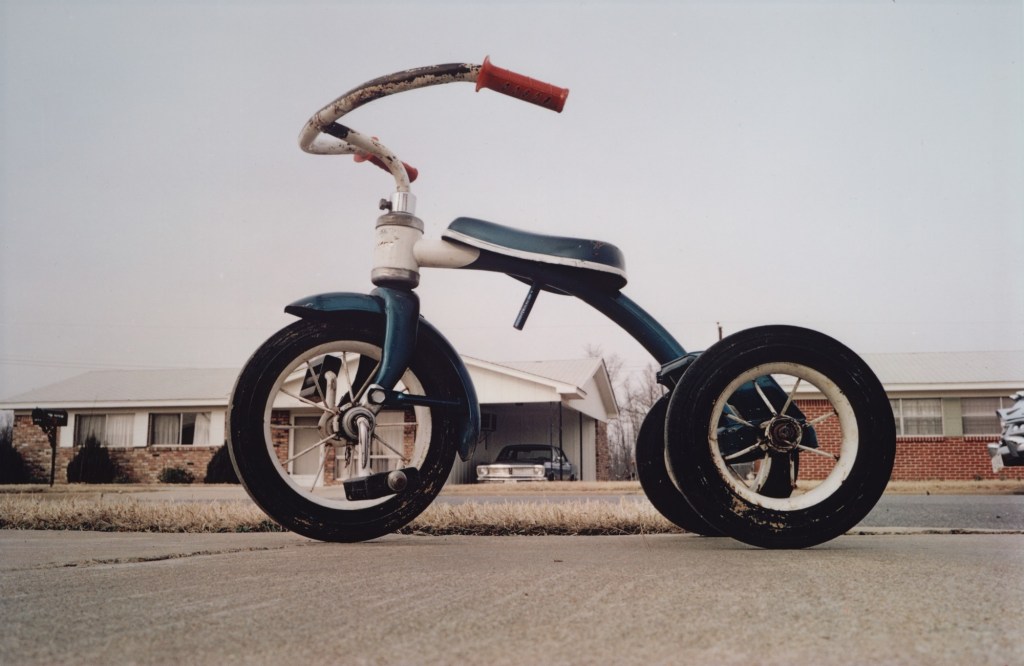
Memphis, 1969 by William Eggleston [2]

Here, the child’s tricycle looks like it has seen better days and is apparently abandoned at the side of an ordinary-looking street. In an interview with the Whitney Museum [3], Eggleston refers to his walking around an ordinary neighbourhood in Memphis without any particular purpose. While sitting on the curb, he noticed the tricycle close by. His photograph puts the viewer at the same level as his subject and it dominates the frame. We cannot help but look at the tricycle as if from a child’s perspective. Why was it left there? What happened to the owner? More importantly, the viewer is encouraged to look beyond the dominant subject at the background. The street looks fairly featureless, but the questions about the neighbourhood are instant. What is the place like? Do people litter the streets with stray children’s toys? We know nothing really about the street or its inhabitants, but Eggleston creates his own version of it through an image of an everyday object in the context of its environment. It’s condition and the fact that it is left out on a pavement lets us draw our own conclusions about it, based on our experiences, prejudices and cultural view of the South US. Eggleston claims that he just likes taking pictures of what he sees, but in looking at his work, there is a great deal more to it than that. In his book Election Eve (1977), he shoots a series of pictures that refer to traces of the subject alluded to by the title, but in reality it’s more about small town American life away from the hysteria of the election. In most cases the images show only traces of the people in the town, with those where we can see them are composed in a way that doesn’t distract the viewer to the other elements in the frame.
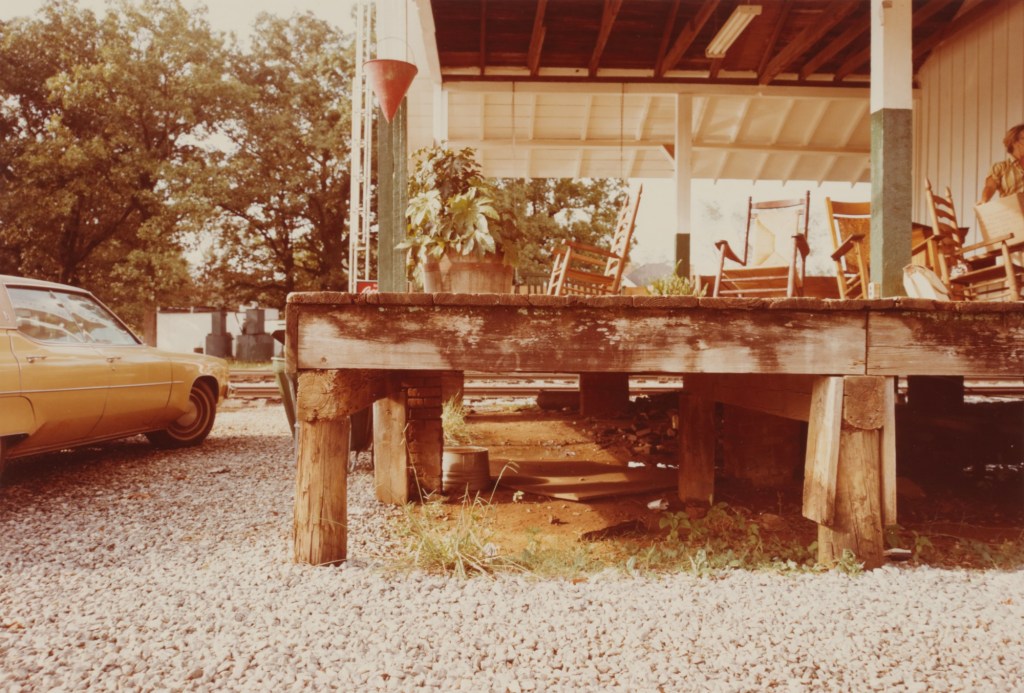
Untitled from the book Election Eve (1977) by William Eggleston [3]

In this image, Eggleston creates a sense of rural America through his use of colour and tone. The use of colour is something that Eggleston is famous for as one of the pioneers of its use when high art was still firmly in black and white. Here, the rich brown tones of the porch and the car are made vivid by the film and the light in the scene. The mood that Eggleston creates is a clash with the urban aesthetic that we would naturally associate with Washington, where the presidential election was taking place. The image, and indeed the series, suggest a ‘meanwhile, away from the noise’ response to the events. Eggleston includes traces of people in this frame (the car, the deckchairs on the porch etc) and also someone on the very edge of the frame. By leaving the woman half in the composition, Eggleston gives the sense that the people of this rural area are somehow unimportant.

“On the eve of the election, when nothing had yet been decided, when everything–whatever that everything was–hung in the balance, Eggleston made an elegy…a statement of perfect calm. To say, however, that these photographs are romantic, sorrowful and quiet is not to imply that they are easy or in any sense comforting. They are richer and more sensual in some ways than Eggleston’s other work, but they are not less penetrating or unsettling. In them Eggleston seems bent, as always, on recording those unremarked units of spatial perception by which the everyday world is unconsciously ordered”

Lloyd Fonvielle writing in the introduction to Election Eve (1976)[4]

Richard Wentworth (1947 -)

In his book Making Do and Getting By (1984), Wentworth presents everyday banality in the same way as Eggleston, only here we have traces of people doing the best they can with whatever is available to them. In a humerous way, Wentworth’s series looks like a collection of badly executed DIY repairs, ranging from the hoarding around the base of the lamp post shown in the notes to the use of the hammer to lift a door off the ground. There are a number of layers of narrative in these works, staring with the obvious poking fun at the ineptitude of what cases of ‘making do’ with botched repairs. However, we also see situations created by people who have little choice as in the image below.
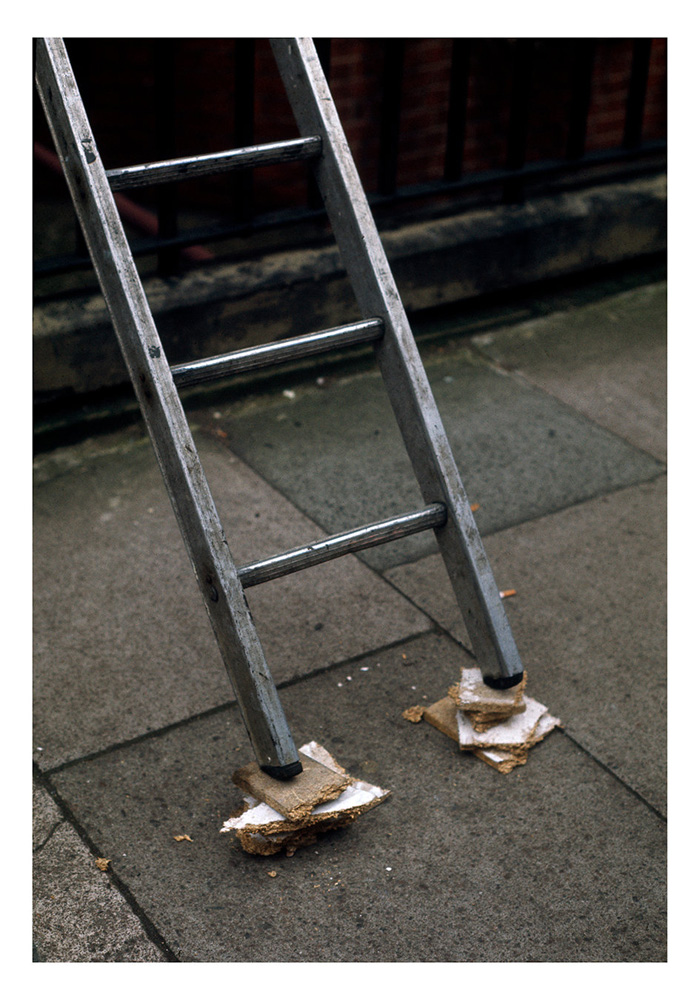
From the book ‘Making Do and Getting By’ (1984) by Richard Wentworth[5]

In this picture we see a ladder precariously balanced on blocks of chipboard. Aside from the perceived stupidity of the arrangement which looks dangerous, we also wonder how the operator concluded that this was the right way to go. Did they have no other alternative or is this the reality of working in the city vs. the countryside? We cannot see the operator and don’t know if they used this setup or not. The picture asks questions of us as a resourceful species, the societal aspects of what is acceptable risk and of the person taking that risk, despite there being nobody in the photograph. In addition to these interpretations, the image is a 2D representation of what could be a modern art sculpture. In the banality of the composition, Wentworth creates a simple but challenging narrative that combines the serious with the satirical. Like Eggleston, Wentworth takes his time to observer, citing the artist’s responsibility is to be vigilant [6]. In looking for the things that we might not notice in the chaos of daily life, both artists create a commentary on an aspect of society that we are all familiar with, even if we are not within it.

Elliott Wilcox (1987 -)

In Wilcox’s work we have much more abstract traces of human life. Both series are shot with tight fields of view which result in shots that ask questions about the subject itself. In Courts his shots of a Real Tennis court, a game popularised in the Tudor era, offer the viewer a perspective on a space that has a vintage feel to it.
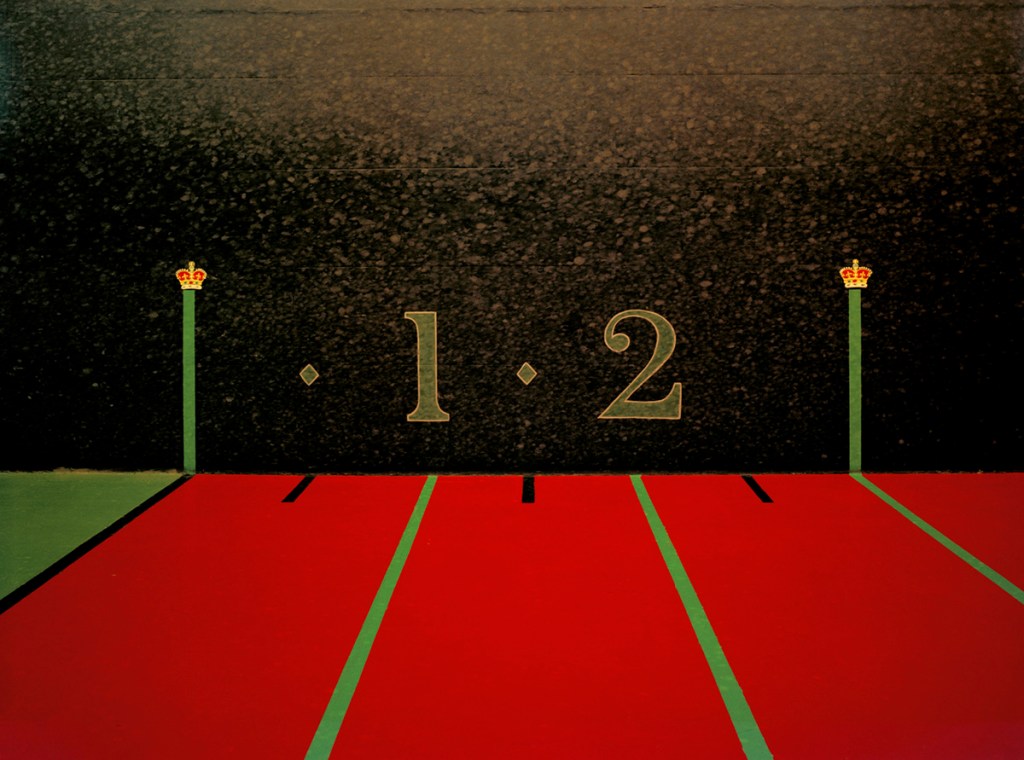
From the series ‘Courts’ (2008), by Elliott Wilcox[7]

The inclusion of crowns painted on the walls suggest that something important or upper class takes place on the court, which in turn sets the space into a societal context. When we look more closely, we see the marks left by the tennis balls striking the once-pristine paintwork. In other images, there are cracks in the surface which future emphasis the sense of intensity in the sport. This points to the passage of time and the vast number of people who have competed in this space. We get sense of the activity and the people taking part without them needed to be there. The notes refer to his other work ‘Walls’, which takes the same approach with a variety of climbing walls. the tight compositions accentuate the minute traces of people left on the walls, but the subjects themselves are often obscure to the point of becoming abstract.

Sarah Pickering (1972 – )

We’ve encountered Sarah Pieckering’s Public Order series in a previous unit[8]. Her bleak architectural landscape shots of a fake town that is used to train police officers in public disorder management are strange but familiar. At the time, I associated the work with the familiar aesthetic of the area where my wife grew up in industrial West Yorkshire. I was considering Pickering’s use of the space, texture and implied dereliction of an urban area, but when I think about it now, I re-evaluate what I brought to that original interpretation. If I were to walk around the area that I am familiar with, I would see the features of the environment in the context of the people who live there, which would in fact tell a story about everyday life. That everyday life would include not only the physical decline, but also the changes in cultural influence. I would be able to see positives and negatives within that area’s identity. When I look at Pickering’s work, however, there is no reference to actual people. We are presented with a visual where we create our own population that might inhabit it. That creation is based in ‘fact’, i.e. what we bring to the reading of the image, but also has a fantastical element to it.

With her other work Incident (2008), I am instantly reminded of the work of mid-20th Century crime photographer Weegee, who for many years turned to crime scenes with his large format press camera to shoot the immediate aftermath of a heinous crime. In those images, the scene was often ‘managed’ in some way by the police presence, which leaves the viewer wondering with many questions about what had just occurred.

Untitled by Weegee (1941)[9]

In this image, we see a police officer and another man looking at a covered body on what looks like a pier. The actual story is of a stampede that killed the woman lying on the ground and we see on further inspection that the wasn’t the only one. However, without the knowledge of the story, we are left with questions about the victims, whether they were linked to each other in any way as well as the obvious ‘what happened here?’ Weegee included enough to suggest documentary, but left enough room for the viewer to make up their own story that fitted the elements in the frame.

From the series ‘Incident (2008)’, but Sarah Pickering[9]

With this image we see a collection of burnt out white goods. At first the damage points to our inner fear of a fire breaking out in our homes, but on closer inspection the items don’t appear to be severely damaged. The soot that covers their surface came from another part of the building, which leaves us wondering about what happened. The domestic nature of the image suggests, but doesn’t specifically include people as with the other artists here. We recognise the machines as part of our daily lives which are now in some way unavailable to the owner. As well as the big questions of whether the people managed to survive the fire, we are also wondering how their lives will need to be rebuilt, starting with these appliances that they/we depend on daily. Of course, the series isn’t about any real people, instead being a training exercise for firefighters. By including familiar objects and linking them with our primeval fear of fire, Pickering creates an anxiety where we hope that our imaginary occupants made it out alive.

Conclusion

The artists in this project have succeeded in making work about people, whether real or imaginary, without any being present in the images. By using subjects that point to some event or activity that people might participate in, the viewer is given a sense of who the absent person might be. However, in leaving the space to create our own impressions the artists make the work more about how we imagine life to be rather than limiting the reading to our own experiences. As Szarkowski pointed out in his introduction to Eggleston’s work, the idea of the picture being more than just an assumed reflection on real life means that there is a great deal more to connect with when we view it. When this happens, the apparent banality of the subject is in fact the art, rather than a statement of fact. For me, the suggestion of identity though the use of traces gives a freedom to the work for which there is no right or wrong interpretation.

References

[1] Fletcher R, 2021, “5) Exercise 1: Personal Reflection”, OCA Blog Post, https://richardfletcherphotography.photo.blog/2021/11/16/5-research-task-personal-reflection/

[2] Eggleston W, 1969, “Memphis”, Image Resource, MoMA, https://www.moma.org/collection/works/51630

[3] Sothebys, 2021, “Election Eve: 50 Masterworks to celebrate 50 Years of Sotheby’s Photographs”, Image Resource, https://www.sothebys.com/en/buy/auction/2021/50-masterworks-to-celebrate-50-years-of-sothebys-photographs-2/election-eve

[4] Editorial, 2010, “William Eggleston: Preface from Election Eve (1977)”, American Suburb X, https://americansuburbx.com/2010/09/william-eggleston-preface-from-election.html

[5] Unknown, 2019, “Richard Wentworth”, Exhibition Catalogue, XIBIT Magazine, https://www.xibtmagazine.com/en/events/richard-wentworth/

[6] Phaidon, 2015, “Akademie X:Richard Wentworth”, Youtube, https://www.youtube.com/watch?v=0jsivEAXRwg

[7]Unknown, 2021, “Elliott Wilcox – Crane Kalman Brighton, Gallery Brochure, https://cranekalmanbrighton.com/artists/elliott-wilcox-biography/

[8] Fletcher R, 2020, “Exercise 3: Public Order”. OCA Blog Post, https://richardfletcherphotography.photo.blog/2020/05/12/exercise-3-public-order/

[9] Unknown, 2012, “Shot Dead: Weegee’s murder photographs go on show – in pictures”, The Guardian. https://www.theguardian.com/artanddesign/gallery/2012/jan/19/weegee-murder-photographs-pictures-new-york

[10] Pickering S, 2008, “Incident”, Image Resource, Artist Website, https://www.sarahpickering.co.uk/works/incident/
5) Research Task: Personal Reflection

  • Where does that leave the photographer? As storyteller or history writer?
  • Do you tend towards fact or fiction?
  • How could you blend your approach?
  • Where is your departure from wanting/needing to depict reality

Make some notes on these questions in your learning log.

Introduction

We are introduced to the work of William Eggleston [1], who photographed scenes and objects that were connected with the presence of people rather than making them the subject. By excluding the people from the picture, the viewer must use their imagination to interpret what they are looking at. The notes make the point that imagination plays a key role in building a story, which in the case of Eggleston’s pictures has to do so with the must subtle of contextual signifiers. The point is also made that when children play with a generic doll, their imagination takes the basic construct and builds a personality and story for it in their play. Back in Expressing Your Vision, I wrote about a piece of research carried out by NASA[2] that involved a creativity experiment with a test group of young children. The study covered their growth and development over some 15 years or so charting their creativity as they got older. The basic premise was that as we grow and learn about the ideas, constructs and rules in the world, we become more reasoned and methodical which results in our creativity being diminished. The percentage of ‘genius’ level children dropped exponentially within the first couple of years of the experiment, becoming next to zero before the group reached their teen years. My experiences at the time of writing that paper were that the only way I could regain some idea of creativity as to revert to a childlike state in the way I see the world. When I look at the artists who use traces of people within a space or related to an object or scenario, I have that same feeling of wondering about the possibilities for meaning in the work. In my submission for Assignment 4[3], I deliberately left real people out of the images because I wanted the impact on the town to be the more obvious narrative than the suffering of its inhabitants. Facsimiles of people appear in a few of the shots, which created a sense of ‘being there but not being there’. I see the same feelings around the absenteeism of the works in Project 1.

Where does that leave the photographer? As storyteller or history writer?

With this concept, the photographer transitions from being someone who observes events unfolding and documents reality, to someone who imagines what the scene might relate to. As we have learned previously, photography has always been a powerful way of documenting as the idea the majority of people still believe that the camera merely copies what is presented to it. We know from the documentary artists of the early 20th Century that this isn’t the case. Their attention to particular subjects, the editing and often censoring of images to suit a narrative, means that they could be seen as both honest and deceitful in equal measure. If a photographer chooses to shoot something where what is missing from the frame isn’t factually important, I see that as a move to conceptual art. We’ve seen plenty of conceptual artists who use photography as their medium, e.g. Duane Michals, but their work still revolves around a real subject. The difference here is that the narrative directed or controlled with the same precision. Any idea of story or documentary is largely the responsibility of the viewer, whose idea may be vastly different from the original intent of the artist. The notes point out the difference between knowing something about the subject (having been to Memphis) or being shown a version of it (Eggleston’s view). I think that this is another power that this style of photography has; to tease a real place or situation, while creating a reality that is entirely their perspective on it. This is more powerful when there are no real actors in the scene.

Do you tend towards fact or fiction?

When I review the work I’ve done so far, I tend towards fact. Again, I think that this is more about photography, in particular the camera, being a recorder of either something real or something I’ve observed about something real. In this module, I have learned about guiding a particular narrative by using portraiture and environment. In my approaches to the assignments, I’ve tended to look for a story behind someone’s life or to reveal something real about their personality. In Assignment 1, I got to know complete strangers (some of whom I still talk to on my morning walks), while in Assignment 2 it was more about revealing something about eccentricity. Assignment 3 was a personal reflection on my life in the context of music technology. In Assignment 4 I was trying represent the contrast in mood between the experiences of my community and government rhetoric. In each case, I was looking for facts to exploit.

How could you blend your approach?

At the end of Assignment 3, I felt that it was time to consider how to blend styles. My idea for Assignment 4 is inspired by the work of former OCA student Michael Colvin’s series Rubber Flapper. I was struck by how he had been inspired by something real in both history and his own life. Instead of digging deeper into the story of the lady who lived in the self-cleaning house, he elected to make up his own story. The anchoring of some of the plot of his story in actual events, e.g. the relationship between Alice Austen and Gertrude Tate) and his views of the acceptance of people’s sexuality from a gay man’s perspective, really add weight to the series. I was particularly drawn to how realistic the series was, with an entirely believable narrative that I found myself Googling to see if any of it was real. I think that my own idea for Assignment 4 will pick up on some of Colvin’s approach, blending real and imaginary in a way where it’s hard to tell the difference. This is probably where I am with my photography than more abstract conceptual art.

Where is your departure from wanting/needing to depict reality

My idea for Assignment 5 is to retell a classic ghost story that has become an urban legend[4]. The original story (or at least one of the many versions) involves a man picking up a female hitchhiker late at night and driving her home. During the drive, the man gives her his coat to keep her warm. Only when he drives away from dropping her off does he realise that she still has his coat on. He drives back to the house that he dropped her off at the following morning only to learn from the grieving owner that the girl was her deceased daughter. She tells the man where the girl is buried and when he visits her grave, he finds his coat neatly folded on the gravestone. I’ve loved this story for most of my life as I remember my friends telling each other when we were young, swearing an oath that it was completely true. My series is going to retell the story in a contemporary setting and will blend the fiction of the narrative taking real-world experiences as cues for the shots.

In taking this approach for the final assignment of this unit, I am looking to push myself away from my default position of representing reality. The reason is simply to try something different.

References

[1] OCA, Unknown Date, “Part Five:Removing the Figure”, page 110, Identity and Place Course Notes.

[2] Fletcher R, 2019, “The Creativity of Children”, OCA Blog Post, https://richardfletcherphotography.photo.blog/2019/11/01/the-creativity-of-children/

[3] Fletcher R, 2021, “Assignment 4: Image and Text”, OCA Blog Post, https://richardfletcherphotography.photo.blog/2021/11/06/__trashed/

[4] D’Costa K, 2013, “Why is American Folklore Overrun with Phantom Hitchhikers?, Blog Post, Scientific America, https://blogs.scientificamerican.com/anthropology-in-practice/why-is-american-folklore-overrun-with-phantom-hitchhikers/

Post Assignment 5 Feedback

Introduction

I have just received the feedback from my tutor for Assignment 5: Making it Up. Overall, the assignment was very well received, with the comments that my single fabricated image both met the brief and was a well thought out, original piece of work. My approach of gaining the feedback of others was highlighted again as in Assignment 3. I had felt that to be the most effective way of testing whether my intent had come through in the image, even though I had also hoped for variety in the narratives that were being created. The feedback contained two areas for consideration, directed more at the next part of the degree than as changes to my assignment submission. I will explore those points here.

Feedback

“You’ve clearly thought quite deeply about this assignment and have documented your thought process is very well. You may want to however cite another photographer who also work with archival family photography as a way to contextualise the work you’ve done. I’d recommend perhaps here looking at the work of Nicky Bird here perhaps, who also uses archival family photography to think about place class and culture.”

Assignment 5 feedback, January 2021

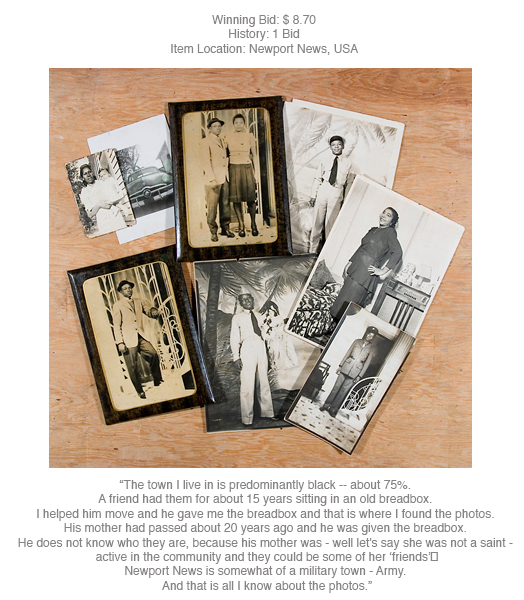
This was interesting feedback for two reasons. The first being that we looked at Nicky Bird’s work Questions for the Seller in Part 5[1] where she purchased collections of photographs that nobody was interested in from eBay. She created an archive of family stories by including the answers to some questions that she posed to the sellers before making the purchases. In some cases, the stories were powerful which invoked the sense of sadness that the photographs were no longer needed, and in others the scant information pointed to the stories being lost. Bird curated the collection as a set of lots that had internal connections of their own but also related to the other groups of photographs in the overall archive. Eventually, Bird sold the photographs in an auction of her own at the gallery where they were being displayed. Her creation of a transient archive being broken up and passed on to the next generation of people who might appreciate the images, struck a chord with me. Historical stories are built from knowledge of events and added to as they continue to be told, but we are merely playing a part in them for a brief moment in time. The reference to Bird in the feedback made me think about the image that I had created and how it is essentially my own version of Jayne’s family history, that could be included in a family archive. I hadn’t previously made the link between the documentary nature of the pictures of her grandfather and father and my version of reality in Sanctum. If they were all stored together as part of an archive, anyone looking at them many years from now might miss the fact that the later image isn’t ‘true’. Therefore, for a brief moment, I have essentially subverted Jayne’s family history by creating a work that steers the viewer towards a certain tale of her grief and love for these two men. We’re not talking about chaos theory here, though; the ‘truth’ that my story tells isn’t that far from reality, it’s just another way of looking at grandfathers, fathers and daughters.

The second reason that this feedback interested me is because of my own situation described in my post reflecting on Photography 1 so far [2]. I have recently left my job as an Engineering Manager to pursue other interests aligned with my studies. One of the tasks that I’ve set myself in the coming year is to curate an archive from the thousands of photographs and slides that I was given by my father a few years ago. My work on Context and Narrative this year has led me to reconsider how I would approach this task. Instead of simply creating a volume that can be accessed by my family for their own purposes, I intend to tell the story of my family through it. I intend to take the work of Bird as well as Bloomberg & Chanarin[3] as inspiration for my archive in order to create my own original work from what is essentially box-loads of disparate images. I will be including this project later in blog when complete.

|”What I would recommend is thinking about this: for your image to work most successfully, I think it should in some way be accompanied by the two archival images that inform it – as it’s these three images together that create the enduring message about repetition memory family inheritance and belonging. Somehow these three images must be brought together to tell this one story. It did occur to me looking at your original image of your wife (in other words the image that you choose to make your shooting notes on – the image of her shot in daylight in the greenhouse) that if you’d printed this image out and then nested it into a clear folder with the other two photographs – a series of three found images photographed together would also made for a very successful piece of work.”

Assignment 5 feedback, January 2021

This comment interested me because of how the sight of the two original images together had made me feel when I found them [4]. Bryan had clearly seen the connection between the photograph of his father and the one that he had taken in his greenhouse. The result was to keep them together in an album that would go unseen for several years until I went through it, looking for inspiration. The idea of incorporating them together with this memory and realisation about the album’s hidden history gave me an idea for further version.

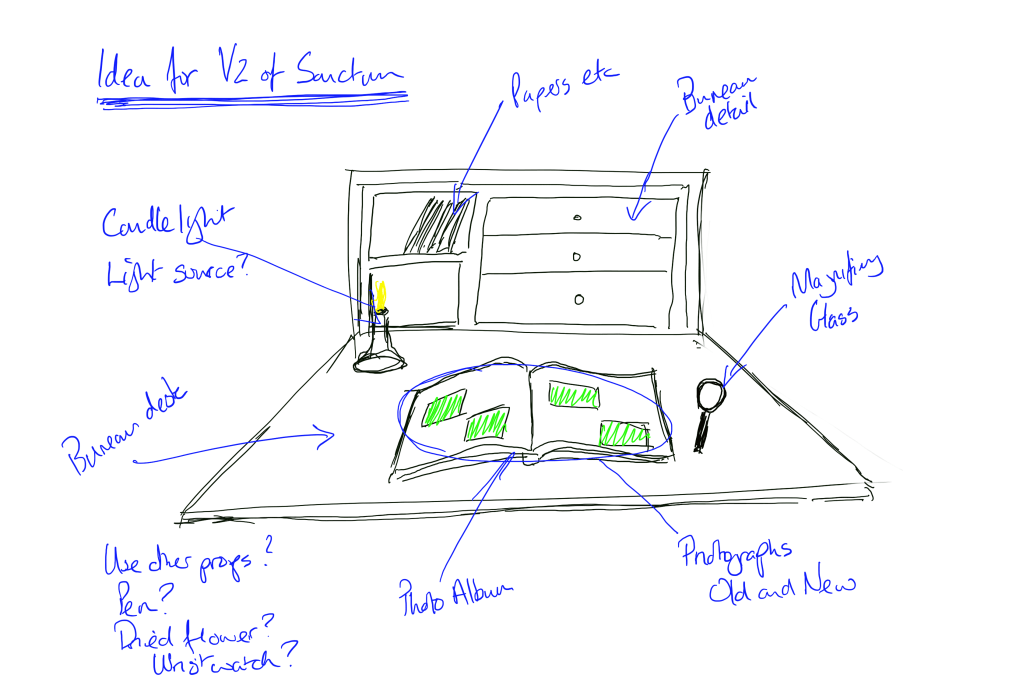
Jayne’s parents house has a number of classical pieces of furniture, some of which were made by her father (a woodwork craftsman and teacher by profession). One of the pieces is a large bureau where he kept all of his important documents and stationery. During the time that I knew Bryan, he kept the bureau private and rarely, if ever left it open long enough to see what was inside.

In this scene, the photographs that I found are included with the shots that I took for Assignment 5 in a vintage photo album. The album is set in its own fabricated image using the bureau as the set. The intent is to tell the story of the discovery of the photographs in the context of a family archive, with the new image Sanctum being part of the archive. Effectively this would add a layer of fabrication with the juxtaposition of new and old within a further constructed narrative.

Conclusion

I was delighted that my Assignment 5 submission was so well received. I pointed out on the call that I had enjoyed the creative process immensely as it gave me an escape from the difficulties I was experiencing at work at that time. The role of director was fun, with everything from the challenges of dressing the set with only what I wanted to include, to keeping the rain off my studio strobes during the setup. I was pleased with the feedback that has pushed my thinking around family stories and believable fabricated images still further; this has been the most interesting assignment of the course so far.

References

[1] Fletcher R, 2020, “5) Exercise 2: Re-situated Art”, OCA Blog Post, https://richardfletcherphotography.photo.blog/2020/12/20/5-exercise-2-re-situated-art/

[2] Fletcher R, 2020, “Reflecting on Photography 1 – how things have changed so far”, OCA Blog Post, https://richardfletcherphotography.photo.blog/2020/12/27/reflecting-on-photography-1-how-things-have-changed-so-far/

[3] Fletcher R, 2020, “Project 2: The Archive”, OCA Blog Post, https://richardfletcherphotography.photo.blog/2020/12/20/project-2-the-archive/

[4] Fletcher R, 2020, “Assignment 5: Making it Up”, OCA Blog Post, https://richardfletcherphotography.photo.blog/2020/12/24/assignment-5-making-it-up/

Reflecting on Photography 1 – how things have changed so far

Two Units Down Already?

As I write this post, it is Christmas 2020 which is the culmination of a tumultuous year for sure. I’ve just submitted Assignment 5 of Context and Narrative to my tutor for review and am now getting on with tidying my coursework ahead of assessment in March. It is during this final phase of the course unit that I find myself reflecting on my OCA experience so far, having nearly completed the first two units of Level 1. How has this course, and EYV before it, changed me as both a person and as a photographer?

The first thing I have noticed is how my perspective on creativity has changed. Prior to enrolling on the course, I would say that I had always had a vivid imagination. My earliest memories of childhood involved imagining stories based on whatever was happening around me. The outlet for these stories was of course school and in particular the creative writing part of our English lessons. As I grew older though, I developed much more of an interest in understanding how things worked, which usually meant taking them apart and not always being able to put them back together. My interest became studies in Engineering and a career followed for the next 30 years. When I started studying with the OCA, my engineering brain was completely confused by the concepts in the first unit. It was hard to switch off wanting to understand how a photograph was made and instead focusing on the ‘why’ – I struggled with some of the exercises where we had to practice thinking about what we wanted to say with our photographs. I initially focused much more on the technique and composition than developing my voice, but as the unit progressed I found myself thinking about what I wanted to say and worrying less if I had ‘got it right’ in the eyes of my tutors. My final assignment in EYV [1] was a very personal story of my recovery from depression, which was not only challenging because of the subject matter, but also because the initial assessment of the work by my tutor highlighted some key concerns about my reliance on the technical aspects of photograph. I learned at that point that this wasn’t a failure, but an opportunity to revisit the series and make it stronger. The re-shoot of 3 of the 10 images certainly achieved this, which made the series something I am immensely proud of.

In C&N, the concept of storytelling was where I started to find my creative side winning the battle against my logical side. Using photography to tell linear and non-linear stories was new to me, but I found the way the artists developed their ideas to be fascinating. I particularly connected with the artists who used theirselves either as a canvass for the story or as an observer or commentator on a social or cultural issue. The works of Morrissey, Brotherus and Lee were all instigators of perhaps my biggest departure from my comfort zone; to use myself as the subject of my series for Assignment 3[2]. As the unit progressed, I started to learn about the artists who had told a story through creating something fictitious that appeared to be real. Wall, diCorcia and Crewdson’s influence on my Assignment 5[3] submissions is obvious – with these approaches to storytelling, I was able to reconnect with that imagination I once had as a child.

The second thing I noticed about my progress through EYV and C&N was the way that my passion for photography had changed. Prior to study, I would regularly go looking for beautiful landscapes to photograph and stand in a field for hours trying to get a technically perfect representation of them. This meant looking for the best times of day to shoot, the best weather conditions etc and it often meant driving for long periods of time to be there when these elements coincided. If I happened to be using on my my vast collection of film cameras, the experience included preparation and processing (which I do myself) to add to the experience that I really enjoyed. Now, I find myself less interested in that type of photography. I have since learned that perfect exposure, perfect sharpness and classical rule-following composition don’t necessarily make a good photograph. If they are present but there is no artistic voice or story being told, the image is simply a document of what was in front of the camera. I’ve learned in C&N how even the seemingly simple act of documentary photography has a voice or bias associated with it; photography is in fact subjective rather than objective and in some cases dishonest. More than this, my interest in traditional landscape had diminished along with the idea of just shooting things. For C&N Assignment 2, I shot a series of images of disused and open spaces to represent the emotions of someone reacting to trauma. The series was said to be good but with lots of room for improvement, which got me thinking about documenting how these landscapes change with time as well as events in society or culture. Like David Hockney’s paintings of the same Yorkshire scenes throughout the seasons, I started to find myself walking the same routes with a camera and looking at how shops, buildings, green spaces changed over time. In some cases during 2020 that has been something enforced rather than by choice as the COVID-19 pandemic took hold of the country; government-sanctioned exercise periods restricted where I could travel with my camera. However I the limitations also introduced me to artists like Michelle Sank [4] who had adapted to the pandemic lockdown by incorporating it into her work. As someone at higher risk from COVID-19, she had to isolate from people so her series Portraits from a Distance told the story of others in a similar position to her. The images were paired as diptychs with the subject and their environment to add context to their situation, which I found interesting and very moving. With regard to shooting things for the sake of it, I discovered that I had lost interest in wildlife photography, something that I have practiced before only in an effort to get better at the technical aspects. A group of my friends are keen wildlife photographers and we have unsuccessfully attempted to meet up in 2020 to shoot wildlife at a number of nature reserves. It became clear to me as the year progressed, that I wanted to spend time with them much more than I wanted to shoot the animals. While still enjoyable, it marked a major shift in my passion for photography. Instead I am thinking about series of work around stories and life events that surround me. How can I make images that tell the story without it being so severely signposted to a meaning that the viewer loses interest? How might I use myself to convey the observer of play a part in something that might be affecting me in some way? How can I document something in a way that is more Robert Frank than my albums of holiday snaps?

The Future

At the time of writing, I am preparing for my engineering career to come to an end following being made redundant because of the pandemic. I made the decision to leave and focus on my studies because the opportunity to learn more about being an artist excites me. My longer term plan is to teach photography, first as a technical discipline for people just starting out with a camera and later as an art form once my OCA studies are complete. One of the things that I want to achieve to progress to the first goal is Associate of the Royal Photographic Society or ARPS. When I looked at the requirements for this accreditation level, I was surprised to see that storytelling through a series of images was at the heart of the assessment criteria for one of its genres [5]. I intend to take what I’ve learned in Context and Narrative and try to apply it to a panel for ARPS. This level of confidence and lack of fear of failure is all to do with studying Photography 1 as prior to this past 2 years, I would have been reluctant to try without being sure of ‘getting the right answer’.

Onwards to Identity & Place, which is the final part of Level 1 of the degree. Having read the sample from the OCA website, I’m confident that it will be every bit as challenging and interesting as what I’ve completed so far.

References

[1] Fletcher R, 2019, “Assignment 5: Photography is Simple”, OCA Blog Post, https://richardfletcherphotography.photo.blog/2019/05/31/assignment-5-photography-is-simple/

[2] Fletcher R, 2020, “Assignment 3: Self Portraiture, OCA Blog Post, https://richardfletcherphotography.photo.blog/2020/09/19/assignment-3-self-portraiture/

[3] Fletcher R, 2020, “Assignment 5: Making it Up”, OCA Blog Post, https://richardfletcherphotography.photo.blog/2020/12/24/assignment-5-making-it-up/

[4] Fletcher R, 2020, “Preparing for Assignment 2”, OCA Blog Post, https://richardfletcherphotography.photo.blog/2020/07/10/preparing-for-assignment-2/

[5] The Royal Photographic Society, 2020, “Associate (ARPS), https://rps.org/qualifications/arps/

Assignment 5: Making it up

The Brief

Construct a stand-alone image of your choice. Alternatively, you may choose to make a series, elaborating on the same theme.

As the culminating assignment for the course you may wish to draw upon skills learned from Parts One to Four – using various forms of narrative, using yourself as subject matter, telling stories and reading images. The only stipulation is that you produce work that has been controlled and directed by you for a specific purpose. Remember to create a story with a specific context like the artists you’ve looked at in Part Five. This means that you need to have an artistic intention, so a good place to start would be to write down some ideas. This could then be form the basis of the 300-introduction to the proceed. You may find it helpful to draw storyboards to help you visualise your ideas. 

The aim of this assignment is to use props, costumes, models, location, lighting etc. to contribute to the overall meaning of the image (Use flash/lights if required but available light is fine as long as it is considered)

If the narrative is set in a different era then the elements fo the image must reflect this. Also consider the symbolic meanings of the objects and try not to be too literal in your approach. For example, don’t automatically use red shoes in a love scent but try to be subtle in your ideas to obtain a more true-to-life scenario.

For this final assignment, you should also include an illustrated evaluation of the process you went through to produce your final image(s). Include snapshots of setting up the work and write about how you felt your direction went, how you found the location, props etc. How did this process affect the final outcome? Write around 1000 words (including your 300-word introduction).

Introduction

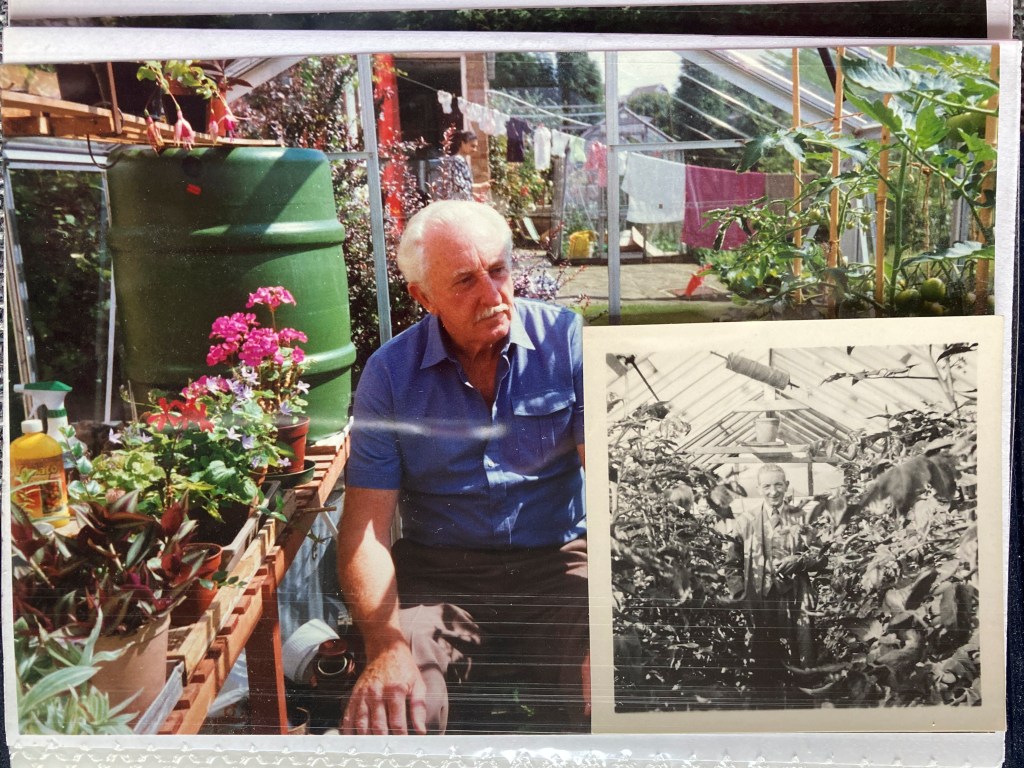
For this assignment, I wanted to tell a story in a single picture in a way inspired by the works of Jeff Wall, Gregory Crewdson and Philip-lorca diCorcia. My initial idea was to tell a story about my wife and her family which in recent years was just her and her parents. I started by looking through the family photograph albums for inspiration; the first thoughts were about Jayne and her father, whose relationship had been close but difficult during her teenage years. Although there was a strong physical likeness and shared traits such as their sense of humour, they had different goals in life and different interests. During the search through the albums, I discovered the following pair of photographs stored as a pair in the same sleeve.

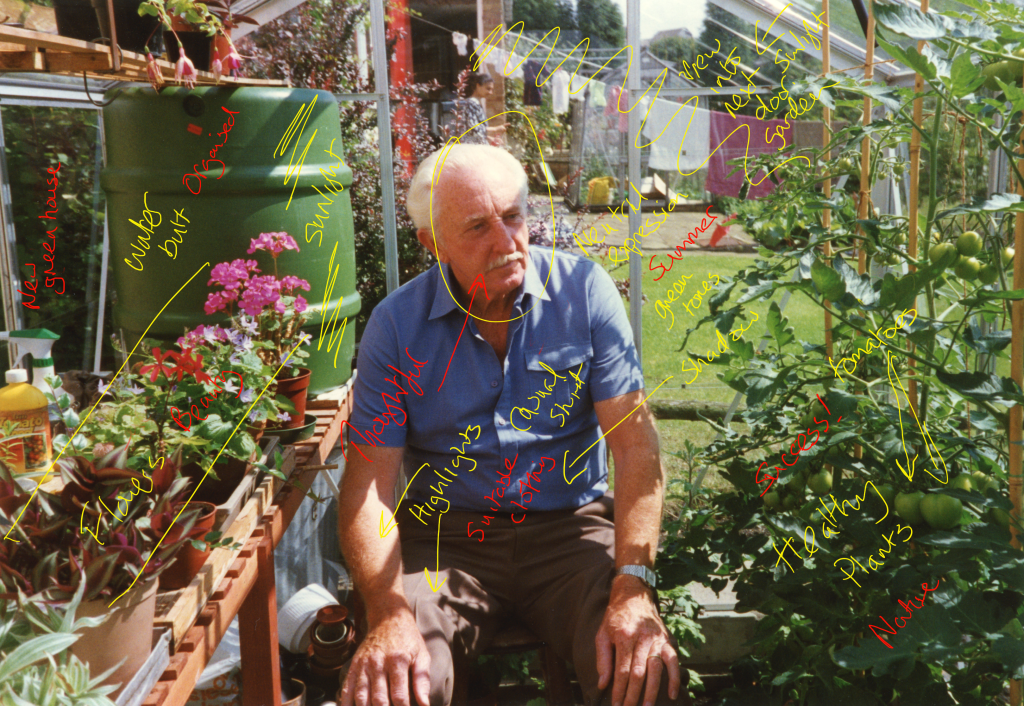
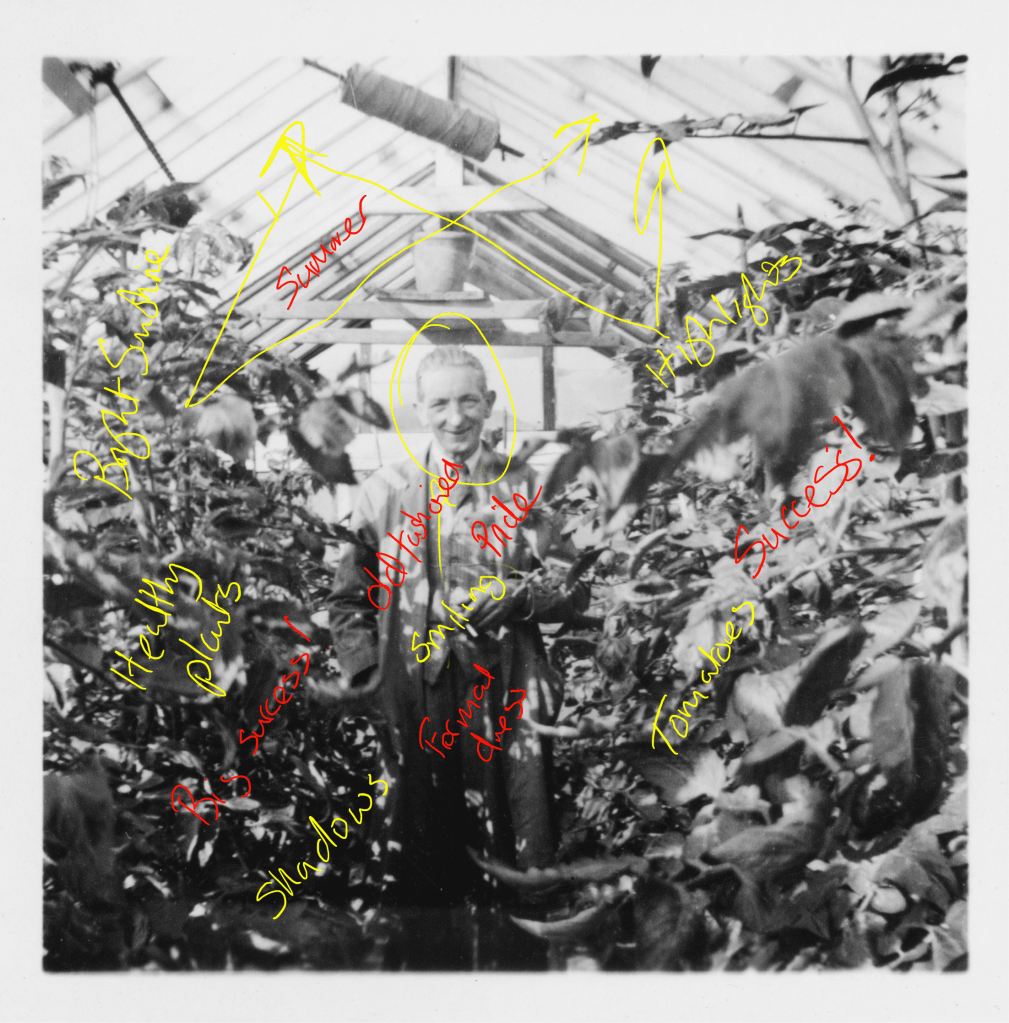
Main image: Jayne’s father Bryan in his greenhouse (c1990s). Inset: Jayne’s grandfather Johnny in his greenhouse (date Unknown)

These photos depicted Jayne’s father and grandfather, both keen gardeners in their retirement, in their greenhouses. Both men are shown surrounded by the fruits of their labours and both have a sense of pride about their expression. The way that they were stored in the album interested me as perhaps Bryan had recognised this similarity when he put them together. It was when I realised that Bryan’s greenhouse was still in the garden, albeit in a state of decay that I had the idea to use it as a set with Jayne as the central focus of the shot. My idea was framed around the idea that the tradition of gardening had passed between generations and that it had ended with Jayne (who has little or no interest in gardening). I planned too recreate the image of Bryan in a way that highlighted their likeness but also this difference in the direction of their lives. I started to storyboard my original intention in a blog post called “Preparing for Assignment 5″[1]. However, during a brief discussion with my tutor during a feedback session for Assignment 4, I was encouraged to sharpen up the story as it felt a little too vague to be told in a single photograph.

The Story

In re-examining my idea, I asked myself what it was about discovering these two photographs that had interested me and how it made me feel. The answer was that I could imagine Bryan’s reaction to discovering the picture of his father and carefully adding it to one of his own. He was a nostalgic man, so I believed that this gave him a great deal of pleasure as he remembered his Dad. When I realised that we could still go to the greenhouse where the photograph was taken, I had that same feeling of connection and nostalgia. These two reactions were actually more powerful than my original idea to highlight the differences between the two men.

The story was now about grandfathers, fathers and daughters and in particular the strength of the emotion around finding some tangible link with the forgotten past in what is left behind.

The Storyboard

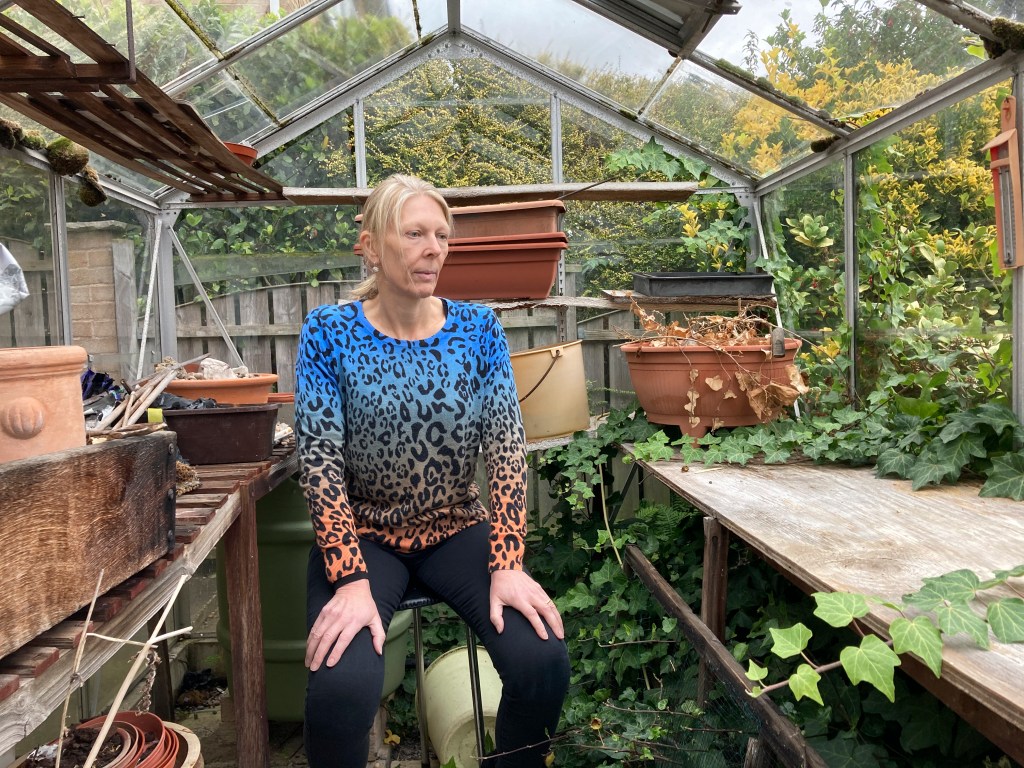
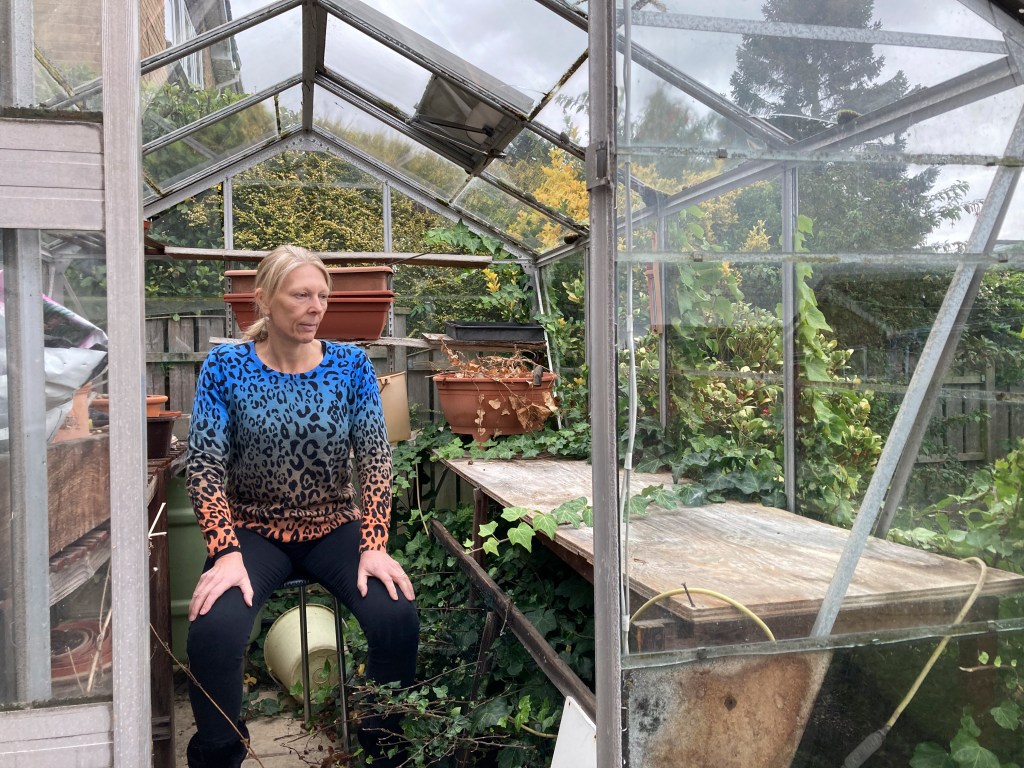
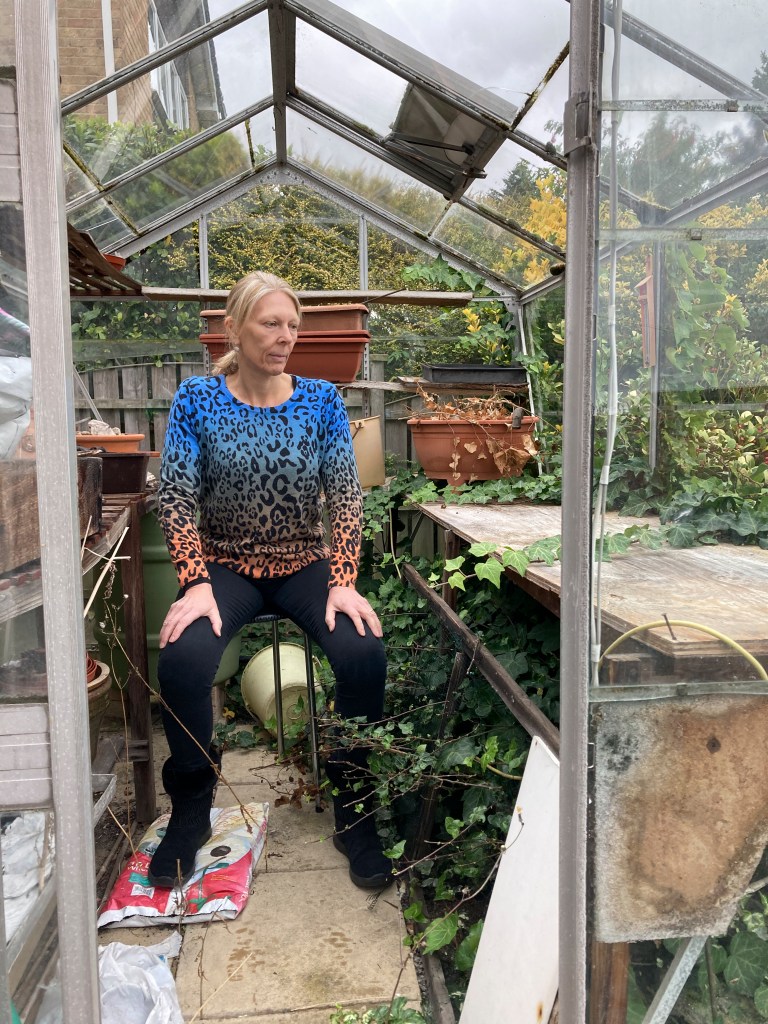
The concept of putting Jayne in the greenhouse was still valid for the revised idea. I wanted to picture her in a similar pose to Bryan but with contextual elements that lent themselves to a different narrative than being a reproduction of the original photograph. I started with one of the test shots I took when I first looked at the location[1]

Storyboard with the first ideas of prop placement, lighting and the model

I needed a way of incorporating the image of Jayne’s father and grandfather into the shot. I considered scattering the picture of her father among other photos from the album on the table on the right hand side of the frame. The picture of her grandfather at only a couple of inches square would be too small to see in any composition, so I thought about projecting it using the same system I used for Assignment 3[2]. The set itself would contain more subtle links to the past through the use of items from the derelict greenhouse. These items includes ceramic pots with gravel but no plants, pots with dead plants in them, rusty tools and rotting bamboo canes. There was also a chalkboard on which Bryan kept notes of his plantings, which could contain some other obscure visual references. For Jayne I wanted her clothing to be utilitarian but not obviously garden wear. The final details would be how she interacted with the space and props. I was going experiment during the shoot to try to capture a sense of affection for her past, sadness at the loss and contemplation of the peace of the space.

Shooting the Photograph

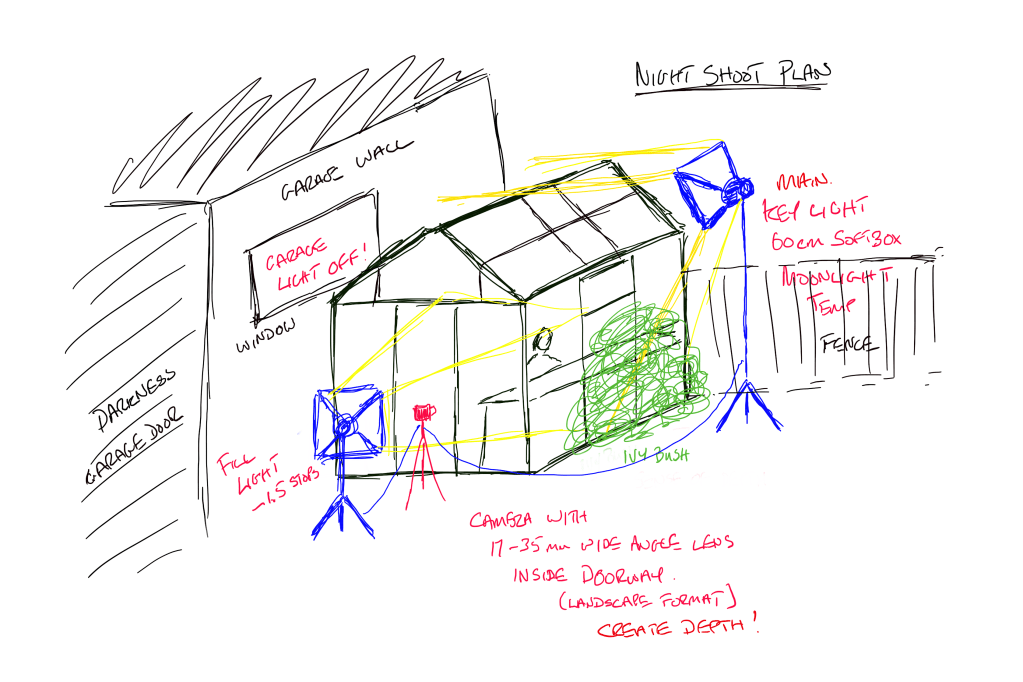
I started by clearing the interior of the greenhouse to leave just the benches and shelving in place. The camera and lighting were set up as in the sketch below.

Shoot sketch showing the lighting arrangement, camera position etc.

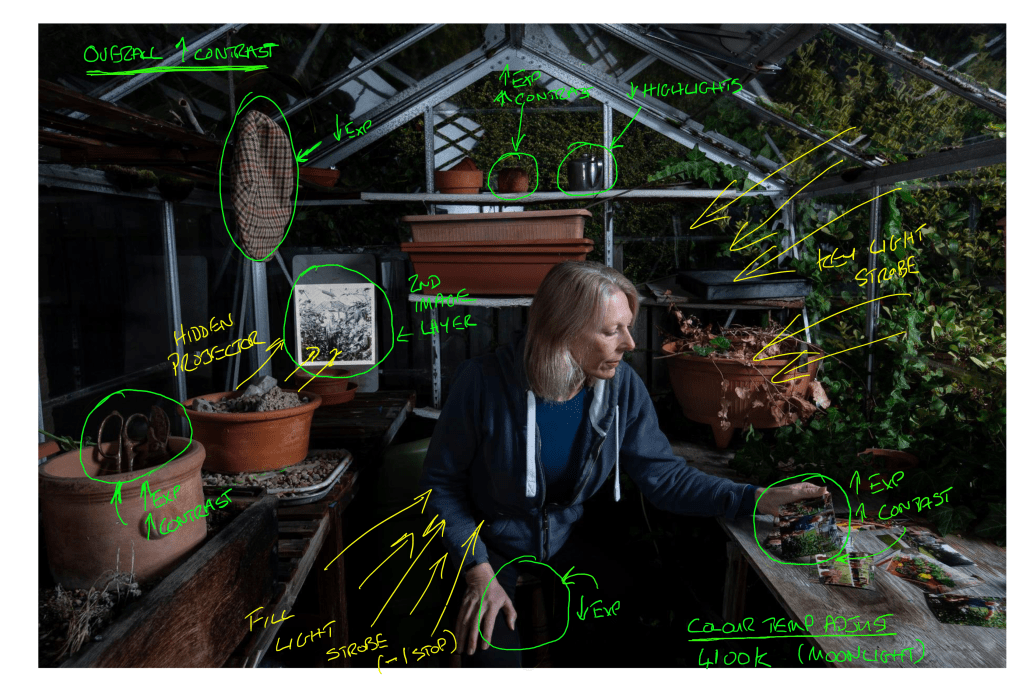
I used studio strobes with 60cm square soft boxes. The key light provided the effect of moonlight streaming through the glass and ivy of the greenhouse and would light Jayne from the front in pose. The fill light was positioned square on to reduce the harsh shadows forming on Jayne and also to light the objects along the left hand side of the space. The camera was fitted with a wide angle lens to create a sense of depth in the scene; the lens aperture was set to f/13 to make as much of the scene’s depth as sharp as possible. Two photographs were taken. The first was with no lights and the projector unit (hidden in the scene behind a plant pot) throwing the picture of Jayne’s grandfather onto the chalkboard at the back of the space. The second shot had no projection but used both strobes to light the rest of the scene. The two images were then blended together in post-processing to create the overall ethereal feel of her grandfather being part of the present day scene.

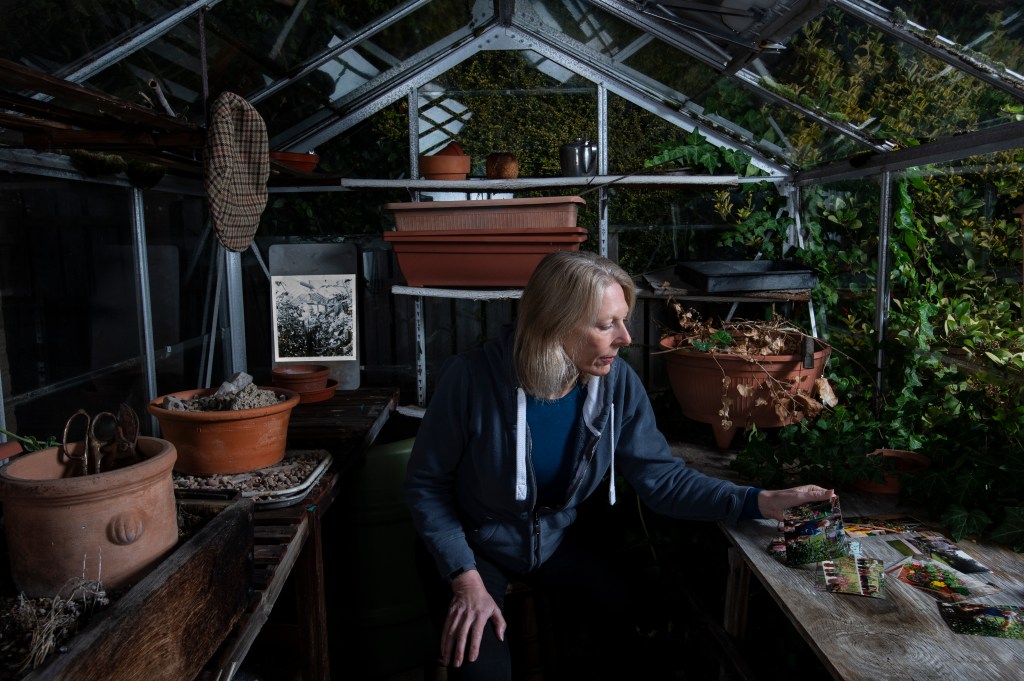
The Photograph: “Sanctum”

Sanctum (2020)

The final processed photograph can be seen above. For the title, I wanted to sum up my intent for the image while not wanting to lead the viewer to a conclusion. I settled on Sanctum because it is defined as “a private place or room where someone is never interrupted”[3]

The post processing done to achieve this final version is shown in the annotations below. Along with the layering of the two shots taken, the white balance was set to replicate moonlight at 4100k and selective edits were made to elements in the frame to increase their impact.

Annotated version showing the edits made in post processing

Reaction and Reflection

As with previous assignments, I decided to share this photograph with a number of my friends to get a feel for the narratives they would naturally create from it. I asked for feedback via social media and had 18 responses from people, some of whom knew Jayne well and some who had never met her. I collated the responses in a separate blog post [4] but the key narrative points are discussed here.

In all of the responses, there was a deep personal connection identified between Jayne, the photograph she is holding and her surroundings. Some saw that it was her father and recognised that the greenhouse was once his. Jayne’s expression and posture were read by many as fondness, sadness and longing, while some saw her as mourning the death of her father despite there not being any clear references to his loss 4 years ago. This was a narrative created by people who didn’t know Jayne or anything about her family, so I assumed the contextual elements of his old cap, the dead plants and neglected greenhouse all served to trigger that response in those viewers. Memory and the desire to revisit somewhere that held special significance also came through in the different narratives with most people seeing this as a special place for Jayne.

I found the reactions to the picture fascinating. In reality, the greenhouse isn’t a particularly relevant place to Jayne (I’m not sure she has been in there for many years, even when her father was alive). The state of the building and it’s contents tell a story on their own of neglect, but putting Jayne in the same place as her father and her grandfather watching on, somehow created the sense that this is a place that joins the three of them together in a way that is very private and intimate. The reaction that interested me the most was the contemplative sense of mourning, which is very real for Jayne in other regards but not in this context. One of my friends told me that the photograph made him cry – he related to the sadness in some way that I didn’t push him to explain, but I guess must be related to his own emotional state in some way. Others who responded also said that they could relate to the strong emotion of the image without that relationship being to do with the subject, elements or composition.

Overall, I am delighted with the way that the image was received by everyone. Far from being a validation of my intent, it signalled that this particular piece of work had the power to provoke some strong emotions in a variety of people. The reactions did work in conjunction with my intent for the picture, which as diCorcia said was the responsibility of the artist; to give enough to help with the viewer’s journey but not complete it. The development and shooting of the picture was a challenging, but rewarding experience for me, the latter being something I was completely comfortable with. Having a good idea for what the picture should look like and experimenting with the props and lighting were key to what I see as the success of the image. I had tried to incorporate elements that highlighted the differences between Jayne and her father, such as references to sport, feminism and professionalism. However, the problem was that even the most subtle elements distracted from my intention that this should be a love story rather than about rebellion or contrast. Eventually, I settled on fewer elements that would work in unison with the wonderfully natural greenhouse set. Although I didn’t rush the creative process, I was under some natural time pressure with new COVID-19 lockdown restrictions coming into force and my mother-in-law’s ambition to tidy the space and potentially even demolish it. For me, this felt like the sort of pressure that might be experienced by a film director with the time taken for the shoot having financial implications. One thought that occurred to me as an enhancement was to create a series of photographs along the theme of special places where emotions and memories are revealed. The creative process would then incorporate other ideas, emotions and storytelling, while maintaining the relationships between each image in the series. I have found working in tableau to be both interesting and challenging for this assignment, so this is something I plan to pursue in the future.

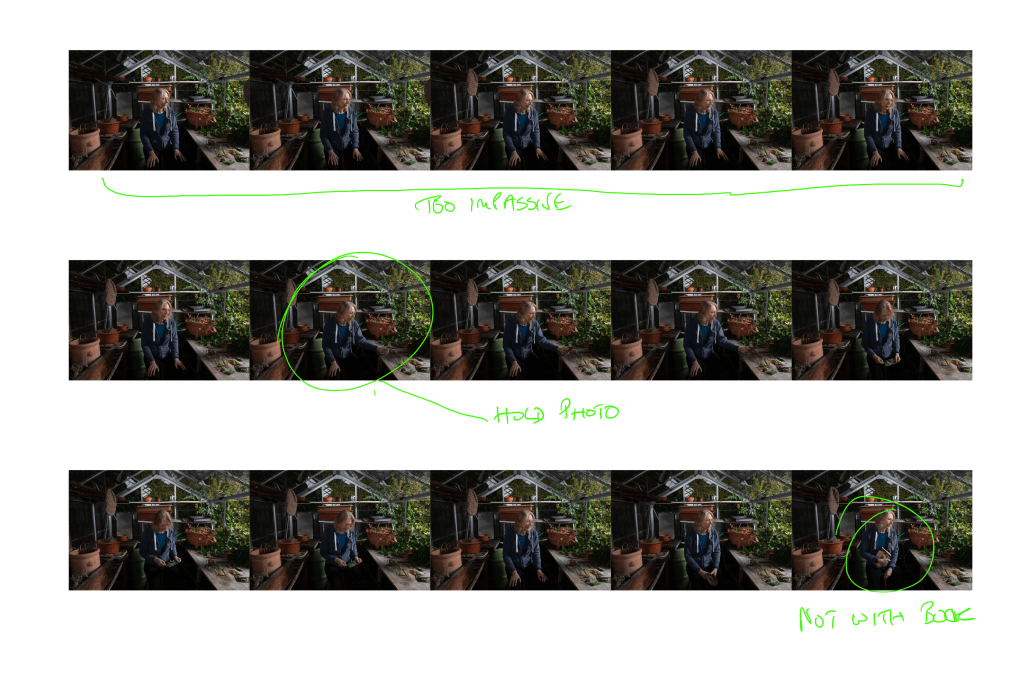
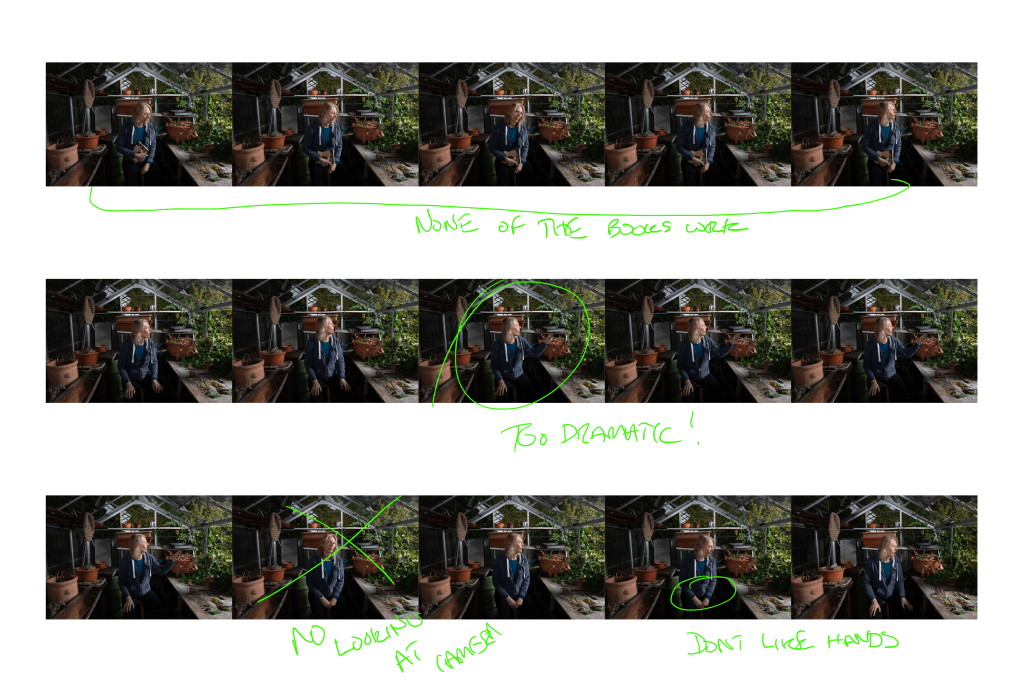
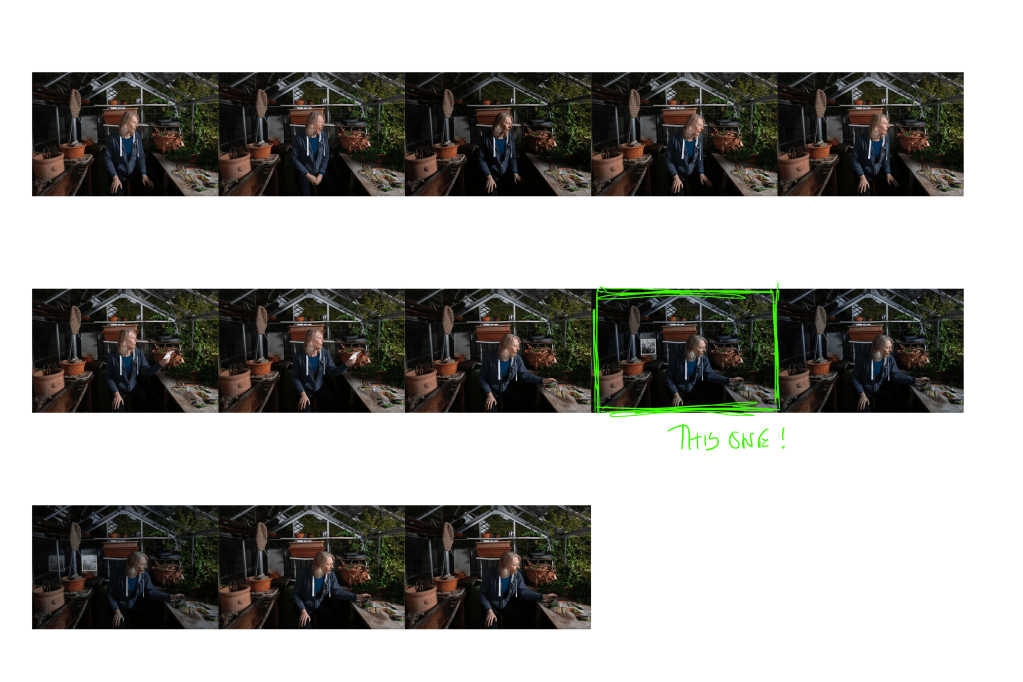
Contact Sheets

References

[1] Fletcher R, 2020, “Preparing for Assignment 5”, OCA Blog Post, https://richardfletcherphotography.photo.blog/2020/12/24/preparing-for-assignment-5/

[2] Fletcher R, 2020, “Assignment 3: Self Portraiture”, OCA Blog Post, https://richardfletcherphotography.photo.blog/2020/09/19/assignment-3-self-portraiture/

[3] Unknown, “Dictionary Definition: Sanctum”, Cambridge Dictionary website, https://dictionary.cambridge.org/dictionary/english/sanctum

[4] Fletcher R, 2020, “Responses to Assignment 5”, OCA Blog Post. https://richardfletcherphotography.photo.blog/2020/12/24/preparing-for-assignment-5/

Assignment 5: Viewer Responses

Introduction

This blog post contains the responses to a request that I made via social media, with a view to understanding the different narratives that could be created when looking at my photograph for Assignment 5[1]. As the people asked were a mix of mine and my wife’s friends, I wanted to establish some ground rules in order to avoid them specifically using any prior knowledge of her or her family in reading the image. At this point, I had also not told them what the title of the picture was.

The Request

Firstly, thank you for agreeing to help me with this. As always, it’s greatly appreciated. As I mentioned in my Facebook post, I have created a photograph for Assignment 5 of my current unit which has the theme of ‘the fabricated image’. What this means is that it’s a real photograph, but the scene is carefully constructed to tell a story in a single frame. This unit has been about context and narrative and how the former is incorporated through the work of the artist while the experiences and imagination of the viewer create the latter. The post-structuralist philosophers stated that the responsibility for the narrative lies very much with the viewer and that it was the job of the artist to leave just enough contextual interest to help them interpret what the work might mean.As I mentioned, there are no special skills or knowledge about the visual arts needed to be able to do what I’m asking of you. The job is to look at the photograph carefully (for say 5 to 10 mins) and consider what the meaning might be. There is no right or wrong answer.

There are some ground rules though:

1) Please look at the photograph on the largest screen possible. Other artists that create these sorts of pictures do so with large format cameras that result in huge prints. These prints show every detail very clearly. However, this is a picture from a 35mm camera which produces a much smaller picture, so you will probably need to zoom in and look around the frame to see the contextual elements.

2) Most of you will realise that the model is Jayne and some of you know her really well. Please try to disregard what you know about her (interests, personality, shared history etc) and keep your review to what you see in the frame. This is going to be difficult for some of you, but please try.

3) For the purposes of this review, I’m not interested in whether the picture is technically good or whether you like it or not. I’m just after what you think the story is. The story that you see will be shaped by your own life experiences and some things may resonate with you that don’t with others. That’s what I’m interested in, so if you want to point out any elements that you noticed that support your story, that would be great.

4)  Finally, please send me your review as a short paragraph of no more than 200 words privately via Messenger or to my email address. I don’t want stories to affect or inspire what other people see.

Thanks again for your help.

The Responses

“The lady – Jayne is sitting in a greenhouse, to me it’s her dad’s one.  The photos (at first I thought they were seeds) tell me that he was a keen gardener, and the Black and white one tells me her grandfather was too, The father became ill or infirm and the greenhouse was left untended and the garden became overgrown. I know it her Dad’s because his hat is hanging up. Sadly he has passed away and the house has been inherited by Jane, Jane has put some clothes on to sort the place out ready for sale. They are not old clothes though, which tells me she is not a diy or gardening type up to now. Jane is wrestling with whether she should restore the house and garden to its former glory and take on the family mantle of gardener or just move on. Her heart says do it, her head says get real.”

“I see a story of love, remembrance, loss and, perhaps regret. Remembrance of a loved one departed surrounded by things that that person held dear and hold importance to the memory of the departed for the sitter. For me, one item in the photo evoked memories of my father, sadly departed 32 years ago, and made me sad for both my mother and myself for the ‘lost years’.”

“In this emotive image I see a woman fondly reminiscing by looking at photographs in a place of personal importance.  The photographs are placed in a manner suggesting that they depict a special person. The greenhouse setting appears to be missing some of the life that was present when this special person was around. There are dead plants, rusty tools, empty pots and ivy creeping in indicating a lack of love and attention. She is surrounded by personal things which provoke memories and the image gives the impression that were a significant part of this special person’s life. The personal items and photographs indicate an older person who loved gardening and nature. Her posture and facial expression indicates that she is thinking of someone who was important to her and is trying to connect with this person. There is a clear difference in the depth of colour and shade as my vision scans from one side of the image to the other. Where the woman is sitting there is more light and colour which shows life and the present, which is further enhanced by the greenery outside. The other side is an image of darker shades and the past.I feel the woman in the photograph is seeking warmth and comfort by spending time alone in what look like her late fathers greenhouse. I’m guessing late father by the way she is deep in thought and lovingly looking at a photograph of an older man. His cap hangs from the green house frame, probably where he left it… She appears to look content with her thoughts, it’s clearly a place that gives her strong happy memories.”

“My first impression was of time travel, and going back in time. Perhaps that we were time travellers but arrived back too late to see again the owner of the greenhouse. Rather fanciful perhaps but I definitely felt that we were looking back to an earlier era when this greenhouse used to be full of lush plants lovingly tended.  The flat cap and picture were very moving and brought back memories of my own father who wore exactly the same cap and was also an enthusiastic gardener. He had a greenhouse very similar which was always full of plants those that over wintered and full of tomatoes in the summer. The empty pots and lack of plants emphasised the fact that the person was not with us anymore. The greenhouse was becoming overgrown with creepers and looked unloved. We/the person in the picture were looking at photos and remembering him with a mixture of emotions of love and sadness but also remembering happier times when they were part of our life.”

“Reflection.  The heart felt need to take the time to preserve, to capture in sharp focus, treasured memories of a love. A love not lost (it could never be lost),  but one which has been forced to move on.  The gathered artifacts help the memory focus and bring further memory senses; a smell, a touch, a smile, a tear. Memories of time spent together in perfect harmony; time, dealings and feelings shared.   Reflection –  a few moments to bask again in a glorious light which will slowly, but inevitably, fade.”

“A lady is sitting in a greenhouse that has fallen into disrepair probably following the death of the gardener. The lady is thinking about the gardener and judging by the look on her face he would have been someone close to her. She is clearly sad looking at his photograph remembering him, his love for gardening and the former glory of the greenhouse indicated in the photographs of previous harvests.  His cap hanging on the peg is poignant and suggest the owner was elderly maybe her father or grandfather, the tools in pot and the general tidiness of the greenhouse indicates that former gardener’s illness and ultimate demise was probably unexpected. The teapot on the shelf reinforces that feeling of unexpectedness and brings a sadness of its own. The missing panes of glass and the plant growth appearing through the broken window gives a timeline to his demise, not that long ago suggesting that this is the lady’s first visit since the demise of the gardener and the grief is still quite raw. The black and white photograph of the man, presumably the gardener behind the lady is strange. I understand the colour pictures that she has but the B&W left me wondering.”

“My thought is that Jayne is sitting in a greenhouse because it was once the happy place for her Father (or Grandfather) and that he has died, possibly some time ago. She is looking at photos of him and his garden as that was his great love and she is missing him so wants to be where they spent time together and she can feel close to him. It feels like it could be the anniversary of his death or his birthday, or he was perhaps ill for a while and neglected the greenhouse for some time.”

“I can relate to this totally, although whether this is your story or just a reflection of my own life I’m not sure. (When I visit the greenhouse at my late parents’ house there are dead plants in pots, a broken window, and vestiges of lives past.) So I’m leaning towards a similar photo-story here. The cap suggests it was the property of an older man, but there is no older man in the picture. This would have been a man whose hair was thinning; the cap used to keep the sun from burning his head or kept the cold draughts off in winter. He may have died or he may no longer be able to look after the place and has gone into a care home (I need to revisit the photo so see if this is answered by visual clues). The woman is the man’s daughter, or maybe even his wife. She looks contemplative, certainly not happy, but not sad either. She seems to be reconciling herself with reality and looking back at memories. The photos show the man’s garden when it (and the man) was in its prime. There are flowers and plants that probably started off from seeds and cuttings in this very greenhouse.”

“The lady in the picture has returned to her childhood home after the death of her last remaining parent. The greenhouse was the pride and joy of her father and he spent many happy hours here tending to his plants. Since his death no one has really been in there and his cap is still hanging where he always left it. She hasnot set foot in the place for a long time, but on finding some old photos of her dad she felt compelled to go and look at them in the place where he so loved to be. As a child she was constantly sent down the garden to find her father and tell him his dinner was ready or that someone needed to talk to him on the phone. That always made him grumpy at being disturbed. She could never understand the attraction of the place then , but now on her own with her memories it seemed the perfect place to remember.”

“Lost in memories but keeping them secret.”

“The person in the photo is having a moment of quiet reflection. She has chosen to sit in the greenhouse and look at pictures of someone that means a lot to her, and who has passed away. The greenhouse is somewhere that the person who passed away spent a lot of their time, and they were always happy here. She is surrounded by things that belonged to the person – the checked cap, the gardening tools – which all hold memories for her. She has sought the peaceful solace of the greenhouse to think about the person to whom the greenhouse belonged. This is someone she misses a great deal, but she finds comfort in the familiarity of her surroundings. She is grieving a loss, hence time spent in this special place is precious to her; it is healing, and it is cathartic. She feels the need to be here, to bring herself closer to the person she has lost. This place to her is a sanctuary, an oasis of calm in a busy, turbulent and sometimes chaotic world”

“I think the picture shows the end of a chapter in a man’s life, to whom the person (Jayne) in the photo was close. The end of the chapter could be that he has died, or that his health has deteriorated and the house is being sold. The plants growing through the glass to the right of the picture imply that the gentleman has not been able to pursue his gardening for some time. Everything in the greenhouse is well kept, and has a place and purpose, so he would have cut the shrubbery back if he was able. We know it was an older man’s domain, as the hat is a gentleman’s flat cap. The greenhouse has been a place where the gentleman has been happy and proud of his growing. This is shown by the gardening tools in the terracotta pot, they have been carefully returned to the pile in the pot. The teapot on the shelf reminded me of my granddad, who had specific containers for jobs in his greenhouse. I felt strongly that the teapot would be used for plant food! Jayne was close to this person and she is taking time to remember the times they shared in his greenhouse and the man who is no more. She is closing her personal life chapter and mourning it’s passing”

“The story that I see being told in the picture is of someone who is dealing with grief and the loss of a loved one. The person is sat in a place that was very special to the person she has lost and is looking through pictures that also reflect the past glory of the greenhouse. From the objects around the shot, you can see personal objects of the person who has passed, the scissors in the foreground are rusty and tell, alongside the missing panes of glass that the greenhouse has been allowed to fall into disrepair, it also indicates that that person passed a while ago, as does the plant in the far right background and again, ivy growing into the greenhouse through the missing panes reflect the neglect. The personal possessions in the greenhouse, the flat cap and the teapot are reminders of the person who once spent time in this place. It’s interesting to wonder the relationship between the person in the B&W picture and the person in the picture being held. Did the greenhouse get passed down from Father to son, does the state of disrepair reflect that the greenhouse is no longer needed or will be passed down and relocated?”

“The subject is not wearing gardening clothes and looks sad and thoughtful. She is viewing photos, some containing an elderly gentleman in a gardening setting. Together with the B&W photo this is clearly his shed and with the level of decay is shows he is no longer able to live there or, more likely alive. Some time has passed as scissors are rusty all pots are barren and vegetation outside is encroaching inside through broken panes. The B&W image further emphasises that the glory days were a long time ago. The cloth cap has not deteriorated the same as its surroundings and may have been placed there latterly as a homage. This is where the subject goes to feel a connection with the man in the photos. The setting helps the subject to reminisce in a location that was very important to the man and was the place where he was most happy” 

“It looks to me like a woman is taking some time away from the rest of the world to remember someone who’s passed away – my assumption is her father based on the pictures of an older gentleman. Based on the photos and the hat that’s hung, I believe the greenhouse that she’s in belonged to her father and it’s been kept and she visits due to its sentimental value. As there aren’t any plants flourishing and tools have rusted, I’d suggest that some time has passed since he’s gone. As she’s in the greenhouse at nighttime, I took that to mean she might be visiting in secret so she can be alone with her thoughts. Based on the fact there are photos there, I also took that to mean that there may be a frequency to her visits”

“There are two ‘angles’ for me. Firstly having worked in health and social care for much of my life I have seen and experienced loss and how it can impact different people in different ways. The second angle is more personal, being of the age now that we are, beginning to attend more funerals than weddings, I’ve experienced loss of friends and family and the associated grief quite a bit recently. As a keen gardener too I can appreciate the before and after state of the green house. So I don’t know Jane but if I were sitting there I would be grieving, this includes the sadness you’d expect but also filled with the happy memories of sharing that space with my relative in the picture on the wall. I have plans to do them proud and get the greenhouse back to it’s former glory. But for now I sit and remember happier times…”

“I see a lady sat down at a table that is in a greenhouse. She is staring at a selection of images of a gent and his plants. There is a hat hanging on the side that would have been worn by the gent in the pics. The greenhouse was his pride and joy, but he has been unable to make use of it recently due to his advanced years. Gardening was his hobby for a very long time. Competitions were not his thing, but anyone calling round would comment on the variety of plants and how they would like a garden like this. The glass is broken, the plants are intruding, nothing has been planted recently. The tools in the pot are rusting. The teapot on the shelf would have contained used teabags for use in the garden. She is reminiscing  about the times she would find him in there when she called round to see him. Unfortunately he has recently passed away and the house will be sold soon”

“In this emotive image I see a woman fondly reminiscing by looking at photographs in a place of personal importance.  The photographs are placed in a manner suggesting that they depict a special person. The greenhouse setting appears to be missing some of the life that was present when this special person was around. There are dead plants, rusty tools, empty pots and ivy creeping in indicating a lack of love and attention. She is surrounded by personal things which provoke memories and the image gives the impression that were a significant part of this special person’s life. The personal items and photographs indicate an older person who loved gardening and nature. Her posture and facial expression indicates that she is thinking of someone who was important to her and is trying to connect with this person. There is a clear difference in the depth of colour and shade as my vision scans from one side of the image to the other. Where the woman is sitting there is more light and colour which shows life and the present, which is further enhanced by the greenery outside. The other side is an image of darker shades and the past”

References

[1] Fletcher R, 2020, “Assignment 5: Making it Up”, OCA Blog Post, https://richardfletcherphotography.photo.blog/2020/12/24/assignment-5-making-it-up/

Preparing for Assignment 5

Introduction

Assignment 5 is the final piece for Context and Narrative and is the culmination of understanding how stories are told through photography in a variety of ways. We have looked at a number of photographers who have created linear stories within the documentary genre, as well as those who use metaphor to more subtly articulate their intent. In Part 3 we were introduced to narratives that could be created through the use of self-portraiture, whether literal or metaphorical. My submission for Assignment 3 was a significant departure from what I had done previously and as well as being outside of my comfort zone as a photographer, it was from this point in the course that I began to understand the concept of the ‘unrea’l image. Now, having completed Assignment 4 and working through Part 5, I am starting to form an idea about what to shoot for the final assignment.

The Brief

Construct a stand-alone image of your choice. Alternatively, you may choose to make a series, elaborating on the same theme.

As the culminating assignment for the course you may wish to draw upon skills learned from Parts One to Four – using various forms of narrative, using yourself as subject matter, telling stories and reading images. The only stipulation is that you produce work that has been controlled and directed by you for a specific purpose. Remember to create a story with a specific context like the artists you’ve looked at in Part Five. This means that you need to have an artistic intention, so a good place to start would be to write down some ideas. This could then be form the basis of the 300-introduction to the proceed. You may find it helpful to draw storyboards to help you visualise your ideas.

The aim of this assignment is to use props, costumes, models, location, lighting etc. to contribute to the overall meaning of the image (Use flash/lights if required but available light is fine as long as it is considered)

If the narrative is set in a different era then the elements fo the image must reflect this. Also consider the symbolic meanings of the objects and try not to be too literal in your approach. For example, don’t automatically use red shoes in a love scent but try to be subtle in your ideas to obtain a more true-to-life scenario.

For this final assignment, you should also include an illustrated evaluation of the process you went through to produce your final image(s). Include snapshots of setting up the work and write about how you felt your direction went, how you found the location, props etc. How did this process affect the final outcome? Write around 1000 words (including your 300-word introduction).

Initial Thoughts

I started by thinking about the research work done so far in this course and how it has changed my perspective on photography. Previously, I tended to work in the literal. My photographs almost signposted the viewer to my intended meaning. By Assignment 2 I was beginning to use metaphor more clearly, but I then started to struggle with not having a structured approach to my creative process. The result was a very stressful experiences of trying to force creativity to happen, looking for compositions to present themselves and being disappointed when they did not. Assignment 3 saw a more structured approach that allowed me more freedom to focus on what I wanted to express. Having the approach under control, I then started to focus on not overthinking what I was trying to say and to experiment with my subjects and compositions. Although Part 4 led to a written essay assignment rather than a photographic project, the analysis of the many layers of narrative within a single image was a core skill learned. This gave me a greater appreciation of all photographic art, whether singular images or as part of a collection. My thoughts at this point were that I wanted to create something that would stand up to a level of analysis. Instead of images that occur naturally, e.g. the decisive moments of street photography, the brief called for something ‘directed’ in the spirit of Wall, diCorcia or Crewdson. At the heart of the brief was the idea that the photograph or series needed to be ‘made up’, suggesting either an entire or partial fiction controlled by me as the artist. I had enjoyed Exercise 3[1] where we had to recreate a childhood memory as it allowed me to think laterally about the kinds of props that I could use to help tell the story. For this assignment, I would start with a story idea and then plan how I wanted to create the contextual elements using props. I’d then plan how to shoot the image from a compositional and technical perspective that would be an experience similar to that of a motion picture director.

Thinking about stories

In Part 3 I discovered how interesting a self-portrait series could be as a way of telling a story. My tutor’s feedback suggested that I think about whether I would consider using self-portraiture as part of my future work. This was my first thought but I quickly dismissed it for the simple reason that I’ve told bits of my story throughout EYV[2] and during this course; to be honest I was a little bored of my storytelling being about me. I wanted to tell a different story that still involved a person or people, however. The next thought was about my wife and her family. Jayne’s immediate family has always been small; when I first met her, all she had were her parents and an uncle. Although her father’s extended family is larger, the connections with them are fairly distant with them not really featuring in each others’ lives Her relationship with her father wasn’t always easy, although for the last years of his life it was more evident how close they actually were. I am reminded of him everyday, not just because my wife has his height and looks like him, but also because they share the same very dry sense of humour. Her mum is very different, both in stature and personality – in Jayne I see her phenomenal strength, kindness and capacity for empathy, something her father sometimes lacked. When I think about it, all families are like this but what struck me was the way that these likenesses and differences are accentuated when the family unit is small like theirs. My own family is considerably larger, so these subtle characteristics are spread more widely.

My conclusion from these initial thoughts was that I wanted to make my story about Jayne’s family in some way. Coincidentally, we were due to visit her mother so I took the opportunity to look through some of the family photo albums for inspiration. Like most families, there were many photo albums ranging from the beginning of the last century through to recent events. It was when looking through one of the albums, I found these pictures in a flip sleeve:

My father-in-law Bryan in his greenhouse, circa 1986 with a photo of his father in his greenhouse (date unknown)

This immediately got my attention. The main picture is of Bryan sitting in his greenhouse in the mid-1980s. He had just retired from teaching after a long and successful career and was indulging one of his passions that he hadn’t had time to do when he was working. What interested me was that Bryan had tucked a smaller photograph of his father in a similar situation into the same sleeve. Bryan had seemingly found the older print and related to its similarities to his own photo, electing to store them together. There was something deeply significant about this act as the album isn’t viewed often these days so the connection between the two photographs could be thought of as everlasting in some way. The actual similarities between the images in terms of composition and context were also striking – to explore this further, I deconstructed both images as I did in Exercise 3 and Assignment 4.

Annotated with formal elements (yellow) and potential meanings (red)

From the two images I could see some common elements. Both men are were the centre of the greenhouses and also the composition. They were both surrounded by the fruits of their labours, which were very healthy looking tomato plants. The photographs were both taken on sunny days with light streaming through the roof of the greenhouses. Both men were wearing the clothes of their era, Johnny in a formal three piece suit and Bryan in 1980s-casual wear. At first they seem at odds with each other, but from what I know of Johnny, he was a smartly-dressed man. So, while he may not have been necessarily dressed for working in the greenhouse as Bryan is, the picture feels spontaneous as if he is showing off what he’d grown.

In terms of themes, the key ones that were common to both pictures are:

Pride – in the achievement

Passion – for their hobby

Nature – wonder of the natural. The black and white even creates a sense of green by the dominance of the plants in the frame. The sun plays a big part in

Father to son – passing on the mantle and it being received

Hierarchy – Johnny has more than in his greenhouse than Bryan. Perhaps the passion isn’t as strong down the generations.

Order – both are neat and tidy spaces

What the deconstruction taught me about these photographs was that both men had a shared interest, likely passed on from father to son. They had the same approach and the same sense of pride in their efforts as amateur gardeners and rightly, given the success of what they had grown. When looking more closely, though both men adopt different poses. Johnny is looking straight at the camera with a beaming smile, but Bryan is not engaging with ‘the viewer’ at all. His shot was definitely posed and he clearly intended that the two images were kept together because of their strong similarities. So why the enigmatic expression? Bryan was certainly comfortable in front of the camera, but perhaps this was more about being surrounded by his plants rather than being about him. Or perhaps it just was that he was not exactly like his father. This got me thinking about what my story could be about.

My Idea

I decided to shoot a single photograph that captured the essence of how these two men came to record the same sentiments in two images separated by so much time. How Johnny passed his love of gardening to Bryan but how the resulting interest evolved through the differences between father and son. The added element would be the fact Bryan’s daughter has no interest in gardening; her passions went down a completely different route to both of them. I want to create a narrative about ‘inheritance’ through the generations and planned to weave the likeness and contrasts into the image, using metaphors and props that stand up to the kind of ‘reading’ that was the focus of Part 4.

Location

While looking at the greenhouse in the ‘Bryan’ photograph, I asked my mother-in-law where the picture was taken, naturally assuming it would be some previous house they had lived in. The answer was the same house she lives in now. The greenhouse still stood in the same place in the garden as in 1986. However, when Bryan became infirm towards the end of his life, the greenhouse wasn’t maintained and had fallen into disrepair. For me, this was a stroke of good fortune as it meant that I had a potential setting for my photograph. I took a series of contextual shots during that visit to capture the scene as it is now, including one of my wife sitting in the same position as Bryan.

The Greenhouse and Contents

The greenhouse contained many potential props, but their use would need careful planning to give enough of a sense of time passing without dominating the frame and potentially any narrative from the image.

Potential Perspectives

I took the following pictures to experiment with perspective – which angle and how much of the greenhouse would I include? I put Jayne in a similar position in the space as Bryan in his photograph. At this stage, this was just for a reference as I hadn’t yet decided on what to do with Jayne in my composition.

Looking at these test shots, the first thing I noticed was that I could easily replicate the composition of the Bryan photo if I wanted to. This is likely because the mobile phone camera that I was using for these context shots has a wide angle lens, which is likely similar to the compact film camera used for the original photograph. Only in the shots taken outside the greenhouse is Jayne fully in the frame, but this increases the depth of the image as well as introducing the doorway into the shot. I could see potential issues with the increased depth lessening the impact of any props that I decided to use and the door frame being a distraction (although it did ‘frame’ Jayne in the image). Looking at these images informed me of how I might go about shooting the picture from a practical perspective. In the past I had been guilty of focusing on the technical aspects of a composition rather than what I want to say with it, so with this photograph I wanted to get that part out of the way first. I would shoot this picture with a wide angle lens from just inside the door to recreate the look and feel of the Bryan photo (as in the first of the test shots above). I could elect to shoot both digital and film to experiment with the look of the final image, but that would be easy once I had the composition ideas firmed up.

Ideas for Composition

The central theme was about inheritance, what we get from our parents and how we make our own way, so my ideas for the picture fell into two parts:

  1. The things that connect Jayne with her Father and Grandfather.
  2. The things that separate her from them both in terms of ‘fashion’, that is the passage of time and what makes her different from them.

Connectors

  • Physical Similarities – Height, facial features
  • Origin – Yorkshire, same region
  • Surname – Ackroyd
  • Middle age – Eldest to Youngest but in the 50 to 70 category.
  • Love of outdoors
  • Intelligence – Formal education and intellectual interests (theatre, drama)
  • Direct, no nonsense – functional clothing, smart without being high maintenance
  • Sense of humour – dry witted, sharp
  • Confident – forthright but not arrogant
  • Focused – work hard for an outcome

Separators

  • Gender
  • Career – Engineering over teaching and plumbing
  • Only child.
  • Sports – marathon running, 6 major marathons of the world, Team GB duathlon and aquathlon, Euro and World Championships
  • Studious – Self Study MBA, Triathlon Coach
  • Non-judgemental – difficult relationship with Dad but not Grandad
  • Outwardly emotional – gets from her mother
  • No children – conscious decision

Potential Props

Clothing – traditional Yorkshire attire or that associated with the region – flat caps, scarves, heavy coats.

Jayne’s outfit – either glamorous or sporty. Something you wouldn’t wear to garden in. Some references to her track record, e.g. the medals or bike helmet.

Books – titles that metaphorically describe evolution or change. This could also be used to tell something about Jayne and her interests. Could be a mix to titles.

The photographs – getting them into the composition somewhere there they can be seen but are not obvious signposts.

Candle – represent the passage of time.

Tea cup – there is a stainless steel teapot, so perhaps something that complements that in some way. Could be a broken one to tie in with the decaying aesthetic or something that contradicts the natural world in some way.

Bouquet of flowers – something that suggests this is the limit of Jayne’s ability as a gardener but also pays tribute to her dad and grandad.

Artificial flower – could say the same thing.

Discussion with my Tutor

At this point in my thinking, I had a call with my tutor to discuss my recent submission for Assignment 4. As this had been an essay, the conversation was shorter than the usual feedback on the photographic assignments. After some recommendations on further reading/thinking about the subject of the essay, the discussion moved on to my thoughts for this assignment. I tried to describe my idea about the inheritance from grandfather to granddaughter and my tutor fed back that she thought it would be difficult to capture that breadth of scope in a single image. She advised me to hone the idea into a more focused story if I really wanted to do a single tableau image. She also recommended using the greenhouse in a more unexpected way than a straightforward setting for the picture. This conversation, like many during the earlier parts of this degree, shook me. I was continuing not to learn the lesson about becoming fixated on an idea in a way that narrowed my perspective on it – I had already planned out the work to a point where I was reluctant to make significant changes. I needed to learn to keep my options open during the planning phase so that feedback like this would not feel like an abandonment of the core of my idea.

Evolving the Idea

With the objective to hone the idea into a stronger story, I started to look at what the photograph and the greenhouse actually meant to me. As I mentioned previously, the relationship between Jayne and her father was not always easy and perhaps initially the presence of the greenhouse in its state of decay reminded me how different they were -we have no equivalent at our home as Jayne has no interest in gardening. When I thought again, I realised that the actual connection was the opposite of this difference; Jayne adored her Dad, particularly in his later years. The same was true of her grandfather who had died many years before. The story was actually about the discovery of the photograph and the way the greenhouse connected her with them both in a more affectionate way. I started thinking about how people revisit places that they have a strong emotional connection with and that if the passage of time has been great, the place can be very different from how they remember. This nostalgia is heightened by the memories of how it used to be, so perhaps the greenhouse and its decaying condition were the gateway to Jayne’s fond memories in this case. My idea was shifting toward this being a story of the love of family, with the decaying greenhouse also creating a sense of sadness at both the loss of loved ones as well as highlighting how some traditions are lost with them.

With the idea now clearer to me, I started to revisit the way the picture would be shot. My tutor’s advice to consider the greenhouse outside of the usual context led me to think about emphasising the impact of the space at any time of day. I therefore decided to shoot it at night instead of during the daytime. The greenhouse would now be a comforting space outside of the context of its intended purpose, i.e. growing plants. The ideas I had previously for composition and props were still valid, although I found that I no longer saw the more obvious contextual elements such as the candle, flowers, etc to be as important as making the setting work with my revised theme. Instead, I would keep the contextual elements subtle in order not to overburden the viewer with signposts to what I intended the picture to be about.

Initial Conclusions

As I have increasingly found over this unit, the creative process and preparation for the assignments is very important. Having a structured approach to the planning and seeking feedback from others have become powerful tools in helping me form my ideas. I was happy that the revised idea, after the feedback from my tutor, was stronger than originally conceived. However, I need to accept that not every idea that appeals to me at the outset will ultimately work as a project. I definitely need to be more patient when it comes to the suggestion that I pivot an idea or even elect to stop developing one. In taking a step back during the preparation of this assignment, I believe I concluded with a much stronger idea to take forward.

References

[1] Fletcher R, 2020, “3) Exercise 3: Childhood Memories”, OCA Blog Post, https://richardfletcherphotography.photo.blog/2020/10/18/3-exercise-3-childhood-memories/

[2]Fletcher R, 2019, “Assignment 5: Photography is Simple”, OCA Blog Post, https://richardfletcherphotography.photo.blog/2019/05/31/assignment-5-photography-is-simple/

5) Exercise 2: Re-situated Art

The Brief

Question for the Seller re-situates images in a different context and in doing so allows for a new dialogue to take place.

Reflect on the following in your learning log:

  1. Does their presence on a gallery wall give these images an elevated status?
  2. Where does their meaning derive from?
  3. When they are sold (again on eBay, via auction direct from the gallery) is their value increased by the fact that they are now ‘art’?

Look online at the Zoe Leonard and Cheryl Dunye series The Fae Richards Photo Archive (1996). You might be forgiven for assuming the images to be remnants from an old family album documenting the life of the beautiful actress Fae Richards. The images appear to chart Richards’ life from her birth in the 1920s through her glamorous career in the 40s up to her involvement in the civil rights movement of the 50s. Fae Richards is an entirely fictional character, however. Leonard and Dunye drew upon historical records and, noting the distinct lack of information about African-American women, they invented one. The purpose of this fictional archive is to question the truthfulness of the archive and how history is recorded. Who gets included in our written histories and why? More importantly, who is left out? And who is in control of this information?

Do you have any archives that you could have access to? Might you be able to use it for the beginnings of a project?

Blog about some ideas that you could come back to some day

Questions for the Seller

Does their presence on a gallery wall give these images an elevated status?

The idea that something can be elevated in status by calling it art is something that has been hotly debated for many years. As I was growing up, I had an inherent cynicism about ‘art for art’s sake’, with the most notable examples being what is considered to be ‘modern art’. Whenever I visited a gallery or museum, I was often left with a greater appreciation of the building architecture than the pieces contained within it; Tate Modern in London and Hamburger Bahnhoff in Berlin being good examples. However in researching what makes something art, it’s clear that the main attribute is what it is being said by the the artist. One philosopher who sought to define art in objective terms was Martin Heidegger. His hugely complex essay The Origin of the Work of Art published in 1950 discusses the relationship between what we understand of an object being represented as art and how that understanding is built. In a review of the concept of art[1] Jon-Paul Stonard states:

At the outset Heidegger says that it is the work of art that ‘gives credit to the master’, enabling them to emerge as an artist. The work of art and the artist exist in a circular relationship, depending on a third, mysterious thing – art itself. You get the sense that he is talking not about the moment of creation, but rather about what happens when works of art emerge into the world – when they are seen and thought about.

Jon-Paul Stonard (2018)[1]

What Stonard suggests is that art is about the artist and what they are trying to achieve with it. It doesn’t become art though, until it is seen and interpreted by others in a way that connects with the artist’s intent. We have learned in this unit that context and contextual elements are key to the viewer being able to form their own narrative. Perhaps what Heidegger and Stonard are saying is that the artist themselves, being the enabler and curator of their work, is also a contextual element. In the case of Bird’s work, the photographs themselves are not her original work. Arguably the only tangible thing that she has done is to add the text and arrange them pictures in a particular way. Of course, this is what emerges as the art. The people going to see the work at Belfast Exposed responded to her treatment of the images; creating a sympathetic archive where none existed previously. The act of displaying them in a gallery with the artist’s intent being on display, does elevate them for me. We should also not underestimate the role of the gallery in the creation of art. Most displays contain some background information on the artist, which can often be the first introduction to the person and their work. The setting and arrangement of the pieces reminds us that we are there to try to derive some kind of meaning from the work, even if the act itself is subconscious.

Where does the meaning derive from?

I would say that the meaning comes from two places. The first is from the context that the artist places with the groups of images. They were bought in lots, so there is a natural grouping by seller. However, the backstory that Bird includes with the series sheds some light in some cases on the lives of the subjects. Bird contrasts the very human stories with the fact that these images were essentially being discarded by their owner. In the interview she did with Boothroyd [2], Bird traced this contrast back to an experience she had in the US prior to this series:

I was in a picture archive in the US. On another table was a contact sheet of Elvis Presley in the 1950s, at a formal dinner table surrounded by immaculately dressed women. There was a picture editor’s pencil mark around his head – indicating the part of the photo they wanted to use. This cropping revealed in an instant the value of the picture and how they weren’t interested in the unidentified group of women.

Nicky Bird talking to Sharon Boothroyd[2]

This idea that archives somehow exist at the behest of their owner and as such only tell the viewer what the archivist wants them to, is a similar experience to Broomberg and Chanarin. In Bird’s case, the pictures were not wanted at all which the artist uses to highlight the fragility of our place in the world and in history.

The second place that their meaning comes from is how we see them out of the context of their time. We tend to linger on an image when presented with it in a gallery setting, which offers us time to write our own narrative that may support or contradict that of Bird. That narrative may simply our reading of what’s in the picture or a very personal connection with what is familiar to us about the image. What elevates the image is perhaps the challenge of ‘this is what I think, what do you think?’ For me, art must be a challenge to the viewer set by the artist that fuels the circular relationship that Heidegger referred to in his paper[1].

When they are sold (again on eBay, via auction direct from the gallery) is their value increased by the fact that they are now ‘art’?

This is an interesting question. In the first instance there is evidence that the individual photographs had an increased monetary value as a result of being in Bird’s series. The video clip on the artist’s website [3] shows a picture with its accompanying ‘title’ selling for £12, which we assume is considerably more than the bare minimum that it was originally purchased for. Being introduced to the public as an artwork and gaining more exposure than it had ever had in the lifetime of the owner [3], the interest in the photograph had grown many times over. That value is more interesting than the financial for me. In seeing the photographs together at a gallery, the viewer is being presented with them as art that has been created by an artist as I mentioned previously. The value may have something to do with that simple fact and Bird’s reputation as an artist and photographer, but for me there is more to it than that. When we see these images, we see the lost history that interested Bird in the first place and because everyone has imagery of some sort that documents their own lives, we emotionally relate to that. The fact that Bird came to the rescue of these uniquely personal documents, saving them from destruction appeals to our own sense of place in the world. The sentimental connection with the past and the narratives that we write for the pictures as we see them, creates value to the piece. The mastery of the work is in the way that it started and ended with an auction, the re-situated archive that Bird created becoming transient [4]. For me, it serves as both an artwork and social reminder that our lives are so brief in the context of history, that some things are worth preserving in some way for the next person to appreciate. The irony of the sale is that not only is the archive transient, but it also becomes disbanded with the images going to a whole variety of new owners.

Leonard and Dunye: The Fae Richards Photo Archive (1996)

The first thing I noted when looking at The Fae Richards Photo Archive was the huge amount of effort that went into creating this fabricated reality. Leonard collaborated with Dunye for a film that the latter was making in which a young black film director was looking for as much as she could find about a Black film star of the early days of modern cinema. The central character in the film essentially investigates the mysterious Fae Richards and narrates her story towards the end of Dunye’s film. In a review discussion of the work [5], it is revealed that the photo archive was created to such a convincing standard that they even employed a number of techniques in the darkroom to age the prints to the appropriate time period. Each photograph was meticulously planned to tell the story of Richard’s struggle as a Black lesbian actress trying to be taken seriously in Hollywood. The story itself is almost a biography in its own right, discussing moves that Richards made in her career and her personal life as well as leaving some elements unsaid. The ‘narrator’ in the film tries to piece together the ‘what happened next’ elements from what she ‘knew’ of Richard’s life.

This is all very clever, but the most interesting point here is the impact the archive has. We are introduced to the central character of Richards and the people who feature in her life and the thread of the story follows a pattern that is familiar to us. A young Black woman who is also lesbian, trying to be taken seriously against a backdrop of the institutional racism of 20th century America. Her beginnings, which tell of being given parts as ‘the Black maid’ or ‘the Black cook’ all fall into what we know as a wretched time in the history of prejudice. Her failed romances with women also point to the difficulties of same sex relationships with the prejudices of the time. However, Richards is a fighter who leaves Hollywood for an independent film studio where she rises to greater roles until eventually retiring from acting. She becomes part of the movement for equal rights and campaigns as an activist in her later life. The problem I have with this is that as a single story, it is a total Hollywood cliché. What we don’t see are the more mundane parts of Richard’s life; the things she admires or the things that she avoids, the accidental snapshots of her just living her life. We don’t see any real evidence of domesticity or how her life changes with her success. The archive very deliberately leaves out any of the things that we would want to know about someone or a situation. When we consider the size and complexity of the curated archive for The Troubles that we encountered previously[4], we see precious little real detail in the fabricated archive about Fae Richards. The feat of creativity and technical attention to detail in Leonard’s work is remarkable, but for me it drives home that photography can be exploited as a pseudo-factual document that convinces the viewer of a version of reality. The director and artist both want to steer the viewer to seeing this incredible life of their character as one might expect in a Hollywood movie. The archive is carefully controlled to steer the viewer through the plot, but leave enough room to create their own impression of the central character. When we think about it, the director is now the archivist which begs the question as to whether any archive is really a historical record of events or merely a version of events. Taking the example of Richards, there we clearly many people in history who fought prejudice against their colour, sexuality or simply their way of life. However, not all of them led lives of signposted narratives and not all were able to change the perceptions of themselves. The Richards archive is a pastiche of all the things we hope that people did when facing the extremes of that period in history. As the notes suggest, this was the intention of the archive that was used in the film. When the work was displayed in its own right, i.e. without the accompanying film, Leonard deliberately included the cast list of each image, to make sure that everyone viewing it knew that it was a fiction[5]. I admire the way that the artist tells a story that is veiled in truth, exercising the control of the context while allowing some freedom for the viewer to fill in the gaps as they see it. The archive, it would appear is a good way of lending credibility to the creation which we want to engage with as if real. I’m reminded of the first time I saw Insomnia by Jeff Wall, when I spent a few moments wondering if this was real or fictional. The longer I looked at the picture, the more I began to notice the way that it was constructed. It didn’t actually matter that I then knew it was a fiction as I could relate the sense of dread, the depressing harshness of not being able to sleep etc with my own experience. The way the picture’s constructed reality merely lent my own narrative some credibility; the same is true for when I look at the Richards archive.

Do you have any archives that you could have access to? Might you be able to use it for the beginnings of a project?

As I started to work on this exercise, I immediately thought about the thousands of slide photographs that I was given by my father a few years ago. My dad was an amateur photographer throughout my childhood and became a professional towards the end of my teenage years. He shot many formats, but slides were the traditional way of showing photographs in those days using projection. I had asked him about photographs of the family which he duly said he had sorted out for me. When it came to being given them, the collection was actually all of his slides with subjects ranging from family holidays to his professional portfolio work. They weren’t really all that organised and not all of them had annotations but some did – they don’t really exist as an archive although I’ve always intended to create one when I have the time. An idea for a project came to mind as I worked this exercise. My childhood was a very happy time in the sense that we were loved and always provided for. My dad had a great job and my mother was a wonderful homemaker, which left me feeling like we were somehow blessed with amazing good fortune. However, at an early age I started to be dogged with the anxiety which would eventually lead to my struggle with depression in my thirties. When my mother became ill and died shortly afterwards, any notion I had of our family being fortunate died with her. The photographs in the collection show the happy side of growing up, but perhaps that could be coupled in some way with the darker side of life in a way that seems real but isn’t. I could either insert altered reality in the form of slides (I shoot positive film fairly regularly) taking inspiration from the artists studied here or simply add some textual context and unrelated imagery from the boarder set of slides. This is an idea that I may explore with time as the raw material is certainly available. The problem that I see currently is that I don’t have the time to devote to it, which rules it out as an idea for Assignment 5.

Conclusions

In conclusion, I’ve found this exercise very interesting. The idea of an archive being used to elevate seemingly disconnected items to a work that has new meaning, is something I hadn’t appreciated before. The artists are challenging the idea of an archive as an accurate depiction or record of real events, but still using our interpretation of them being factual to increase the impact. In the case of Bird, she acts as a temporary landlord for other people’s photographic records of someone else’s history. In her elevation of the photographs, Bird re-energises the interest in these long lost people and incites the viewer to take their ownership of the story. She has this concept of filling in the narrative in common with Leonard and Dunye, but in their case what is provided to the viewer is done so by their design. Like the tableaux photographers, the careful construction of the key messages are left for us to fill in the blanks. The archive in both cases serves as a referee for what is real or believable.

References

[1] Sonard J-P, 2018, “Opinion: When does art become art?”, Tate Etc, https://www.tate.org.uk/tate-etc/issue-44-autumn-2018/opinion-john-paul-stonard-art-makes-artists

[2] Boothroyd S, 2013, “Nicky Bird by Sharon Boothroyd”, Photoparley website, https://photoparley.wordpress.com/2013/05/09/nicky-bird/#comments

[3] Bird N, 2007, “Questions for the Seller: Closing Live Auction Event, Belfast Exposed”, Vimeo accessed via the artist’s website, https://www.nickybird.com/projects/question-for-seller/

[4] Fletcher R, 2020, “5) Project 2: The Archive”, OCA blog post, https://richardfletcherphotography.photo.blog/2020/12/20/project-2-the-archive/

[5] MOCA, 2019,”The Fae Richards Archive, A Panel with Garrett Bradley, Huey Copeland, Lanka Tattersall, and Rebecca Matalon”, Youtube, https://www.youtube.com/watch?v=0-5gf2qqPB4

Project 2: The Archive

Introduction

In this project we are introduced to how artists use archived material as the basis for their work, whether creating their own or challenging the concept. Like the other artists in Part 5, they are using other media as the inspiration for their version of reality. Here we will look at two approaches, one that takes a view of material through the way that people engage with an archive and one that seeks to build order from seemingly unconnected material.

Broomberg and Chanarin

Adam Broomberg and Oliver Chanarin were invited by Belfast Exposed, an organisation that manages an archive of photographs taken by photojournalists during The Troubles, to create a response to it. Their approach was to first look at how an archive works, from the selection of images to the way that people interact with them. The Belfast Exposed archive contained over 1.8 million photographs arranged as contact sheet prints stored with their negatives. During the many years that the archive has been curated, it has been maintained by a group of archivists working within the constructs of the local authorities as well as in terms of what the public are allowed to see. The artists started by looking at the contact sheets as articles their own right rather than the photographs within them. The evidence of the many years curating, cataloguing and even censoring the images was evident by markings on the sheets; many techniques were used from hand annotation to the use of stickers and sticky notes. What the artists realised was that these annotations were only made on the printed sheets and the negatives remained untouched in the accompanying files. This was brought home to them when they looked at the damage caused by the visiting public. In some cases, those who appeared in the photographs objected to being in the images and scratched themselves from the contact sheets. In a video presentation of the work [1], the artists realised in both cases, some were using the archive to hide part of the story from the viewing public, whether out of shame or personal embarrassment. What the artists also became drawn to was the use of coloured round dots on the contact sheets that were used to obscure particular elements in the pictures that gave some concern to the archivists. Far from being the straight documentary that we were introduced to earlier in the course, these edited images only revealed part of any story that the original photojournalists observed. In removing the dots, the artists could see what was being hidden. The archive had become more of a document of what wasn’t in the photographs as much as what was included. In the presentation[1] the artists discuss the concept of responding to what is considered to be an accurate historical document. The Troubles in Northern Ireland were a brutal time of protest and suffering which the archive intended to document. However, in censoring some of the images, such as the behaviour of some of the law enforcement agencies at the time, the archive offers a particular narrative. In their response the archive, Broomberg and Chanarin invert the notion of documentary. Their approach for their first series was to use a circular mask in the darkroom which could be positioned when reproducing the original photograph (from the untouched negative).

Untitled (Girls Deflecting) from the series People in Trouble Laughing Pushed to the Ground (Dots) (2010) by Broomberg and Chanarin [3]

For their second series, they reproduced the obscuration seen on the original contact sheets in larger prints.

Sheet 27, Frame 9 from the series People in Trouble Laughing Pushed to the Ground (2011) by Broomberg and Chanarin [2]

Both series are curated in a way that tell a different story of The Troubles to the archive. The story is now more a fiction than a series of ‘facts’ that the artists took control of. Now the people of Northern Ireland are seen almost out of their historical context, which means that the viewer can only bring what they know about the conflict to the pictures. In the first image above, the two girls are shielding their faces from being photographed. We are left wondering why this might be because we cannot see what else is happening in the picture. The artists are showing us something previously obscured and out of context. This photograph could be anywhere and in any time period; the artists have elevated the girls from The Troubles and are asking use to think what they might be doing or involved with. In the second image, we see a man whose face has been obscured with a black marker. The immediate thought when I look at this image is that the obscuration reminds me of the classic redaction used in official documents that are somehow classified. Whoever did this was trying to keep the man’s identity from us but as we look closer, hasn’t been completely successful. Who was the man and why didn’t he want to be identified (assuming he was the culprit for the redaction)? Was it out of embarrassment, concern for his privacy or perhaps fear for his life. If we apply no external context, it could be any of these reasons and more, but if we consider against the context of the situation in Northern Ireland, it could well be the out of fear. In both images, the point about their elevation from the context of the archive is further emphasised by the factual titles that the pictures are given. The titles make no reference to any history, merely point out the obvious subject in the frame.

Nicky Bird

Nicky Bird’s take on the archive is slightly different to Broomberg and Chanarin, but the end result is similar. We are told in the notes that Bird purchased photographs from eBay that nobody was interested in. They images of people and families had found their way onto the auction website with the obvious sentiment that they were unwanted. Immediately this idea of people discarding a family history provokes a response in the viewer; what has happened to make the seller reach this conclusion? Is there some historical reason or is it merely a clear-out? Are the people in the photographs even related in any way to the seller? I know from experience that the resurgence of film photography has created a demand for old cameras that have been lurking in people’s attics etc (I have purchased many of my collection this way). Sometimes, these cameras contain partially used film and sometimes they are kept with negatives that were shot by the owner. This phenomenon of ‘found film’ has led to many images that have remained unseen for decades being viewed for the first time. They are out of their own time and being viewed in the context of the present. What Bird did with her purchases was to ask the seller how they got hold of them and whether they knew anything of their history. The answers were included by Bird along with details of the purchase as context for the collections of photographs. This approach, similar to diCorcia’s Hustlers (where the men’s names and their fees were included) is very factual and its impact entirely dependent on the granularity of the information provided by the seller.

The first purchase, by Nicky Bird. From the series Questions for the Seller (2002)[4]

We can see from the photographs in the collection above that there is an intimacy to them. When we read the notes from the seller, the photographs take on a greater sense of emotion which, coupled with where they eventually ended up (on eBay) asks the viewer to evaluate their response to them. Bird explored the way that people connect with historical photographs during an interview with Sharon Boothroyd[5]

eBay is interesting as a sort of house clearance – in one way the photos can be seen as thrown away, but in another sense, it is a type of postponement i.e. why do people not just throw these photos in the bin? In fact, one eBay seller had rescued a batch of photographs from a skip, while another said that eBay sellers and buyers were new ‘custodians now’ for such materials… so it was interesting that both examples (the brutal and the benign) had a presence in Question for Seller.

Nicky Bird[5]

With the idea that Bird was the new custodian of the images, we now see how her role as archivist has evolved. In curating a collection of groups of images in a a disparate collection, the archive that she creates is one that both preserves the history, but allows us to write our own stories based on the subjects themselves and the journeys the photographs themselves have taken towards being viewed.

Bird held her own auction of some of the photographs in her work for charity, which in a sense passes the historical preservation and maintaining of their impact on to the next generation of custodians. In doing so, Bird’s archive is transient; the opposite of our understanding of the traditional definition. Like Broomberg and Chanarin, the artist takes control of how people will interact with it, fabricating reality and suggesting new meanings as she goes.

References

[1] London Consortium TV, “Broomberg and Chanarin: Presenting Four Projects on Vimeo”, Vimeo online, https://vimeo.com/32622798

[2] Broomberg and Chanarin, 2015, Tate Installation Photographs, artist website http://www.broombergchanarin.com/hometest#/contacts/

[3] Aikens N, 2011, “Adam Broomberg and Oliver Chanarin – Paradise Row”, Review, Frieze, https://www.frieze.com/article/adam-broomberg-and-oliver-chanarin

[4] Bird N, 2006, “Questions for the Seller”, artist website, https://nickybird.com/projects/question-for-seller-2/

[5] Boothroyd S, 2013, “Nicky Bird by Sharon Boothroyd”, Photoparley website, https://photoparley.wordpress.com/2013/05/09/nicky-bird/#comments

Cindy Sherman

Introduction

We are introduced to Cindy Sherman as an example of an artist who has made her name through fabricating realties in a slightly different way to those we have studied in Part 5. Sherman stages herself in her compositions in a similar way to the artists that we studied in Part 4, but uses the fabricated reality to tell stories about women in a number of social contexts. Sherman carefully constructs her images to subtly subvert how we see women, directing each element in a similar way to the artists working in tableaux that we have looked at in this section.

Centrefolds (1981)

In this series, Sherman recreates the typical scene found in a centrefold of a softcore pornographic magazine. Everything from the lighting, the few set props and the oversaturated look of a studio film shoot are present. The model is posed in a typical ‘seductive’ way that dominates the whole frame, something that was used by the photographers in that genre to emphasise the female form. However the first and most obvious difference is that Sherman is clothed, which immediately challenges the viewer to figure out what is going on.

Untitled (1981), by Cindy Sherman from the series ‘Centrefolds'[1]

In this photograph, we see Sherman reclined diagonally across the frame with her arms placed in a revealing pose as was popular in the magazines of the period. Her gaze away from the camera is distant but suggests that she is looking at someone, taking on a more seductive meaning. However her clothing almost completely contradicts the feeling that this is somehow a sexual scene. Her plain jumper and gingham skirt take on a potentially more sinister theme than erotic. Instead of being seductive, the woman looks vulnerable. What is happening to her? When we look more closely, we see that she is clutching a crumpled piece of paper in her hand. Perhaps then, she has just received some bad news and she is fearful of what might happen as a result. The reclined pose itself now suggests someone submitting to a situation. Perhaps the woman has been threatened or attacked by the person she is looking at outside of the frame. What Sherman does with this image and the rest of the Centrefolds series is to almost mock the sexy poses of the glamour and softcore pornography world by telling stories of the objectified women and how our perceptions may not be reality. The photograph cleverly weaves narrative by the careful placement of the contextual elements, much like the tableau practitioners, but by using herself as a canvass Sherman asks the viewer directly to consider the way that women are subjected to objectification and categorisation against a backdrop of the largely male fantasy of pornography. The irony of the series being rejected by the magazine that originally commissioned it is not lost on me[2] as the whole idea of women being vulnerable wasn’t the aesthetic that the magazine would have been looking for. In her portrayals, Sherman creates an alternative reality that makes us feel uncomfortable, yet the message is clear that we should look beyond the female ‘object’.

Conclusion

Sherman’s take on the fabricated reality is a subtle, yet powerful way of taking a familiar context and altering it to tell a different story. While I focused on the Centrefolds series, the same approach can be seen in Untitled Film Stills (1977-80) and Society Portraits (2009). In the former Sherman explores the way that women are seen in society through the medium of cinema. In the latter, she portrays America’s wealthy women in a way that highlights them struggling to maintain their status rather than trying to defy the ageing process [3]. In both series, we see Sherman playing many different women with many different outward images, but each has a sense of the vulnerable about them. Perhaps this sense is stronger from the male perspective as the series are all set against a male dominated environment. Either way, I find the work highly charged in its emotion and very clever in its execution, perhaps the reason why Sherman’s work is prized in the world of fine art photography.

References

[1] Christies, 2011, “Cindy Sherman (b.1954) – Auction Posting, Image Resource, https://www.christies.com/lot/lot-cindy-sherman-b-1954-untitled-5437823/

[2] Manchester E, 2001, “Untitled #97, Cindy Sherman”, Gallery Page, Tate Website, https://www.tate.org.uk/art/artworks/sherman-untitled-97-p77728

[3] Unknown author and date, “The Truth about Cindy Sherman’s Society Portraits”, Phaidon Books article, https://www.phaidon.com/agenda/art/articles/2014/february/04/the-truth-about-cindy-shermans-society-portraits/