We are presented with the part of the conversation between Hurn and Jay[1] on what makes a photographer different from a person who takes photographs. Some interesting points came out of this text:
1) the concept of what a bad photograph is. I have always thought int dreams of the traditional interpretation of bad photographs as being those with cluttered scenes, no obvious subjects that the viewer can look at and a lack of technical skill. Here, the authors make the point that a bad photograph is more where the viewer isn’t interested in looking at the picture for long enough to see any meaning. For me, the idea of dwelling on the image was established in the previous course, with the idea that the image needs to hold the attention of the viewer in some way. Only where there is time to digest what is happening, can the photograph be considered ‘successful’. The parallel drawn with Graham Greene’s comment that the hardest parts of a written work to write are the bits that link the action is interesting. Some photographic series that I’ve looked at so far have some clearly weaker images from my point of view. Their value in the series though is to keep my attention as i move through my created narrative. I’m not sure I’ve ever approached photography in this way before.
2) the need for good design. This is presented not as the photographer establishing clever links or patterns within a series, but the notion of designing the revelation of the subject. The authors describe the act of producing connected images through technique or patterns of similar subject material as being fairly boring. I would agree and add that I actually find that process of connecting a series of photographs, even when not trying to overtly tell a story, exhausting and not particularly conducive to creativity. Design in this case, then is more about looking at the subject and trying different ways of revealing the thing we saw in the first place. Reference is made to taking a number of shots of the subject to see if there are stronger ways of getting to the meaning of the image through small variations in the approach.
3) Linked with 2, the idea that good design is what separates the powerful photographers from those that are less competent. This is more important that technical prowess or knowledge of photography as some sort of process.
4) The concept of a beautiful photograph of a social issue distracting away from the subject and being more about the photographer. This is disputed by the authors who instead favour the idea that a photograph is only good if it reveals the subject. The role of the photographer is to do this in the most elegant way, not simply to create a beautiful image.
In trying to think about the subject of Exercise 3 and Assignment 2, I realise from Hurn and Jay’s conversation [1] that my starting point needs to be a subject that I am interested in or passionate about and starting to think about the design of how that will be revealed in my series. Exercise 3 is about interpreting a poem through a series of images. The emphasis is on how to interpret the poem as opposed to describing the poem. So, I am going to need to select a poem that resonates with me in a way that makes me care about how it is interpreted through imagery.
Cut out some pictures from a newspaper and write your own captions.
How do the words you put next to the image contextualise/re-contextualise it?
How many meanings can you give to the same picture?
Try the same exercise for both anchoring and relaying. Blog about it.
The Pictures
I cut these three photographs out of the The Times newspaper and removed the text that went with them. They were taken from different sections of the newspaper that cover different types of story.
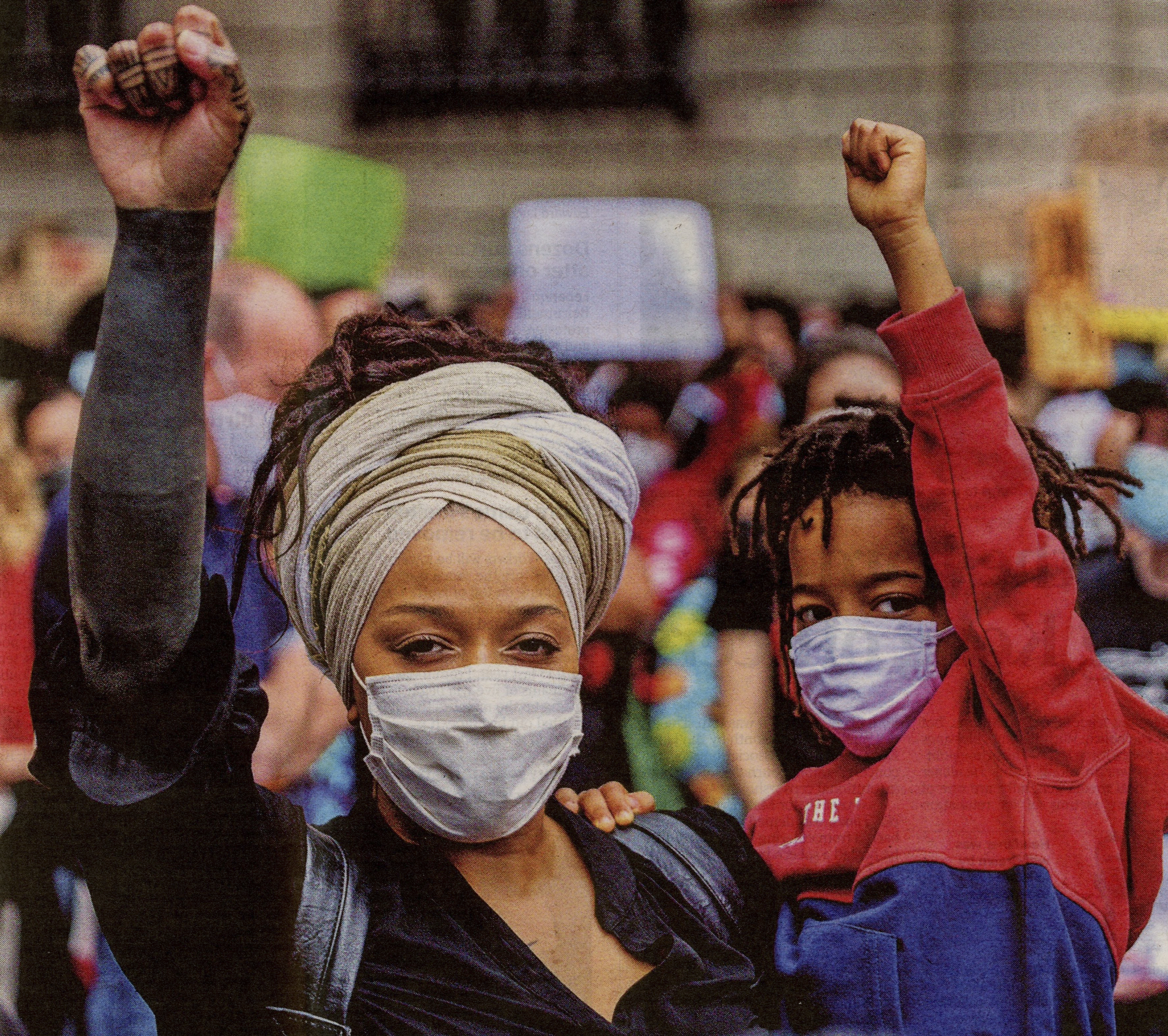
We are brave
I chose this photograph for its powerful imagery but also for the lack of any textual messages within it. I wanted there to be no distractions from the visual messages in the picture, that is the woman and what is assumed to be her child in a classical protest pose. I added the words ‘We are brave’ to contextualise the image as a rally against struggle. The image is actually taken from a recent protest at the senseless killing of George Floyd in the US, which has vastly increased the racial tension across the country. When I consider my caption, it is firstly a much shorter and ambiguous text to accompany a news item. It suggests a brave struggle against something, but not what specifically isn’t made clear. The subjects both appear to be of African descent, but with part of their faces obscured by the medical masks, it is difficult to be sure. The raised arms speak to the Black Power movement of the 1960s, which famously had John Carlos using this gesture at the 1968 Olympics to protest the treatment of black people across the world, in particular in his home country of the United States. The actual photograph caption was:
Hundreds of people lined a rally in Barcelona in support of protests in the United States where activists have called for the abolition of the police departments
Now we have the specific context in the form of an anchor. We now know that this is a rally in solidarity with the US, rather than a protest itself. We know that it is in Barcelona rather than the US and the extra information about the demand to abolish police departments sets the political backdrop to the image. If the viewer has similar or contrary political opinions about the police, the photograph is intended to put only one side of the argument through its anchoring caption. By contrast, my caption could be referring to COVID-19, which is the currently the dominant news story in the world. It finds its way into this photograph because of the medical masks, so this image could have other meanings through my caption. It could be interpreted as a defiance of lockdown rules, families determined to conquer the virus or a show of unity with the rest crowd that can be seen in the background. The general narratives are similar, though, but my caption doesn’t seek to constrain the viewer in the same way as the newspaper.
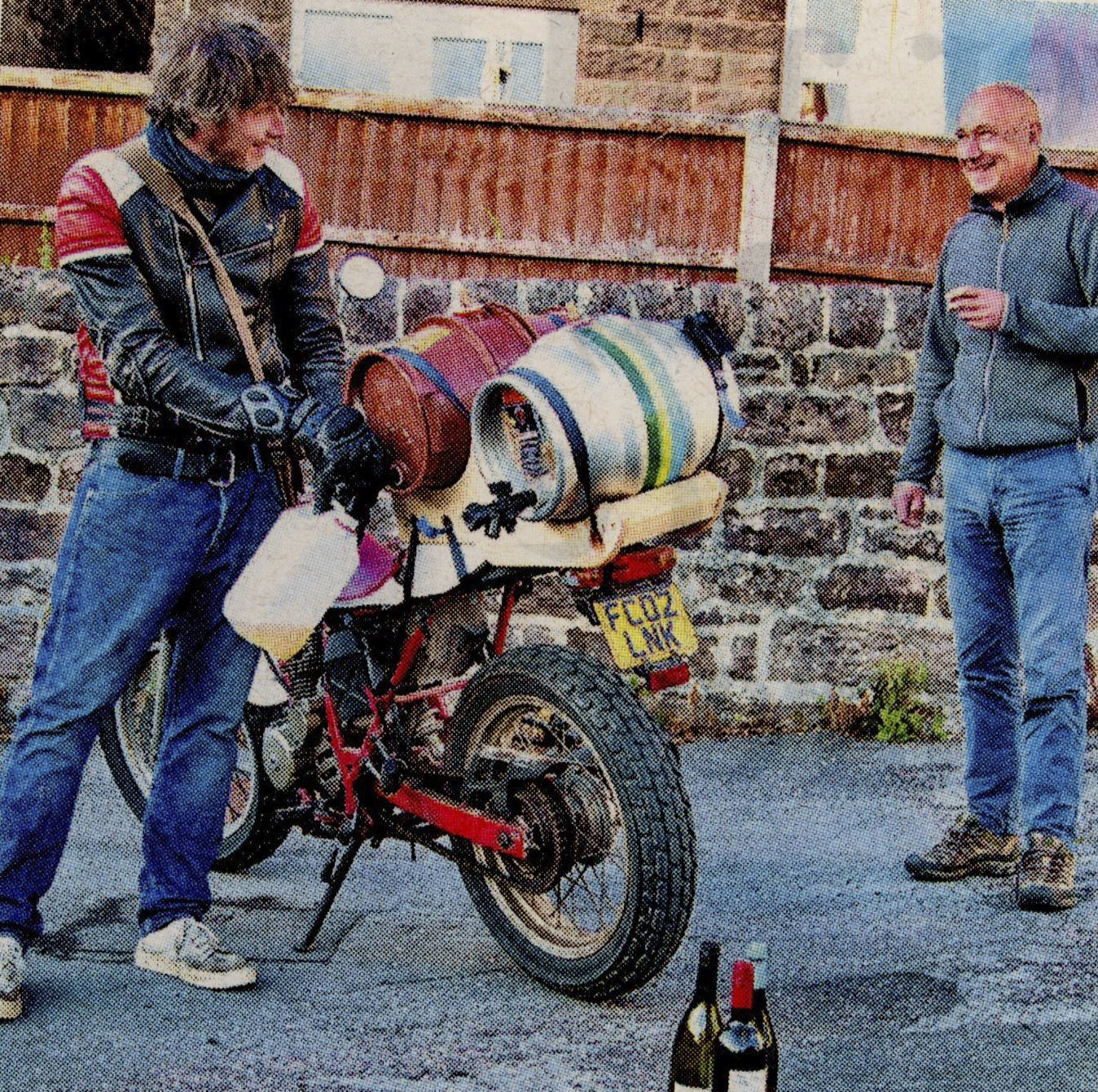
The biker bar that delivers
I chose this image because there is something obvious about it, but without the caption that the newspaper used, it could be interpreted in different ways. For my caption, I wanted to be more descriptive in explaining the scene than in the previous photograph. Here we see a man with a heavily modified motorcycle that holds kegs of beer and he is serving a very happy looking customer. In the foreground there is further evidence of the delivery being made by the biker with the wine adding something different to the beer being poured. This photograph is actually of a landlord who’s novel way of staying in business during COVID-19 is shown in the newspaper as testimony to the resilience of the British people in times of crisis. The original caption was:
Rob Galvin, landlord of The Feather Star in Wirksworth, Derbyshire, serves a happy customer
Now we have lots of information about the picture that we didn’t have before. The caption is similar to mine, in that it is a mobile bar but where there are no real pointers to where the picture was taken added by my caption, now we know that it is a place in Derbyshire. If the viewer knows about Derbyshire, they may know that Wirksworth is a very small market town in the Derbyshire Dales National Park, so this is a service to a remote part of the country. The use of the landlord’s name is almost a tribute to him, where my caption keeps the anonymity of the principle subject.
We can interpret this image in a number of ways ranging from the intended show of inventiveness during COVID-19 to a crackpot inventor’s money-making scheme. What is clear, though is that the messages within the image are positive ones. The expressions of both men and the implied transaction point to this being part of a ‘feel good’ piece.
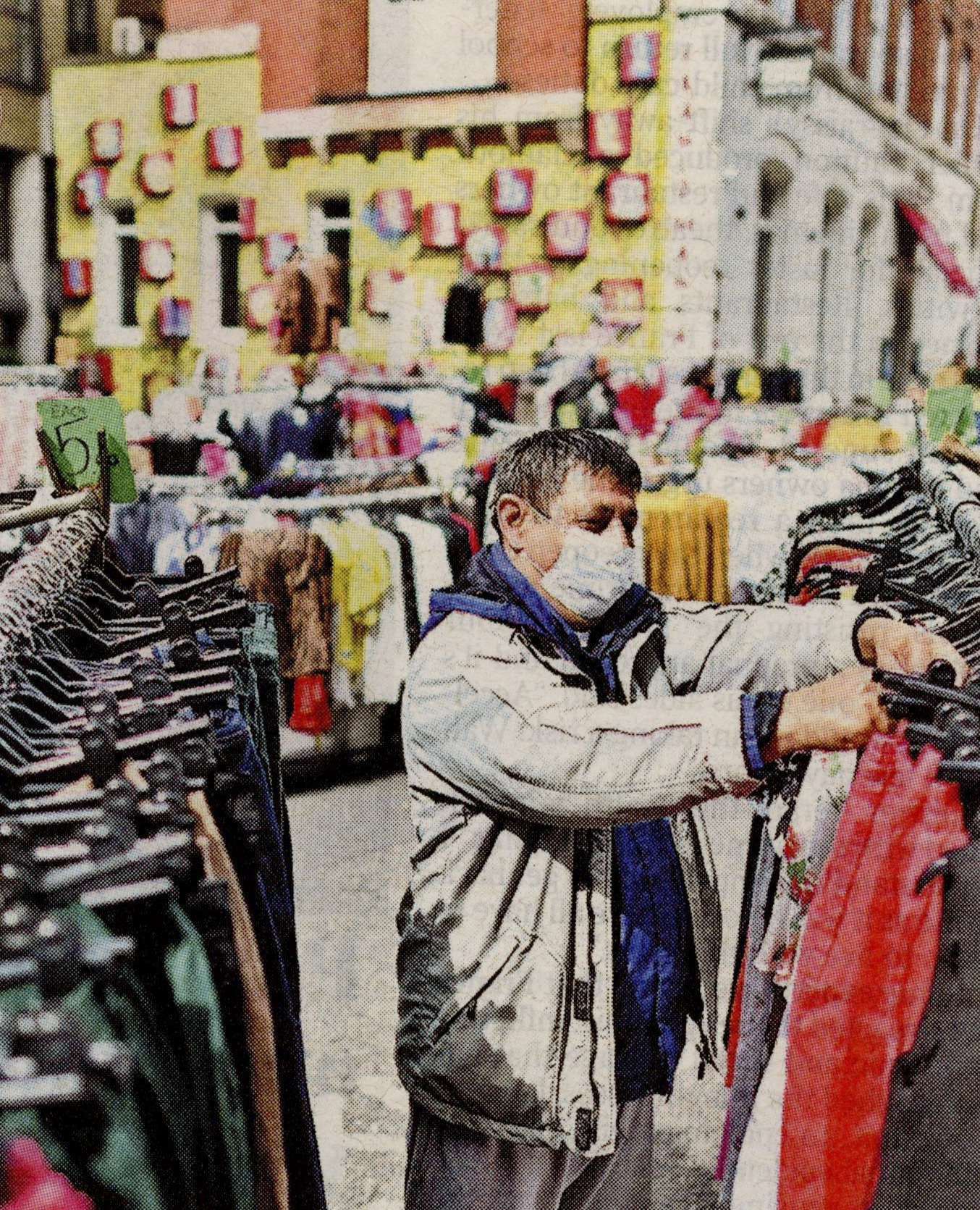
Looking for the right size
This photograph was taken from another story but is aesthetically similar to the previous shot. This time, I wanted to lead the viewer away from the story by adding an unrelated caption. Here we see a man sorting through the clothes on the rack whilst wearing a medical mask. The caption suggests that this is a shopper, although the clothes appear to be very different from what the man is wearing. Perhaps he is shopping for someone else, or perhaps he’s the proprietor. The visual signs are of an outside street market illustrated by the bright light, the building exterior and the price tag on the rack that has the appearance of being handmade as opposed to a professional ticket. The inclusion of the face mask points to the story of the moment, COVID-19. The recent announcement that some business can reopen with protective measures in place. The caption that accompanied this photograph was:
A seller takes stock at Petticoat Lane market in London
Now we have confirmation that the man is the seller of the clothing and we know his location. My interpretation of the image now shifts away from buyer to someone trying to overcome the effect of COVID-19 on his business. The inclusion of the location could almost be and advertisement for the market or simply an indication of the vulnerability of open-air markets in a normally bustling city such as London.
Research Task: Relay
We’ve had the concept of relay introduced through the writings of Barthes, but this task is to explore it further using examples in contemporary photography.
Sophie Calle – ‘Take Care of Yourself’
Calle’s work begins with a letter from her boyfriend informing her that their relationship was over. This letter, which has been translated from her native French into English, is to begin with an anchor that directs the reader to a state of confused, negative emotions. The sender begins with his own self-pity, explaining to Calle that he’s throughout his recent malaise, he has acted honourably. The references to ‘the others’ suggests that he had more relationships than just Calle’s during their time together. His noble gestures of not having seen them, but instead to do the right thing by her are interpreted by me as a warm up to blaming her for the break-up. The letter goes on to suggest that Calle had precluded any notion of them remaining friends which effectively made the break up and the need for the formality of writing, her fault.
Little wonder then, that the letter left Calle in a state of shock. Her reaction, that she states was an idea that came within days of receiving the email [1], was to create an artwork that addressed the sender through the eyes of women. She asked 107 women to read the letter and respond in some way, which Calle captured using mixed media. The reactions ranged from the letter being reimagined as a crossword puzzle to the more extreme shooting of a copy by a professional sports markswoman. Each woman brought their own perspective through the context of their professional lives as well as their emotional response to the words. The result is a curation of many cultural narratives, with no guidance through them by the artist with the exception the initial text of the letter itself. The viewer joins the narratives together by bringing their own feelings toward the events and the players. As the subject matter is something we all encounter at some point in our lives, the effect of parallel experiences further enhance the meaning of the works. For me, it aligns with the post-modern narrative that Barthes was referring to in Death of the Author. On the surface, it appears as lazy, almost getting other people to create the piece for her. However, the use of the mixed media to draw attention to and enhance the reactions of her women, make it an impressive piece of work.
Sophy Rickett- Objects in the Field (2012)
Rickett’s work is different but similar to Calle’s. Here we have an artist telling the story of her encounter with a renowned astrophysicist and the way she purloined his photographic documents of celestial bodies for her art. The project seeks to explore the relationship between what is created and what is appropriated [2], namely Rickett’s use of Dr Wilstrop’s old negatives to create her story. The collection is brought together by a written essay that walks the viewer through Rickett’s relationship with Wilstrop. For me, perhaps the most compelling use of media to support Rickett’s work is her video [3]. The video is a loop of Wilstrop polishing the optics for the telescope that he pioneered in a small workshop at his observatory. The audio track that is dubbed over the video is of Wilstrop reading Rickett’s essay account of their meeting and subsequent ‘collaboration’. When we are first presented with the video, it is difficult to understand how the words align with what we are seeing. As it becomes clearer, the impact of Wilstrop speaking the artist’s words is evident. His belief that his negatives taken through his telescope had no intrinsic value outside of his scientific field is contradicted by what he is saying. At no point does the video show his images or how Rickett worked them through her own use of photographic process, but it does in its own right offer a big contextual point to the narrative. Like Calle, this additional information in video and text doesn’t support the image series but works equally to tell the story. In the case of Rickett, her decision to use someone else’s photographs rather than her own may appear controversial, but the piece is as original as the previous examples of non-sequential story telling we have encountered so far.
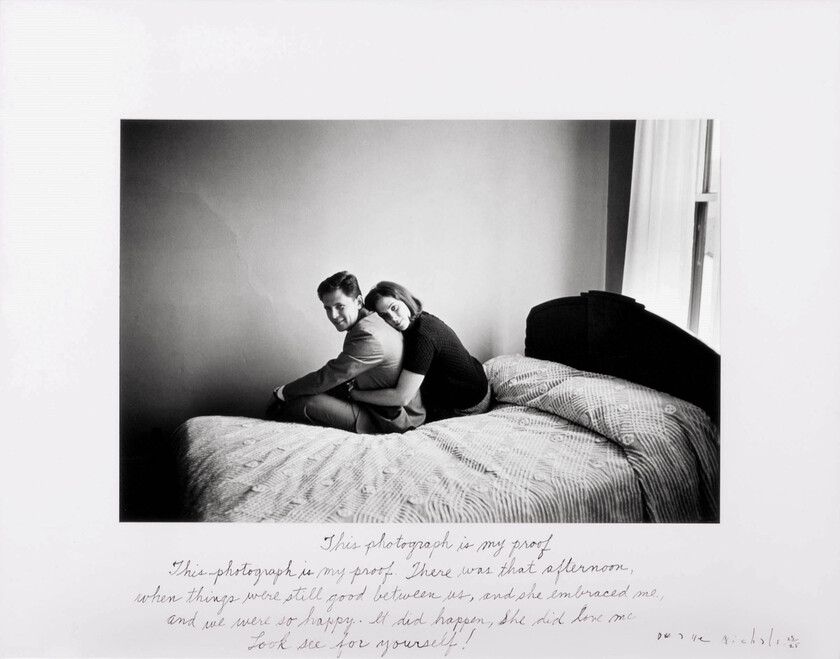
Duane Michals – This photograph is my proof (1974)
This image is a further example of how the additional information can have an equal standing to the image, but in this case the wider interpretation of the photograph leads us to something almost unrelated to the subject.
‘This photograph is my proof (1974)’, by Duane Michals [4]
Michals presents us with a photograph of a couple in embrace, sat on bed and obviously posing for the camera. This then is a self-portrait similar to the sort that we see everywhere with the advent of ‘the selfie’. There is clear affection in the way the couple are connected in the image, but the accompanying text seeks to steer us to a situation; the affection that was once there but no longer. In this sense, the text has a feeling of ‘anchor’ about it; directing the viewer to a certain conclusion. However, the text also offers something more broad than the instant conclusion that we may have already reached:
“This photograph is my proof. There was that afternoon, when things were still good between us, and she embraced me, and we were so happy. It did happen, she did love me. Look and see for yourself.”
The text starts with a suggestion of dishonesty. The photograph is ‘my’ proof, as if it has been suggested that the claim was false. It then proceeds to describe a point in time when things were good between the couple, clearly not the current situation. The relationship could have ended for a number of reasons, but I naturally find myself assuming an acrimonious split. The element of disbelief continues with the claim that it was real; it DID happen. The last sentence invites the viewer to see for themselves. This is perhaps the most interesting element of the text, because it now asserts that the photograph must be telling the truth. We already know that the truth of an image is entirely subjective as opposed to objective, so what the photographer is saying here is that this proof cannot be challenged by the viewer. It could almost be seen as the evidence in a court case, perhaps even a divorce proceeding. What I see when I put the image and the text together is someone daring me to disagree. As the photograph was taken in 1967, the additional context of the time that has passed suggests to me that perhaps this is a take on ambivalence in a relationship, a taking for granted of the people we love. Perhaps this is supposed to be a warning to me and my generation that love is something that evolves in a way that we don’t necessarily expect, the longer we have it in our lives. I guess that depending on our own life experiences, each viewer is going to be inclined to either agree or disagree with Michals’ version of events.
In a similar vein, I was drawn to the other work in the course notes but Sharon Boothroyd. The series Disrupted Vision tells a story of clashing perspectives through a series of instant photographs. Boothroyd asks her subjects for their perspective on the picture that she has just shot of them, which in itself is a major advantage of using instant film. The immediate reaction of the subject is more often than not contrary to the intentions of the photographer. There were three images from that series that I wanted to discuss here. Unfortunately, I am unable to find the series on Boothroyd’s website (or anywhere else online) to include here.
The first is of a man standing in front of a fairground stall, holding his bag of chips. His reaction, written a on the bottom of the photograph is his commentary on his appearance rather than anything to do with the setting of the photograph. It’s undoubtedly not what Boothroyd had in mind with the selection of subject, background and his relaxed pose for the portrait. However, like the other examples of Relay, the inclusion of the text gives alternative meaning to the image. The subject has a voice with regard to his appearance in the shot that he agreed to and we are going to hear it.
The second image is of a man standing in front of a leafy background, holding some flowers. Again, the pose is simple enough and again the subject offers their opinion on the image but this time its about how to improve the picture. His reaction that it would have been better without his coat suggests that there was something more interesting in his clothing underneath or that the picture is fairly dark already; his coat doesn’t really contrast with the scene. The viewer can decide for themselves whether they agree with the sentiment which leaves plenty of ‘space’ for the narrative to be created.
The final image is of a man seated on a park bench. This time, the text is a very pointed question of the artist’s photographic skills and knowledge. His reaction is potentially based in some knowledge of the medium and rather than being a passive voice in the final result, is vocal is what appears to be disagreement. When the text is used with the picture, instead of a clash of meanings we have something that is almost in agreement. The subject’s expression is uncomfortable, his agreement to be photographed looks like it was more of an inconvenience than the other two shots and the whole demeanour of the image lends itself nicely to the text. The ironic inclusion of the criticism of the lack of the use of the rule of thirds is contrasted with the use of a Polaroid camera, which in itself is more artistic than of technical photography.
Conclusion
This exercise has been very interesting. We have the contrasting use of additional media that supports or contrasts with the seemingly obvious interpretations. We have the very specific Anchor text that leads us straight to the predetermined meaning, such as the traditional addition of photographs to written journalism. We then have the interesting takes on how media can be used and where it can be sourced from. I liked the way that Rickett had the subject of her work read her description of their encounter and subsequent collaboration over footage of him at work. That video highlighted the difference in their perspectives on his scientific work, while showing her clear respect of his achievements. The series of reproduced photographs are uplifted from their original context to be part of Rickett’s narrative. It’s a fascinating piece of work. I also loved the way that Boothroyd included the perspectives of her subjects to challenge the obvious imagery in her Polaroid photographs. I’m reminded of the reactions of some people to my use of film in my photography, which on occaision poses the question “why would you use that? It’s not as ‘good’ as digital”. The ‘goodness’ being referred to is their perspective on what makes a good photograph rather than what the artistic message may be. Boothroyd’s subject who challenges her for not following the rule of thirds is a powerful statement on photographer vs. subject vs. viewer and it’s my favourite of the series.
The two photo essays we have looked at so far draw on other media to enhance the strength of their messages. In the case of Smith’s work for LIFE magazine, the pictures were set against a written text, mainly because of that was the way the stories were being consumed by the readers. In the case of Briony Campbell, the text was also accompanied by a video that contained interview segments with her father. During the video, he doesn’t once refer to the work itself either as individual images or as a series. His testimony of sorts, seeks to add the context that begins the project and his wishes for its purpose as a father-daughter bond and catharsis for his family upon his death. In both cases, I find that the supporting media adds to, but does not detract from the ability of the images to tell the story on their own. This is my starting position in entering this project.
Roland Barthes (1915 to 1980)
Barthes was a literary theorist and philosopher who’s two works Death of the Author and Rhetoric of the Image are presented to us. The former asserted that the author was not some creative genius that should be lauded for their own original ideas; that their work was in fact an assembly of ideas that span a huge range and variety of cultural references. The ideas of structuralism with its categories and classifications was said by Barthes to lead the reader through the story aligned with conventional signposts with the result that the reader believes they understand the original intention of the work. Barthes encouraged the reader to stop being so passive in the way that they consumed the story, picture or artwork, instead encouraging them to apply their own experiences as if they were completing the narrative. The effect of Death of the Author was to create more challenging and obscure work that demanded the viewer to work harder to gain a sense of the story.
The second essay introduced the concept of Anchor and Relay to describe the purpose of accompanying text. Anchor being more akin to the news media, where the text controls the narrative in a very specific way in order to avoid any misunderstanding. This description matched my view of Paul Seawright’s Sectarian Murders that we studied in Part 1 [1]. The application of very specific text lead the viewer to see the work and all of its cleverly applied layers to the narrative that this was all about murder. In the case of the image that I looked at in the series, the blended use of the factual statement of what occurred in the drive-by shooting and the emotive sadness of the way the boy died, leave the viewer in no doubt that something terrible happened in the scene. Without the accompanying text, the photograph has multiple meanings that I could bring my own experiences and political viewpoints to when looking at it. However, I don’t because of the very specific nature of the Anchor text.
For me, the Relay is how I would describe the use of the video in The Dad Project. It seeks to almost lead the viewer away of the sadness of losing someone to a long, debilitating disease and leave enough space to interpret as a testimonial. The interview with her father looks at his letting go of the idea of being the provider of the family and he desire to explore a slightly different relationship with his daughter while he has time. In this case, some of the imagery that is included in The Dad Project isn’t just about the sadness of the subject. The image below is an example of the effect of Relay for me.
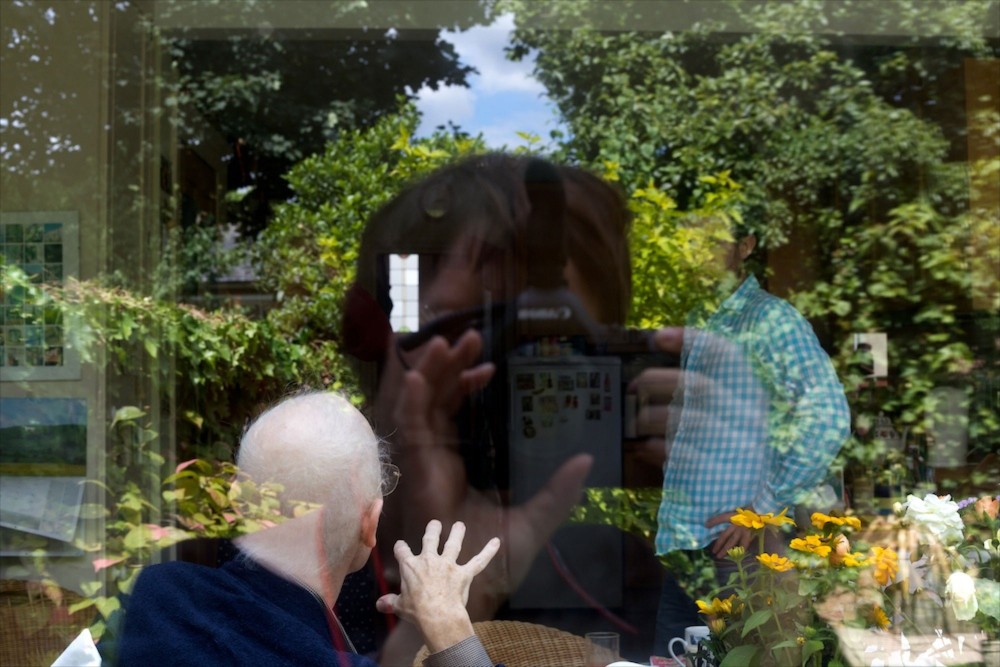
‘Family Portrait’, by Briony Campbell (from The Dad Project) [2]
Here we have a slightly abstract portrait of her father and brother in conversation in the kitchen of their home, shot through the window glass. The composition is interesting enough with Campbell and her camera being visible in the frame as well as the reflected outside detail overlaid on the kitchen items (such as the refrigerator). Campbell’s father is clearly ill, but the image doesn’t speak to me of sadness, but much along the sentiments of the video that accompanies the series. However, it is the title that goes with this image that invites interpretation without being constrained by Campbell’s intentions for the image. ‘Family Portrait’ is a simple setting of the scene. It’s up to the viewer to judge the mood of the image for themselves. To me, this is a happy exchange between father and son, being observed from outside the relationship by the daughter. She is both insider and outsider to the scene and the jumbled effect of the inside and outside elements in the frame further enhance that.
Conclusion
I read both of Barthes’ texts and, like many found them difficult to grasp in their entirety. From my understanding of the essays, I believe that in the case of Death of the Author Barthes began by challenging the traditional notions of originality in writing and asked the reader or viewer to take focus instead on what they bring to the understanding of a piece of work rather than trying to get to the ‘true intent’ of its creator. The idea that we can never know what the original intent of a work is, but instead bring our own completing piece of a narrative through our understanding and experience, makes sense. However, I can well believe that this was considered a controversial shift in thinking at the time of its publication, particularly with the literary authors of that age. In his video explaining the essay [3], Tom Nicholas refers to the way that J K Rowling continues to re-visit her Harry Potter series, perhaps to increase the volume of information that supports her original intent for the characters and the story. Far from being a straight-forward embellishment, the effect on the readers could be a sense of distrust of Rowling, brought about by her intrusion on their narrative, created over a number of years and readings of the texts. When I reconsider The Dad Project with this in mind, I then start to recognise myself trying to interpret what the purpose of the essay was. As I ‘consumed’ the information as laid out on Campbell’s website, I was directed away from how the series made me feel and more onto how she felt. Perhaps there is such as a thing as too much information.
When presented by Barthes’ analysis of the messages in advertising, I understood the way that text with an image could control the narrative in a recognisable way. In the case of the Panzani advertisement, the idea of Italianicity is created through the eyes of the French culture through the mix of native language and label names. Barthes points out that an Italian wouldn’t have necessarily observed the impact of the labels as the image of what ‘looks Italian’ is different within the culture from outside of it. The concepts of Anchor and Relay made sense to me in that we see examples of both in everyday life without ever noticing them.
References
[1] Fletcher, R, 2020, “Project 4: The Gallery Wall – Documentary as Art, OCA Blog Post, https://richardfletcherphotography.photo.blog/2020/05/12/project-4-the-gallery-wall-documentary-as-art/
[3] Nicholas, T, 2019, “The Death of the Author: WTF? Roland Barthes’ Death of the Author Explained, Youtube, https://www.youtube.com/watch?v=B9iMgtfp484
How does Bryony Campbell’s The Dad Project compare to Country Doctor
What do you think she means by ‘an ending without an ending’
In Project 1 I discussed the two photographic essays Country Doctor and The Dad Project [1]. This exercise reviews the differences between them.
Similar But Different
I think the first fundamental difference in the two series’ is how they came about in the first place. In the case of Country Doctor, we have an assignment for LIFE magazine and although we cannot be sure how the subject was chosen or how much of it was Smith’s natural observation, there is an element of editorial motive in the series. The story being told is a remote perspective of life in a rural community and the hard work of the local physician. The documentary style of the story is clearly aimed at informing an audience that is not all that familiar with the subject with a feel-good element of knowing that such heroic people exist in the country. The audience then is perhaps akin to a collection of movie-goers who bring to it little or no predetermined knowledge of the story before it is told. The series is powerful and it is shot as if a window on the doctor’s working life, but Smith put himself in the environment to such an extent that he was a silent participant in the events that make up the story. It is clear from the photographs that he would have reacted to the situations both as the photographer and as the audience. From a narrative perspective, Smith builds complex layers in the sequence by including elements that are obvious to the viewer and those that need more thought. In the shots where the doctor is not the central focal point of the composition, the viewer has to reach their own conclusion as to what is going on, e.g. the doctor treating the little girl’s broken arm [1].
In Campbell’s essay, we have a much more intimate story being told. This time, Campbell includes herself in the story, both as daughter and photographer. The story is about her saying goodbye to her dad, which meant that she had to capture the relationship as if she wasn’t the photographer. This ‘insider’ perspective is the first difference between the two stories. The second is that her father actively participated in the story. Some of the shots in the series had his direct engagement, something that wasn’t present at any time in Smith’s work. The accompanying video to the series further emphasises this point and perhaps a very obvious difference in the use of mixed media. Technology allowed Campbell’s father to describe what the project would mean to him in a contextual way that was not available to Smith in 1948. Campbell’s use of subjects other than her father is similar to Smith’s in making the viewer look for the meaning rather than being signposted to it. She also uses compositions of seemingly unconnected subjects, such as the spilled milkshake alongside more obvious imagery. In the case of the milkshake, Campbell’s father had dropped it on the floor in a minor accident caused by his declining strength. Alone the shot doesn’t tell us much, but woven into the sequence, it gently points us to the shift in what is normal. Campbell describes the series as gentle and quiet, which comes through strongly as the the story progresses. Contrasting with Smith’s often dramatic images of surgery and the doctor’s exhausting work, Campbell’s work doesn’t set out to make us feel a particular way. Instead it relies on the viewer knowing enough about the pain of losing someone to cancer as a backdrop. With the current pressures of daily life with COVID-19 and my own personal experience of losing my mother to cancer, I procrastinated about completing this research work and writing because it was just too hard. While Smith’s work won acclaim for its clever storytelling, Campbell’s has been praised for offering comfort to people who are experiencing similar losses.
An Ending without an Ending
The second part of this exercise asks about the statement made by Campbell in The Dad Project. My thoughts on what she meant by this centre around the way that the narrative doesn’t end with the photographs themselves. This series walks the viewer through the final months of her Dad’s life from the perspective of him fading away, but also the struggle of his family to adapt to the dynamic nature of his decline. Campbell states that it was a way of saying goodbye to him with the help of her camera, but his death in many ways was the start of the project. What I mean by this is in the same way that a death begins the process of mourning, it is also in this case the beginning of the response to the work. In her appraisal of the project Campbell writes as a retrospective some 3 months after his death. The ending without an ending for me is the ongoing story of Campbell coming to terms with her loss through reflecting on both the work and the way people respond to it. As Campbell states in her writing, the effect of the project of spreading her grief out means that it takes on different meaning with the passing of time. In the short term, the story would be raw and painful but with the gathering interest in the work it would become more of a celebration of her father. She writes that she wishes he could read the letters she had received in response to the project’s publication, because it would have given him a sense of pride.
When compared to Country Doctor, which documented a slice of the life of someone fairly anonymous to the photographer, The Dad Project is clearly acting as a catharsis for Campbell many years after it notionally ended.
We are introduced to W. Eugene Smith’s 1948 photo essay called Country Doctor, which was published by LIFE magazine. It is a series of photographs of a rural physician called Dr Ernest Ceriani, who allowed Smith to follow him around his daily life treating his patients. The course notes refer to Smith having shot without film in his camera in the early stages while Ceriani became comfortable with his presence. There are many stories of photographers using such techniques to relax their subjects; I am reminded of the story of Tony Vacarro, another photographer who worked for LIFE at the same time as Smith, who outsmarted Picasso during a shoot [1]. Picasso had a tendency to pose for photographers that Vacarro didn’t want in his images. In order to catch him off-guard, Vacarro pretended not be working, instead relaxing with Picasso as friends would. Once he saw his subject off-guard, he shot his portrait. What I see when I look at Smith’s Country Doctor is a man who is completely undistracted by the presence of the photographer and his camera. In every shot, Ceriani is pictured focusing on the job at hand, which his patients more interested in the attention from the doctor than the photographer documenting their treatment.
The Series
I’ve picked out a few of the images that stood out for me in Country Doctor and describe here why they had an impact on my from a story-telling perspective. These are part of the linear sequence as published by LIFE Magazine.
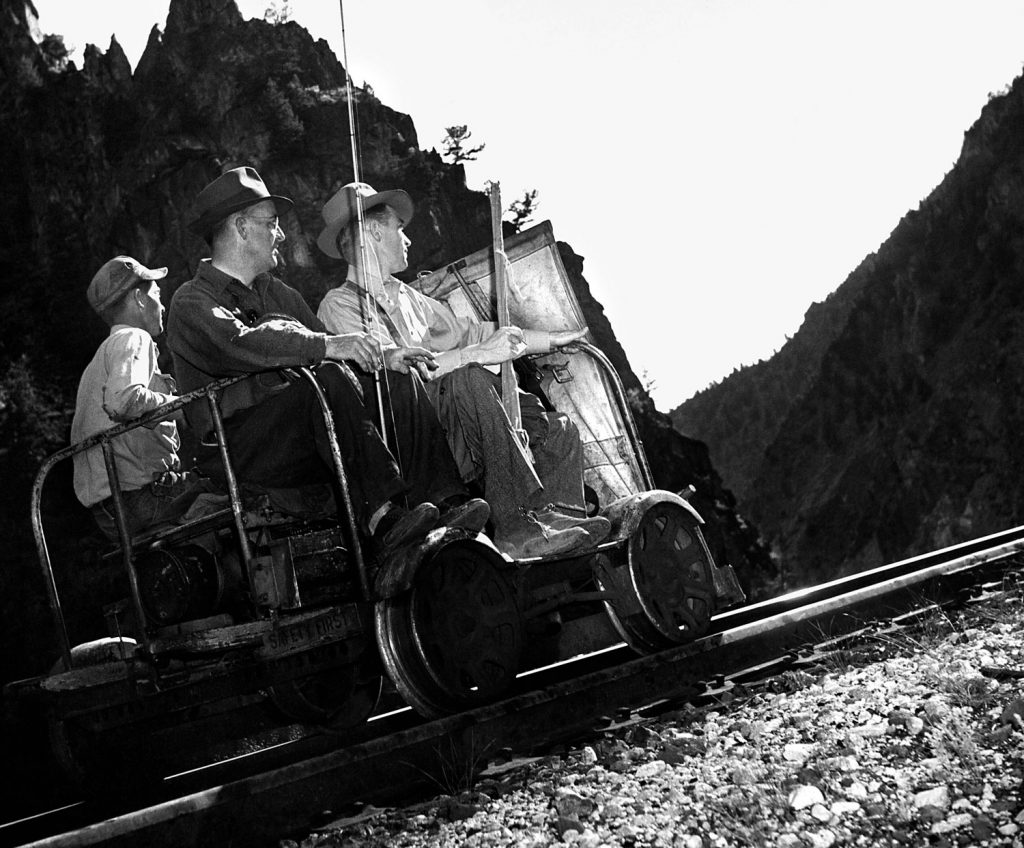
Two friends transported Dr. Ceriani to Gore Canyon so he could enjoy a few hours of recreational fishing, a rare treat for the hard-working physician. [2]
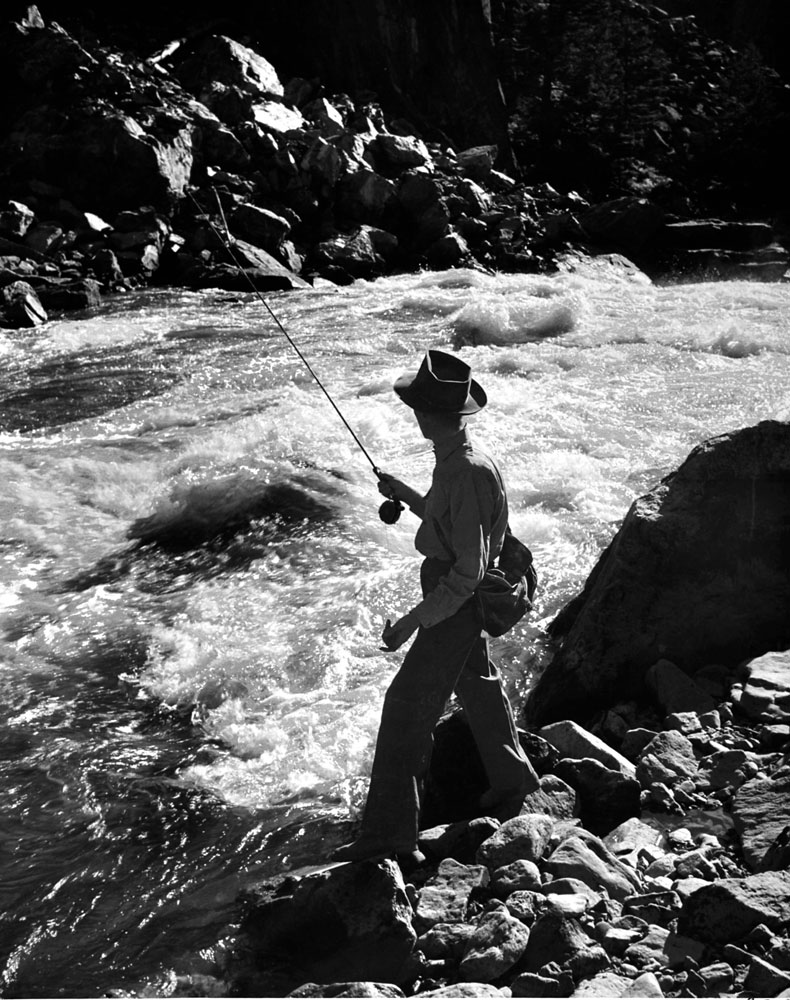
Dr. Ceriani fly-fished on the Colorado River. [2]
Thirty minutes into his fishing excursion, Dr. Ceriani was called to an emergency: A young girl has been kicked in the head by a horse and was badly injured. [2]
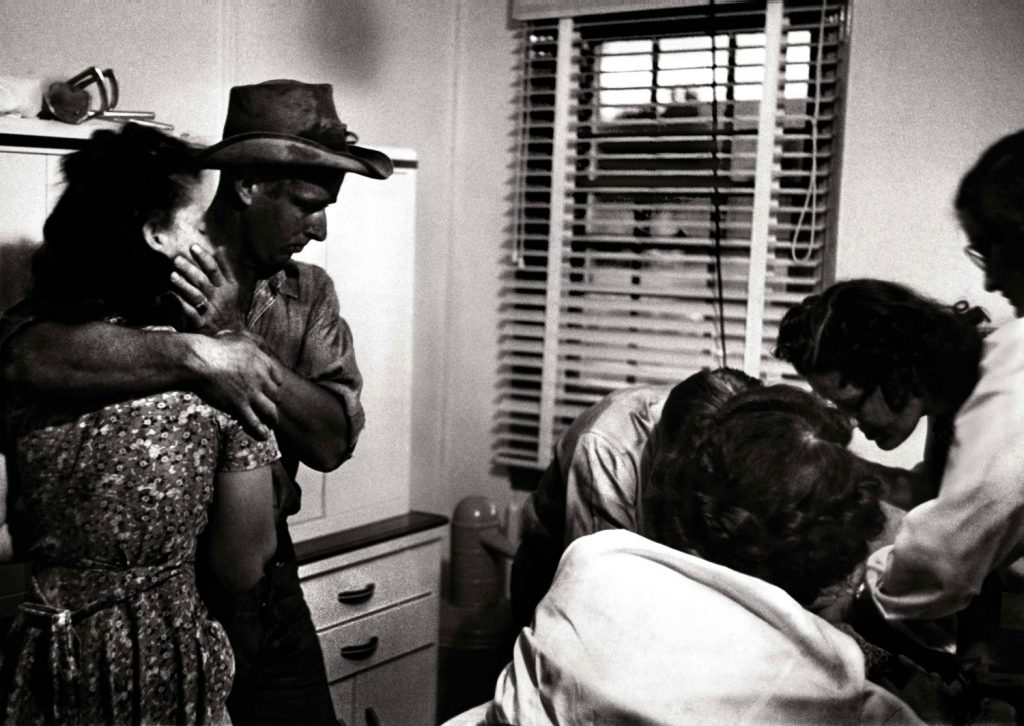
The child’s worried parents looked on as Dr. Ceriani, surrounded by nurses, examined their two-year-old daughter. [2]
Analysis
In this sequence, which is shown in its chronological order as published, we see Dr Ceriani heading along a railway track with two people and fishing equipment. The caption informs us that this is a rare and well-earned break for the doctor, which fits with the photographs of him working hard that precede it in the series. The caption adds some context to the photograph. The next shot is of the doctor enjoying his fishing trip in a simple composition by the Colorado river. The next photograph is of the doctor back at the rail car, this time with a policeman in attendance. The caption tells us that there has been an accident where an little girl has been badly injured. The doctor is being interrupted from his trip to attend to the little girl. The final image shows the doctor tending the girl’s injuries as the anxious parents look on.
What struck me about this sequence was the way that there are sufficient elements within the frame to tell the story without the captions being added. The inclusion of the details such as the fishing rods in the first photograph and the policeman in the third suggest recreation that is being disturbed for some serious reason. The shift from a man enjoying his break to the professional working on his patient is made more obvious by the way that Smith makes him a non-essential part of the final frame (in fact we can barely see him). The drama first introduced by the policeman in number 3 is increased with the worried expressions on the faces of the girl’s parents and the activity going on at the right hand side of the frame. The layers of the sequence build with the increasing number of elements included in the compositions. The emphasis moves away from the doctor as the main subject and the addition of the text narrative in order to tell the story, which has the little girl treated successfully in the subsequent frames. However, this is only a small part of the essay that Smith created. He shot the doctor making house calls for minor ailments, building relationships with this patients and moving on to facing increasingly challenging situations with more serious illnesses. The story that LIFE published, highlighted through Smith’s essay the challenges of living in rural America and the dedication of the care services that are at the heart of the community. However, Smith regularly had disagreements with the way that LIFE presented his work because he had carefully crafted the linear sequence, which they regularly ignored [3]. In Cosgrove’s article [2] there are a number of photographs that depict the doctor in a less dramatic situations, such as delivering a baby, that were not published by LIFE at the time. While Smith would have undoubtedly wanted to portray Dr Ceriani’s more routine activities, perhaps LIFE felt that it diluted the impact of the story. With editorial control, they would have published what they thought would be more impactful to their readers.
Smith’s series is considered a landmark in photojournalism and it easy to see why. The contextual elements in the pictures and the layered stories that play out in the sequence make it a powerful collection that is still relatable nearly 70 years later.
Bryony Campbells’s The Dad Project (2009)
The second photo essay we were introduced to was Bryony Campbell’s ‘The Dad Project”, which told the story of the final months of her father’s life suffering with cancer. I found this photo essay particularly difficult to look at as it mirrors my own experience of the death of my mother 25 years ago. I think the reason it was so difficult is the way that Campbell approached the project. In the video that accompanies the work [4], we first see an interview with her dad in which he describes the thought processes and emotions surrounding the original request to shoot the project. Campbell’s father talks about the opportunity the project offered for him to learn more about what his illness meant for his daughter and in a way understand her more. He also wrestled with the idea of not being the main source of care and support to his family as he saw his health decline. The project would be something for the family to collectively focus on instead of the awful nature of his illness.
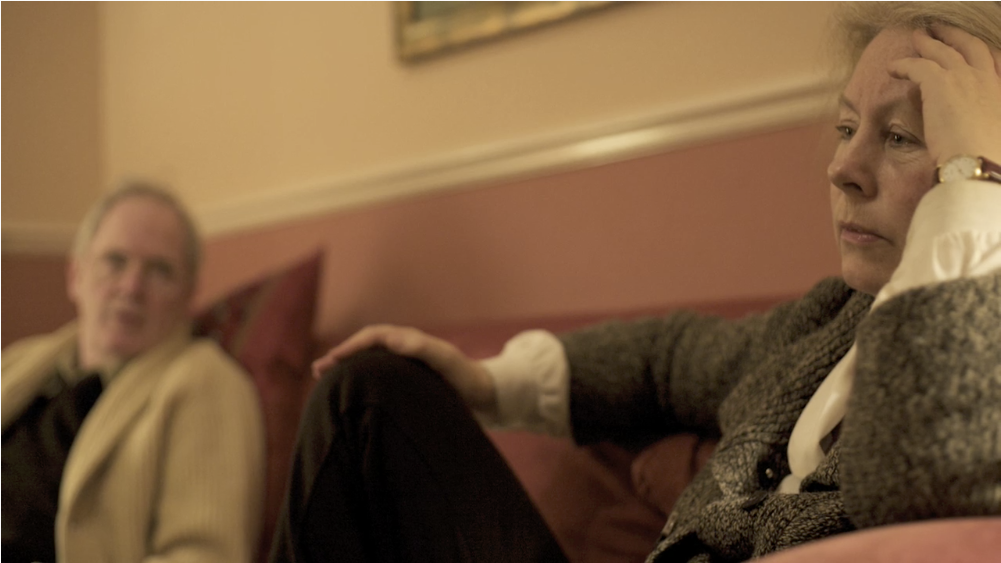
The series itself tells a number of stories through the use of a different subjects. The first layer is obviously pictures of her father. He appears as one would expect, to decline in health as the series progresses with the obvious physical effects coming out in the images. The next layer is his family. Campbell uses images of her family and self portraits to describe the more mundane acts of looking after her father as well as the intense emotional reactions to his condition. One of my favourite shots from from the accompanying video is a shot of her parents in conversation (below).
Screenshot of The Dad Project by Bryony Campbell [4]
Campbells father is talking but the point of interest in the photograph is her mother who has a distant, almost vacant stare. The expression on her face reinforces some of the earlier imagery and the video in which the positivity of Campbell’s dad comes through. My own experience echoed this narrative as my mother was optimistic and practical throughout, while her family around her struggled to keep it together. The final layer for me is the use of the inanimate but related objects. There are photographs of the sun shining through trees, empty glasses and milk bottles that emphasise the normality surrounding the family while the story plays out.
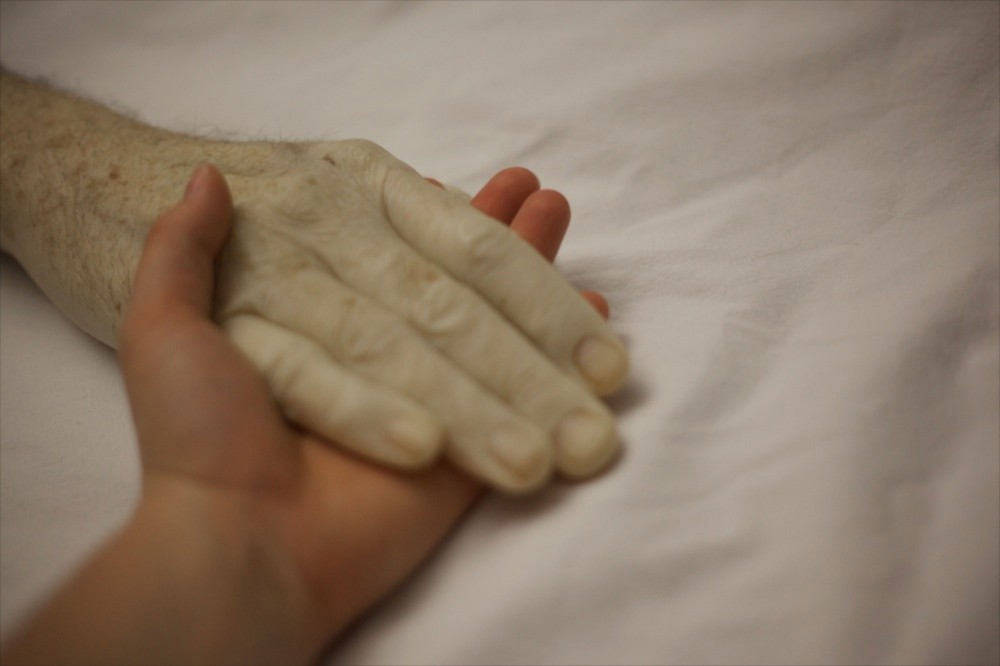
What struck me about Campbell’s description of how she went about the project [5] was her initial reluctance and discomfort about whether to tackle her father’s illness using photography. Like most people she continued to doubt her decision to start the project as it progressed and only when it became an established part of her family’s experience did she start to appreciate the part that her photography was taking in her coping with the situation. One telling moment in the text is after her dad had passed away when her mother asked if she had enough photographs. Perhaps the most powerful image in the series was taken after his death (below)
Me and Dad, 2009 by Bryony Campbell [5]
Here we have Campbell holding her dad’s lifeless hand, which shows the dramatic change in appearance when a body is no longer living. I love this photograph because of the stark contrast and obvious statement that here is a man who has gone, but also because it serves as a loving close of the series, with the comforting way Campbell cradles her dad’s hand.
Overall, this project has looked at two very similar but different photographic essays, both in subject matter but also approach. Exercise 2.1 explores The Dad Project further in relation to Smith’s Country Doctor.
References
[1] Kasfikis, P, 2016, “The life of Tony Vaccaro: A Lens into Modern History, Medium Magazine, https://medium.com/vantage/the-life-of-tony-vaccaro-a-lens-into-modern-history-4d0e422b73eb
[2] Cosgrove, B, 2012 “W. Eugene Smith’s Country Doctor: Revisiting a Landmark Photo Essay”, LIFE Magazine, https://www.life.com/history/w-eugene-smiths-landmark-photo-essay-country-doctor/
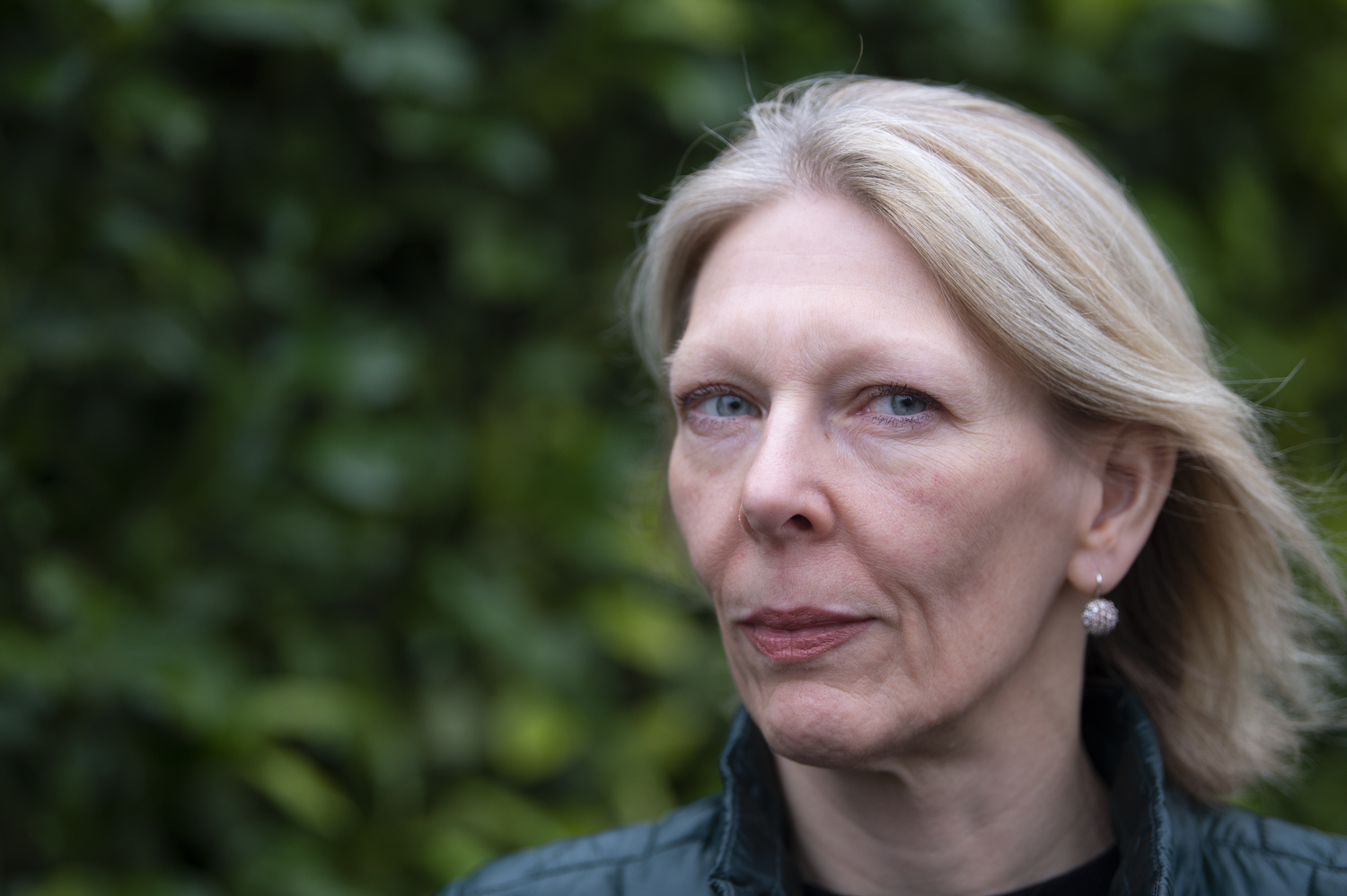
Find a location with good light for a portrait shot. Place your subject some distance in. front of a simple background and select a wide aperture together with a moderately long focal length such as 100mm on a. 35mm full-frame camera (about 65mm on a cropped-frame camera). Take a viewpoint about one and a half metres from your subject, allowing you to compose a headshot comfortably within the frame. Focus on the eyes and take the shot.
My Image
Jayne
Reflection
I shot this photograph in overcast light against the backdrop of a large laurel hedge. The focal length was 105mm and aperture f2.8 with an ISO of 400. By getting Jayne to turn her head and look at the camera, only her ‘leading eye’ was in focus. This is a fairly common practice in portraiture and in this case I wanted to get across how the depth of focus rolls off over a short distance. The viewer’s eye is drawn into her gaze with the soft detail of her face completing the knowledge that we are looking at her face. By the time we get past the hair and into the background, the main feature is the deep green of her coat and the background becoming just a texture.
I’ve not taken many portraits, but the ones I have shot have benefitted from reducing the number of distractions in the frame. Large apertures and flattering focal lengths (anything over 50mm) help focus on the detail and reduce any lens distortion.
When I first started taking photographs as a child, my keenness to operate the camera correctly far outweighed my concentration on what I was pointing it at. If a photograph was, albeit it accidentally, exposed correctly then the result would be straight representation of what I was looking at. Needing no skill beyond pressing a button and waiting for the film to be processed, this child-like documentary vision was easy to achieve and its importance as a piece of work, fairly trivial. I was listening to a podcast recently where one of the hosts talked about ‘found film’; that is film left in cameras that he had purchased in a thrift store or flea market. He was routinely processing these rolls and in many cases finding photographs that were like my early efforts. What was interesting was that many of these fairly uninteresting photographs were shot over 50 years ago. The fact that they were straight documentary wasn’t interesting but the clear view of how the world and subjects had changed over that time, elevated the images to art.
“Deep focus gives the eye autonomy to roam over the picture space so that the viewer is at least given the opportunity to edit the scene himself, to select the aspects of it to which he will attend” (Bazin, 1948).
The Bazin quote rings true in the above case because as the eye wanders the frame, the passing of the time since the photograph provokes either a feeling of unknown (if the viewer has no memory of the time) or the familiar in the case of the older generation.
Ansel Adams is one of my favourite landscape photographers but although I’ve marvelled at his famous works like most others, his main influence has been technical. Through his collection of books: The Camera, The Negative and The Print, I’ve sought to improve my technical skills in both film and digital photography.
In his early years as a photographer, he used technical skill to enhance or emphasise beauty in an image, to move away from the mechanical representation of the subject. The more pictorial style [4] was still very evident in photography during the early 20th Century, so it was a natural reaction to want to embellish the image to stand out from the crowd. When Adams encountered Edward Weston and Dorothea Lange and went on to form the f64 group, his view had changed dramatically to using photography to reveal what is already there, concluding that there was beauty to be found in the subject already and that it was the job of the photographer to bring it out. Small apertures were the way to achieve this. Weston said his own work “Such prints retain most of the original negative quality. Subterfuge becomes impossible. Every defect is exposed, all weakness equally with strength. I want the sharp beauty a lens can so exactly render,” [1]
Adams went on to demonstrate the power of this approach to landscape photography to influence the politics around nature, wilderness and the environment; most notably in putting the case for the Kings Canyon National Part in Sierra Nevada. The staggering detail and beauty of his work proved persuasive in the argument being put to the National Park Service.[1]
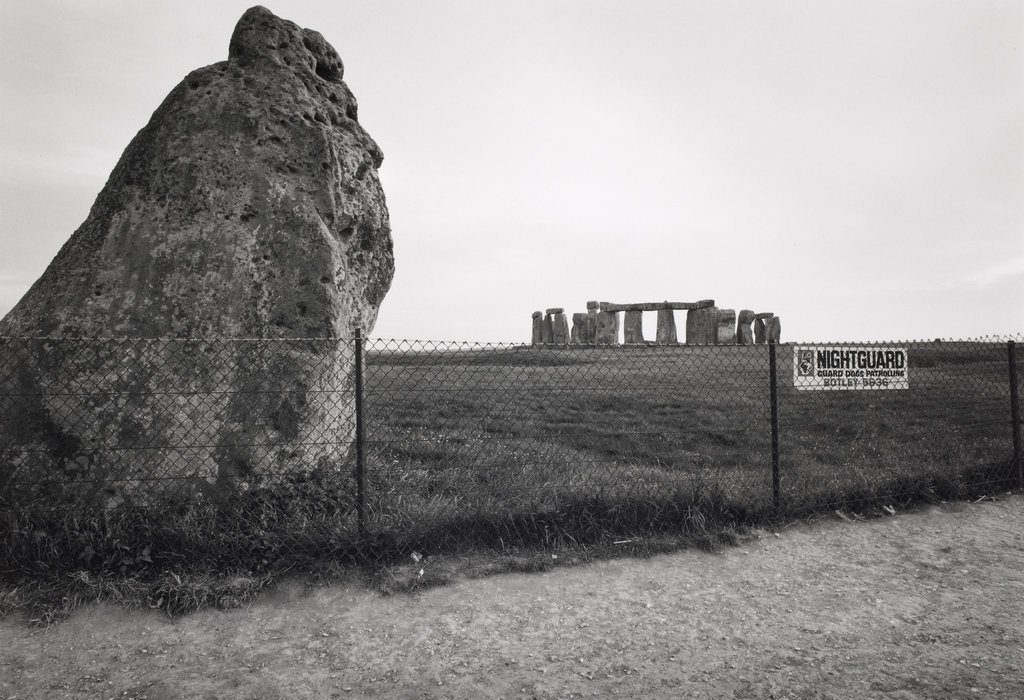
What I find interesting about this approach is that the need for strong composition, light and being able to see the moment are even more important if the photographer wants to convey beauty than if lens distortion is being used to focus awareness on a particular element in the scene. In the case of the photograph in the course notes by Fay Godwin (below), the subjects and their relationships to each other already have the potential to tell their story. Careful composition and large depth of field avoid tricking the eye with perspective and exaggerated depth or space.
Fay Godwin, Night Guard, Stonehenge
In this image, the large rock anchors the sense of space and points to natural history, while the ancient monument of Stonehenge invites the eye into the frame. The difference in size of the structures asks questions about whether the large rock is a natural occurrence and whether it is dominating the impact of man. The final element in the frame is the closing off of the subject. The fence and its clear guard measures deliberately prevent the viewer from investigating the subject further. This photograph holds attention because everything is sharp and while wide angle, the perspective doesn’t create a sense of unreality.
By stark contrast, the work of Gianluca-cosci adopts extreme shallow depth of field to lead the viewer to the obscure but recognisable. In his collection ‘Panem et Circenses’, he often uses the camera on the ground to create a large textured out-of-focus region to exaggerate the perspective. Interestingly, not all of the sharp subjects are actually sharp which is as if the photographer wants the view to decide as opposed to automatically seeking out that point. The lessons from the Woodpecker exercise are evident here, with the view appreciating the soft, texture and colour of the bokeh without it being a distraction. For me, the choice of subjects for the collection don’t work on a personal level in the same way as with Mona Kuhn, the other photographer mentioned in the course notes as while I appreciate their aesthetic qualities I find it difficult to connect with what they mean as an intimate collection.
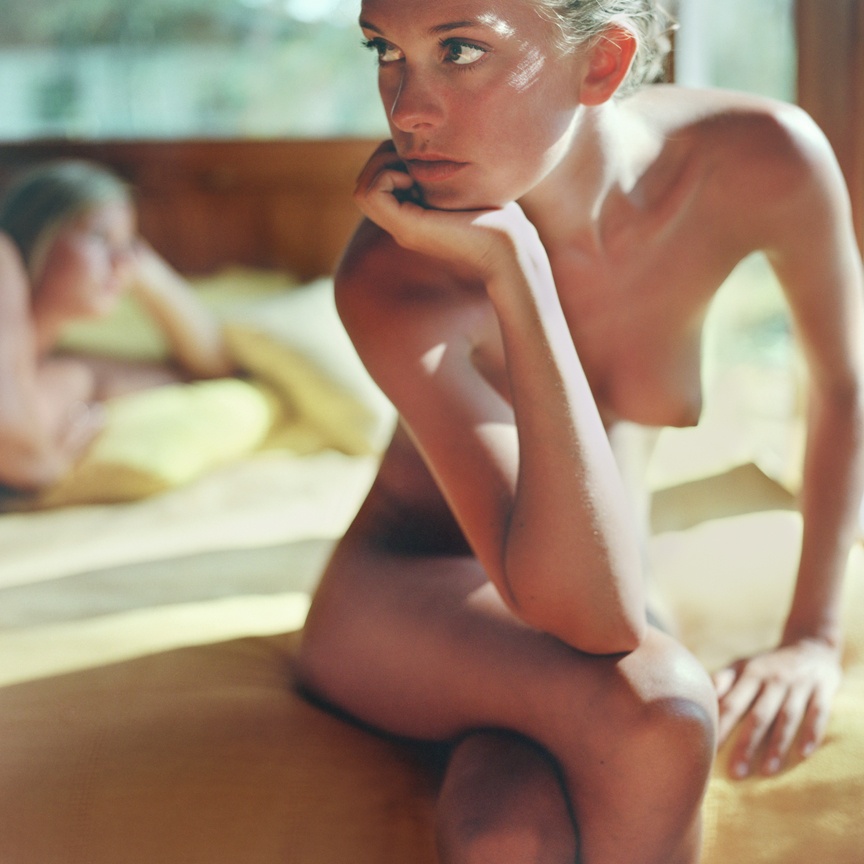
Mona Kuhn’s collection ‘Evidence’ takes the very familiar subject of the naked body and creates a strikingly intimate aesthetic. The achievement through her approach is to reveal beauty, ask questions using what isn’t in the frame and keep the viewer’s attention through the interest in the out-of-focus regions. A good example from that collection can be seen below.
Fatale, Mona Kuhn, from the series ‘Evidence’
What we see here is a beautiful woman sitting on the end of a bed that has another girl on it. The point of focus is the eyes which are looking out of the frame at something unknown. The fact that both subjects are nude suggests an intimate moment, but steers away from the overtly sexual. The demeanour of both women is ambiguous and more thoughtful than passionate, so what is going on here? Are they lovers who have had a disagreement or are they sharing a daydream moment together? The title of the photograph suggests danger or seduction, so why the separation. I really like this photograph because it doesn’t conform to the rules of composition and majors on an aesthetic that could only really work with a shallow depth of field; the impact and mystery would have been reduced if any of the other detail in the frame was embellished in any way.
The conclusion of the exercises in Part 2 refers back to how photographers have forged their own way in expressing their vision. Looking at my own historical work, I’m honestly unaware of any conscious decision to use depth of focus in the ways described here. However, when I moved on from the style, or lack thereof, I had when I was a child, I have tried to keep composition simple and used both perspective and depth of field to steer the viewer to the heart of the photograph. Of the works that I’ve looked at in this project, it’s Mona Kuhn’s collection that is most powerful to me, which isn’t a surprise when shallow depth of field has been a tool I’ve used many times in my photographs. What is different here is it’s use to create an aesthetic.
My image
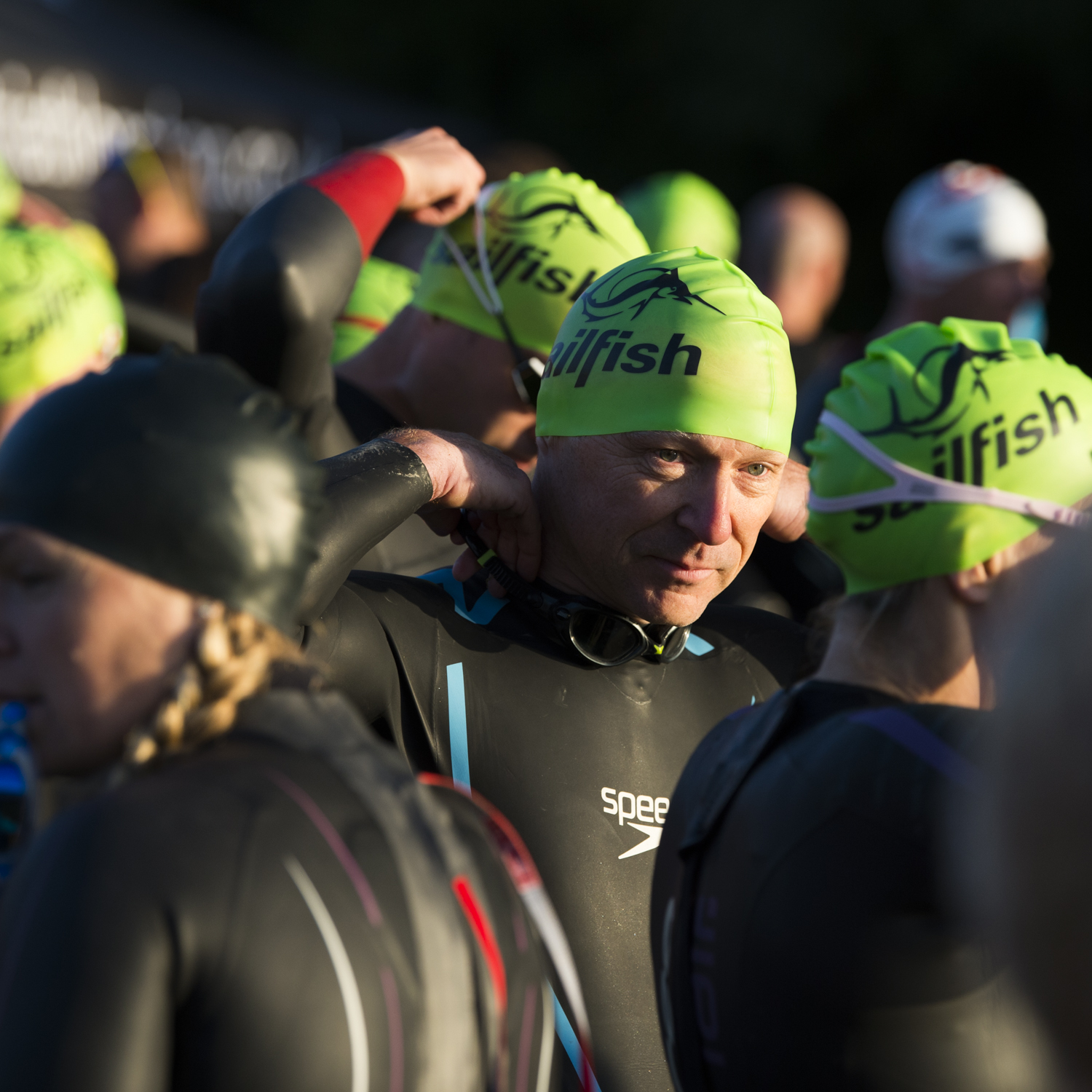
Confidence, R Fletcher, 2017
I shot this photograph of my friend Clive about to take part in a long distance triathlon a couple of years ago. The first discipline in the race is an open water swim, which well known to be the least enjoyable event for him. Using a long telephoto lens at f2.8, I wanted to isolate Clive from the rest of the swim pack and with the early morning sunlight, I really liked this image. I’ve called it ‘Confidence’ as with the Kuhn photo above, there is not obvious story here. In actual fact, he is looking at the lady in front of him who is his wife. They frequently take part in events together and when I look at this image, his expression points to looking for a sign that the race will be ok.
References
[1] Robert Turnage, The Living Wilderness, reprinted by The Ansel Adams Gallery
Find a subject in front of a background with depth. Take a very close viewpoint and zoom in; you’ll need to be aware of the minimum focusing distance of your lens. Focus on the subject and take a single shot. Then, without changing the focal length or framing, set your focus to infinity and tone a second shot.
Without moving the camera, select a very small aperture and find a point of
My Approach
Using the same camera setup as the previous exercise, I found an old wrought iron gate at the end of a pathway to shoot.
Photo 1
Photo 2
My first attempt at this exercise wasn’t all that successful as I made a simple error that is common with modern zoom lenses such as my 70 to 200mm. The lens has a manual override of the auto-focus function which means that if a subject is locked in focus, the photographer can manual adjust the focus to something different simply by grabbing the focus ring. I always shoot with a single, central focusing point because of my enthusiasm for old film cameras which often don’t have a fancy autofocus system. When I reviewed these images, it was clear that I must have momentarily let go of the shutter release button between frames which allowed the camera to do the focussing for me. In Photo 2, the sign is sharp but beyond that point the effect of using f8 is seen with the railing and dust losing sharpness. I concluded from this that the camera was not focused at infinity.
Second Attempt
This time, I shot through the railings of the bandstand in the Winter Gardens park. In these two photographs, the focus was achieved as directed in the brief.
Photo 3
Photo 4
Reviewing the Images
The effect of leading the eye to the area or subject that is sharp is clear in all 4 photographs. This effect was first highlighted to me long before starting this course, however. During some previous learning it was suggested that I watch a drama programme on television and pay attention to scenes where multiple characters in dialogue with each other. When the subjects are in the frame together, i.e not in individual close-up shots, the camera operator shifts focus between the characters when they speak. The connection between the dialogue (sound) and the action (vision) is made by exploiting the left hemisphere of the brain’s need to look at the subject that is sharp. Throughout the scene, the viewer is aware of the other characters and their surroundings, but don’t consciously look at them until the camera focus changes. This is what this exercise reminds me of and indeed was the most significant shift in my early photography away from simply documenting what I see as ‘photorealistic’. Looking at Photo 3, the detail in the railing really stands out because it is sharp and the shapes lead the eye around the detail of the ironwork. However, the depth of the image is something that the viewer is aware of; there is clearly a path leading off into the distance and some kind of staircase in the distance. The sign on the right only becomes clear when the focus shifts, though. In Photo 1, the viewer can see the detail of the wrought iron and if looking carefully, the tiny lights that are around it. However, the effect of shifting focus in the composition in Photo 2 creates the bokeh effect on one of the lights, which now becomes something the viewer is aware of, even though the subject that is sharp is the sign in the background.
Photo 5
Photo 6
For the third image, I had to return to the subject some time after the original shots. I set the camera to 200mm and selected the smallest aperture possible, which was f22. In order to get a decent exposure, I had to increase the ISO to 3200 to accommodate the low, overcast light. Photo 4 was shot with the foreground in sharp focus, but the background can be resolved easily when looking around the frame. Photo 5 shows the inverse with the focus set to infinity and the detail in the close-up subject being easy to see despite not being the point of focus.
Does zooming in from a fixed viewpoint change the appearance of things? If you enlarge and compare individual elements within the first and last shots of the last exercise you can see that their ‘perspective geometry’ is exactly the same. To change the way things actually appear, a change of focal length needs to be combined with a change in viewpoint.
Select your longest focal length and compose a portrait shot fairly tightly within the frame in front of a background with depth. Take one photograph. Then walk towards your subject while zooming out to your shortest focal length. Take care to frame the subject precisely the same way in the viewfinder and take a second shot. Compare the images and make notes in your learning log.
My Approach
My approach to this exercise was largely driven by the subject, or lack thereof. Instead of a portrait of a person as in both the brief and other student work on this exercise, I elected instead to demonstrate the same effect with an inanimate subject while out walking. I used my Nikon D4 with 70 to 200mm f2.8 lens which combines the ability to zoom over the most generally usable focal lengths and open to a very wide aperture. For this exercise, however I would need a fairly small to medium aperture in order to preserve background detail in both shots, particularly the one a the longest focal length. In this case, when the subject is significantly separated from the background the details are lost when the aperture is too wide resulting in the effect the Japanese call ‘bokeh’.
It was an overcast winter day, so the ISO selected was 800 and both photographs were shot at f8 in Aperture Priority Mode. The subject I settled on was one of Malvern’s Victorian gas lamps.
The Images
Focal length of 200mm
Focal Length of 70mm
Reviewing the images
The first challenge with this exercise was finding a subject that had sufficient room in front of it to allow me to move from the 200mm composition to the 70mm. This lamp is situated on a terrace that provided this distance and also position the subject on a similar plane to my elevation. However, it’s immediately noticeable that the angle changes that are produced by changing focal length and position when recomposing, causes the lamp to appear elevated in the 70mm image. This is most noticeable looking at the top cover of the lamp in the 70mm shot, which looks a little compressed. While the subjects in both photographs look the same, they do have slight differences like this one.
Looking at the background, it is clear the apparent distance to the next pair of lampposts has increased with the shorter focal length and that the tree behind now dominates the background. An expected consequence of using this subject with the sky behind it is the change in exposure between the two images. My camera was set to evaluative matrix metering which takes an average across the whole frame. With the increase in sky behind the subject, the camera’s response was to close down 1 stop to 1/320th second to keep the sky within an acceptable exposure. The result, of course is the subject being underexposed, but I think the perspective demonstration is effective.
In conclusion, I looked at a number of my own photographs using my collection of lenses for the D4. I have previously used lens distortion effectively in landscapes to give depth and portraits to present a pleasing representation of the face, but hadn’t noticed the way the a background changes when the subject is maintained ‘close to normal’.
Find a scene that has depth. From a fixed position, take a sequence of five or six shots at different focal lengths without changing your viewpoint. (You might want to use the specific focal length indicated on the lens barrel). As you page through the shots on the preview screen if feels as though you are moving through the scene.
Research
The course notes make reference to Ridley’ Scott’s Blade Runner, which is one of my favourite science fiction films. I have been a fan in large part because of the close relationship between what could be real science or engineering, and the fiction that the film envelops it in. Growing up, the predictions of this century were all around voice control, self-driving flying cars and artificial intelligence. While cars don’t fly, the rest is pretty much here including the ability to resolve images in ultra-high resolution. Deckard’s scanner is almost real, only separated from reality by the 3D exploration of a 2D image. We can, however forgive that level of artistic licence. In reviewing Google’s gigapixel work, it’s clear that the technology is hugely impressive but the real interest is in what the extreme zoom capability reveals that could be missed from the more distant viewpoint. The painting that caught my eye was Vermeer’s “Girl with the Pearl Earring”, a very famous, and often copied image. I’ve always been superficially impressed by it, but with the gigapixel, the ability to explore the micro detail of the painting gave me a new appreciation of it.
Girl with a Pearl Earring (full size), Johannes Vermeer, 1665
Closeup (courtesy of Google)
Maximum zoom (Google Gigapixel)
The original canvass is only 17.5 inches by 15 inches in size, which makes the detail of the painting closeup extraordinary. Looking at the eyeball itself, we can see subtle shadowing near the lower eyelid and both colour and texture in the cornea. Vermeer painted this with attention to these details as well as the subtle highlight and shadow detail around the face and was known to use a camera obscure to accurately assess the way that light was falling on the subject [2]. To think he did this in the 17th Century with whatever light was available and his own imagination, I find remarkable. Except for the fact that there are many painters of this era who were achieve similar feats. What surprised me is how the technology of the modern digital camera provides us with these insights.
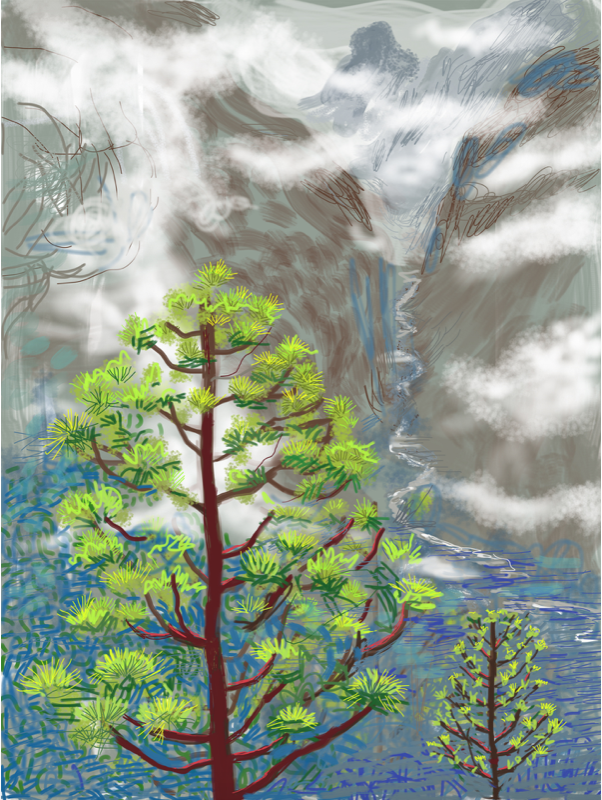
This reminded me of one of my favourite artists, David Hockney who presented an exhibition of his work at the Royal Academy of Art in 2012 [1]. I went to this exhibition and the paintings that struck me the most were a series called Yosemite. Hockney had created artworks that were 365.8 cm by 274.3 cm made up from an assembly of 6 prints made on dibond paper. This in itself wasn’t the unusual aspect, because Hockney had ‘painted’ each panel on an Apple iPad. In the reverse situation to Deckard’s extreme blow-up of a small print, Hockney achieved a huge painting by working at the micro level first. The effects were a series of beautiful paintings as digital prints as shown below.
Yosemite 1, David Hockney, 2011
My plan
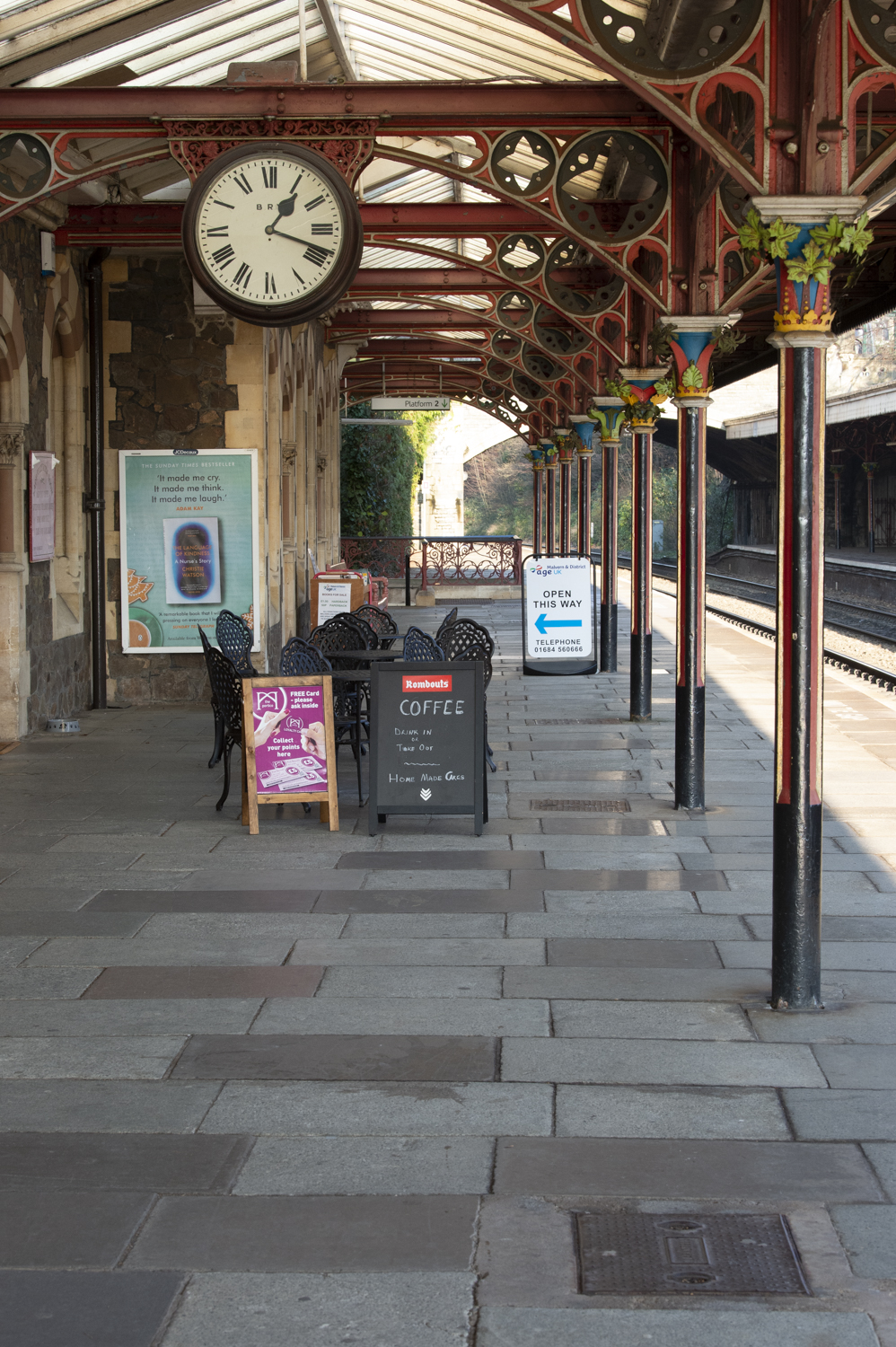
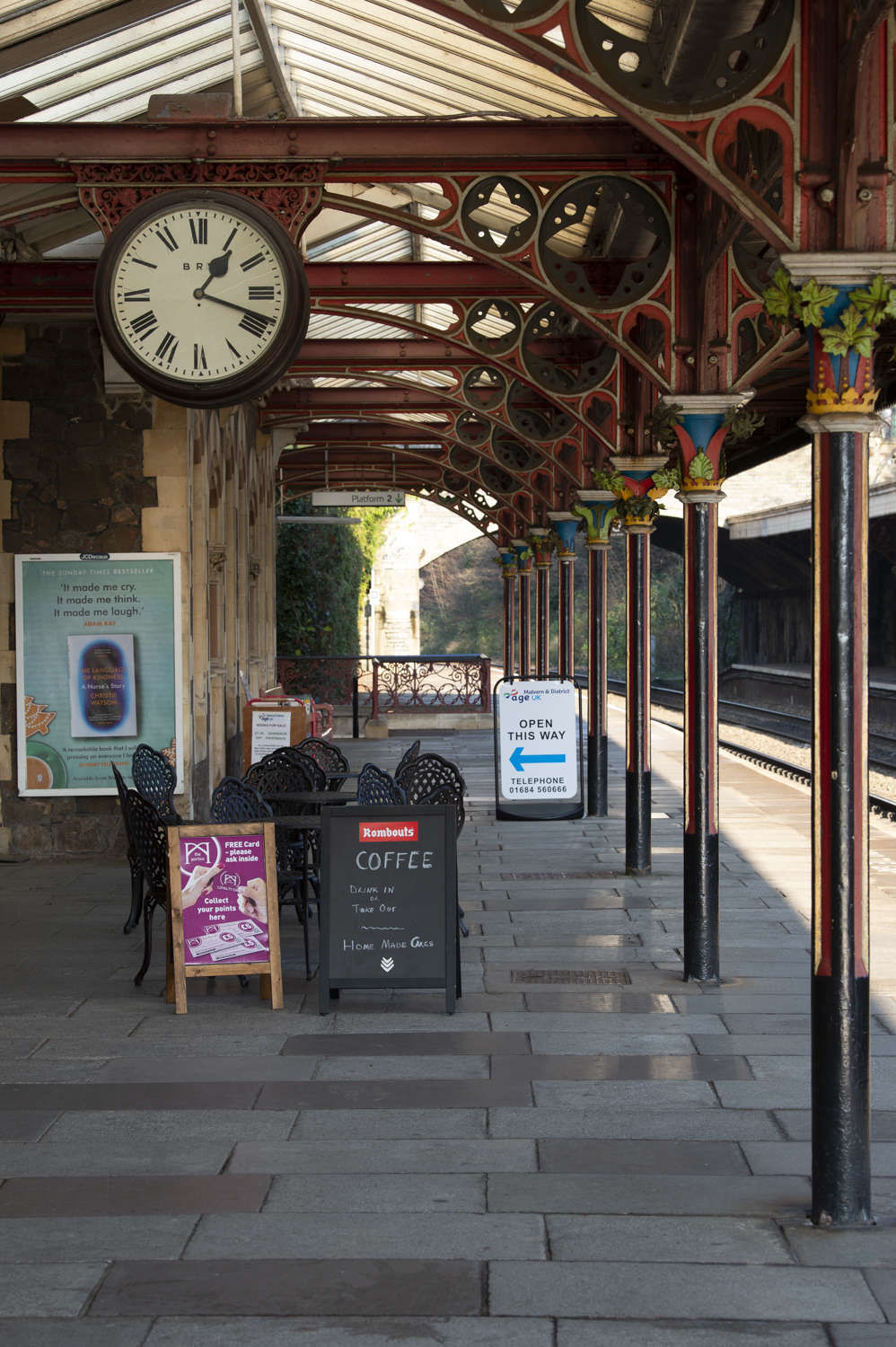
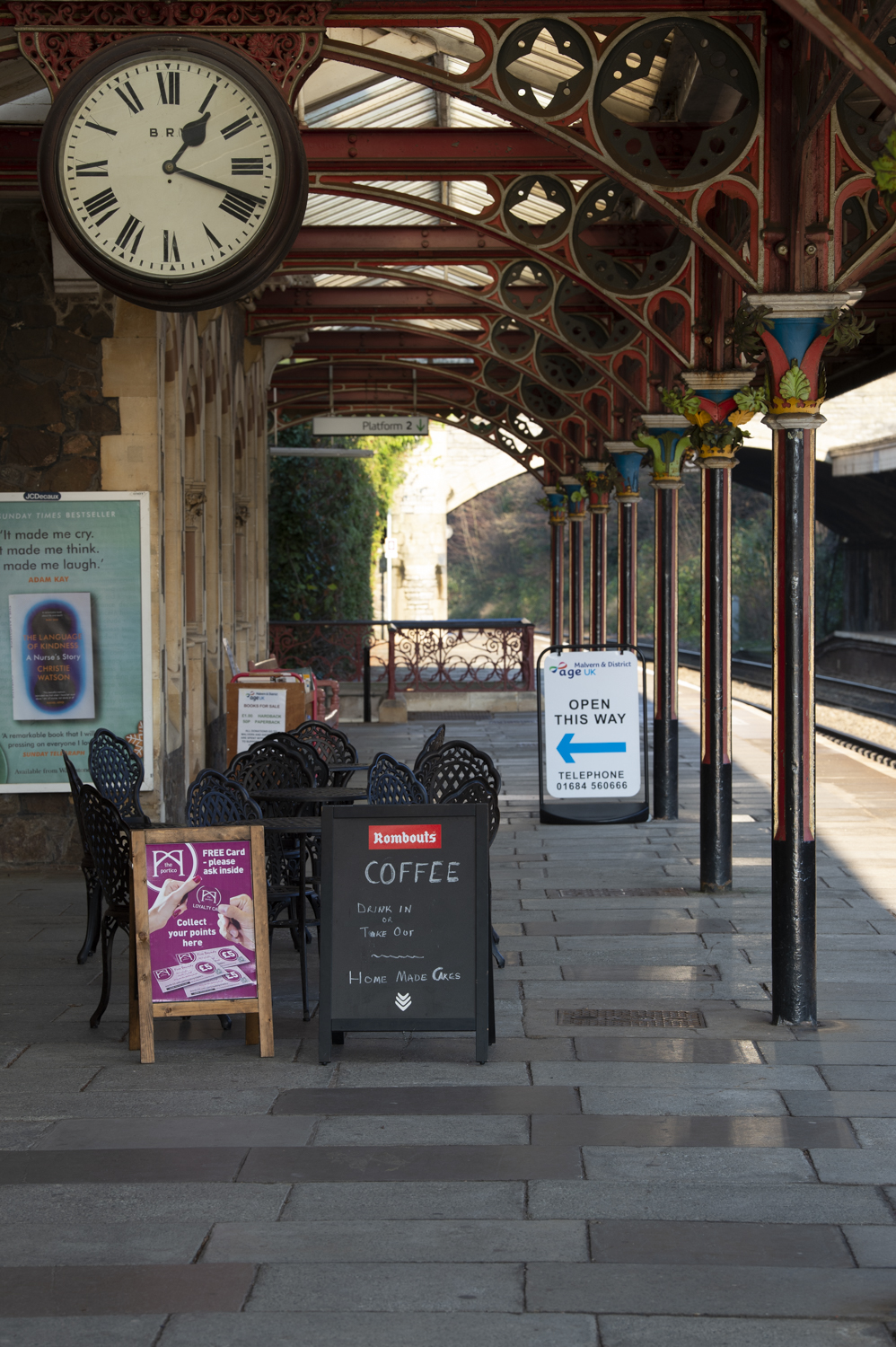
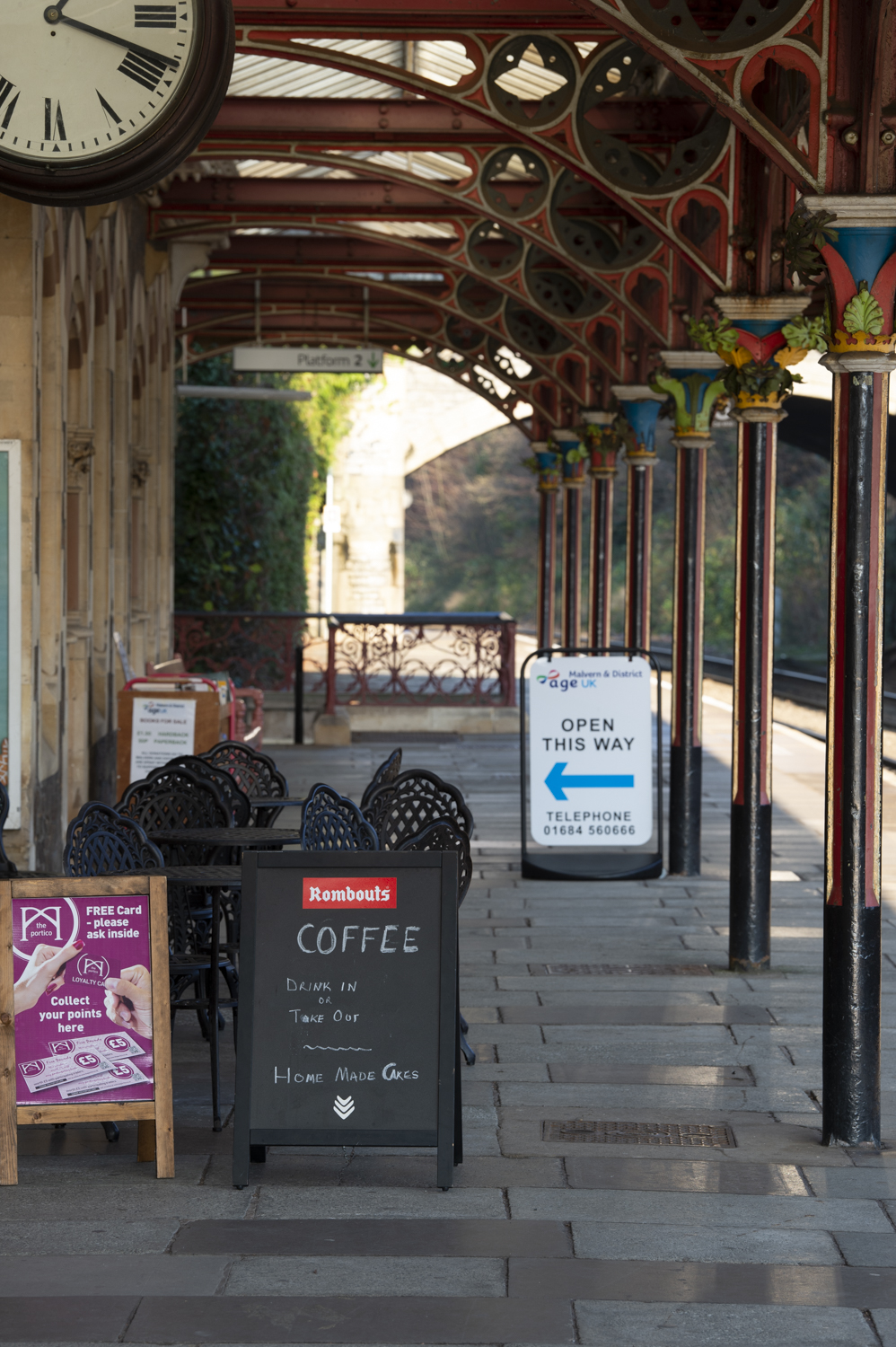
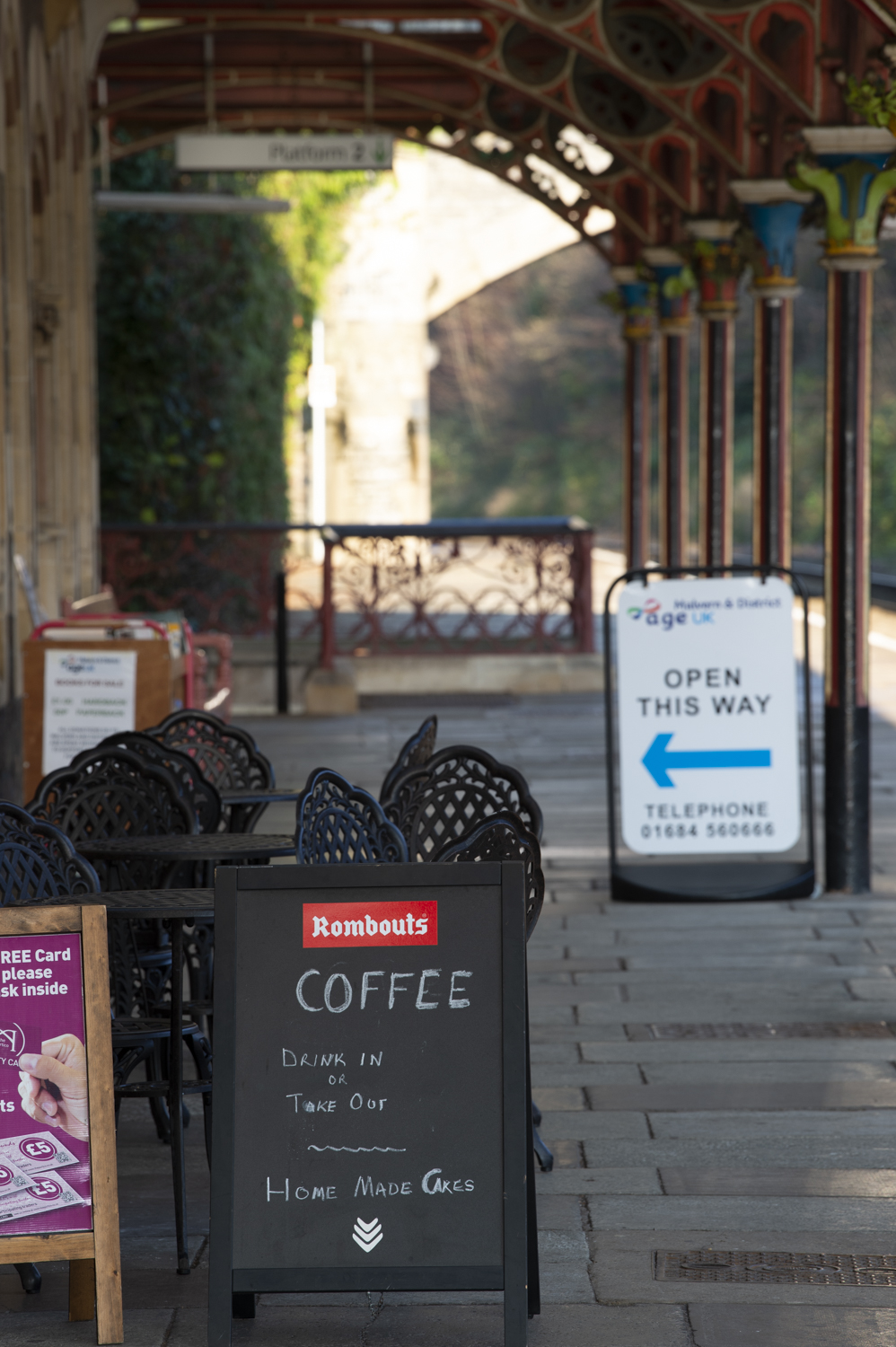
I have a mix of lenses for my DSLRs that include fixed focal length, or prime lenses, wide angle and telephoto zoom lenses. For this exercise I decided to use the Nikon 70 to 200mm f2.8 lens as it offers the longest range of focal lengths and has very high quality glass elements. For the location, I chose Great Malvern’s railway station platform, which is a typical example found in a Victorian town.
When I arrived I realised, quite reasonably that the railway station did not allow tripods. For my set, I was going to have to hand hold so I went with the following settings.
Aperture Priority set at f11.
ISO200.
Manual focus – to begin with, I did not want to re-focus and re-meter between shots. I picked the coffee sign as the point of focus.
Setting 70, 85, 105, 135 and 200mm as per the lens barrel markings.
My Images
P1 (70mm @ f11)
P2 (85mm @ f11)
P3 (105mm @ f11)
P4 (135mm @ f11)
P5 (200mm @ f11)
The first noticeable issue is that reading the focal length markings on such a large lens while handheld is a major challenge. It’s particularly noticeable between 70 and 85mm, where although my position and viewpoint haven’t changed, the position of the clock in the scene is slightly higher than it should be.
Nevertheless, scrolling through the images, one gets the sense of walking along the station platform toward the cafe. The subjects within the composition exit the frame with increased zoom and the effect of the image depth being reduced is clear as the focal length approaches 200mm – note the apparent reduction in distance between the rail at the end of the platform and the white sign. By using a smaller aperture, the signs and clock are acceptably sharp (while not totally so).
Reflection
A tripod would have improved the accuracy of the zoom, but that wasn’t the point of this exercise. What I’ve got from it, and by recalling and reviewing the film references in the brief, is that the image can start with one viewpoint and change to another through using zoom. As with Deckard viewing the photographs in Bladerunner, everything that is of less interest falls outside of the frame, leaving a narrow window on the subject. If used in a composition without changing viewpoint, the subject itself can be completely different. In my case, I looked at the images I shot for this exercise and saw something that amused me; the way the signs direct the viewer. For my final shot for the set, I took P4 and used a tight crop, effectively throwing away most of the frame. The subjects are now isolated from the railway platform; no longer obvious where the photograph was taken and they stand on their own in relation to each other.
What I have learned from this exercise is that although I already knew that a longer focal length creates a narrower field of view than a shorter one, zooms can be used to creatively alter what we want the image to say.
References
Hockney, David 2012 – A Bigger Picture Exhibition Book, Royal Academy of Arts




 Richard Fletcher OCA Photography Blog