Category Archives: Learning Log

In thinking about The (in)Decisive Moment

Fresh from my tutor’s feedback on Assignment 2 and with the next set of exercises underway, I’ve started to think about Assignment 3. Regarded by many fellow OCA students as a significant challenge in ‘Expressing Your Vision’, the assignment introduces the concept of perfect timing.

The Decisive Moment was a concept developed by the legendary Henri Cartier-Bresson in 1952 and discusses the photograph as an instant in time that represents both a moment unfolding for the subject and a decision by the photographer to freeze it permanently. In postulating this concept and demonstrating it through his, now famous photographs, Bresson cemented himself in history as the father of Street Photography genre.  While the concept has been argued, dismissed as old fashioned by some and interpreted in multiple different ways, most street photographers roam around looking for that moment to shoot.

Sadly, for me Street Photography has been something that I’ve never been comfortable doing, to the extent that I will imagine myself walking the streets and then totally bottling the actual taking of a photograph. My problem is not uncommon; I am reluctant to invade people’s space when they are going about their daily business. Pointing the camera at them and, heaven forbid they actually see me do it, leaves me anxious about the whole idea. It’s further exacerbated by the fact that I can’t really blame a lack of equipment. I routinely shoot two Leica M film cameras, an M3 and an M6., These are regarded by many as the perfect street camera, discreet, quiet and styled in the opposite fashion to the modern DSLR. The Leicas look less like a rocket launcher and so, if the subject of the photograph were to look in my direction, it probably wouldn’t even register that I was shooting them.

I was asked by a friend whether it was really an issue for people, having their photograph taken. I told them the story of Philip-Lorca Di Corcia as discussed in Project 2 and how he was sued by one of the subjects of his Heads series. The gentleman he photographed objected to the invasion of his privacy and use of his image by the photographer and although the subsequent court case was not found, it was clearly a difficult time for the artist. The modern age is one of suspicion and concern for anything that stands out; a result of terror activities and acts of violence widely reported across the world. So, if street photography was a daunting subject to begin with, the fear of being confronted by an angry subject makes me very reluctant to give it a go.

When thinking about the previous assignments, my sense of discomfort was present throughout both. In Assignment 2, I wondered all the way through the research, shoot and write-up whether I had done ‘the right thing’ in my choice of subject and approach to the series.  Even though I ultimately concluded that this was more about my lack of experience creating photographic series, it remained a challenge to think about how I might approach Assignment 3.  The brief calls for a series in support of or counter to the concept of the decisive moment.  Whatever I shoot would have to have my perspective on this well known area of photography.

The Setup

I mentioned that I shoot a pair of Leica Ms. In fact, I have a large collection of cameras, most of which are film with only 2 digital DSLRs. Which kit should I choose? The Leicas both use a 50mm f/2 lens, which is excellent for general work as on a 35mm camera they are considered a ‘normal’ lens.   Cartier-Bresson shot an earlier Leica with the same focal length and established the 50mm as being a good street lens.  However, the modern view is that a wider angle lens such as a 35mm or 28mm is more usable. Whatever the preference, primes are always more popular than zooms for this kind of work owing to their sharpness, speed and simplicity of use.

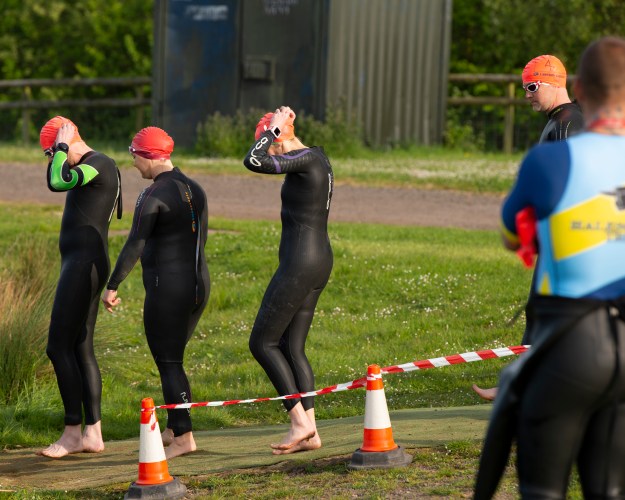
However, the main consideration in selecting focal length appears to be both how close one wants to get to the subject and how easy it is to focus.  The shorter focal lengths require the photographer to be closer to the subject to fill the frame compared to the longer 50mm.  Once in place, the photographer cannot waste time focusing the shot because they may miss the moment and draw attention to themselves.  If the lens is autofocus, the subject may actually hear the sound of the motor as it focuses.  To combat this, street photographers practice a technique called zone focusing, which allows for a photograph to be shot quickly.  Zone focusing uses a combination of focal length (the lens), focal distance (the range to the subject) and the aperture to set the lens so that it doesn’t need to be adjusted prior to the shot being taken. Once focused, an area of sharpness exists in front of, and behind the point of focus which is considered ‘acceptable’.  See the example below:-
DSC_1654

Swimmers lining up for the race. Shot at f5 at around 10 metres with a focal length of 200mm

In the example above, the swimmers are in a narrow field of sharpness because of the relatively wide aperture, distance and the telephoto lens.  The swimmers and the traffic cones in the foreground are within the region of sharpness, while the trees in the background are out of focus.

In a street photography example, for a lens of 35mm on a full frame camera, if the aperture is set to f/11 and focused at a distance of 6ft, the acceptable sharpness range (or Zone) is 3ft to 12ft.  So, if a subject is anywhere in this range, they will be sharp. Knowing this, means that street photographers can pre-select the focus distance and aperture and know that they don’t have to touch either to shoot a subject in that zone. The benefits of that are pretty obvious.

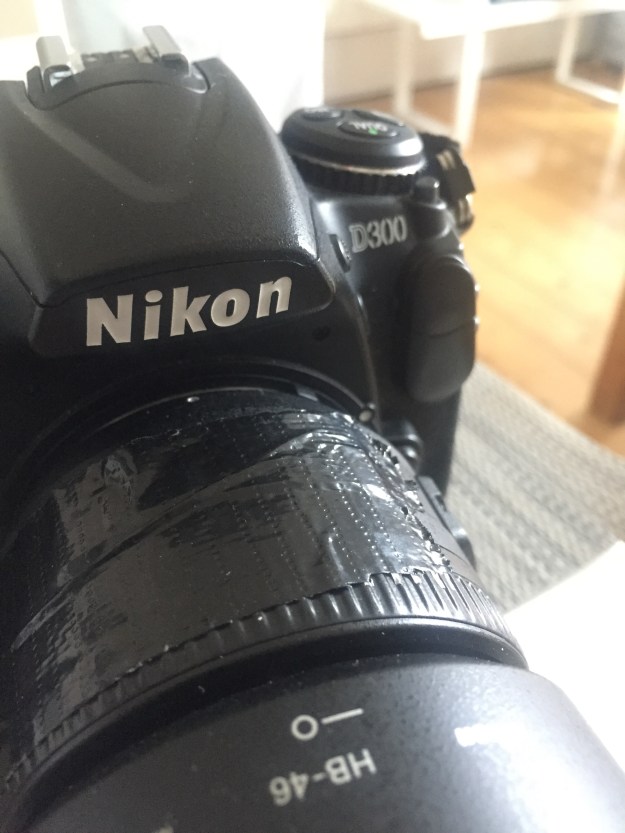
I have a 50mm lens, which is harder to zone focus than a 35mm which isn’t a great start. The longer focal length leads to a shallower region of acceptable focus for the same aperture in the 35mm example.  The cameras are also film, so there is no easy option for compensating a drop in light level when the aperture is fixed as part of the arrangement by adjusting the ISO.  I could ‘push process’ the film afterwards to achieve a pseudo increase in its sensitivity but that would affect all of the frames on the roll.  Whatever film is in the camera is pretty much the ISO available for that roll.  At this point, I started to look at my DSLRs.  Both have good noise performance at higher ISOs and can be set to automatic. Problem here is that the 35mm lens I have for the smaller camera has no focus distance numbers on the barrel, which means that in order to pre-focus, I would have to measure or estimate the distance…or use autofocus.   I tried experimenting with my D300 by pre-focusing the lens and taping the barrel to stop the focus from being accidentally adjusted (see photo).  With the focus mode set to manual, the camera would effectively be zone focused.
IMG_0679

Some modern consumer lenses have no focus distance markings or aperture rings to reduce cost

The experiment worked, but the  other key drawback of the DSLR is that they have an internal mirror that, like all conventional DSLRS has to move from in front of the sensor before the shutter fires. This makes them very noisy, compared to the mirrorless, rangefinder Leicas.  At this point, it’s not looking good.  All of this is before I’ve actually decided how I want to interpret the brief. Perhaps an alternative to street photography is needed here.

I ultimately chose to stick to street photography and use both of my DSLRs.  However, I used a much longer focal length zoom lens for most of the shots to avoid close contact with my subject.  This was an early learning point for me as photography has always previously been a comfortable experience owing to my interest in landscapes, architecture and shooting portraits when I know the subject is happy to sit for them.  It’s clear that discomfort is part of the development of my artistic vision, so I am preparing for more of it.
Surface and Depth Revisited

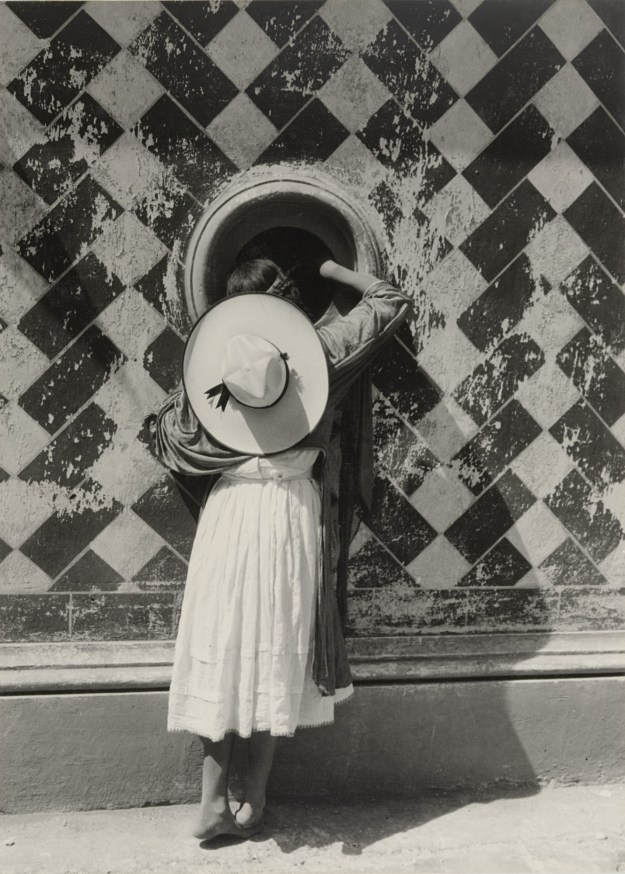
This is about seeing and not seeing, about the hole in the wall acting as a round lens letting light into a dark camera interior, about framing of vision, oppositions of dark and light, the curiosity of looking into a dark space, and about the figure caught between two objects that capture her image, the hole – her face – and the camera – her body.’ – Leonard Folgarit

The Daughter of the Dancers, by Manuel Álvarez Bravo, 1933

This was Leonard Folgarit’s review of The Daughter of the Dancers, by Manuel Àlveres Bravo that was quoted at the start of this Project.  The concept being established in this section of EYV was of The Aesthetic.  According to the Stanford Lexicon, “the term ‘aesthetic’ has come to be used to designate, among other things, a kind of object, a kind of judgment, a kind of attitude, a kind of experience, and a kind of value”.  In the context of this course and, more importantly my approach to photography, the concept of a picture having any of these elements to it is a further departure from what I am used to.  Sure, I have been told about a photograph telling a story and having meaning, but my reaction has been to carefully place subjects in the frame to create an interesting composition.  Any emotion or judgement or value attached to the image would be fortunate at best and accidental at worst.

The review of Thomas Ruff’s work interested me, not because of the visual tension his images created when viewed, but the increased sense of what was happening in the picture, enhanced by having all the technical detail stripped away.  My only issue really being that his use of other people’s photographs moved him away from ‘photographer’ in my mind and towards ‘artist’.  I was discussing his work with a colleague today, who is also a photographer.  When I explained the story of Ruff’s ruined images of the 911 attacks and his subsequent downloading of low-resolution versions of other people’s work, he was horrified.  “Can you even do that?”

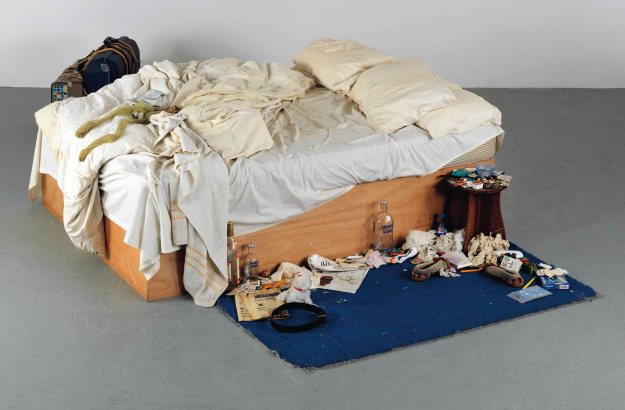
I got to thinking about the work of modern artists such as Tracey Emin and Damien Hirst.   Like all artists who create art from seemingly ordinary objects or collages of images, they are effectively not something they own.  Emin’s bed, for example is at face value (Surface) as being simply the creation of any teenager, but when asking questions about how the individual elements came to be there can easily lead to the artist’s narrative.  However,  many people including myself saw what was in front of them and the judgement of it being a wasteful, almost narcissistic statement by someone with clear issues now appears to be as valid as the emotions Emin was trying to convey about a dark time in her life.   Everyone will have a different view.  What makes the difference to me is, like The Daughter of the Dancers, the viewer cannot see what is going on beyond the obvious ‘surface’.  What is happening deeper in this picture?  How did the owner of the bed get both it (and presumably themselves) into such as state?

My Bed by Tracey Emin, 1998

Coming back to Ruff’s work, I decided to look at other examples of his work and found a collection he created in the early part of this century called Nudes.  Like jpegs, Nudes is a seemingly obvious subject that achieves an aesthetic when a level of distortion is applied.  However, in this case Ruff downloaded pornographic images from the internet to make his art.  What reaction do these photographs create?  For me, initially shock followed by a softer appraisal of what could easily be a classical art nude, with all its potential beauty.  But it’s still porn at the heart of it.

From the collection ‘Nudes’ by Thomas Ruff, 2000

The difference between my predecessors and me is that they believed to have captured reality and I believe to have created a picture. We all lost, bit by bit, the belief in this so-called objective capturing of real reality.

Each of my series has a visual idea behind it, which I develop during my research. Sometimes the development follows a straight line from A to B; sometimes something completely new and interesting shows up, which makes me leave the straight path and follow a more indirect one with new rules.
—Thomas Ruff

Reflection on my Work

With the distinction between the concepts of formal and aesthetic better understood, I reviewed some photographs from a recent test of an old Olympus XA film camera I had picked up on eBay.  This was a few rolls just seeing how it performed as an instrument and I was shooting them during a visit to London on holiday.  One image in particular stood out as demonstrating both the formal and the aesthetic which can be seen below.

Retrochrome004

The photograph was made using an expired Kodak Ektachrome slide film, a characteristic of which is a colour shift caused by age.  This was simply a test of the camera’s ability to meter the scene (no evaluative metering on a camera from 1979!).  The dominant light from a very sunny day and the composition with the subject on the right hand third line was all planned.  However, in review there are aesthetic questions that arise.  We cannot see what the gentleman is doing.  Is he reading a phone while waiting for someone or is this quiet cafe a regular haunt for him?  I was hoping for more detail in what was beyond the cafe’s window, but the fact that there isn’t asks what would people see if they looked in at this man?    I was surprised to realise that the image, while a simple and seemingly boring test of an old camera and film actually asks more questions than it answers.  For me, not dissimilar to my reaction when I saw Bravo’s photograph.

Ever the engineer, I wanted to look at this further with another recent photograph.  This time, I had shot a performance of The Ladykillers by a local theatre company for their publicity and personal use.  This one photograph illustrates for me the difference between creating an aesthetic and a formal composition.

The Ladykillers, 2018

In this scene, the lead character looks under the cover over a bird cage.  While his reaction to the horror within is clear, the only aesthetic is not being able to see the bird.  From the formal composition, it is clear how the two subjects are interacting and obvious that the cage contains some kind of bird or animal.  For me, the photograph works well as a composition but doesn’t provoke any real emotion or judgement.

In conclusion, I found this Project fascinating as it reveals what can be achieved without the necessity to be obvious, technically accurate or abiding by the rules.

Always Meet Your Heroes

What the…?

I mean it.  Always meet your heroes.

In my case, I don’t have many really as I’ve never aspired to be like someone else, well known or otherwise.  I’ve greatly admired the achievements of many people over the years and continue to be inspired by the works of others, but ‘hero’ is a peculiar word to use in this context unless you can identify something that has changed as a result of their direct impact upon you.

My photographic ‘hero’ over the past several years has been the American street photographer, Joel Meyerowitz.  I first encountered his work in a clip from the BBC documentary ‘The Genius of Photography’ back in 2007.  I’d only seen a brief clip of him as at that point I had not seen the whole series.   Then, in 2013 I saw it again when attending a course in London run by my now good friend, Nigel Wilson.  His enthusiasm for Meyerowitz got me thinking about this highly respected photographer’s work and so began my becoming a fan.  Meyerowitz was one of a number of street photographers in the 1960s who made their art on the busy, diverse streets of New York.  What set his work aside from many of his peers was his exploration of street photography in colour, where traditional Black & White had been the norm.  Instead of being a distraction, colour became another element to bring the picture together.  A good example is shown below:

9055344_orig

Untitled, New York City 1975, by Joel Meyerowitz

This photograph is interesting enough in its composition.  A lady on crutches coming face to face with a giant pair of shoes and dances with them.  However, for me it is the colour of the shoes that make them stand out and be more obvious to the viewer.  The contrasting tone and shade of the background also makes the subjects more vivid in the frame.

By 2013 I had started to take my photography more seriously rather than shooting interesting record shots from my holidays, which is why I was on that course in the first place.  I learned how to use my digital camera properly, the aspects of exposure that were under my control etc.  My photographs became a little more interesting and technically better as time and study progressed.  However, I was still looking at the process of taking a photograph as just that…’taking’.  Digital cameras offer a great level of control, but also a comfort in the ability to shoot something quickly, while being confident that the image will be alright.  I had been introduced to the concept of ‘making’ a photograph, which rather than simply being a quaint historical reference to the early days of photography, actually meant showing meaning in the picture.  If you asked yourself what the photograph was intended to mean, you would then go on to produce something with meaning. A piece of art, essentially.    Being an engineer by profession though, meant that this was a concept that I would continue to struggle with.

Then, in 2015 I purchased a beautiful original print by another American photographer, called Berenice Abbott, from a gallery in London.  We’d been collecting paintings by a few artists over recent years, but this was our first photograph.  After that of course, the gallery would periodically send me invitations to shows and lectures they were hosting and so, in January 2016 I received one for an exhibition of Joel Meyerowitz’s Cape Light photographs.   These photographs were made in Cape Cod with an 8×10 inch field camera.  To get a sense of how big the camera was, you had to appreciate the concept of a single frame negative 8 inches by 10 inches in comparison to the much smaller 35mm frame.  Joel carried this camera around the Cape and spent a great deal of time setting up and shooting each picture.  The resulting images with their space, light and window on life in the vibrant, party town of Provincetown in the 1970s are remarkable.  I naturally jumped at the chance to see the exhibition and hear the man speak.

When I arrived at the gallery, I was stunned to find Joel chatting casually about his photography with the guests and with the advice ‘never meet your heroes’, went over for a chat.   What followed was a fairly awkward exchange; one guy struggling to ask a host of questions and the artist politely answering them.  Then came some advice that changed the way I would engage with photography forever.  He said to slow everything down and use time to really appreciate what you’re looking at and get into the moment with the subject.  He said that using the 8×10 in Cape Cod forced him to really look, take time and care (the film was costly even back then) and ‘make’ the photograph he visualised.  The time taken to set the camera up meant that it the ‘process’ could not be rushed.

What changed for me after that conversation was that as soon as I returned from London, I bought the first of many film cameras.  I believed that by shooting film, I could do just what he said; take my time, take care not to waste the film and think about the image I want to make.  I started to shoot film regularly and taught myself how to calculate the exposure for my camera, which had no electronics, metering or compensation; basically a shutter that opens and closes.  I feel that I have improved those skills just by getting into the spirit  of what Joel said that evening and I enjoy the slower pace of making a film photograph more than the digital alternative.  A few examples of my film work are shown below:

Aside from a bad case of collecting classic cameras (I’m now on 18, but I do shoot them all), understanding exposure and specifically how film stocks react to light, has continued to stretch my technical approach to photography.  However, the development of my creative voice and composition skills haven’t really progressed.  This is why I’m now here, studying with the OCA.

All prompted by a brief, chance meeting with Joel Meyerowitz.  Always meet your heroes; you never know what might happen.