The French writer Georges Perec wrote a book called An Attempt at Exhausting a Place in Paris ( 1975) in which he wrote down everything he could see from a certain viewpoint. You may like to read it.
A further work by Perec is entitled ‘Species of Spaces and Other Pieces’, the first chapter of which attempts an interesting classification of spaces, ranging from the page itself to world and space outside. Again, this might help in relation to the following exercise.
Choose a viewpoint, perhaps looking out of your window or from a café in the central square, and write down everything you can see. No matter how boring it seems or how detailed, just write it down. Spend at least an hour on this exercise.
Here are some areas to consider:
- Can you transform this into a photography version?
- Would you stay in the same place or get in close to the things you listed?
- Would you choose to use your camera phone in order to be discreet or would you
- get your tripod out?
- Would it be better in black and white or colour?
- Would you include your list with the final images?
You may choose to turn this into a photography project if it interests you.
The Setting
Sitting at the back of a large café, furthest from the door. From my vantage point, I can see all fo the other customers, the counter and the staff. There is nothing behind me, so I don’t need to change my position or turn my head to see.
What’s going on.
- Wood panelling needing attention
- Canvas photographs of people presumably from Italian culture on the walls.
- Large litter bin with LITTER written on it. Almost overflowing
- Couple sit down with coffee and cake. She is dressed in a glamorous coat, he in his scruffs
- Man reading the Daily Mail with his reading glasses on. Ignoring his phone.
- Woman scrolling through social media by herself.
- Man finishing his coffee and putting on his coat
- He gets up and leaves.
- Family with small children sit down. Proud grandparents, new parents, all of the items associated with having a new baby.
- Granddad chases his granddaughter around the café to try to keep her under control.
- Friend of mine enters, still recognisable despite wearing a mask. Orders a coffee and uses the loyalty app. Finds a seat, not near me. He hasn’t seen me.
- More children enter. Parents struggling to keep them under control.
- Pensioners sit down and loudly chatting. Perhaps they are deaf.
- Windows have misted up because of the stormy weather outside. Door being held open for someone to enter slowly. Temperature is dropping because of the wind outside.
- Smell of toast burning at the counter.
- Lady joins one who is waiting, they get up and leave quickly. Didn’t have coffee.
- Staff buzzing around clearing tables.
- Lady walks past me to go to the loo. Uses the disabled toilet instead of the main one for women.
- Proud granddad helping young father with baby. Grandad wearing a papoose.
- Friend gets up and walks the counter to talk to the staff. He is given a small pot of milk
- Man with the paper now doing the crossword
- Bright red umbrella seen passing by the steamed up windows
- Woman next to me checking the weather forecast app.
- The floor is wet from the recent visitors.
- Staff member hading over a takeaway bag to a customer. He is wearing a ‘staff in training’ T-shirt which is different from the other staff members.
- Scruffy man and glamourous lady arguing about something. Getting animated.
- Man enters with a very serious-looking medical mask.
- Little girl drags grandma to the front door because she wants to look outside at the rain. Grandad sits down looking exhausted. Still wearing his papoose.
- Woman checks her loyalty card to see if she has a free coffee.
- Laughter from the pensioners table at the other end of the cafe.
- Woman takes off her coat 10 mins after arriving. Must have dried out. Wearing an elegant dress under it.
- Woman tries the disabled toilet door but the previous lady still in there.
- Man finishes the crossword and is heading out. He is wearing a colour coordinated mask and coat with bizarre camouflage pattern.
- Grandma persuades the little girl to return to her seat while she heads for the occupied toilet.
- Woman chuckles loudly at something on her phone.
- Couple’s argument appears to be over. All quiet.
- Queue forming at the loo.
- Sound of coffee grinder over the rest of the noise.
- Couple enter, shaking their umbrella and searching for their masks
- Staff member ambling aimlessly around the café
- Little girl crawling on the floor. Trying to lift the one-way arrow up.
Review
This view of cafe life could be turned into a photography project with a number of themes. The first is about family and friends, with the three generations of one family being the most consistently active in the scene. This theme could challenge the traditional roles of family, where the grandfather was carrying the baby in a papoose, something that is traditionally worn by a parent. The second would be about the way the café is used for many different purposes; I was there working while there were people doing the crossword etc. The final one would be something about the contrast of social/antisocial where some people are in groups and some sit alone looking at their mobile phones.
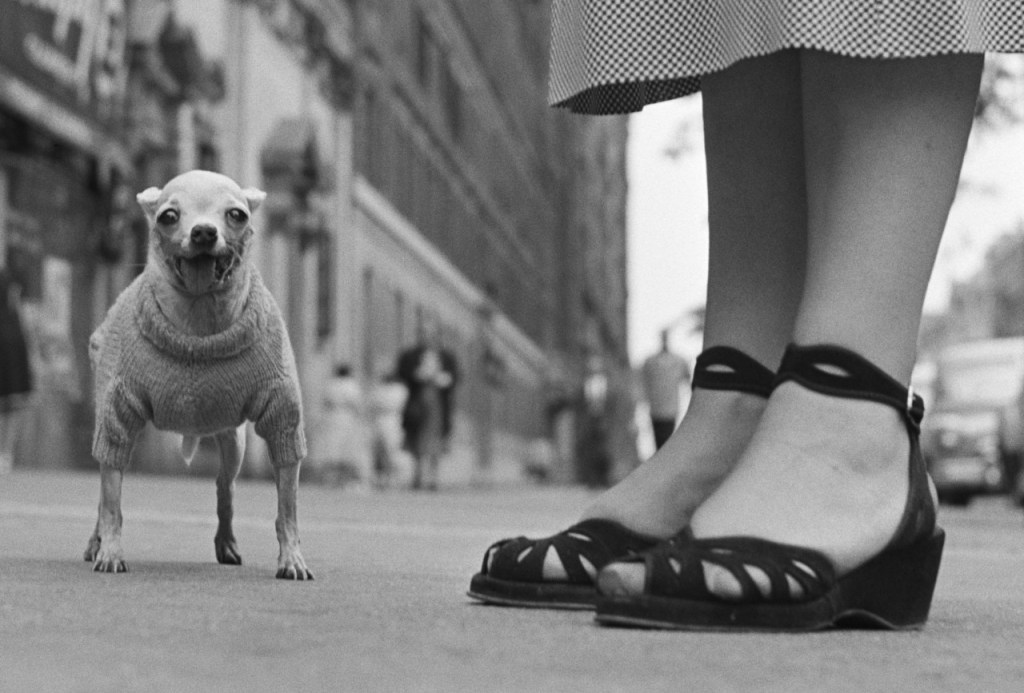
It would be easy to use a hidden camera technique similar to Walker Evans [1] to document the movements and interactions between people. Moving around the cafe with this technique would introduce an element of risk to composition, as I discovered in the Covert exercise[2]. While not an issue, the random nature of this style of shooting removes some of the planning that I think such a series would benefit from. Instead, I would consider discussing the use of the space for the series with the café owner and create a more metaphorical series using tableaux. I’ve found two elements in story-telling very useful during this past year or so, the first being summoning the courage to ask for help with an image or series. e.g. the lorry picture in Assignment 4 of EYV[3] where I asked the removals people if I could shoot with them (admittedly blurred out) in the frame and in this unit with the strangers in Assignment 1 [4]. The second has been the use of carefully constructed images to create a multi-layered narrative as opposed to being literal. This has been my preferred way of helping the viewer see many different potential meanings to a work and it’s been useful in most of my assignments and exercises in this unit. For this case, I would split the action and inaction into individual images, principally because there are not perceivable interactions between the groups of people beyond that of staff/customer. By breaking the scene into individual tableaux, I think the multiplicity nature of the café in our culture could be emphasised by individual stories that have no apparent connection; almost challenging the idea of a café being a social place.
In answer to the questions of representation (black and white or colour, text or no text), I look back at Perec’s document of Paris. He describes the sights and sounds, movements and behaviours as they are presented to his eyes. Part of this vision is colour, which he documents when he notices something about it. For me, this visual distinction is important to a photographic project, so I cannot see the benefit of using black and white. In terms of using text, Perec uses it to make a physical note of what he sees. In a photographic project, I would use the tableaux to steer the narrative rather than include text. Perhaps the title of the image or series could be used to set the basis for it as with Boothroyd’s If you get remarried, will you still love me?
Conclusion
I found this exercise interesting as Perec’s assertion that we only really notice the sensational resonated with me. We are surrounded by 24hr news, most of which is dramatic and frightening in nature. We are almost desensitised to the information and take no part understanding what is being asked or told.
“The daily papers talk of everything but the daily. The papers annoy me, they teach me nothing. What they recount doesn’t concern me, doesn’t ask me questions and doesn’t answer the questions I ask, or would like to ask”
Georges Perec, from Approaches to What? (1973)[5]
The result of this bombardment is the notion that our individual lives, society and culture are defined by the big things that happen around us (and often to other people). Perec noticed that our lives are actually defined by habit and routine, some of which describe what we like and some which show us coping with the unseen aspects of daily life. His contemplative work Attempting at Exhausting a Place in Paris (1975) produced a document of precisely what he observed over 3 days in a particular place in the city. What struck me wasn’t just the observation, but the descriptions of things he didn’t really understand or could be certain of. One great example is when he believes he is being photographed from a bus by a Japanese tourist. Instead of applying his interpretation of who the tourist was or why they might be taking his picture, he simply documented what he thought was happening in a factual way. Perec almost takes Barthes’ reading of visual images (in this case what he sees in front of him) at its face value, without conscious bias or cultural interpretation. My conclusion from this exercise centres around the need to really look at the what before getting into the why. The work by Perec could act as a catalyst for creating a story because it focuses on the everyday experience rather that the media-driven narrative about the state of the world.
References
[1]Fletcher R, 2021, “2) Project 1: The Unaware”, OCA Blog Post, https://richardfletcherphotography.photo.blog/2021/05/24/2-project-1-the-unaware/
[2] Fletcher R, 2021, “2) Exercise 2: Covert”, OCA Blog Post, https://richardfletcherphotography.photo.blog/2021/05/24/exercise-2-%E2%80%8Bcovert/
[3] Fletcher R, 2019 “Assignment 4: The Languages of Light”, OCA Blog Post, https://richardfletcherphotography.photo.blog/2019/06/30/assignment-4-the-languages-of-light/
[4] Fletcher R, 2021, “Assignment 1: The non-familiar”, OCA Blog Post, https://richardfletcherphotography.photo.blog/2021/04/11/assignment-one-%E2%80%8Bthe-non-familiar/
[5] Perec G, 1974, “Approaches to What? (!973)” from Species of Spaces and other Pieces (1974), published by Penguin Books






 Richard Fletcher OCA Photography Blog