Category Archives: Assignments

Assignment 4 – A picture tells a thousand words

The Brief

Write an essay of 1,000 words on an image of your choice

The image can be anything you like, from a famous art photograph to a family snapshot, but please make sure that your chosen image has scope for you to make a rigorous and critical analysis.

Introduction

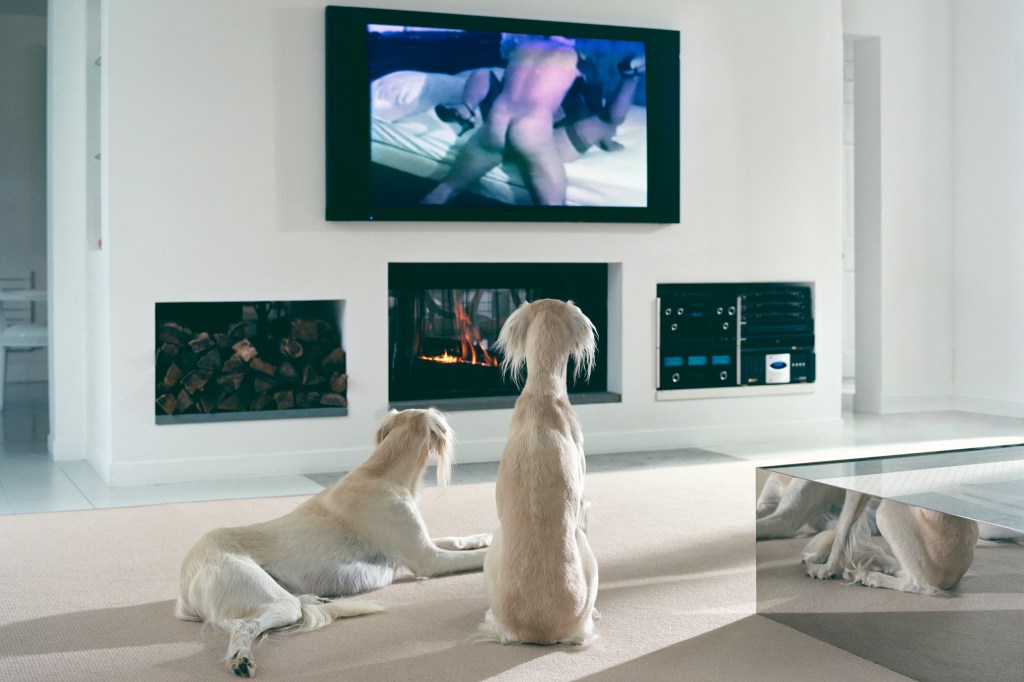
For this assignment, I chose a photograph from the series East of Eden, by Philip-Lorca diCorcia. The theme of the series is described by diCorcia as America’s ‘loss of innocence’ experienced towards the end of George W Bush’s presidency in 2008[1]. The title refers to the ongoing struggle between good and evil that is referred to in the Book of Genesis[1], Cain becoming the symbol of ‘evil’ through murdering his ‘good’ brother Abel in a jealous rage. diCorcia invokes this struggle by relating it to the immoral banking practices that led to the financial crash towards the end of the Bush era. The photograph that I selected is called The Hamptons (2008), shown below. In this essay I read the photograph using the techniques learned in part four and describe my interpretation of it.

The Hamptons (2008), by Philip-Lorca diCorcia [2]

I chose this photograph because of the obvious, slightly shocking humour of the subject; two dogs watching a pornographic film. The photograph follows diCorcia’s consistent style of work that developed while a fashion photographer with W magazine in the 1990s. The composition is devoid of any distracting clutter and arranged with a ‘cinematic’ feel; diCorcia describes his subjects being square on to the camera and shot from a neutral position, i.e not from the photographer’s perspective. The result allows the viewer to ‘step into’ the frame in a similar way to modern cinema.

My Reading of The Hamptons (2008)

I started by deconstructing the elements within and looking for possible meanings using semiotics[3]. In the version below, the formal elements of the photograph are labelled in red. The potential meanings of those elements are labelled in blue.

Annotated version of The Hamptons showing the formal elements and what they might mean

The red items are signifiers which are identifiable to most viewers. The room’s plain, light coloured decorative elements: the coffee table, fireplace and audio-visual equipment, are all formal elements that create the impression a living space. Although lacking sofas or chairs, the signifiers are strong enough to signify a living room. We also have a restricted view into the next room, which gives the impression that of a large space; an apartment or house. The furniture and the audio-visual equipment could signify the room part of an expensive home; the size of the television and appearance of the other items signify something that has been carefully designed and executed. The first sign then is that this is a room belonging to someone with money. This is further supported by the photograph’s title, The Hamptons, referring to a region of upstate New York that has among the highest property values in the US, some homes costing over $100m. The other formal elements are the dogs and the pornographic film. There are two light coloured dogs of the same breed facing away from the camera in the direction of the television. One is lying down and the other is sitting upright. The latter’s hind quarters are reflected in the mirrored side of the coffee table. The film itself is mildly explicit, shows a man taking control of the sex through the position being used. The TV and the surrounding elements provide the only colour contrast to the muted tones of the scene. In terms of what the dogs and the film signify, the first impression is of entertainment being viewed by a viewer. The way that the photograph asks a viewer to look at someone (in this case something) viewing something else aligns neatly with diCorcia’s cinematic perspective described previously. The sign here is one of voyeurism, with we the viewers being the voyeurs on the scene.

In terms of what the elements mean, the way the room appears to connote a highly ordered purity, with a lack of clutter or signs of life within. The dogs share the same ‘pure’ appearance, but their reactions to what they are looking at are different. These poses could connote how what looks the same isn’t necessarily the case. For me, the dogs represent people in this image – perhaps the owners of the house who are absent from it. People may be similar but we are all different. The presence of the porn film connotes the ‘impure’ that is invading the space and perhaps points to corruption of innocence. The impressions of wealthy, class-led society being somehow better are rich in western culture, referenced many times through the years in the writings of authors like Dickens. Victorian society liked to think that people with wealth are of a higher moral standing as illustrated in his novel Oliver Twist and the idea that they might not be, makes us uncomfortable. In the case of Dickens, he had to make street urchin Oliver’s character almost angelic so that his readers could more readily accept his transcending from working to upper class[3]. When considering these connotations the studium of wealth and implication of class or being better than everyone else is, for me, being revealed or debunked by the punctum of the pornography. Our relationship with pornography is one of secrecy and sub-culture, a thing should be hidden or not spoken of with exceptions of highlighting how it corrupts society[3]. The idea of the pure dogs, in their pure environment being corrupted and the implication of damnation suggested by the fire, helps create the narrative around good vs. evil; the theme of the series the photograph comes from.

Conclusion

Introducing this photograph, I described my initial reaction as one of seeing a slightly edgy humour at it’s clear contrasts. However, after analysing the elements, their potential meanings and the context within the series, I can now appreciate the many layers of narrative that this image allows for. With my reading, the more sinister ideas about clean becoming dirty, pure becoming corrupted and how the evil is not limited to class or standing, becomes evident in the representation of the dogs in their living room. Far from being a little edgy or shocking, the image takes on a sad feeling that through our own indolence or blind trust in ‘our betters’, we somehow let evil in, a good metaphor within the original intent of diCorcia’s series.

References

[1] Zwirner D, 2015, ‘East of Eden Press Release’, David Zwirner website, https://www.davidzwirner.com/exhibitions/east-eden/press-release

[2] Zwirner D, 2015, ‘East of Eden Exhibition Catalogue, David Zwirner website, https://www.davidzwirner.com/exhibitions/east-eden

[3] Fletcher R, 2020, “Preparation and Research for Assignment 4”, OCA Blog Post, https://richardfletcherphotography.photo.blog/2020/11/13/preparation-and-research-for-assignment-4/

Preparation and Research for Assignment 4

Introduction

Assignment 4 is slightly different from the others in this unit in that it is a written essay rather than a photography project. The brief is for a critical analysis of a photograph either by a famous photographer or one of our own. The essay is intended to break down the image into its context and meanings as we have learned in Part 4. This post is the preparation and research for that essay.

The Image

The Hamptons (2008) by Philip-Lorca DiCorcia [1]

This image is from Philip-Lorca diCorcia from his series East of Eden and depicts two dogs ‘watching’ a pornographic film in a very modern-looking room. I chose this image because my initial reaction was a one of humour at the slightly shocking contrast of the subjects. I am also as a fan of diCorcia’s work, having first seen an exhibition of his work, including East of Eden at the Hepworth Gallery in Wakefield in 2014. I was drawn to the way that his images seem relatively simple in their composition, yet are interesting; containing many layers of complexity that are revealed the longer we look at them.

Contextual Research: diCorcia and East of Eden

Philip-Lorca diCorcia started his career in fashion photography, working on assignment for W magazine with the same creative director for over a decade [2]. With his work in that industry he developed a style of creating a scene that was not naturally observed, by using models, flash strobes, props and of course the element of fashion that was the subject of the ‘story’. When he started to develop his ideas for his own work, he took this sense of fantasy and unreality into his art. His brother died of AIDS in the 1980s, which diCorcia used as the inspiration for his famous series Hustler, a collection of photographs of male prostitutes in the major cities in the USA. At the time, the government rhetoric about AIDS was one of moral denia (it only affected the ‘degenerate’ homosexual community) and disconnection from the way that it was wiping out a whole swathe of the population. With Hustler, diCorcia wasn’t trying to document the struggles of the lives of the young men, but instead drawing attention to their existence as people and actors in their way of life. diCorcia has stated that he didn’t know or get to know them in any way, he just set up the composition he wanted and then hired them to be part of it. What diCorcia was interested in was revealing how the outward personality of his subjects differed from what they were really like. Since he didn’t know them personally, he left any conclusions about that they were actually like to the viewer to narrate.

“A person’s interiority is very different than their exterior appearance and to some degree, life is a performance”.

Philip-lorca diCorcia, talking to The Hepworth Gallery, Wakefield[3]

In a presentation made to The Modern in Fort Worth [4], diCorcia mentions that prostitutes are essentially actors for hire and that the variety of fantasy roles that males play is much bigger than their female counterparts. In the same presentation, he answers a question about how he creates narrative in his pictures.

“I’m supposed to give you just enough information, in my mind, as you need to be intrigued, not enough to finish your experience”

Philip-lorca diCorcia on his approach to narrative [4]

What he meant by this lends itself to the theories of post-structuralism where the artist is not drawing on cultural references to tell a story, but shifting the responsibility onto the viewer. In the case of Derrida’s idea that a trace of what isn’t there is also present in a story or image, diCorcia is showing us perhaps the obvious outward impressions of what male prostitutes are, but also leaving an idea that all is not what it seems. These young men had a story of how they ended up with this lifestyle, perhaps the lack of family support or struggles with their mental health. The elements that suggest this are often implied but not actually present. His use of unreality, i.e a contrived setting for these young men to be placed within, he adds to the mystery of what the image means. We see examples of this in his fashion work:

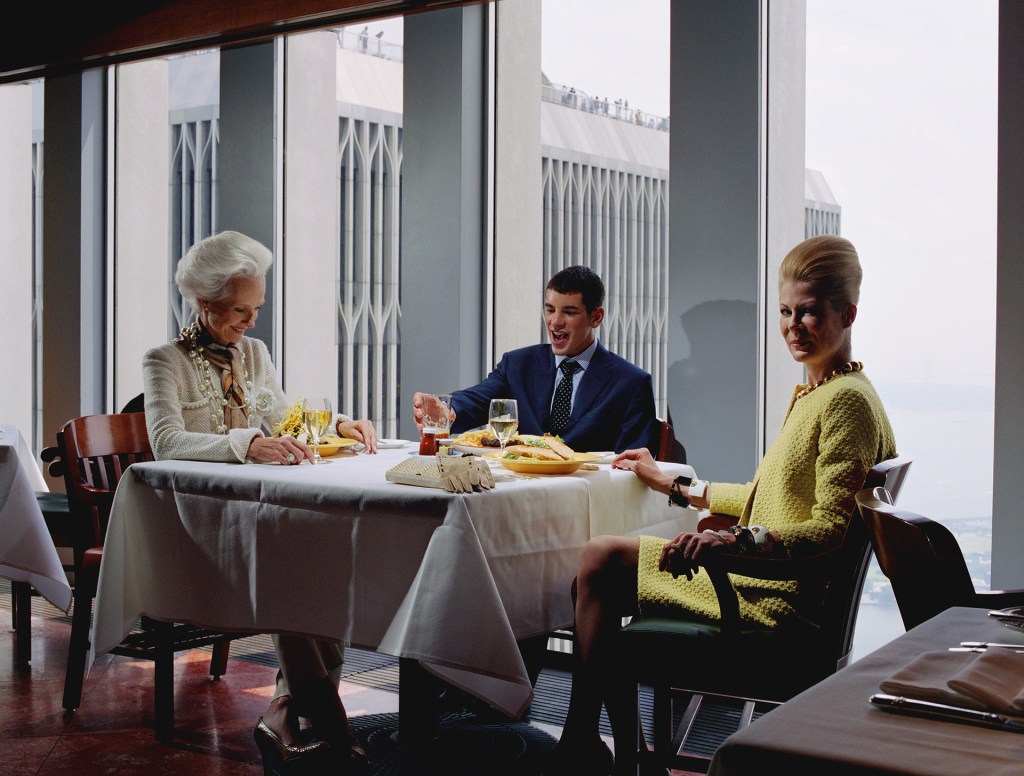
W, September 2000 #6, by Philip-Lorca DiCorcia [1]

Here we have three people enjoying lunch in a restaurant that is immediately recognisable as the Windows on the World at the top of the World Trade Center towers. The shot was taken in 2000, the year before the towers were destroyed in the 911 attacks, but the location’s use was merely an accident; the artist knowing someone involved in the running of the restaurant. The main contextual elements in the image are the two middle-aged ladies having lunch with a much younger man. diCorcia states that the series was a fashion story about the ‘boy toys’ of women of a particular social class and age group[4]. The fashion elements that are layered into the photograph are what the series is supposed to be revealing, but when we look closer at the picture we see that nothing is at all natural about the shot, from the bright lighting to the almost over-the-top acting of the subjects. One of the women appears to be enjoying the presence and attention of the young man, while the other looks embarrassed, glaring at the camera as if she’s been found out in some way. In this image, there is both total abandonment with the mature women being entertained by the young man, as well as the acknowledgement that it’s not perhaps the done thing in society. The elegant setting adds weight to that impression, the twin towers being a symbol of prosperous America. In discussing this image, diCorcia confirmed that in fact, the women were professional models but the young man was actually a hustler in the same way as his previous series. This blending of the perceptively real and unreal, which traces of their opposites is to me, very indicative of most of diCorcia’s work; the added context making it even more intriguing.

In various interviews[4][5], diCorcia has discussed his desire to create art that is separated from his perspective, almost always making it clear that he is not part of the story but merely using a camera to observe. In the case of Heads, he elected to add a lack of control over the subjects by photographing them from a considerable distance. His lights were set up within the scaffolding of building works and his camera pre-focussed. When a person walked through the region of focus, he triggered the camera. What resulted was a series of images captured by chance more than design, in some cases the subject would be too tall or too short for the picture to work but in others, the sense of people going about their daily lives comes through strongly. The series got diCorcia in trouble as one of the subjects sued him for using his image[6], but in the main the reaction when the subjects realised they had been photographed ranged from happiness to ambivalence.

With East of Eden, diCorcia set out to create a sense of the loss of innocence. The work began in 2008 around the time that America was transitioning from the Republican era of George W Bush to the Barack Obama’s first Democrat administration. diCorcia, who described himself as ‘not Republican’ combines the contextual references of contemporary American society with religious themes throughout East of Eden. References to Adam and Eve, Cain and Abel etc give the sense of the damage done by the political culture on modern America through diCorcia’s alternative realities. The works are subtle, though as in the case of the photograph Cain and Abel.

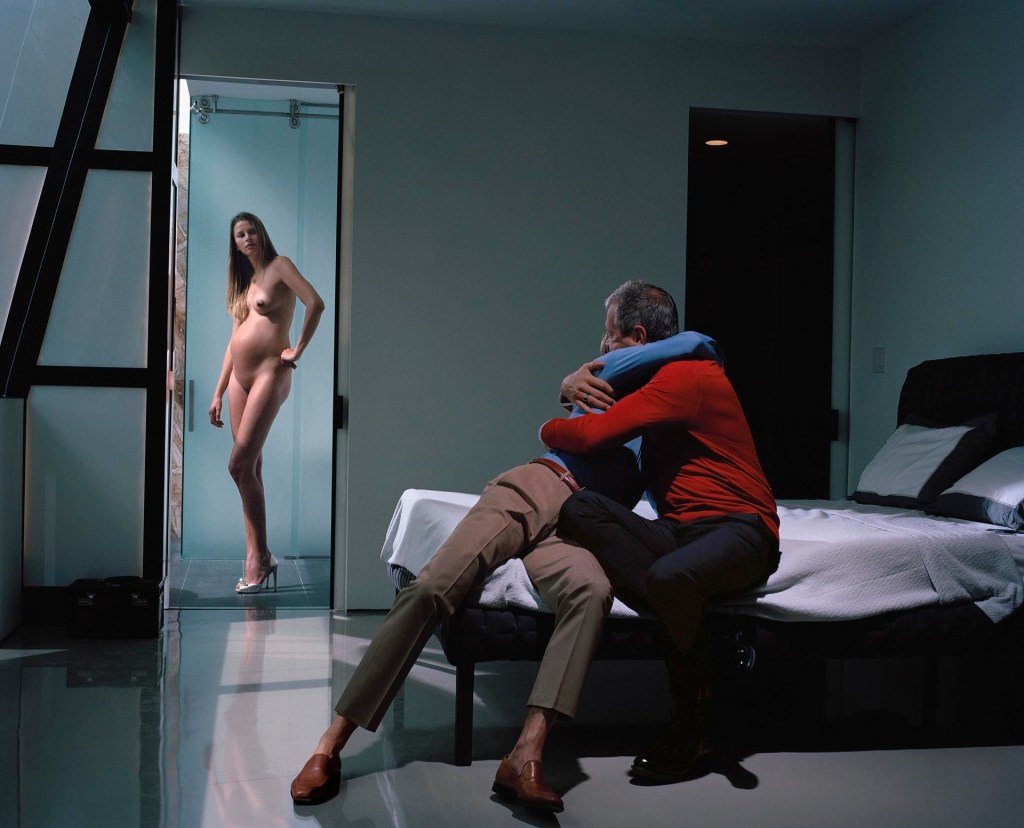
Cain and Abel (2013) from the series East of Eden by Philip-Lorca diCorcia [1]

In the bible story from the book of Genesis, Cain and Abel were brothers and the children of Adam and Eve. The story tells of Cain murdering his brother after his offering to God was seen as of lesser value than Abel’s. His action resulted in his banishment from Eden to ‘the land of Nod’, located to the East. East of Eden is the direct reference to the story and the descent of Cain and his descendants into moral corruption following his destroying of the righteous[7]. It has been retold throughout history and in the case of Steinbeck’s novel also called East of Eden, set brought into the context of modern society[8]. In diCorcia’s Cain and Abel, we are presented with two men in embrace. The nature of their relationship is unclear but the presence of the bed suggests a homosexual couple. The men are wearing the colours of the two main political parties in the US, so the viewer is immediately asked if the embrace is one of affection or rather that they are fighting. In the doorway a naked woman watches the two men. She is pregnant, which creates the sense of motherhood. In fact, diCorcia intended the woman to be Eve, the mother of Cain and Abel – he admitted to having photoshopped her naval form the image to give her the impression of being the original human female[4]. The multiple layers of context that this photograph contains is typical of the series. Themes such as separation and division, with the chance of reconciliation are matched by the reaction to the men being a gay couple, something that conservative America still regards as a sin. The disapproval or disappointment of the Eve figure could further reinforce that sense and her pregnancy while signposting her status as mother, could also be seen as continuation – a sense of ‘we’ve started as we mean to go on’; the age of innocence lost. It could equally be read as sadness that the general narrative about homosexuality as being ‘wrong’ is still evident today, despite significant progress in acceptance and rejection of prejudice.

When we think about it, loss of innocence can have many meanings such as the loss of childhood to adulthood portrayed in literary works like William Golding’s Lord of the Flies where the extreme circumstances cause the children to have to fight for survival and, almost inevitably power. Visual artists have represented this same theme in a variety of genres, for example Costa Rican artist John Paul Fauvres’s series The Loss of Innocence which was inspired by his observations about his son growing up [9]. Fauvres challenges the associated we have with the things we enjoyed as a child by altering them in an adult, often sinister way. One such image of Mickey Mouse blended into Marilyn Monroe suggests a shift away from the pure to the superficially pure in an almost nightmarish way created by the act of seeing it through adult eyes [9]. Perhaps this explains then, some of the criticism levelled at renowned Sally Mann who photographed her children innocently playing and frequently nude. Our application of an adult perspective immediately associates the nudity of children as observed by their parents as being sinister or abusive, serving to erode innocence where it is clearly evident – I was quite shocked by this when studying the artist as part of EYV.

However ‘loss of innocence’ could also be a term associated with the veil lifting on a preconception. diCorcia believed that America had changed during the Bush administration with the financial crash brought about by the ‘immoral’ behaviour of the banking industry and the ‘terror’ and the subsequent war on terror that revolved around the 9/11 attacks. This series explores the notion that perhaps the age of innocence had been lost without anyone noticing and that it was more about the way we see the world that had changed.

East of Eden then is a series that is full of metaphor, alternative narratives and multi-layered meaning, which is why I chose a photograph from it.

Deconstructing ‘The Hamptons’

I approached this in a similar way to Exercise 2[10], where I analysed an advertisement for sliced ham. I started with the formal, factual elements in the frame and then moved on to some of the potential connotations of them. The annotated photograph can be seen below.

The elements that are labeled in red are the signifiers, or factual elements present in the composition. We see here the space containing furniture and equipment that denote a living room. The presence of the television, fireplace, hi-fi equipment and coffee table all point to a space with a very specific purpose. The space is painted and carpeted with neutral colours, which combined with the style of the coffee table connote a modern living room. Indeed the style of the room architecturally suggests modern with its central block containing the fireplace, hi-fi and log store. We cannot see what is beyond, but what we can see denotes open-space living. The audio and video equipment are large and expensive-looking, which connotes a space owned by someone with money. These elements come together to result the photograph’s first sign, which is that this is an expensive living space. This sign is further emphasised by the title of the photograph, The Hamptons. The Hamptons is a very wealthy area of upstate New York, which fits with this first sign.

The next noticeable elements are the two dogs and the pornographic film being shown on the television. The dogs are clearly of the same breed, which has a clean, lightly coloured coat. One is sitting upright and the other is laying down, but both are looking in the direction of the wall with the television on it. For me, the two dogs dennote the occupants of the space as they are the only living beings in the photograph. Their postures connote different emotional responses to whatever they are looking at. The one sitting suggests interest or tension while the other connotes relaxation and perhaps comfort. The former has their posture further emphasised by their reflection in the coffee table which only reveals the dog’s hind legs. The connotation here is that the dog is alert and ready to move if necessary, which further adds to the sense of attention being paid to what the dog is looking at. The television on the wall is what we assume the dogs are looking at and on it is a pornographic film. If the modern, expensive, perfectly neat and tidy sign of the living room is the studium when considered with the picture’s title, the porn film is the punctum. It’s stark contrast to the rest of the picture is evident from first examination and when combined with the fire offer the completely opposite sign. Here we have the perfect space and perfect occupants in the presence of something that doesn’t obviously belong. When I observed this punctum, I also noticed the increased significance in the way the scene is lit, by a uniform soft light from the right hand side of the frame. diCorcia is well known for using artificial light in his compositions because of his fashion work, so it is no coincidence or accident that the light in this image is pure. It is, of course part of the signs relating to the modern, expensive living space, but I noticed it when presented with the contrasting element, i.e. the porn film.

Exploring the possible cultural themes

With the studium and punctum of the image beginning to present themselves to me, I wanted to explore the cultural themes relating to them. The first is the culture of wealth and the way that it affects our perception of the people who have it. As mentioned previously, The Hamptons is a region of upstate New York which has some of the highest house prices in the US, some properties reaching over $100m. The fascination with that kind of wealth can be found throughout modern media, ranging from reality television stars such as the Kardashians to the billionaire businessmen and women such as Jeff Bezos (Amazon) and Alice Walton (Walmart) whose lifestyles are coveted by many. We associate money with power and indeed some of the people with money also wield power over our lives. However, where does the association with higher class and standing come from when it comes to money? Since the modern US culture and the UK share a common history, we can consider the attitudes to wealth and class that span the past few hundred years. In the Tudor era, the wealthy were born of privilege and as a result expected to be responsible for the lower classes in their regions or estates. Such responsibility was associated with respect for standing and the resources to give jobs to working men and women of the lower class. The respect was engendered, even if the ‘master’ was just a fortunate benefactor to family wealth that he hadn’t earned. These notions continued into Victorian England where the social classes were shaken up by the Industrial Revolution [11]. Now wealthy people were both revered and reviled for being ‘the betters’ of the common man, a sentiment that we see in literature such as Dickens’ Oliver Twist. In his novel, Dickens uses the theme of class divide as a battleground where the poor and morally bankrupt rob the rich as part of a criminal enterprise. The principal character, born to poverty eventually ascends to wealth by being adopted by a ‘gentleman’ and ultimately turning out to be a member of his family through his mother’s line. The story tells us that the rich are special and the poor must fight, but it is possible to cross the divide. At the time of writing, Dickens’ readers would have been acutely aware of gulf between classes, so the notions being put to them by the Dickens would have appeared unreal[12]. Dickens answer was to make Oliver a pure figure, beyond reproach whose destiny to achieve wealth and standing was ‘because he was one of them’. However, we know now that while the legacy impression of wealth symbolises higher standing or ‘being better’, we know from our more recent history that this simply isn’t the case. Highly publicised scandals and the private lives of the rich and famous and even royalty have made us cynical about what goes on behind the perfect facade of the image of wealth and success. The continued morally questionable behaviour of President Trump presents us with almost a confession that you don’t have to be good to have money. Perhaps then diCorcia’s loss of the age of innocence starts with the notion that wealthy means goodly and then contradicts it with both obvious and subtle narratives.

The second are of cultural context I wanted to explore was our relationship with pornography. Pornography has long been a devise subject that most prefer not to discuss. It’s association with historical illegality and the seedy side of life have driven it’s existence underground or behind closed doors. However it is more prevalent than ever, being regularly recorded as the most accessed material on the internet [13]. The effect of pornography on society prompted a House of Lords report in 2015 [13] in which concerns about the accessibility to children, it’s effect on their sexual development and implication in violent acts committed on women were offset by the lack of real understanding of who watches it. Their own statistics didn’t capture the volume of material being watched and which sexes, social groups and classes were the main audience for it. Arguments have been made that it is an industry like any other and that the boundaries between art and pornography are blurred at best. Take the work of Fauvres discussed earlier for example. Some of those paintings take childlike constructs and overtly sexualise them. Robert Mapplethorpe’s extreme portraits often portraying homosexual ‘acts’ and male nudity are considered art, yet despite there not being anything illegal about them, were considered pornographic when they were first published. That response was driven mainly by heterosexual sensibilities that considered being gay to be unnatural. Porn then, is something unnatural that we should be ashamed of. Despite this, many women watch pornography as well as many couples with strong, loving relationships. Like societal beliefs in wealth and morality, pornography is something best kept hidden – almost the opposite side of the same cultural coin.

Reading ‘The Hamptons’

When I read The Hamptons (2008) by Philip Lorca-diCorcia, I first see the signs that I identified in the deconstruction. This is a wealthy living space where everything is seemingly pure, but in fact there is a contrasting activity taking place. The two dogs symbolise two types of people that have a common appearance to the outside world. The pornographic film symbolises the replacement for the innocence lost, in this case the contrasting aesthetic to the purity of the room and its occupants. The inclusion of the fire that seemingly serves to provide heat to the space now looks like an almost religious signpost that whatever is happening has some form of damnation associated with it. The reactions of the two dogs to the film are different, one appearing to be ambivalent to the loss and the other being acutely aware of it. There are no other beings in the space which suggests that the occurrence and their reactions are all private; the notion of ‘not knowing what goes on behind closed doors’ could be literal when considering the dogs and the film, but my reading is that it is a metaphor for our lives – some things are neat and controlled like the room (with its almost clinical tones) and others are beyond our control (the dogs wouldn’t chose to watch a porn film by themselves). The struggle between the image of good and the struggle with the evil is not a simple one. In this photograph, the evil is already there but the dogs are merely accepting of it or intrigued by it. As with the banking scandal that served as diCorcia’s inspiration, the behaviour was going on but nobody really paid attention to it until it was too late. Like our ability to recognise the slow degradation of innocence causes by such events, our reaction to them depends on our point of view. As with the other photograph Cain and Abel, diCorcia weaves layers of potential messaging with only a handful of props and environmental conditions.

Conclusion and Preparation for the Essay

In conclusion, I am glad I selected one of diCorcia’s photographs for this assignment. As with the previous exercises, the methodical approach of looking first at what is present in the frame and what it might mean is a good way of structuring the photograph before reacting to it in some way. My reading of the studium and punctum led me to looking at how my own experiences and perspectives affect the meaning of the overall image to me. Having visited the US several times now and stayed in places where the rich are truly rich, I recognise the setting that diCorcia presented this subject within. My own views people’s morality is not driven by social media personas or public faces. Neither is it judged in any way by them looking at pornography, which I feel to be a complex subject that shouldn’t be reduced to a tool by which people are assessed. The use of dogs instead of people further reduces the temptation to judge by appearances, instead the potential narrative that the inclusion creates is all the more interesting because of the metaphor. What I loved about this photograph when I first saw it was that it made me smile. The humour introduced by the silly way the dogs are watching the film belied the sadness and almost sinister way my reading of the image evolved. It’s that complexity that makes this image resonate with me.

In preparation for writing the essay, I am intending to use a structure defined in a recent training course that I completed for work, referred to previously [14]. The structure aligns with:

  1. Setting the scene with context and what the speech is about
  2. Summarising the key points of the information being imparted
  3. Personal experience and connection with the subject
  4. A final point connects the conclusion back to the original intent in 2.

By following this structure, I will be able to prioritise the key points while remaining within the word count.

References

[1] Image Resource, “Philip-Lorca DiCorcia, David Zwirner Gallery, https://www.davidzwirner.com/exhibitions/philip-lorca-dicorcia-paris#/explore

[2] Helmore E, 2011, ‘Still Life: Philip-Lorca DiCorcia’s breathtaking and outlandish fashion photography, Independent Newspaper website, https://www.independent.co.uk/arts-entertainment/art/features/still-life-philip-lorca-dicorcias-breathtaking-and-outlandish-fashion-photography-for-w-magazine-2229656.html

[3] HepworthWakefield 2014, “Philip-lorca diCorcia: Photographs 1975 – 2012, Youtube, https://www.youtube.com/watch?v=So_FK4qnz5Q

[4] Unknown, 2015, “Tuesday Evenings at the Modern – Philip-Lorca DiCorcia, Youtube, https://www.youtube.com/watch?v=zs8z9DCVrYA

[5] Unknown 2018, “Interview – Philip-Lorca diCorcia, CICART video, https://www.youtube.com/watch?v=67U-0_wExLA

[6] Gefter P, 2006, “Street Photography: A right or invasion?”, The New York Times, https://www.nytimes.com/2006/03/17/arts/street-photography-a-right-or-invasion.html

[7] Multiple Authors, 2020, ‘Cain and Abel- Bible Story’, Bible Study Tools post, https://www.biblestudytools.com/bible-stories/cain-and-abel.html

[8] Unknown author and date, “East of Eden – Plot Synopsis”, St Jose State University website, https://sits.sjsu.edu/curriculum-resources/east-of-eden/plot-synopsis/index.html

[9] Carter F, 2017, “John Paul Fauves Loses His Innocence”, Forbes Magazine, https://www.forbes.com/sites/felicitycarter/2017/07/10/john-paul-fauves-loses-his-innocence/?sh=6ab5ede91367

[10] Fletcher R, 2020, “4) Exercise 2 – Deconstruction Task”, OCA Blog Post, https://richardfletcherphotography.photo.blog/2020/10/30/4-exercise-2-deconstruction-task/

[11] UKEssays 2018. “Social Class During The Victorian England”, [online], https://www.ukessays.com/essays/history/a-persons-social-class-during-victorian-england-history-essay.php?vref=1

[12] LitCharts, Unknown Date, “Oliver Twist by Charles Dickens, https://www.litcharts.com/lit/oliver-twist/summary

[13] Santo M, 2015, “Impact of Pornography on Society”, House of Lords Library (linked download), https://lordslibrary.parliament.uk/research-briefings/lln-2015-0041/

[14] Fletcher R, 2020, “Research Task – Insomnia”, OCA Blog Post, https://richardfletcherphotography.photo.blog/2020/11/13/research-task-insomnia/

Assignment 3: Self Portraiture

The brief

Drawing upon examples in Part Three and your own research, you can approach your self-portraits however you see fit. You may choose to explore your identity or masquerade as someone else, or use empty locations or objects to speak of your experiences. However you choose to approach it, use yourself – directly or indirectly – as subject matter.

Keep a diary for a set time (at least two weeks). Each day write two or three pages about yourself – what you’ve been doing/thinking. This can be as specific or poetic as you wish. You may wish to pick a theme for the duration. This is an open brief designed to give you freedom to create something personal which suits you best. Use the artists you’ve looked at in Part Three for inspiration. Select the most interesting parts of the diary (which could be the most banal or mundane) and interpret them into a photographic project. A good way to approach selection could be to ask a friend/fellow student/stranger to read it and send back a highlighted version. You could then base your project on those parts. This would take the pressure off you to find a ‘good story’.

You may choose to select a few days or phrases that stark an idea for you, or you may wish to exaggerate how you were feeling one day into a parody of yourself or the circumstance. You may wish to create a ‘document’ of that time in a re-creation of events – or direct a model to act out some of the content of the diary, making your own ‘film-stills’.

You could present your chosen diary entries as a visual diary or use it as a springboard for further exploration. You may choose to insert the pictures like snapshots into your diary and hand it all in together. You don’t have to restrict yourself in the diary itself; you may decide to use it to take you into new territory.

Introduction

This assignment began with my diary [1] and an initial idea that took its inspiration from Larson and Hindelmann. The idea was to use my diary text to choose a location using the What Three Words navigation software. The tool uses a combination of three words as coordinates and is used as a simpler way of navigating than GPS. I would then visit the locations in a similar way to the artists in their Geolocations project and photograph myself as a positional marker in the scene. I would also follow a similar approach in choosing a composition that related to the diary text. This idea picked up on advice from the feedback in my previous assignment about having a structure to my planning and looked promising until I ran into difficulties with the technology that prevented my using What Three Words in this way. After reflecting on what I wanted to achieve with the work, I realised that I could explore the differences between my expression through the words in diary and the cold, impassive way that technology processes this kind of information. I would contrast the two interpretations and invite the viewer to draw their own conclusions by creating a linear series of photographs containing contextual references to the themes in the text. The evolution of these thoughts are captured in the blog post ‘Preparing for Assignment 3′[2].

Summary of the Idea

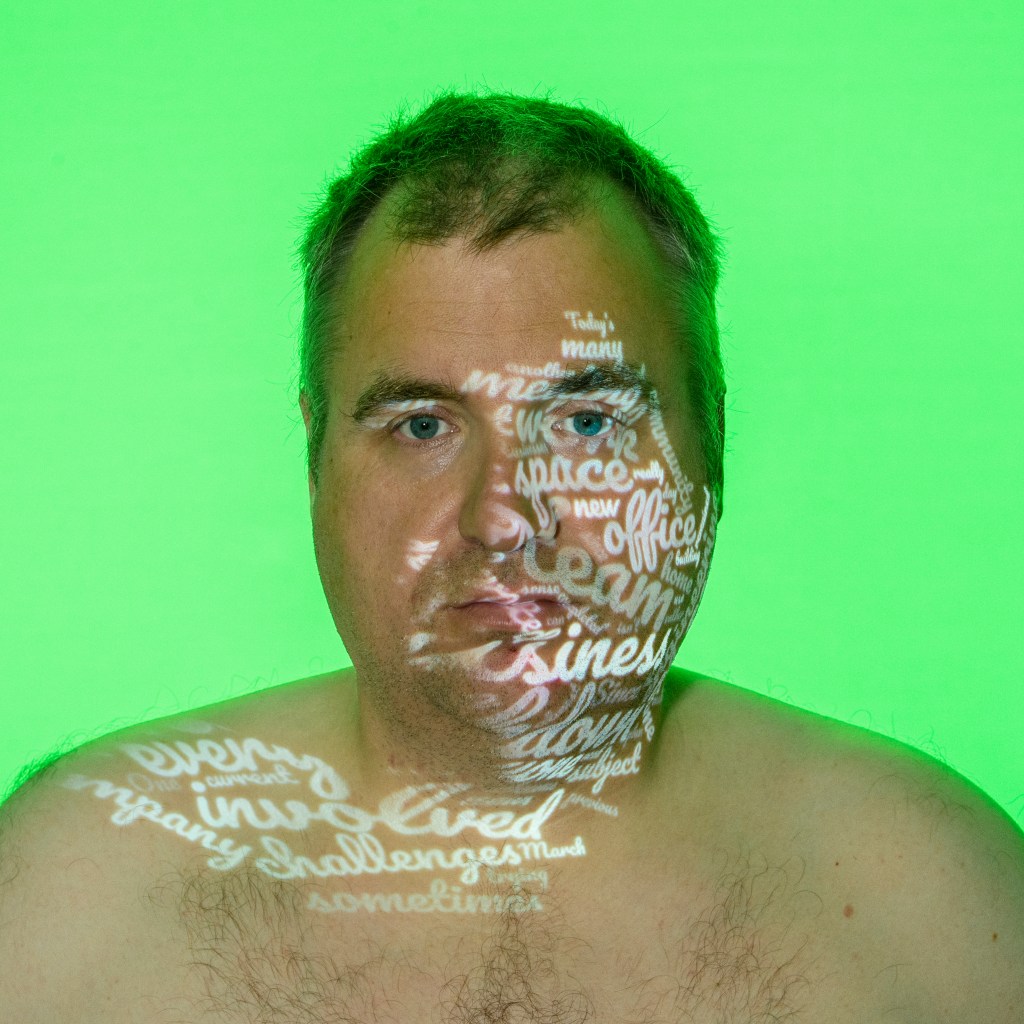
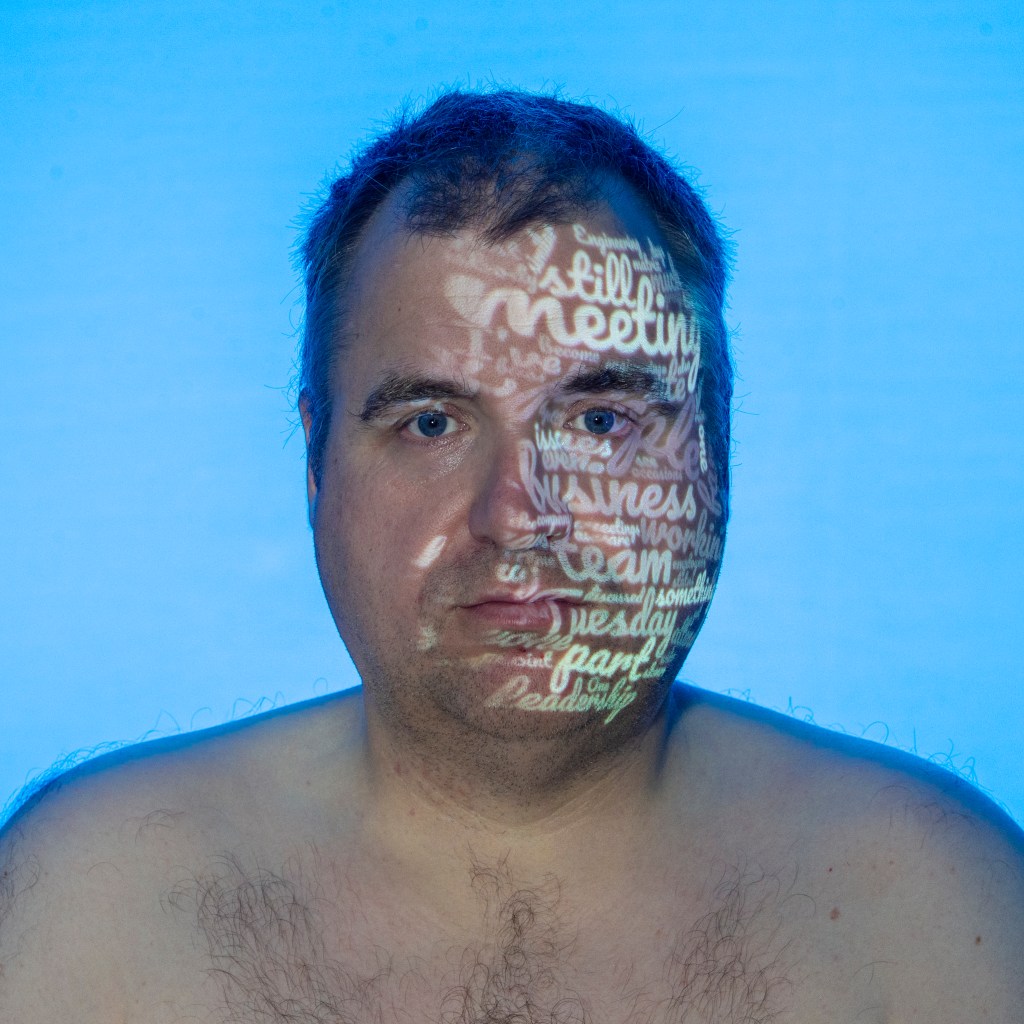
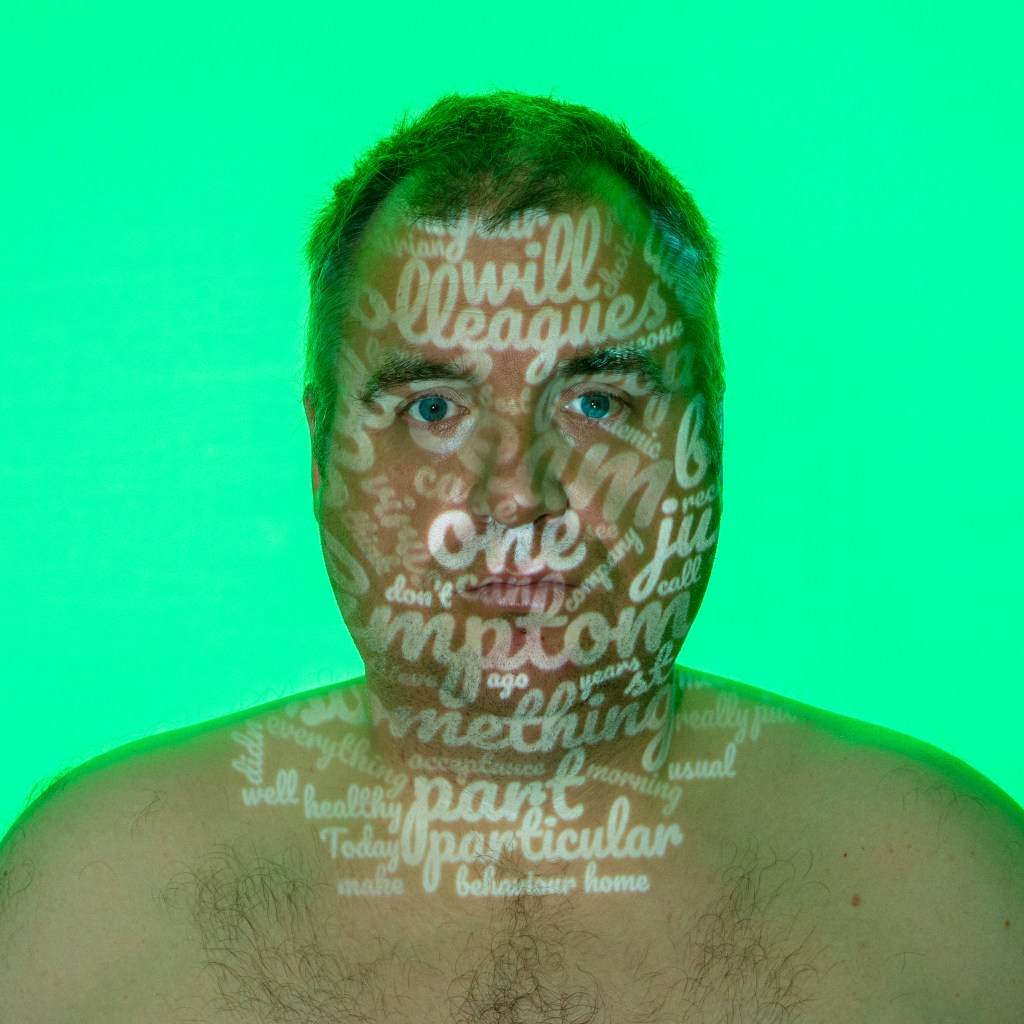
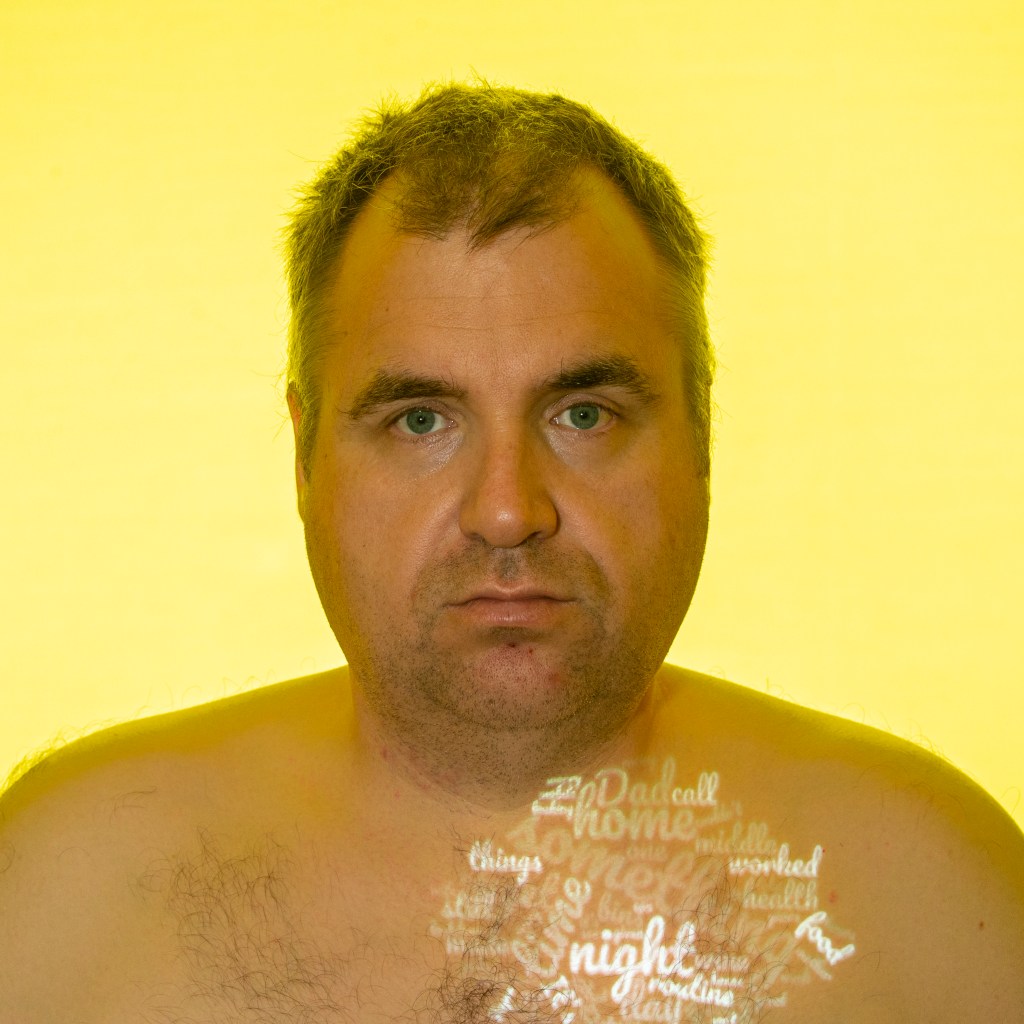
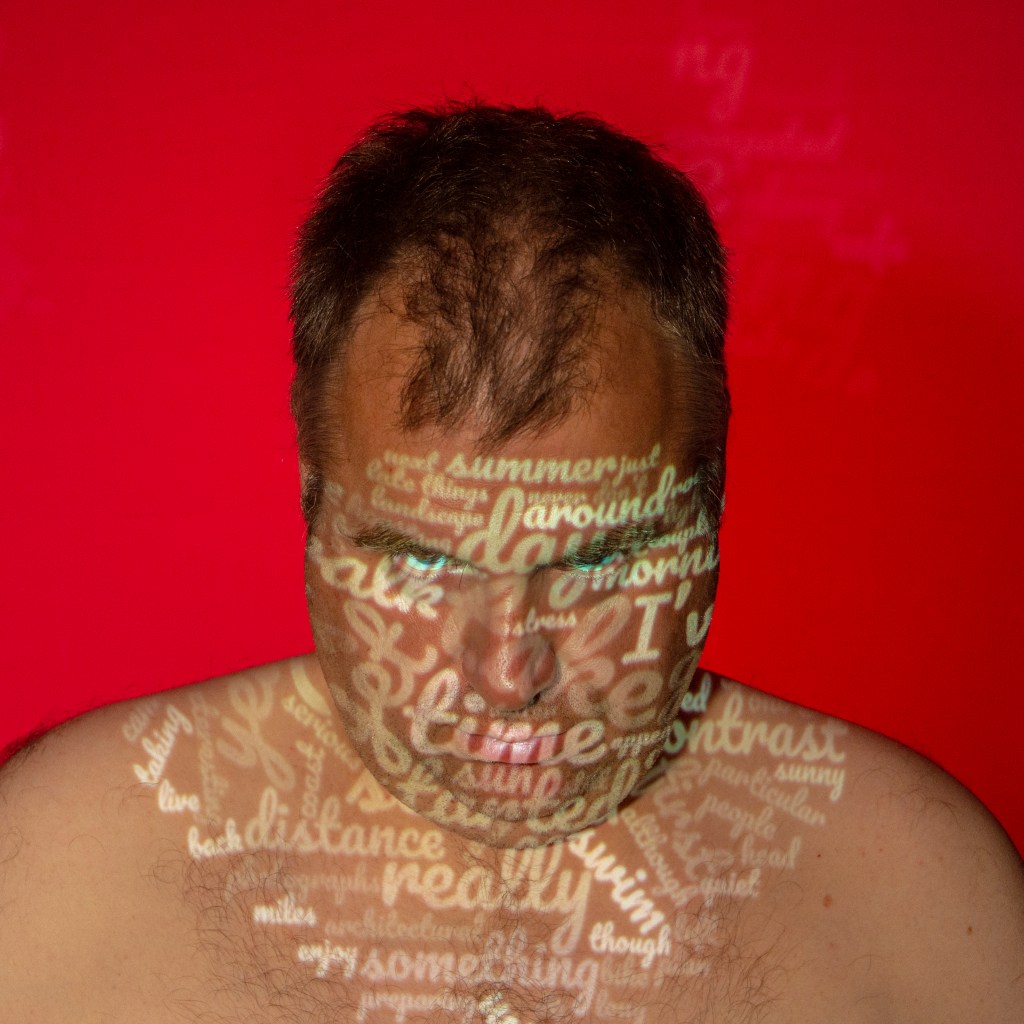
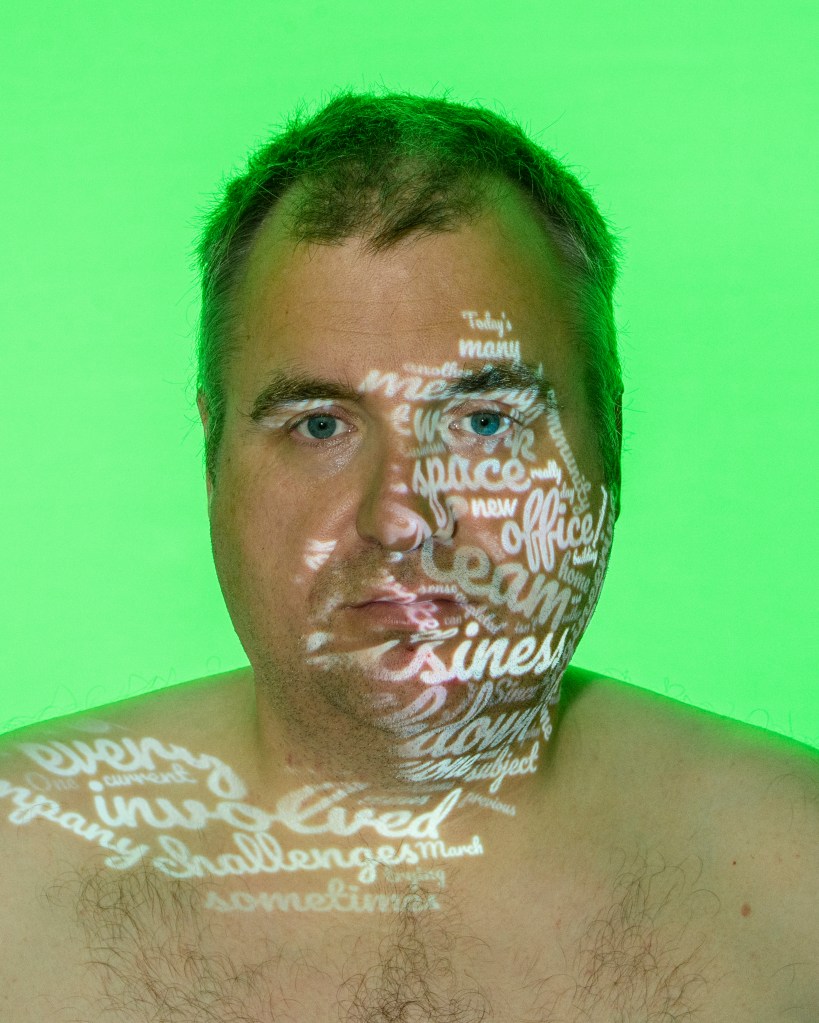
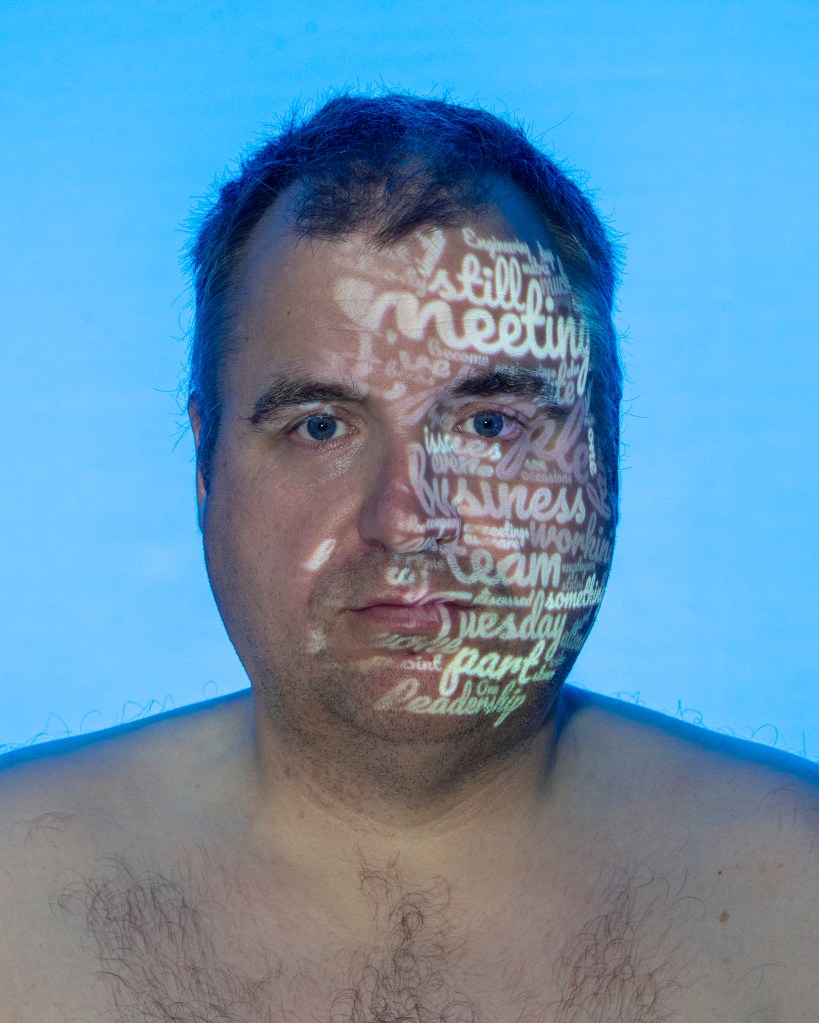
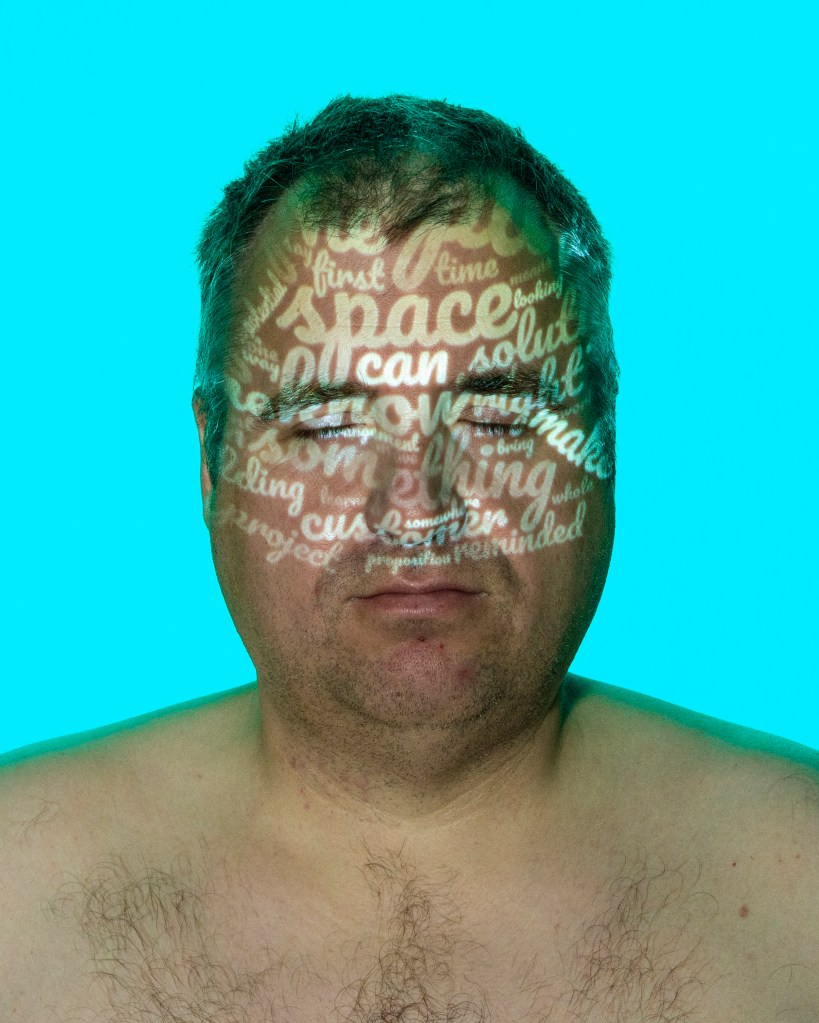
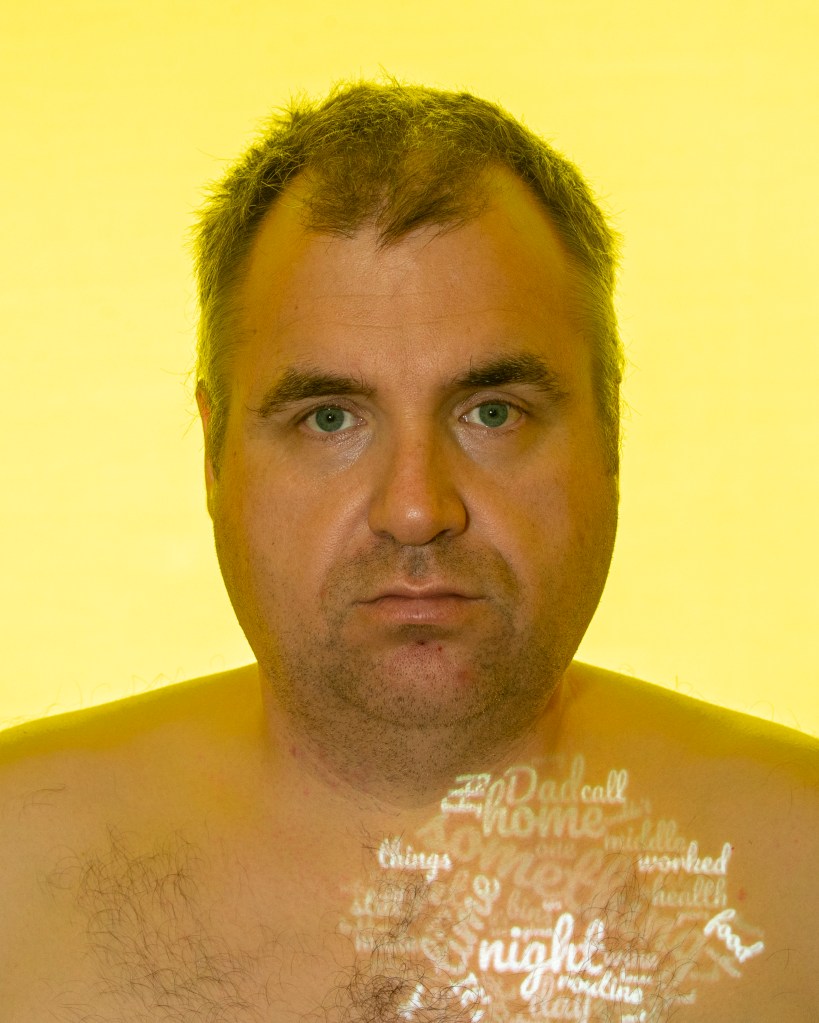
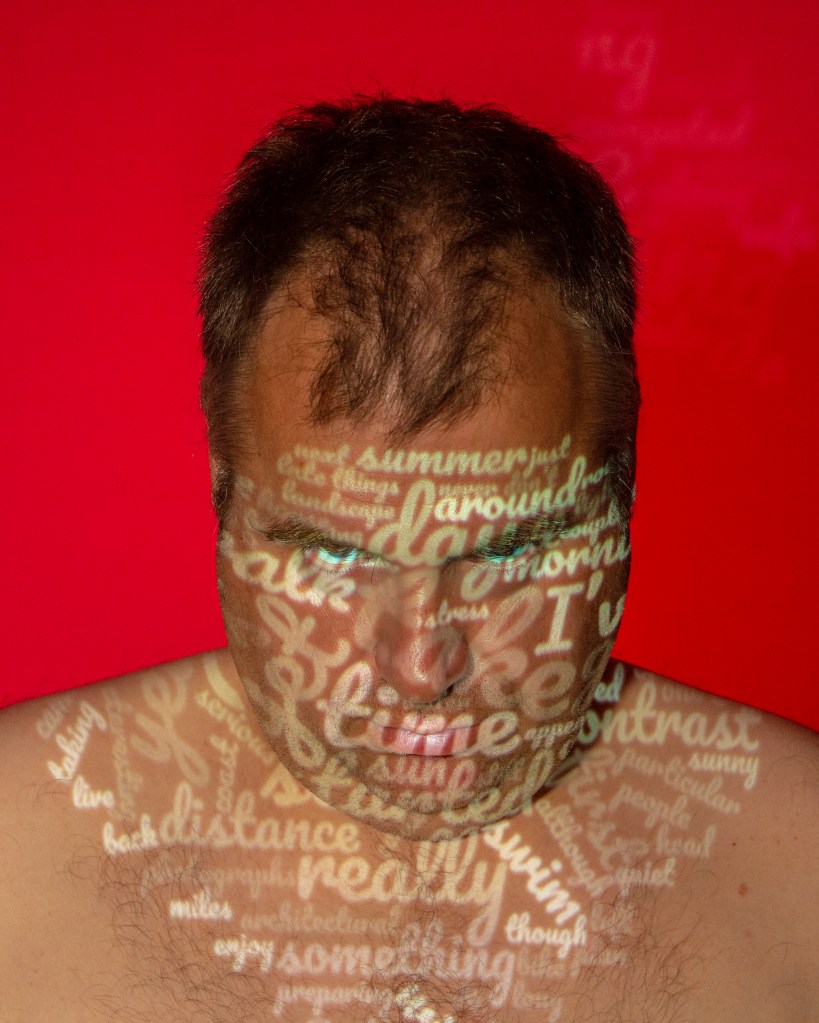
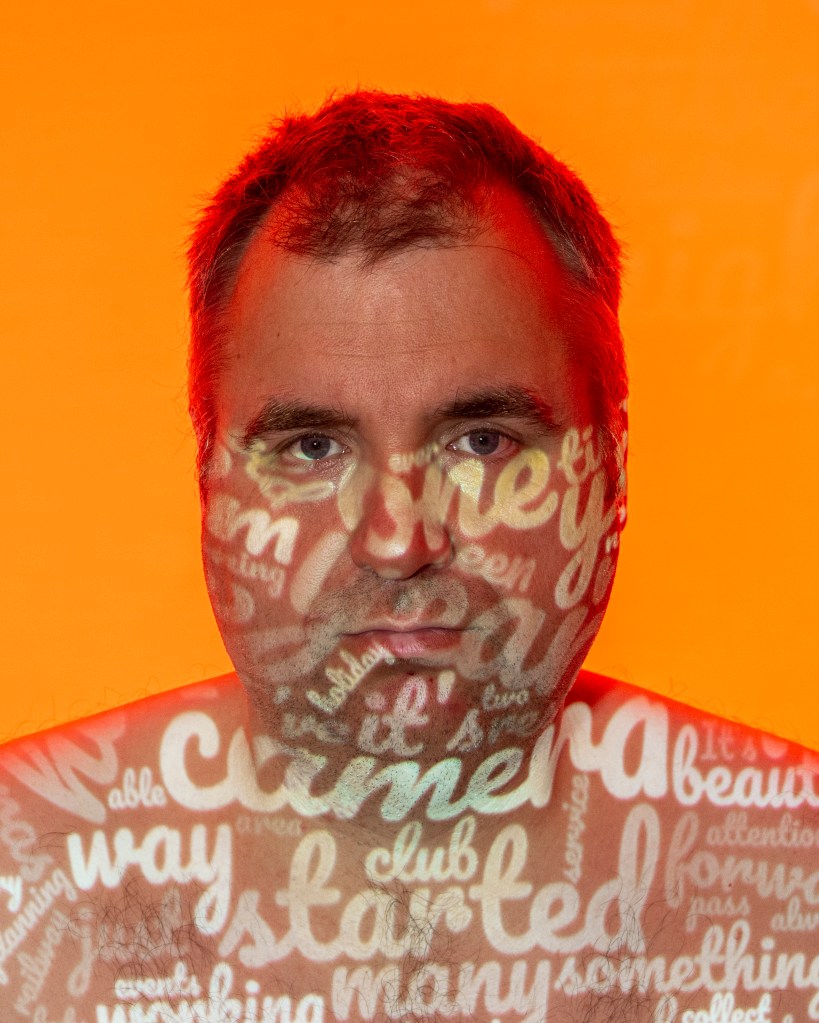
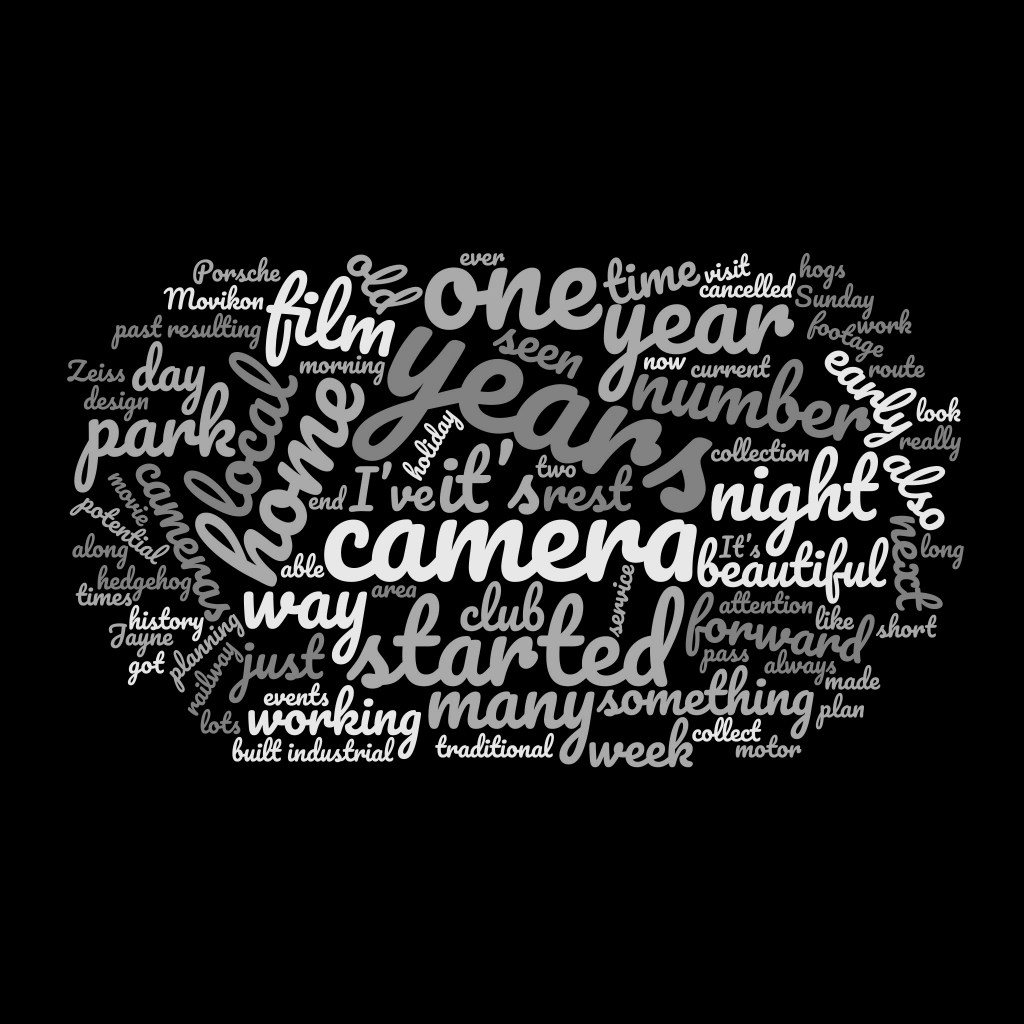
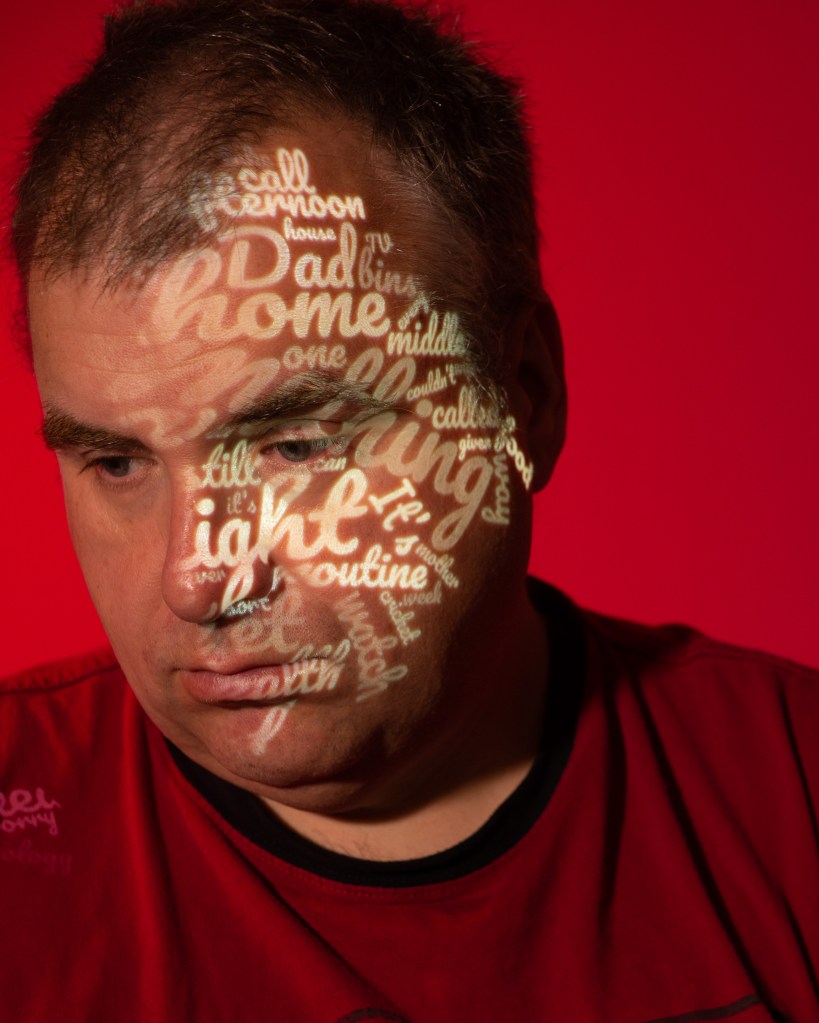
My idea was to take the text from each day of the diary and run them through a software tool to count the most frequently used words produce a word cloud of the most used words. The words are subsequently sized by their frequency, with the higher counts being the larger font size. This crude analysis of the diary produced an impassive assessment of my writing, which often contrasted with the original intent. I wanted to highlight these differences by projecting the words onto my expressionless face. I would further add to the contrast by lighting the background of the portraits with colours that represent or invoke emotional responses both in me and in the viewer. It would be up to the viewer as to how they interpreted the image in terms of narrative. Arranging a week’s worth of portraits would present the linear passing of time through the series. During the preparation work, I had decided to stop developing the idea so that I could shoot it. However, during further reflection I realised that the viewer would actually have to read the whole diary in order to appreciate the series. I felt that this would significantly lessen the impact of the images, so decided to include short paragraphs of the respective days alongside them. Each image would now be captioned, which I felt would make the series stronger.

Technical Approach

I set up a small studio with a plain grey background and a studio strobe fitted with different coloured gels. The camera, key light (the projector) and fill light (continuous LED) were positioned on stands and the camera on a tripod. I enlisted my wife to set the final position of the words onto my skin and operate the camera. Each portrait was then further post-processed and had the text added to it.

The Series: Mark My Words

Monday
“Where there are questions or challenges from the team about what they are being told, I endeavour to resolve them if I can.  It’s not always possible though,as the engineering leadership team isn’t currently involved in some of the higher-level discussions or decisions.  At the point that we are, some of the information that is being briefed will be easier to explain.  For now, though there is a sense of ‘no news is good news’ – a bizarre expression that suggests that ignorance of something happening is better than knowing”
Tuesday
“The meeting itself for me is only about 50% effective in discussing the important topics, so I find myself questioning the point of it.  As Tuesday progresses, the topics become more interesting as more people are involved in their debate.  Perhaps my reticence about the first meeting is more about it feeling like a morning prayers session than a constructive meeting”
Wednesday
“As we were all working from home, there was little to no risk of it causing an issue in the business, but it was still a theme that people would tell us about their symptoms on the morning call.  On this particular morning, I realised how that doesnt happen at all now.  Isolation was indeed a good way of reducing the risk to our health, it would seem.  Today, everyone was in good form”
Thursday  
“The need to de-personalise the workspaces is something that we aren’t undertaking lightly, but it won’t be seen that way by the people who work for us.  I have a team member with four computer screens who is going to go mad when I tell her she can have only one.  If I think about my own sense of home, I’m reminded of the time when home was the last place I wanted to be.  I was being driven slowly mad by noise from our upstairs neighbour, which became the trigger for a series of serious depressive episodes that eventually landed me in hospital.  I had no axe to grind with our neighbours and they could never have fully understood the damage they were doing to me”
Friday
“On this occasion one of her neighbours who has been looking out for her during lockdown, called to say she couldn’t get hold of her.  While the neighbours have been great, this one is a bit of a busybody.  She had become accustomed to watching Hazel’s routine of putting her recycling bins back in the garage after they had been emptied in the morning.  On this day, the bins were still out in the afternoon.  The neighbour had tried the house but got no answer, called her mobile and got her voicemail and, after some time called Jayne”
Saturday  
“I’ve always felt proud of my own distance swimming achievements, though.  My first distance swim was 2 miles open water, which is a massive challenge in its own right.  Even though COVID has put paid to my training this year, I am determined to swim the 11 mile length of Lake Windermere before I am 50 in just under 2 and a half years’ time”
Sunday
“One the way home, we started planning our next holiday.  We have had two cancelled this year so far, with a number of triathlon events that would include long weekends also being called off.  With the rest of the year provisionally planned, we turned our attention to 2021 and 2022.  Towards the end of this year, we have hired a camper van as a trial with a view to buying early next year.  It’s something we are both very excited about because it give us a little more freedom to take off for short breaks whenever we like” 

Reflection

This assignment was a labour of love. The process of developing an idea and trying to learn from my previous work was an interesting experience. One of the driving forces in this evolution was the need to not overthink what I was trying to do. Past experience has led to me shooting what comes naturally or is the most comfortable. I believe this to be the main reason for choosing to be in the photographs in the way normally associated with self-portaiture as opposed to one of the alternative interpretations. Although I was hugely inspired by Morrissey, I set out to create something different. The idea of projection as both communication and visualisation came to me when I was thinking about becoming a canvass. I was immediately drawn to the way that light bends around a curved surface, so with my face and body as the canvass this would be emphasised in the images. I’m happy with the way that the pictures are not of me, but are a carriage for my words. In essence, the diary and the computer’s highlighting of my impactful words is what is about me. The mood colours were essentially chosen by my wife, based on both my words and how she knows I feel about certain events or memories. This series has therefore become a very personal narrative about me with internal and external context leading through it. I still don’t like being in photographs, but here I believe I’ve succeeded in being both present and absent at the same time. I deliberately tested this assertion in the series itself as two of the photographs have slightly different poses to the others. When I was editing the series, the shot for Saturday was the one that naturally stood out when looking at them all on the same screen. However, the more subtle ‘eyes closed’ shot for Thursday went almost unnoticed. I found myself reading the words and taking in the bright colour of each frame, which was my original intent.

In preparing the text for the captions, I naturally re-read the diary carefully. It was interesting to see what my wife saw when she read it. The two weeks that I worked on it were a rollercoaster of emotions, actions and reactions that I could see more clearly in the context of the photographs I had been shooting. Monday to Thursday told a story of a man who was in control of his daily working life. Themes of acceptance, opportunity, boredom and frustration were evident, not surprising given the COVID-19 situation. The rest of the week centred around my creative time, my passion for photography and study, as well as planning ahead for more adventurous days. When I think about it, that is exactly what life is like for me at present.

Against the Assessment Criteria

Demonstration of Technical and Visual Skills

This assignment used multiple lighting sources in a challenging mini-studio setup. The light level of the project could not be adjusted, so using it as the key light presented exposure challenges. The main issue was that the background light could not be reduced in power any further, so selecting an exposure that flattered my skin was extremely difficult. However, I wanted to create the sense of emotion ‘aura’ by using real lighting instead of adding a background in post-processing (as Moffatt did in Scorpio) so I was happy with the result. Visually, I think the images all have very similar composition with the exception of the ‘Saturday’, which was shot near the end of the day. I liked the way that the slightly cynical expression echoed my experience of the diary and the duration of the shoot, so I left it in the series to add something different. When I look at the sequence together, I’m reminded of the pop art style adopted by Warhol and his peers, which was an unexpected visual but one I actually like.

Quality of Outcome

I set out to show my words as seen by me and by a machine set against the context of what I was experiencing emotionally in the diary. I believe that the series achieves this through as series of subtle layers to each image. Visual tension is maintained by the words on their contoured canvass. The connections to the diary are strong through use of a single paragraph and the contrast between the human and machine interpretation stands out. All of these elements distract from my being in the picture and to an extent I achieve anonymity in each composition.

Demonstration of Creativity

This assignment was the first time that I’ve rejected the notion of creating a work that a viewer may like. Instead of wondering “will my tutor like this?” or “will anyone understand what I mean?”, I simply created what I wanted. I drew heavily on influences from Part 3, but the end result is not in any way a facsimile. Each picture is different from the previous, so there is no sense of repetition or lack of originality between them. I also pushed myself further out of my comfort zone in the use of my face and body as the canvass. My initial thinking once I had the concept of projection onto my skin was to use my body more than my face. I liked the idea of curvature distorting the words, but ultimately rejected the idea because it could be the body of anyone rather than obviously mine. This was a creative decision based on how to give the photographs impact, something that I have learned throughout Context and Narrative.

Context

In the context of my learning on the course so far, this assignment takes influences from the photographers studied and results in something that I believe meets the brief. The scope of the assignment brief was very open, stating that we had freedom to experiment with our interpretation of it. My interpretation is very different from any other coursework completed so far; to that extent I am very happy with the outcome.

Special thanks to my very patient wife Jayne, who helped set up and was ultimately responsible for the shooting.

Post-Feedback Changes to Assignment 3

During the feedback session with my tutor, a number of ideas were proposed to enhance both my submission and my appreciation of similar work within the genre of self portraiture. In addressing the feedback, I conducted the recommended further research, described in the blog post Reflecting on Assignment 3 Feedback[3]. However, one of the suggestions related to my assignment photographs was to change the crop from square format to portrait. This would not only tie in with the idea of them being portraits but it would also emphasise the main subject by reducing the amount of background colour in the frames. I could immediately see the benefit of re-cropping so decided that my final submission should incorporate this change.

Revised Series

Monday
“Where there are questions or challenges from the team about what they are being told, I endeavour to resolve them if I can.  It’s not always possible though,as the engineering leadership team isn’t currently involved in some of the higher-level discussions or decisions.  At the point that we are, some of the information that is being briefed will be easier to explain.  For now, though there is a sense of ‘no news is good news’ – a bizarre expression that suggests that ignorance of something happening is better than knowing”
Tuesday
“The meeting itself for me is only about 50% effective in discussing the important topics, so I find myself questioning the point of it.  As Tuesday progresses, the topics become more interesting as more people are involved in their debate.  Perhaps my reticence about the first meeting is more about it feeling like a morning prayers session than a constructive meeting”
Wednesday
“As we were all working from home, there was little to no risk of it causing an issue in the business, but it was still a theme that people would tell us about their symptoms on the morning call.  On this particular morning, I realised how that doesnt happen at all now.  Isolation was indeed a good way of reducing the risk to our health, it would seem.  Today, everyone was in good form”
Thursday  
“The need to de-personalise the workspaces is something that we aren’t undertaking lightly, but it won’t be seen that way by the people who work for us.  I have a team member with four computer screens who is going to go mad when I tell her she can have only one.  If I think about my own sense of home, I’m reminded of the time when home was the last place I wanted to be.  I was being driven slowly mad by noise from our upstairs neighbour, which became the trigger for a series of serious depressive episodes that eventually landed me in hospital.  I had no axe to grind with our neighbours and they could never have fully understood the damage they were doing to me”
Friday
“On this occasion one of her neighbours who has been looking out for her during lockdown, called to say she couldn’t get hold of her.  While the neighbours have been great, this one is a bit of a busybody.  She had become accustomed to watching Hazel’s routine of putting her recycling bins back in the garage after they had been emptied in the morning.  On this day, the bins were still out in the afternoon.  The neighbour had tried the house but got no answer, called her mobile and got her voicemail and, after some time called Jayne”
Saturday  
“I’ve always felt proud of my own distance swimming achievements, though.  My first distance swim was 2 miles open water, which is a massive challenge in its own right.  Even though COVID has put paid to my training this year, I am determined to swim the 11 mile length of Lake Windermere before I am 50 in just under 2 and a half years’ time”
Sunday
“One the way home, we started planning our next holiday.  We have had two cancelled this year so far, with a number of triathlon events that would include long weekends also being called off.  With the rest of the year provisionally planned, we turned our attention to 2021 and 2022.  Towards the end of this year, we have hired a camper van as a trial with a view to buying early next year.  It’s something we are both very excited about because it give us a little more freedom to take off for short breaks whenever we like” 

Updated Conclusion

I believe that the re-crop makes the pictures more impactful. On reflection, the area of background colour was distracting from the main subject and although I liked the Warhol-esque feel that it created, I don’t think it has been diminished by making the area smaller. The revised crop also makes it easier to read some of the smaller words being projected. Overall, I’m happy with the revised set.

References

[1] Fletcher R, 2020, “Assignment 3 Diary”, OCA Blog Post, https://richardfletcherphotography.photo.blog/2020/08/23/assignment-3-diary/

[2] Fletcher R, 2020, “Preparing for Assignment 3”, OCA Blog Post, https://richardfletcherphotography.photo.blog/2020/09/19/preparing-for-assignment-3/

[3] Fletcher R, 2020, “Reflecting on Assignment 3 Feedback”, OCA Blog Post, https://richardfletcherphotography.photo.blog/2020/10/09/reflecting-on-assignment-3-feedback/

Preparing for Assignment 3

Introduction

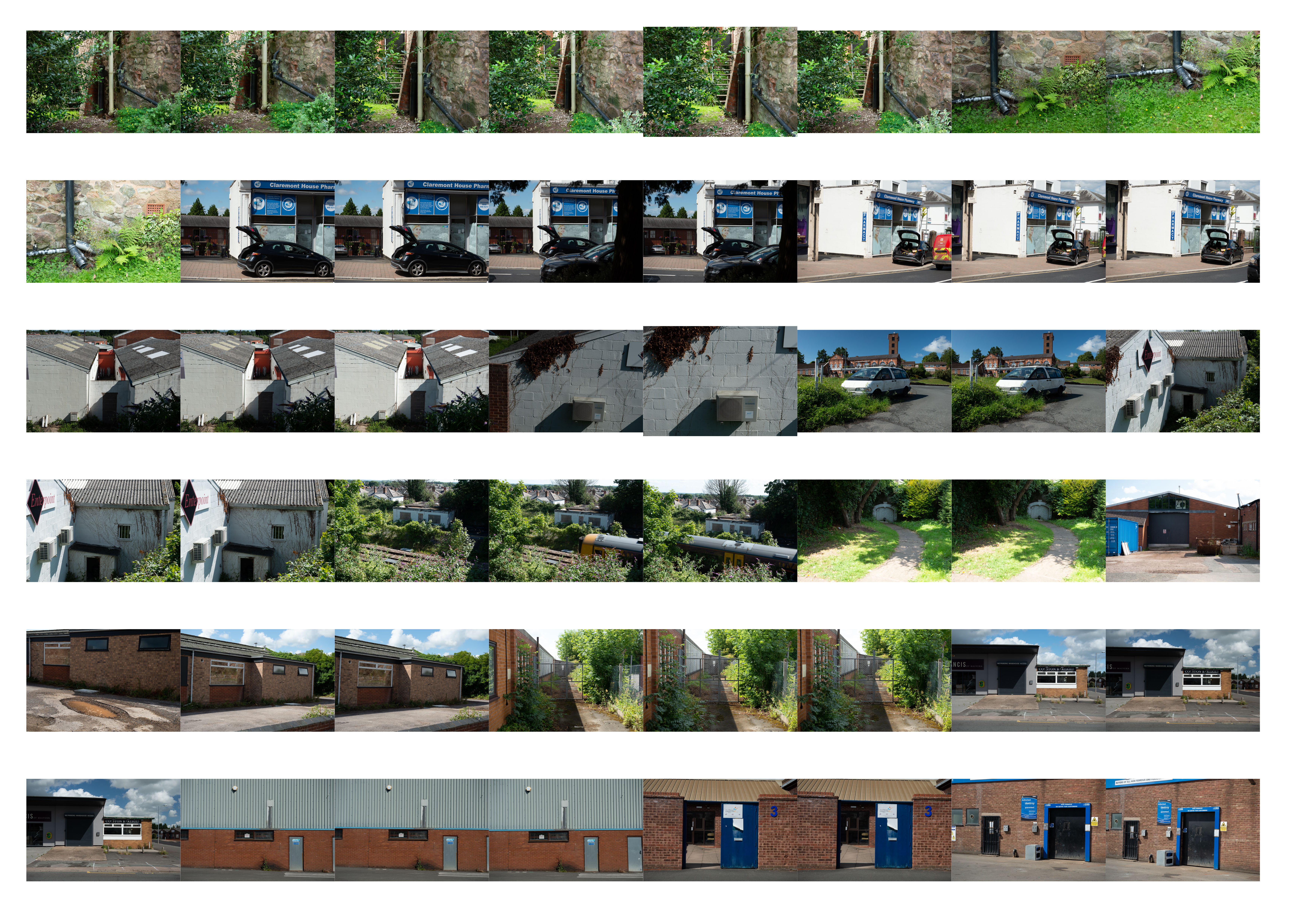
I have just received the feedback on Assignment 2 in a video call with my tutor.  That was the first assignment in Context and Narrative that would count towards assessment at the end of the unit.  I was hoping that I had met the brief, and indeed that was part of the summary, however the feedback that struck a chord was that I had made things harder than they need be by not having a methodology in the way I had approached the shoot.  What that meant was that I had connected the text to the pictures, but I hadn’t had a strong common anchor between the images that would make searching for subjects more consistent.    This is not to be confused with the theory of anchor and relay that Barthes postulated, but literally something that connects the photographs in some way.  When I reflect on the work, I had been very stressed throughout shooting the photographs.  I had formed an idea that I wanted to explore, mapped out in my logical brain which elements would represent trauma in the frame and set about taking the pictures.  That was when the assignment became difficult and as I gradually found it harder and harder to find inspiring subjects, the more I tried to force creativity to come.  I hadn’t set out with a common approach to the subjects in mind and had I done so, the creative part would have been more free-flowing. An example of an strong anchoring element would be Fox’s series “My Mother’s Cupboards and my Father’s words” [1]  In this case, all of the pictures are not just of the same kind of subject, they are all of a particular subject that the artist was both familiar with and had ready access to.  Her mother’s cupboards and their inherent tidiness was the anchor, the narrative forming around the contrast of order and the brutality of the words from her father.  During the feedback call, my tutor suggested that if I’d travelled to the place where the traumas had taken place, that would have tied the images together more strongly.   I had to agree with that sentiment.

Assignment 3

Usually I would not be thinking too much about the next assignment when working through the research and coursework that leads to it.  However, the course notes steer us towards Assignment 3 with the writing of a daily diary [2].  I’ve been writing mine for about a week a the time of this post and it’s already been an interesting experience in terms of what happens to me during the course of a working day and the thoughts and feelings that are invoked.  What we need to do for Assignment 3 is to include ourselves in the narrative in some way.  The diary is supposed to stimulate ideas or be a part of the series in some way which builds on the storytelling we’ve been doing thus far.

I was reflecting on the feedback and discussing with my wife on our daily walk this afternoon.  She could understand the points about anchoring the images together by having a structured approach to the shoot and we started talking about ideas for how to include me in the narrative without it being too prescriptive.  This is still always a concern for me, which I believe stops me from completely letting go of my imagination. What my tutor meant by structure was more about having something that made the creation of the work consistent.  She highlighted the series Geolocations by Nate Larson and Marni Shindelman, which I refer to in my assignment diary [3].  This was a series that took tweets from Twitter and used the publicly available geolocation data to find where precise location they were posted from.   The photographers then visited the locations with a large format film camera and shot a photograph that was then paired with the words from the tweets.  The creativity of the idea of shooting something that tells as story of the words and what may have been happening for the author, by using a visual from where it was written is obviously very powerful.  Modern technology has allowed our precise position on Earth to be mapped to within a few metres and the idea of the trace of a story from the space we once occupied is fascinating.  An example of the work can be seen below:

From the series Geolocations by Larson and Hindelman, 2007 [3]

Here we have a beautifully composed and lit photograph from the location where the emotional tweet was written. The tweeter is asking if they have made the right decision, which could mean anything but suggests a major decision made with relation to another person. Could it be that the tweeter has left a partner to be with the undisclosed person? Could it be an innocuous as someone making a purchase from that person? The accompanying image shows a lone car parked outside a motel, which could almost be from a David Lynch film. This visual tends to support the life-changing decision narrative and when coupled with the words, has great impact. When considering the concept of the series, I naturally identified with how clever it is to use the modern technology in conjunction with the uniquely personal written word. It’s also a strong narrative that tells both the story of the unfortunate tweets as well as revealing just how private our lives really are. The debate about sharing our innermost feelings on social media is one that has been raging since its inception, but here we have an almost voyeuristic element where anyone can find where we have been and place themselves in what they believe to be our story. What interested me was the structure or plan that was being followed. The photographers clearly selected the tweets that had the biggest impact on them and then methodically visited the scene. What they shot was going to be the creative element, but the ‘mechanical’ act of visiting the scenes removed the ambiguity of “How am I going to represent the words?” This was something I really struggled with in Assignment 2. I had the random thoughts as spoken by friends and the idea of representing the traumas through industrial and empty spaces, but spent a huge amount of time trying to find compositions that fit. This forced location-hunting and subsequent ‘creativity’ was exhausting. What I needed to do in Assignment 3 was to have a plan – form an idea and then focus on a workflow for the shoot. This would leave me with more capacity for creating the imagery that supported my idea.

The Diary

The idea of keeping the diary [2] was something that appealed to me from the start of Part 3. A simple document of my working days and free time was unlikely as most of the things that happen to me in my life prompt memories and reflections on things that have happened. I would describe myself as a reflective person in general and while I don’t live in the past, I am hugely appreciative of the things I have learned from my experiences. My plan was just to write what came to me that day and with this in mind, achieving the large number of pages set out in the course notes was never a concern. My plan from the start was to share the diary with my wife as she has known me better than almost anyone in my life so far. I would ask her to read the diary and just take on board her reaction to it. My thoughts were around a series that would describe how I felt during the two weeks rather than reporting what I had for breakfast.

Initial Idea

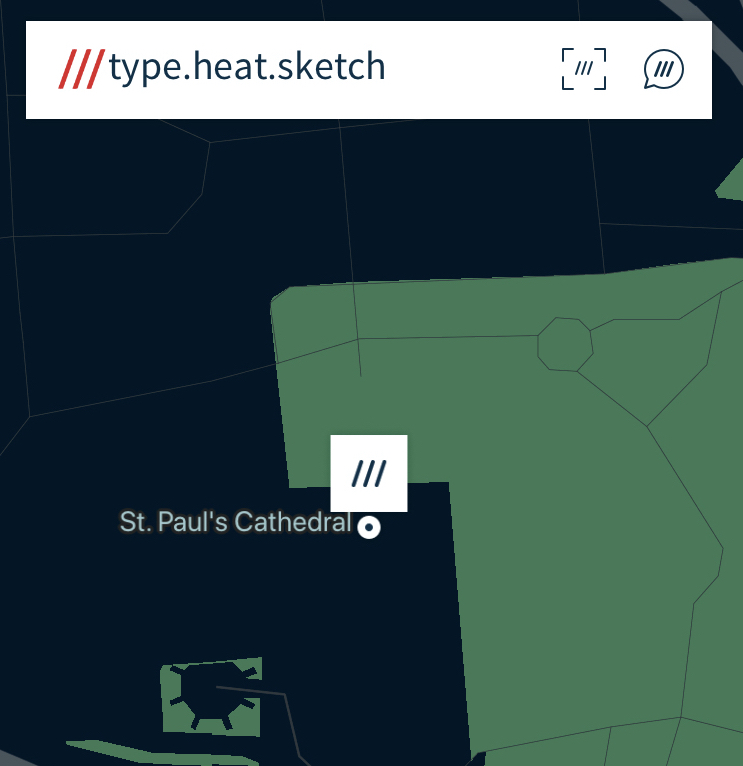
My first thought was around something similar to what Larson and Hindelman, using location technology to link to themes in my diary. I considered the fairly new application called What Three Words, which uses seemingly random words as a simple map reference for any 3x3m space in the world. A map from this software can be seen below:

‘Type.Heat.Sketch’ – the ‘What Three Words’ location for St Paul’s Cathedral in London

By choosing and searching on key words that support the themes of my diary entries, I planned to search locations and visit them. The photographs would be portraits of me standing in the precise location of my words, almost as a waypoint or position marker. I was interested in what I could create with the compositions and how they might link with my thoughts and feelings in the diary. My presence would be a reflection on my place in the world and that place would be something I had expressed with my writings. The idea was a good start, but I quickly ran into difficulties with the technology. What Three Words is a global system, so the grid of spaces it describes spans the whole globe in by using geolocation in the same way as twitter. I knew early on that if I chose the wrong words, I could be looking at a location on the other side of the world, which would be an obvious problem. My preparation for that would be using a thesaurus to come up with many different connotations that may yield more local targets. The main issue though, was the application doesn’t allow searching for locations through the individual words themselves. Currently, the only way it can be used is either by knowing the whole string of words, so Type.Heat.Sketch as in the above example or the landmark (St Paul’s) or the postal address. This was essentially a hurdle I could not overcome. However, it led to me thinking about what I wanted this assignment to say.

Back to the Drawing Board

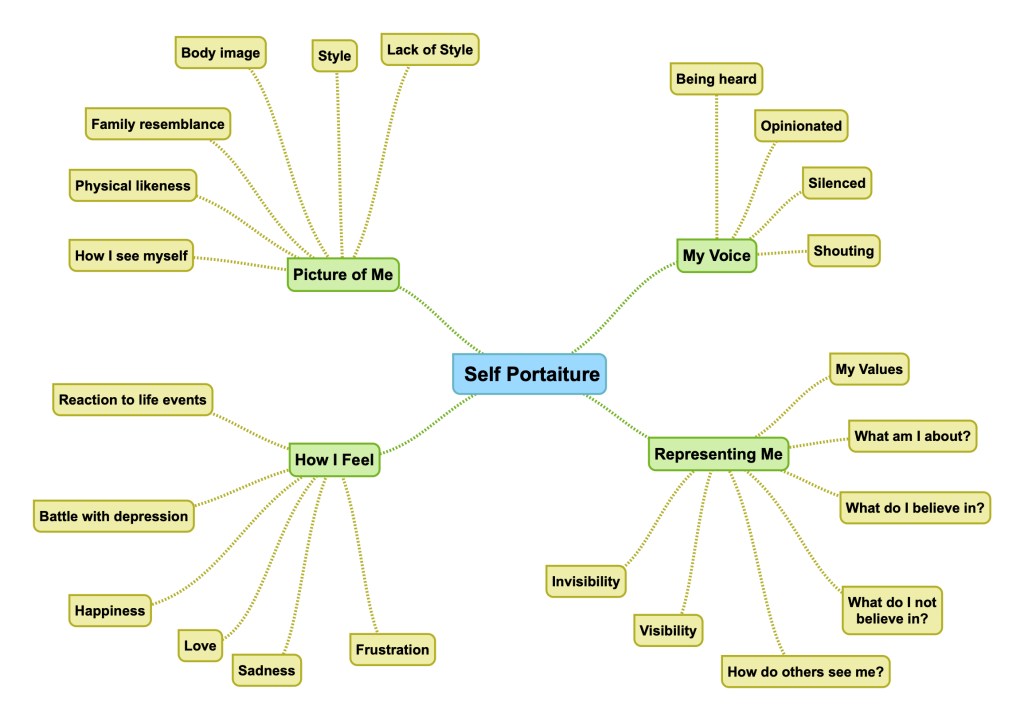
Disappointing as the first idea was, I started to think about what I wanted my assignment to say. The subject was Self-Portraiture, so it needed to have a central theme about me, my perspective or my life experiences. I was still thinking about using location in some way but accepted that it my not fit my interpretation of the brief. I used a mind map to try to articulate my thoughts on the brief at this point.

Mind Map of Self Portraiture (as I saw it at this point).

At this point, I was still thinking of self portraiture in the traditional sense. A picture of me in some contextual setting with some narrative that could be drawn from it. The subsequent work in Part 3 introduced me to the works of Morrissey who placed herself in the lives of others[4] or used herself as a simple blank canvass [5] in a way that is clearly self portraiture. Then, with the addition of Calle, Kapajeva and Shafran, the concept of self portraiture as something that the artist has to be physically present in was challenged. With Moffat, the artist became an actor in the work with the connections between her sense of self and her subjects being imitation [6]. When I revisited the mind map, I could add ‘absentia’ and ‘mirror’ to the ideas of portraiture of myself. The work that really inspired me from those artists was that of Calle and Morrissey. Calle’s act of getting a group of people to articulate how she might be feeling about being dumped was almost creating the art automatically. The 107 women told Calle’s story from their own perspectives but in a way that anyone could relate to. She introduced humour in the destruction of the words which creates the narrative of taking away her ex partner’s power. Morrissey worked with her young daughter to produce a series about the way that children express themselves as they develop. Her role in the series was as a blank canvas for her daughter to paint on which also created a narrative about parents and children and their natural bond. The other artist that had inspired me from the start of this course was Anna Fox. In her work Cockroach Diary [7], Fox tells the story of her battle with her landlord over an infestation of cockroaches. She blends images of her handwritten diary that details her encounters with factual images of the insects either crawling around her flat or recently killed by the artist. What is a documentary struggle to persuade her landlord that there really is a problem they should be looking at, is also a commentary of life is like when you don’t have a comfortable home environment. Fox was a struggling artist and mother when this series was created and it really made me feel like a lucky man.

Another idea

My second idea for the assignment took cues from Calle, Morrissey and Moffat. I’ve always been told that I write well, which is partly down to the many reports and documents I’ve had to prepare in my career but also because of my passion for communicating with people. The written word is not necessarily the easiest medium for this as it is open to interpretation. Care needs to be taken to get the message across while accounting for how the audience may react which is a challenge that I always relish when I’m writing. During the writing of the diary, I enjoyed setting the scene for what I was trying to say and found myself drifting into my memories with ease. This is something I wanted to get across in the assignment in order to represent my personality. Like Calle, I wanted an alternative view of the text but instead of using other people I opted for technology to do the legwork for me.

In my line of work, there are always ways of collating messages from multiple sources e.g a survey or poll so that people can easily grasp the consensus. One of the techniques that emerged a number of years ago was the creation of a word map or cloud. They would be a collation of the most used words in a body of text or description or even a narrative that are represented visually. The most used words would be the largest font size, while the less frequent ones relegated to a smaller, less distracting size. The theory with this technique was that the importance was related to the number of times the word occurred. In the case of a survey, this is true as it’s usually a collection of many views – the more it occurs, the greater the consensus. An example of this can be seen below:

Example of a word map\

What is interesting about these maps is that they are specifically designed to draw our attention to a few key messages. I started thinking about how I write and the connections I make between subjects. This crude algorithmic representation could be used to represent my thoughts without actually forming sentences in the traditional structure. More importantly, running the diary entries through a word map generator would provide the structure that I was missing in my previous assignment. I did a quick search online for software that would create a word map from my diary and found one that would work well for this idea.

In terms of photographing to support the words, I was immediately drawn to Trish Morrissey’s work The Failed Realist [5] where she used her face as a blank canvass for her daughter to paint on. The consistent theme was her blank expression on the artist’s face and each composition being the same. The distinguishing features were the painting with their childlike interpretation and the image titles that tell us what each is supposed to be. I was really inspired by the self-portraiture being a canvass serving no other obvious purpose than to showcase something else. In reality, Morrissey’s part in the series is another layer of context pointing to her relationship with the other artist and, perhaps the visualisation of the child’s creativity through adult eyes. For my assignment I would use my physical self as a canvass for my diary by projecting the word maps onto my skin. I could create the context by choosing which part of my body to project on, depending on the words in the map. I was also inspired by Moffat’s use of photoshop to create an almost unreal visualisation of her as her subjects and decided to light the background in a way to both make as statement of my mood and make each image stand out on its own.

Initial Conclusions

At this point, I felt that I had achieved a number of milestones with this idea for the assignment. I had taken on board the feedback about having a structure to the approach in my work. I had taken inspiration from a variety of photographers studied in this section of the course and combined elements in my idea. I would be experimenting with the compositions so that they enhance the words.

Technical Approach

I started by finding a Word Map generator program that could analyse my diary. I chose an online tool called wordclouds.com which allows the user to upload large bodies of text, change the shape of the resulting map as well as colours and fonts. The most important feature was the ability to remove words from the map using the word count list. I decided that I wanted the most-used words to stand out in the word map, so I chose to delete all of those that appeared only once in the text.

The first step was to upload the text for each day of the diary and save local copies of the word maps for processing. I then removed the single-event words and experimented with the shape of the map. Different shapes meant that the words would be arranged differently when projected. I didn’t want the maps to be too contrived, so largely stuck to simple square and diamond patterns which resulted in aesthetically pleasing maps. Each processed map was saved as an image file.

The projector that I was using was connected to my computer and some tests were carried out on my skin. The first thing I noticed was that there was enough contrast to make the words stand out. The projection bent around the contours of my face and body, which was the effect I was after. However, I realised early on that the colours of the words were too much of a distraction and were actually only related to the word count. Since the size of the text was also related to word count I decided that I could remove the colour and still keep the look I was after. To achieve the final look, I converted the maps to black and white. An example of the word maps can be seen below:

Example of word map

At this point, I started thinking again of what I wanted to say with this series. I wanted to highlight the differences between the emotions and memories that I’d expressed in the diary and the impassive interpretation of a computer algorithm. The words created in the maps were the ones most commonly used in my writing, but their meaning collectively differed from the original text to such an extent that multiple narratives were possible when viewing them. I needed a way to bring that into the photographs, so I asked my wife to work through the diary again paying attention to the sense of emotion in each entry.

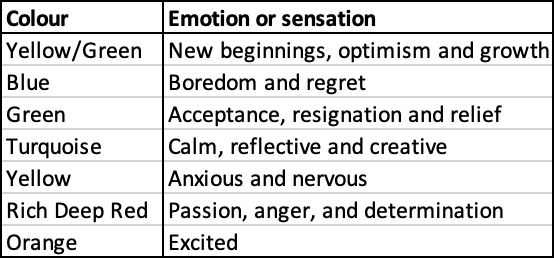
The conclusion from reviewing the diary entries was that the core themes in the two weeks of the diary could be grouped into emotional themes. Rather than a simplistic model of happy, sad, angry etc., the themes that Jayne recognised in the text were more about sensation or perception relating to the events being described. In this case, boredom and excitement were just as tangible as the traditional category of mood. These themes could be grouped across the 14 days of the diary into 7 clear ’emotions’ There is significant research into how emotions are both represented and invoked by our perception of colour. As our primary sense, the sight of colour can induce a mood that we subsequently associate with that colour subconsiously. For this series, I wanted to both represent my emotional responses by using colour but also to suggest to the viewer how they might feel about the image through its use.

Researching colours and emotions revealed both theory and empirical data that was promising for my group of emotional responses. I first looked at how colour is used in advertising to make the target audience feel a certain way. In an interesting article on the psychology of colour [8], the author suggests that our associations with colour can cover a variety of emotional reactions the follow a common relatable theme and that the reactions depend on the other contextual aspects of a situation or subject. For example, red is associated with anything that invokes passion but an image of glossy red lipstick invokes erotic or romantic feelings where a fire engine creates a sense of danger or hazard. The response to get the pulse racing is the same, but the stimulus is different depending on the situation. When used in a photograph, how the viewer responds will be dependent on what else is going on in the frame. The second research source was a survey of how men and women of different cultures react to colours when they see them [9]. The survey asked people to choose the emotion that best matched their reaction to a colour from a multiple choice list. The data was then collated to show the emotions that best correlate with colour. From the two papers, the following list of colours and emotions was created.

Grouped emotional responses with their associated colours

At this point, I shot another test, this time with a colour in the background created by a strobe and red gel.

Second Test – Using a red gel combined with the monochrome text projected onto my face.

The final stage was to experiment with composition. I was originally inspired in this idea by Trish Morrissey’s The Failed Realist, which revolved around just one composition where the artist looks straight into the camera. The frames were cropped to her head and shoulders and her expression is completely blank. There are no props, backgrounds or attention to her form such as hair and makeup – she literally uses her face as a blank canvass for her daughter. I wanted to something similar in order to focus the viewer on the words with only the background knowledge that they were mine. What makes each photograph interesting in that series is the different paintings and their titles. I needed to ensure that my images had that same variety to hold interest. As the diary was a linear progression of two weeks of my life and the colours mapped the emotions of each day, I decided that this was sufficient context to keep the series from looking like 7 versions of the same picture.

Conclusion

During this preparation phase, the idea had developed through my having a structured approach that would provide the baseline for creating the work – this was one key takeaway from the feedback after Assignment 2. I took inspiration from the photographers studied in Part 3 and my plan for this series should lead to a piece of work that highlights the contrast between expression seen through human eyes and those of a computer; the emotions being both a representation and invitation to the viewer to feel a certain way about the words. In conclusion, I feel that the series potentially has the multiple layers of context we’ve been working with throughout this unit as well as being uniquely personal to me in terms of creativity.

References

[1] Fox A, 1999, “My Mother’s Cupboards and My Father’s Words”, Artist Website, https://annafox.co.uk/photography/my-mothers-cupboards-and-my-fathers-words/

[2] Fletcher R, 2020, “Assignment 3 Diary”, OCA blog post, <insert link>

[3] Feinstein J, 2016, “Geolocations: Two Photographers Heatbreaking Visualizations of Tweets”, Humble Arts Foundations Blog Post, http://hafny.org/blog/2016/geolocation-two-photographers-heartbreaking-visualization-of-tweets

[4] Morrissey T, 2007, “Front”, Artist Website, https://www.trishmorrissey.com/works_pages/work-front/workpg-01.html

[5] Morrissey T, 2011, “The Failed Realist”, Artist Website, http://www.trishmorrissey.com/works_pages/work-tfr/statement.html

[6] Rosenberg K, 2007, “Show and Tell, Tracey Moffatt at Stux Gallery”, New York Magazine, https://nymag.com/arts/art/showandtell/26538/

[7] Fox A, 1999, “Cockroach Diary”, Artist Website, https://annafox.co.uk/photography/cockroach-diary/

[8] Rickard, 2015, “The Psychology of Color: A Designer’s Guide to Color Association & Meaning”, ZevenDesign, https://zevendesign.com/color-association/#green

[9] Centeno A, “Colour and Emotion Across Culture – Emotional Responses of People to Various Colours”, Real Men Real Style Magazine Post, https://www.realmenrealstyle.com/color-emotion-cultures/

Assignment 2: Narrative

The Brief

Choose between the following two assignments:

Photographing the Unseen

Start by doing some reflecting in your learning log.  What kinds of subjects might be seen as unphotographable? How might you go about portraying them using photography? List a few examples of things you’re experiencing now or have been recently thinking about. This doesn’t have to be too in-depth or revealing, but can be if you want.  Equally, it might be something as apparently trivial as you are going to fit everything into your busy day.  At first you may come up with literal examples, but the more you think about them the more those ideas will develop into specific and more original ones.  Make a list of at least seven ideas.  Trust to keep to things you have a personal interest in or curiosity about.

Implement one of your ideas.  Aim for a tightly edited and visually consistent series of 7-10 photographs.

Using Props

This option is about photographing an object to suggest a narrative.

Choose between a white shirt and a hankerchief for your subject. Once you’ve decided, make a series of 7-10 photographs which tell a story about or including you object.

You can make your photographic style anything you like.  You may wish to include the prop in all of your series or just some of the images, depending on the narrative.  Bear in mind that the story is being alluded to through the use of the prop and its location – and characters should you choose to include them.

Draw a storyboard before you start to help you consider the progression of the plot and how you’ll use the shots.

Now implement one of your ideas.  Aim for a tightly edited and visually consistent series of 7-10 images.

Initial Thoughts

In this assignment, we were presented with two different takes on narrative; one that explores what isn’t obviously visual and one using a visual prop around which a narrative is created.  When I first looked at the two topics, I was immediately drawn to thinking about something that isn’t a subject that is traditionally photographed or represented through visual media.  The reason was largely found in the feedback that I received for Assignment 1.  That work was aimed at describing something with more than one interpretation, where the viewer drew conclusions from the contextual elements in the individual images as to the meaning.  I really enjoyed the challenge of this duality and when working through Part 2, considered photographing the unseen as an interesting challenge.

In my consideration of the Props topic, I started to think about storytelling in the more traditional sense.  Written stories are created in a fairly linear fashion, resulting in a defined ‘beginning’, ‘middle’ and ‘end’.  As Barthes mentioned [1], the author of a story takes familiar or established cultural texts and stitches them together in a way that leads the reader through the narrative.  The nuances of the story, internal visuals and intents are created by the reader with the author as the guide; the point being that the reader never really understands the real intention of the author.  We know that this linearity is not always present in photographic stories, but the for me the idea of ‘storyboarding’ links back to that more traditional storytelling approach.  While the individual images can be created out of sequence, a storyboard brings back that sense of linear timeline when the collection is assembled, e.g. when a movie is shot, the takes are done out of sequence because of environmental factors, availability of the set etc. and it only truly becomes a story when assembled in edit.    As my natural tendency is to the literal (something I’m trying to break away from here), I felt the Props topic would be dangerously close to what I am comfortable with.   For this reason, I decided to choose ‘Photographing the Unseen’ as my assignment topic.

Ideas

I first started to think about the unseen in general terms.  What does it actually mean?  As sight is just one of the senses, the unseen could anything related to the other four.  I started to recall the recent lockdown challenge that I took part in with some photographer friends where we started with the obvious subjects.  These included The Decisive Moment, leading lines, macro etc., but we then moved to more obscure subjects, one of which was ‘the senses’.

The five senses

Taking a photograph that evokes the sense of a smell turned out to be a challenge with some creating images with broad ideas of the theme while others went for something more specific.  In the case of the former, flowers can be said to have a scent, but the viewer may not necessarily know the specifics of it, whereas in the case of the latter, a cup of steaming coffee is a smell familiar to almost everybody.  I then considered the other senses and how they might ‘be photographed’.  For all of them, there were subjects that could convey what we understand to be the senses, however my initial thinking about what I would shoot felt to be too literal.  An idea for working with the senses would be to contrast the obvious scent with an anchoring reference that completely contradicts it.  For example, there have been intelligence tests for pattern recognition that use the names of colours but using a different coloured font.  For example, RED might be written in a blue font.  When presented with this, the viewer has to quickly say what the colour is.  Many people react to the word before the colour, so will get the answer wrong.   The same thing could be done here with the other senses.  While this was an interesting idea for a project, the brief (and feedback so far) pointed towards something I had a personal connection or interest with.  I didn’t feel at this point that I wanted to use this for the assignment.

Depression and its many effects

Over many years I have suffered with my mental health for a variety of reasons, most of which relate to the loss of my mother when I was in my early twenties.  The struggle to keep this condition at bay continues to this day, so would work as a project or series of separate ideas.  Within depression there is an innate sense of loneliness (even when not alone), coupled with a constant anxiety  around the speed of recovery and, in fact whether recovery will ever happen.  There is also the damage done to the people around the sufferer and in some cases (not mine) addiction to alcohol or medication that makes the whole situation worse.   There is a very unhelpful expression that people use with depression sufferers that talks of the illness as being less obvious to others than a broken leg, which is something I’ve had said to me over the past 20 years.  This got me thinking that the condition and the secondary effects are indeed unseen, so this could make a good subject for the assignment.   What prevented me from pursing this further was twofold.  Firstly, my last assignment in Expressing Your Vision was about my struggles with depression, so it felt too soon to be looking at this subject again even though the two objectives for the work were different.  Secondly, while it’s very personal to me I have learned not to dwell on my experiences too much.  Rather than be a catharsis, the subject doesn’t really interest me that much and I’ve never really seen my photography as an expression of that pain; quite the opposite, it serves as an escape from it.

Ageing

Something that became more obvious to me during lockdown is the way that people’s quality of life varies with their age.  We have been surrounded by commentary about the effect of self-imposed isolation on the elderly in terms of their struggles to get food, loneliness and often concerns about how the virus may be more lethal to them than the younger generation.  This suffering, similar to my thoughts above is largely unseen.  Ageing itself has obvious physical effects that we can all see, but the decline in confidence and acceptance that physical ability are not what they once were, are largely unseen.  My idea here was to contrast images of youth with the thoughts of the elderly.  This idea was my favourite so far and would have been the subject for Assignment 2 if I had not connected it with an event that occurred during my time reflecting ahead of starting the work.

Evolution of the Idea

My previous ideas broke down into the following themes:

  1. Sensory – the senses that are not specifically sight
  2. Suffering –  Depression and the long road out of it
  3. Anxiety – that things won’t get better, linked to depression, but also the heightened focus on trivial issues during the current pandemic
  4. Loss – related to control when suffering from mental illness, but also the loss of faculties with ageing
  5. Loneliness – the isolation of suffering in general
  6. Ageing – the change in outlook and many challenges that come with ageing
  7. Acceptance – also related to ageing, the slow process that many go through of accepting that they are old.

Yes, the brief talks about 7 ideas but it became apparent that these were all related to each other in some way and, unfortunately most having largely negative connotations.  While these things were of interest, I wanted to explore something that wasn’t just another documentary of something bad happening.  I thought back to Campbell’s Dad Project, which was a sad but heartwarming story of the evolving relationship between father and daughter.  It’s underlying theme of coming to terms with his terminal illness was offset by the sense of warmth and love within the family,  The supporting context which included her father’s views added his personality to the images.  This was something I wanted to bring into this series; something unseen but a contrast of an experience with a situation.  One of these could be positive or humorous and the other something sad or contemplative.

It was at this point that the 25th anniversary of the death of my mother occurred.  It’s naturally always been a sad and contemplative day, but always with a ‘happy’  remembrance of a very special member of our family.  This year had a particular poignancy for me as I am now the same age as she was when she died.  One of the experiences I always have on this day is a replaying of her final moments in my mind – I had never seen death happen in front of me before.  One thing that struck me about the immediate aftermath was a random, bizarre thought that I had as I left the hospital.  My world had just seemingly collapsed and as I waited to pull out into the traffic, I asked out loud “Where are all these people going right now?”  Of course, bereavement is personal and naturally the commuters going home from work weren’t aware of or part of the recent events.  It was the randomness of the thought that gave me the idea for this assignment.  I began asking around and realised that these thoughts occur with pretty much any serious trauma, from bereavement and loss to illness and injury.  The situations themselves were serious, but the thoughts were often fairly banal.  My idea formed around contrasting the randomness of the thought with something that metaphorically represents the sadness or negativity of the event.

Planning

The first task in planning was to seek random thoughts.  I polled my friends and connections on social media to see if they would be prepared to share some thoughts with me.  This would be a challenge in terms of asking people to re-visit traumatic events in their lives, but I assured them that the thoughts would be used, but not the detailed context (in fact, I stated that they didn’t need to share the context with me at all).  The use of the thoughts would take the form of a single sentence and would be completely anonymous.   Using a single sentence would be an open enough contextual element to create a narrative without the photograph, e.g. my thought “where are all these people going right now?” could relate to anything from being stuck in traffic to being at the scene of a major terror incident.  The reader can build their own narrative from a sentence that is not too prescriptive.

I then considered what would sum up the types of trauma that would be experienced. People suffer serious problems every day that can be considered traumatic. What I wanted to do here was to focus on the type of problems that people are most familiar.  As I was going to ask people for their random thoughts, I similarly didn’t want to predict or limit the range of traumas.  However, I started to work on the assumptions that they would fall into categories of loss, bereavement, serious illness, the breakdown of a relationship or some shock that provokes a negative emotion such as fear or disgust.

The next area I focused on was the theme for the photographs.  I started with the idea that people with obviously contrasting expressions or facial features could be the focus of the images.  I quickly dismissed this when re-visiting the works of the photographers in Parts 1 and 2.  For example, Public Order[2] features the real but fake scenes from a police training facility which, while telling the seemingly believable story of the environment during the photographer’s early life, is contrasted with the emerging knowledge that the scenes themselves are an interpretation of that environment.  The contrast is subtle rather than literal; by using people as the centre of my series, I was in danger of falling into old habits.   I started instead to think about how trauma makes us feel.  For me personally, the overwhelming sense of isolation and the temporary broken patterns of normal life are the key feelings.  Although I’m no psychologist, I believe the randomness of our thoughts when we suffer something serious is our brains connecting to what we recognise as normal life.  In my case, wondering where everyone was going when my world had collapsed was simply a question prompted by the sight of life going on as normal.   I considered what represents isolation to me and concluded that large, open, derelict or abandoned spaces sum up those sensations of being alone and also fairly unimportant to the rest of the world. By presenting an object or even a single person in the space, I could use the commonality of empty spaces with a connection to the words that wasn’t too obvious to the viewer.

The Words

After asking my social media friends and some of my family for their help, I received the following random thoughts.  I was really happy with the variety of the thoughts and the circumstances during which they occurred.  I combined them with my own thought which was the basis of this idea.

  1. “Where are all these people going?”
  2. “I hope the paramedics don’t traipse dog mess through the house”
  3. “I’ll have to make my own dinner tonight”
  4. “How am I going to teach them what I know?”
  5. “I won’t know anyone there”
  6. “Tell them I may be late to teach the class tonight”
  7. “Did I eat too many of the wrong foods”
  8. “Must remember the right way out”
  9. “Are we the only entry in the phone book now?”
  10. “I’m glad my parents aren’t alive to see this”
  11. “I hope my cat hasn’t got into any fights”
  12. “I could murder one of those chocolate biscuits”

The challenge was to now represent these unseen thoughts in photographs of spaces and objects that metaphorically represent them with the trauma.  The variety of the thoughts I received led me to call the series ‘Random Access Memories”, a reference to the ordered but unstructured way that information is retrieved in computer hardware.

But wait…

I started to consider how I would photograph subjects that documented the thoughts of the people I had spoken to.  It was at this point that I realised that I had lost sight of what the unseen element in this story is.  Indeed the thoughts were random and unseen, probably not ever discussed with anyone before I had asked for them.  However, they were a response to something terrible happening in the lives of the people concerned.  It is actually the trauma and the response that make up the unseen that I needed to document.  This was a serious turning point for me during this assignment for reasons that I will discuss later.  For now, I had to find subjects that suggested the trauma being experienced and marry the words to the photographs to help support the narrative.  This required returning to the beginning and thinking carefully about metaphors for trauma. I created the mind-maps below to help steer the project, which I found to be useful in what was becoming an increasingly difficult challenge.  Based on the types of traumas that my friends suffered, I created maps for Bereavement, Illness/Injury and Separation/Divorce to cover them all.  The maps show my thought processes and ideas for subjects to shoot as metaphors for aspects of the trauma rather than just describing the event itself.  These were ideas that I took forward into shooting.

As I mentioned previously, I don’t find metaphor easy to deal with partly because I’ve never considered myself particularly creative.  The act of ‘engineering’ the ideas into potential subjects was falling back on what I’ve known throughout my career.  What I wasn’t prepared for was the challenge of seeing those subjects and photographing them.

Shooting

I had settled on the idea of trauma being isolating and lonely on a personal level; even a shared event impacting people differently and in a way that makes them feel like they are the only people involved.  I looked for subjects that contained visual elements that suggested but didn’t point to the trauma being experienced, taking the cue to leave as much room in the image for the viewer to make up their own mind.   To this end, I also elected to leave out the idea of a single person in the frame, which felt a little too obvious to me.  Unlike Sank’s lockdown story [3], which was about the people she met on her walks and their outlook on life during COVID-19, my story was about the speaker of the words. I felt that adding people into the photographs would distract from the anonymity of the speakers that had shared their thoughts with me.

What I found really difficult with my project was to look for the metaphorical, despite having the mind-maps to help me.  I took my camera everywhere I walked and changed routes to take in industrial areas and secret footpaths through them.  However, I found myself shooting anything and everything that may support my story.  This was a departure from what I’d believed to be the way these photo stories were created.  I’ve strived to be more clinical in my approach to shooting, tending towards fewer images of my subject than taking lots of pictures.  For this assignment, the editing process was much more pronounced than it had been previously.  From a total collection of 288 photographs, I created the collection of 10 photographs that I then matched to a selection of texts.

Random Access Memories
DSC_9201

“Did I eat too many of the wrong foods?”
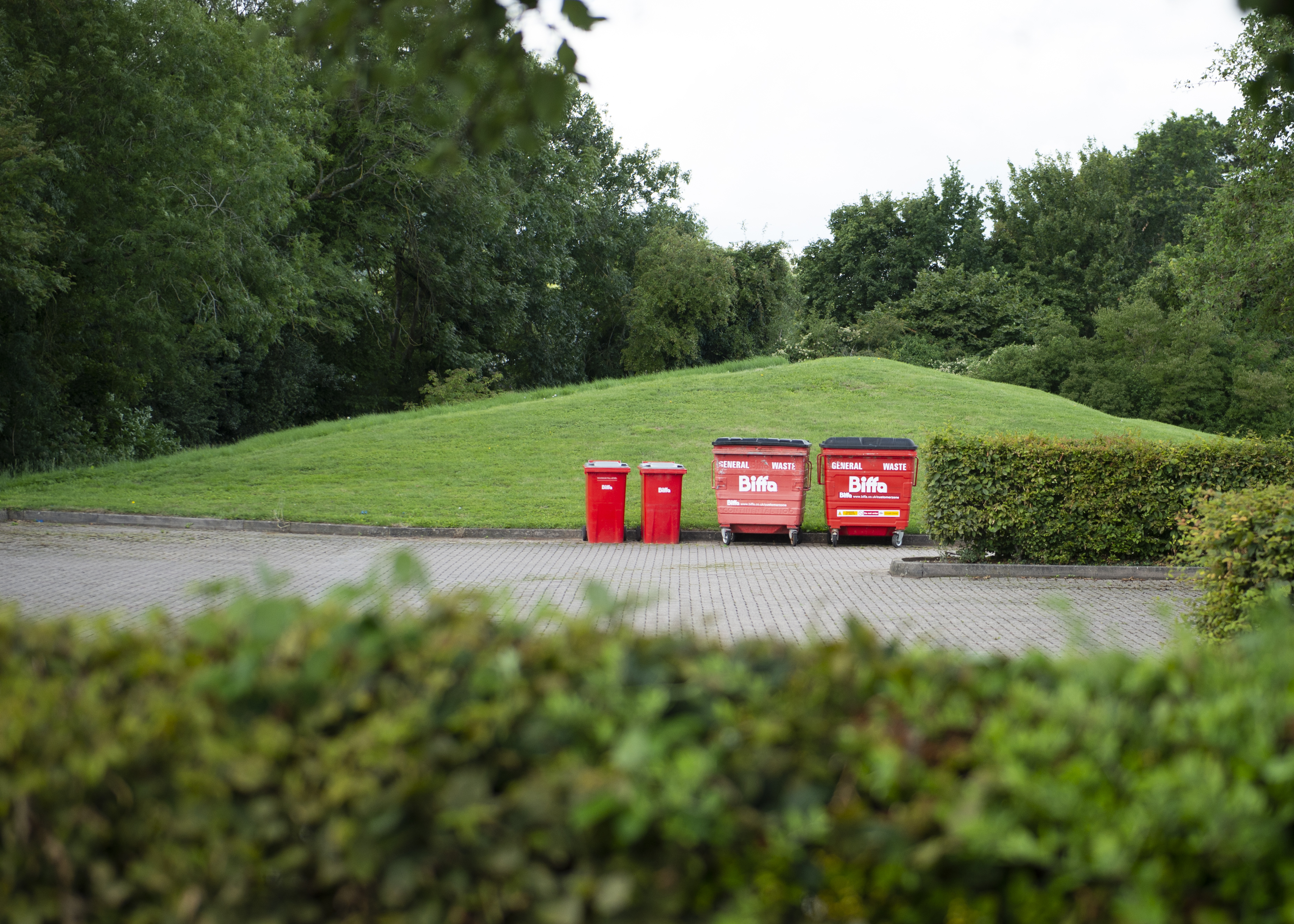
DSC_9070

“I could murder one of those chocolate biscuits”
DSC_9280

“I’ll have to make my own dinner tonight”
DSC_9231

“Tell them I may be late to teach the class tonight”
DSC_9197

“I hope the paramedics don’t traipse dog mess through the house”
DSC_9054

“I’m glad my parents aren’t alive to see this”
DSC_9015

“Where are all these people going?”

DSC_3075

“Must remember the right way out”

DSC_9222

“Are we the only entry in the phone book now?”
DSC_9268

“How am I going to teach them what I know?”

Reflection: Photographing the Unseen

In keeping with the anonymity and not wanting to steer the narrative, I elected to not describe in detail my intentions for each image in this section.  Instead, I’ve included the themes and how intended the images to work together in the series.

As described previously, my theme was trauma which takes many forms.  The series starts with ill health and injury, which can be debilitating, frustrating and of course life-threatening.  The reactions of the people here were focused primarily on the disturbance to their routines or daily lives, but also including self-doubt.  The questions around whether the situation could have been avoided were powerful.  Similarly the denial in the fourth photograph was something most people could relate to as we never really want to have a change of circumstances forced upon us.

The series then moves to loss, both in terms of a relationships and death.  Here we have people having to cope with trauma that is happening to them almost indirectly.  I was fascinated by the randomness of thoughts had by the people who had just lost something or someone dear to them.

For me, the strongest image is the last one.  My friend had that thought upon learning of the suicide of a family member and went into automatic pilot; one responsibility was to hand over her work to her colleagues.  Such a simple statement contrasting with the horror of the event needed a simple composition with the evidence of the bleakness of the trauma clearly represented.   For me, the dull grey walls and barred windows give the sense of a world less colourful; the simple instruction to use the dilapidated tin and the discarded cigarettes suggested a lack of understanding of how awful suicide is to those affected by it.

For me, the weakest image is number 7, which is actually the trauma that I experienced.  I found it extremely difficult to express the pain of losing my mother through a photograph, irrespective of where it sat in a series.   Throughout this assignment, I struggled significantly with metaphor and inspiration.  I’m not surprised that my own experience would be the biggest challenge and I believe this to by why I don’t like this image as much as the others.   What I ended up with was a representation of my world collapsing while people went about their business.  However, the composition and lighting aren’t what I wanted for the series; harsh direct sunlight that I toned down with a filter, but still leaving the highlights a little jarring.

Overall, I believe that this series meets the brief.  The unseen elements are represented metaphorically and the words add context to the images in changing the way the viewer interprets them.

Against the Assessment Criteria

Demonstration of Technical and Visual Skills

My intention was to shoot the images in a way that connected them together, but without relying on a simple visual to link them.  The compositions largely follow conventional techniques but I’ve used focal length, depth of focus and leading lines to draw attention to the key elements in each photograph.  An example would be number 5, where the short focal length and wide aperture allow for metering on the point of focus (the TV screen) as well as keeping everything relatively sharp around it.  What this achieves is the viewer seeing the TV before exploring the rest of the composition to see the other key elements (the pipe, the disturbed earth in front of the building and its general state of decay. I’ve also tried to use colour to draw out key features, such as the hazard tape and dead leaves in number 9.  Overall, the photographs work as a series without any significant clashes in colour, light or composition.

Quality of Outcome

As described above, I believe the images to be technically good quality.  In terms of the use of elements within the images, I believe there to be enough to raise questions in the viewer’s mind as to what the series is about.  At the heart of the story, is the contrast between the effect of trauma and our less obvious reaction to it.  I feel that I’ve taken on board my tutor’s comments about the strength of words when added to the pictures.  The texts here add information that supports the narrative (relay) rather than being a direct route to a meaning (anchor).

Demonstration of Creativity

This assignment has pushed me to be much more creative than any of my previous work on the course.  I believe that I have successfully fought my natural instinct to be literal and achieved a series that has enough scope for variety in its interpretation.  Using almost empty space and derelict buildings to represent the trauma and contrasting with the random memories was inspired by Fox’s work, with nods to Botha’s Ring Road.  What I set out to achieve was to work on  a subject that really interests me and that I have my own relationship with and perspective on.  It has been a significant challenge but I am  happy with the resulting demonstration of my creativity.

Context

In the context of the learning, I’ve demonstrated that I understand how stories can be non-linear and that photography can be used to visually represent an idea, feeling or unseen element without having a subject that links directly to it.  This has been a tough part of this unit, but I believe that I have demonstrated my understanding and, hopefully my new interest in this genre of photography.

References

[1] Nicholas, T, 2019, “The Death of the Author: WTF? Roland Barthes’ Death of the Author Explained, Youtube, https://www.youtube.com/watch?v=B9iMgtfp484

[2] Pickering S, “Public Order”, artist website, https://www.sarahpickering.co.uk/works/public-order/

[3] Sank M, 2020, “Portraits from a Distance”, Wellcome Collection, https://wellcomecollection.org/articles/Xsd98hAAACIAhct_

[4] Botha  D, 2013, “Ring Road”, Artist Website, https://www.dewaldbotha.net/ring-road.html

Contact Sheets
Assignment 1: Two sides of the story

The Brief

Create at least two sets of photographs telling different versions of the same story.  The aim of the assignment is to help you explore the convincing nature of documentary, even thought what the viewer thinks they see may not in fact be true.  Try to make both sets equally convincing so that it is impossible to tell which version of the images is ‘true’

Choose a theme and aim form 5 to 7 images for each set, depending on your idea.

Send your images to your tutor by the method you’ve agreed.  Include an introduction of 300 words outlining what you set out to do and how you went about it.  Also, send the relevant pages of your learning log or your blog url.

Introduction

I started thinking about this assignment shortly after reading through the course notes for the first time.  I had been working on a long-term project which would document the decline, battle for survival and beginnings of rebirth of the high street in my home town of Malvern.  Over the 20 years I have lived here, there have been huge changes to the retail and recreational landscape of this old town, whose roots were established during the Victorian era.  The changes from that time were significant as Malvern was then considered a destination for health and wellbeing.  The Victorians believed that the spring water from its hills was a cure for common ailments, so along with the desire to walk in the countryside that inspired Elgar, people flocked to the town to ‘get well’.   The more recent changes though, have been as a result of the shift from traditional high street footfall to the online shopping model and an age where everything can be purchased in one giant supermarket.  The town had become a place where only national chain cafes, restaurants and charity shops are the only places that could survive; the latter benefitting from vastly reduced rents.  However, there are some signs of revival, with independent specialist shops opening up to serve niche markets.  This evolution is slow and gradual, which meant that my project was probably not going to work for this assignment because of how long it would take to complete.

When I came to actually plan for the assignment, the world had been plunged into a crisis, the like of which hadn’t been seen since the Second World War.  Coronavirus originated in China towards the end of 2019 and by the beginning of March 2020 had taken hold in almost every country on Earth.  Life had changed immeasurably during that period, with most countries introducing strict lockdown measures that restricted the movements of their citizens.  Every way of life has been affected and businesses have had to react quickly to survive.  In my own company, all personnel that can work from home are now doing so, which presents its challenges, anxieties and impacts on family life.   My team of 25 comprises families, single people, those with physical and mental health vulnerabilities. My daily challenge with the team has been navigating the fear and anxiety that the virus has created, focussing on what is important to them while maintaining control over the business.  During our daily calls, we talk about the news coverage, the panic-buying and social distancing that have become everyday life for all of us.  This got me thinking about my how the current situation has more than one side to the story.  For every tale of the speed of the virus spreading and how people are acting irresponsibly, there are numerous stories of positivity, gratitude and solidarity during what is an unprecedented, horrific time.

My Theme

I decided to choose a statement the describes, perhaps controversially my perspective on the experience of the coronavirus lockdown.  My first set would support the statement and the second present the counter argument.  I was inspired by the work of both Gideon Mendel and Paul Seawright as two things resonated with me during the work in Part 1.  The first was Mendel’s use of traces of the event in his work in the immigrant camps [1].  His use of possessions to tell a story about the owners without them actually being present was documentary in the way that we could relate to the objects, but built around a specific context that resonated with the artist.  Seawright’s Sectarian Murders [2] was hugely powerful to me as the context was layered with news reports, themselves steering us towards a particular narrative.  Yes, the blame wasn’t specifically apportioned in the works, but the documentary of the horror without historical context (the causes behind each event) leaves the viewer with their own take on the Northern Ireland conflict.  As Seawright said in an interview, using too few contextual points leaves too much room for narrative and too many leaves the viewer with nowhere to go. For my series then, I would not be using anything that specifically referred to the virus or the lockdown, only imagery that includes the context and space to allow the viewer to create their own narrative.  My take on the brief is that the two sets of photographs will have a sense of duality about them, making it difficult to understand what is happening or determine if the ‘truth’ is being told.

For my theme, the statement is “Coronavirus is changing society for the better”

Ground Rules

I set out with some simple ground rules for the images for this assignment and how they would be presented.  They were as follows:-

  1. There would be no visual references to Coronavirus or COVID-19 in the images.  As with Mendel’s work [1], the contextual details in the image would only suggest that something has happened/is happening.
  2. I would include people, but not exclusively.  As this theme was a take on the changes to society, it would be easy to simply depict people in their new environment.
  3. I would present them as a jumbled collection with no external context applied to begin with.  This is how I viewed Seawright’s work and was startled by how the addition of the simple contextual paragraph changed my perception of them.  I would not give them names or numbers at this point.
  4. I would then add a two word context to each image to split them into their supporting and contradicting stories and review how effective they are as a document of these unusual times.
  5. Each image would be the colour and the same crop.  Since I believed in Exercise 3 that black and white was able to actively assign a mood to the images, I would avoid its use. I naturally tend towards landscape format with an 8×10 crop, probably because of my connection to film.  Making them all the same would avoid any distracting elements that steered the viewer one way or another.

The Unordered Images

Initial thoughts

Since starting this degree course, I’ve noticed a need that I’ve developed for making sure that the elements in a photograph work with each other.  If something is superfluous and doesn’t connect with my vision of how I want the photograph to look, I generally discard and reshoot if possible.  Of the images here, only one of them is staged, while the rest were observations during my government-sanctioned daily walks. I’m happy that the set contains no distractions or jarring compositions to begin with.  As we’ve been blessed with glorious weather during this work, I don’t believe there to be any context created by differences in the light either.

Applying the Context

Here are the images again, presented individually with two word context added in the form of a title.

Now we have some clearer ideas about the intended message behind this photographs.  From this, they can be grouped into their supporting and contradicting sets:

In support of…

Contradicting…

Review – Intent vs. Alternative Meaning

Smile, People – We saw this camper van on the driveway of a house in a less affluent part of the town one evening.  The whole street had put out smilie face and Jolly Roger flags in their gardens to cheer up any passers by.  This simple smile gesture certainly made me smile, even though there is a sadness to the van that is going nowhere while we are in lockdown.

You ok? – One of the many negative things about COVID-19 is the queueing for food, which at the start of the crisis was further characterised by panic buying and stockpiling essential items.  Standing in this orderly queue for the supermarket, the lady in from started a conversation with a friend she hadn’t seen since lockdown.  They had their conversation over the barrier at a safe distance from each other.

Great Outdoors –  I came across this scene of an elderly and young woman out in the sunshine carrying their shopping home.  One of the positive elements of the lockdown is the encouragement of people to get some daily exercise following the government guidelines.  Here we have two people of very different age groups combining exercise with the necessity of shopping.   This could equally be a statement about isolation and vulnerability with the younger woman not obviously helping out the old lady.

Grateful Patients – Positive messages in support of the NHS have been everywhere, with weekly clapping and painted signs like this one saying thanks to the key workers.  While not limited to the NHS staff, they have been the biggest target of affection.  Here, the patients of a local care home are also thanking their carers.  This could equally have been a comment about being locked down in a care home and just wanting to communicate with the outside world.

Nature Reclaims – With no non-essential work being carried out, Malvern’s own street art is being reclaimed by nature.  Another positive impact of the virus has been the effect on nature, both wildlife and the wider drop in pollution.  This could also have been about a lack of attention to the town; letting it get scruffy through lack of maintenance.

Peaceful Parking –  This stretch of parking spaces is generally never empty.  The effect of less people out in town is that the whole place takes on a peace that is only normally witnessed at night.  It could also have been about the crippling impact of the virus on the local economy.

Typically British – One of the town’s many shops showed its sense of humour with the socially distancing bears.  They started out 2 metres apart and then moved closer together with the addition of some fetching wartime gas masks.  The masks themselves have a sinister appearance, which could be interpreted as part of the fear around the virus and the way that it has taken hold.

A Promise? – I shot this photograph because I noticed the juxtaposition of the advertisement that has slipped from its mount and the promise of being able to move in the summer.  I wanted to capture the interrupted good intentions of the window display where clearly nobody was at work in the building to fix the broken advert.  The pharmacy in the background actually relocated to another building before COVID-19 struck, but in this image it reinforces the impact of the virus on key businesses.  The duality of this image is that its possible that the advert hadn’t been noticed by the staff and the combination of the good weather and the promise could be read as resilience in the face of the virus instead.

Socially Distant –  On one of our sanctioned exercise slots, I followed my wife with the camera looking to capture the new behaviour of people deliberately distancing themselves from each other.  In this shot, my wife walks into the road to avoid the lady with her dog.  What I wanted to capture here was the matter-of-fact action taken by wife at this moment, almost ignoring the lady altogether.  The message being that despite the context of the sunny day, the excited dog and the smiling lady, the act is one of coldness.  In fact, the opposite is often true.  In this case the smile was appreciation of the gesture and pleasantries exchanged.  This is an example of a decisive moment not describing the sequence of events, but merely an instant where the internal context is the only thing we have to go on.

Behind Bars – The children’s playground in the Winter Gardens park was, for a while a place where people gathered defying the lockdown.  Since then, it has been closed with warning signs all around the perimeter fence.  As I had decided not to include specific references to the virus, I looked for a composition with just the sense of being abandoned.  This image of the roundabout with hazard tape around it struck me as sad, with no children around to play on it in the sun.  The railing lends itself to the sense of imprisonment.  The image could have been something less sinister, though with the park being temporarily closed for maintenance ready for the summer weather.

Little Choice – The pubs and cafes are all closed, but public transport is still running for essential journeys to be completed.  The sight of empty buses roaming the streets of the town with the stark ‘Stay Home’ message displayed is becoming all too familiar.  I like the conflict in this image with the pub and view enticing people to gather to enjoy the weather against the fact that we cannot.  With this image, though there is room in the context to create a narrative beyond the virus.   The message could be part of an advertisement instead of a government instruction and because we cannot see into the bus itself, we cannot tell that it is empty.
Thwarted Dream – This building is featuring in my series on the decline of the high street, but the shot I took for that was of a run-down, empty shop.  In the weeks before the virus took hold, work started on turning it into the new business.  This image without context could be interpreted as optimistic; the final step being the peeling of the transfer labels on the windows.  If we look closer though, we can see that the works inside have barely begun.  There is nobody working on the premises to get it ready to be opened.  For me, the sadness of the image is that the virus may make the business untenable before it gets going.
Faded Art – This is an art installation by students of a local college that was created to brighten up the windows of the recently-closed department store in the town.  Each installation has a colour theme and it has really lifted the look of the grand old building as it waits to be converted into new business premises.  Here, we have a balloon display which in itself should be a joyful image.  However, the building is empty and the helium has escaped the balloons.  I wanted to capture the sadness of the way it had been abandoned, unmaintained and how the loaned balloons would not likely to be returned or reused.  The image does contain am humorous inversion of that aspect though, saying ‘who thought that borrowing balloons was a good idea?’
Business Attire –  This image was spotted by my wife one morning as I started work.  Working from home may have saved me a commute but the negative impact on my routine has become apparent.  Here, I’ve not even bothered to get dressed prior to starting my first online meeting of the day.  Although staged with a tripod and remote release, there is an honesty in the elements in the frame.  The negative context is reinforced by the inclusion of the mug and the state of my dress.  It could also be read as a relaxed way of working where there are no expectations other than performing in the job.

Conclusion

I really enjoyed this first assignment.  The question ‘can photography be truthful?’ was one that I had not asked myself before Part 1, but the artists that we looked at offered an insight into its subtle exploitation for documentary or art purposes.   With my collection, I feel like the duality of photography as a document is shown clearly.  The situation we find ourselves in with COVID-19 is unprecedented and for the main, terrifying.  However, one of the earliest realisations that I came to was that forcing people to change their lifestyles and stay away from each other would have a positive impact on society as a whole.  As a photographer, being limited in the places I could visit because of lockdown actually made me look harder for that positivity which resulted in my capturing more of it.  I actually struggled to find compositions that were overtly negative to be the greater challenge.  I am happy that my interpretation of the brief works; there are two sides to the story and part of that is being unable to obviously tell the difference.  By adding the simplicity of two words as a title, the narrative comes quickly.  If anything, even something as simple as that leads the viewer too readily to a narrative.   A change I would make to the series is to make the titles more obscure.

What went well

The strongest image for me is Typically British as I like the clear sense of humour mixed with the gravity of the situation.  Humour in photography has become something that I’m drawn to when times are difficult; a kind of self-medication, I guess.  The sinister side of the photograph is the thought that not even our teddy bears are safe from the virus.  Giving them WW2 gas masks emphasises how dangerous the infection could be.  For a simple composition, I think it tells both sides of the story effectively.

The other strong images for me were Behind Bars and Socially Distant, both of which provoked a negative reaction in me.  In the former it had not occurred to me that this happy space which is very popular with the town’s children would be abandoned.  Seems obvious, but its impact on me was profoundly sad.  I definitely felt like Soloman-Godeau’s outsider trying to capture this scene.  Socially Distant was also a sad image for me as the dog in the photograph came towards me for some attention, but I was distracted by my wife’s exaggerated deviation from the path.  Under normal circumstances, the dog would have been made a fuss of and pleasantries exchanged.  This situation is clearly not normal and that comes out in the photograph. Unlike Behind Bars, I was an insider in this shot.

What could have gone better

The weakest image for me is Business Attire because it is not as candid as the others.  I wanted to use natural light for the shot to ensure that there were no harsh reflections from the shiny surfaces on my desk.  This meant that I needed to use a tripod and tethered remote.   I think the sentiment and duality come out in the image, but for me there is a sense of overt context.  The inclusion of the Mr Grumpy mug, on reflection is too much of a sign-post element in the image.

Also, I would consider re-visiting the titles themselves as even though they are short and seemingly simple, they point very clearly to the intent behind the image.  Before I added them, I showed the collection to my wife.  Her interpretation of the context differed only slightly from my own, which I conclude is because we have been married so long coupled with her sharing my photographic ‘journey’ so far.

Getting Feedback

My intention was to share more widely to see which sides of the story are being ‘told’ and, more importantly, whether people believe my statement that we will be an improved society when the danger of coronavirus passes.  I sent the unallocated images to a small group of my photographer friends with simple numerical titles and asked them to arrange in the supporting and contradicting groups.   I deliberately asked them not to confer or share their thoughts on the meanings of the images with each other and perhaps unsurprisingly, some found the job of grouping them a challenge.  To make things more difficult, I told them that I wasn’t all that interested in their explanation of the narrative created for each image as discussion would have helped them form a view that was influenced by my intentions for the series.  The results were as shown below:

Screenshot 2020-05-02 at 11.44.04

Results of Review of the Unallocated Photographs

What struck me first about the results was the strong agreement with my intention for the images of the playground, the NHS thank you and the unfinished shop front.  These images were strong with elements that steered to a great sense of sadness or extreme happiness.  The ‘negative’ images were almost signposted to contradict my story, so using photography to effectively prove a lie. The next thing that stood out was the balance in some of the responses, i.e. in two minds about what the photographs say to them.  In these photographs, the story about the improvement in society comes through but with an equally opposing feeling created by the knowledge we have about the pandemic.  Socially Distant is a good example of this.  I felt that we were losing personal contact, but three people thought differently.  Perhaps the act of social responsibility caused by the distancing in the image supports that we actually care more for each other with the current restrictions.  The final observation was where the consensus was generally in disagreement with my original intent.  Looking back at the earlier research in Part 1, I was reminded of how our perspectives are built on our personal circumstances, beliefs, biases and the previous events in our lives.  Four of the people asked are living in urban environments where the virus is affecting many people in a confined space.  Their views on the images are naturally going to differ from the other two (and me) who live in a more rural setting.

Overall, I am happy with the way this assignment has gone. In Part 1, I’ve learned the difference between being part of the story and an observer, how photographs are used to get a message across that is not always truthful and that there are many different versions of what is the truth.  With the ghost photography of the late 19th Century, the trust in photography as an honest viewer of events was severely tested, with the foremost intellects being conned by photo manipulation.  Where documentary fails though, art becomes the destiny for photography ‘stories’.  Powerful messages about society like those in Dzhangal and Public Order don’t need to rely on facts to have impact. Perhaps objectivity is not all it’s cracked up to be.

References

[1] Mendel, G, 2016, Dzhangal Work, Artist’s Website, http://gideonmendel.com/dzhangal/

[2] Seawright, P, c1970s, ‘Sectarian Murders’, Artist’s Website, http://www.paulseawright.com/sectarian

Assignment 4 – Post Tutor Feedback

Introduction

This post is essentially a restructure of my thoughts and comments made immediately after I received the tutor feedback.  In preparation for assessment, I’ve further expanded my reflection on this assignment, considering some of the areas where it could have been enhanced or developed further.  This includes any additional research carried out and any re-working that I have done to improve the way the photographs meet the original brief.  The overall learning points are also summarised in my final post “Reflecting on Expressing Your Vision” which can be found in my Learning Log.

Tutor Feedback

The feedback from Assignment 4 was very positive and during the video call with my tutor, we discussed how I found this assignment to be relatively straightforward being  predominantly technical.  I agreed that it was something that I had found comfortable, as most of my photography over the past few years had been to better my technical understanding of how to take good pictures.  What I wanted to do with this assignment was create a simple but effective narrative around lighting dark corners with artificial light connecting the series that way.   Adding the gradual increase in lighting intensity through the series was another way of connecting them, albeit again entirely technical.  I believed the connection to be subtle enough to be artistically interesting.  The main point of feedback that came from this assignment was that I needed to consider a more layered approach to connecting the series.  What I interpreted this to mean is to create connections through style, the interesting detail of the subject and less obvious aesthetic qualities that could be represented in each image.  In my assignment, the connections were those of artificial light as per the brief, the lighting of dark areas that reveal something about the subject and the fact that they were all shot in my home town.  I could have expanded further by focusing on an aspect of my home such as its Victorian grandeur, as with the gaslights in Photos 1 and 3, or the faded glamour, or mix of eras and styles as with the shopping arcade in Photo 8.   When added to the theme of the original response, these layers of connection could have moved me away from the technical domain and into the more creative space.

Although I didn’t elect to reshoot any of Assignment 4, following reflection on the feedback I did push myself to move away from the technical in Assignment 5.  The degrees of success can be seen in the post for that assignment.

Assignment 3 – Post Tutor Feedback and Re-work

Introduction

This post is essentially a restructure of my thoughts and comments made immediately after I received the tutor feedback.  In preparation for assessment, I’ve further expanded my reflection on this assignment, considering some of the areas where it could have been enhanced or developed further.  This includes any additional research carried out and any re-working that I have done to improve the way the photographs meet the original brief.  The overall learning points are also summarised in my final post “Reflecting on Expressing Your Vision” which can be found in my Learning Log.

At the time that I received feedback on Assignment 3, I did not write a formal response.  The feedback had generally been positive about how I had approached the decisive moment, acknowledging my difficulties both with this genre of photography and my intention to include partial obscurity as a humorous element.  The original series can be seen below:

However, my overwhelming feeling from the feedback was that the series wasn’t particularly strong.  My tutor stated that he liked Photo 1 because of the colours more than the moment.  I was disappointed with as for me the ‘moment’ was the scrolling  ‘repair’ sign and the humour came from the fact that the building is covered in scaffolding.  Photos 2 and 5 were said to have worked in terms of the decisive moment, while 3 and 6 were said to be a little too busy to get the impact.  I thought at the time that these comments were fair as both appeared to lack balance in the elements around the frame.  Photo 4 was felt to be a little less interesting than it could have been.  I didn’t agree with that as the postmen in the image were working quickly and only in that position for the briefest of moments.  I do understand how that doesn’t come out in the image, however.   Further reflection on Photo 6 and some feedback from Rob Bloomfield during our cohort video call, led me to a different conclusion about how well it works.  I had just missed the moment I was looking for where the dog first emerged from the back of the car, but I’ve since noted the other moments that are going on in the photo.  The conversation between the owners of the car and the reaction of the little girl on the right hand side of the frame point to another moment in the image; when she sees the dog.  I always liked the balance of the image with the reflection of the rest of the girl’s family in the window of the car in the foreground.  My tutor was right about the original moment being missed, but as Rob stated on the call, the image still had impact.

I elected to keep it as part of the series as a result, but also because I had to present at least 6 images.    This was the overwhelming reaction to feedback on this assignment for me; the series was minimal in number and lacking in impact as a result.    I considered how I might address this beyond the assignment and realised that in learning about the decisive moment, I had learned how to look.   I rarely leave the house without a camera and had noticed since this series, that I was now looking for events unfolding in front of me more than I was before.  I decided that if I saw further moments I would consider adding them to this series to strengthen the impact.

Re-working the Assignment

Photo 3

The first change I made to the series was a re-crop of Photo 3.  This had been felt to be too busy, distracting from the main subject of the woman obscured by the makeshift cymbal.  The original and revised can be seen below, with some adjustments to the colour temperature added, which are present in the final version for assessment:

I considered the balance of the frame, so I still needed the drummer and the small group of people cheering her on to be in the image.  However, by reducing these elements, the main subject is now larger in the frame, which I think makes the picture more impactful.

Additions

During the months that followed, I continued to look for scenes that had both humour and the obscuring of the subject in the frame.  While supporting my wife at a triathlon event in Spain, I captured two moments that I felt fitted this series well.  These can be seen below.

Photo 7 was an encounter in one of the town’s historical squares during the ‘rest day’ at the event.  As we rounded the corner of the church, I saw the photographer roll onto his back to shoot his friends sitting on the steps.  He’d thrown his straw hat nonchalantly on the ground before setting up to take the shot.  It was a fleeting and amusing moment to me, made better by the fact that we can barely see his subjects behind the stonework.

Photo 8 was a moment that I had time to get into position to capture.  My friend who was shooting the race with me pointed out the young lady walking along the pavement from a distance.  I took this shot as the cyclist came into view and it shows him looking to his right as he passes her.  The bridge we were on was completely straight, so the cyclist had clearly started to look at her when she was obscured by the lamppost between them.  I liked the way this moment was captured as the obscuration is between the two subjects in the frame rather than the subject and viewer.

With these two images added, the series was now presented as below.

Conclusion

After making the changes to the series, I was happy that it now had more impact.  I was always uncomfortable with shooting this assignment because it involved photographing people without them knowing, required me to get closer than I would normally do and was made more difficult with my inclusion of the other themes.  I don’t find this style of photography any easier for having done this assignment, but I did learn to keep looking even though the project was complete.  I also learned that I overthink projects which effectively paralyses me in getting started; this assignment taking the longest to complete of the five during this course.  What I should have done was more experimentation to try, and potentially dismiss anything that I didn’t feel worked on the fly.  That way, I would have settled on the idea more quickly and completed the series without the self-imposed time pressure that I had experienced.

Assignment 2 – Post Tutor Feedback

Introduction

This post is essentially a restructure of my thoughts and comments made immediately after I received the tutor feedback.  In preparation for assessment, I’ve further expanded my reflection on this assignment, considering some of the areas where it could have been enhanced or developed further.  This includes any additional research carried out and any re-working that I have done to improve the way the photographs meet the original brief.  The overall learning points are also summarised in my final post “Reflecting on Expressing Your Vision” which can be found in my Learning Log.

Initial Response to Feedback (from the original blog post)

I’ve received my tutor’s feedback for this assignment recently.  It was very positive about my approach to my collection, starting with my initial inspiration and progressing through my research.  The variety of my research including Plutchik’s work on visualisation of emotions was highlighted in the feedback as well as the breadth of research into the painters.

The areas that were suggested to progress the assignment revolved around viewer response.  Although my tutor stated that the images worked as a set, he suggested that feedback from others would give me sense of whether I had achieved what I set out to.   I have since asked a number of people to read this blog post and they all confirm that what I described as my idea, works in the photographs.

I had another suggestion from my tutor to look more closely at the lighting effect used in the film that inspired me at the beginning.  The use of the technique was used in early cinema to increase the mystery of the character.

On the whole, I’m very happy with how this assignment went and the reaction of everyone that has read the blog post so far.

Expanding my Review (January 2020)

In the 12 or so months since I submitted this assignment to my tutor, I have been testing how people have reacted to it as suggested in the feedback.  The first decision I made in presenting the work to people was to to continue with the ‘grid of 9’ format.  This came from a period where I reflected on each image as part of a series.  My conclusion from that review was that each image does have impact in its own right, but the cumulative effect of showing them all at once is far stronger.  In the grid we see the differences in emotions from each model, as well as common groups of expressions that could create similar viewer perspectives across the different models.  When I recall the studio time, I remember how each model sat for the shoot and as the conversation flowed, their emotions changed with each topic.  I feel this is much more strongly represented when the images are shown as a grid as we can almost see this evolution across them.

I then began to show the work to a number of people who had some interest in art, whether as a photographer or painter.  The first reaction was from a fellow photographer with whom I had discussed the idea for this assignment before shooting it. His reaction was largely technical and while he appreciated the shoot maintaining the same lighting and broad composition, he was disappointed that I had limited my attention to the eyes only.  His understanding of my idea was more around the power of eye expression within the context of the rest of the face.  Although he accepted that he had perhaps misunderstood my idea, he didn’t believe that the series worked.  I tried to get him to be more specific about his criticism, but he wasn’t comfortable doing so.   This was a learning point for me as I realised at that moment that I was looking for people to ‘like’ my work.   The fact that we are friends meant that he wasn’t really prepared to explain why he didn’t for fear of offending me.

The next few critics of the work were much more appreciative of the way the images worked in the set.  One piece of feedback was that one could look at them for a long time before forming a confident view of which emotions were being revealed.  Also, taking time to review them together revealed the connections between the way they were arranged as I mentioned previously.  One person suggested that the symmetry of the compositions was almost like that of a flag.

A discussion with a local painter was different again.  She stated categorically that she didn’t like the work as it made her feel uncomfortable.  She appreciated what I was saying with the piece, but felt that she didn’t really want to look at it for any length of time.  I wondered if this was more about human contact than looking at a photograph, and after some research concluded that her reaction may have been about making eye contact.  There are many studies about why people struggle to make eye contact apart from the problems suffered by autistic children that I mentioned  in the original assignment post.  People believe that they are being penetrated by the viewer’s gaze, whether it is welcome or not.  An article in business magazine Inc [1] described this as:

Direct eye contact opens a door to the person inside you, without your permission. The less authentic you are — and the more you worry about being judged, the more the more uncomfortable this feels. If you overcome this by over-compensating, you could lose trust.  [1]

While I don’t believe that my friend has a problem with authenticity, I would describe her as very private, so it made sense that she might have felt that the eyes were looking at her from the picture.  What I also learned from this feedback was that I shouldn’t be looking for people to like my work, but to have some form of reaction or experience by viewing it.  I pointed out to her that I really didn’t mind that she had reacted that way.

The final feedback I received was when the images were being mounted for assessment. The picture framer and I were discussing the distances between the photographs in the multi-aperture mount that they would be presented in.  Her view was that they needed to be seen without the viewer having to actively look around the frame.  Instead, there should be an initial viewpoint from which the viewer can then look more closely at each image in the set.  I was reminded of Exercise 1.4 – Frame earlier in the course where we had to place our subject at a specific position in the frame.  Only afterwards were we to consider the rest of the space.  That exercise was the inspiration for my presenting the photographs together, so I felt that this feedback supported my original intention.

Overall, I was very happy with this set and elected not to re-shoot any of the images.

References

[1] Storoni, M, 2017, “If You Don’t Know Why Eye Contact Makes You Uncomfortable, This Is It”, Inc.com, https://www.inc.com/mithu-storoni/the-powerful-reason-youre-so-afraid-of-looking-int.html

Assignment 1 – Post Tutor Feedback

Introduction

This post is essentially a restructure of my thoughts and comments made immediately after I received the tutor feedback.  In preparation for assessment, I’ve further expanded my reflection on this assignment, considering some of the areas where it could have been enhanced or developed further.  This includes any additional research carried out and any re-working that I have done to improve the way the photographs meet the original brief.  The overall learning points are also summarised in my final post “Reflecting on Expressing Your Vision” which can be found in my Learning Log.

Initial Response to Feedback (from the original blog post)

I had my tutor feedback on this assignment during our first Skype call this week.  The feedback offered some insights which, on reflection make perfect sense to me as well as being in agreement with my personal observations.  The key points were:

  1. While my approach to the brief was good, the subject I selected was very broad and as such, the limit of 12 photographs was probably insufficient to do it justice.  My tutor highlighted two areas of my submission, the loss of the railway and the village being in a popular television series as being potentially subjects for the assignment in their own right.  The absorption of the railway into the landscape following Beeching’s closures could be developed to include the socioeconomic impact on the village as well as other, related industrial absences that have been part of the village’s history.   The more interesting idea to me was our discussion about the television series.  My tutor comes from a film production background and worked in television.  The insight was that when television programmes are made, the producers define how they want the viewer to see the subject, as opposed to how it is in reality.  They do this for context as well as creating an asthenic in which the action can take place.  In the case of Askrigg, it would be interesting to compare the reality of Yorkshire village life with that created 40 years ago in All Creatures Great and Small.   A project for the future, for sure.
  2. The other notable feedback was on my use of titles for the photographs.  When you think about it, a title for a photograph suggests and even directs the viewer to what the photograph is about.  If the photographer is telling a story with an image or collection of images, there should be no real need to title the photograph.  This isn’t a hard rule, of course as many photographers title their work.  The feedback to me was to let the viewer make up their mind and see how effective that narrative is without the aid of direction.  I thought this was great advice.

On the whole, the feedback on the assignment was very positive, which has given me a great deal of confidence to proceed with the course.

Expanding my Review

Assignment 1 was the precursor to Expressing Your Vision, which introduced me as a photographer to my tutor.  At the time, I didn’t really appreciate the concept of a photograph’s context, that is how an image can have multiple interpretations dependent on a number of internal and external influences.  This means that the relatively simple advice of removing the titles from my photographs was a powerful statement.  Having not been experienced at assembling a series of photographs on a theme before, I had a need to explain them to the viewer, effectively providing my perspective as their starting position.  In other walks of life it can be very frustrating when someone asks a question of us and then proceeds to answer it.  By removing the titles of the images and external context out of the assignment, it was easy to see where the weaknesses in the series were.   The question I asked myself when reflecting on this assignment later in the course was what really links the photographs together?  I knew that my response to the brief was too broad, but leaving that aside the other issue that was apparent was the lack of layers in the connections.  There is little beyond the crop ratio and the fact that they are all colour that physically connects them, which led me to thinking again about the aesthetic referred to in the feedback.

Think of a wider context – paintings for example, of even the way the TV crews photographed the village for ACG&S

I mentioned at the time that looking at how the aesthetic of 40 years ago in the TV series compares to real life today would be an interesting project and while I haven’t fully researched this, my thoughts are summarised below.

The TV Series

All Creatures Great and Small was made into a TV series in the 1970s and depicted 1930s rural Yorkshire as the setting for a veterinary practice.  As I mentioned originally in the assignment, Askrigg was used as the location for the fictional Darrowby and my immediate thoughts when looking at an image from filming and one of my modern photographs of the village are that things really haven’t changed all that much.


0fc3f696-4b4a-47c5-aae9-e08409e14146_l

An exterior shot of the stores from the TV series [1]

Cafe Stop

The same shop front, now a cafe (from Assignment 1)


The Aesthetic

Rural North Yorkshire is well known for being traditional and in places, largely untouched so it wasn’t a surprise that the details are similar.  However, when looking at the way the TV series portrayed the area a number of visual themes presented themselves.  The first is the sense of wide open space and fresh air, which contrasts with the general social and economic problems of the 1930s following the Great War and subsequent economic depression that occurred afterwards.  The Herriot stories revolve around a great sense of traditional community set against this rural backdrop, so this is portrayed in the imagery.  For example, in the photograph above Heriott is seen settling a dispute in the street between neighbours; something I recall my Grandmother telling me was a common occurrence in rural England.  An educated professional such as a vet would be respected by almost everyone, so this image of him involved in a brawl creates the impression of his importance in the setting.  In the publicity material for the programme, the sense of gentle nostalgia is further reinforced by the idea that colleagues become family when one works in the countryside.  An example of this can be seen below.

methode-sundaytimes-prod-web-bin-a2703ee0-197f-11e8-a5d9-69d395ae2ec3

Colleagues, friends and animals.  A publicity shot from All Creatures Great and Small [2]

Here we have the principle characters posed in front of the blurred stonework of a typical North Yorkshire building.  The image contrasts the older, more established vet in Siegfried (Robert Hardy) and the two younger Herriots (Christopher Timothy and Peter Davidson) and adds the dog as the contextual element suggesting they are vets.  At the time of shooting the assignment, I had not noticed the skill with which a visual aesthetic is created by film-makers.  This programme came out in 1978, a year of continuing political turmoil that culminated in the so-called ‘winter of discontent’, which would ultimately lead to a change in government.  It’s perhaps not a surprise then that the nostalgic look and feel of a tiny, fictional slice of 1930s rural Yorkshire would have such an appeal as a form of escapism.

Since looking into the way that the original series was shot, I have learned that a more recent series of prequel stories was planned, but then shelved in 2012.  The only photograph I could find from the promotional material is shown below.

Young-James-Herriot-008

Promotional Shot from Young James Herriot [3]

Here we have a more bleakly imagined countryside with stormy weather and the misty hills behind.  The characters, supposedly depicted as they start there careers in Glasgow are more serious looking than the charming version from the original series.  For me, this single image creates a sense of determined ambition that most people have when they start their careers.  Although set even earlier than the original, there’s something relatable when we consider the cultural landscape of the so-called ‘millennial’ professionals of the 21st Century.

Conclusion

I’m still happy with the photographs I shot for Assignment 1, but with the knowledge gained from the later stages of the course, I can see how their impact could have been increased by reducing the complexity of the theme and through creating an aesthetic that reinforces it.  I could have followed the TV series vision of a countryside idyll with the walking or cycling themes or instead picked out viewpoints that steered more towards the industrial railway and roads themes.  Either would have potentially stood out on their own but were lost within the broad scope of my actual theme.

I elected not to re-shoot or alter the series because I had completed it during a holiday in the area and was unlikely to have time to re-visit as the course progressed.  However, as I learned later on, a project like this can be revisited at any time if there is potential for making it better.

References

[1]. Matheison, D, 2013, “The Stores, Main Street  Askrigg, N Yorks, UK – All Creatures Great & Small, Brotherly Love (1990)”, Waymarking.com, https://www.waymarking.com/waymarks/WMH91C_The_Stores_Main_St_Askrigg_N_Yorks_UK_All_Creatures_Great_Small_Brotherly_Love_1990

[2] Gilligan, A, 2018, “Vet quits as home of All Creatures Great and Small goes corporate”, The Times, https://www.thetimes.co.uk/article/vet-quits-as-home-of-all-creatures-great-and-small-goes-corporate-stx7p62gv

[3] Conlan, T, 2012, “BBC axes Young James Herriot drama series, The Guardian, https://www.theguardian.com/media/2012/apr/24/bbc-axes-young-james-herriot-series