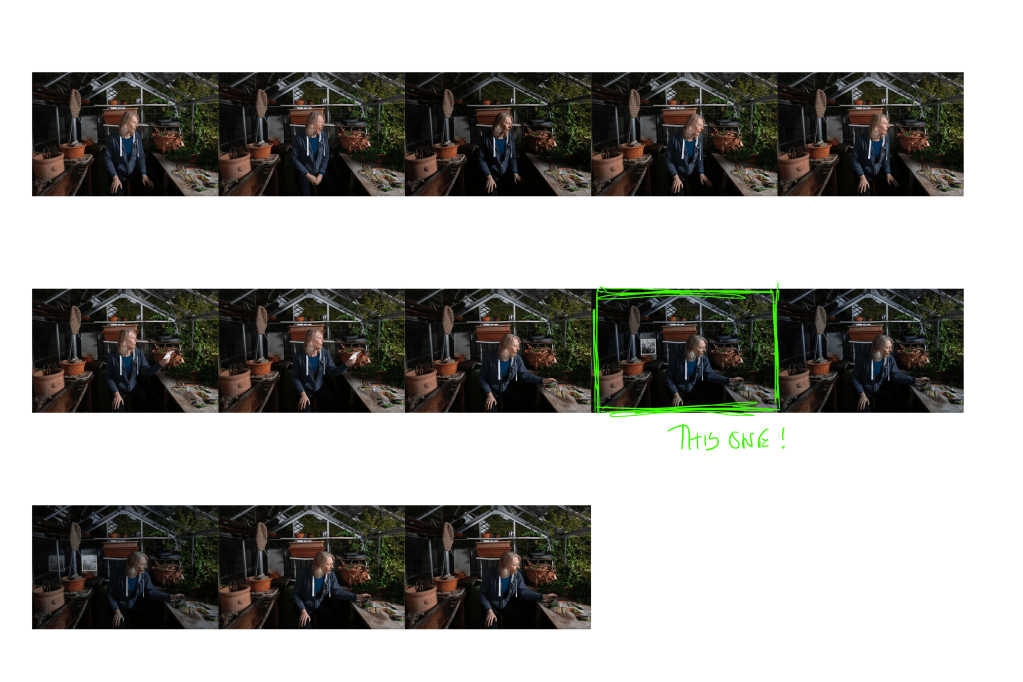
Category Archives: Assignments

Assignment Three: ​Mirrors or Windows

 Choose ONE of the following:

a. ‘Mirror’

Choose a community that you’re already a part of. It could be your child’s nursery or your regular gym class, but it should be something that takes up a substantial amount of your interest and time.

Create a photographic response to how this group informs who you are as a person.

●  What aspects of this group or community reflect on you?

●  What do you share?

●  How does it function as a mirror reflection of who you are?

b. ‘Window’

Use this opportunity to find out about a community that you don’t know much about and tell their story. Get to know them and talk to them; learn by listening and understanding.Your aim here is to become an insider. You’re beginning as an outsider so it is important to choose a group that you can spend a lot of time with. Negotiation skills and respect are intrinsic to working well with your subjects and are invaluable skills for your development as a photographer.Be clear about your intentions and involve your subjects in the process in order to obtain the best results.

What window into this world can you access through your role as a photographer?

In either case you can create as many pictures as you like but, in your reflective commentary, explain how you arrived at the final edit. The set should be concise and not include repetitive or unnecessary images. Be attentive to this aspect of production. Spend some time researching how other photographers seem to edit series of works. There’s helpful advice on editing and sequencing in Maria Short, ​Context and Narrative​ (2011) Lausanne: AVA Publishing.

Some questions to consider are:

●  What order should the images be shown in?

●  Are there too many repetitive images?

●  Do you need to let go of earlier images because the project has changed?

●  Are you too close to some of your favourite pictures and they don’t fit thesequence?

●  Do you need to re-shoot any for technical reasons?

●  Are there any gaps that need to be filled?

Send your final series of images to your tutor together with your reflective commentary (500 words) on this assignment.

Introduction

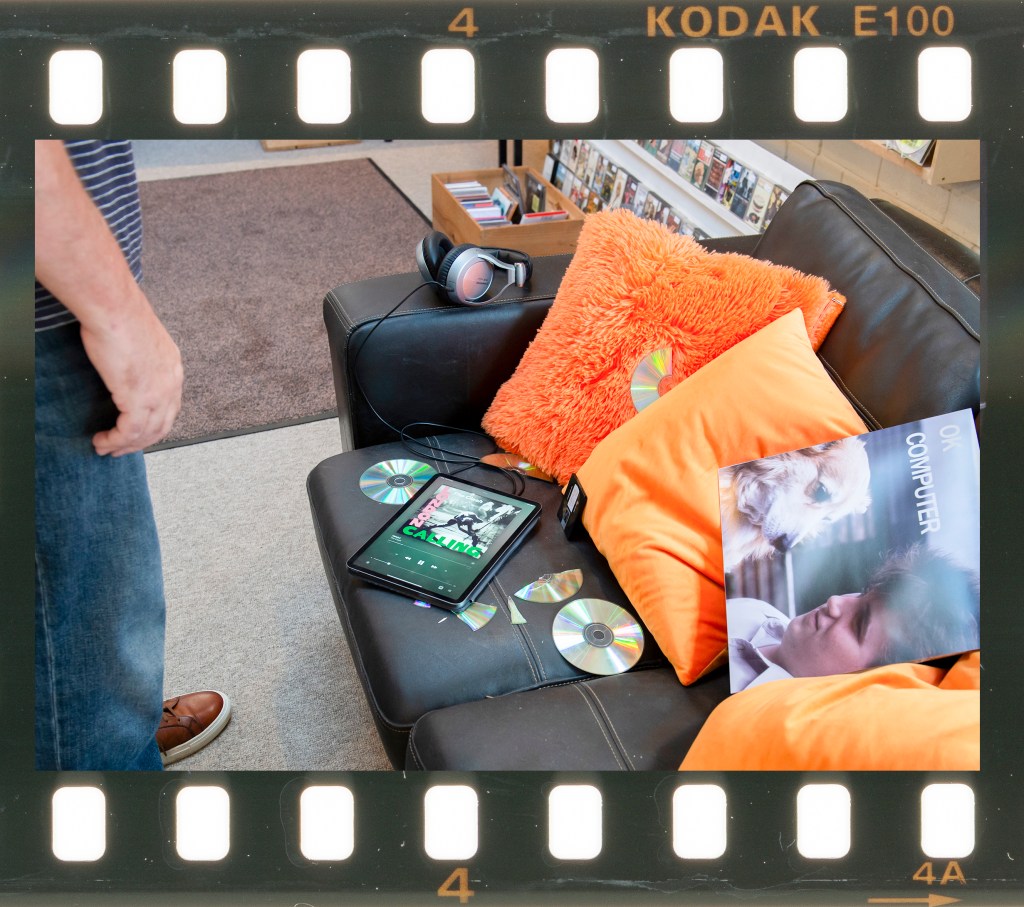
For this assignment, I chose the concept of the mirror as I was inspired by a coincidental conversation that occurred while working on Part 3. For as long as I can remember, I’ve been passionate about music and in the past few years have joined the many people who have rediscovered vinyl records. I’m fortunate to live in a town that has its own independent record shop that is owned by a friend of mine and it was during a conversation with him that this idea came about. I was having a tough time and was digging through records as a way of relieving my stress. My friend suggested that if I ever needed to just escape, I could just sit on the shop’s sofa and listen to what was playing at the time. He offered this because “you’re part of our community”, a quote that immediately resonated with me. We went on to discuss the idea of the vinyl community over the next few visits and concluded that while music was mainstream, the people that choose to listen to it on this particular medium are somewhat on the fringes of society. Their idea of relaxation is to look through thousands of records for something they might like, rather than quickly surfing the internet for their music. They like nothing more than to talk to other like-minded people about new releases, gigs they went to in the past and even the gear that they play their vinyl on. I started to think about how this conversation affected me. Being a child of the 1970s, I grew up with vinyl and cassette tapes as being the two ways to listen to music. I would spend hours listening to pop music on my hand-me-down record players which were only given to me as an alternative to throwing them out. At the weekend, I would go to the nearest town and spend my time looking through records in the same was as I do now. While CDs and digital music essentially killed off vinyl for 30 years, its revival makes me feel as though I’ve come full circle.

My Idea

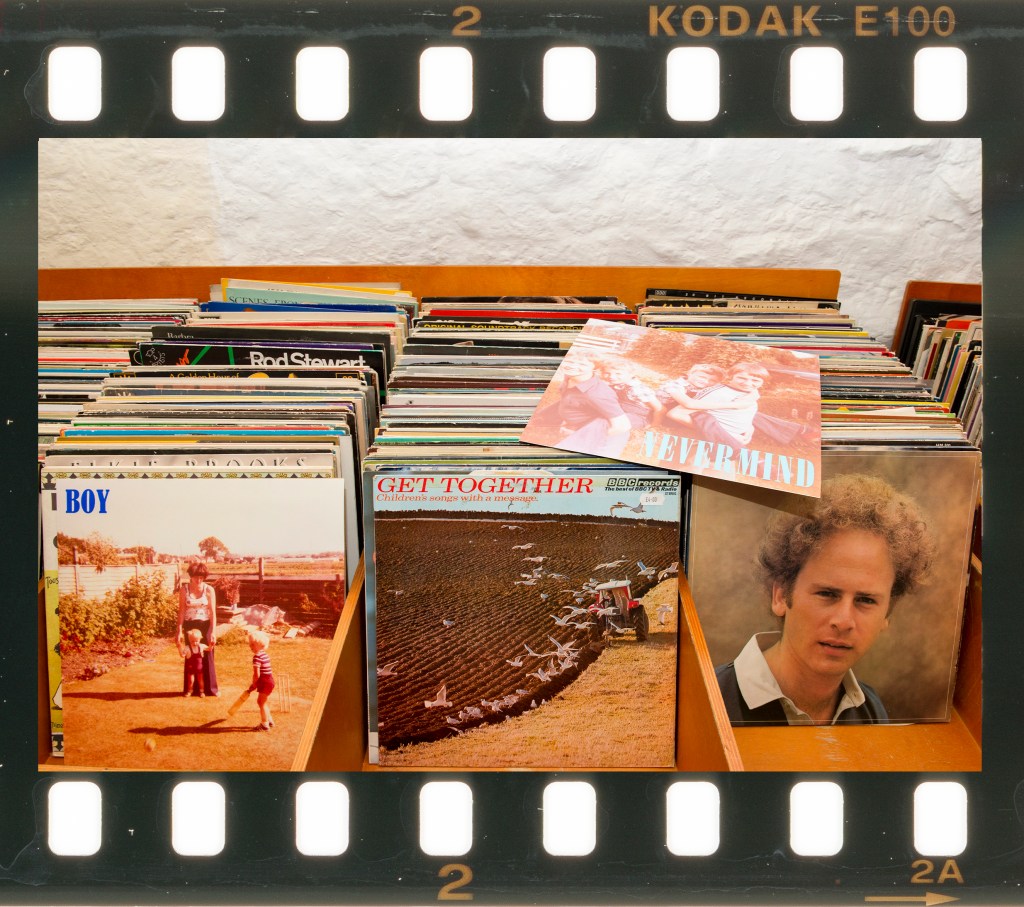
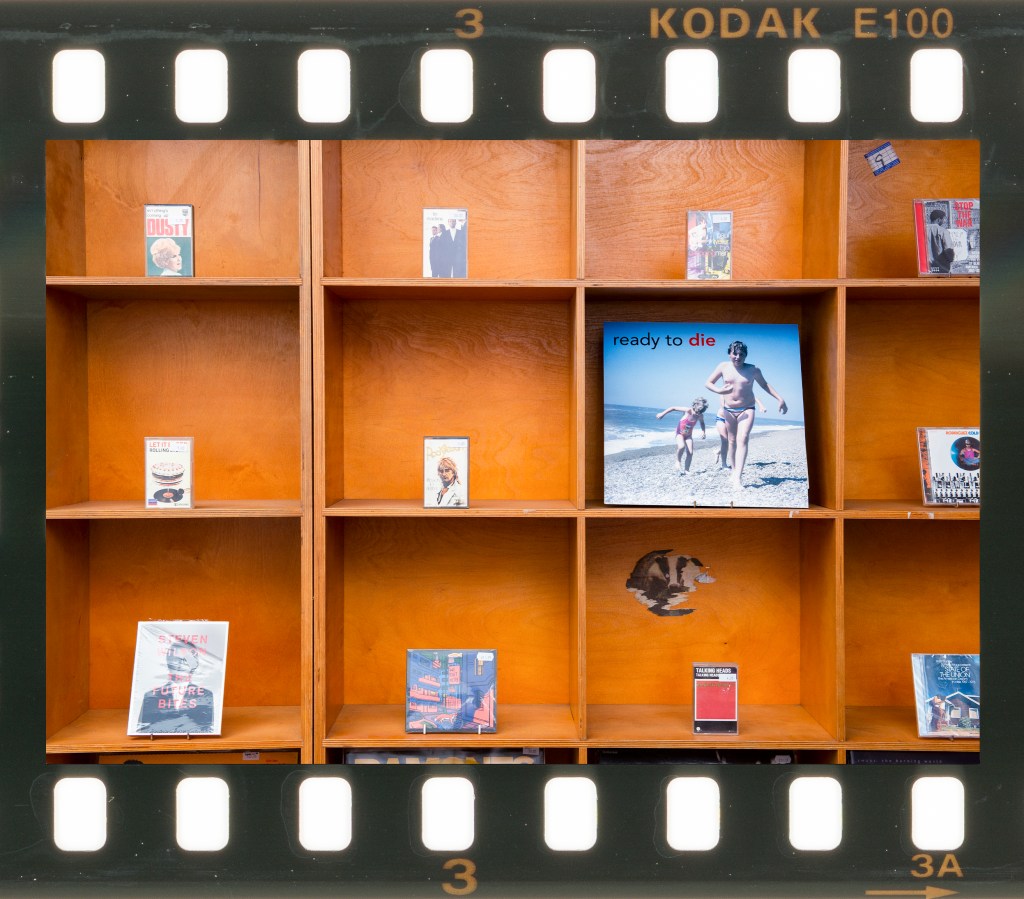
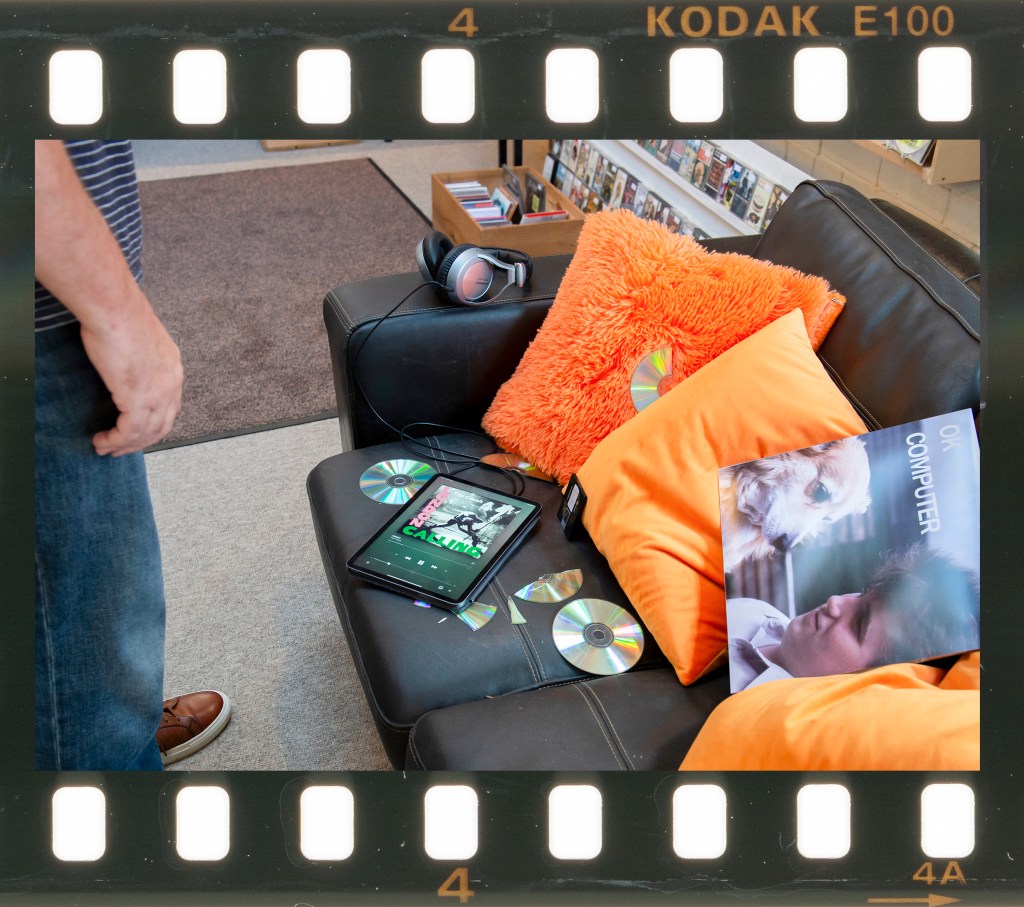
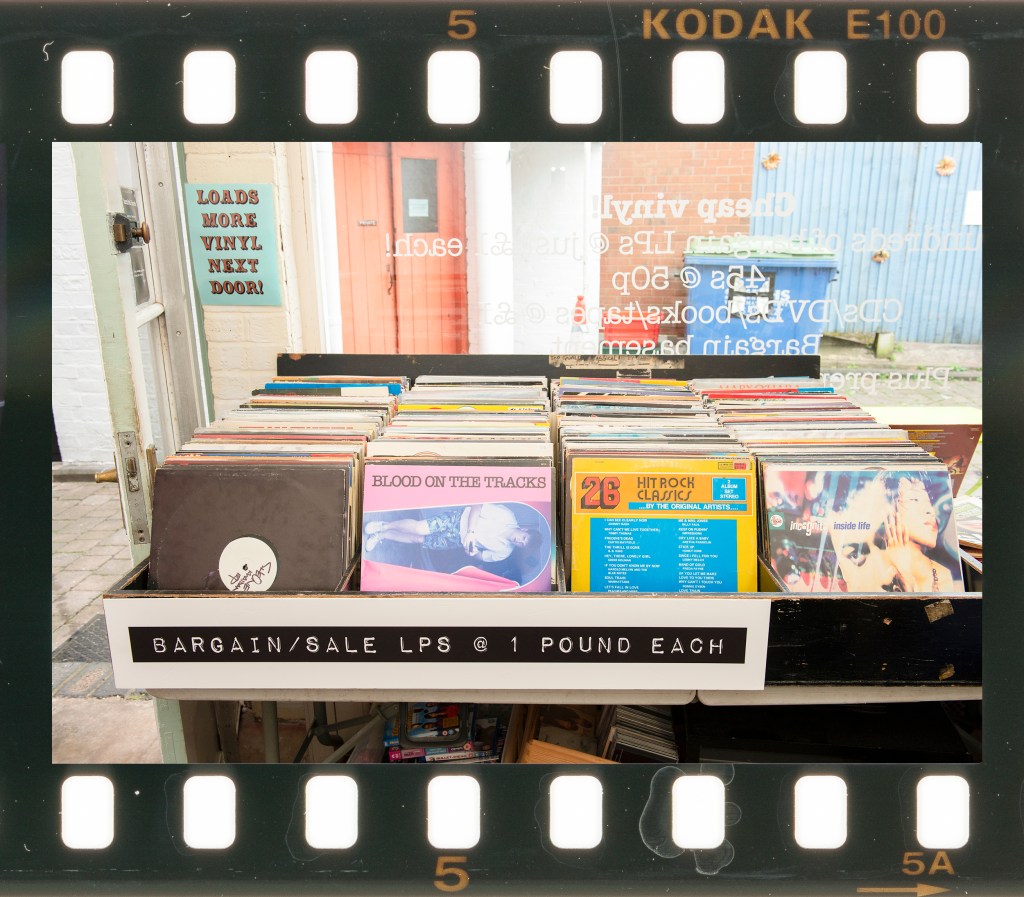
I wanted to explore the prevalence, decline and revival of vinyl and how it tied in with the passage of my own life. I would use family archive photographs of me growing up to establish a form of timeline and combine with text to suggest how both vinyl and I changed over that period. I realised that the intention here was not to suggest key moments in my life aligned directly with the vinyl story but to reveal something about me as it played out. After considering how to incorporate images with the background, I took inspiration from Hans Eijkelboom [1] and Trish Morrissey [2] and looked for a way of substituting myself into the frame. Both artists replaced a person in their pictures which asked the viewer to look closely at their likeness and potential meanings for the fabricated image. I found both of their projects fascinating as they contained an implied self rather than being overtly about the artist’s image. For my series, I decided to make my own vinyl album covers with my photographs as the artworks. Over many years, musicians used artists and photographers to create the image for their albums to draw attention to their style, the album’s themes or just to stand out from the rest. The result was a broad spectrum of ideas and designs, which meant that I could include myself in a similar chameleon-like way to Eijkelboom and Morrissey but stand out enough to invite questions. To help support the narrative, I decided to give each album cover the name of a real album by a well-known artist. Including text would add another layer of context and further enhance the narrative about the vinyl story while further physically connecting my image to it.

Approach

I started by reviewing my family archive. As a shy child, I was always reluctant to be photographed, so of the 2000 or so pictures I have of the family, there are probably only 100 with me in them. I selected 6 photographs that showed me at different ages from a baby to late teens with the only criteria being that I was the main subject in the image (most included other members of my family). I then included them with two shots of me as an adult, one taken on my wedding day and the other a self-portrait taken specifically for this assignment. I wanted to keep the chronology of my portraits but didn’t want to be limited in the same way in the use of album titles as I saw those as supporting the narrative rather than obviously leading it. This meant that I selected album titles from across the decades that suited my photographs without a timeline that linked them together. I made the album covers using actual cardboard sleeve blanks and for each shot on location, put a record inside to make it look like a real album.

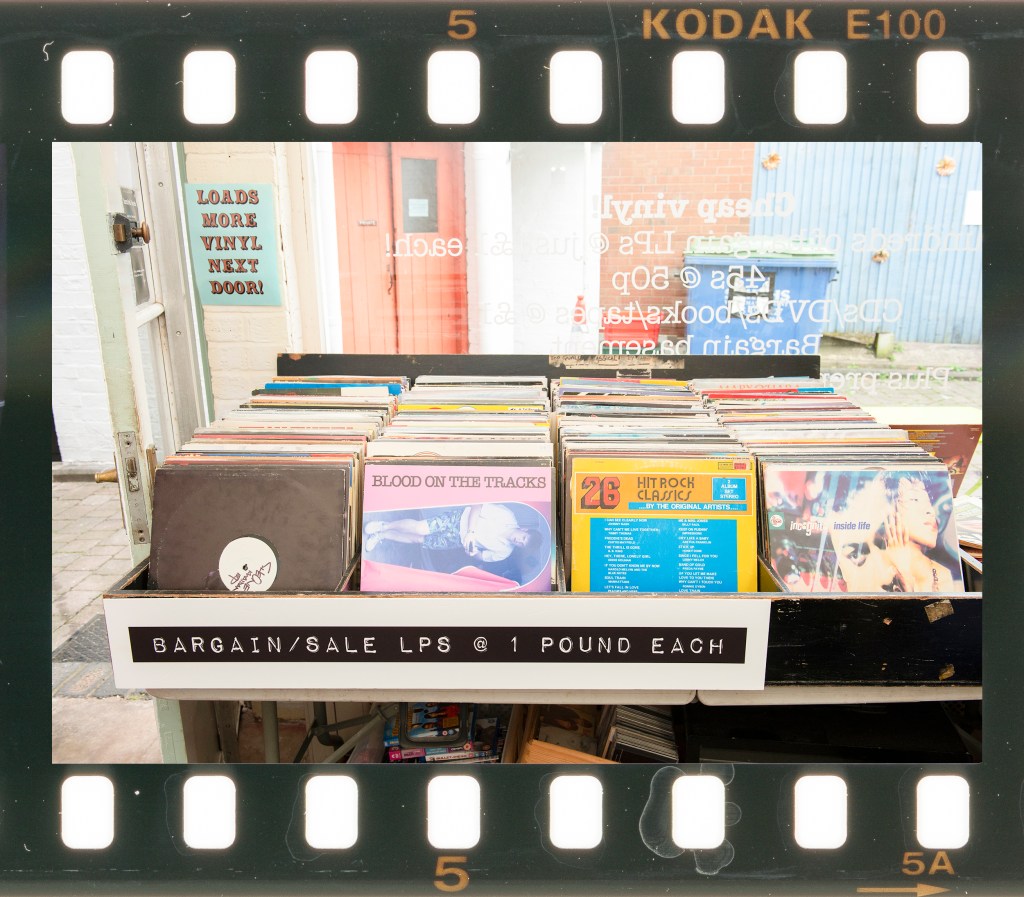
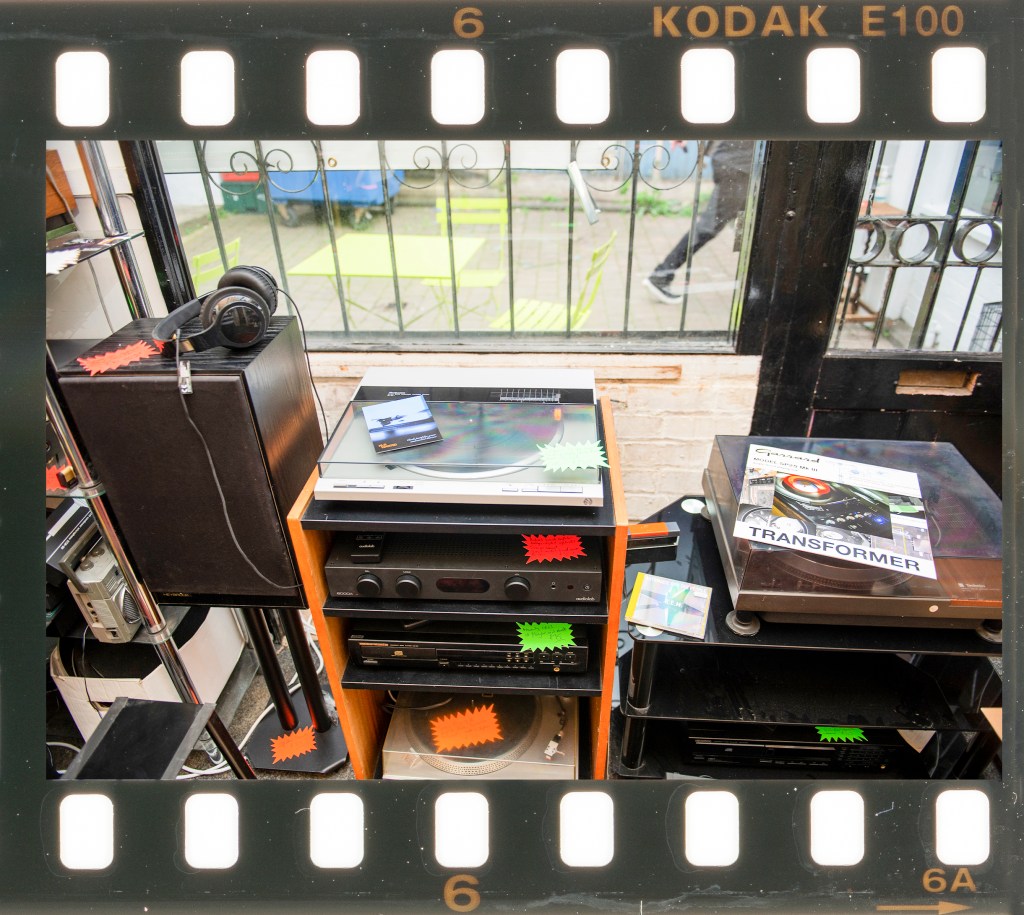
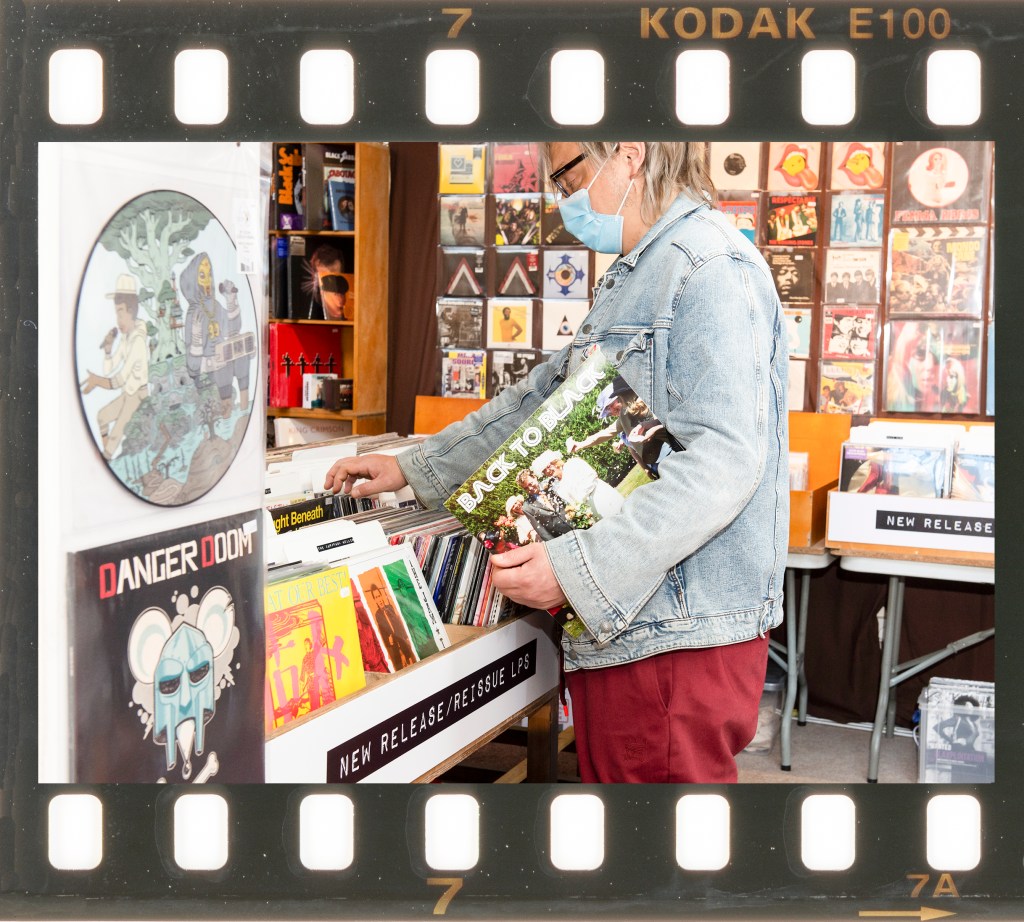
I shot each photograph with a single speedlight flash and kept them as landscape format for consistency. While thinking about this work, I was reminded of another revival in photography that echoed vinyl. Film has undergone a resurgence in the past few years and a specific example is Kodak Ektachrome E100, which was discontinued in 2018 only to be reintroduced 5 years later. Like vinyl, film is an analogue and often imperfect medium so I decided to present my series as a set of Ektachrome film frames. The scans of the film strips show the imperfections such as water marks, dust and minor scratches, which I felt added to the nostalgia of the images even though they were shot digitally.

The Series
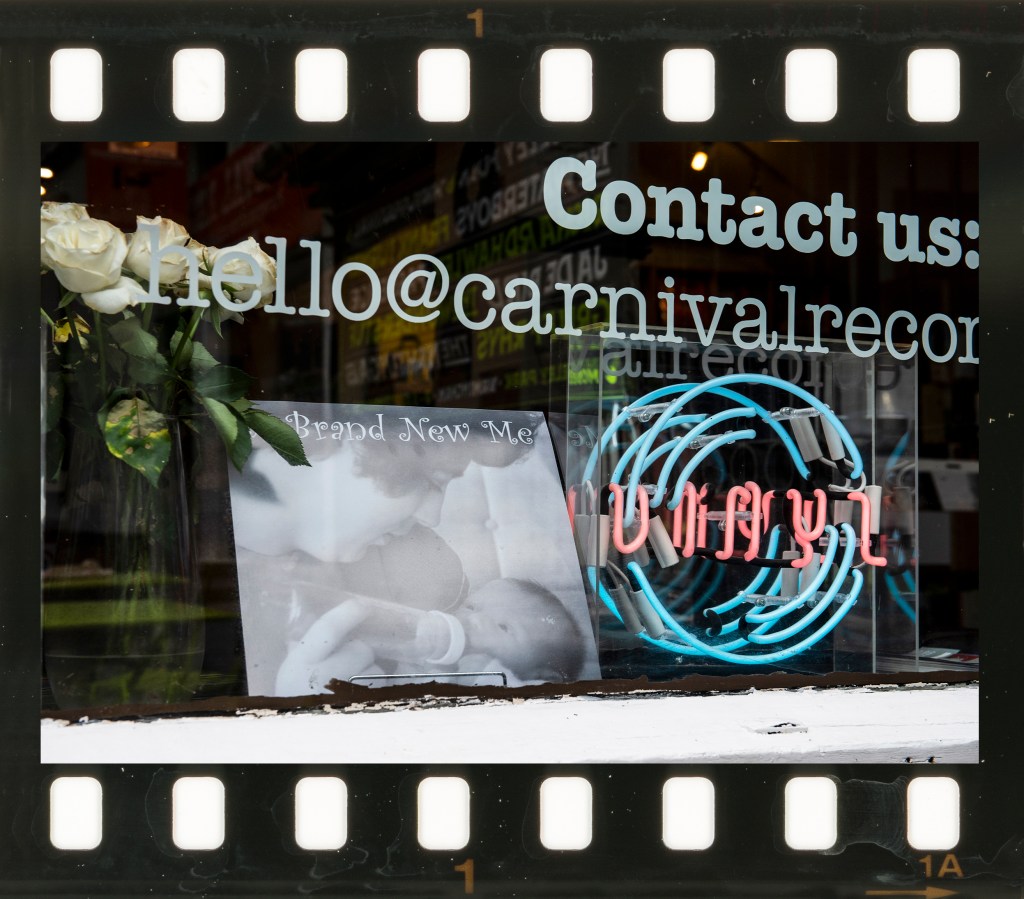
Individual Images

Reflection

My intention for this series was to tell the story of the heyday, decline and revival of vinyl in a contemporary setting, using images from my childhood to provide my perspective.  I chose to present them as individual pieces of film to further tie in the narrative of rediscovery as well as the imperfect nature of classical analogue media   

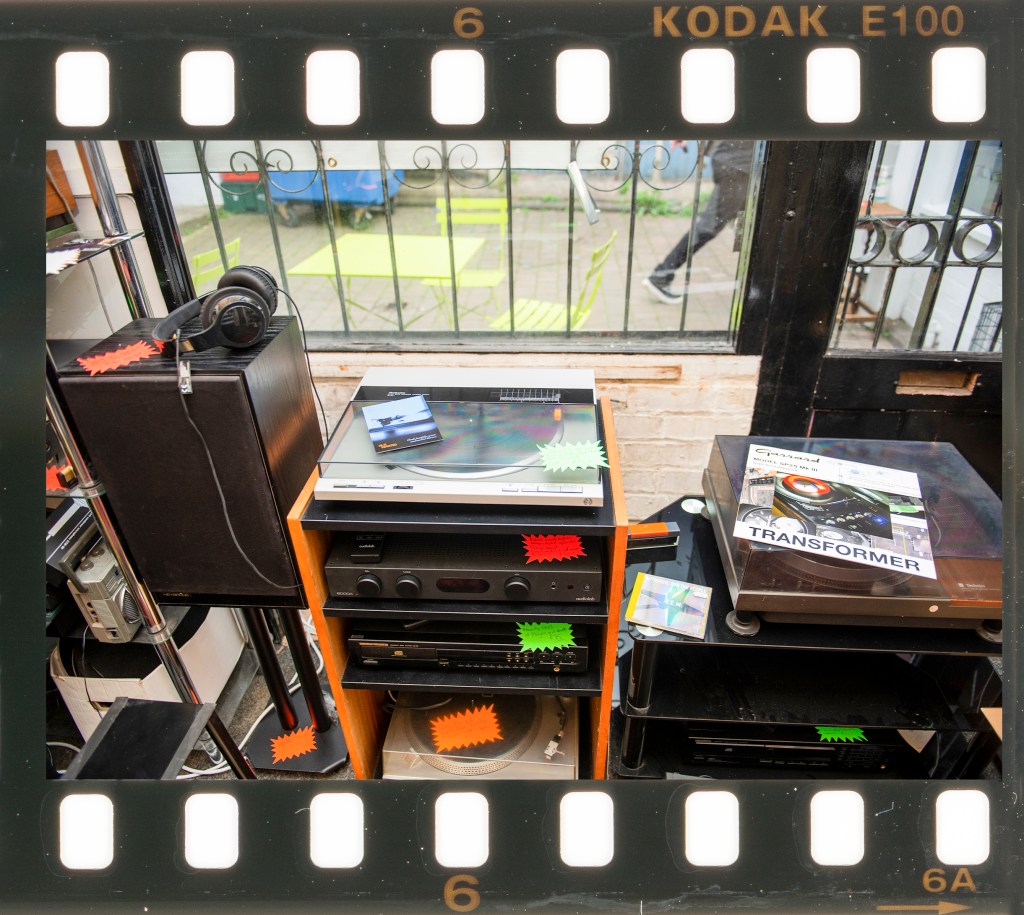
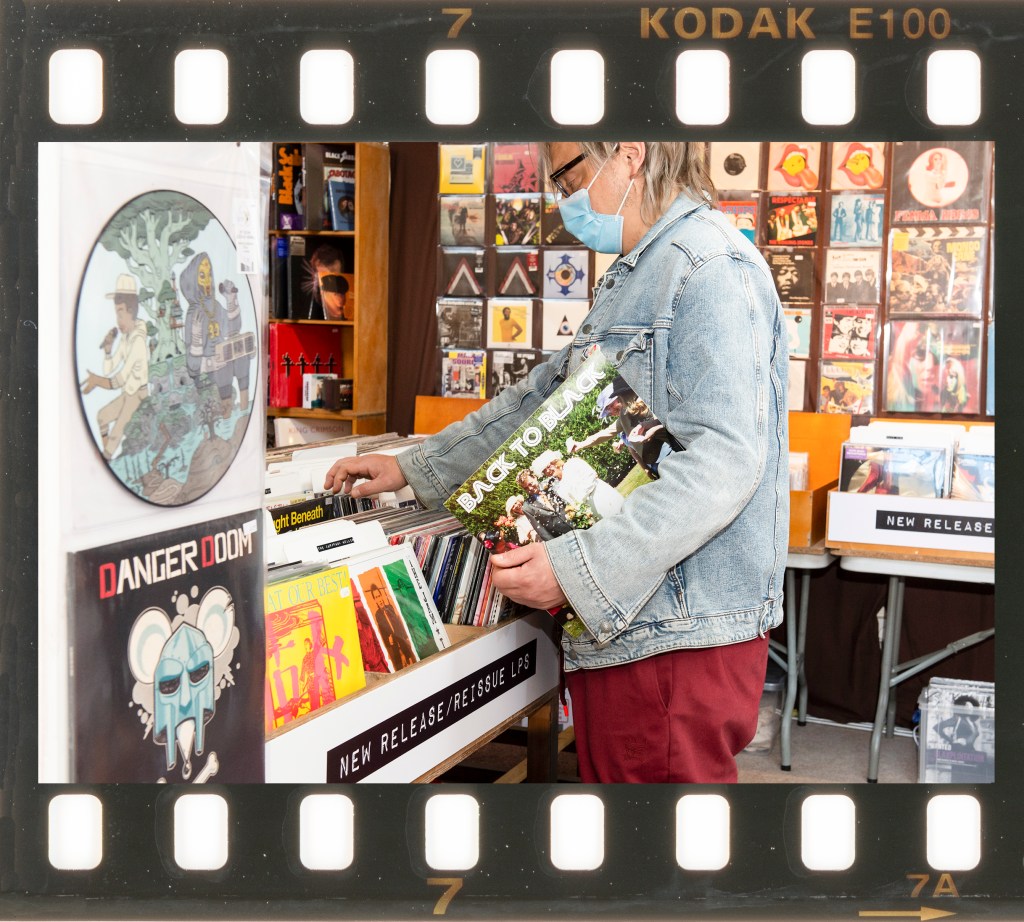
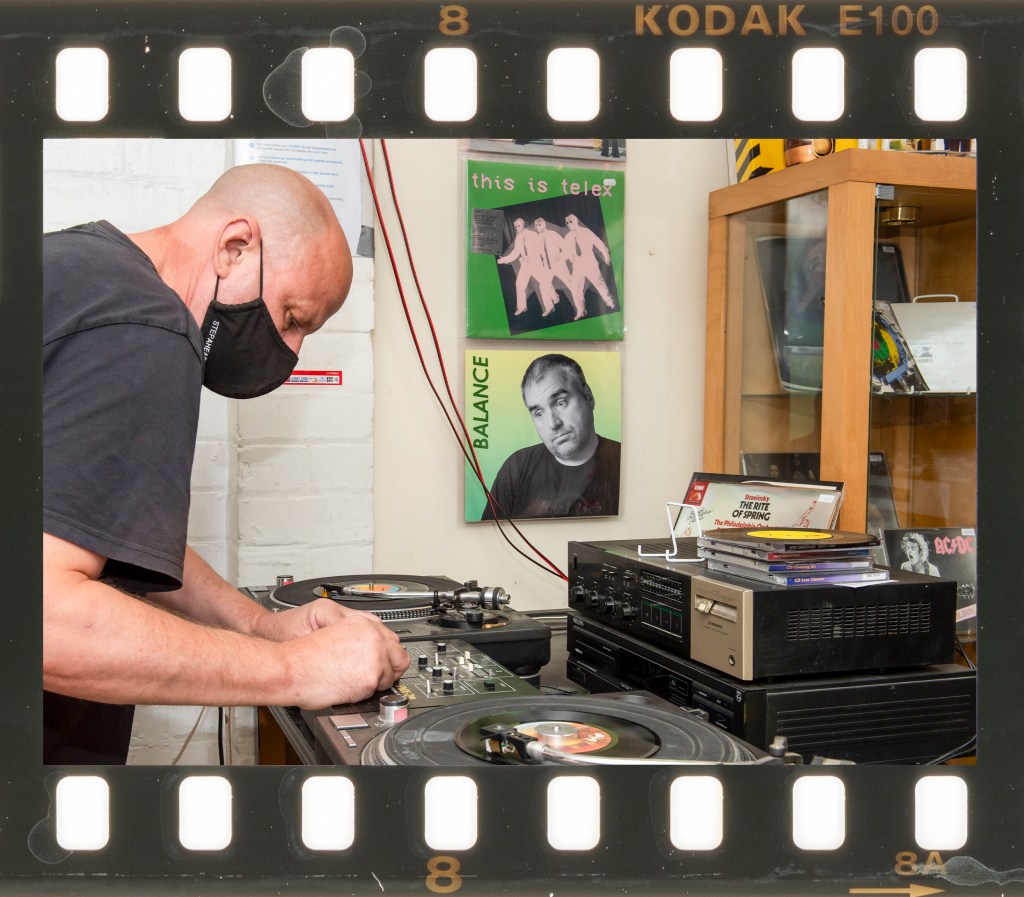
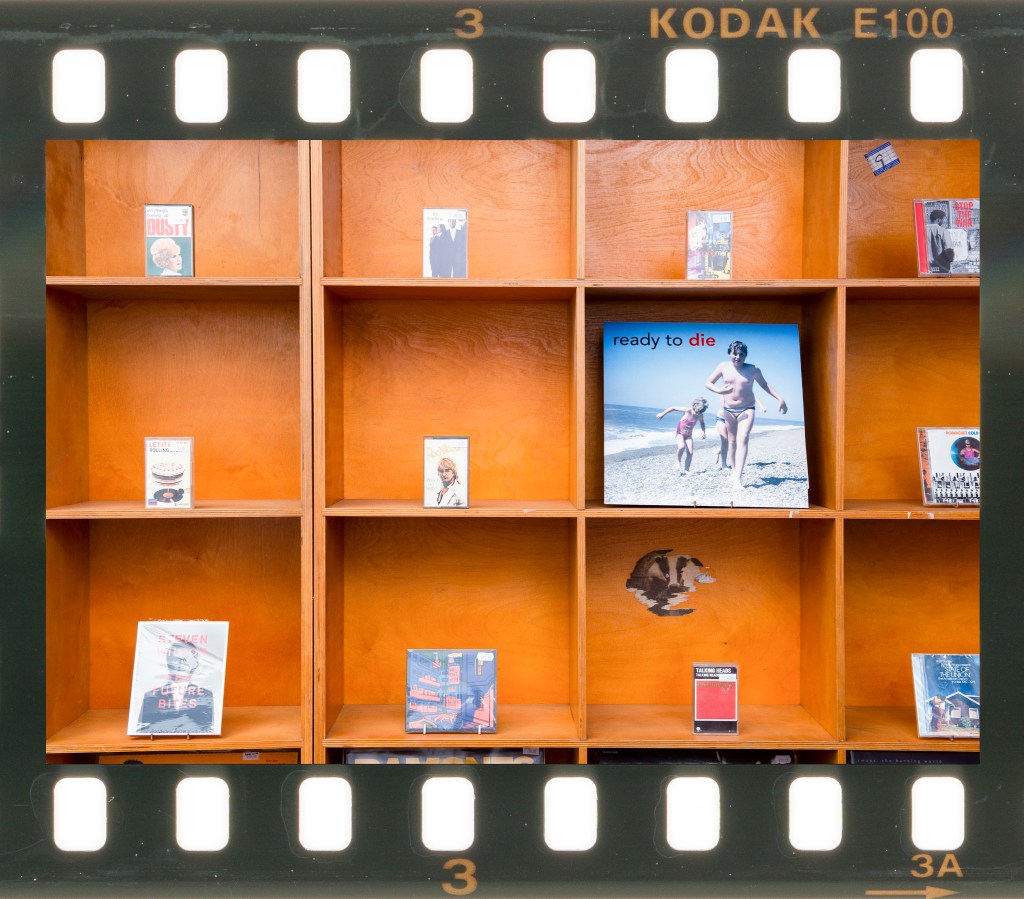
When reflecting on the series, I am happy that the general themes of abundance, loss, alternative ideas and rediscovery come through in the photographs.  One and Two speak to a time early in my life where vinyl was abundant and the most available medium to listen to music on.  My memories of those early years were my family and friends enjoying music together, sharing our thoughts on new releases and rushing out to buy them from our local, community record shops.  Three invokes the takeover of cassettes and CDs as I reached my early teenage years and how, within a short space of time the vinyl records became less popular.  By the time we reach Four, even the seemingly modern CD has succumbed to downloads and computers, with vinyl about as far removed as it could be.  The revival then begins around Five, where most people couldn’t believe it or understand why. In Six I’d reached a point where I needed a record player, something I’d not had for nearly 30 years, and electing to rebuild my family’s old system.  Seven and Eight complete the full circle nature of this revival, with new records being released and shops like this one stocking music on more than one format.  

I believe that the series flows well with 8 images and cannot really identify any gaps that would be filled by including more.  I’ve deliberately tried to avoid repetitive images, which is one reason why I mixed shots of the shop and its products with the people who run it.  The inclusion of people was intended to provide some context rather than be the dominant subject, which is why they are ‘cropped’ by at least one edge of the frame.  I think that the album covers work well with their titles as in some cases they seem incongruous with the image.  The connections between the images of me and the chronology of the story are clear, but each picture has enough context for the viewer to decide what it’s about without being led. 

The strongest image for me is 3 as it shows my perception of the choking of the format, contrasted with the happy scene on the beach by including a dark album title.  When I saw this photograph, I was struck by the similarity of being chased by my smaller siblings and the looming advance of cassettes and CDs on the older format.  The weakest image is 6, as the album cover doesn’t tell the story of my rediscovery of hifi equipment as strongly as the other image narratives.  My decision to restore the system was an emotional one as my earliest memories are of my mother playing it when I was a child. I struggled to find a way of expressing this emotion so placed the image more as a factual signpost. While it’s not as strong, I still believe it fits well enough in the series without reshooting.

Against the Assessment Criteria

Demonstration of Technical and Visual Skills

All of the images are well exposed and sharp with use of aperture to reduce any impact of distracting elements not related to the subject. I deliberately composed in landscape in order to present the photographs as film frames and incorporated people only as supporting contextual elements instead of being the dominant subject. I believe these tableaux compositions meet my original intent in incorporating many different connotations in a each frame.

Quality of Outcome

This series was intended to be a mirror with the images revealing something about me within the narrative. I believe that this series meets the brief in this regard. Each photograph features a representation of me at an age that aligns with the key theme and the often contrasting album titles both ground the fake album covers in reality and help tell the overall story. Feedback received so far indicates that this clever combination of real and imaginary strengthens the connections both within each frame but also the series as a whole. I believe it meets the brief.

Demonstration of Creativity

My approach to the brief differs from traditional self-portraiture because I’ve included archive photographs of myself in the contemporary setting of the record shop rather than posing for the photographs. The arrangement of the compositions is such that a sense of events that happened in the past have been brought into the present. The photographs present a mix of the straight chronology of my life with the events around vinyl’s decline and rediscovery with the familiar, yet out of time album titles. The contrasting imagery of the album covers and their titles asks questions about my past life and how I view it from a nostalgic perspective. It could be argued that contrasting, for example putting Amy Winehouse’s album title ‘Back to Black’ on a photograph of my wedding day, suggests a dark view of a joyous time. The true meaning of course is that we are back on vinyl which is black in colour, but I don’t make that clear with the rest of the composition. The inclusion of the model and his mask could also be interpreted as a commentary on the current pandemic crisis – I leave that to the viewer to decide. For me, the series comprises of 8 images that work together without any obvious gaps and each image has a number of layers of potential narrative to keep the viewer’s attention.

Context

Within the context of Part 3, I was heavily inspired by Eijkelboom and his substituted family photographs. By inserting himself into a stranger’s family for a picture, Eijkelboom challenges the viewer to tell the difference between what is real and what is not. His perspective on the traditional family unit and how that blueprint is so recognisable in our culture is done with a humorous angle. What I intended with my series was to ask the viewer to relate to the ‘full circle’ narrative around vinyl, but also the linearity of my life moving through the story. It is a mirror because it reflects my experiences without being too literal, but it could also be considered a window into the sub-culture of vinyl listeners. The shop has a very indie aesthetic, with everything designed around making the music accessible rather than being pretty. To the uninitiated, the series could simply act as a document of how things are now within this community.

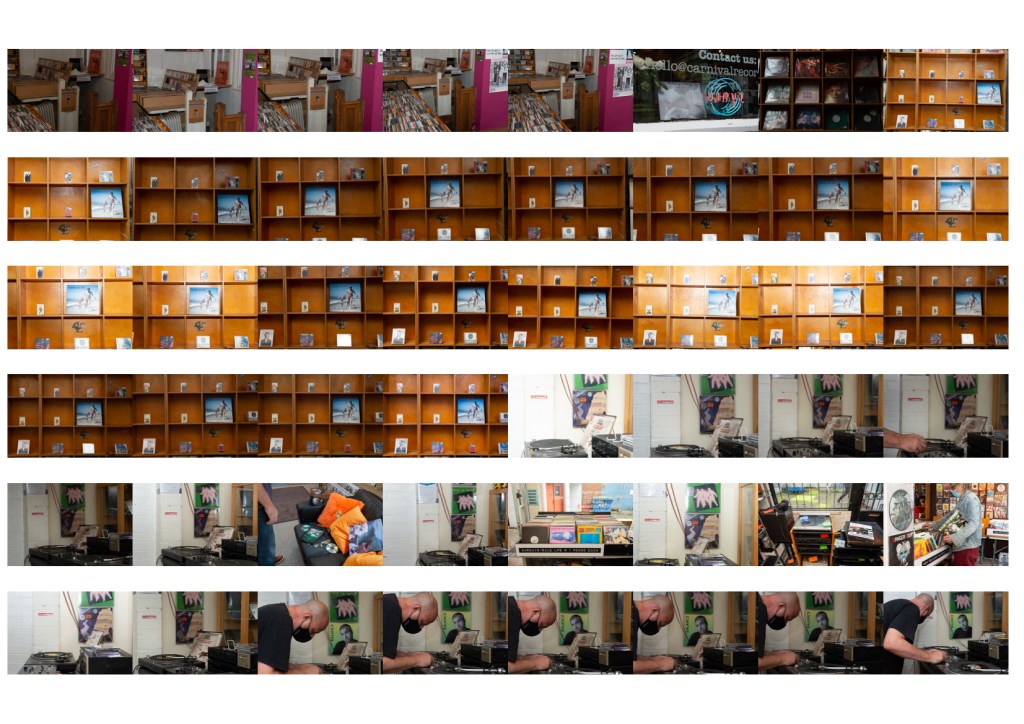
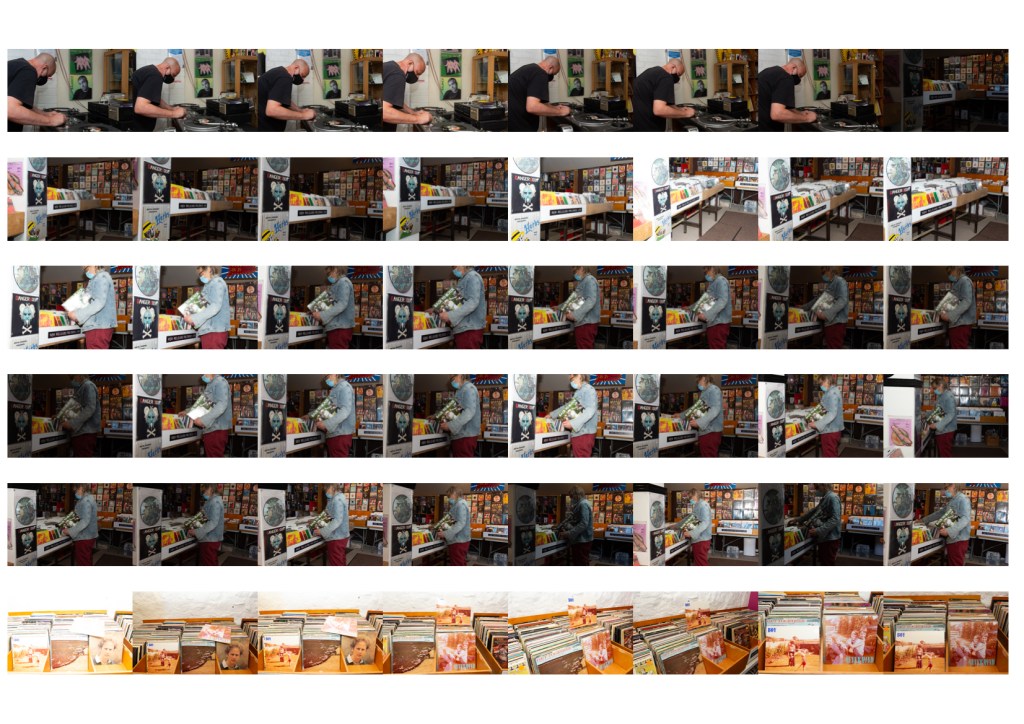
Contact Sheets

References

[1] Fletcher R, 2021, “3) Project 1 Mirrors”, OCA Blog Post, https://richardfletcherphotography.photo.blog/2021/08/11/3-project-1-mirrors/

[2] Fletcher R, 2020, “3) Project 2: Masquarades”, OCA Blog Post – Context & Narrative, https://richardfletcherphotography.photo.blog/2020/08/21/3-project-2-masquerades/

Post Assignment 2 Feedback

Introduction

I have recently received tutor feedback on Assignment 2 which raised a number of points that I will address in this post. General feedback about the photographs was positive, but my tutor questioned how effective the joint themes were and whether I had played things too safe by not electing to publish the post (for reasons outlined in the assignment).

Feedback Points

The first point was about the themes. My blending of street photography composition with studio lighting was evident in the series and my tutor indicated that some images were stronger than others. He highlighted One and Four as the strongest, which aligned with my own views on the series. I liked the humour in both and I think they worked best from a lighting and composition perspective. My tutor took issue with the idea of challenging the viewer in terms of how the images were shot. He rightly pointed out that most people viewing them wouldn’t know or even care how they were taken. While I had fooled a few photographers with the use of artificial lighting, this technical distinction wasn’t really a strong theme. I have to agree, which is probably why I wanted to have a creative link as well as a technique one.

At this point, I raised my concerns that the brief steers us towards experimenting with techniques and approaches while the title Vice Versa suggests a specific inversion of them. We agreed that this was my interpretation and accepted that the main reason that I struggled not to merely invert the techniques from a technical perspective was that portraiture is not a genre of photography that I am at all comfortable. When I feel that way about a topic, I tend to revert to type.

The second point of feedback was my strong connection with and management of my models. It was cited as a strength the series and the creative process that I was able to engage openly with my models, who are all friends of mine. It was clear from the final images that the collaboration between photographer and subject was strong, which made for more natural results. This point raised the main critical point about the series. I had elected to not publish it out of respect for two of the models who weren’t comfortable with it being widely circulated. Although my tutor accepted my reasons for censoring the work, he made the great point that this act undoubtedly had an impact on the strength of the series in the context of challenging convention. Other ideas such as challenging gender conventions within the series, e.g. having one of the men dressed as the cheerleader in Four, were discussed. These were good suggestions that I think were perhaps lost by my slightly blinkered view of the brief.

We discussed the conversation that I had with my cohort about how the use of paid models as a way of avoiding the discomfort. The point that I made was that paid models would be easier in that regard but would potentially lack the natural feel of the work that came from my relationships with my subjects. The overall conclusion was for me to look into examples of self-censorship in art and those who genuinely broke boundaries with their work. The artists Pedro Meyer, Richard Avedon and Joel-Peter Witkin were recommended to me, which I will be looking at in parallel with Part 3.

Other feedback was received about my writing style and some of the work within the exercises that raised interesting questions. However, this post is about Assignment 2 so that is not included here.

In conclusion, I cannot disagree with any of the feedback that I received. I was happy with the photographs individually and as a series, however I was aware that the response to the brief was weakened by my use of composition and lighting rather than subject. I felt that the subject-based theme worked well, but take on board the comments about self-censorship.

Post-assignment 1 feedback

Introduction

I’ve just received tutor feedback for Assignment 1 – The non-familiar. The overall view was that my submission met the brief with a series of portraits that worked well together, were technically good and sympathetic to the subjects. There were some interesting observations and recommendations for further consideration that I will address in this post. On reflection, I am really happy with how this assignment was received by not only my tutor, but everyone else who has seen the work.

Using Text with Images

“The use of text and image is an area that can be fraught with difficulties and needs careful consideration as to how text and image will work together. There is always the danger that text will swamp the narrative within the images and will not allow the viewer an independence of interpretation when viewing the work. Everything is directed through the text rather than letting the images reveal the narrative. When reflecting upon the images you might ask how will they be interpreted without the text?”

This is a really welcome observation as when I was getting to know my subjects, I was making mental notes about their story that I then wrote up when I left the conversation. I didn’t write lengthy commentaries, but just enough to prompt the memory of our conversation when I came to write up the assignment. At this point I was thinking that I may have many ‘interviews’ with subjects, so wanted to ensure that I didn’t overlook anything important. When it came to the write-up, I selected a a few of the notes to include with the pictures. It would have been easy to have written a very clear narrative from the notes that described in great detail how the subjects used the park. Of course, the more detail the less room for manoeuvre in interpreting the theme for the images and the series. I was reminded of Paul Seawright’s comment about narrative in the previous course and how the artist should give enough context to help the viewer reach a conclusion about the work. His work Sectarian Murder was a great example of pairing text with photographs and when I revisited my research into the work[1], I could see how I was influenced in my inclusion of text with these photographs. In Seawright’s photographs, the text suggested the horrors of the Irish conflict taking place at the seemingly peaceful scenes. The inclusion of the two contexts together tells a story that each cannot when considered individually. I think that my photographs in Assignment 1 refer to the subjects back-stories through both the text and their pose/expression, but when the text is removed, the scope for interpreting the meaning of the pictures expands. I believe that I managed to stay the right side of Seawright’s comment on narrative with each short paragraph revealing just enough about the subject to ask questions about why they visit the park.

Diversity of Subjects

“A wider range of age groups would have opened up other challenges in interpretation and it would have been interesting to see the images made from such encounters. But you have commented upon the absence of diverse groups in the park and considered this an area for further investigation. Perhaps this will result in a future project?”

The second piece of feedback that resonated with me was this comment about the lack of diversity in the shots, whether in terms of age or race. This was something that I reflected on during the shoot and certainly interested me from the point of view of the questions it raised. Why was the park used predominantly by white families and the middle-aged to elderly? It was particularly interesting because it wasn’t based on the lack of diversity in the town itself. Malvern has a number of private schools, so there are many young people around. It also has a large population of people from the Middle East, which is most noted in diversity of the businesses in the town. It’s perhaps easy to see why young families would visit with the children’s playground and the ducks around the lake. The concentration of middle-aged to elderly was also obvious to me at the time as there is a ‘retirement town’ vibe to the town, mainly because of its beautiful hills and rolling fields. The lack of young people and people from other ethnic groups was a puzzle, to the extent that I had looked out for them in the weeks after completing the shoot. What was more interesting was thinking about how a more diverse group would affect the narrative for the series. Their absence already points to a social typology for a space like a park, but by including some young adults or some families from the Iranian, Indian and Turkish communities, perhaps that would replace that idea with a statement on multiculturalism. I was reminded of the German obsession with physiognomy in the late 1920s, where pseudo-scientific conclusions were reached by a person’s physical characteristics. Perhaps a series with more diversity could seek to break any pre-existing assumptions about the park and perhaps, more interestingly a series made up entirely of a different culture, age group or culture could contrast with the gentile impression of our little Victorian town. It’s something I definitely want to pursue outside of my studies as it combines both the engagement with strangers with the development of an alternative story.

Overall Conclusions

In conclusion I was very happy with the feedback given. The warning of being over-prescriptive with the addition of text was a useful insight that I will keep an eye on in future projects. The recommendation about a project on the diversity of the park visitors is something I will be looking at in the future.

References

[1] Fletcher R, 2020, ‘Project 4: The Gallery Wall – Documentary as Art’, OCA Blog Post, https://richardfletcherphotography.photo.blog/2020/05/12/project-4-the-gallery-wall-documentary-as-art/

Assignment One: ​The non-familiar


The Brief

Your first assignment is to make five portraits of five different people from your local area who were previously unknown to you.

You will almost certainly find it challenging to take photographs of people you don’t know; it’s often much easier to photograph somebody you’re already familiar with.This could be referred to as the ‘comfort zone’ – and for the purposes of this assignment you will be specifically required to leave it!

Leaving technical photographic considerations aside, there are a whole range of issues to deal with in making a portrait of somebody you don’t know. This additional skill set should arguably be in every photographer’s kitbag, regardless of what genre of photography they end up working in. The ability to concentrate on technical and aesthetic considerations whilst engaging with a complete stranger brings a plethora of difficulties. Added to the fact that most people aren’t that comfortable with having their photograph taken anyway, then you can see why this could become a minefield!

Just as you learn the techniques behind how your photographic equipment works, there are techniques you can learn about how to photograph people you’ve never met before. Many historical and contemporary portrait photographers have written about this and one piece of advice stands out:

Tip

If it is at all possible, spend time with your subject, getting to know them and triggering a dialogue with them, prior to even showing them your camera.

“A portrait by photography needs more collaboration between the sitter and the artist than a painted portrait. To make satisfactory portraits of persons it is necessary for me to like them, to admire them, or at least to be interested in them. It is rather curious and difficult to explain exactly, but if I dislike my subject it is sure to come out in the resulting portrait. The camera is all recording and very sensitive to the slightest graduation of expression of the personality before it. Also the impression that I make on my sitter is as important as the effect he has on me. I make friends quickly and am interested in the mental alertness of the people I meet. You can know an artist or an author, to a certain extent, from his pictures or books before you meet him in the flesh, and I always try to acquire as much of this previous information as possible before venturing in the quest of great ones.”

Alvin Langdon Coburn

Who you photograph is entirely your choice but don’t give in to the temptation to photograph people you know!

Approaching strangers can be daunting at the best of times, let alone with a camera in your hands. But it doesn’t have to be. If you are really terrified, consider asking a friend or relative to be your assistant.

You may want to explore the idea of types, thus sticking to a theme. Or the sitters could be very disparate, linked only by the fact that they come from your local area. Give consideration to this and also how and where you photograph your sitters. Bearing in mind the strategies and techniques discussed in Part One, keep your set of images consistent and choose a technique that complements your conceptual approach. For example, do you want a series of location-based portraits? Do you want the portraits to be situated inside? If so, drawing on your experience in Exercise 2, how will you select your backgrounds in order to give context?

Reflection

Before you send your work to your tutor, check it against the assessment criteria listed in the introduction to this course guide and make sure it meets all the criteria. Make your evaluation available to your tutor.

Your tutor may take a while to get back to you. Carry on with the course while you are waiting, but please don’t attempt the next assignment until you’ve received your tutor’s feedback on this one.

Reworking your assignment

Following feedback from your tutor, you may wish to rework some of your assignment, especially if you plan to submit your work for formal assessment. If you do this, make sure you reflect on what you’ve done, and why, in your learning log.

Introduction

I first read the brief for this assignment when I enrolled on the course and was looking through the material for Part 1. My initial reaction, like those of many students I would suspect, was complete terror. As the brief suggests, this idea of approaching a complete stranger for their portrait feels unnatural. In my case however, I have done this before, most notably when on holiday in Canada in 2016 [1]. On the vineyard tour, I elected to photograph the people involved rather than simply documenting the surroundings because one field of vines is very much like another. I continued this theme when I visited California in 2019, photographing the people involved in making and selling wine during each visit.

Dave and John of the Homewood Winery, California (2019)

The first issue I wanted to explore with his assignment was why did I feel that terror if I had already done something similar in the past? The first consideration was that although unknown to me, my subjects and I were introduced to each other in a transactional way. I had paid for a tour of the vineyards and they were providing a service to me. The step from engaging on the tour and asking specifically for a portrait of them was not as great as it would have been with no connection at all. Coupled with this transaction was the fact that by profession, they were used to engaging with the public and therefore most likely more comfortable with having their picture taken. I certainly remember their reactions being more ‘surprise at being asked’ than any awkwardness over the act itself. In the case of the photograph above, both men were not comfortable with being photographed initially, but by talking to them about their passion for their boutique winery they lightened up for the shot itself.

The next consideration with regard to my discomfort was related to starting conversations that turn into an opportunity to take a portrait. Since leaving my job in engineering in January, I have walked to my local park to shoot photographs of the wildlife as part of my daily morning exercise. While shooting, I am regularly approached by other visitors to the park who are curious as to what I am doing. We usually have a brief chat about the animals that I’ve seen and how they behave and then go our separate ways. If I could chat to complete strangers in this context, why was I worried about approaching on this subject? I wondered whether that kind of conversation might be the way to introduce the idea of asking for a portrait. I tested this theory with one of the people that I regularly see in the park one morning. We had been talking about the elusive kingfisher that had been spotted at the lake. After about 5 minutes, I steered the conversation around to my redundancy and photographic studies. She was really interested in what I was doing and my plans for the future, but when I brought up the subject of the assignment, her reaction was “Oh, I wouldn’t let you take my picture”. After some exploring of the reasons why, she pointed to lockdown and how it had affected her appearance. I didn’t push this conversation further, but what understood Coburn was referring to in the quotation in the brief. The camera or the idea of it being used can affect the mood of the engagement, however brief. If the effect is received positively, the relationship is built between photographer and subject and the expression should be more natural in the portrait. However if there is some tension or awkwardness between photographer and subject, the resulting image will include that to some degree. With strangers, the amount of ‘stage management’ of the portrait is significantly lower than if the subject is paid to sit or has commissioned the picture. When we looked at traditional portraiture in Part 1, this context determines how much influence both photographer and subject have over the resulting portrait, set against the other elements in the frame. For this series, there is no real choice but to build some form of relationship with the subject before thinking of how to photograph them in a meaningful way.

My Theme

The COVID-19 pandemic has made meeting people more difficult that normal. Not only have the opportunities varied through multiple lockdowns, even when allowed out people are wary of getting too close to each other. The adoption of face coverings to protect from infection have added to the difficulties in getting people talking to each other, which presented challenges with how I approached this assignment. I decided to stick with where I had encountered the most people in the past year, the park in my home town. The central theme would be the people who visit and their stories about why they visit.

Approach

I used my Nikon D4 DSLR with an 85mm f/1.4 prime lens for all of the shots. This focal length is widely regarded as ideal for portraiture owing to the depth of field and subsequent ability to isolate the subject from the background. I shot each portrait at f/8 which is the sharpness sweet spot for the lens while maintaining subject separation through relatively shallow depth of focus. At this aperture, the subjects were isolated from the background but there was sufficient ‘sharpness’ behind them to provide context.

The downside of this combination of camera and lens is the physical size, which meant that I really needed to follow the advice in the brief about not introducing it too quickly to the conversation with my subjects. I composed the photographs to allow for a 8×10 crop, which for me gives a traditional feel to the shots; this format was popular in early portraiture with the development of 4×5 and 8×10 film cameras. The only other adjustments to the images were contrast, some highlight ‘dodging’ where the lighting conditions were harsh and tweaks to the white balance.

When it came to approaching subjects, I started a conversation with them about something that we might have both observed, such as wildlife behaviour, a rapid change in the weather etc. I would then steer them around to why they come to the park and make mental notes that I wrote up after the conversation. The only other information that I asked for was their first name. I then shot a number of portraits from different angles and distances, letting the subject relax into whatever expression they wanted to give me. I was inspired to do this by the Double Take work [2] where the photographer shot two portraits on one glass plate that resulted in subtle changes to the subject’s pose or expression as they relaxed into it.

The Series – People of the Park

The Photographs

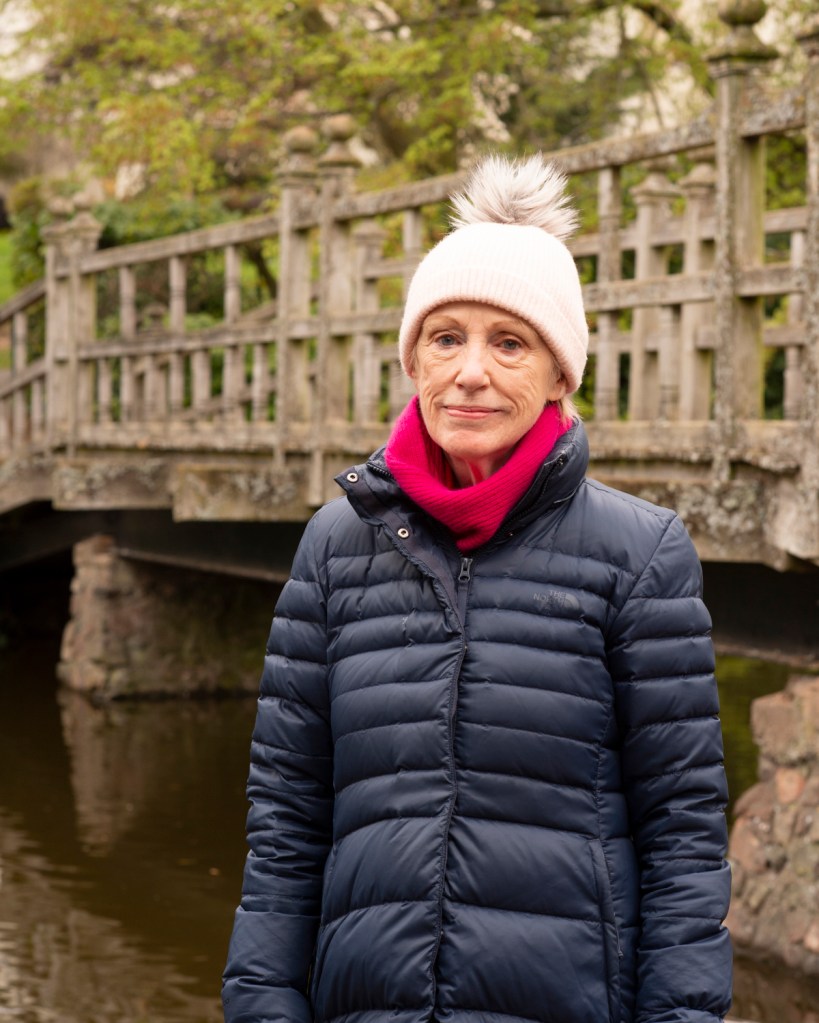
Janet

“I tend to come out on my own now as my husband can’t walk at my pace anymore”

Janet walks through the park on her morning walk. She enjoys the fresh air and exercise that she often has to get for herself as her husband suffers ill-health. She is looking forward to group exercise starting up again for the social interaction.

I met Janet when she had stopped to look at a tribute to Sarah Everard, who was murdered on her way home in London recently. I was immediately struck by the poignancy of the situation (the park was pretty much deserted) and nearly didn’t approach her for a portrait because of it. However, she was very chatty with a great sense of humour. She referring to considering herself fortunate to have worn a hat as she couldn’t yet visit the hairdresser. When she told me her story, particularly the part about her husband’s health, she did so without being melancholy but with a sense of needing to grab opportunities to take care of her own wellbeing whenever she could.

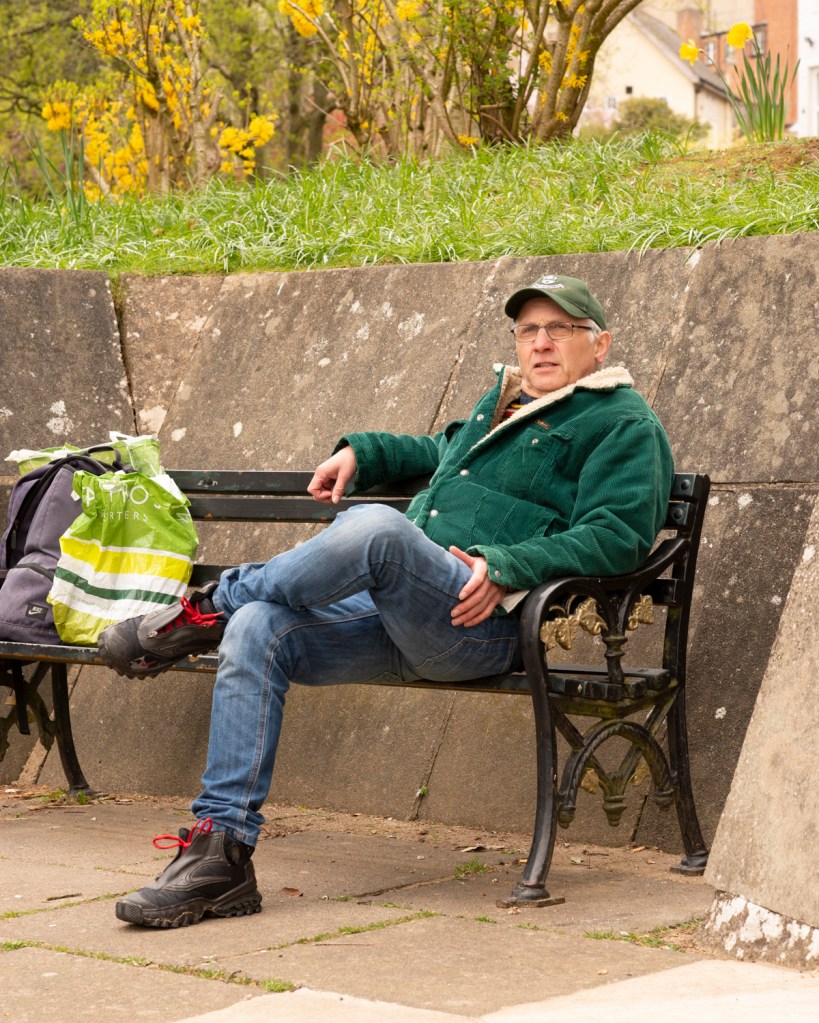
Steve

“I thought you might get around to asking me…either that or you wanted to borrow some money”

Steve has only recently started visiting the park as a change from sitting on a bench in the town centre. His routine includes buying his morning coffee and then transferring it into a rival chain’s reusable mug, which he hides in his carrier bag.

I met Steve when I sat on a nearby bench, elsewhere in the park, to drink my coffee. He was drinking out of a huge, battered reusable mug from one of the well-known café chains and delighted in telling me that he actually bought his coffee from a rival. We talked about everything from COVID vaccinations, camper vans and cricket (we are both huge fans) to music, photography and my studies. When it came to having his portrait taken, nearly an hour had passed. He chose this bench for the portrait as he felt it was a nicer background than where we were sitting.

Wendy

“I come to the park at the moment because I’m really pissed off…ooh, pardon my French”

Wendy drives to the park every day with her dog, Alf. She has a challenging job in social care and within the past few days has suffered a bereavement and one of her nephews having major heart surgery. The park gives her a chance to relax and talk to other people as she throws Alf’s ball for him to fetch.

I had said hello to Wendy and Alf a few times over the past weeks when I’d been photographing the wildlife. On this particular morning, she was very stressed about what had happened to her in the past 48 hours. What concerned her more, as she told me her story, was the need to apologise for her language which seemed the least important thing to me. We talked at length about the discomfort of asking to photograph a stranger in the current social climate. COVID and the recent fears over women and children’s safety had made people more concerned about being approached by people they don’t know in any context, but particularly when that person is carrying a camera. Wendy assured me that ‘I didn’t come across as a weirdo’, which I really appreciated.

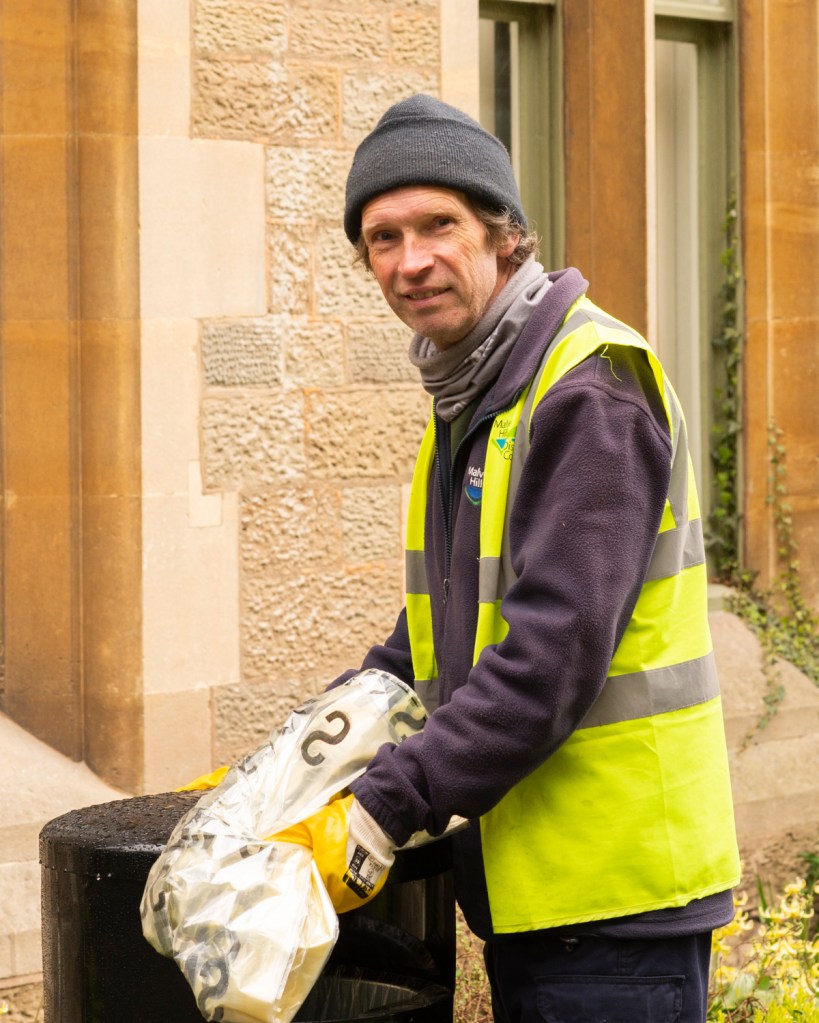
Les

“I feel sorry for these people who only have a concrete play park with those markings for games, you know like basketball or something – we are really lucky”

Les has worked for the Malvern Hills District Council for over 20 years and he loves his job. He takes great pride in how it helps keep the park looking good throughout the year. He’s very aware of how lucky we are to have such a beautiful green space.

I met Les as he was emptying the recycling bin next to my bench. In true British tradition we started to discuss the inclement weather and how much we were looking forward to emerging from lockdown. Les had seen me in the park before and asked if I had been lucky in photographing the resident kingfisher. I said that I hadn’t, but had been enjoying the other wildlife that could be more readily seen. When I described this assignment to him, he said that he could never do that. I initially mistook this for not wanting his photograph taken, but he was actually more than happy to help as long as he could continue on his rounds while we shot the picture.

Judith

“I like all my clothes to be colour coordinated… shame about this blessed mask. Shall I remove it?”

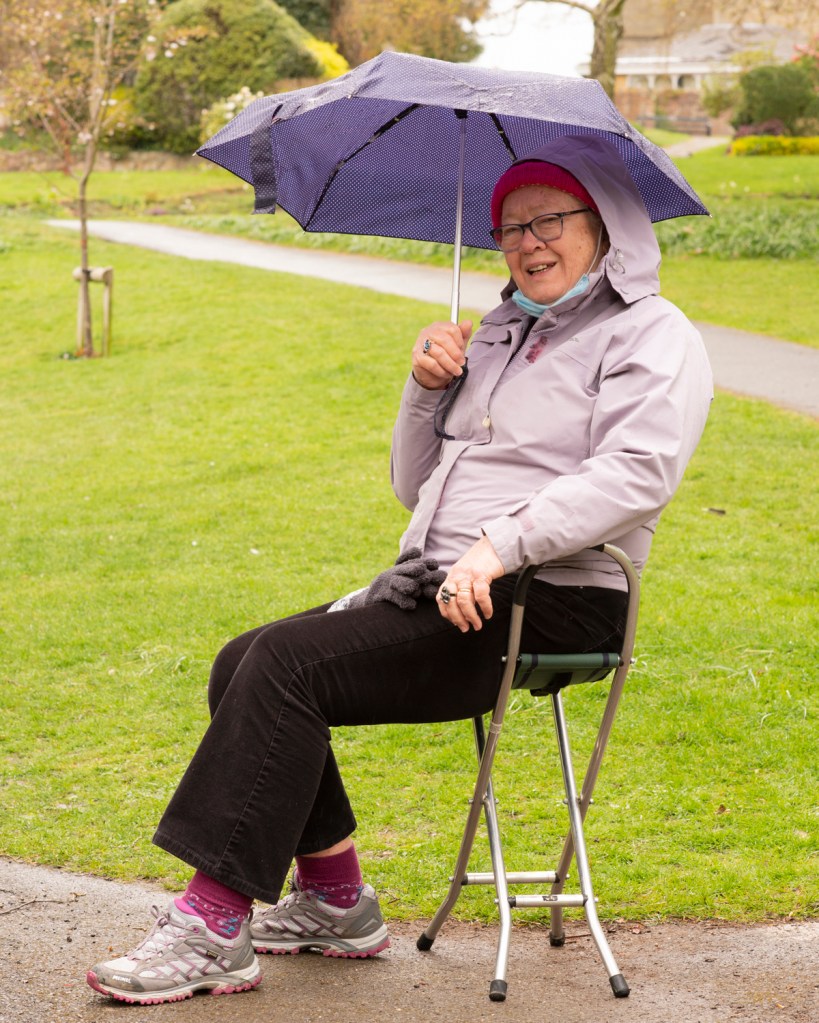
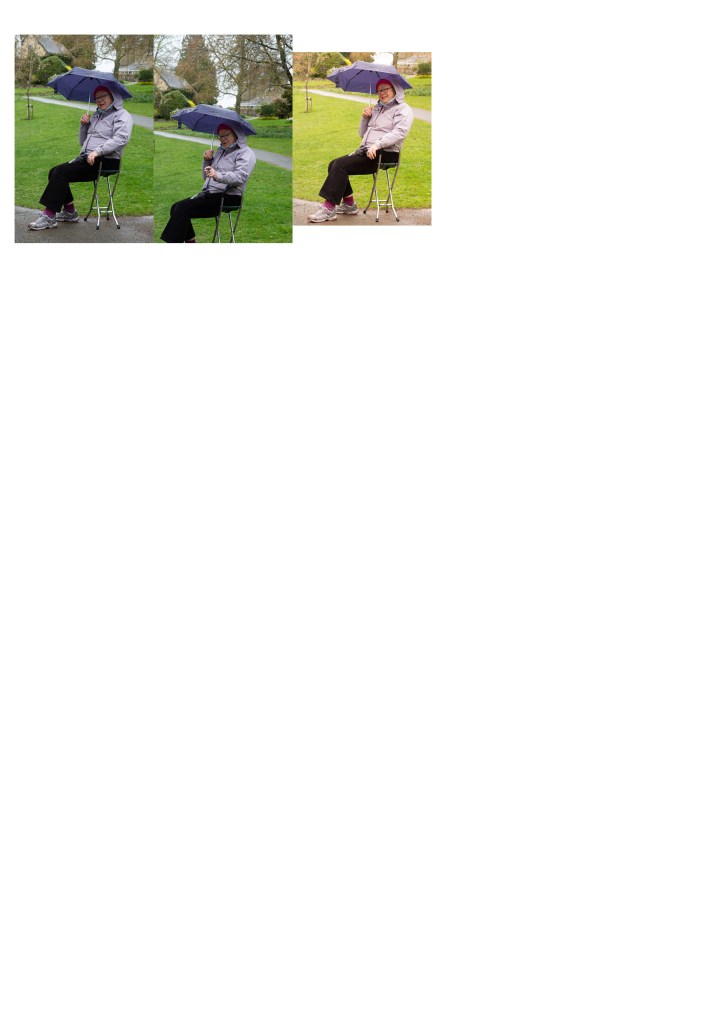
Judith retired to Malvern 5 years ago and lives in one of the smart new retirement developments near the park. She regularly walks around the park for fresh air and exercise, taking her shooting stool with her for when she wants to pause to take in the beauty of the scenery and its wildlife.

I met Judith when I was on my way home having shot what I thought were my 5 portraits. We started chatting about her ability to stop wherever she liked with her shooting stool. She moved to after over 50 year living in Somerset and said that she loved her new home. When we got around to discussing my assignment, she cheekily suggested how people might question my motives, acknowledging the difficulty in making an approach. For her shots, she played to the camera by shaking her finger at me in a mock outrage etc. I chose this one because it reflected her wonderful sense of humour and fashion without being too obvious. As we finished, she said “Might I know your name so I that may tell everyone about this when you are famous?”

The Rejected Image

To give myself some flexibility in assembling the series, I approached 6 people for their portraits during my time in the park. The sixth image was ultimately rejected because it was a group portrait. Until that point in the work, I was considering having mixed subjects, e.g couples, families, age groups etc, to be more reflective of the variety of people who visit the park. Malvern is a culturally diverse town, but for some reason I didn’t observe many people from those different cultures out walking or sitting in the park. This is something that could have multiple reasons, which I could explore further in other portraiture series in future. When it came to approaching families, I was extremely uncomfortable. There have been some fairly high profile cases of crimes against children in the county recently and I just felt approaching them was a step too far – this of course reflects more on my insecurities than it specifically being a bad idea. When it came to couples, they were the ones who rejected the approach, perhaps as one was more uncomfortable than the other which made ‘no’ an easier response. The shot I did get though, was an encounter with a group of ladies eating cake in the sunshine.

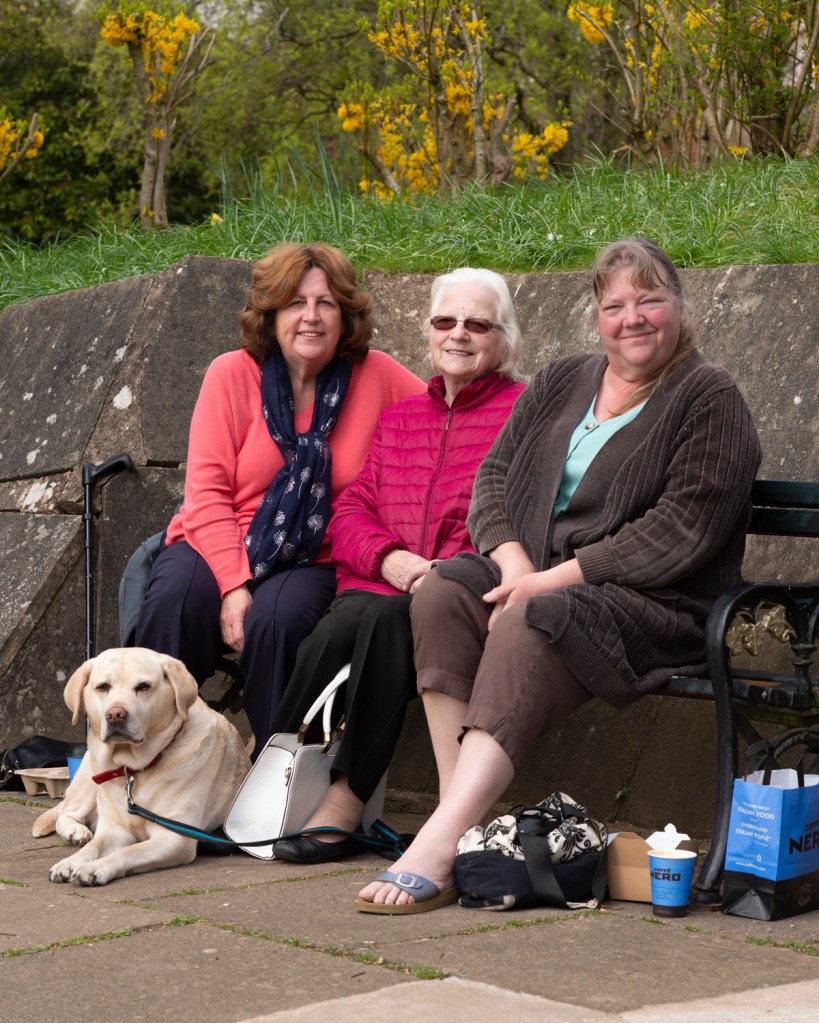
The Merry Widows

These ladies referred to themselves as The Merry Widows and were mother, daughter and close friend. They had been visiting the park to keep each other company, walk one of their many dogs (they were dog breeders) and each cake in the sunshine. I had a great conversation with them and they were the only people that volunteered to be part of this assignment without me actually asking them. I really liked this image as it had the contextual elements that supported happy ladies enjoying their treat in the park (their smiles, the bag and coffee mug being the main ones). The added bonus of the dog that sat patiently for the shot, reminded me of a portrait of my own family that I used in Exercise 4 [4]. Although I liked this shot, it didn’t fit with the rest of the series so was rejected in favour of Steve. Not only does the latter have a single subject, it also meant that I only had one shot at this same location within the park. Over the previous course units, I had learned the benefits of being self-critical and making tough edits, so this wasn’t really an issue for me.

Reflection

This assignment has undoubtedly been difficult because of the reasons mentioned previously. The most stressful part of the experience was finding an entry into a conversation with someone, however this wasn’t as bad as I had imagined. As suggested by Coburn, the establishment of some form of relationship is crucial to setting the tone of the resulting portrait. I have learned that this is also crucial in reducing any internal tensions that photographer and subject may have that are not necessarily obvious at the outset. With Janet for example, she may have been nervous about the approaching man in a fairly deserted park first, then anxious about where our conversation started to lead. By encouraging her to tell her story, almost in a ‘chat show host’ style, we both started to relax. At one point I told her that she was much more photogenic than she might have thought, to which she replied “you really know how to say the right things, don’t you?” with a big smile on her face. In the portrait that resulted, Janet’s discomfort at posing for the camera can still be seen, but it is combined with a wistful half smile which leads the viewer to ask what she is actually thinking about. When paired with the accompanying text, we see a woman who has a lot to deal with, but takes these moments in the park to seek some peace. Janet was the first person I approached and hers is my favourite of the series because I believe I’ve represented her both physically, but also how she came across emotionally.

With the others, our conversations varied in length from the 5 minutes or so chatting to Les as he worked, to the hour with Steve. In each case, I looked for something that described them but also their experience at the time I asked them to be my subject. This part of the assignment was the most rewarding as I felt that I had met some really interesting people who shared my passion for the park, but like me also used it to escape their complex, challenging lives. When we set the series agains the context of the national lockdown, the relationships between the subjects, the park and me take on a sense of ‘thanks for noticing me’. That sense comes through strongly with Judith and Les, the former because where she was sitting was blocking a footpath which would have been potentially been merely a nuisance to other people. With the latter, though there is a feeling that Les is almost invisible to other park users as it is his place of work. On reflection, I would have liked more background context with Les’s portrait his ‘props’ work well with his expression to represent the pride he has in his job which makes up for that.

When I consider my initial thoughts on this assignment right at the beginning of Part 1, I am surprised at the outcome. I didn’t take an easy route like advertising that I needed help or using interesting-looking cameras to lure people to me. Instead, I just showed some interest in them and introduced the idea of being photographed when we were both comfortable. On reflection, this was always the best way to approach this and I am happy to have conquered my anxieties about adopting it.

Against the Assessment Criteria

Demonstration of Technical and Visual Skills

All of the images are correctly exposed, sharp and the subjects are isolated from their background through the use of the lens focal length and aperture. Visually they all have good contrast between highlight and shadow, although the shot of Wendy had very challenging lighting conditions. The adjustments in post have reduced the high contrast on her face, but I would have preferred it to have been overcast. Each portrait includes background context that suggests a park and contextual links or props that support the context that is added by the supporting text.

Quality of Outcome

The series is presented in chronological order because that suited evolution of the assignment, starting with my initially awkward encounter with Janet and concluding with my very relaxed time with Judith. I believe the engagement between photographer and subject comes through in each photograph, particularly because I asked them not to adopt a what they might consider to be a traditional pose for me. It comes through most strongly in ‘Les’ and ‘Wendy’, both of which were shot as they were doing a specific activity. I asked them to carry on as normal and only got them to look at the camera when I saw the moment I wanted to capture. With Judith and Steve, I continued our conversation and shot them when I saw a moment that best represented our encounter. In terms of balance of subject selection, I tried to include both sexes as well as varying the age group where possible. The challenge here was that during a working week, the majority of visitors to the park are retired which resulted in all of them being older than me.

Demonstration of Creativity

I believe the series works in terms of revealing the people of the park in my town. Each story is different and by including a quotation and short commentary from each subject, I believe the personal connection between them and I is stronger. Each shot has different views of the park, from the bridge over the lake (Janet) to the elegant Victorian building that serves as the council offices (Les). Although I controlled the background and composition, I left the expression to the subject but prompted reactions from them by continuing our conversations. I believe this makes each as natural as possible. Finally, as I shot the series over 3 days, I was able to shoot under a variety of light conditions, weather and temperature which meant that each portrait has a different feel to it, despite them being shot in the same environment.

Context

I was heavily influenced by series Double Take[2] and the work of Sander[3] for this series. I set out to look for subtle changes in the expressions of the subjects by reading their reaction to our conversation, much like a studio portrait photographer would do. In Double Take, I was drawn to the way that the original photographer Keith Medley, shot two images per plate which elicited changes in the sitter during the process. The way that some shots were subsequently defaced because of some technical issue makes those differences intriguing when we look beyond the damage. In my case, I didn’t make many technical mistakes but still wanted to ‘watch and shoot’ rather than simply set up something static; I believe this comes through in the photographs. With Sander’s use of props and background, I was inspired to include just enough to ask questions about the subject and then add context with the inclusion of the few lines of their story and the quote. Sander caused me to think carefully about what to include and what to leave out. For example, I wanted to include the dog lead around Wendy’s neck because it contrasted with the other context of Alf being off the lead and ‘controlled’ by her having his ball. This creates a sense that the park is a place where dogs can run freely and that Wendy didn’t really need to use the lead. With Les there was plenty of context to suggest that he emptied the bins, but that isn’t his only job. The composition contains the obvious bin references but the inclusion of his MHDC fleece jacket suggests that he is not limited to this kind of work. With Steve, I had the story of his mug and how hid it in the bag and I wanted to avoid any really obvious context, such as asking him to hold the mug, that supported that narrative. The inclusion of the carrier bag coupled with Steve’s relaxed, inclined posture creates the narrative that here is a man who’s gotten away with something.

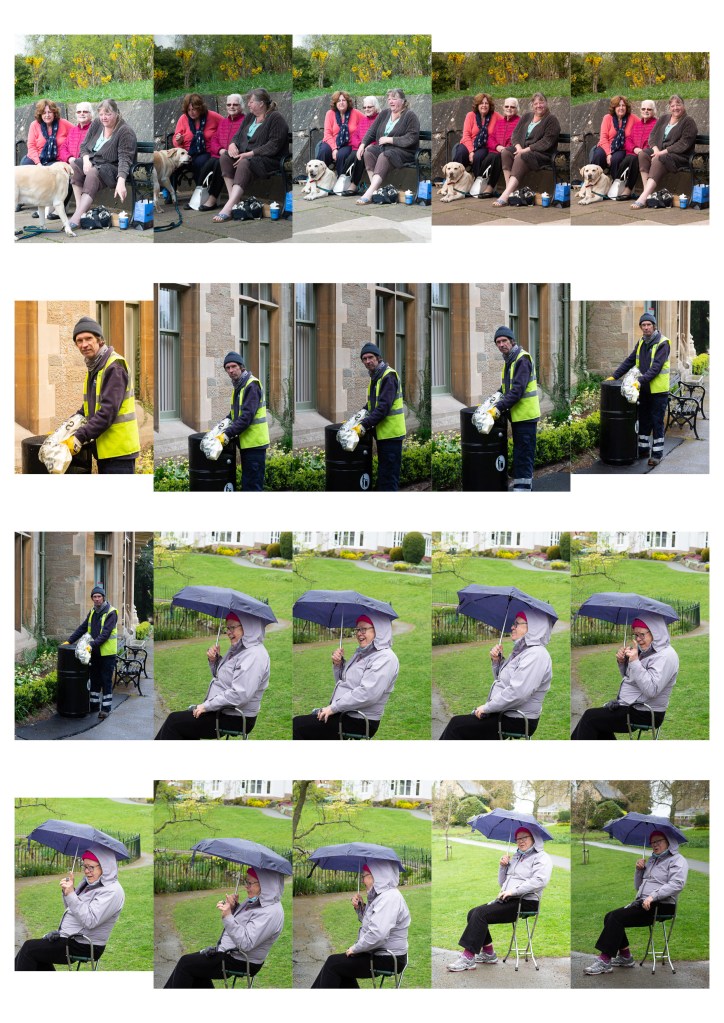
Contact Sheets

References

[1] Fletcher R, 2021, “Initial Meeting with My Tutor”, OCA Blog Post, https://richardfletcherphotography.photo.blog/2021/02/16/initial-meeting-with-my-tutor/

[2] Fletcher R, 2021, “Project 3 – Portraiture and the Archive”, OCA Blog Post, https://richardfletcherphotography.photo.blog/2021/04/10/1-project-3-portraiture-and-the-archive/

[3] Fletcher R, 2021, “Exercise 2: Background as Context”, OCA Blog Post, https://richardfletcherphotography.photo.blog/2021/03/16/1-exercise-2-background-as-context/

[4] Fletcher R, 2021, “Exercise 4 – Archival Intervention”, OCA Blog Post, https://richardfletcherphotography.photo.blog/2021/04/05/1-exercise-4-archival-intervention/

Post Assignment 5 Feedback

Introduction

I have just received the feedback from my tutor for Assignment 5: Making it Up. Overall, the assignment was very well received, with the comments that my single fabricated image both met the brief and was a well thought out, original piece of work. My approach of gaining the feedback of others was highlighted again as in Assignment 3. I had felt that to be the most effective way of testing whether my intent had come through in the image, even though I had also hoped for variety in the narratives that were being created. The feedback contained two areas for consideration, directed more at the next part of the degree than as changes to my assignment submission. I will explore those points here.

Feedback

“You’ve clearly thought quite deeply about this assignment and have documented your thought process is very well. You may want to however cite another photographer who also work with archival family photography as a way to contextualise the work you’ve done. I’d recommend perhaps here looking at the work of Nicky Bird here perhaps, who also uses archival family photography to think about place class and culture.”

Assignment 5 feedback, January 2021

This was interesting feedback for two reasons. The first being that we looked at Nicky Bird’s work Questions for the Seller in Part 5[1] where she purchased collections of photographs that nobody was interested in from eBay. She created an archive of family stories by including the answers to some questions that she posed to the sellers before making the purchases. In some cases, the stories were powerful which invoked the sense of sadness that the photographs were no longer needed, and in others the scant information pointed to the stories being lost. Bird curated the collection as a set of lots that had internal connections of their own but also related to the other groups of photographs in the overall archive. Eventually, Bird sold the photographs in an auction of her own at the gallery where they were being displayed. Her creation of a transient archive being broken up and passed on to the next generation of people who might appreciate the images, struck a chord with me. Historical stories are built from knowledge of events and added to as they continue to be told, but we are merely playing a part in them for a brief moment in time. The reference to Bird in the feedback made me think about the image that I had created and how it is essentially my own version of Jayne’s family history, that could be included in a family archive. I hadn’t previously made the link between the documentary nature of the pictures of her grandfather and father and my version of reality in Sanctum. If they were all stored together as part of an archive, anyone looking at them many years from now might miss the fact that the later image isn’t ‘true’. Therefore, for a brief moment, I have essentially subverted Jayne’s family history by creating a work that steers the viewer towards a certain tale of her grief and love for these two men. We’re not talking about chaos theory here, though; the ‘truth’ that my story tells isn’t that far from reality, it’s just another way of looking at grandfathers, fathers and daughters.

The second reason that this feedback interested me is because of my own situation described in my post reflecting on Photography 1 so far [2]. I have recently left my job as an Engineering Manager to pursue other interests aligned with my studies. One of the tasks that I’ve set myself in the coming year is to curate an archive from the thousands of photographs and slides that I was given by my father a few years ago. My work on Context and Narrative this year has led me to reconsider how I would approach this task. Instead of simply creating a volume that can be accessed by my family for their own purposes, I intend to tell the story of my family through it. I intend to take the work of Bird as well as Bloomberg & Chanarin[3] as inspiration for my archive in order to create my own original work from what is essentially box-loads of disparate images. I will be including this project later in blog when complete.

|”What I would recommend is thinking about this: for your image to work most successfully, I think it should in some way be accompanied by the two archival images that inform it – as it’s these three images together that create the enduring message about repetition memory family inheritance and belonging. Somehow these three images must be brought together to tell this one story. It did occur to me looking at your original image of your wife (in other words the image that you choose to make your shooting notes on – the image of her shot in daylight in the greenhouse) that if you’d printed this image out and then nested it into a clear folder with the other two photographs – a series of three found images photographed together would also made for a very successful piece of work.”

Assignment 5 feedback, January 2021

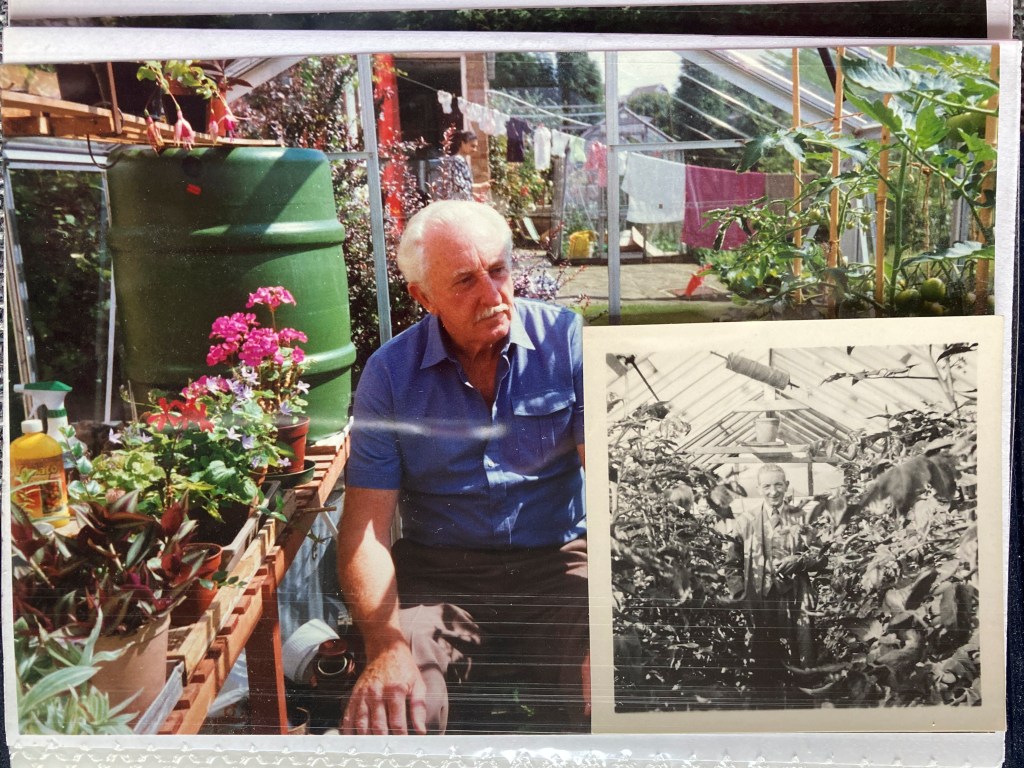
This comment interested me because of how the sight of the two original images together had made me feel when I found them [4]. Bryan had clearly seen the connection between the photograph of his father and the one that he had taken in his greenhouse. The result was to keep them together in an album that would go unseen for several years until I went through it, looking for inspiration. The idea of incorporating them together with this memory and realisation about the album’s hidden history gave me an idea for further version.

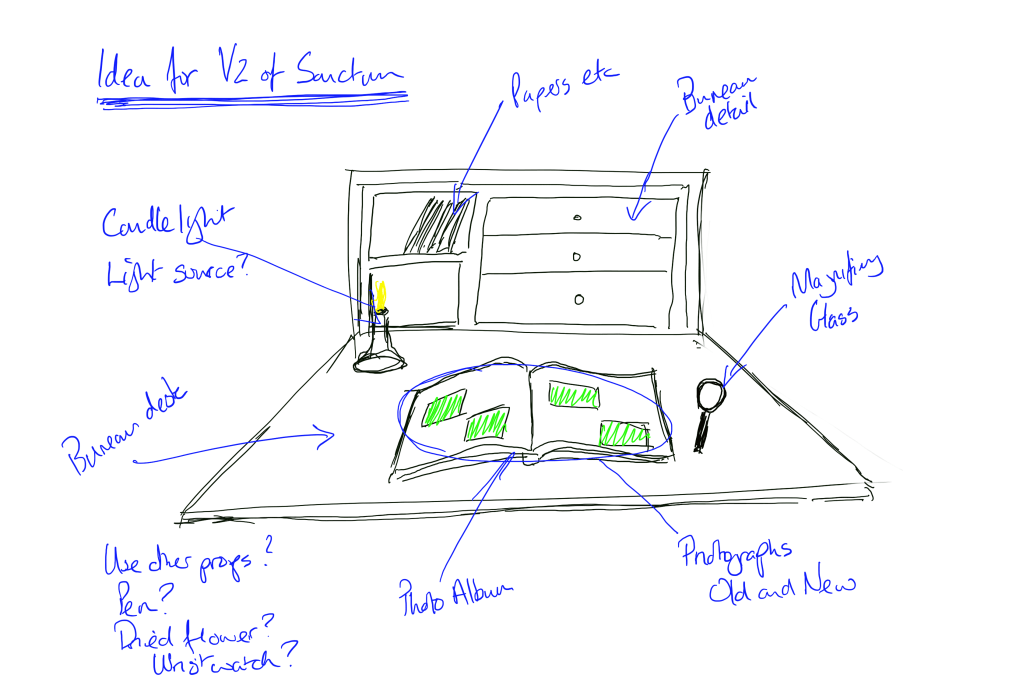
Jayne’s parents house has a number of classical pieces of furniture, some of which were made by her father (a woodwork craftsman and teacher by profession). One of the pieces is a large bureau where he kept all of his important documents and stationery. During the time that I knew Bryan, he kept the bureau private and rarely, if ever left it open long enough to see what was inside.

In this scene, the photographs that I found are included with the shots that I took for Assignment 5 in a vintage photo album. The album is set in its own fabricated image using the bureau as the set. The intent is to tell the story of the discovery of the photographs in the context of a family archive, with the new image Sanctum being part of the archive. Effectively this would add a layer of fabrication with the juxtaposition of new and old within a further constructed narrative.

Conclusion

I was delighted that my Assignment 5 submission was so well received. I pointed out on the call that I had enjoyed the creative process immensely as it gave me an escape from the difficulties I was experiencing at work at that time. The role of director was fun, with everything from the challenges of dressing the set with only what I wanted to include, to keeping the rain off my studio strobes during the setup. I was pleased with the feedback that has pushed my thinking around family stories and believable fabricated images still further; this has been the most interesting assignment of the course so far.

References

[1] Fletcher R, 2020, “5) Exercise 2: Re-situated Art”, OCA Blog Post, https://richardfletcherphotography.photo.blog/2020/12/20/5-exercise-2-re-situated-art/

[2] Fletcher R, 2020, “Reflecting on Photography 1 – how things have changed so far”, OCA Blog Post, https://richardfletcherphotography.photo.blog/2020/12/27/reflecting-on-photography-1-how-things-have-changed-so-far/

[3] Fletcher R, 2020, “Project 2: The Archive”, OCA Blog Post, https://richardfletcherphotography.photo.blog/2020/12/20/project-2-the-archive/

[4] Fletcher R, 2020, “Assignment 5: Making it Up”, OCA Blog Post, https://richardfletcherphotography.photo.blog/2020/12/24/assignment-5-making-it-up/

Assignment 5: Making it up

The Brief

Construct a stand-alone image of your choice. Alternatively, you may choose to make a series, elaborating on the same theme.

As the culminating assignment for the course you may wish to draw upon skills learned from Parts One to Four – using various forms of narrative, using yourself as subject matter, telling stories and reading images. The only stipulation is that you produce work that has been controlled and directed by you for a specific purpose. Remember to create a story with a specific context like the artists you’ve looked at in Part Five. This means that you need to have an artistic intention, so a good place to start would be to write down some ideas. This could then be form the basis of the 300-introduction to the proceed. You may find it helpful to draw storyboards to help you visualise your ideas. 

The aim of this assignment is to use props, costumes, models, location, lighting etc. to contribute to the overall meaning of the image (Use flash/lights if required but available light is fine as long as it is considered)

If the narrative is set in a different era then the elements fo the image must reflect this. Also consider the symbolic meanings of the objects and try not to be too literal in your approach. For example, don’t automatically use red shoes in a love scent but try to be subtle in your ideas to obtain a more true-to-life scenario.

For this final assignment, you should also include an illustrated evaluation of the process you went through to produce your final image(s). Include snapshots of setting up the work and write about how you felt your direction went, how you found the location, props etc. How did this process affect the final outcome? Write around 1000 words (including your 300-word introduction).

Introduction

For this assignment, I wanted to tell a story in a single picture in a way inspired by the works of Jeff Wall, Gregory Crewdson and Philip-lorca diCorcia. My initial idea was to tell a story about my wife and her family which in recent years was just her and her parents. I started by looking through the family photograph albums for inspiration; the first thoughts were about Jayne and her father, whose relationship had been close but difficult during her teenage years. Although there was a strong physical likeness and shared traits such as their sense of humour, they had different goals in life and different interests. During the search through the albums, I discovered the following pair of photographs stored as a pair in the same sleeve.

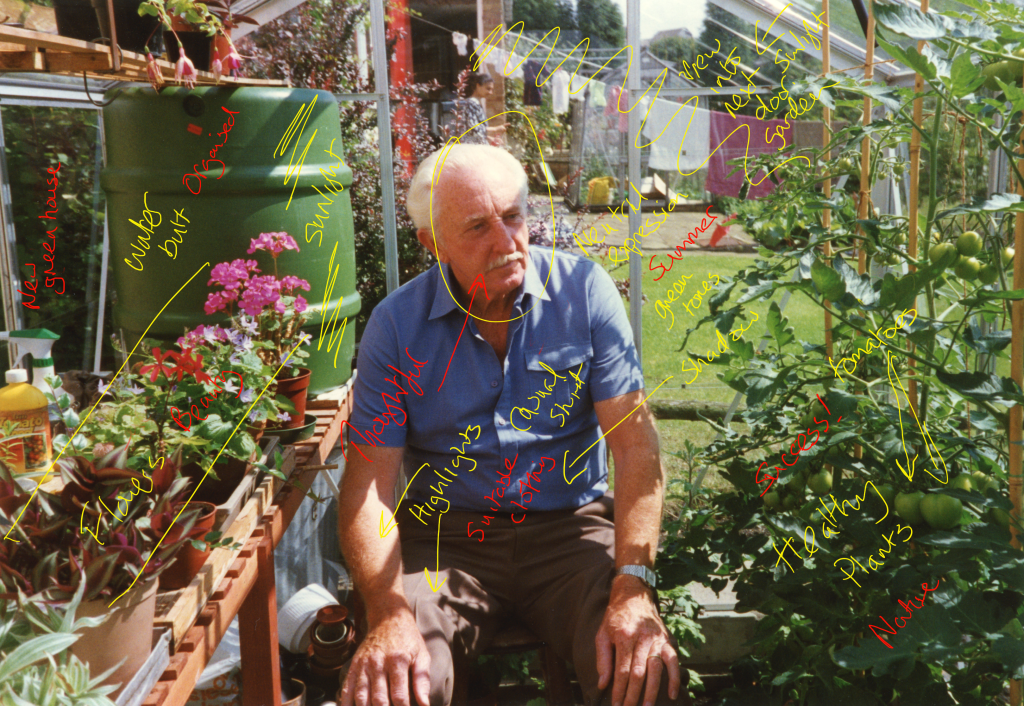
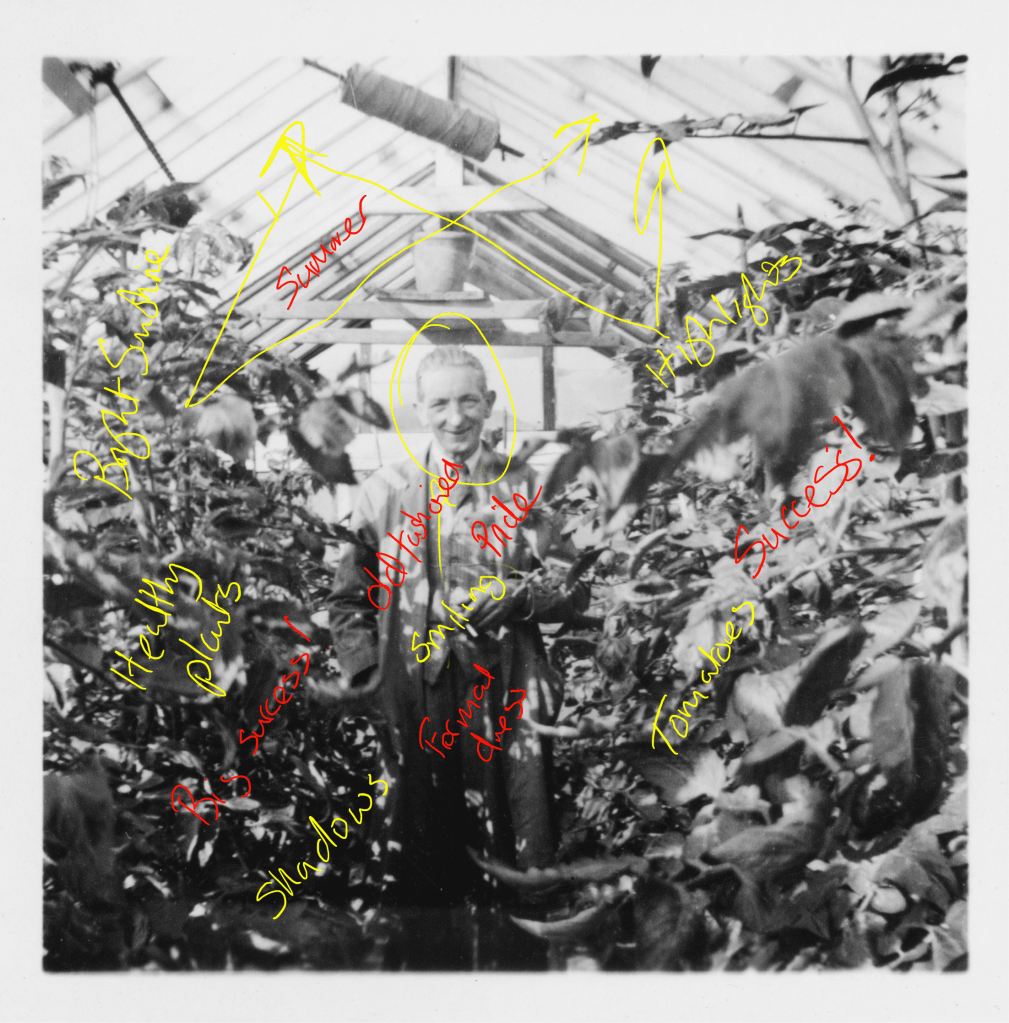
Main image: Jayne’s father Bryan in his greenhouse (c1990s). Inset: Jayne’s grandfather Johnny in his greenhouse (date Unknown)

These photos depicted Jayne’s father and grandfather, both keen gardeners in their retirement, in their greenhouses. Both men are shown surrounded by the fruits of their labours and both have a sense of pride about their expression. The way that they were stored in the album interested me as perhaps Bryan had recognised this similarity when he put them together. It was when I realised that Bryan’s greenhouse was still in the garden, albeit in a state of decay that I had the idea to use it as a set with Jayne as the central focus of the shot. My idea was framed around the idea that the tradition of gardening had passed between generations and that it had ended with Jayne (who has little or no interest in gardening). I planned too recreate the image of Bryan in a way that highlighted their likeness but also this difference in the direction of their lives. I started to storyboard my original intention in a blog post called “Preparing for Assignment 5″[1]. However, during a brief discussion with my tutor during a feedback session for Assignment 4, I was encouraged to sharpen up the story as it felt a little too vague to be told in a single photograph.

The Story

In re-examining my idea, I asked myself what it was about discovering these two photographs that had interested me and how it made me feel. The answer was that I could imagine Bryan’s reaction to discovering the picture of his father and carefully adding it to one of his own. He was a nostalgic man, so I believed that this gave him a great deal of pleasure as he remembered his Dad. When I realised that we could still go to the greenhouse where the photograph was taken, I had that same feeling of connection and nostalgia. These two reactions were actually more powerful than my original idea to highlight the differences between the two men.

The story was now about grandfathers, fathers and daughters and in particular the strength of the emotion around finding some tangible link with the forgotten past in what is left behind.

The Storyboard

The concept of putting Jayne in the greenhouse was still valid for the revised idea. I wanted to picture her in a similar pose to Bryan but with contextual elements that lent themselves to a different narrative than being a reproduction of the original photograph. I started with one of the test shots I took when I first looked at the location[1]

Storyboard with the first ideas of prop placement, lighting and the model

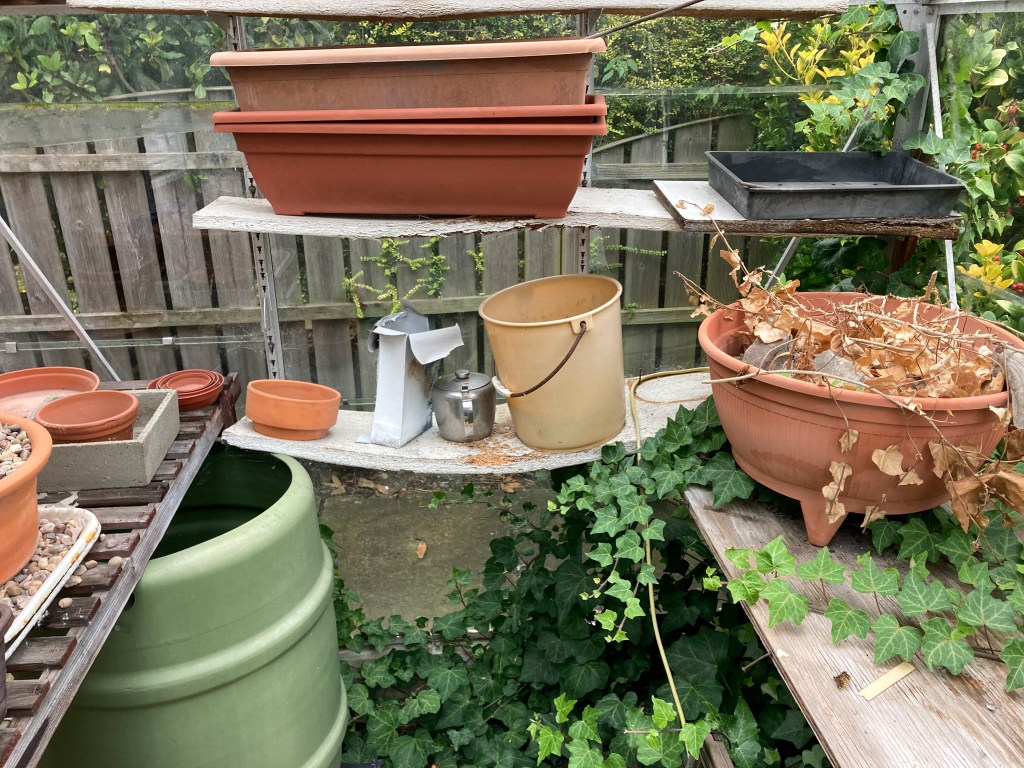
I needed a way of incorporating the image of Jayne’s father and grandfather into the shot. I considered scattering the picture of her father among other photos from the album on the table on the right hand side of the frame. The picture of her grandfather at only a couple of inches square would be too small to see in any composition, so I thought about projecting it using the same system I used for Assignment 3[2]. The set itself would contain more subtle links to the past through the use of items from the derelict greenhouse. These items includes ceramic pots with gravel but no plants, pots with dead plants in them, rusty tools and rotting bamboo canes. There was also a chalkboard on which Bryan kept notes of his plantings, which could contain some other obscure visual references. For Jayne I wanted her clothing to be utilitarian but not obviously garden wear. The final details would be how she interacted with the space and props. I was going experiment during the shoot to try to capture a sense of affection for her past, sadness at the loss and contemplation of the peace of the space.

Shooting the Photograph

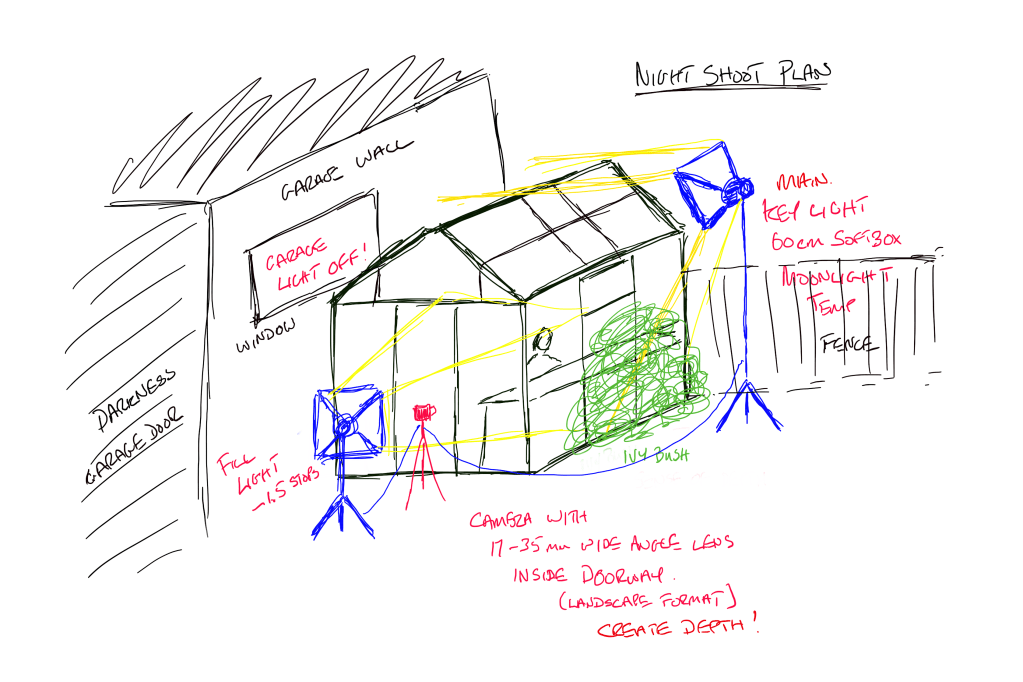
I started by clearing the interior of the greenhouse to leave just the benches and shelving in place. The camera and lighting were set up as in the sketch below.

Shoot sketch showing the lighting arrangement, camera position etc.

I used studio strobes with 60cm square soft boxes. The key light provided the effect of moonlight streaming through the glass and ivy of the greenhouse and would light Jayne from the front in pose. The fill light was positioned square on to reduce the harsh shadows forming on Jayne and also to light the objects along the left hand side of the space. The camera was fitted with a wide angle lens to create a sense of depth in the scene; the lens aperture was set to f/13 to make as much of the scene’s depth as sharp as possible. Two photographs were taken. The first was with no lights and the projector unit (hidden in the scene behind a plant pot) throwing the picture of Jayne’s grandfather onto the chalkboard at the back of the space. The second shot had no projection but used both strobes to light the rest of the scene. The two images were then blended together in post-processing to create the overall ethereal feel of her grandfather being part of the present day scene.

The Photograph: “Sanctum”

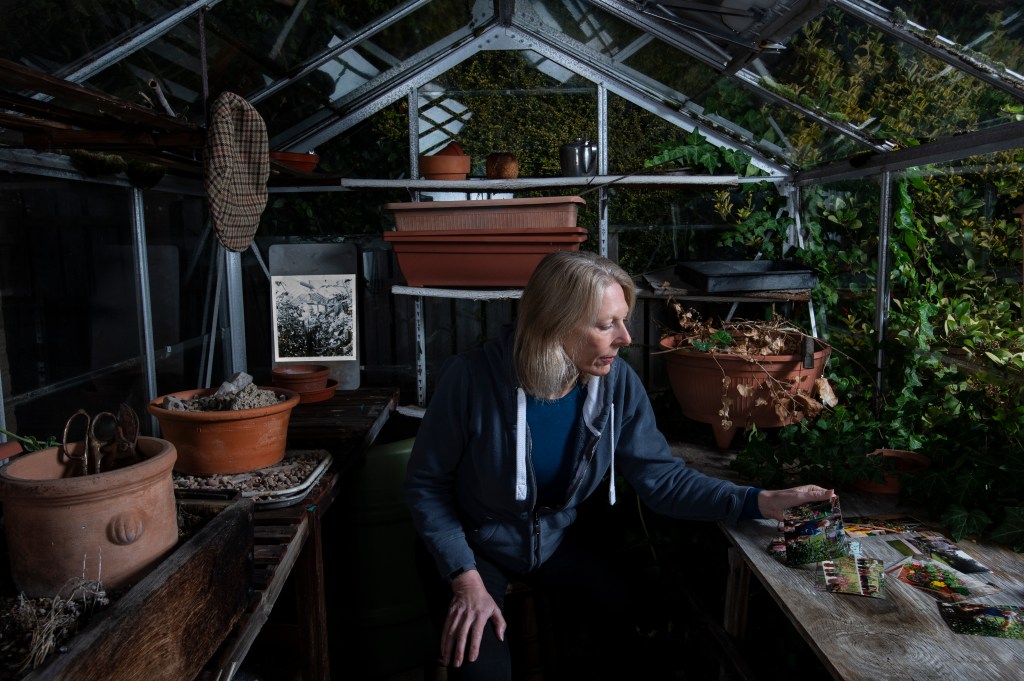
Sanctum (2020)

The final processed photograph can be seen above. For the title, I wanted to sum up my intent for the image while not wanting to lead the viewer to a conclusion. I settled on Sanctum because it is defined as “a private place or room where someone is never interrupted”[3]

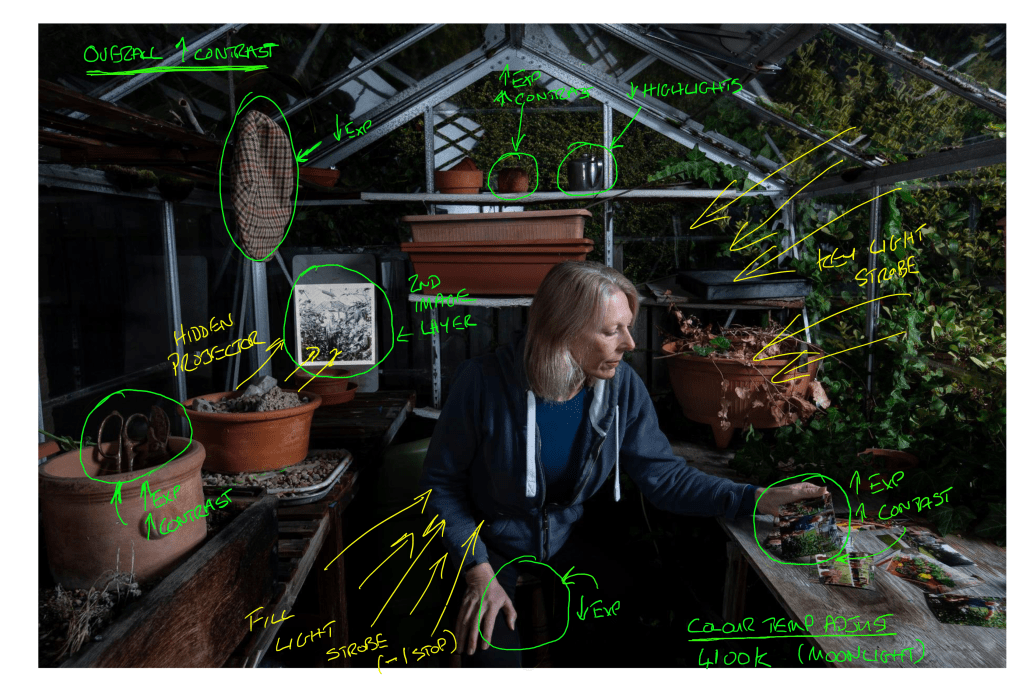
The post processing done to achieve this final version is shown in the annotations below. Along with the layering of the two shots taken, the white balance was set to replicate moonlight at 4100k and selective edits were made to elements in the frame to increase their impact.

Annotated version showing the edits made in post processing

Reaction and Reflection

As with previous assignments, I decided to share this photograph with a number of my friends to get a feel for the narratives they would naturally create from it. I asked for feedback via social media and had 18 responses from people, some of whom knew Jayne well and some who had never met her. I collated the responses in a separate blog post [4] but the key narrative points are discussed here.

In all of the responses, there was a deep personal connection identified between Jayne, the photograph she is holding and her surroundings. Some saw that it was her father and recognised that the greenhouse was once his. Jayne’s expression and posture were read by many as fondness, sadness and longing, while some saw her as mourning the death of her father despite there not being any clear references to his loss 4 years ago. This was a narrative created by people who didn’t know Jayne or anything about her family, so I assumed the contextual elements of his old cap, the dead plants and neglected greenhouse all served to trigger that response in those viewers. Memory and the desire to revisit somewhere that held special significance also came through in the different narratives with most people seeing this as a special place for Jayne.

I found the reactions to the picture fascinating. In reality, the greenhouse isn’t a particularly relevant place to Jayne (I’m not sure she has been in there for many years, even when her father was alive). The state of the building and it’s contents tell a story on their own of neglect, but putting Jayne in the same place as her father and her grandfather watching on, somehow created the sense that this is a place that joins the three of them together in a way that is very private and intimate. The reaction that interested me the most was the contemplative sense of mourning, which is very real for Jayne in other regards but not in this context. One of my friends told me that the photograph made him cry – he related to the sadness in some way that I didn’t push him to explain, but I guess must be related to his own emotional state in some way. Others who responded also said that they could relate to the strong emotion of the image without that relationship being to do with the subject, elements or composition.

Overall, I am delighted with the way that the image was received by everyone. Far from being a validation of my intent, it signalled that this particular piece of work had the power to provoke some strong emotions in a variety of people. The reactions did work in conjunction with my intent for the picture, which as diCorcia said was the responsibility of the artist; to give enough to help with the viewer’s journey but not complete it. The development and shooting of the picture was a challenging, but rewarding experience for me, the latter being something I was completely comfortable with. Having a good idea for what the picture should look like and experimenting with the props and lighting were key to what I see as the success of the image. I had tried to incorporate elements that highlighted the differences between Jayne and her father, such as references to sport, feminism and professionalism. However, the problem was that even the most subtle elements distracted from my intention that this should be a love story rather than about rebellion or contrast. Eventually, I settled on fewer elements that would work in unison with the wonderfully natural greenhouse set. Although I didn’t rush the creative process, I was under some natural time pressure with new COVID-19 lockdown restrictions coming into force and my mother-in-law’s ambition to tidy the space and potentially even demolish it. For me, this felt like the sort of pressure that might be experienced by a film director with the time taken for the shoot having financial implications. One thought that occurred to me as an enhancement was to create a series of photographs along the theme of special places where emotions and memories are revealed. The creative process would then incorporate other ideas, emotions and storytelling, while maintaining the relationships between each image in the series. I have found working in tableau to be both interesting and challenging for this assignment, so this is something I plan to pursue in the future.

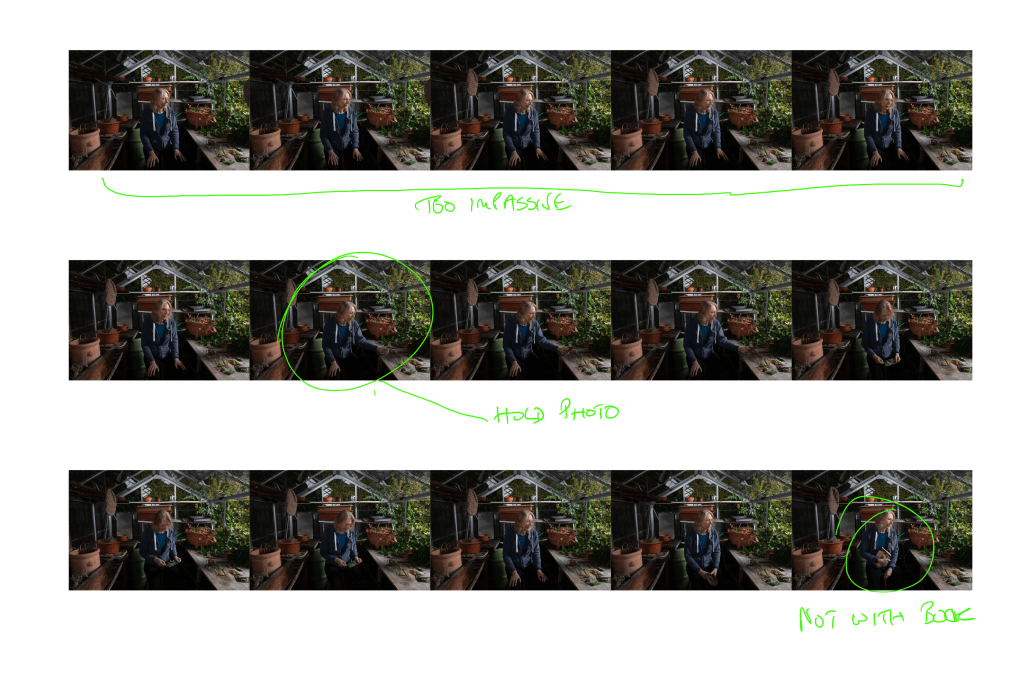
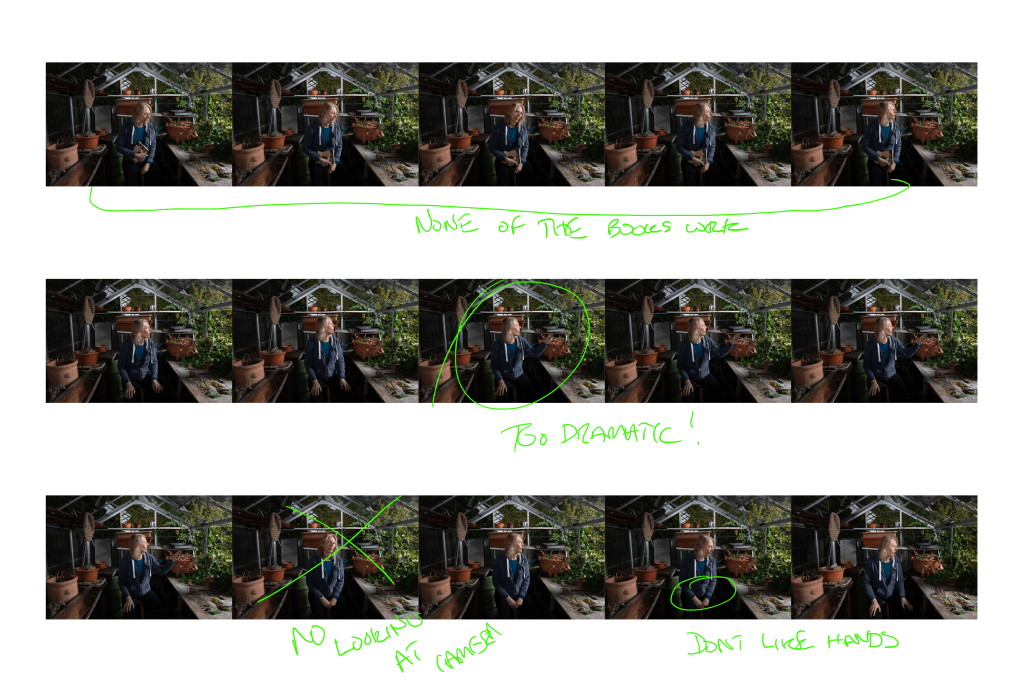
Contact Sheets

References

[1] Fletcher R, 2020, “Preparing for Assignment 5”, OCA Blog Post, https://richardfletcherphotography.photo.blog/2020/12/24/preparing-for-assignment-5/

[2] Fletcher R, 2020, “Assignment 3: Self Portraiture”, OCA Blog Post, https://richardfletcherphotography.photo.blog/2020/09/19/assignment-3-self-portraiture/

[3] Unknown, “Dictionary Definition: Sanctum”, Cambridge Dictionary website, https://dictionary.cambridge.org/dictionary/english/sanctum

[4] Fletcher R, 2020, “Responses to Assignment 5”, OCA Blog Post. https://richardfletcherphotography.photo.blog/2020/12/24/preparing-for-assignment-5/

Assignment 5: Viewer Responses

Introduction

This blog post contains the responses to a request that I made via social media, with a view to understanding the different narratives that could be created when looking at my photograph for Assignment 5[1]. As the people asked were a mix of mine and my wife’s friends, I wanted to establish some ground rules in order to avoid them specifically using any prior knowledge of her or her family in reading the image. At this point, I had also not told them what the title of the picture was.

The Request

Firstly, thank you for agreeing to help me with this. As always, it’s greatly appreciated. As I mentioned in my Facebook post, I have created a photograph for Assignment 5 of my current unit which has the theme of ‘the fabricated image’. What this means is that it’s a real photograph, but the scene is carefully constructed to tell a story in a single frame. This unit has been about context and narrative and how the former is incorporated through the work of the artist while the experiences and imagination of the viewer create the latter. The post-structuralist philosophers stated that the responsibility for the narrative lies very much with the viewer and that it was the job of the artist to leave just enough contextual interest to help them interpret what the work might mean.As I mentioned, there are no special skills or knowledge about the visual arts needed to be able to do what I’m asking of you. The job is to look at the photograph carefully (for say 5 to 10 mins) and consider what the meaning might be. There is no right or wrong answer.

There are some ground rules though:

1) Please look at the photograph on the largest screen possible. Other artists that create these sorts of pictures do so with large format cameras that result in huge prints. These prints show every detail very clearly. However, this is a picture from a 35mm camera which produces a much smaller picture, so you will probably need to zoom in and look around the frame to see the contextual elements.

2) Most of you will realise that the model is Jayne and some of you know her really well. Please try to disregard what you know about her (interests, personality, shared history etc) and keep your review to what you see in the frame. This is going to be difficult for some of you, but please try.

3) For the purposes of this review, I’m not interested in whether the picture is technically good or whether you like it or not. I’m just after what you think the story is. The story that you see will be shaped by your own life experiences and some things may resonate with you that don’t with others. That’s what I’m interested in, so if you want to point out any elements that you noticed that support your story, that would be great.

4)  Finally, please send me your review as a short paragraph of no more than 200 words privately via Messenger or to my email address. I don’t want stories to affect or inspire what other people see.

Thanks again for your help.

The Responses

“The lady – Jayne is sitting in a greenhouse, to me it’s her dad’s one.  The photos (at first I thought they were seeds) tell me that he was a keen gardener, and the Black and white one tells me her grandfather was too, The father became ill or infirm and the greenhouse was left untended and the garden became overgrown. I know it her Dad’s because his hat is hanging up. Sadly he has passed away and the house has been inherited by Jane, Jane has put some clothes on to sort the place out ready for sale. They are not old clothes though, which tells me she is not a diy or gardening type up to now. Jane is wrestling with whether she should restore the house and garden to its former glory and take on the family mantle of gardener or just move on. Her heart says do it, her head says get real.”

“I see a story of love, remembrance, loss and, perhaps regret. Remembrance of a loved one departed surrounded by things that that person held dear and hold importance to the memory of the departed for the sitter. For me, one item in the photo evoked memories of my father, sadly departed 32 years ago, and made me sad for both my mother and myself for the ‘lost years’.”

“In this emotive image I see a woman fondly reminiscing by looking at photographs in a place of personal importance.  The photographs are placed in a manner suggesting that they depict a special person. The greenhouse setting appears to be missing some of the life that was present when this special person was around. There are dead plants, rusty tools, empty pots and ivy creeping in indicating a lack of love and attention. She is surrounded by personal things which provoke memories and the image gives the impression that were a significant part of this special person’s life. The personal items and photographs indicate an older person who loved gardening and nature. Her posture and facial expression indicates that she is thinking of someone who was important to her and is trying to connect with this person. There is a clear difference in the depth of colour and shade as my vision scans from one side of the image to the other. Where the woman is sitting there is more light and colour which shows life and the present, which is further enhanced by the greenery outside. The other side is an image of darker shades and the past.I feel the woman in the photograph is seeking warmth and comfort by spending time alone in what look like her late fathers greenhouse. I’m guessing late father by the way she is deep in thought and lovingly looking at a photograph of an older man. His cap hangs from the green house frame, probably where he left it… She appears to look content with her thoughts, it’s clearly a place that gives her strong happy memories.”

“My first impression was of time travel, and going back in time. Perhaps that we were time travellers but arrived back too late to see again the owner of the greenhouse. Rather fanciful perhaps but I definitely felt that we were looking back to an earlier era when this greenhouse used to be full of lush plants lovingly tended.  The flat cap and picture were very moving and brought back memories of my own father who wore exactly the same cap and was also an enthusiastic gardener. He had a greenhouse very similar which was always full of plants those that over wintered and full of tomatoes in the summer. The empty pots and lack of plants emphasised the fact that the person was not with us anymore. The greenhouse was becoming overgrown with creepers and looked unloved. We/the person in the picture were looking at photos and remembering him with a mixture of emotions of love and sadness but also remembering happier times when they were part of our life.”

“Reflection.  The heart felt need to take the time to preserve, to capture in sharp focus, treasured memories of a love. A love not lost (it could never be lost),  but one which has been forced to move on.  The gathered artifacts help the memory focus and bring further memory senses; a smell, a touch, a smile, a tear. Memories of time spent together in perfect harmony; time, dealings and feelings shared.   Reflection –  a few moments to bask again in a glorious light which will slowly, but inevitably, fade.”

“A lady is sitting in a greenhouse that has fallen into disrepair probably following the death of the gardener. The lady is thinking about the gardener and judging by the look on her face he would have been someone close to her. She is clearly sad looking at his photograph remembering him, his love for gardening and the former glory of the greenhouse indicated in the photographs of previous harvests.  His cap hanging on the peg is poignant and suggest the owner was elderly maybe her father or grandfather, the tools in pot and the general tidiness of the greenhouse indicates that former gardener’s illness and ultimate demise was probably unexpected. The teapot on the shelf reinforces that feeling of unexpectedness and brings a sadness of its own. The missing panes of glass and the plant growth appearing through the broken window gives a timeline to his demise, not that long ago suggesting that this is the lady’s first visit since the demise of the gardener and the grief is still quite raw. The black and white photograph of the man, presumably the gardener behind the lady is strange. I understand the colour pictures that she has but the B&W left me wondering.”

“My thought is that Jayne is sitting in a greenhouse because it was once the happy place for her Father (or Grandfather) and that he has died, possibly some time ago. She is looking at photos of him and his garden as that was his great love and she is missing him so wants to be where they spent time together and she can feel close to him. It feels like it could be the anniversary of his death or his birthday, or he was perhaps ill for a while and neglected the greenhouse for some time.”

“I can relate to this totally, although whether this is your story or just a reflection of my own life I’m not sure. (When I visit the greenhouse at my late parents’ house there are dead plants in pots, a broken window, and vestiges of lives past.) So I’m leaning towards a similar photo-story here. The cap suggests it was the property of an older man, but there is no older man in the picture. This would have been a man whose hair was thinning; the cap used to keep the sun from burning his head or kept the cold draughts off in winter. He may have died or he may no longer be able to look after the place and has gone into a care home (I need to revisit the photo so see if this is answered by visual clues). The woman is the man’s daughter, or maybe even his wife. She looks contemplative, certainly not happy, but not sad either. She seems to be reconciling herself with reality and looking back at memories. The photos show the man’s garden when it (and the man) was in its prime. There are flowers and plants that probably started off from seeds and cuttings in this very greenhouse.”

“The lady in the picture has returned to her childhood home after the death of her last remaining parent. The greenhouse was the pride and joy of her father and he spent many happy hours here tending to his plants. Since his death no one has really been in there and his cap is still hanging where he always left it. She hasnot set foot in the place for a long time, but on finding some old photos of her dad she felt compelled to go and look at them in the place where he so loved to be. As a child she was constantly sent down the garden to find her father and tell him his dinner was ready or that someone needed to talk to him on the phone. That always made him grumpy at being disturbed. She could never understand the attraction of the place then , but now on her own with her memories it seemed the perfect place to remember.”

“Lost in memories but keeping them secret.”

“The person in the photo is having a moment of quiet reflection. She has chosen to sit in the greenhouse and look at pictures of someone that means a lot to her, and who has passed away. The greenhouse is somewhere that the person who passed away spent a lot of their time, and they were always happy here. She is surrounded by things that belonged to the person – the checked cap, the gardening tools – which all hold memories for her. She has sought the peaceful solace of the greenhouse to think about the person to whom the greenhouse belonged. This is someone she misses a great deal, but she finds comfort in the familiarity of her surroundings. She is grieving a loss, hence time spent in this special place is precious to her; it is healing, and it is cathartic. She feels the need to be here, to bring herself closer to the person she has lost. This place to her is a sanctuary, an oasis of calm in a busy, turbulent and sometimes chaotic world”

“I think the picture shows the end of a chapter in a man’s life, to whom the person (Jayne) in the photo was close. The end of the chapter could be that he has died, or that his health has deteriorated and the house is being sold. The plants growing through the glass to the right of the picture imply that the gentleman has not been able to pursue his gardening for some time. Everything in the greenhouse is well kept, and has a place and purpose, so he would have cut the shrubbery back if he was able. We know it was an older man’s domain, as the hat is a gentleman’s flat cap. The greenhouse has been a place where the gentleman has been happy and proud of his growing. This is shown by the gardening tools in the terracotta pot, they have been carefully returned to the pile in the pot. The teapot on the shelf reminded me of my granddad, who had specific containers for jobs in his greenhouse. I felt strongly that the teapot would be used for plant food! Jayne was close to this person and she is taking time to remember the times they shared in his greenhouse and the man who is no more. She is closing her personal life chapter and mourning it’s passing”

“The story that I see being told in the picture is of someone who is dealing with grief and the loss of a loved one. The person is sat in a place that was very special to the person she has lost and is looking through pictures that also reflect the past glory of the greenhouse. From the objects around the shot, you can see personal objects of the person who has passed, the scissors in the foreground are rusty and tell, alongside the missing panes of glass that the greenhouse has been allowed to fall into disrepair, it also indicates that that person passed a while ago, as does the plant in the far right background and again, ivy growing into the greenhouse through the missing panes reflect the neglect. The personal possessions in the greenhouse, the flat cap and the teapot are reminders of the person who once spent time in this place. It’s interesting to wonder the relationship between the person in the B&W picture and the person in the picture being held. Did the greenhouse get passed down from Father to son, does the state of disrepair reflect that the greenhouse is no longer needed or will be passed down and relocated?”

“The subject is not wearing gardening clothes and looks sad and thoughtful. She is viewing photos, some containing an elderly gentleman in a gardening setting. Together with the B&W photo this is clearly his shed and with the level of decay is shows he is no longer able to live there or, more likely alive. Some time has passed as scissors are rusty all pots are barren and vegetation outside is encroaching inside through broken panes. The B&W image further emphasises that the glory days were a long time ago. The cloth cap has not deteriorated the same as its surroundings and may have been placed there latterly as a homage. This is where the subject goes to feel a connection with the man in the photos. The setting helps the subject to reminisce in a location that was very important to the man and was the place where he was most happy” 

“It looks to me like a woman is taking some time away from the rest of the world to remember someone who’s passed away – my assumption is her father based on the pictures of an older gentleman. Based on the photos and the hat that’s hung, I believe the greenhouse that she’s in belonged to her father and it’s been kept and she visits due to its sentimental value. As there aren’t any plants flourishing and tools have rusted, I’d suggest that some time has passed since he’s gone. As she’s in the greenhouse at nighttime, I took that to mean she might be visiting in secret so she can be alone with her thoughts. Based on the fact there are photos there, I also took that to mean that there may be a frequency to her visits”

“There are two ‘angles’ for me. Firstly having worked in health and social care for much of my life I have seen and experienced loss and how it can impact different people in different ways. The second angle is more personal, being of the age now that we are, beginning to attend more funerals than weddings, I’ve experienced loss of friends and family and the associated grief quite a bit recently. As a keen gardener too I can appreciate the before and after state of the green house. So I don’t know Jane but if I were sitting there I would be grieving, this includes the sadness you’d expect but also filled with the happy memories of sharing that space with my relative in the picture on the wall. I have plans to do them proud and get the greenhouse back to it’s former glory. But for now I sit and remember happier times…”

“I see a lady sat down at a table that is in a greenhouse. She is staring at a selection of images of a gent and his plants. There is a hat hanging on the side that would have been worn by the gent in the pics. The greenhouse was his pride and joy, but he has been unable to make use of it recently due to his advanced years. Gardening was his hobby for a very long time. Competitions were not his thing, but anyone calling round would comment on the variety of plants and how they would like a garden like this. The glass is broken, the plants are intruding, nothing has been planted recently. The tools in the pot are rusting. The teapot on the shelf would have contained used teabags for use in the garden. She is reminiscing  about the times she would find him in there when she called round to see him. Unfortunately he has recently passed away and the house will be sold soon”

“In this emotive image I see a woman fondly reminiscing by looking at photographs in a place of personal importance.  The photographs are placed in a manner suggesting that they depict a special person. The greenhouse setting appears to be missing some of the life that was present when this special person was around. There are dead plants, rusty tools, empty pots and ivy creeping in indicating a lack of love and attention. She is surrounded by personal things which provoke memories and the image gives the impression that were a significant part of this special person’s life. The personal items and photographs indicate an older person who loved gardening and nature. Her posture and facial expression indicates that she is thinking of someone who was important to her and is trying to connect with this person. There is a clear difference in the depth of colour and shade as my vision scans from one side of the image to the other. Where the woman is sitting there is more light and colour which shows life and the present, which is further enhanced by the greenery outside. The other side is an image of darker shades and the past”

References

[1] Fletcher R, 2020, “Assignment 5: Making it Up”, OCA Blog Post, https://richardfletcherphotography.photo.blog/2020/12/24/assignment-5-making-it-up/

Preparing for Assignment 5

Introduction

Assignment 5 is the final piece for Context and Narrative and is the culmination of understanding how stories are told through photography in a variety of ways. We have looked at a number of photographers who have created linear stories within the documentary genre, as well as those who use metaphor to more subtly articulate their intent. In Part 3 we were introduced to narratives that could be created through the use of self-portraiture, whether literal or metaphorical. My submission for Assignment 3 was a significant departure from what I had done previously and as well as being outside of my comfort zone as a photographer, it was from this point in the course that I began to understand the concept of the ‘unrea’l image. Now, having completed Assignment 4 and working through Part 5, I am starting to form an idea about what to shoot for the final assignment.

The Brief

Construct a stand-alone image of your choice. Alternatively, you may choose to make a series, elaborating on the same theme.

As the culminating assignment for the course you may wish to draw upon skills learned from Parts One to Four – using various forms of narrative, using yourself as subject matter, telling stories and reading images. The only stipulation is that you produce work that has been controlled and directed by you for a specific purpose. Remember to create a story with a specific context like the artists you’ve looked at in Part Five. This means that you need to have an artistic intention, so a good place to start would be to write down some ideas. This could then be form the basis of the 300-introduction to the proceed. You may find it helpful to draw storyboards to help you visualise your ideas.

The aim of this assignment is to use props, costumes, models, location, lighting etc. to contribute to the overall meaning of the image (Use flash/lights if required but available light is fine as long as it is considered)

If the narrative is set in a different era then the elements fo the image must reflect this. Also consider the symbolic meanings of the objects and try not to be too literal in your approach. For example, don’t automatically use red shoes in a love scent but try to be subtle in your ideas to obtain a more true-to-life scenario.

For this final assignment, you should also include an illustrated evaluation of the process you went through to produce your final image(s). Include snapshots of setting up the work and write about how you felt your direction went, how you found the location, props etc. How did this process affect the final outcome? Write around 1000 words (including your 300-word introduction).

Initial Thoughts

I started by thinking about the research work done so far in this course and how it has changed my perspective on photography. Previously, I tended to work in the literal. My photographs almost signposted the viewer to my intended meaning. By Assignment 2 I was beginning to use metaphor more clearly, but I then started to struggle with not having a structured approach to my creative process. The result was a very stressful experiences of trying to force creativity to happen, looking for compositions to present themselves and being disappointed when they did not. Assignment 3 saw a more structured approach that allowed me more freedom to focus on what I wanted to express. Having the approach under control, I then started to focus on not overthinking what I was trying to say and to experiment with my subjects and compositions. Although Part 4 led to a written essay assignment rather than a photographic project, the analysis of the many layers of narrative within a single image was a core skill learned. This gave me a greater appreciation of all photographic art, whether singular images or as part of a collection. My thoughts at this point were that I wanted to create something that would stand up to a level of analysis. Instead of images that occur naturally, e.g. the decisive moments of street photography, the brief called for something ‘directed’ in the spirit of Wall, diCorcia or Crewdson. At the heart of the brief was the idea that the photograph or series needed to be ‘made up’, suggesting either an entire or partial fiction controlled by me as the artist. I had enjoyed Exercise 3[1] where we had to recreate a childhood memory as it allowed me to think laterally about the kinds of props that I could use to help tell the story. For this assignment, I would start with a story idea and then plan how I wanted to create the contextual elements using props. I’d then plan how to shoot the image from a compositional and technical perspective that would be an experience similar to that of a motion picture director.

Thinking about stories

In Part 3 I discovered how interesting a self-portrait series could be as a way of telling a story. My tutor’s feedback suggested that I think about whether I would consider using self-portraiture as part of my future work. This was my first thought but I quickly dismissed it for the simple reason that I’ve told bits of my story throughout EYV[2] and during this course; to be honest I was a little bored of my storytelling being about me. I wanted to tell a different story that still involved a person or people, however. The next thought was about my wife and her family. Jayne’s immediate family has always been small; when I first met her, all she had were her parents and an uncle. Although her father’s extended family is larger, the connections with them are fairly distant with them not really featuring in each others’ lives Her relationship with her father wasn’t always easy, although for the last years of his life it was more evident how close they actually were. I am reminded of him everyday, not just because my wife has his height and looks like him, but also because they share the same very dry sense of humour. Her mum is very different, both in stature and personality – in Jayne I see her phenomenal strength, kindness and capacity for empathy, something her father sometimes lacked. When I think about it, all families are like this but what struck me was the way that these likenesses and differences are accentuated when the family unit is small like theirs. My own family is considerably larger, so these subtle characteristics are spread more widely.

My conclusion from these initial thoughts was that I wanted to make my story about Jayne’s family in some way. Coincidentally, we were due to visit her mother so I took the opportunity to look through some of the family photo albums for inspiration. Like most families, there were many photo albums ranging from the beginning of the last century through to recent events. It was when looking through one of the albums, I found these pictures in a flip sleeve:

My father-in-law Bryan in his greenhouse, circa 1986 with a photo of his father in his greenhouse (date unknown)

This immediately got my attention. The main picture is of Bryan sitting in his greenhouse in the mid-1980s. He had just retired from teaching after a long and successful career and was indulging one of his passions that he hadn’t had time to do when he was working. What interested me was that Bryan had tucked a smaller photograph of his father in a similar situation into the same sleeve. Bryan had seemingly found the older print and related to its similarities to his own photo, electing to store them together. There was something deeply significant about this act as the album isn’t viewed often these days so the connection between the two photographs could be thought of as everlasting in some way. The actual similarities between the images in terms of composition and context were also striking – to explore this further, I deconstructed both images as I did in Exercise 3 and Assignment 4.

Annotated with formal elements (yellow) and potential meanings (red)

From the two images I could see some common elements. Both men are were the centre of the greenhouses and also the composition. They were both surrounded by the fruits of their labours, which were very healthy looking tomato plants. The photographs were both taken on sunny days with light streaming through the roof of the greenhouses. Both men were wearing the clothes of their era, Johnny in a formal three piece suit and Bryan in 1980s-casual wear. At first they seem at odds with each other, but from what I know of Johnny, he was a smartly-dressed man. So, while he may not have been necessarily dressed for working in the greenhouse as Bryan is, the picture feels spontaneous as if he is showing off what he’d grown.

In terms of themes, the key ones that were common to both pictures are:

Pride – in the achievement

Passion – for their hobby

Nature – wonder of the natural. The black and white even creates a sense of green by the dominance of the plants in the frame. The sun plays a big part in

Father to son – passing on the mantle and it being received

Hierarchy – Johnny has more than in his greenhouse than Bryan. Perhaps the passion isn’t as strong down the generations.

Order – both are neat and tidy spaces

What the deconstruction taught me about these photographs was that both men had a shared interest, likely passed on from father to son. They had the same approach and the same sense of pride in their efforts as amateur gardeners and rightly, given the success of what they had grown. When looking more closely, though both men adopt different poses. Johnny is looking straight at the camera with a beaming smile, but Bryan is not engaging with ‘the viewer’ at all. His shot was definitely posed and he clearly intended that the two images were kept together because of their strong similarities. So why the enigmatic expression? Bryan was certainly comfortable in front of the camera, but perhaps this was more about being surrounded by his plants rather than being about him. Or perhaps it just was that he was not exactly like his father. This got me thinking about what my story could be about.

My Idea

I decided to shoot a single photograph that captured the essence of how these two men came to record the same sentiments in two images separated by so much time. How Johnny passed his love of gardening to Bryan but how the resulting interest evolved through the differences between father and son. The added element would be the fact Bryan’s daughter has no interest in gardening; her passions went down a completely different route to both of them. I want to create a narrative about ‘inheritance’ through the generations and planned to weave the likeness and contrasts into the image, using metaphors and props that stand up to the kind of ‘reading’ that was the focus of Part 4.

Location

While looking at the greenhouse in the ‘Bryan’ photograph, I asked my mother-in-law where the picture was taken, naturally assuming it would be some previous house they had lived in. The answer was the same house she lives in now. The greenhouse still stood in the same place in the garden as in 1986. However, when Bryan became infirm towards the end of his life, the greenhouse wasn’t maintained and had fallen into disrepair. For me, this was a stroke of good fortune as it meant that I had a potential setting for my photograph. I took a series of contextual shots during that visit to capture the scene as it is now, including one of my wife sitting in the same position as Bryan.

The Greenhouse and Contents

The greenhouse contained many potential props, but their use would need careful planning to give enough of a sense of time passing without dominating the frame and potentially any narrative from the image.

Potential Perspectives

I took the following pictures to experiment with perspective – which angle and how much of the greenhouse would I include? I put Jayne in a similar position in the space as Bryan in his photograph. At this stage, this was just for a reference as I hadn’t yet decided on what to do with Jayne in my composition.

Looking at these test shots, the first thing I noticed was that I could easily replicate the composition of the Bryan photo if I wanted to. This is likely because the mobile phone camera that I was using for these context shots has a wide angle lens, which is likely similar to the compact film camera used for the original photograph. Only in the shots taken outside the greenhouse is Jayne fully in the frame, but this increases the depth of the image as well as introducing the doorway into the shot. I could see potential issues with the increased depth lessening the impact of any props that I decided to use and the door frame being a distraction (although it did ‘frame’ Jayne in the image). Looking at these images informed me of how I might go about shooting the picture from a practical perspective. In the past I had been guilty of focusing on the technical aspects of a composition rather than what I want to say with it, so with this photograph I wanted to get that part out of the way first. I would shoot this picture with a wide angle lens from just inside the door to recreate the look and feel of the Bryan photo (as in the first of the test shots above). I could elect to shoot both digital and film to experiment with the look of the final image, but that would be easy once I had the composition ideas firmed up.

Ideas for Composition

The central theme was about inheritance, what we get from our parents and how we make our own way, so my ideas for the picture fell into two parts:

  1. The things that connect Jayne with her Father and Grandfather.
  2. The things that separate her from them both in terms of ‘fashion’, that is the passage of time and what makes her different from them.

Connectors

  • Physical Similarities – Height, facial features
  • Origin – Yorkshire, same region
  • Surname – Ackroyd
  • Middle age – Eldest to Youngest but in the 50 to 70 category.
  • Love of outdoors
  • Intelligence – Formal education and intellectual interests (theatre, drama)
  • Direct, no nonsense – functional clothing, smart without being high maintenance
  • Sense of humour – dry witted, sharp
  • Confident – forthright but not arrogant
  • Focused – work hard for an outcome

Separators

  • Gender
  • Career – Engineering over teaching and plumbing
  • Only child.
  • Sports – marathon running, 6 major marathons of the world, Team GB duathlon and aquathlon, Euro and World Championships
  • Studious – Self Study MBA, Triathlon Coach
  • Non-judgemental – difficult relationship with Dad but not Grandad
  • Outwardly emotional – gets from her mother
  • No children – conscious decision

Potential Props

Clothing – traditional Yorkshire attire or that associated with the region – flat caps, scarves, heavy coats.

Jayne’s outfit – either glamorous or sporty. Something you wouldn’t wear to garden in. Some references to her track record, e.g. the medals or bike helmet.

Books – titles that metaphorically describe evolution or change. This could also be used to tell something about Jayne and her interests. Could be a mix to titles.

The photographs – getting them into the composition somewhere there they can be seen but are not obvious signposts.

Candle – represent the passage of time.

Tea cup – there is a stainless steel teapot, so perhaps something that complements that in some way. Could be a broken one to tie in with the decaying aesthetic or something that contradicts the natural world in some way.

Bouquet of flowers – something that suggests this is the limit of Jayne’s ability as a gardener but also pays tribute to her dad and grandad.

Artificial flower – could say the same thing.

Discussion with my Tutor

At this point in my thinking, I had a call with my tutor to discuss my recent submission for Assignment 4. As this had been an essay, the conversation was shorter than the usual feedback on the photographic assignments. After some recommendations on further reading/thinking about the subject of the essay, the discussion moved on to my thoughts for this assignment. I tried to describe my idea about the inheritance from grandfather to granddaughter and my tutor fed back that she thought it would be difficult to capture that breadth of scope in a single image. She advised me to hone the idea into a more focused story if I really wanted to do a single tableau image. She also recommended using the greenhouse in a more unexpected way than a straightforward setting for the picture. This conversation, like many during the earlier parts of this degree, shook me. I was continuing not to learn the lesson about becoming fixated on an idea in a way that narrowed my perspective on it – I had already planned out the work to a point where I was reluctant to make significant changes. I needed to learn to keep my options open during the planning phase so that feedback like this would not feel like an abandonment of the core of my idea.

Evolving the Idea

With the objective to hone the idea into a stronger story, I started to look at what the photograph and the greenhouse actually meant to me. As I mentioned previously, the relationship between Jayne and her father was not always easy and perhaps initially the presence of the greenhouse in its state of decay reminded me how different they were -we have no equivalent at our home as Jayne has no interest in gardening. When I thought again, I realised that the actual connection was the opposite of this difference; Jayne adored her Dad, particularly in his later years. The same was true of her grandfather who had died many years before. The story was actually about the discovery of the photograph and the way the greenhouse connected her with them both in a more affectionate way. I started thinking about how people revisit places that they have a strong emotional connection with and that if the passage of time has been great, the place can be very different from how they remember. This nostalgia is heightened by the memories of how it used to be, so perhaps the greenhouse and its decaying condition were the gateway to Jayne’s fond memories in this case. My idea was shifting toward this being a story of the love of family, with the decaying greenhouse also creating a sense of sadness at both the loss of loved ones as well as highlighting how some traditions are lost with them.

With the idea now clearer to me, I started to revisit the way the picture would be shot. My tutor’s advice to consider the greenhouse outside of the usual context led me to think about emphasising the impact of the space at any time of day. I therefore decided to shoot it at night instead of during the daytime. The greenhouse would now be a comforting space outside of the context of its intended purpose, i.e. growing plants. The ideas I had previously for composition and props were still valid, although I found that I no longer saw the more obvious contextual elements such as the candle, flowers, etc to be as important as making the setting work with my revised theme. Instead, I would keep the contextual elements subtle in order not to overburden the viewer with signposts to what I intended the picture to be about.

Initial Conclusions

As I have increasingly found over this unit, the creative process and preparation for the assignments is very important. Having a structured approach to the planning and seeking feedback from others have become powerful tools in helping me form my ideas. I was happy that the revised idea, after the feedback from my tutor, was stronger than originally conceived. However, I need to accept that not every idea that appeals to me at the outset will ultimately work as a project. I definitely need to be more patient when it comes to the suggestion that I pivot an idea or even elect to stop developing one. In taking a step back during the preparation of this assignment, I believe I concluded with a much stronger idea to take forward.

References

[1] Fletcher R, 2020, “3) Exercise 3: Childhood Memories”, OCA Blog Post, https://richardfletcherphotography.photo.blog/2020/10/18/3-exercise-3-childhood-memories/
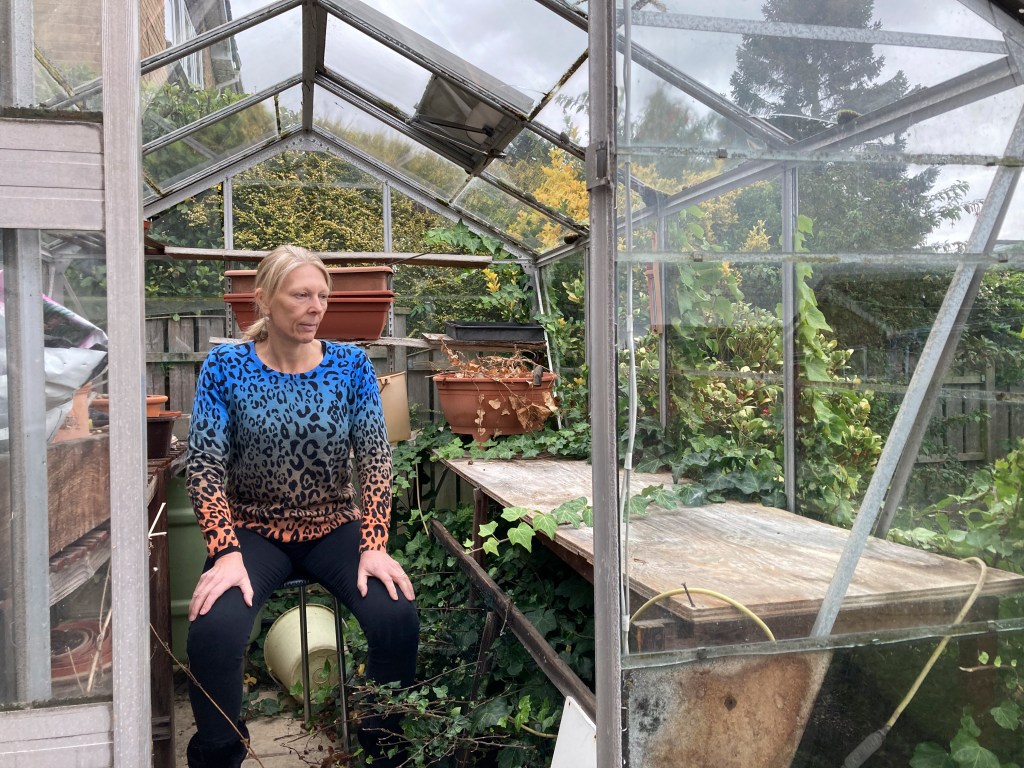
[2]Fletcher R, 2019, “Assignment 5: Photography is Simple”, OCA Blog Post, https://richardfletcherphotography.photo.blog/2019/05/31/assignment-5-photography-is-simple/

Post Assignment 4 Feedback

Introduction

I’ve recently received feedback on my submission for Assignment 4: A Picture Tells a Thousand Words [1] from my tutor. The assignment was an essay critiquing a photograph of my choice, which followed on from the work on semiotics in Part 4. I had chosen Philip-lorca diCorcia’s The Hamptons (2008) from his series East of Eden, which depicts a pair of dogs apparently watching pornography on TV in a living room.

The feedback was very positive with regard to both the written essay and the research that I had done in preparation for it. There were a couple of recommendations for additional research that came from the feedback report, which I will address in this post.

Annotating the Photograph

“I also really like the way you’ve pointed us to your ideas by writing on your chosen image, using red and blue markers to point to your working methods (these reminded on Wendy Red Star’s wonderful recent works where she made her own annotations onto archival photographs onto portraits of her American Indian ancestry (see here: https://aperture.org/interviews/people-of-the-earth-wendy-red-star/ )”

First observation from my feedback report on Assignment 4

What I love about this course is the way that seemingly innocuous connections often lead to my discovering a completely new artist. I had realised during the assignment preparation that I could import a photograph into an application on my iPad and then annotate with the device’s graphics pen. It meant that I could carry out my analysis of the signifiers and connotations and write them on the picture itself rather than in a set of accompanying notes. As well as reacting positively to this technique, my tutor pointed me at the artist Wendy Red Star, who incorporates similar annotations in her mixed media art.

Wendy Red Star (1981 -)

Wendy Red Star is a Native American artist who grew up as a member of the Crow tribe in their territory in Montana. Her work to rediscover, explore and publicise her people started as an undergraduate in Montana when she erected teepees in the grounds of her school[2]. She had recently learned that the school was in Crow territory and that all traces of her people living there had essentially been wiped away. This early act that was perceived as a political statement set Red Star on the course of creating work that highlighted the Crow against the backdrop of American colonialism. By its very nature, it is considered to be a political statement, something that Red Star denies is her intention. However, the work has found new importance within the context of the current climate of interracial tension in the US.

The work that my tutor made me aware of was Red Star’s series of photographs called 1880 Crow Peace Delegation. The photographs were taking 140 years ago when a delegation of Crow chiefs were invited to Washington by the President to ‘discuss’ the building of a railway link that would run through their lands. The discussion was essentially a way of colonial America to tell the Crow people that it was happening and that there was little they could do about it. In an interview with SmartHistory.org [3], Red Star tells of how the tactic being used was to invite the Crow half way across the country (taking many days) to the nation’s capital where they would be intimidated by the technological and military might of the white man. What the Americans didn’t realise was that the Crow chiefs were well aware of this and to counter the sense of intimidation, turned up to the negotiations in full tribal dress. The photographer, Charles Milton Bell, took a series of portraits of the chiefs in the traditional seated poses that were fashionable in the early days of photography. Bell’s images are cold and distant, as if there was little or no connection between photographer and subject – this was something he was well known for. When Red Star looked at the images, she saw the intricate details of what the chiefs were wearing. She went on to discover more about the men in the photographs, even getting in touch with their direct descendent to gain more of an understanding of their history. Red Star added written contextual elements to the original photographs, tracing around the edges of the details to help the viewer identify with their meanings. An example can be seen below:

Déaxitchish / Pretty Eagle from the series 1880 Crow Peace Delegation, 2014, by Wendy Red Star[4]

In this photograph we see Pretty Eagle, seated on a western-style chair wearing his traditional Crow clothing, holding an axe. His gaze is beyond the photographer and his expression fairly static. Typically the subjects of these early photographs had to sit very still as the exposure times were long even with the primitive magnesium flash of the time. Even taking this into account, his proud expression comes through in the composition, which ironically may not have been Bell’s intention, given the political circumstances that led to the chief being in Washington. What makes this image is of course how Red Star has annotated it with bright red ink. Her additions highlight the different elements that she thinks need attention drawing to them, e.g the ermine skins that hang from his right shoulder, awarded when an enemy weapon is captured. Other context is about the man’s life, with commentary on his wife and family in the top left of the frame as well as the story of his remains after his death on the right hand side. Red Star seeks to introduce the man behind the attempted propaganda of the original photograph, the result being an education to those who need it. Like the discussions about photography needing some visual tension that we encountered in EYV, this picture and the others in the series are difficult to ignore. The act of writing on the photographs makes the viewer stop, take time to read and then consider the meanings. In the same way that we have seen context used in this course, the viewer creates their own narrative of Pretty Eagle when looking at this image, which has its roots in historical fact. The added text essentially helps build a narrative about the character of these hugely misunderstood people. Red Star isn’t trying to be political here, merely giving a face to her people with the hope that the historical prejudices about their ‘savage’ way of life or their ‘red skin’ are debunked. The importance of her work clearly increases when we consider the extreme prejudice and fear in modern America. However, when I look at these images, I find myself focussing on the man’s face which has no annotation. The sense of ‘this is who I actually am’ is emphasised by the text but for me it really comes down to the way that the photograph was originally captured. The context here seems obvious, but the story still has space within which to develop because the central subject is captured in such a matter-of-fact way.

My tutor was relating these photographs to my use of annotation in the preparation for Assignment 4, where I identified contextual elements and potential meanings by writing on the original photograph. The thought was how Red Star’s work might influence my own, which is something I’ve been thinking about since our call. The key difference that I see here is that the original images were appropriated rather than created; the text seeking to challenge the seemingly obvious narrative about a Crow being exploited. For Assignment 5, we are required to ‘make up’ an image, so the text could be used to either help the viewer or distract them away from the obvious. As I have an easy way of trying this out on my photographs, I am intending to do so. Mixed media (as with Red Star’s work) isn’t something I even considered when deciding to study photography, so I feel that this is expanding the constraints of what I consider my creativity.

Censorship in Photography – when is art really pornography?

The second observation in my tutor’s feedback was that although I had touched on the way that artists have been misinterpreted as immoral or purveyors of what people believe to be pornography, I could perhaps explore how this has evolved over the years. We know that art is subjective within some established constructs, but how have our sensibilities changed with regard to works that we find cross the line between decent and immoral?

Pornography

booksmagazinesfilms, etc. with no artistic value that describe or show sexual actsor naked people in a way that is intended to be sexually exciting:

Dictionary definition of pornography, Cambridge Dictionary[5]

At face value, the definition of pornography above makes complete sense. An item of media that has no artistic value containing content meant to be sexually exciting. I was quite surprised at how clear this definition is, however. If it’s true, how is it that we are surrounded by ‘racy’ material in classical literature or fashionable clothing that leaves little to the imagination? Is that pornographic? The key clue here is the idea of nakedness, combined with sexuality. Where these literal or metaphorical elements are combined visually or in our imaginations, the morality of the work is questioned. Take, for example D H Lawrence’s Lady Chatterley’s Lover, which tells the tale of a wealthy woman who engages in a passionate affair with her gardener at the behest of her disabled husband. The story contains very graphic depictions of the couple’s sexual relationship and leaves the reader in no illusions of its physicality. The book caused outrage in 1930s society when it was published and in fact was banned in the UK until as late as 1960. The words, then create such a sexual reaction in the reader that unless they have no imagination, cannot help but get them sexually ‘excited’. This was the basic argument for its banning as pornographic. This too makes sense in a way as what is being depicted is sexual conduct between people, however to say that a piece of writing has ‘no artistic value’ is stretching the narrative to suit the ultimate outcome. This is where censorship has its origins – the protection of the people from that which subverts them in some way. In the case of Lawrence, it was fine for people to have sex but another thing entirely for them to read about it. The natural argument about protection of junior readers and the vulnerable is, of course a good one. It does seem like an extremely dictatorial process to ban the book in its entirety, though.

In the case of the visual arts, the arguments for censorship are even more clear. Now we have the actual representation of sex or sexuality presented to us to see for ourselves. Or do we? I mentioned two photographers in the preparation research for Assignment 4[6], Robert Mapplethorpe and Sally Mann, both of which have been either banned or criticised for the potentially corrupting nature of their work.

Robert Mapplethorpe (1946-1989)

Mapplethorpe was a photographic artist who came to prominence in New York in the 1960s and 70s. His work spanned many genres including still life and traditional portraiture, but it is for his images of nudity and homoeroticism that he is perhaps best known, both for their quality and controversy. His images of male genitalia and homosexual acts appeared to some as straight pornography, i.e. with no artistic merit beyond the simple excitement or repulsion of the viewer. However, Mapplethorpe was fascinated with sin and its conflict with what he saw as beauty. As he started to explore his own homosexuality, Mapplethorpe’s work addressed the male experience of sex and eroticism; it was controversial at the time and even more so after Mapplethorpe’s death in 1989. In 1990 a retrospective exhibition of his entire catalogue of work in Cincinnati resulted in an obscenity trial which centred on two groups of images in the collection. The first, Mapplethorpe’s collection of nudes and BDSM photographs were considered obscene for obvious reason. The second, a pair of nude images of children were seen as incredibly disturbing, drawing the conclusion in the eyes of the law that this was child pornography. The case against the organisers grew in strength with some politicians demanding that funding for the arts be withdrawn. The trial went down in history as a direct challenge of what is considered art, ultimately concluding that if a piece of work has artistic merit, it cannot be considered to be pornography. What the trial actually did was cement Mapplethorpe’s entire work into history and the allure of the artist remains to this day. What interests me about this attempt to censor the arts is that it completely overshadows Mapplethorpe’s talent for photography. His brother Edward, who worked in his studio at the height of his fame described him as not at all interested in the technical aspects of the craft [7]. Mapplethorpe instead saw the beauty in the subject and the way is should look when represented on film. His brother’s classical training in technique would bring the ideas to life more reliably than perhaps he could achieve on his own. When we look at his still life and less explicit nudes, we see a delicate respect for natural beauty that we don’t necessarily think of when we hear the artist’s name.

Patti Smith (1976) by Robert Mapplethorpe [8]

This photography of his then girlfriend, the singer Patti Smith is an example of one of Mapplethorpe’s nudes that creates a sense of vulnerability and beauty rather than being overtly sexual. The use of the natural light of the window and contrasting lines in the composition emphasise the natural beauty of Smith’s form which is curled in a sitting foetal position. I love this image because despite being simple in the way it’s constructed, it asks so many questions about what is going on for the model – what is she thinking and what happens next?

The other important aspect of the censorship of Mapplethorpe’s work is the suggestion by the trial that the artist had created child pornography. While the ultimate outcome of the trial was to dismiss this notion, the mere thought that it might be considered as such is deeply disturbing. The abhorrent nature of any form of child exploitation is never more greatly emphasised than by pornography, so much so that while reading about the obscenity trial, I decided immediately not to look at the works concerned and most definitely not to include them here in my blog. The thought made me physically sick despite the fact that they were ultimately considered to be art rather than porn. Naturally, what separates art from pornography is the idea of artistic merit which can come from multiple cultural and contextual elements in the photograph, for example a series like Nan Goldin’s Eden and After, which depicts children being children in many different ways is considered a loving tribute to them, in particular to those in her life (she has none of her own). Despite some of the images being of children bathing etc, and along with Goldin’s reputation for more adult material, the book is artistically a celebration of children that Goldin wanted them to take ownership of. There were no doubt some raised eyebrows however, but no gathering of crowds with pitchforks. How then, does the public decide? Why has Sally Mann being singled out for criticism of her similar images of children?

Sally Mann (1951 -)

We encountered the work of Sally Mann during the early exercises on light in EYV. A traditional large format photographer, Mann rose to fame with her portraits of her young family, which also drew criticism for its depiction of her young daughters as nymph-like beings. Some read these intimate portraits as sexualising underage girls, which led to similar accusations of pornographic imagery. Similarly, in Mann’s case the accusations involved children with the very real threat of Mann being arrested and charged. After being called out on her work by a preacher in Minnesota[9], Mann volunteered to talk to the FBI ahead of publishing her book Immediate Family. The conclusion was that the controversial pictures didn’t constitute child pornography by the FBI’s behavioural sciences. He went on to make the remark that while some people would potentially be sexually aroused by them, he had met people who had the same reaction to inanimate objects. There are many other anecdotes about Mann and the motivation behind her photographs of her children, but I was more interested in why people reacted the way that they did. Like Mapplethorpe and his shocking of the ‘decent, moral heterosexual’ people of American society, Mann’s pictures make people uncomfortable. In her book Pictures of Innocence: The History and Crisis of Ideal Childhood, art historian Anne Higonnet states that “No subject is as publicly dangerous now as the subject of the child’s body”. Rather than consider a mother wanting to document her children growing up through exploring their play, interactions as siblings and how they are within their environment, we instead focus on the fact that the hot summers of Virginia lead the children to often be nude. We believe that Mann is somehow exploring her own complex childhood and freely liberal attitudes through the exploitation of her kids, despite hearing from the artist that her children desperately wanted to be part of their mother’s work. The point on exploitation is further emphasised when we learn from her son that they were paid a few cents per negative[10], which in every other circumstance would be considered giving pocket money to a child. Most of all, the criticism of Mann as a ‘pornographer’ comes as much from the way that she is written about. In 1992, The New York Times published an article that explored many aspects of Mann’s life and work, including her controversial photographs of her children[10]. They gave the article the title The Disturbing Work of Sally Mann, which when reading the accompanying text, only accounts for a small part of the article. Perhaps then, we feel the need to assign some label to artists and work that makes us feel uncomfortable. The in-built discomfort means that we might acknowledge their existence but not wish to go further in understanding the context of what is bothering us. As with Mapplethorpe, my own limitations (and I consider them to be so), make me not want to include reproductions of Mann’s work in this post, despite my seeing nothing remotely sexual in the photographs. I guess we all have these limits to some extent.

Conclusions

This post covers two very different aspects of feedback from Assignment 4. I enjoyed learning about Wendy Red Star’s reclamation of her Crow heritage through annotating historical documents. For me, the pictures come alive with her additions and create a sense of who the subjects were, despite them being dead for over 100 years. In considering my own work, I can see some merits in using physical annotation to create mixed media art, but I think it’s probably a step too far at present. It has taken the past 2 years to think of myself as a photographic artist rather than an amateur ‘shot-taker’ and the conflict between my engineering brain and this new-found purpose is well documented in this blog. I will definitely be looking at other examples of mixed media in later courses as it is offers an original perspective.

The second part of this post deals with a subject that people don’t generally want to talk about publicly. Visual arts that include sex and sexuality do indeed provoke a response in the viewer, but is that pornography? Mapplethorpe’s work lifts the lid on a way of life and sexual practice that most are not aware of or wish to acknowledge, but where does the argument for ‘no artistic merit’ begin? What I realised from researching his work more deeply is that he was a great advocate of the beauty and danger of the human body, mixing perception of sin with the most natural resource we all have, our physical selves. I find some of his pictures shocking, but can appreciate the way they are shot and even deriving a narrative from them. What makes me sad is that his appreciation of his subject and talent for light and composition are completely overshadowed by the controversy and the way that his life was cut short so tragically by AIDS. The same goes for Mann. I find myself asking how any mother could create sexualising images of the children that she clearly loves very much. I know that such people exist in the world, but that vile underbelly of society doesn’t go about creating a carefully constructed documentary with a large format camera. We almost want to believe that someone is ‘not right’ when they photograph their children playing in the garden without any clothes. I think that says more about society than it does about Mann. The remaining sadness in her case is that her young children are now all grown adults and as such Mann’s work has since moved on. When we do a search of her work, though we are not directed at her intimate documentary about her husband’s debilitating illness or her beautiful landscapes. We don’t see her work about the effects of decay on the human body, we just see references to the controversy of her earlier work with her children. I come back to the original definition of pornography as being something that deliberately invokes sexual arousal, is graphically depicting sex and has not artistic merit. None of these apply to Mann or Mapplethorpe.

References

[1] Fletcher R, 2020, “Assignment 4: A Picture Tells a Thousand Words”, OCA Blog Post, https://richardfletcherphotography.photo.blog/2020/11/13/assignment-4-a-picture-tells-a-thousand-words/
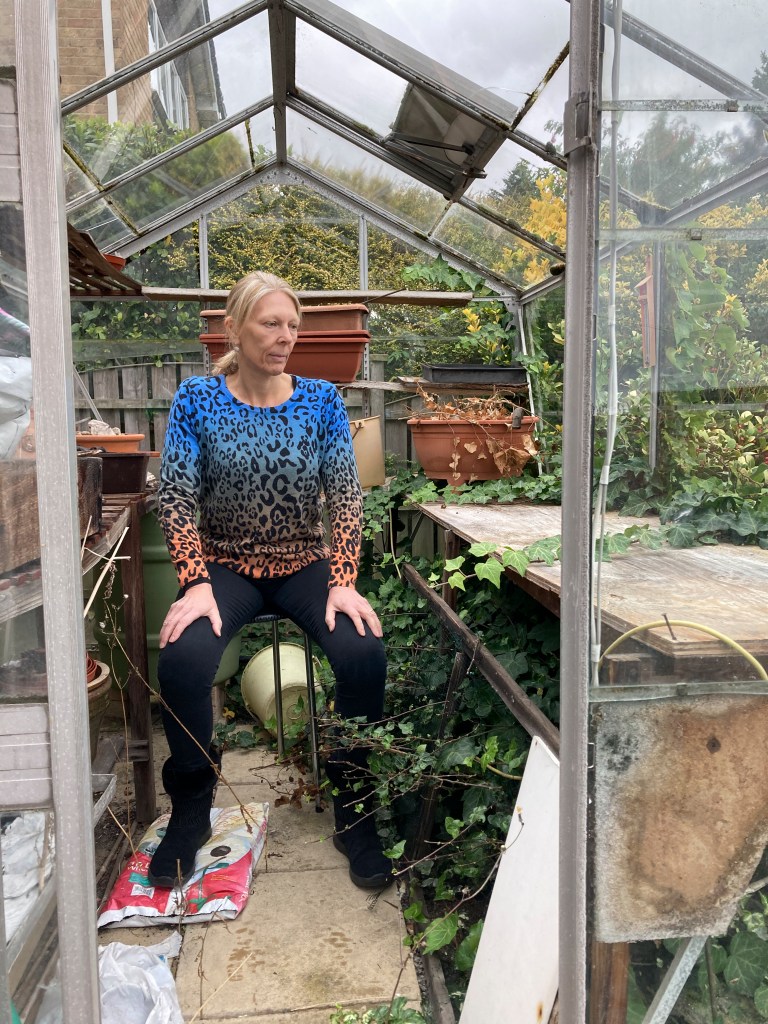
[2] Griffiths M, Unknown Date, “Wendy Red Star”, Hundred Heroine website, https://hundredheroines.org/featured/wendy-red-star/
[3] Red Star W et al, Unknown Date, “Wendy Red Star, 1880 Crow Peace Delegation, Smart History, https://smarthistory.org/wendy-red-star-1880-crow-peace-delegation-2/

[4] Unknown., 2018, “1880 Crow Peace Delegation”, Image Resource, Birmingham Museum of Art, https://www.artsbma.org/1880-crow-peace-delegation/

[5] Unknown, “Dictionary Definition of Pornography”, Cambridge Dictionary Online, https://dictionary.cambridge.org/dictionary/english/pornography

[6] Fletcher R, 2020, “Preparation for Assignment 4”, OCA Blog Post, https://richardfletcherphotography.photo.blog/2020/11/13/preparation-and-research-for-assignment-4/

[7] Lee Ball A, 2016, “The Other Mapplethorpe”, The New York Times online, https://www.nytimes.com/2016/04/17/fashion/edward-mapplethorpe-robert-babies-brother.html

[8] McAteer S, 2013, “Patti Smith; Robert Mapplethorpe 1976”, Image Resource, Tate Online, https://www.tate.org.uk/art/artworks/robert-patti-smith-ar00186

[9] Gross T, 2015, “Making Art out of Bodies: Sally Mann Reflects on Life and Photography, npr online, https://www.npr.org/transcripts/405937803?t=1606894062435

[10]Woodward R, 1992, “The Disturbing Photography of Sally Mann”, The New York Times, https://www.nytimes.com/1992/09/27/magazine/the-disturbing-photography-of-sally-mann.html