The glossary you started to build in Project 1 will most likely exist as a list of terms which help you to construct, define and classify. However, these terms can also be considered as the beginning of marking out a territory for any work.Your glossary can help you as you start to build a map, or diagram, which includes the broad theme you are investigating, noting some of the key terms, theories and practitioners whose work may overlap or have strands of practice which sit in different territories.
Response
Following Exercise 2[1], the following terms are added to my glossary.
Reformism – the approach of documentary photographers to drive some form of social change through their work. Covers the revealing of something kept hidden or disregarded by society – bringing to light a subject that is uncomfortable or disturbing to shock people into changing the status quo.
Concerned – the concerned photographer who is personally bought into the issue that they are revealing, e.g. Salgado and his documenting of the fragility of his immediate environment as well as the planet[2].
Compassion Fatigue – the saturation of a message through imagery where the senses are overwhelmed. Example of my own experience at the Don McCullin exhibition [2].
Advocacy – linked to reformism, but more about the photographer trying to act on behalf of the subject. Example – Lewis Hine accessing the textile mills under an assumed identity to photograph the child workers. Hine was giving voice to the children who were an accepted and forgotten element of textile production at the time[2].
Mass Observation – large scale documentary projects aimed at social anthropology. Voyerisitic observation of people, their places in society and the context of their surroundings. Grandiose ideas similar to Sander’s portraits of Germans and their professions, but more emphasis on ‘the camera sees’
Self – the concept of one’s identity as actively portrayed through photography. The pursuit of the perfect representation of how we see ourselves. The ideas that we can portray ourselves in terms of our ambitions or alignment with cultural expectation. Example – ‘Come to Dubai’ and ‘Sober for..’ [3]. Transformational identities where artists become someone else to challenge assumptions about gender, race or sexuality. Examples: Jo Spence and Rosy Martin [3].
Theatre of Self – presenting an aspect of our identity and it affects our lives. Peter Mansell’s series’ about his disability[2] which don’t tell the complete story of his identity, but give an insight to those who are not familiar to the struggles of it.
Voyeurism – Martin Parr admitted to being voyeuristic in his approach to photography and highlighted the way that other photographers tend to avoid the term. His work is a blend of very carefully observed and composed images with the aesthetic of a family snapshot. It’s become a visual code in its own right.
Begin by browsing the Source Texts and Case Studies and make notes of at least 5 broad themes you can identify that interest you. Identify at least 2 source texts or case studies that you can work through to help develop your own practice and have these ready to support your Project 4 work. List other possible broad themes that you think could have potential for yourself, your peers or other practitioners that interest you.
My idea of exploring communication as a broad theme (Exercise 1 [1]) led me to consider the further themes that overlap the idea. My starting point was the way that communication has evolved in recent years, with the advent of mobile phones, messaging platforms and social media. This led to the first broad theme of ‘Technology’. In moving to a more digital interaction, I was interested in the way that we communicate with each other and how that had changed. Personal engagements are influenced by who we are, where we fit into a social or familial hierarchy. This led into the broad themes of ‘Identity’, ‘Family’ and ‘Relationships’. I realised also that we are surrounded by information that instructs and prohibits our behaviour, most of which are technology agnostic, that is they require no expert knowledge beyond our way of reading (visually, braille or audible) in order to be effective. Our engagement though, is ultimately driven by our willingness to consume. My final theme is around ‘Rebellion’.
Reading the Source Texts and Case Studies, I selected “Look at Me! The Representation of Self” and “Documentary Depictions and Dilemmas” because they cover the central aspects of what I am interested in. The former deals with representation of personality both as the artist sees it, but also the ideas of projecting a persona, something that is highly relevant to the online world of imagery. The latter deals with the historical shift from straight representation of a scene or event with a view to revelation or social change, to the photographer guiding the narrative according to their perspective. I thought this to be particularly relevant as my ideas communication and its impact on our seeing the world around us, also beg the questions “Does it matter?” and “If there is no noticeable harm, does it matter?” I want to pursue this later in my SDP.
Reviewing the Source Texts
I used Padlet to map the key learnings and messages from the two source texts. They can be found at:
The first conclusion from this exercise was that my broad theme of Communication does indeed span the 5 other themes that identified. There is a strong theme of change in how we engage with each other and the wider population, which is contiguous with the attitudes of the photographers who pioneered documentary. Their intentions evolved from straight reporting and furthering the idea of the camera being a tool, to growing a conscience and becoming both reporter and advocate. The photographers who wanted to reveal poor living conditions or human rights violations, broke the conventions. It’s no surprise that these photographers were unaffectionately known as ‘muckrakers’ owing to their deliberate attempts to let the viewer into an aspect of humanity to be ashamed of. The emergence of the mass observation and curated stories of the 1930s could be argued to mirror the broadening collective of modern media outlets that push specific narratives across the internet, furthering a confusion over what is truth. The ‘truth’ of the photographic representation in the mid-20th Century became less important than the tactic to present or shock the audience. In a parallel with the idea presented in “Look at me…” that Big Brother created an apathy in the audience with regard to the ‘reality’ of reality television, the full context of stories such as the migrant sharecroppers or the people of the Bowery in New York, was no longer important – just as long as the editorial was ‘broadcast’ Similarly with Cindy Sherman, Jo Spence and Rosy Martin, we had serious assumptions about contemporary and generational female identities challenged by the artists acting as other people. With both genres, external context such as our preconceived ideas of a culture or gender, our memories of how things used to be and our recognition of ‘progress’ are increasingly introduced into our reading of an image when stories are being told instead of relayed.
For my theme, I will need to consider how to home in on the core messages I want to convey. This exercise has allowed me to gather my thoughts about the various aspects of communication as a theme and, most importantly, how I react to them.
Select a broad theme as your individual starting point and research how it is expressed photographically through different genres by different practitioners.
Some examples of broad themes include (but are not limited to):
The Body
Identity
Friendship
Systems
Home
Environment
Anthropocene
Power
The Gaze
Materiality
Otherness
Time
Family
You can choose one of these, a variation, or something else. Assignment 3 is designed to help by making connections within your analysis.
Response
The broad theme that I have chosen is ‘Communication’, as it is something that I’ve been interested in since Identity and Place. Communication covers a very large area of established norms in the natural world, but in human life it has continued to evolve at pace over the past century or so. What interests me is not so much the methods for communicating a message between people, but how our understanding of visual or symbolic communication has changed with the advances in technology and the impact it has had on our general awareness of what is going on around us. For example, I was in town this week and noticed the increased presence of Union Jack flags hanging from the buildings in the centre. On its own, the flag symbolises the national identity for the UK and stirs many emotions and memories from its use in the sports events such as the Olympic Games to the uniforms of our Armed Services. The current context for its use in Malvern is the upcoming Queen’s Platinum Jubilee. We recognise this without any prompting, because the many methods we use to communicate information tell us that this event, unique in British history, is very soon. The message is reinforced further by the addition of banners and signs in shop windows, but only when we pay attention to them, do they have a conscious effect on us. Subconsciously, we know that there is a celebration coming.
In Assignment 4 of I&P, I paired transcripts of the government COVID briefings with imagery that suggested a contrast between the mood of my town and the messaging coming from our leadership. The briefings were televised, which in itself presented us with a visual communication of how serious the situation was, while trying to reassure the public that those in charge were working the problem.
Fig 1. Prime Minister’s statement on coronavirus (COVID-19): 12 March 2020 (s.d.)
This still, taken from one of the broadcasts, contains the visual elements we came to expect. The Prime Minister flanked by his scientific experts, standing at lecterns, which themselves are symbols of education or presentation. The setting is grand and important-looking and in the centre are two Union Jack flags, creating a sense of national identity and unity as explained previously. The modern use of a website address completes the message ‘if you are unsure, for any reason, go check the website’. The impact of this visual (even in video) is different from the written words that I included in Assignment 4 as they create more internal context, leaving little to our own interpretation. This is where I am interested in our attention to such communication, how it has changed with technological distraction and the effect it has had on our daily lives.
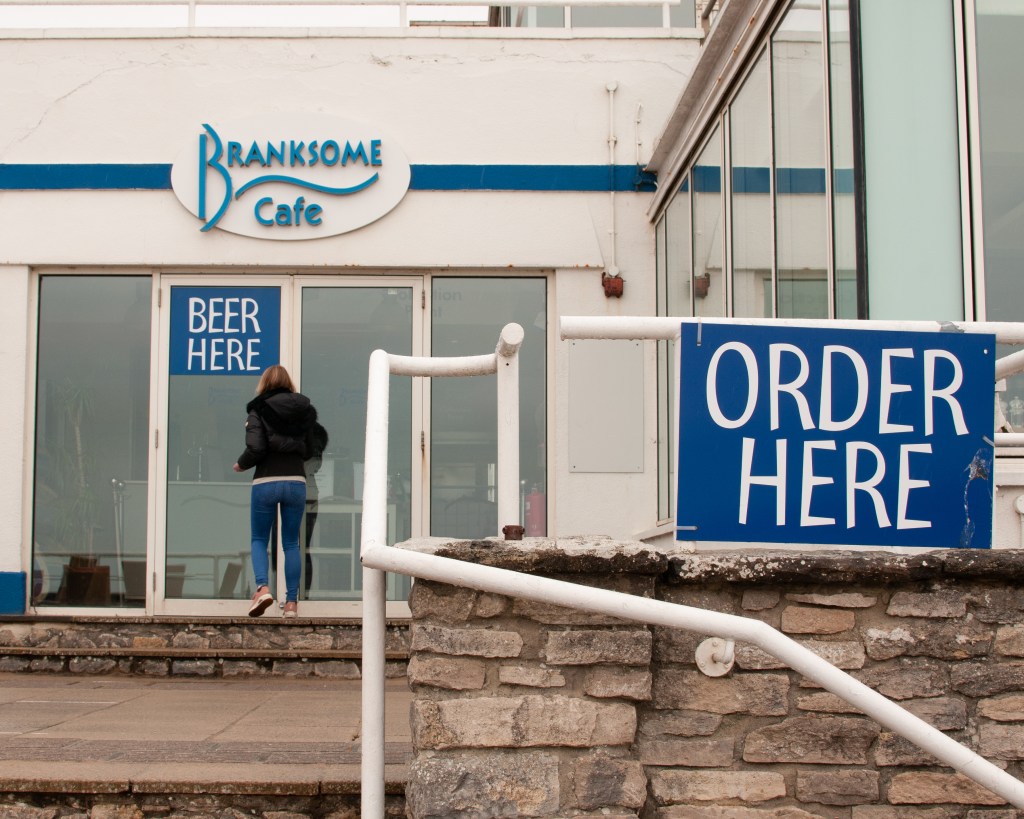
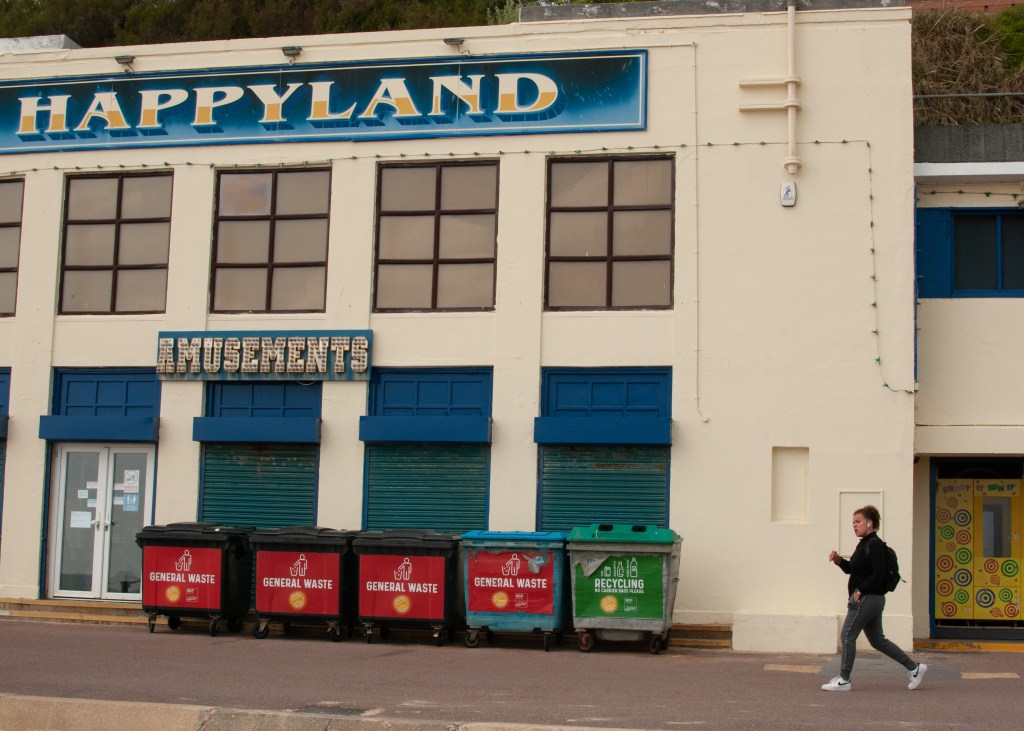
In exploring this theme, I started to observe examples around me and took a few photographs to start shaping my thoughts.
OneTwoThree
Research into how my broad theme fits or overlaps into the genres, as well as practitioners can be found in the Padlet linked below:
My broad theme is actually vast. Communication is clearly a word that covers many different ways of establishing an understanding between people, whether on a one-to-one basis or as a broadcast. How information is received is as important and as varied because expectation and ideas of truth are influenced my many social factors and personal beliefs. Aside from the physical communication mentioned here, there are cultural understandings that we learn to the extent where concentration on the meaning is negated, such as the Union Jack symbolism.
During a recent cohort call, my peers analysed my three images above using Barrett’s CRIT process. Amongst the feedback was a comment about the deckchairs in the beach shot. They are positioned together and facing the sea, which when we think about it is the usual position for deckchairs when we see them for real or in an image. The communication comes in the form of an invitation to ‘sit, with company and admire the shore’. As well as the work in the Padlet, this feedback led me to think about the participants in a communication series that I might create. Are the messages I want to present between people within the frame (or implied within the frame) or is the viewer part of the message? For example, a still life image representing communication needs the direct engagement with the viewer because it is a relationship between them and the artist. However, in my three images above, the relationships are between the signs and the people within the compositions. I believe the answer to this is not a simple choice of one or the other for a documentary series that merges with the still life and portraiture genres, instead it is a hierarchy of meaning. I need to choose which form of communication, it’s participants and the general idea of what the image means as a priority, letting the viewer look beyond that to the alternative ideas.
This broad theme is going to form the basis of my Self Directed Project in the second half of the course, because I see a number of strong areas for exploration through photographs.
Make reflective notes on your reading and the comparisons that are being drawn in this chapter – add these to your learning log.
Choose an image from Art History which you will visually respond to and reflect on your choice on your learning log (you might initially choose several before narrowing it down, and you can write about the choices and ideas you are considering).
Developing your work from Project 1, make your own photographic image, or set of images that explores, challenges, or pays homage to the conventions and visual codes of the original image.
Reflection on Photography and the Art of the Past (Kingsley, 2012)
The essay begins by defining historicism as photography’s use of traditions from art history in terms of inspiration rather than straight reproduction or homage to the genres. I was struck by the popularity of art history conventions in modern photography with the examples given, although there is a definite sense that it is less so than the Victorian era when the ‘new medium’ of photography was in its infancy. The emergence of photography as a way of recording classical painting shouldn’t be a surprise, given the mechanical/physical processes it uses. What interested me was the move towards creating work that looked like them, not just in the visual aesthetic, but also the subject matter. Julia Margeret Cameron’s portrait Light and Love (1865) has the hallmarks of a Victorian portrait (black and white, the soft focus of old lens technology etc), but Cameron dresses her mother figure in a similar scarf to that used in The Holy Family with Child, by Bartolomeo Schedoni (c1613). Cameron was portraying the love of a mother for a child to the Madonna using a nest-like setting for the infant to belie the period the picture was taken. This idea of using the visual codes and signifiers that typically represent the Holy birth as the basis for what Cameron saw as every mother’s love for their child is compelling. This was the example in the essay that resonated with me, because although my modern reading of Cameron’s image is based upon the knowledge that photographers take inspiration from paintings, she was actually merely trying to produce a more accessible version of them using photography. Her contemporaries were similarly using the medium to effectively copy similar works. In doing so, they were able to recognise the style and techniques used in order to create their own original work. In the case of some artists, the paintings themselves feature in new photographic work. The essay discusses Jorma Puranen’s Shadows and Reflections (after Goya) 2011 which connects photography with the past through deliberately revealing the techniques used to make Goya’s famous portrait of The Duke of Wellington. The structures of the canvas and brush strokes, coupled with Wellington’s gaze from the portrait give a sense of intrusion into the making of the famous image, the sitter almost being exposed by the new perspective on the original process.
The main conclusion. from this essay is that modern artists are still inspired by the ideas and techniques employed in traditional painting, with some seeking to use the technical codes and some the iconography that was popular throughout art history.
Example for Analysis
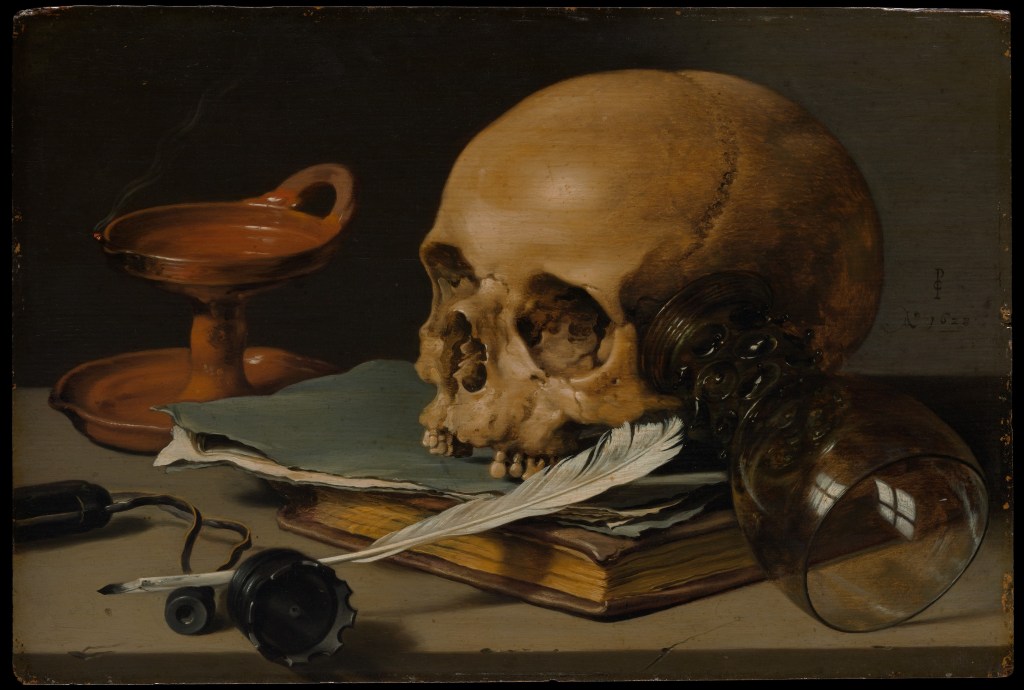
I have chosen a still life by Dutch painter Pieter Claesz (1597 to 1660 called Still Life with a Skull and Writing Quill (1628). The image is from the sub-genre of Still Life called Vanitas, defined as:
“A still life artwork which includes various symbolic objects designed to remind the viewer of their mortality and of the worthlessness of worldly goods and pleasures”
(Tate, s.d.)
Fig 1. (Pieter Claesz | Still Life with a Skull and a Writing Quill, s.d.)
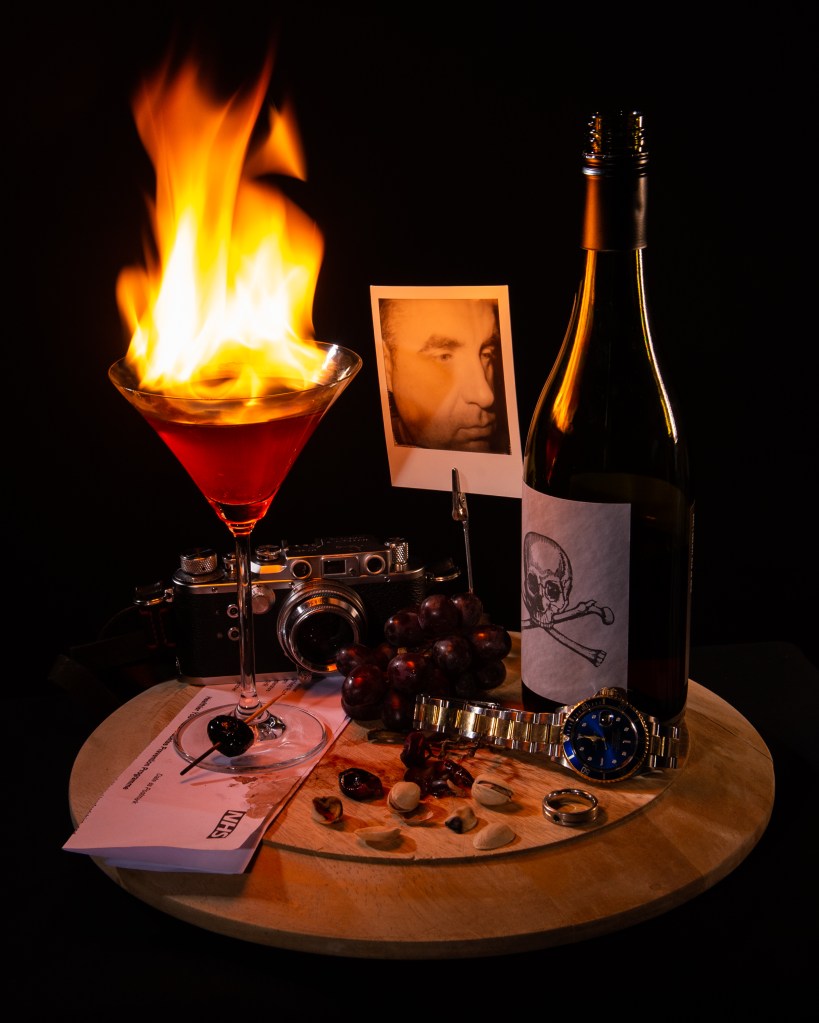
Vanitas images deal specifically with mortality, with the reminder of the fragility of a life in balance. They almost always contain signifiers of the end of things, with skulls, writings, candles and empty vessels such as wine glasses to connote the impending. In this image, the dominant element is the skull, which faces the light. It’s condition with its lower mandible and some teeth missing, signifies age which ties in with our rational perspective on death – old people die. The empty candle holder is clean, which suggests it’s either never been used or has been tidied after death. This could connote regret for things not done or started during life or what remains of the flame once long extinguished. The skull rests against an upturned wine glass which is empty. This empty vessel points to previous pleasures, something that many Vanitas images have in common. Others contain musical instruments, food etc, all of which connote better times. The final elements in the image are the quill, the journals and the upturned inkwell. All of these signify labour and their aged appearance connotes something that has been done for a long time. The quill’s repose is such that the writer may be back at any time, or could have left for good. All of the elements are placed on a worn stone table or platter, which connotes the slow passage of time, but presents something familiar about the composition; the artist not simply presented disconnected items to the viewer.
Visually, the image contains elements that are all similar on colour and tone; there are not dramatic contrasts. This is reflected in the lighting, which owing to the lack of a candle is assumed to be natural. These images are deeply rooted in religious iconography so the choice of lighting could connote the ascension to the afterlife or the antithesis of the end of the day/end of the life.
This painting and the others of the same sub-genre appealed to me because they use still life in a way that I had not considered. Other artists were painting images of bountiful life, with exotic fruits, wines and flowers being the most popular themes. Vanitas serves as a reminder that things don’t last for ever and while often extreme in their execution, their style lends itself to story-telling.
My Image
Vanitas still life resonated with me because of the transitional messaging within the image. The ideas of being reminded of mortality while simultaneously celebrating the good things in life connected with a recent change in my own life. I recently gave up alcohol, not because of some problem, diagnosis or epiphany but more because of the way it, in small measure, become part of routine. Lockdown and changes in my working life meant that it was easy to indulge in the weekend treat more regularly than before. My decision to stop has had a huge impact on my wellbeing and made me reflective about the health issues caused by alcohol, some of which are very serious. I wanted to explore this with a Vanitas-style image.
Key elements to reproduce:
Sense of warning represented in the paintings by a skull.
Direction of light – ethereal and from above as if suggesting divine light.
Enjoyment of life’s pleasures – hobbies, food etc.
The sense of timing – being warned about the future, but also the present moment.
My Image
Temperance, after Claesz (2022) by Richard Fletcher
Analysis
For an analysis of my image using Barrett’s tools for critique, please see Padlet below:
The combination of analysing Claesz and making my own still life that uses similar codes and ideas has given me a new perspective on the genre. More than the classical fruit scenes, the Vanitas still life paintings were multi-layered in their connotations, using signs that provoke a sense of dread in the viewer. They combined the artist’s skill in representing light with an understanding of form and luminance that draw the attention of the viewer to the powerful iconography. With my image, I tried to assemble a collection of items that paid homage to Claesz’s image, as well as recreating the directional lighting and matched tones. Once I’d included the camera as representation of ‘enjoyable pursuits’, I realised that there was going to be some diversion from the tonal qualities by introducing harsh highlights. When I realised this, I included my watch to add balance to the spatial composition. One element in classical still life that intrigued me was the use of candle light. For me, this was where the differences in the skills of the classical painters varied considerably. Some master practitioners, such as Rembrandt, really gave a sense of the scene being lit by this natural source, while others used artistic licence with the brightness of the flame and its fluid movement. That inspired my lighthearted criticism in including the flaming cocktail. I wanted the scene to appear to be lit by the flame alone and for it to look completely natural. For this, I used a slow shutter speed rather than a fast one to freeze the flame. The scene is fill-lit by a two strobes and a further LED with a warm colour temperature, which when combined with the key light gives a natural feel. The most important part of this assignment for me was the post-production analysis using the ideas of Terry Barrett, with which I was able to re-evaluate what I had intended to achieve with the picture.
“Thus, all photographs, even straightforward, direct and realistic-looking ones, need to be interpreted. They are not innocent, free of insinuations and devoid of prejudices, nor are they simple mirror images. They are made, taken, and constructed by skillful artists and deserve to be read, explained, analyzed and deconstructed”
(Barrett, 2006)
This assertion by Barrett resonated with me in Exercise 1[2], where I made the selection of the images from each genre randomly. At first glance, the Ansel Adams landscape is a beautiful representation, but by analysing using semiotics, a number of meanings could be derived from the elements and and what they connote. Barrett’s approach simplifies the reading of an image in my opinion, which makes it more intuitive to use.
In conclusion to this assignment, I am happy with my still life. I’ve received feedback from my peers about both the connotations of some elements and the relationship between my composition and that of Claesz. These observations lead me to think about how close to the original image my photograph is and whether that is important. Other feedback questioned how it fits with contemporary Vanitas works. I had partly been inspired to look at the still life genre after analysing Paulette Tavormina’s Banquet (2017) in Exercise [2]. Her use of including movement with the birds in flight, but in a staged fashion, led me to question the movement of candles in other paintings. By incorporating ‘real’ movement into still life, does it still fit with the codes of that genre? Is it truly ‘still’? Looking at Ori Gersht’s Exploding Flowers [3], where the movement from the dispersing petals is clearly there but frozen by a fast shutter speed, I would argue that it’s a difference in detail definition. My flame is clearly identifiable, yet the movement is more life-like owing to the longer exposure. Therefore in terms of being an homage to still life, and in particular Vanitas, I am happy that my image meets the original intent.
Against the Learning Objectives
LO1: Compare the theoretical features, characteristics and histories of different photographic genres.
The features of Still Life were studied in Exercise 1 and brought into this assignment.
LO2: Deconstruct a given genres’ conventions and create visual material informed by that knowledge.
Visual codes such as composition, lighting etc for Still Life were recreated in my image. I took the idea of Vanitas, a sub-genre of Still Life and made it about the warnings of health impact from alcohol instead of mortality. I used similar internal contextual elements as laid out in my post analysis in the Padlet
LO3: Produce new visual work informed by your research.
I produced an image that pays homage to Claesz’s work but isn’t a replication of it. The contextual elements are similar but the overall meanings that can be connoted from them lend themselves to my story.
LO4: Analyse the wider global contexts surrounding contemporary image making.
I was inspired by Paulette Tavormina’s Banquet (2017) which took the classical ideas of a feast in still life and incorporated a flock of birds descending to eat the food. The ambiguity of their presence (see Exercise 1) added a layer of narrative to the image, which in every other regard looked like a painting.
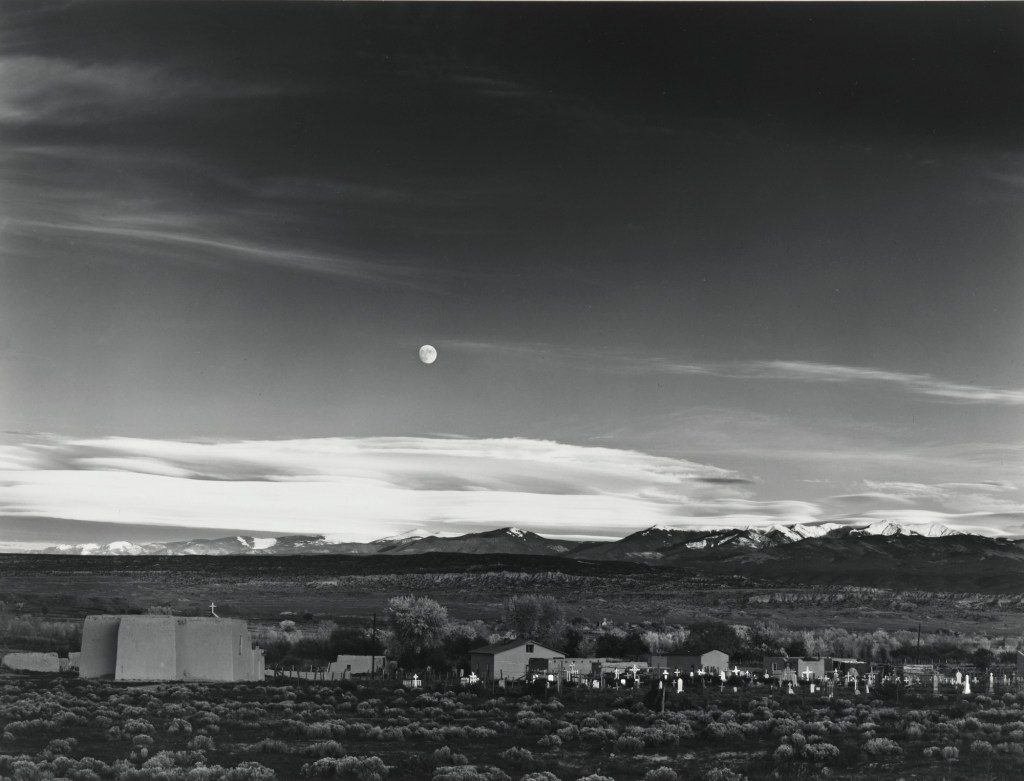
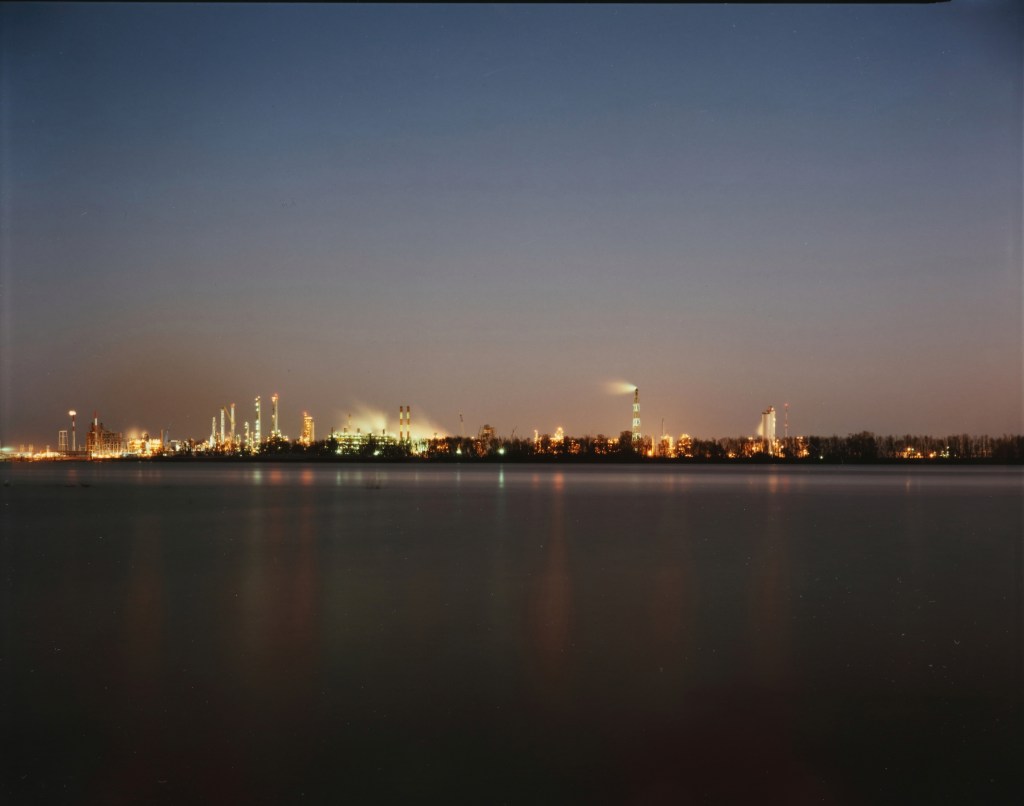
For this exercise, I have chosen two landscape photographs; Moonrise over Hernandez, New Mexico (1941), by Ansel Adams and Bonne Carre Slipway, Norco, Louisiana (1988), by Richard Misrach
[Fig1] Moonrise over Hernandez, New Mexico (1941), Ansel Adams[Fig 2] Bonne Carre Slipway, Norco, Louisiana (1988), by Richard Misrach
These images are visually very similar, both depicting a wide-open landscape with some form of human presence within the frame. They are both shot on large format film with the obvious difference being one is colour and the other is black and white. Moonrise… is perhaps the most famous image by Adams, probably the most recognised landscape photographer in history. This image is famous for the story about how it was made almost as much as the composition. Adams was travelling back from a failed day’s shooting and saw the gibbous moon, lit by the fading sunset. He rushed to set the camera up, couldn’t find his light meter and worked out the exposure from his knowledge of the luminance of the moon. The story reinforced the legend of Adams as a ‘technical’ photographer. Misrach’s image, has no back story, being part of a documentary series about the impact of the petrochemical industry on the environment in ‘cancer alley'[1], a region of Louisiana. Outside of the artistic intensions, the images have other visual differences. Moonrise… is very precise and sharp, exposed carefully for the moon’s luminance, whereas Misrach’s picture is a deliberately long exposure. The fine details of the refinery are lost in the flattened movement of the water and the smoke rising from the buildings. Where Adams captures the natural light impacting on the buildings, Misrach represents the light pollution impacting on the environment; the antithesis of each other. The technical codes used create a sense of wonder in Adams’s picture and his familiar use of scale makes the manmade part less significant in the context of the desert space, where Misrach’s image is depressing. The light pollution creates artificial colour in the sky and is reflected in the water in lines that lead towards the viewer. Misrach’s image relies on colour to create this mood.
I chose these pictures because of the aesthetic similarities and the obvious technical codes that identify each as landscape. They also both contain natural and man-made context in similar compositions. However, it is clear that even without knowing of either artist’s work, they are very different ‘cultural tones’. Where one is rich in detail and natural beauty (then moon, the almost clear sky and the highlights from the sun setting behind the viewer), the other is devoid of the same elements. The composition is simpler but the use of polluting rather than natural light immediately sets this in a environmental/political space. It’s no longer a pure landscape but a documentary protest. With the rest of Misrach’s series, the images serve as a stark warning. Adams’ image isn’t part of a series, but an observation of a moment of natural beauty. Both could be argued to be ‘documents’, but Misrach’s is more of a commentary on man’s destruction of his environment.
“I photographed the landscape, but where it collided with civilization,” he said…
…while Misrach outgrew Adams’ influence, he still reveres the nature photographer. In fact, he has a typewritten letter Adams sent him in 1979 framed on his wall at home. Adams had sent it to Misrach’s first gallery, expressing his admiration for the work…
…“He’s still my hero,” Misrach said.
(Richard Misrach Photographer | All About Photo, s.d.)
For Part 1, I created a Padlet to capture my thoughts and observations and for Part 2, a Padlet for each image analysis. This blog post simply contains reflections on both pieces of work. The Padlets can be found at the following addresses:
The source material draws our attention to what Rose (2001,p25) referred to as the three sites of a visual image; the site of the production, the site of the image and the site where audiences will view it. These aspects form meaning in interpreting an image and are the most debated in terms of the importance placed upon them. The idea that there could be shifting emphasis on the importance of all three reasonably suggests that there are many potential interpretations of what is ‘truth’ in documentary. The rhetoric of an image is dependent on how the photographer has used photographic codes to influence the reading. I was taken by the idea that for every ‘rule’ there is subversion and the clues as to how that makes a photograph believable or otherwise is down to how the image is broken down.
The artists included in the both the notes and the embedded exercise have all taken the idea of documenting using a camera in different directions. The first thing that I noted was the exploratory nature that evolved over time. The early photographers, such as Fox-Talbot were interested in how to capture a significant event visually, e.g. the building of Nelson’s column in Trafalgar Square. Although a fairly simple composition, use of visual codes such as scale and perspective, coupled with the rudimentary equipment and processing used to make the picture, raise questions that change over time. Shafran makes the point that the image has a modern feel to it with only the necessary elements included (e.g. the column’s base but not the statue) and the advertising hoardings in the frame. Was Fox-Talbot establishing photographic composition codes from the outset or have modern analyses of the visual image and structuralist ideas made sense of his work after the fact? The collection of artists impressions in We are Here have the common notion of re-visiting works of lesser known photographers with a post-structuralist eye. Works by Hinde and Charles Jones break down the codes of very simple compositions to give clues as to an area of society that we might not be familiar with. I was drawn to the catalogue photographs of pristine vegetables as if being judged in a horticultural show as shot by Jones. They use technical codes such as light and composition (uncluttered, filling the frame etc) to bring out the natural beauty of the subjects. The subjects, although familiar are shown to have been cared for and made as good as possible for the camera to document, asking the viewer to see how important horticulture is to some people.
As the 20th Century progressed, the subjects and approaches to documenting them became more experimental. Photographers began subverting the ideas of their time, such as Munby’s portraits of dirty women. His idea of humorously substituting the female form into male professions and further subverting the notions of class in Victorian England mirror the work of Julia Margaret Cameron, who was pilloried by the establishment for what was seen to be poor technical skills. Her pictures create a real sense of her subject’s personality as she saw them, rather than majoring on the accurate representation of their features. Towards the 1960s and 70s, we see more voyeristic style of documentary, taking cues from classic and contemporary street photography. Here we saw the visual codes of separation, isolation through focus and highlight as well as the decisive moment, being used by the viewer to create narratives as though they were part of the scene. In the V&A article about South Africa, the cultural evolution of the country with its troubled recent history is documented through an approach that highlights what we may have no experience of. We can see influences of early practitioners such as the FSA group in Jodi Bieber’s Women Who Murder Their Husbands. The horror of the women’s acts is contrasted with their visual aesthetic and being surrounded by their meagre possessions in their cells. We don’t even need the additional context of why they committed their crimes to break down the visual clues in their portraits. The pictures are constructed and don’t tell the subject’s whole story, but Bieber makes us connect with them as if we were actually visiting and asks us to consider gender violence and societal bias when viewing the images. This fabricated reality theme is naturally present in the works of Crewdson, Wall and diCorcia who direct their pictures so that they viewer can create a narrative based on their own experiences and perspectives.
The final artist in the reference material was Richard Misrach, who’s series Destroy this Memory is a documentary of the region of Louisiana that was devastated by Hurricane Katrina. The series focuses on the people of the towns that were worst hit through the graffiti they left behind. This included messages of hope in preparation for the storm, fear of the event and the shock of the aftermath. Messages warning looters and asking people to call their families as well as rages against the state government and insurance companies are curated into a series that explores the human response to crisis. There is some gallows humour in amongst the desperation, which Misrach uses to punctuate the series. The interesting thing about the series is the apparent lack of technical setup in the images. Misrach made the series from his scouting photographs which were taking with a basic digital camera. As a result, the style isn’t cinematic or constructed, but more snapshot as if a tourist (or the viewer) took the pictures. Composition is ‘careful’ but doesn’t have a sense of planning about it. This style brings the viewer closer to the scenes as the photographer saw them. The absence of people creates the eerie sense of emptiness but their wrecked possessions and their need to write something on them is compelling.
It’s clear from the reference material that documentary has evolved from the straight ‘truth’ of presenting something to the camera, through coded composition, rebelling against convention and the subversion of cultural understanding, to the more intimate act of being part of what is happening.
“I guess that is how photographic culture shifts and changes as time passes. We think that everything’s been done, but, of course, there are many things that haven’t. In twenty years’ time we will be shocked by how certain works are perceived, and that’s exciting.”
Martin Parr, 2007
Reflection Part 2
My conclusion from part 2 of this exercise is summarised in the following key points:-
The analysis of an image using semiotics can be applied to any of the genres, even when at first glance, the image contains signifiers that do not have apparent connotations. I chose 4 random images by famous photographers of the 20th century as well as contemporary artists and my choices were purely aesthetic. When looking at the codes that help to identify an image as being part of a genre, we know that the visual aesthetic is one of the most common; a portrait contains a person and little else, a landscape contains a view of some sort etc. When analysing, I could determine the denoting elements and derive some connotations from them with little difficulty between genres.
The connotations are greatly affected by the social and cultural perspective from which the elements are viewed. For example, Ansel Adams shot with black and white film in 1947 because that was the established technology, not because he was looking for an aesthetic. The drama of his landscape is enhanced by its use and the technical approach to highlight and shadow with each element, certainly helped support the narrative that I saw within the image. Similarly with Winogrand’s image, I would argue that it is as shocking in today’s culture where racial prejudice has often been seen to be worse than the 1960s.
The technical codes direct the viewer to not only the elements that are ‘important’ through use of depth of field and framing, but also create a mood through lighting and colour temperature. In Djikstra’s portrait, the tones of the image contriubte to the sterile connotations of the subject against the background, while the low contrast offers a bleak feel to the subject’s experience.
What we bring to the interpretation of an image. In the case of Adams’ image, I saw religious connotations in the snaking river that was lit to reveal its surface texture. Although I’m not particularly religious, the combination of the scale of the mountains and their reaching the dramatic sky, invoked the creationism stories I was taught as a child. Other cultures would not necessarily prioritise the connotations in the way that I did, instead introducing their own meanings allied to their own experiences.
Overall, I found this exercise to be interesting because of the application of the structure of linguistics to a variety of images. It focuses our attention on what is physically present and what each element might mean.
Add these terms and definitions to your Glossary – you may wish to do your own further and independent research and reading to enhance your understanding of these terms.
Response
I completed this research task in the form of a Padlet that can be found at this address:
Create a Padlet that presents a critical and reflective summary of the conventions, expectations and meanings of a genre of your choosing.
For this assignment you will use Padlet to present a summary of your understanding of the key concepts (conventions, expectations, meanings) of a chosen genre from the materials you have engaged with. The readings, research and activities will have enabled you to think about genre in a variety of ways and you can reflect on this in your assignment.
Within Padlet you can use image, video, text and sound as ways to summarise and critically reflect on what you have discovered so far. It will be useful to go back over your learning log and think about the ideas that have sparked your interest.
You may wish to write freely in a journal style extended reflection to give yourself room to explore and think through your ideas about genre so far. This could be presented on your learning log and then summarised or tightened into a shorter version for the Padlet presentation. Alternatively, you could format this as a PDF and upload to your padlet.
This assignment will be built upon throughout the rest of the course, so although you may choose one genre for focus now, by the end of the course you will have explored and created work across Landscape, Documentary, Portraiture and Still Life.
Suggested 750 words/annotation, or 6 minute presentation.
Ensure you correctly credit and reference any images/quotes used throughout the course.
You may find it useful to compare and explore areas of similarity or difference across Landscape, Documentary, Portraiture, and Still Life. Consider theoretical features, characteristics, histories, and techniques. How has this project enabled you to think differently or expand your understanding of particular elements of the genre you have studied?
Introduction
The genre I have chosen is Documentary, owing to its close relationship and maturity to the social sciences, principally sociology. While it is clearly not the only genre to focus on the exploration of human society, it is a genre where the ideas of objectivity and creativity are blurred. The idea of documentary suggests ‘truth’, which drives both the academic exploration of culture and is believed implicit in documentary photography. However, as we have learned in previous units, the concept of the camera faithfully documenting what it sees is a flawed foundation upon which to build an understanding.
During the reading around Documentary, I have created a Padlet to show how the various ideas and relationships between the academic and the artistic approaches are connected. It can be found at this address:
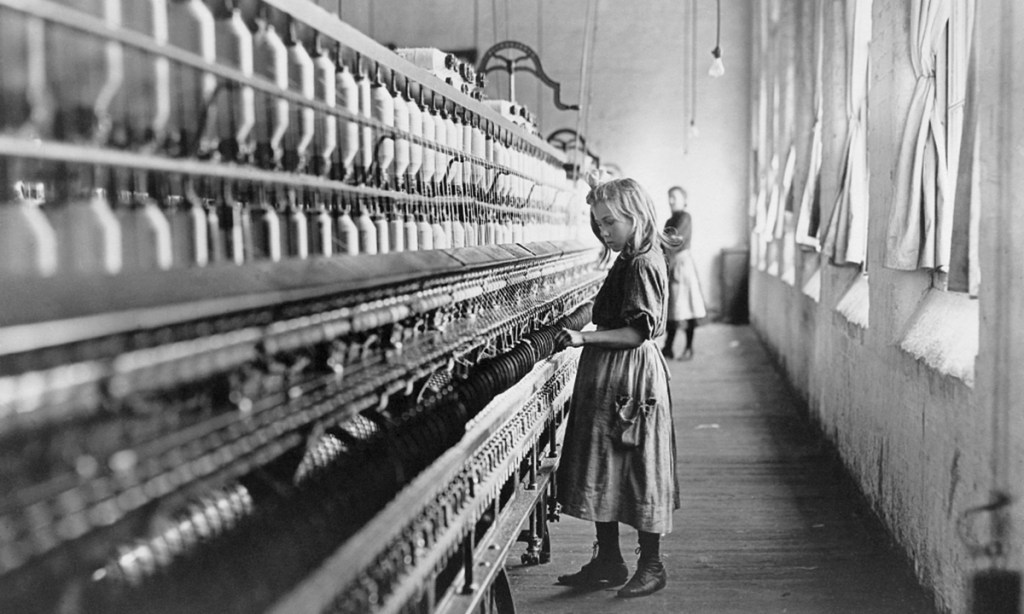
The immediate conclusion from reading Becker[1] might be that the relationship between sociology and documentary photography is a strong one. However, while they have the same fundamental objective of the exploration of social and culture, they go about it in almost opposing ways. Sociology bases itself in the science of gathering observed data or testimony, its analysis and logical conclusions. Photography creates a visual document of what the camera, and more importantly the photographer sees. They both need to be immersed in the ‘subject’ but sociologists view their technical approach as less prone to creative intervention. They believe the camera to be an objective instrument, but not in the hands of a creative photographer. In The Currency of the Photograph, Tagg[2] describes a presentation by Berenice Abbott where she describes realism being defined by the artist. This seems like a strange claim until we think about how we define reality. It’s almost as much about how it’s perceived, culturally and historically as it is about something being recorded. Documentary photography then follows the photographer’s physical process (lens selection, aperture, shutter speed etc) and incorporates their observation of the scene or event as a complimentary creative process. The viewing audience brings their own context in the reading of the elements that asserts whatever realism the image represents. In reality, both photography and the social sciences are constrained by the editorial practice. With the former, the results of analysis might not be shared widely of the message is potentially catastrophic (consider the impact of commercial logging on the climate being aimed more at the consumer rather than the communities who depend solely upon it). The famous ‘killing’ of negatives by FSA editor Roy Strkyer demonstrated this censorship. That series, like many others of the time sought to ‘document’ the plight of one area of society to another who was oblivious. The rise of the magazine editorial revealed topics such as child exploitation as in Lewis Hine’s photographs from Child Labors of the Carolinas[3], a collaborative paper with investigative journalist A J McKelway in 1909. The work was intended to both educate and shock the higher classes of American society from their apathy when it came to textiles. It is within works like Hine and The FSA that we see where the documentary genre borrows from others. For example, consider the image below:
No. 22.–LANCASTER S. C. Spinner. A type of many in the mill. If they are children of widows or of disabled fathers, they may legally work until nine p. m., while other children must legally quit at eight pm [Fig. 1]
The image is documentary because it records an example of a young child working in an dangerous environment. Here we have a strong connection with sociology, with girl’s details contained in the caption. The composition emphasises the scale by revealing the seemingly endless loom reaching out into the distance in a way similar to the leading lines of a landscape photograph. The exposure’s sublime aesthetic is also borrowed from the landscape genre to further emphasise the child’s tough life. When we look closely at the image, we see little movement in the girl. At this point in photography, film speed and artificial lighting was still fairly primitive, so its unsurprising that some level of staging in order to get the sharp picture that we see here. When we consider her expression, small stature and the context of the background worker, we can surmise that the image borrows from the portraiture genre.
Conclusion
In conclusion, the documentary covers many aspects of the human condition, whether about cultural development, behaviour or events that impact people and their environment. Documentary photography strives to faithfully reveal the subject and tell the story of it, but its direction is driven by what the photographer sees and their reaction to it. The criticism of photography from the sciences is that this creative ‘direction’ is more akin to art than evidence-based analysis. In reality there is always some direction taken by the audience for the work in both fields. As the genre covers some many areas of life from the everyday to the landmark events, documentary borrows from the other conventions such as portraiture and landscape, using them to emphasise the story behind the image or series. I’m interested in this genre because above all else, there is the common misconception that the camera tells the truth. How this idea can be used to subvert documentary is something I want to pursue in this unit.
Against the Learning Objectives
LO1: Compare the theoretical features, characteristics and histories of different photographic genres.
Read across the genre and its place within wider documentary. Reviewed the theoretical approach and incorporated areas that are borrowed from landscape and portraiture with examples. Reviewed the work of a number of practitioners who have worked in different areas of the genre
LO2: Deconstruct a given genres’ conventions and create visual material informed by that knowledge.
Deconstructed the visual ideas and approach to documentary. No creative work in the assignment aligned with this LO.
LO3: Produce new visual work informed by your research.
Not applicable for this assignment
LO4: Analyse the wider global contexts surrounding contemporary image making.
Not applicable for this assignment – the work focuses on the history of the genre.
[1] Becker, H. S. (1974) ‘Photography and Sociology’ In: Studies in the Anthropology of Visual Communication 1 (1) pp.3–26.
[2]Tagg, J. (2002) The burden of representation: essays on photographies and histories. (Transferred to digital print) Basingstoke: Palgrave Macmillan.
[3] A. J. McKelway (Alexander Jeffrey), 1866-1918. Child Labor in the Carolinas: [A]ccount of Investigations Made in the Cotton Mills of North and South Carolina, by Rev. A. E. Seddon, A. H. Ulm and Lewis W. Hine, under the Direction of the Southern Office of the National Child Labor Committee (s.d.) At: https://docsouth.unc.edu/nc/childlabor/childlabor.html(Accessed 03/04/2022).
● Becker, H. S. (1974) Photography and Sociology, Studies in VisualCommunication. Pg 3-26.
Reflect on the similarities (and differences) between social research and photography and documentary’s combination of a “journalistic and ethnographic style with a self-conscious and deliberate artistic purpose” (Becker, 1974: 5).
Follow the ‘reading images’ exercise as outlined by Becker (1974) in the above essay using any well known documentary photograph you wish or, as Becker advises, one that is presented in the essay.
● Use key words to describe the content of the image. What exactly is in the picture? What is it about? Note these down in your learning log / blog.
● Make a list of what you understand the ‘visual grammar and syntax’ of the picture.
● Can you identify and compare a number of images which show “pictures of something that was not done just for the photographer’s benefit” (Becker, 1974:14). Can you give an example of a picture which shows something or someone that was done for the photographer?Add notes and reflections to your learning log
Reflecting on Social Research and Photography
As the Documentary Traditions notes begin by directly quoting Becker[1], sociology and photography have been around for a similar amount of time. This opening line in Becker’s paper indicates that one methodology for exploring society is no more advanced or developed than the other, which appears to me to be a rare occurrence. Other genres of art that have been assigned to photography have their origins in classical art, which was the standard for all visual representations of subjects. Photography was the newcomer, so perhaps the assignment of traditional ways of looking at a subject from classical painting was to be expected. Photography could be used to ‘capture’ the scene, which Becker suggests is the root of the plausibility of photography for documentary – the myth that the camera merely records whatever is in front of it. While Becker goes on to suggest that photography as a tool can be turned to any avenue in the right hands (his typewriter analogy being that the machine doesn’t determine how it used), but the inherent believe of the photographic image as being objective underpins it. By contrast, ethnography which is defined as being way of qualitative research by immersing oneself in the culture or society[2], relies on observation, empirical proof of behaviours and traditions that take written form. Both approaches contain potential for ambiguity, photography tends to be influenced by how the photographer sees rather than what they see. Research as a science tends to avoid such bias. Becker goes on to make the point that as photography advanced, it was used more and more to highlight the societal or cultural issues that the public weren’t aware of. Photographers such as the group assembled by the Farm Security Administration to photograph the migration of the poor from Depression hit communities to the cities of America, were highlighting the situation that the subjects faced. However, as we also know they were not representing the suffering of the people alone, but documenting everything that they encountered which resonated with them. The editorial as the function that determined the ‘correct’ messaging for publication, which resulted in images being rendered unprintable [3]. The ‘conscious’ view of the photographer results, according the Becker, in the the separation between sociology and photography; photographers don’t back up their visual representations with research and sociologists don’t support their findings with photographs. For me, the two approaches to exploring society are essentially trying to achieve the same thing, a better appreciation for societal or cultural behaviours and problems, but from different directions. Both involved a deep understanding of their subject and reflect the real events, but sociology doesn’t ask the viewer to bring their own knowledge or experience to the reading of research, where documentary photography hasn’t really moved far from it’s artistic leanings. I wonder what the FSA series would have looked like with a few of the Walker Evans images, particularly the happy farmer and the young, middle-class black couple walking in Chicago, both of which were real observations, but were ‘killed’ by the editor[4]
Reading Images Example
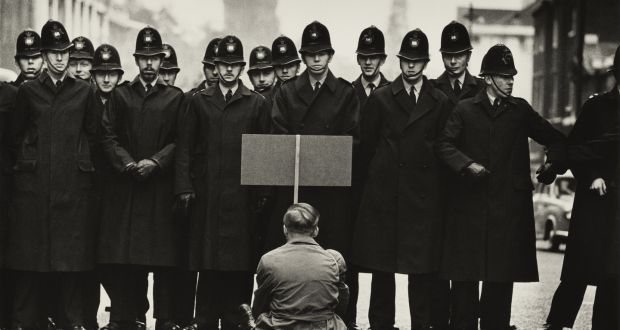
For my reading example, I’ve chosen this image by Don McCullin taking in London in 1963.
Fig 1. Don McCullin, Protester, Cuban Missile Crisis, Whitehall, London (1963)
Visual breakdown
The image contains a man sitting with his back to the camera, holding what looks like a placard. He is facing a line of British police officers in constable uniform, forming two lines across the frame. They are facing him. To the right of the scene, the line is one deep and has a gap in it. The last ‘complete’ officer to the right of the frame is reaching across to another who is partially out of frame. The scene is clearly a city street with the background detail blurred out of focus. The only other element is the partial view of a car in the broken line of police.
In interpreting what the image is about, we are immediately struck by the contrast of the characters. The police in their uniforms that appear black because the image is black and white, appear menacing when compared to the single man dressed in lighter, casual clothing. We cannot see his placard, so without the context of the title of the image, we cannot be clear on what it might say. When we include the title context, we assume it is a protest placard. I was struck by this image, because my immediate conclusion was that the barrier of police were somehow threatening the man, for reasons that include the above. However, I wondered why I had jumped to that conclusion. The man looks peaceful and in no way a threat to the police. My interpretation takes into account the way the police line isn’t complete. This raises the idea that the police feel vulnerable without that gap being filled, yet there are no other protestors present. It looks like an overreaction by them to a minimal threat. Of course, what is happening is that I am bringing to the reading, my own perspectives on the way that the police ‘manage’ protests, particularly peaceful ones. McCullin was documenting a protest during the Cuban Missile Crisis but Britain’s role was relatively small, with agreements being made for US arms to be located in nearby British colonies. The protest was therefore fairly distant., but without the context of what is written on the placard, we cannot know the strength of feeling at the time. My own perception is defined by protests that have occurred in my lifetime, some of which have been documented by photographers and film makers in a similar way to McCullin’s approach in this image. The protestor is being oppressed by the state via their police force. The identical uniforms and extreme visual contrast summon images of Nazism, even though there is nothing to suggest any trouble. In fact, when we look more closely a the image, the police officers look fairly relaxed, some are in fact smiling. The meaning of the image could just as easily be that the police were in the process of closing a street when the protestor arrived, perhaps being the first one to arrive. The visual language of the man being outnumbered by the police, the tonality and the way the composition allows for just the interplay between the people in the frame as context, evokes social post-memory which could be argued was as powerful then as it is now. I think this image is definitely more about the photographer’s perspective on the strength of the oppressed man than an actual document of the protest.
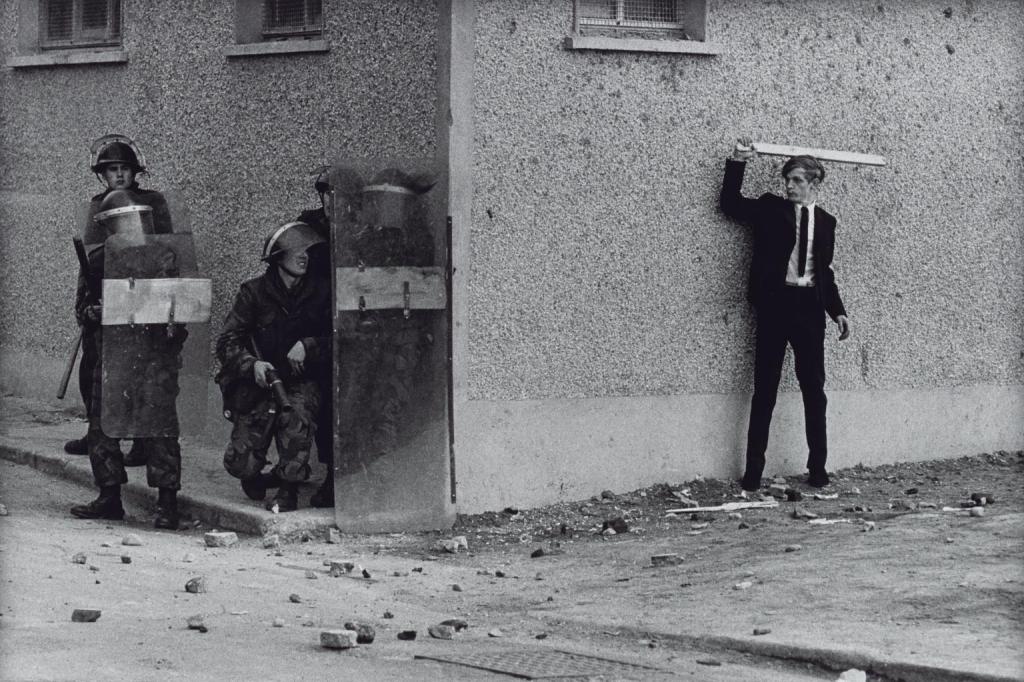
Examples of images that were not done for the benefit of the photographer include other work by McCullin. The image below was taken in Belfast during The Troubles. This shot is more in keeping with Cartier-Bresson’s decisive moment, with the two sides of the conflict about to clash on the street. The picture is one of a triptych of the ensuing confrontation.
Fig 2. Northern Ireland, The Bogside, Londonderry 1971, printed 2013 Don McCullin born 1935 ARTIST ROOMS Tate and National Galleries of Scotland. Purchased with the assistance of the ARTIST ROOMS Endowment, supported by the Henry Moore Foundation and Tate Members 2014 http://www.tate.org.uk/art/work/AR01189
This image contains similar elements to the previous one. A small force of riot police approach the edge of a wall, behind which a young man waits with a plank of wood. Unlike the previous photograph, McCullin has no control over the composition as the events are unfolding in front of him. We don’t know what has transpired before the sequence frames, but we can deduce from the scene that some form of pursuit is likely. McCullin is capturing the events unfolding but not approaching the image in the same pre-visual way.
In Becker, the comparison between socialolgy and documentary photography is described in terms of the approaches taken. The former is the based in scientific gathering of empirical data and its interpretation through analysis, while the latter tends towards the photographer’s reading of a scene. McCullin’s triptych, taken over a period of a few seconds, documents the impending ambush on the police in a way that lends itself to a more scientific data gathering than the first image.
When it comes to the photographer creating something for the benefit of themselves, I immediately thought of Walker Evans’ Subway series. The shots, taken using a hidden camera, are documents but are very much how Evans saw his fellow passengers. If he had shot them at regular intervals, say every 10 minutes, the resulting series would have been more methodical and arguably more ‘objective’
Recreate a well-known image in any of the 4 genres you have explored. Consider the conventions, styles and themes specific to the genre and how the image you choose to re-create speaks to those. You are free to interpret ‘re-creation’ as imaginatively as you like, subverting conventions or adhering to them.
Using the Challenging Genres Forumshare your work, including; your image, the image that inspired it and a short paragraph explaining your process.
Write up the activity on your learning log. After sharing the image and receiving some feedback, reflect on the experience in a short post on your learning log.
Introduction
“What all portraits have in common , in their overlapping and different ways is the central point that the portrait is a means employed to establish the identity of the sitters, regardless of whether they are viewed as a social problem or as human beings with positive features”.
David Bate, Photography: The Key Concepts, p 89.[1]
When I read Chapter 4 of Bate’s Photography: The Key Concepts, I was struck by this quotation. It followed an explanation of the evolution of the portraiture genre from early 19th Century societal pictures that demonstrated wealth and influence, through the working class use of it to establish identity or true likeness whether on one side of the law or the other, and onto the portrayal of someone’s personality. The quote essentially says that the establishment of identity of the sitter is common to all uses of portraiture to some extent.
For this exercise, I decided to look at a non-human portrait with the quotation in mind and read the image in terms of the 5 elements of portraiture that Bate describes. In doing so, I wanted to test whether the same conventions used with portraits of people apply with images of, say dogs.
The Image
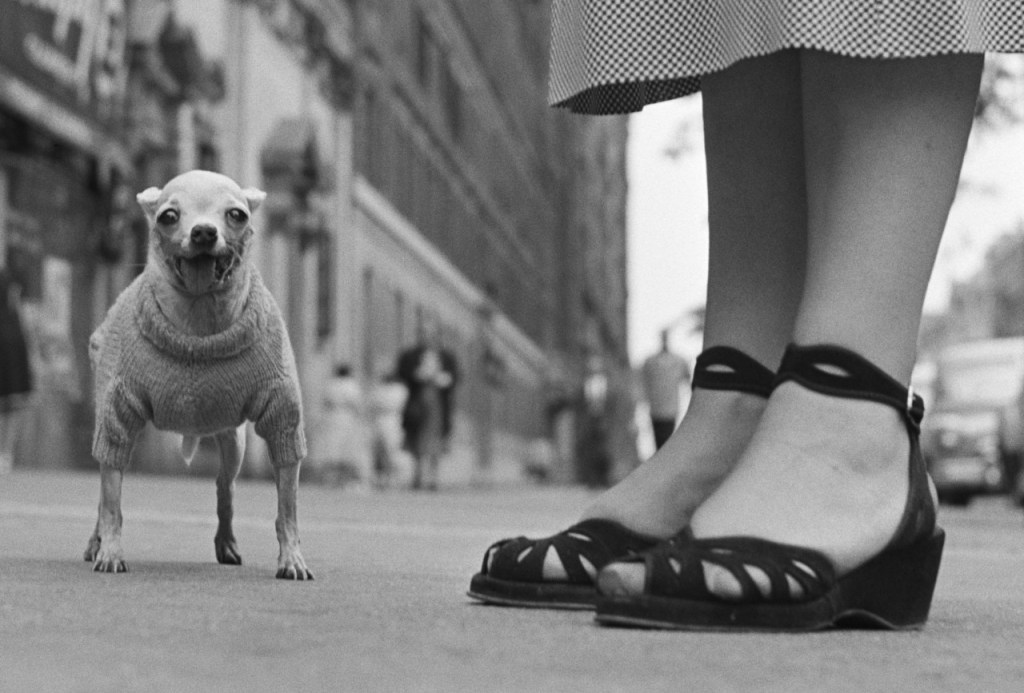
USA. New York City. 1946.[2]
This is one of the most famous images from Elliott Erwitt’s book Dogs (1998) and it shows a chihuahua standing on a sidewalk on New York City. The first question to consider is whether it is a portrait or documentary photograph because although there is a clear subject in the frame, Erwitt was a respected street photographer (a sub-genre of documentary). The image was also a severe crop from a much larger 6×6 frame – the crop is shown below:
Contact Sheet Print: Chihuahua New York [3]
When we look at the rest of the images from the roll, we can see the variety of angles and the natural movement of the owners being captured as if in a street photography style; only when the dog is isolated by the crop does the meaning change. I hope to demonstrate that it is a portrait by discussing the elements as laid out by Bate and how my process of recreating further established it for me.
Bate considers the 5 elements of a portrait as face, pose, clothing, location and props which all have an impact in this image. When we look at the dog’s face, we see the lively expression of a content animal. Our cultural understanding and appreciation of dogs as pets tells us that the panting expression means exercise, thirst or excitement. When I read the dog’s expression, my tendency is to see the latter, particularly given his gaze at the photographer. His pose tells us more about his character. Chihuahuas are small dogs, which is further borne out by his location and the scale of his owner’s feet. His pose, however connotes confidence with his wide, head-on stance. Combined with his face, he looks like a dog squaring up to something or someone, as if he doesn’t fear them. Now the face takes on the potential meaning that he is mid-bark, which further emphasises that he’s a confident dog. The clothing is a simple coat (black and white robs us of knowing if it was brightly coloured or not), but when considered with his surroundings and the seemingly elaborate shoes for dog-walking, the coat may connote a privileged class pet. The location of the image is clearly an American city sidewalk and we are informed of its actual location by the title. The location and what we know of NYC’s skyline plays a further part in emphasising the dog’s diminutive stature. The position of the dog with respect to his owner’s feet and legs completes the idea of his size belying his large personality. The props in the image for me are the shoes his owner is wearing. While they don’t really add impact, I think they work with the setting to connote their social standing.
My Image
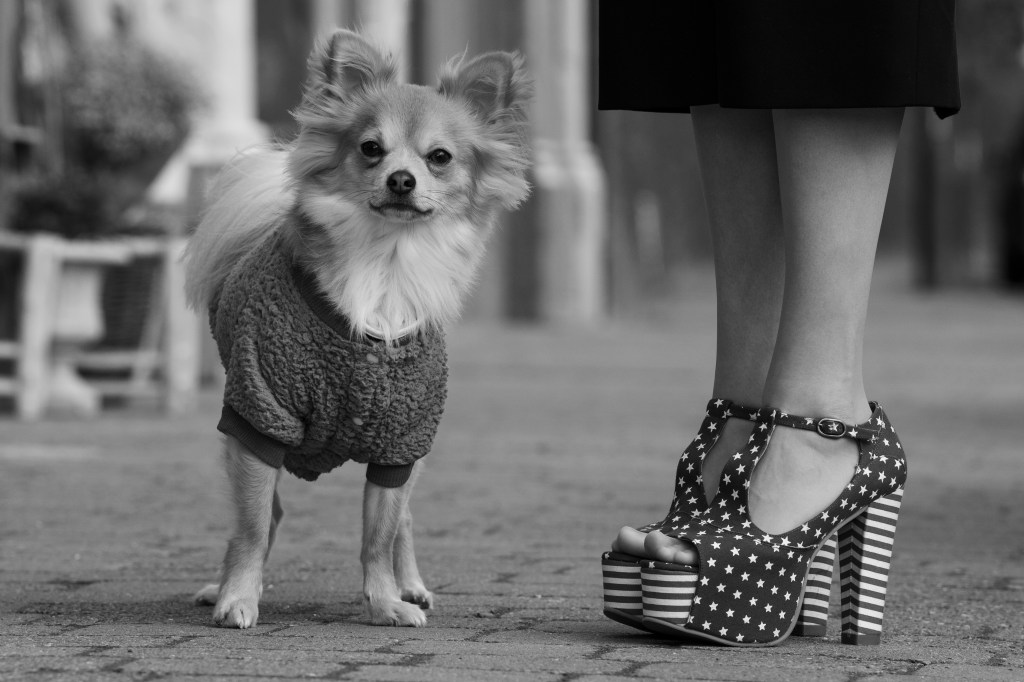
Chihuahua, Great Malvern (2022)
My approach to this image was to take a portrait of the dog (called Togo), with the same or similar conventions from the original image. The first difference is that I shot this picture while lying the ground and attempting to frame them in the same way. Togo is taller than original chihuahua but shares the relative scale that the breed is known for. His direct gaze, alert expression and stance are all similar with the exception of the panting – this image is defintely all about him. His coat when considered with the glamorous shoes suggests a cherished pet as in the original. The location is a street similar but much smaller than the original, so the scale isn’t as clear. To shift the establishment of location I included the context of the Stars and Stripes details on the shoes. Finally, the high heels and below-the-knee skirt emphasises Togo’s size in a similar way to the original image. However, it’s clear that the dog in Erwitt’s picture is smaller and stood a little behind his owner, which makes that difference much more impactful. I made the image black and white because I didn’t feel that including colour (dominated by the shoes) really added to the aesthetic and made it further from a recreation of the original picture.
Peer Group Feedback
I’ve now received some feedback from my peers. The image was generally seen as being a good recreation of the original. As I didn’t directly copy the picture (I wasn’t in the right city, didn’t have exactly the same dog, shoes etc), my interpretation of the picture from a portraiture perspective appears to worked within the conventions. When viewing the picture, the reaction is one of humour, both at the stature and personality of the dog and the choice of shoes as a prop. Moving the location of the picture from the background context to the prop in this way has added to the sense of fun in the overall image.
Reflection
In reflection, my objective was to take a non-human portrait and demonstrate that it does work with the conventions of portraiture. What Erwitt saw in the dog’s face and posture combined with his relative size to the surroundings, takes into account the conventions of portraiture as postulated by Bate. How these conventions balance is very important in terms of how the picture will be read. The viewer brings the vital interpretation of each element and the importance placed on each will determine the overall reading of the image. For example, an American might see the shoes as something patriotic in terms of the dog and owner’s identity rather than a signifier of the location. This actually happened when an American follower of mine on Instagram saw the picture – his first reaction was to express his being impressed by the shoes. In my recreation, there is a visual element that I removed in post processing in order to make it look more like the original. In my version Togo was on a short lead and a small piece of it was visible in the unedited version. I elected to remove this digitally to match the dog in the original who wasn’t being restrained. If I’d left it in the picture, the context of the dog’s pose changes, as well as his interaction with his location. An alternative reading of the image is now likely – some might see the dog as being less confident in some way. Either way, the elements that are being read are present. In cropping his image the way he did, Erwitt draws our attention to them rather than any other distractions such as the woman’s hands in the full frame.
Bibliography
[1] Bate, David (s.d.) Photography: The Key Concepts. (s.l.): (s.n.).



 Richard Fletcher OCA Photography Blog