Introduction
Project 5 has taken the idea of socially responsible documentary on from photographing people that might be unfamiliar, but from a similar culture, through to those historically termed ‘the others’. We have seen how cultures have been both actively and passively appropriated over time, and how contemporary artists are seeking to address these historical issues in their work. Most of the artists included in Project 5 were connected directly with the communities or cultures they were representing in their work, e.g. Ryan Christopher Jones with both his Mexican and American heritage, but what happens when the photographer is a total stranger to the ‘others’ they are trying to represent?
This assignment calls for a review of Assignment 2, in which we engaged with and photographed a community we were not part of, and I had chosen the Malvern Hills Trust volunteers. Reflecting on that work, I question whether the group could be considered as ‘the others’, given my connections to the town. Consider the questions posed by the brief:
What assumptions did you have about that community before you started the project?
Malvern is a largely white community, with only small number of Eastern European and Middle Eastern making up the general populous. It is also largely known as a retirement town, with many retirement homes and complexes in the area. These two pieces of knowledge led me to assume that the volunteers would be older white people who had retired and had the time to carry out this type of work. When I attended the shoot, my assumptions were largely correct, with the exception of the group leader (employed by the MHT) and Giles, a man in his early 30s.
Looking back at your project now, how did your assumptions shape the photographs you took? What stereotypes or visual tropes did you replicate?
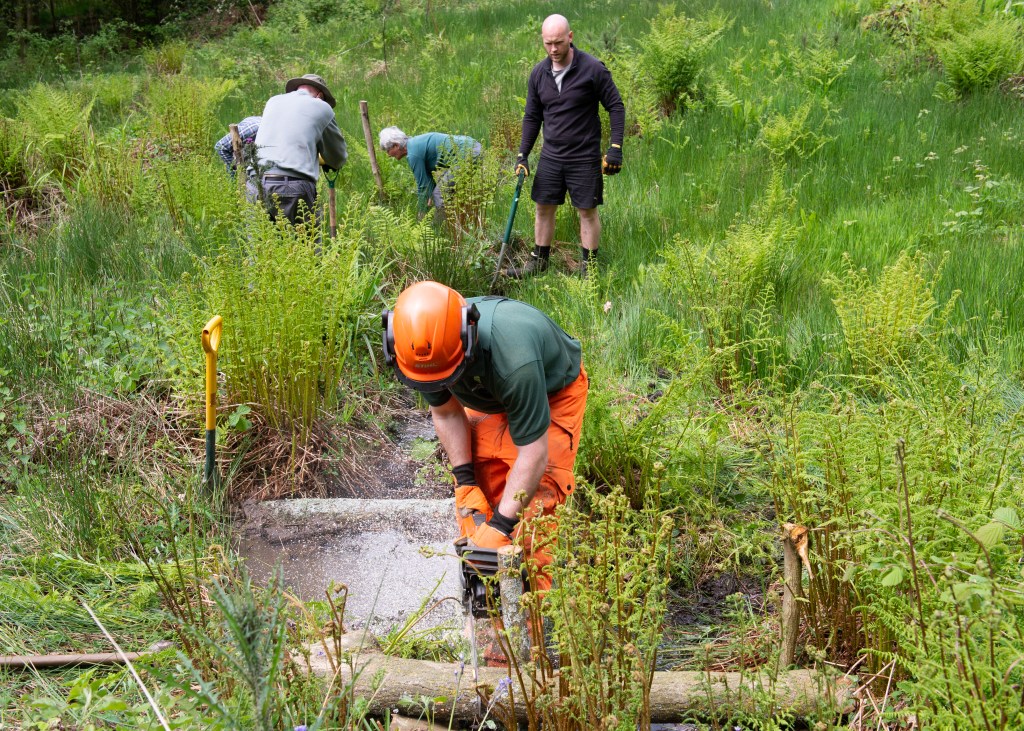
My assumptions guided my thinking on composition in the opposite way to the stereotypes of older people being somehow slower or frailer than younger people. The work they were doing was manual, gruelling, and required the use of tools, which is what I wanted to represent in the series. In the picture above, I show the leader of the group, Ben, operating a chainsaw with Giles just behind him. Although only Ben was trained and insured to use the chainsaw, the image visually conforms to the older people stereotype; the youngster uses the heavy equipment. I put this down to my own unconscious bias that is created by my being middle-age. In the rest of the series, only the images of the tea break conformed to a visual stereotype of British people in that tea breaks are very much part of our working culture.
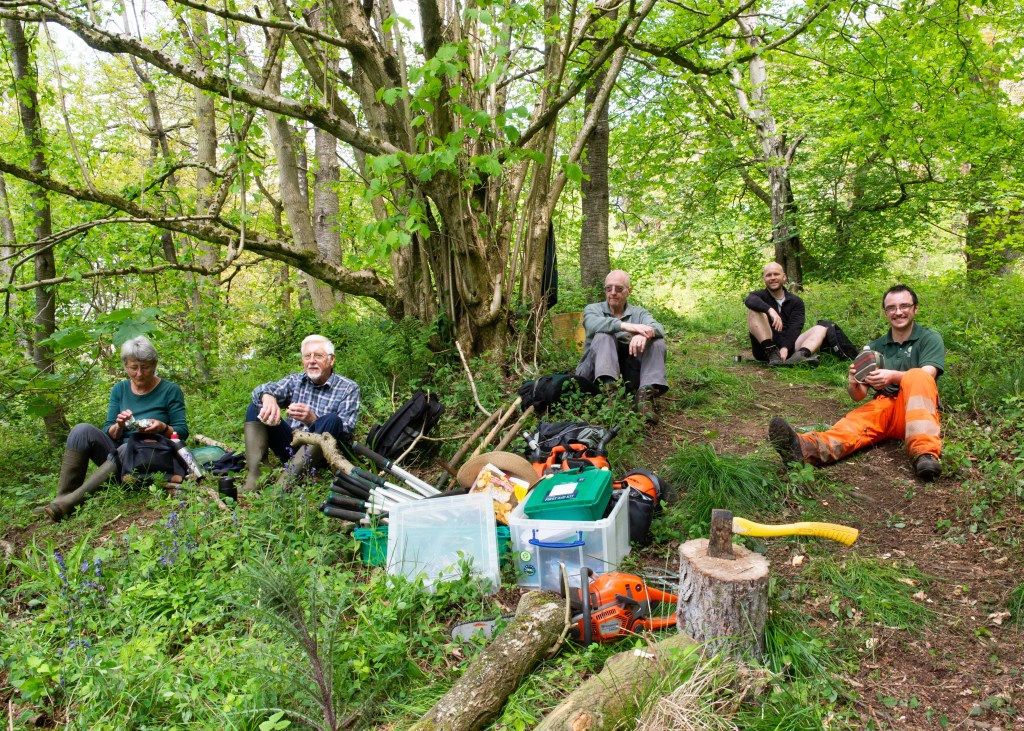
The fact that everyone was white was considered almost a given because I had no control over the group that I was engaged with. The other assumptions that I made were about the scenic nature of the work. Malvern is known to be a beautiful landscape, and my images visually represent this with the shots all being of the work and where it was situated. The dominant colours are derived from the greenery and the sky, and the light being typical of British summer.
Did making that work challenge your assumptions? How else have you learned to challenge your assumptions?
The only assumption challenged in the work is that the older generation cannot do physically demanding work. I was consciously seeking to reveal this about them after we first met. Aside from that, I don’t believe that I did enough to represent their passion for their own environment, focusing on the work more than the people. At this point in the course, we had been introduced to the ideas of getting to know the subjects, and I did spend time with each of them to do so. However, we had yet to encounter artists like Anthony Luvera and Margaret Mitchell, who had made their projects over many years, inviting more collaboration from them. This is something I am currently addressing in my SDP, having spent hours interviewing my subjects and exploring how they represent themselves before considering the context and balance of future series about the LGBTQ+ community. Ryan Jones’ work made me think about how an intended story can change as the work progresses and assumptions are disproved, with the idea of documenting housing issues in New York becoming a commentary on the inversion of the ideas of US prosperity and Mexican destitution.
If you were to re-do this project, how would you approach the project differently?
Approaching this project again, I would consider starting from a different place, as with Chimamanda Ngozi Adichie’s TED talk. Perhaps the series should have started with the need for the maintenance work and the efforts of MHT and its role in the community. Exploring the way MHT raises the profile of the environmental needs of the Malvern Hills could anchor the series in the socio-political landscape where climate change is a continuing worry. The call to arms nature of what the Trust’s volunteers could set the starting position for a documentary series about the work that introduces the people without any predisposed bias. It’s clear, as with Jones’s project, that the story could evolve to be more about the people involved the work and their motivations for being involved. I think this approach would reduce the risk of dwelling on stereotypes related to age.
With regard to my Self-directed Project
While there are a few stereotypes relating to Assignment 2, this reflection is probably more appropriate to my planned SDP. We learned that colonisation doesn’t only relate to race or culture, but also gender and sexuality. In Authority Collective (2020). The Photographers Guide to Inclusive Photography”, two authors gave advice on socially responsible photography of gender and, more specifically, the LGBTQAI community. As my project is about that community, its struggles and the continuing need for Pride, the latter of the articles resonated with me. In particular, I was drawn to the dangers of seeing the community as a curiosity and photographing the people as if they were some kind of show. The article makes the point that sexuality makes up only a small part of our identity, which is something I’ve observed in my interviews with my SDP subjects. We don’t walk around with a label that states our sexuality or gender identity, but for some reason people who are LGBTQAI are given labels and judged on the basis of them. One of the themes I want to explore is why straight people feel the need to label and categorise people who have one aspect of their identity that is different. With catagorisation comes stereotyping; all gay men are flamboyant and camp, all lesbian women are either classically glamorous or somehow masculine, etc. My subjects have universally raised the idea of referring to them as a community, as if they were some kind of social group, where the opposite is in fact the truth. From my perspective as a straight man who is an ally to LGBTQAI, I have to find away of staying clear of these stereotypes and the dangers of telling only one story about people that I have built relationships with, that have so far revealed interesting and complex lives behind identity.
 Richard Fletcher OCA Photography Blog