The Brief
This exercise is in preparation for the formal critical review in Assignment 5 at the end of the project. As given, the critical review brief is as follows:
- Compare the theoretical features, characteristics and histories of one or more photographic genres
- Use your research skills competently to deconstruct a given genres’ conventions
- Demonstrate an awareness of the multiple readings of the histories that have informed genre in a global context
The critical review takes the learning from parts 3 and 4 and picks up from the comparative analysis completed in Project 2, which can be found here:
https://richardfletcherphotography.photo.blog/2022/05/08/project-2-exercise-2-comparative-analysis/
For this exercise, I will briefly review the above analysis and update with what I’ve learned since. I will then decide on my area of interest for the review within this project.
Summary of Project 2: Exercise 2: Comparative Analysis
For the exercise, I chose two landscape images; Ansel Adams’ Moonrise over Hernandez, New Mexico (1941) and Richard Misrach’s Bonne Carre Slipway, Norco, Louisiana (1988). Both images are classical landscape in terms of their visual codes. My comparison related to the contextual emphasis of each image, rather than their aesthetic merits. With regard to the latter, I drew attention to the similarities and differences, one being black and white, both featuring manmade structures, one being more traditional in the use of thirds and the other, not so. However, with the context the two photographers differed considerably, despite them both being interested in conservation of the natural world. Adams’ image reveals the majesty of the landscape and man’s insignificance both in scale and when considered within the construct of religion. By contrast, Misrach’s image shows us how man is impacting the landscape, his subject being an oil refinery.
Having completed parts 3 and 4, I am now familiar with the works that formed the New Topographics exhibition in 1975, where the artists moved away from the aesthetic beauty of the landscape to show how construction and human behaviour fit within it. This made sense of where Misrach’s inspiration came from. The series that his picture comes from walks the viewer through the routine of petrochemical processing in Louisiana, an area that for most part is rural country. His images follow the landscape traditions in terms of composition, but having now covered the difference between the interpretations (beautiful, picturesque, sublime), I now appreciate the narratives that can be derived from them more. The series is actually terrifying, as the destruction of the natural world is almost desensitised owing to the world’s reliance of the fossil fuel being processed. Images of dead trees, hazardous waste dumps and abandoned dwellings reveal what has taken place and continues to do so at such a slow pace that nobody notices. Unlike Adams, Misrach is showing what we can’t or won’t see about how we live, in a similar way to the likes of Lewis Hines and Martha Rosler with their documentary advocacy.
Thoughts on a Critical Review
I considered revisiting my analysis as the context of the additional learning explained the motivation behind the images, Misrach’s in particular. However, I have been interested in a question from Part 4, which is related to landscape but could be applied to the other genres as well.
In Colin Pantall’s lecture and supporting presentation notes, titled The Way We See, Where We Look and What we Show, he said
“Landscapes can show the infrastructure of power, can show the dividing lines of power. Sometimes we don’t think of these as landscape, but they are, because that is the defining part of them”
(Colin Pantall Presentation, s.d., video timestamp 11m,50s)
At the point that he says this, the presentation is showing this photograph by Mohammed Borrouisa from his series Périphérique.
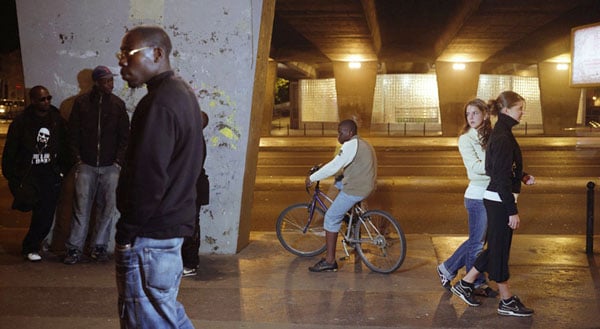
I was confused by the comment as Landscape was not my initial reading of this photograph. Instead, I believed it to be more documentary or one of the sub-genres, street photography. This was the basis for my critical analysis – what is it that makes this a landscape and how does the reading of the internal and external context affect our classification of a photograph?
The research for the essay can be found in the Padlet:
https://oca.padlet.org/richard5198861/x3zfpecfl3guc6yw
Essay Title
“Which is it? – How contexts can alter our interpretation of the genre of a photograph?”
Additional Note
At this point, I received feedback that my literal interpretation of the brief for Assignment 5 may result in lots of repetition. With this in mind, I focused my attention on gathering research and writing my submission. I am offering the draft as my completed essay, electing to update ahead of assessment if required. For this reason, there is no write-up for Exercises 2 and 3.
References
Colin Pantall Presentation (s.d.) At: https://oca.cloud.panopto.eu/Panopto/Pages/Viewer.aspx?id=7818fd51-11c1-4dec-b524-adc100b4b808 (Accessed 21/09/2022).
 Richard Fletcher OCA Photography Blog