The main focus of Project 4 is developing your own work. In support of that activity, use the Source Text and Case Study examples to further your practice and research as you develop your understanding and awareness of complex boundaries of artistic practice and research themes and genres.
Start by browsing the four sources below before returning to two of these in more depth.
The Source Texts – Notes
Part four introduces us to source texts that deal with the changing perspectives on landscape and how it has historically been represented, as well as exploration of our identity within the world. These are inextricably linked in the work of the artists and critics in this section and the first thing to note is the absence of boundaries between the genres exploited to tell these stories. In Colin Pantall’s Ways of Seeing, there are recognisable landscape photographs that obey the conventions of the beautiful, the picturesque and the sublime, mixed with a documentary and even ‘still life’ style such as the work of Ester Wonplon. Her series explores the threat to the glaciers caused by climate change in a mixed media presentation.
Her theme is one of documentary in the traditions of the advocates of the early 20th Century. She highlights the impact of human behaviour but set against the specific backdrop of the landscape. Pantall discusses the move away from straight representation of the landscape with the New Topographics exhibition in 1975, which focused on more man’s place and influence on it. The aesthetics were significantly different, but the ideas were important because they now started to associate our identity in terms of the world around us. When we consider these additional elements, such as buildings, telegraph poles etc, we can connect with the idea of an object’s impact on the landscape. Artists are able to blur the lines between the landscape genre and still-life in order to say something that is inherently documentary. With Wonplon’s series, the sheets of fabric used to reflect the sun’s rays and keep the ice cool, are themselves treated in some frames as still life. The images become more about the futility of the idea, with the frayed fabric suffering from the environment that it is being used to protect. It speaks to the desperation and arrogance of man; that the impact of human behaviour could be restricted once the damage has been done.
In Sibusiso Bheka’s At Night They Walk With Me, the artist explores the evolving landscape of his home town of Johannesburg, viewed at night. He brings perceptions of the streets and neighbourhoods from his childhood into the work, revealing how areas take on a different feeling to the daytime, how the people behave towards each other etc. The idea of a landscape shaping and being shaped by people draws on the conventions of portraiture and documentary in the context of observation. The work invites the viewer to appreciate the sense of community after hours, while making it clear that the progressiveness of Joburg, and it’s continuing battles with poverty and crime, still has a long way to go. Some of these themes are also present in the other source texts, but I’ll be returning to this specifically in Part 2 of the exercise. In Stacey Tyrell’s Self-Portrait and the Colonial Gaze Padlet, the artist explores the preconceptions of her origins as seen through the eyes of a black girl growing up in a predominantly white region. She looks at how her ancestry and DNA comprises a significant mix of European and African ethnicities, but she was never comfortable or culturally expected to celebrate her non-black origin. Her self-portraits take their cues from traditional painted images of white icons, with her playing the white part using make-up. The questions it raised with me were around appropriation, hers in playing the part of another ethnicity (much like Nikki S Lee, who Tyrrel cites as an inspiration), but also by society. We associate world regions with races in a way that is rooted in history, or more importantly the documentation of history. Black people are associated with Africa and the Caribbean, and white people, Europe etc. Even though the modern world has a greater understanding of our mixed origins through DNA technology, these associations are almost as rigid as those for the portraiture genre itself.
In Chris Coekin’s Forwards and Backwards in Time, we see an exploration of identity from within a community, where there is an ideological bubble around its people, as well as an observer of where a community sits within the grander idea of British society. Coekin’s inspirations are artists who have taken an idea of how an area of society lives or is expected to behave, and both celebrates and challenges those stereotypes. I was particularly drawn to Case Histories by Boris Mikhailov, which explores the effects of the break up the USSR on the people of Ukraine. His images contrast the progression of capitalism and the idea of prosperity away from the Soviet regime, with the destitution, poverty and abuse of the disaffected. The photographer invites the viewer to see the people through their obviously desperate circumstances, even paying them to strip nude to make the point. His pictures don’t create a sense of poverty tourism however, but instead document the fact that they exist in a society that generally dismisses them. This work is even more poignant with the present day conflict in Ukraine, leaving the viewer wondering what might become of these people in the long term. In Coekin’s own work, he explores a variety of societal constructs, including the working class and the idea of free roaming in the UK. I’ll be looking at his work more closely in part two of this exercise.
In the final source text, Andy Hughes explores the human impact on the ocean environment with his series ‘Dominant Wave Theory’ about plastic pollution. The images are still-life, taking their cues from momento mori, defined as:
…a Latin phrase meaning ‘remember you must die’. A basic memento mori painting would be a portrait with a skull but other symbols commonly found are hour glasses or clocks, extinguished or guttering candles, fruit, and flowers.
(Tate, s.d.)
Closely linked to Vanitas, which was the sub-genre of still life painting that looked at in Assignment 2[2], the idea of remembering our mortality comes through in Hughes’ images, where the scale and position of the objects within the frame give the viewer nowhere else to look. With each image, the object is made to represent something different from what it actually is. An example can be seen below:
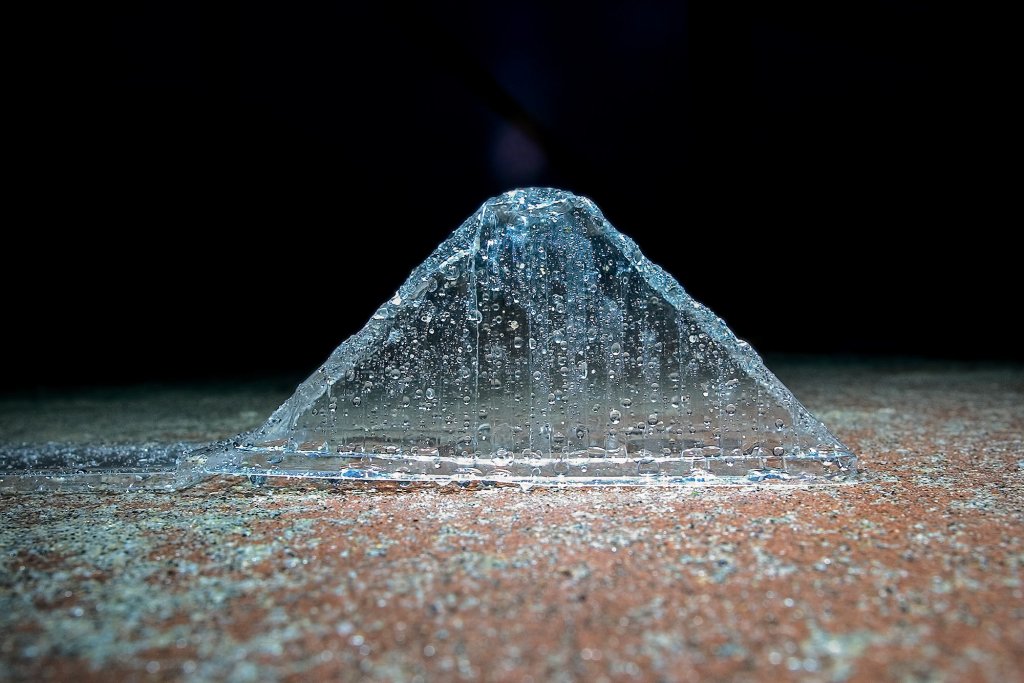
In this picture, a discarded sandwich wrapper rises from the floor like a mountain. Its appearance resembles the classical representation of mountains, in particular the iconic view of Mount Fuji in Japan. The use of shallow depth of field gives the sense that the object is being viewed from far away, which further enhances the illusion of the wrapper being transformed. The image utilises other visual codes that suggest that no good comes from this plastic object, namely the black backround from which it is revealed. The suggestion here is that at some point, there will be nothing else other than plastic in the natural world. The wet surface suggests it being impervious to the elements, which predicts the fact the object will not degrade quickly. All of these things serve to shock the viewer back into realising that it’s just a sandwich wrapper, but that it could mean so much more if the human disregard for waste continues. Like the Vanitas paintings of the 17th Century, the use of simple objects as powerful symbols convey much more than they do at first.
Conclusion
In conclusion, each of the source texts use a particular genre to describe something about mankind, either on a macro level (our impact on the environment and attitudes towards it) or on a micro level (specific cultural behaviours and histories). For me, they are all equally effective but I found the use of landscape and still-life most interesting. There is a clear overlap between landscape and documentary within Pantall’s Ways of Seeing, which I intend to explore further. I was also drawn towards Coekin’s combination of portraiture and documentary, which is an area I touched on in Assignment 3, but need to investigate in light of my feedback from that work.
References
[1] ESTER VONPLON_Nuit de l’Année 2015 (2015) At: https://vimeo.com/143865219 (Accessed 10/08/2022).
[2] Tate (s.d.) Memento mori. At: https://www.tate.org.uk/art/art-terms/m/memento-mori (Accessed 10/08/2022).
[3] richardfletcherphotographyblog (2022) Assignment 2: Analysis Through Making. At: https://richardfletcherphotography.photo.blog/2022/05/19/assignment-2-analysis-through-making/ (Accessed 10/08/2022).
[4] dominantwavetheory (s.d.) At: https://www.andyhughes.net/dominant_wave_theory.html (Accessed 10/08/2022).
 Richard Fletcher OCA Photography Blog