For this exercise, I have chosen two landscape photographs; Moonrise over Hernandez, New Mexico (1941), by Ansel Adams and Bonne Carre Slipway, Norco, Louisiana (1988), by Richard Misrach
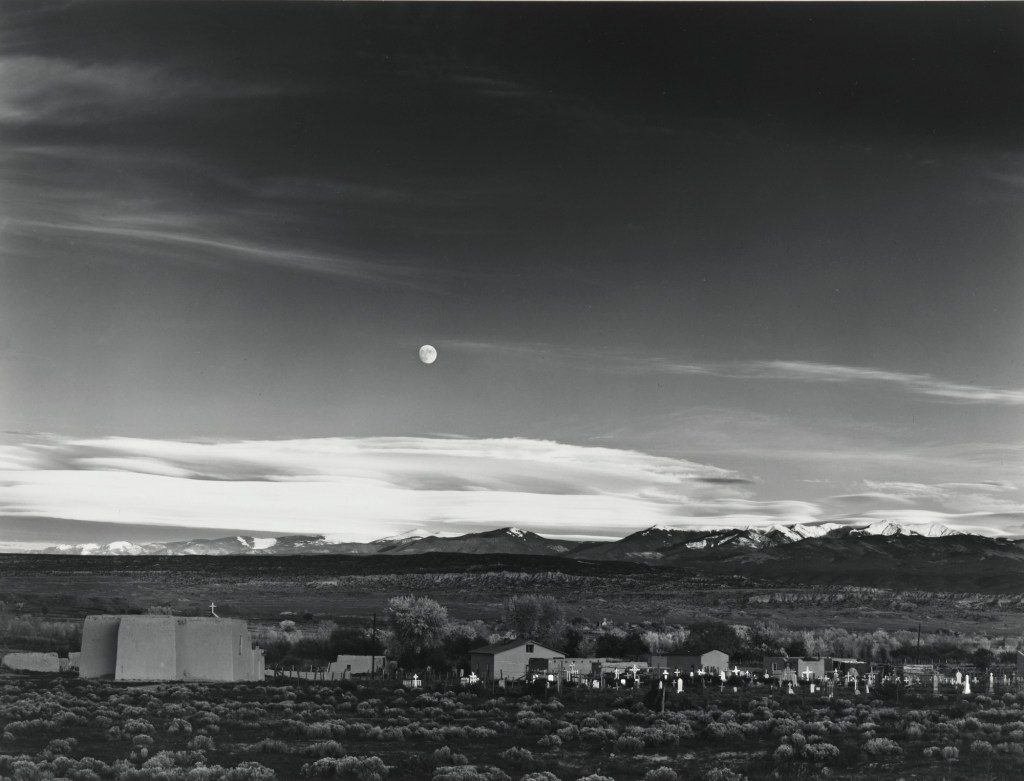
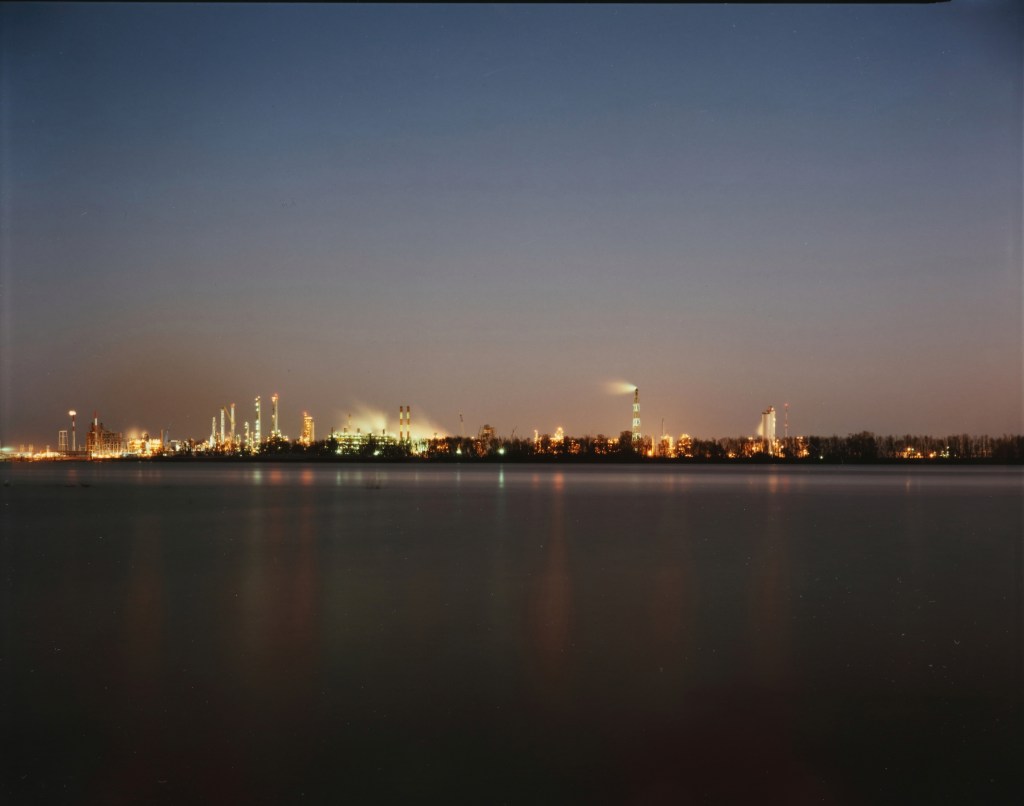
These images are visually very similar, both depicting a wide-open landscape with some form of human presence within the frame. They are both shot on large format film with the obvious difference being one is colour and the other is black and white. Moonrise… is perhaps the most famous image by Adams, probably the most recognised landscape photographer in history. This image is famous for the story about how it was made almost as much as the composition. Adams was travelling back from a failed day’s shooting and saw the gibbous moon, lit by the fading sunset. He rushed to set the camera up, couldn’t find his light meter and worked out the exposure from his knowledge of the luminance of the moon. The story reinforced the legend of Adams as a ‘technical’ photographer. Misrach’s image, has no back story, being part of a documentary series about the impact of the petrochemical industry on the environment in ‘cancer alley'[1], a region of Louisiana. Outside of the artistic intensions, the images have other visual differences. Moonrise… is very precise and sharp, exposed carefully for the moon’s luminance, whereas Misrach’s picture is a deliberately long exposure. The fine details of the refinery are lost in the flattened movement of the water and the smoke rising from the buildings. Where Adams captures the natural light impacting on the buildings, Misrach represents the light pollution impacting on the environment; the antithesis of each other. The technical codes used create a sense of wonder in Adams’s picture and his familiar use of scale makes the manmade part less significant in the context of the desert space, where Misrach’s image is depressing. The light pollution creates artificial colour in the sky and is reflected in the water in lines that lead towards the viewer. Misrach’s image relies on colour to create this mood.
I chose these pictures because of the aesthetic similarities and the obvious technical codes that identify each as landscape. They also both contain natural and man-made context in similar compositions. However, it is clear that even without knowing of either artist’s work, they are very different ‘cultural tones’. Where one is rich in detail and natural beauty (then moon, the almost clear sky and the highlights from the sun setting behind the viewer), the other is devoid of the same elements. The composition is simpler but the use of polluting rather than natural light immediately sets this in a environmental/political space. It’s no longer a pure landscape but a documentary protest. With the rest of Misrach’s series, the images serve as a stark warning. Adams’ image isn’t part of a series, but an observation of a moment of natural beauty. Both could be argued to be ‘documents’, but Misrach’s is more of a commentary on man’s destruction of his environment.
“I photographed the landscape, but where it collided with civilization,” he said…
…while Misrach outgrew Adams’ influence, he still reveres the nature photographer. In fact, he has a typewritten letter Adams sent him in 1979 framed on his wall at home. Adams had sent it to Misrach’s first gallery, expressing his admiration for the work…
…“He’s still my hero,” Misrach said.
(Richard Misrach Photographer | All About Photo, s.d.)
References
[Fig 1] Unearthing the Enigma of Moonrise Hernandez Murals – AAG (2020) At: https://www.anseladams.com/a-halloween-story-moonrise-hernandez/ (Accessed 07/05/2022).
[Fig 2] Petrochemical America by Richard Misrach (210PH) — Atlas of Places (s.d.) At: https://atlasofplaces.com/photography/petrochemical-america/ (Accessed 07/05/2022).
Bibliography
[1]Petrochemical America by Richard Misrach (210PH) — Atlas of Places (s.d.) At: https://atlasofplaces.com/photography/petrochemical-america/ (Accessed 07/05/20
[2] Richard Misrach Photographer | All About Photo (s.d.) At: https://www.all-about-photo.com/photographers/photographer/61/richard-misrach (Accessed 07/05/2022).
 Richard Fletcher OCA Photography Blog
Pingback: Project 5 – Exercise 1: Planning you area of interest | Richard Fletcher OCA Photography Blog