Create a Padlet that presents a critical and reflective summary of the conventions, expectations and meanings of a genre of your choosing.
For this assignment you will use Padlet to present a summary of your understanding of the key concepts (conventions, expectations, meanings) of a chosen genre from the materials you have engaged with. The readings, research and activities will have enabled you to think about genre in a variety of ways and you can reflect on this in your assignment.
Within Padlet you can use image, video, text and sound as ways to summarise and critically reflect on what you have discovered so far. It will be useful to go back over your learning log and think about the ideas that have sparked your interest.
You may wish to write freely in a journal style extended reflection to give yourself room to explore and think through your ideas about genre so far. This could be presented on your learning log and then summarised or tightened into a shorter version for the Padlet presentation. Alternatively, you could format this as a PDF and upload to your padlet.
This assignment will be built upon throughout the rest of the course, so although you may choose one genre for focus now, by the end of the course you will have explored and created work across Landscape, Documentary, Portraiture and Still Life.
Suggested 750 words/annotation, or 6 minute presentation.
Ensure you correctly credit and reference any images/quotes used throughout the course.
You may find it useful to compare and explore areas of similarity or difference across Landscape, Documentary, Portraiture, and Still Life. Consider theoretical features, characteristics, histories, and techniques. How has this project enabled you to think differently or expand your understanding of particular elements of the genre you have studied?
Introduction
The genre I have chosen is Documentary, owing to its close relationship and maturity to the social sciences, principally sociology. While it is clearly not the only genre to focus on the exploration of human society, it is a genre where the ideas of objectivity and creativity are blurred. The idea of documentary suggests ‘truth’, which drives both the academic exploration of culture and is believed implicit in documentary photography. However, as we have learned in previous units, the concept of the camera faithfully documenting what it sees is a flawed foundation upon which to build an understanding.
During the reading around Documentary, I have created a Padlet to show how the various ideas and relationships between the academic and the artistic approaches are connected. It can be found at this address:
https://oca.padlet.org/richard5198861/w68jsm0wo53epcly
Analysis of the Documentary Genre (750 words)
The immediate conclusion from reading Becker[1] might be that the relationship between sociology and documentary photography is a strong one. However, while they have the same fundamental objective of the exploration of social and culture, they go about it in almost opposing ways. Sociology bases itself in the science of gathering observed data or testimony, its analysis and logical conclusions. Photography creates a visual document of what the camera, and more importantly the photographer sees. They both need to be immersed in the ‘subject’ but sociologists view their technical approach as less prone to creative intervention. They believe the camera to be an objective instrument, but not in the hands of a creative photographer. In The Currency of the Photograph, Tagg[2] describes a presentation by Berenice Abbott where she describes realism being defined by the artist. This seems like a strange claim until we think about how we define reality. It’s almost as much about how it’s perceived, culturally and historically as it is about something being recorded. Documentary photography then follows the photographer’s physical process (lens selection, aperture, shutter speed etc) and incorporates their observation of the scene or event as a complimentary creative process. The viewing audience brings their own context in the reading of the elements that asserts whatever realism the image represents. In reality, both photography and the social sciences are constrained by the editorial practice. With the former, the results of analysis might not be shared widely of the message is potentially catastrophic (consider the impact of commercial logging on the climate being aimed more at the consumer rather than the communities who depend solely upon it). The famous ‘killing’ of negatives by FSA editor Roy Strkyer demonstrated this censorship. That series, like many others of the time sought to ‘document’ the plight of one area of society to another who was oblivious. The rise of the magazine editorial revealed topics such as child exploitation as in Lewis Hine’s photographs from Child Labors of the Carolinas[3], a collaborative paper with investigative journalist A J McKelway in 1909. The work was intended to both educate and shock the higher classes of American society from their apathy when it came to textiles. It is within works like Hine and The FSA that we see where the documentary genre borrows from others. For example, consider the image below:
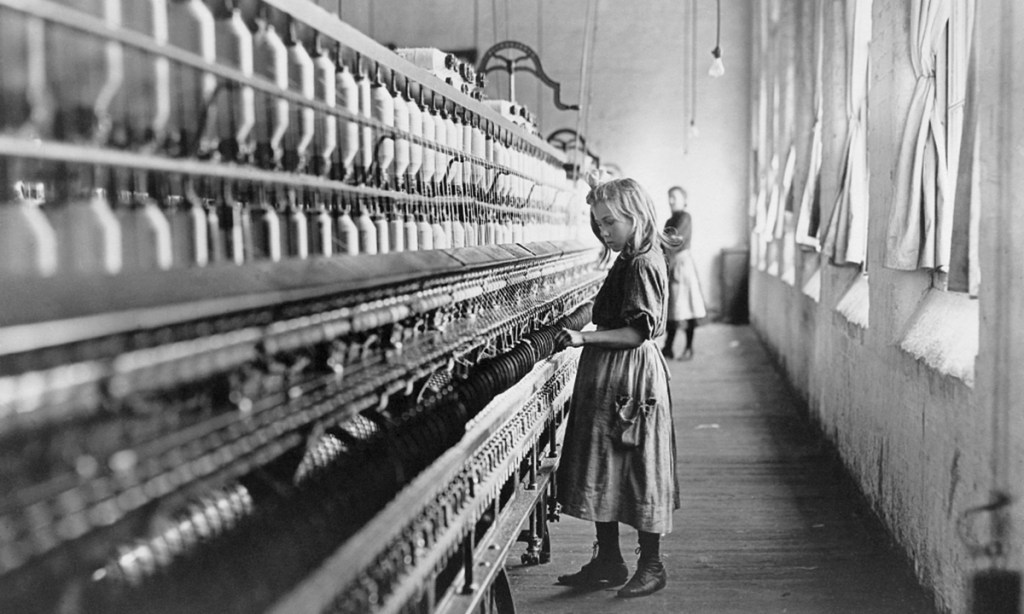
Spinner. A type of many in the mill. If they are children of widows or of disabled fathers, they may legally work until nine p. m., while other children must legally quit at eight pm [Fig. 1]
The image is documentary because it records an example of a young child working in an dangerous environment. Here we have a strong connection with sociology, with girl’s details contained in the caption. The composition emphasises the scale by revealing the seemingly endless loom reaching out into the distance in a way similar to the leading lines of a landscape photograph. The exposure’s sublime aesthetic is also borrowed from the landscape genre to further emphasise the child’s tough life. When we look closely at the image, we see little movement in the girl. At this point in photography, film speed and artificial lighting was still fairly primitive, so its unsurprising that some level of staging in order to get the sharp picture that we see here. When we consider her expression, small stature and the context of the background worker, we can surmise that the image borrows from the portraiture genre.
Conclusion
In conclusion, the documentary covers many aspects of the human condition, whether about cultural development, behaviour or events that impact people and their environment. Documentary photography strives to faithfully reveal the subject and tell the story of it, but its direction is driven by what the photographer sees and their reaction to it. The criticism of photography from the sciences is that this creative ‘direction’ is more akin to art than evidence-based analysis. In reality there is always some direction taken by the audience for the work in both fields. As the genre covers some many areas of life from the everyday to the landmark events, documentary borrows from the other conventions such as portraiture and landscape, using them to emphasise the story behind the image or series. I’m interested in this genre because above all else, there is the common misconception that the camera tells the truth. How this idea can be used to subvert documentary is something I want to pursue in this unit.
Against the Learning Objectives
LO1: Compare the theoretical features, characteristics and histories of different photographic genres.
Read across the genre and its place within wider documentary. Reviewed the theoretical approach and incorporated areas that are borrowed from landscape and portraiture with examples. Reviewed the work of a number of practitioners who have worked in different areas of the genre
LO2: Deconstruct a given genres’ conventions and create visual material informed by that knowledge.
Deconstructed the visual ideas and approach to documentary. No creative work in the assignment aligned with this LO.
LO3: Produce new visual work informed by your research.
Not applicable for this assignment
LO4: Analyse the wider global contexts surrounding contemporary image making.
Not applicable for this assignment – the work focuses on the history of the genre.
References
Figures
[Fig. 1] Child labor, a sore spot in US’ human rights record – Global Times (s.d.) At: https://www.globaltimes.cn/page/202106/1225421.shtml (Accessed 03/04/2022).
Bibliography
[1] Becker, H. S. (1974) ‘Photography and Sociology’ In: Studies in the Anthropology of Visual Communication 1 (1) pp.3–26.
[2]Tagg, J. (2002) The burden of representation: essays on photographies and histories. (Transferred to digital print) Basingstoke: Palgrave Macmillan.
[3] A. J. McKelway (Alexander Jeffrey), 1866-1918. Child Labor in the Carolinas: [A]ccount of Investigations Made in the Cotton Mills of North and South Carolina, by Rev. A. E. Seddon, A. H. Ulm and Lewis W. Hine, under the Direction of the Southern Office of the National Child Labor Committee (s.d.) At: https://docsouth.unc.edu/nc/childlabor/childlabor.html(Accessed 03/04/2022).
 Richard Fletcher OCA Photography Blog
This is a really interesting read Richard. I also found your Padlet very clear, logical and easy to follow and of course, up to your usual standard of excellent thoroughness. Like you I find documentary photography interesting, when I first started the course I thought that the camera showed impartial truth, but I was soon disabused of this theory. However, I do very much like the process of recording and documenting, partly an engineering thing I guess. Anyway, good, interesting post and I am looking forward to see how your work develops on this unit.
LikeLike