From the Documentary Traditions Course Note:
Exercise 1: Humanism
● Becker, H. S. (1974) Photography and Sociology, Studies in Visual Communication. Pg 3-26.
Reflect on the similarities (and differences) between social research and photography and documentary’s combination of a “journalistic and ethnographic style with a self-conscious and deliberate artistic purpose” (Becker, 1974: 5).
Follow the ‘reading images’ exercise as outlined by Becker (1974) in the above essay using any well known documentary photograph you wish or, as Becker advises, one that is presented in the essay.
- ● Use key words to describe the content of the image. What exactly is in the picture? What is it about? Note these down in your learning log / blog.
- ● Make a list of what you understand the ‘visual grammar and syntax’ of the picture.
- ● Can you identify and compare a number of images which show “pictures of something that was not done just for the photographer’s benefit” (Becker, 1974:14). Can you give an example of a picture which shows something or someone that was done for the photographer?Add notes and reflections to your learning log
Reflecting on Social Research and Photography
As the Documentary Traditions notes begin by directly quoting Becker[1], sociology and photography have been around for a similar amount of time. This opening line in Becker’s paper indicates that one methodology for exploring society is no more advanced or developed than the other, which appears to me to be a rare occurrence. Other genres of art that have been assigned to photography have their origins in classical art, which was the standard for all visual representations of subjects. Photography was the newcomer, so perhaps the assignment of traditional ways of looking at a subject from classical painting was to be expected. Photography could be used to ‘capture’ the scene, which Becker suggests is the root of the plausibility of photography for documentary – the myth that the camera merely records whatever is in front of it. While Becker goes on to suggest that photography as a tool can be turned to any avenue in the right hands (his typewriter analogy being that the machine doesn’t determine how it used), but the inherent believe of the photographic image as being objective underpins it. By contrast, ethnography which is defined as being way of qualitative research by immersing oneself in the culture or society[2], relies on observation, empirical proof of behaviours and traditions that take written form. Both approaches contain potential for ambiguity, photography tends to be influenced by how the photographer sees rather than what they see. Research as a science tends to avoid such bias. Becker goes on to make the point that as photography advanced, it was used more and more to highlight the societal or cultural issues that the public weren’t aware of. Photographers such as the group assembled by the Farm Security Administration to photograph the migration of the poor from Depression hit communities to the cities of America, were highlighting the situation that the subjects faced. However, as we also know they were not representing the suffering of the people alone, but documenting everything that they encountered which resonated with them. The editorial as the function that determined the ‘correct’ messaging for publication, which resulted in images being rendered unprintable [3]. The ‘conscious’ view of the photographer results, according the Becker, in the the separation between sociology and photography; photographers don’t back up their visual representations with research and sociologists don’t support their findings with photographs. For me, the two approaches to exploring society are essentially trying to achieve the same thing, a better appreciation for societal or cultural behaviours and problems, but from different directions. Both involved a deep understanding of their subject and reflect the real events, but sociology doesn’t ask the viewer to bring their own knowledge or experience to the reading of research, where documentary photography hasn’t really moved far from it’s artistic leanings. I wonder what the FSA series would have looked like with a few of the Walker Evans images, particularly the happy farmer and the young, middle-class black couple walking in Chicago, both of which were real observations, but were ‘killed’ by the editor[4]
Reading Images Example
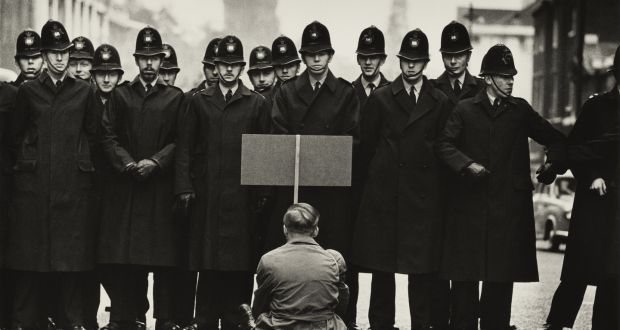
For my reading example, I’ve chosen this image by Don McCullin taking in London in 1963.
Visual breakdown
The image contains a man sitting with his back to the camera, holding what looks like a placard. He is facing a line of British police officers in constable uniform, forming two lines across the frame. They are facing him. To the right of the scene, the line is one deep and has a gap in it. The last ‘complete’ officer to the right of the frame is reaching across to another who is partially out of frame. The scene is clearly a city street with the background detail blurred out of focus. The only other element is the partial view of a car in the broken line of police.
In interpreting what the image is about, we are immediately struck by the contrast of the characters. The police in their uniforms that appear black because the image is black and white, appear menacing when compared to the single man dressed in lighter, casual clothing. We cannot see his placard, so without the context of the title of the image, we cannot be clear on what it might say. When we include the title context, we assume it is a protest placard. I was struck by this image, because my immediate conclusion was that the barrier of police were somehow threatening the man, for reasons that include the above. However, I wondered why I had jumped to that conclusion. The man looks peaceful and in no way a threat to the police. My interpretation takes into account the way the police line isn’t complete. This raises the idea that the police feel vulnerable without that gap being filled, yet there are no other protestors present. It looks like an overreaction by them to a minimal threat. Of course, what is happening is that I am bringing to the reading, my own perspectives on the way that the police ‘manage’ protests, particularly peaceful ones. McCullin was documenting a protest during the Cuban Missile Crisis but Britain’s role was relatively small, with agreements being made for US arms to be located in nearby British colonies. The protest was therefore fairly distant., but without the context of what is written on the placard, we cannot know the strength of feeling at the time. My own perception is defined by protests that have occurred in my lifetime, some of which have been documented by photographers and film makers in a similar way to McCullin’s approach in this image. The protestor is being oppressed by the state via their police force. The identical uniforms and extreme visual contrast summon images of Nazism, even though there is nothing to suggest any trouble. In fact, when we look more closely a the image, the police officers look fairly relaxed, some are in fact smiling. The meaning of the image could just as easily be that the police were in the process of closing a street when the protestor arrived, perhaps being the first one to arrive. The visual language of the man being outnumbered by the police, the tonality and the way the composition allows for just the interplay between the people in the frame as context, evokes social post-memory which could be argued was as powerful then as it is now. I think this image is definitely more about the photographer’s perspective on the strength of the oppressed man than an actual document of the protest.
Examples of images that were not done for the benefit of the photographer include other work by McCullin. The image below was taken in Belfast during The Troubles. This shot is more in keeping with Cartier-Bresson’s decisive moment, with the two sides of the conflict about to clash on the street. The picture is one of a triptych of the ensuing confrontation.
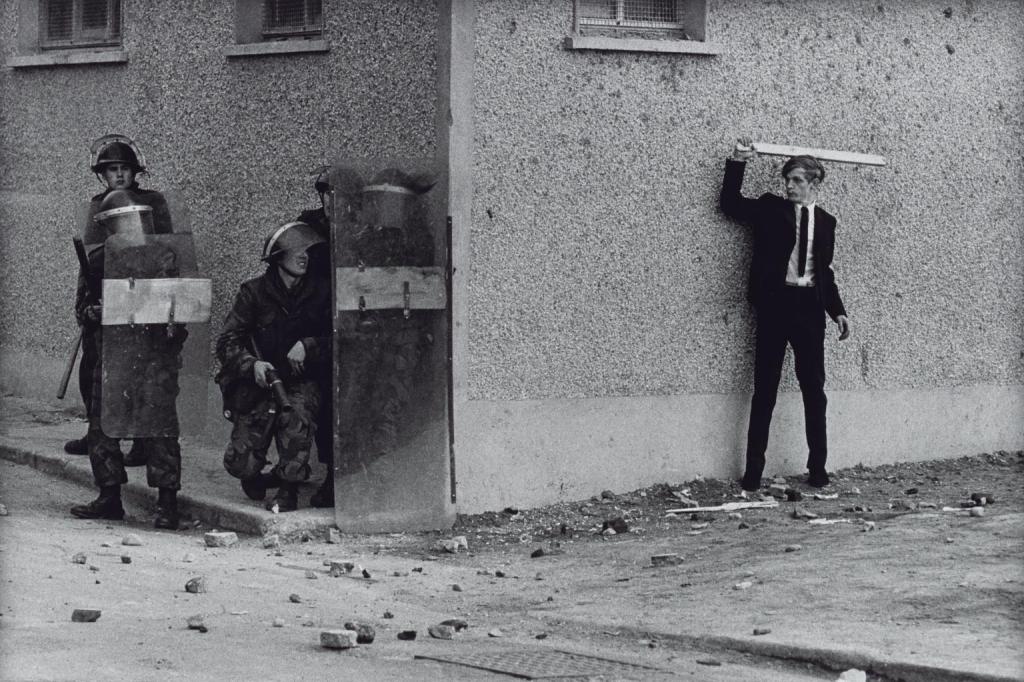
This image contains similar elements to the previous one. A small force of riot police approach the edge of a wall, behind which a young man waits with a plank of wood. Unlike the previous photograph, McCullin has no control over the composition as the events are unfolding in front of him. We don’t know what has transpired before the sequence frames, but we can deduce from the scene that some form of pursuit is likely. McCullin is capturing the events unfolding but not approaching the image in the same pre-visual way.
In Becker, the comparison between socialolgy and documentary photography is described in terms of the approaches taken. The former is the based in scientific gathering of empirical data and its interpretation through analysis, while the latter tends towards the photographer’s reading of a scene. McCullin’s triptych, taken over a period of a few seconds, documents the impending ambush on the police in a way that lends itself to a more scientific data gathering than the first image.
When it comes to the photographer creating something for the benefit of themselves, I immediately thought of Walker Evans’ Subway series. The shots, taken using a hidden camera, are documents but are very much how Evans saw his fellow passengers. If he had shot them at regular intervals, say every 10 minutes, the resulting series would have been more methodical and arguably more ‘objective’
Image References
Fig.1: Sheehan, S. (s.d.) Don McCullin: Photographs you can’t look away from. At: https://www.irishtimes.com/culture/art-and-design/visual-art/don-mccullin-photographs-you-can-t-look-away-from-1.3792696 (Accessed 21/03/2022).
Fig 2: Tate (s.d.) ‘Northern Ireland, The Bogside, Londonderry’, Don McCullin, 1971, printed 2013. At: https://www.tate.org.uk/art/artworks/mccullin-northern-ireland-the-bogside-londonderry-ar01189 (Accessed 22/03/2022).
Bibliography
[1] Becker, H. S. (1974) ‘Photography and Sociology’ In: Studies in the Anthropology of Visual Communication 1 (1) pp.3–26.
[2] A guide to ethnography (2020) At: https://www.scribbr.com/methodology/ethnography/ (Accessed 16/03/2022).
[3]Sucker punch: destroyed images of 1930s rural America – in pictures (2016) In: the Guardian 18/04/2016 At: http://www.theguardian.com/artanddesign/gallery/2016/apr/18/bill-mcdowell-ground-photography-fsa (Accessed 30/03/2022).
[4]Rejected & 3000 Killed | William E Jones (s.d.) At: https://www.williamejones.com/portfolio/rejected-3000-killed/(Accessed 30/03/2022).

 Richard Fletcher OCA Photography Blog