Introduction
We are introduced to the ideas of Place and Space, which when I think about it, have always naturally meant the same thing to me. That’s not to say that they have the same meaning, as described in the notes. I think my interpretation of both has been influenced by my experience of mental illness, during which the idea of the two was significantly blurred. People talk about ‘head space’ and ‘happy place’, referring to a situation that is contained within our minds rather than being something tangible. To maintain your head space is to keep a clear mind and similarly, to go to one’s happy place is to mentally escape an experience by consciously thinking about something or somewhere that makes us happy. When I was unwell, I felt that my head space and the physical space around me were essentially the same thing. If something bad was happening around me, my mind focused on that to the detriment of any other, more positive thoughts. Being someone who found it difficult to hide what they were feeling, it was as if I had become transparent. I didn’t really take in my surroundings either for fear of becoming fixated on the negative.
Since my recovery, I’ve been successful at keeping reality and my imagination separate while allowing the former to inspire the latter. Enrolling on this degree course was one of those inspirations. I am now content in being able to imagine a ‘place’ that is inspired by something I see around me or online, as well as being able to appreciate a physical ‘space’ and the things that influence it. I had always been able to appreciate a beautiful view (as long as there wasn’t something negative to interpret from it), so now when I pause to take one in, I’m more likely to linger on thinking about the seasons, the history and how people have shaped the landscape. If I’m looking at a building, I try to imagine what it was like when it was built – did it have a special history etc? When I first bought my house, which was build in 1897, my brother-in-law asked me if it was haunted. We had a laugh about it, but when we think about old houses and the history they have ‘seen’, the concept of something supernatural existing within its walls isn’t that crazy an idea. In it’s 124 year history, the house has stood through 2 World Wars, the smallpox epidemic, financial crashes etc and has been shaped by the people who have lived there. My contribution to its history is tiny by comparison.
When it comes to ‘looking’ at space, this course has taught me to take my time and to not seek somebody else’s intent for it. What I mean by this is that I try to reach my own conclusion about what I’m looking at without wanting an explanation. My problem is that when I create a photograph or series, I look to explain it to the viewer. This is perhaps because of the way I perceive people looking at space. I’ve mentioned previously about Nan Goldin’s distaste for social media because of the way it’s shortened our attention span when looking at pictures. Indeed if we look at her masterpiece The Ballad of Sexual Dependence with this way of viewing, we’d miss the messages it contains (I regularly look at the book when I feel uninspired). People have become accustomed to seeing the objects within a picture without wanting to imagine why they occupy a particular space or interact with something else present. In Project 1, we looked at human behaviour in photographs that contained no people. If we just looked at the dishes in Shafran’s Washing Up for example, we’d probably not understand the meaning of the work. Such is our dependence on the visuals provided by our phones that we feel completely naked without them. A friend of mine was recently telling me of a traditional London pub that has a ban on mobile phones being used – whenever someone takes one out of their pocket, they are first warned and then thrown out. The idea is to appreciate the simpler interactions between people and the environment (and beer) that the pub has worked hard to provide. I mused at how long my wife and I would last.
Research Task: Your Environment
In considering the above and my own environment, I realise how much my ‘visual awareness’ has changed since finishing work. I walk a 3 mile route around my town every day, which varies only slightly depending on whether I need to shop for food or do some work. I started this routine nearly 12 months ago in an effort to get fitter, but I soon started to notice how the space is affected by the change of seasons. Traditionally, we know that when winter moves to spring, there is new plant life, changes in the colours of trees etc, but the first thing I noted was the way that the buildings changed. People stopped spreading salt on the pavement outside their business and houses to prevent ice, the number of chimneys expelling smoke and vapour from their heating systems gradually declined as the weather warmed. The wildfowl at the lake in our park started to breed and nest in the newly shaded trees. My walk was staying the same, but I was seeing a different town to the one from the version I saw during winter. What remains consistent with the seasons, however is the sense of familiarity and comfort. I’ve lived here for over 20 years and although the town continually evolves, the daily walk makes me feel at home when I see the familiar environment. My wife and I were out recently with some friends who pointed out that there had been a surge in new and interesting places to eat in the town. We recognised this change in the demographic, but it was lost in our sense of belonging here. When I looked at Robert Harding Pittman’s Anonymization, I could see the artist’s connection with the natural world being challenged by the behaviour of man. His images of the beginnings of ground works for buildings struck a chord with me as they symbolised change. The seemingly relentless progression of building ‘desirable’ living spaces is revealed in Pittman’s work as disrespectful to the natural world; the proliferation of the pattern making the landscape essentially anonymous. When we think of the lack of harmony between man’s needs and the natural world, there are many examples that immediately spring to mind. The urbanisation of California is a good example, where a landscape that sits on a major tectonic plate is cultivated because of its warm, dry climate. Millions of people live in the shadow of potential natural disaster and the rapidly advancing signs of global warming (the state suffers catastrophic fires every year nowadays). In spite of this, the people continue to build towns of houses with lush gardens and swimming pools because of what they see as the beauty of the environment. One image in Pittman’s series that stood out for me was the one below:
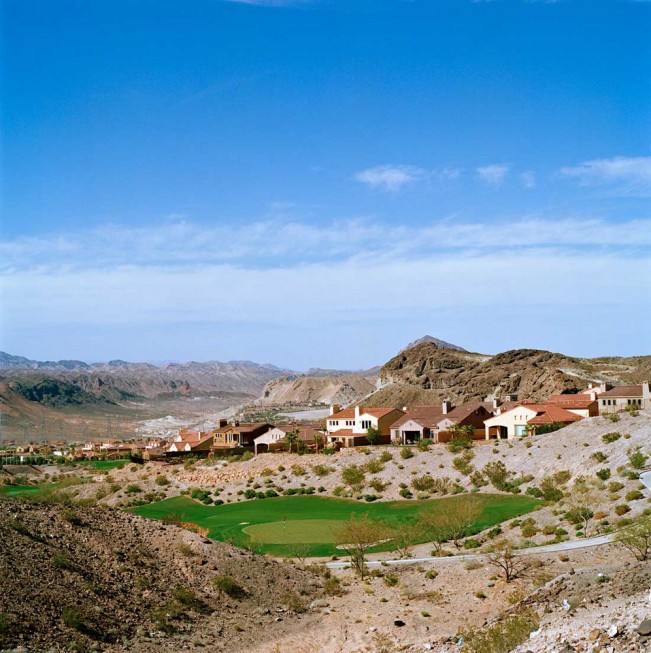
Here we have a beautifully shot scene of the landscape of Nevada under a deep blue sky. The subject is a hotel-style development called the Lake Las Vegas Resort. What immediately struck me about this photograph was what was missing from the image. There is no lake to speak of, which when considering that Las Vegas in in the Nevada desert, isn’t a surprise. This awkward naming of the hotel seems incongruous in the landscape and is further emphasised by the lush green golf course in the foreground. The resort is billing itself as being Las Vegas which translates to ‘The Meadows’ because of the surprisingly well irrigated regions in the desert, but the golf course has the appearance of being entirely fabricated. The image screams insensitivity to me, highlighting the irresponsible development of the natural world for what is an entertainment venue. Other images in the series suggest a scale of this attitude, depending on social or economic status and some developments paying lip service to their surroundings. Whatever the social or political perspectives of the viewer, the series is interesting because it deals with people and culture by exploring their actions and their environments.
Stephen Shore (1947 -)
We are introduced to Stephen Shore in the context of the photographic journey. Like Walker Evans and Robert Frank before him, Shore photographed what at first glance appear to be uninteresting locations. The title of is book Uncommon Places mixes these images with slightly abstract portraiture and still life work, much like that of Eggleston. The title, as the notes suggest, is at odds with the banality that the subject matter appears to exhibit – this invites us to look closer at the series. Like Frank, Shore’s journeys that became the setting for his series was one of personal discovery. He was 23 years old before he realised that he’d not set foot outside of his native New York and that resolve to learn about the rest of the United States drove the observations in his book. The ‘Uncommon’ in the title could instead refer to that exploration or that the locations and experiences of the trip might be familiar but new to anyone looking at the images. Whatever Shore’s intention, the images have a sense of what it is like to be in America to natives and strangers alike. The notes refer to the comment by Szarkowski about Eggleston’s Memphis being a faithful representation to the uninitiated and the same being said of Shore’s work. For me, the work echoes the Italianicity that Barthes talked about[2]. Modern American culture surrounds most of the western world and unlike Frank’s look behind the curtain of it, Shore takes it head on. His work has drawn critical review that catagorises it as ‘formal, clinical, objective, impersonal and dispassionate’, which almost suggests little part of the photographer’s eye in the creation.
“She looked at them and said: ‘So, Stephen, you want to photograph every main street.’ I replied, ‘No, Hilla, that’s what you want to do. I want to photograph the quintessential main street.’”
Stephen Shore in conversation with Hilla Becher, quoted in an interview with The Guardian[3]
In the above quotation, Shore was telling Becher, one of the typology pioneers studied in Part 1[4] that he was interested in capturing the idea of an American street as seen by most people. Uncommon Places achieves that for me with its many cultural elements.
Personal Reflection
The notes ask us to consider where we would do a project of the scale of Shore’s or Frank’s and I think mine would probably be about a culture within a culture. The UK is a truly multicultural society, which has its successes and its problems in terms of acceptance. We are very familiar with the clashes of different races and the fight by many ethnic minorities against racism and everyday prejudice, but I am more interested in the cultures that interact with the wider population but quietly avoid becoming part of it. The one area that I would explore is the traditional Romani gypsies, who unlike the generic term ‘traveller’, live their lives within traditional family structures and customs. Our interactions with true Romanis are few and far between, limited to door-to-door sales and travelling fairgrounds. My series would explore life for the Romani in the UK, beginning with the densely populated regions such as Greater London and ending with in the more rural areas. It would seek to reveal there world by capturing their act of travelling around, so becoming journey within a journey.
Paul Gaffney and Alec Soth
Paul Gaffney series We Make the Path by Walking (2013) is a book that captures the beauty of the natural world shot during many long walks. When I looked through the book, there were a few things that stood out for me. The notes refer to the mindfulness evoked by the images, but for me the key theme is the sense of familiar and unfamiliar. I regularly walk around the area that I live in and inevitably take photographs of the things that are obvious to its location and some that are not. Gaffney’s series contains familiar images of grasses and tree-lined pathways that could just as well be where I live. As well as the beautiful aesthetic, it is this familiarity that invokes a sense of peace in me. Gaffney further enhances this by not giving any clues as to where they were shot. Conversely, the viewer is invited to appreciate the nature surrounding the artist while he walks in a place that is unfamiliar to them.
“I always wanted the images to evoke rather than describe, and for people to engage with the work and to bring their own experience to it, rather than it just being about my own experiences. I sometimes recorded ambient sounds which I have considered using in an installation, and I was also thinking about recording conversations with people along the way, but it was always going to make things overly complicated and as it becomes complicated, it tends to bring you further away from the experience.”
Paul Gaffney in conversation with Walter Lewis for Photomonitor[5]
Gaffney’s ‘simple’ approach to his work leaves the viewer free to draw their own conclusions about the environment, the act of walking through it and connecting with nature. Some of the images contain humerous elements such as the blocked off mountain bike ramp, while some show the struggle between man-made objects and nature like the one below:

I particularly like this image because it is both beautifully shot and asks questions about nature coexisting with the manufactured. Depending on our reading of the image, nature could be seen to be fighting back or the enduring ‘permanency’ of concrete could make the battle a futile one. Man is not shown, but is observed by man moving through the space, which makes pictures like this really powerful within the series.
Alec Soth has been heralded as the modern day Robert Frank; his story-telling being of a similar style in its exploration of that which is behind the facade of culture. In his collaborative book with Patrica Hampl, Soth explores the Mississippi region alongside the great river of the same name. The photographs span a wide range of cultural elements, some specifically about people that are shot in portraiture and some that capture the traces of personalities and behaviours. They all serve to tell as story of a region that is not mainstream America, in the same way that Frank’s The Americans did many years before. The image from Soth’s series that struck me was Cape Giirardeau, MO, 2002[7] which shows the wall of a room with some kind of laminate panelling and an a painted section that used to have pictures hung on it. The pictures are gone, but the hooks and outlines remain in the discolouring of the paintwork. The only things left attached to the wall are a fragment of newspaper with the word ‘Folklore’ on it and part of Ansel Adams’ famous picture The Grand Tetons and the Snake River. This picture invites so many questions about the human condition through a very simple composition. The derelict state of the wall looks like it’s been abandoned with the pictures removed and presumably taken away. The newspaper fragment suggests that the owner was collecting some new stories, but we can only imagine their subject. The inclusion of Adams’ picture suggests that a desire to get away to another place, yet we have only part of the image. Could this instead mean that the vista wasn’t important beyond the visual aesthetic? Why did they leave it behind? For me, this was one of the most powerful images in the series, because of what is not contained within the frame. Soth’s images create a sense of the region and it’s people being a kind of subculture, in a similar way to Goldin’s work. It has the aesthetic quality of Crewdson’s tableau and the use of bright, contrasting colours pioneered by Eggleston and Meyerowitz.
David Spero and Martina Lindqvist
David Spero’s work Settlements takes a very personal view of subculture. Unlike Soth’s representation, Spero blends photographs of off-grid living arrangements from sheds to bothies with traditional portraits of the people who live in them. The latter are, in some cases, staged like family photos which gives them a warmth that we would not necessarily have if limited to the photographs of their homes. Some of the portraits depict more of the way of life of the people to add the overall sense that we are invited to look at their settlement rather than being an observer. This plays well into the outsider/insider idea suggested by Abigail Solomon-Godeau (studied in C&N)[7] with Spero becoming part of the culture he is representing. The interior shots of the homes take on an aesthetic that is similar to the tableaux work we have looked at, yet there is a documentary feel to them. The artist is representing another way of life rather than making a personal statement about what he sees – this is in contrast to how I read Soth.
With Martina Lindqvist’s Neighbours, we see architecture in a different light again. Where Spero had created a sense of the community and variety of the homes that his subjects lived in, Lindqvist uses very simple composition to tell a story about private space and isolation. An example can be seen below:
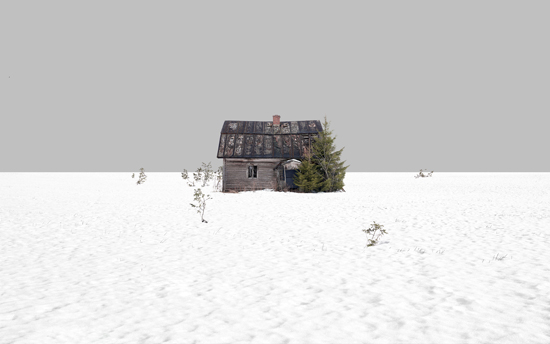
In this picture we see a simple composition of equal land vs. sky with a solitary house in the middle of the frame(the whole series is shot like this). The bleakness of the environment around the house and the snow on the ground contrasts with the greenery of the trees. The mood created by the composition could be bleak but the juxtaposition of the tree and house suggests a pride in their home. The small trees that poke out of the snow invite the viewer to imagine what the land around the house might look like beneath it. In every picture the thought is that the neighbour is in their house, which may not be true. We are left wondering what they are like, purely on the basis of their home.
Conclusion
This has been an interesting project because each of the artists represents the concept of place in a different way. Pittman’s apparent despair at the way that we impact the natural world is more political than say, Gaffney’s while both artists make a statement about the struggle between nature and man. The idea of a culture as seen through representation in Shore’s work is very different from that of Soth, even though both artists are exploring something new (Shore having not experienced travel until he was in his 20s). The concept of home is explored by Spero and Lindqvist with a not to the diversity of how people choose to live, however the former is very much from within the culture while the latter takes a remote perspective. What is clear from this and the other work in Part 5 is that people move through the world leaving a trace of themselves, their behaviour or decisions and their culture behind. The artists we have covered in both projects are tuned into these traces without worrying too much about including the people themselves. What results can be powerful from a social and political perspective, act as educator or myth-dispeller, with the one thing in common; they all ask questions of the viewer and rely on them bringing their own life experiences to the reading of the work.
References
[1] Smithson A, 2015, “Robert Harding Pittman, Anonymization”, Image Resource, LensScratch, http://lenscratch.com/2015/05/robert-harding-pittman-anonymization/
[2]Fletcher R, 2021, “Research Task: Rhetoric of the Image”, OCA Blog Post, https://richardfletcherphotography.photo.blog/2021/11/05/research-task-rhetoric-of-the-image/
[3] O’Hagan S, 2020, “Stephen Shore: ‘People would chase me off their lawns with my Leica'”, Guardian Interview, The Guardian, https://www.theguardian.com/artanddesign/2020/feb/29/stephen-shore-ordinary-america-photographs-interview-plate-camera-leica
[4] Fletcher R, 2021, “1) Project 2: Typologies”, OCA Blog Post, https://richardfletcherphotography.photo.blog/2021/03/04/project-2-typologies/
[5] Lewis W, 2014, “Paul Gaffney/We Make the Path by Walking”, Interview, Photomonitor, https://photomonitor.co.uk/interview/we-make-the-path-by-walking-3/
[6]Gaffney P, 2014, “We Make the Path by Walking”, Image Resource, Artist’s Website, http://www.paulgaffneyphotography.com/We-Make-the-Path-by-Walking
[7] Lindqvist M, 2013, “Untitled 08, Neighbours”, Image Resource, Artist Website, http://www.martinalindqvist.com/neighbours08.html
 Richard Fletcher OCA Photography Blog