The Brief
In this exercise, you’ll build on your ‘Background as context’ exercise in Part One by taking the relationship between your subject and their surroundings a step further. The objective here is to try to create a link between the two components of your image, i.e. the subject and their surroundings.Make three different portraits using three different subjects. Prior to shooting your portraits, engage with your subjects and agree three different specific locations which have some relevance or significance to them individually. You’ve already tried to give a particular context to a portrait by considering how the background might link to the subject positioned in the foreground, but now you must go one step further and negotiate a specific physical location where you’ll photograph your subject. This can either be inside or on location, but the key to this portrait is the interaction you’ve had with your subject in identifying a place that has specific meaning for them.
Each portrait should be accompanied by a very short piece of text explaining the choice of location or venue. Don’t be tempted to create a work of complete fiction here; it might make life easier for you, but you’d be missing an opportunity to really engage with your subject and collaborate with them in the image-making process.You have complete freedom to work this out as you feel appropriate; for example, you may choose to theme the narrative behind all three portraits. Think carefully about how these images could work together as a set. For instance, if you plan to shoot outside, try to make sure the lighting conditions/ time of day/weather conditions all work coherently.
Present all three images together as a series and reflect upon how successful this exercise was in your learning log or blog. Write around 500 words.
This is my Church
For this exercise, one of the first things that occurred to me was that of comfort or peace. The past year or so has been tough on most people, with the restrictions on social contact and the constant anxiety of potentially catching the virus. When I think about my own situation, I know where I am most at peace. This past few months since leaving my job, I have found this place to be my morning visits to the local park. That realisation led to the series that I shot for Assignment 1 [1], where I sought to reveal something about why people specially visit the place and how it makes them feel. For this series, I decided to continue that theme and ask my subjects to take me to a place where they felt most at peace, for whatever reason. This wasn’t about being able to sleep or relax, but somewhere where they felt calm and balanced. It might be a room in a house, an outdoor space like a garden or somewhere that distracts them from what worries or stresses them. It could be more a state of mind than a physical space, which would potentially present a challenge in representation. The idea of This is My Church was to place the subject in their peaceful place and use the background context to tell the story. This exercise called for the use of a small amount of text to explain the location, which is something I had adopted for Assignment 1. In my feedback, it was suggested that care needed to be taken not to make the text more meaningful than the photograph that it accompanied. I managed that successfully before, but would need to be mindful of it here.
This is My Church
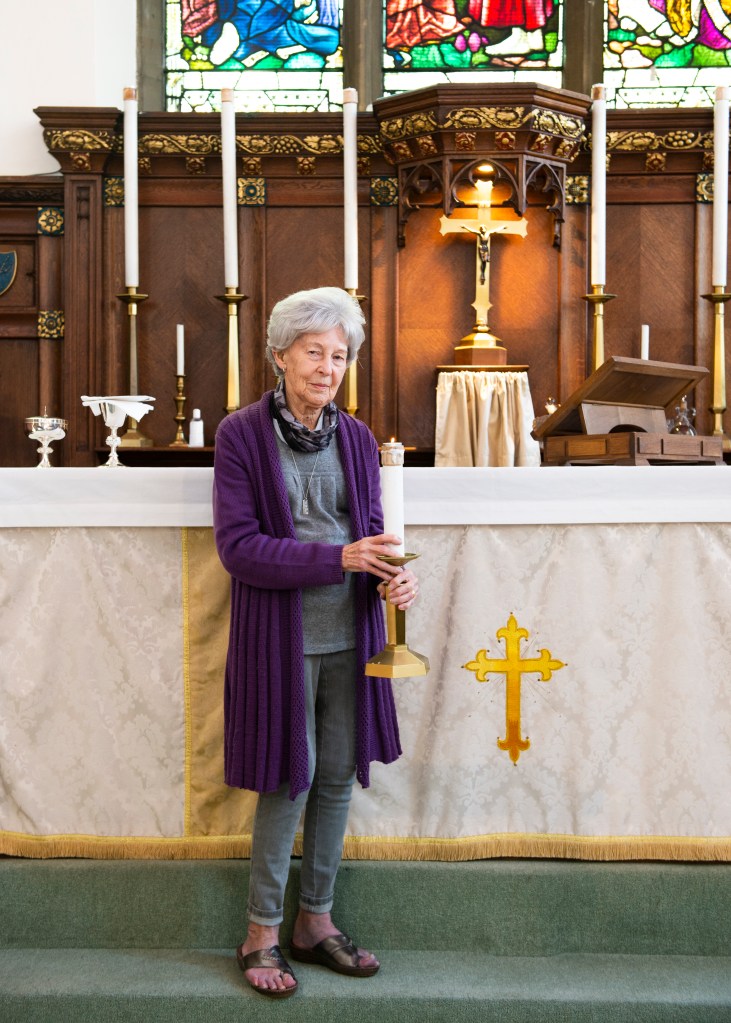
Hazel is at peace in in her literal church. She’s both worshiper and warden, so her connection to the space is both spiritual and functional. Giving something to the community, whilst being in a sacred place gives her a great sense of peace.

Peter is a yoga teacher who has been working from his home studio during the pandemic. When he is not teaching, he is able to achieve peace through creating and practicing new routines for his classes.
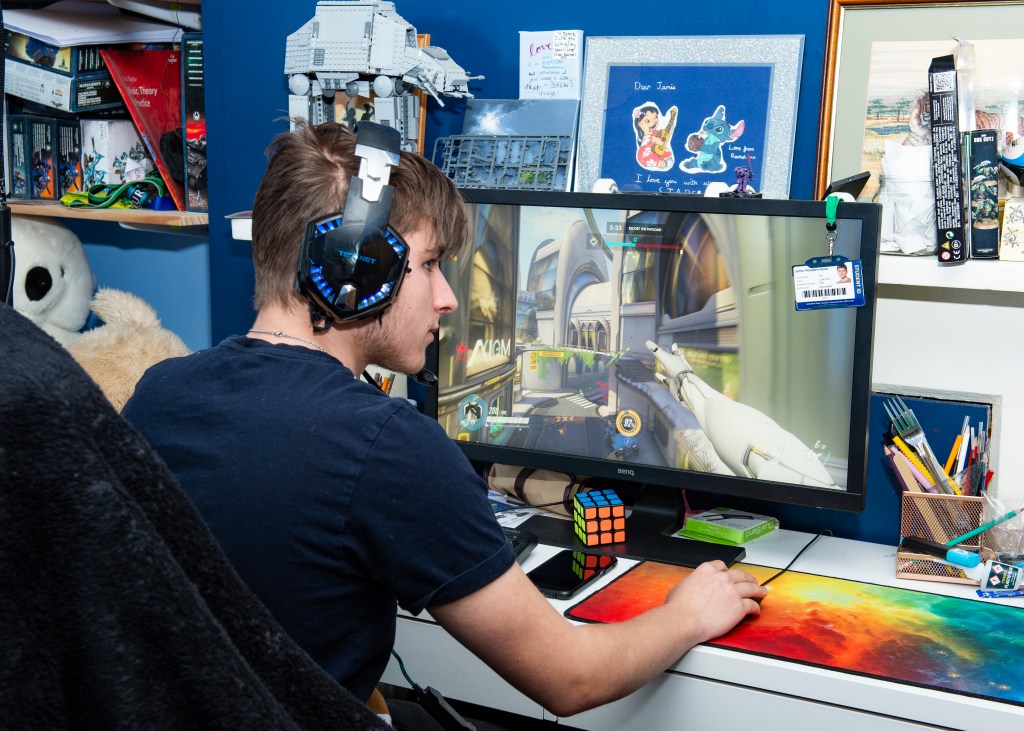
Jamie is a 6th form student who uses video gaming to achieve his peace. Games offer a sense of escape, for him, his headphones shutting out any distractions that may invade his space.
Reflection
My original intention for the series was to let the subject define the circumstances in which they achieve peace and how their environment helps create that sense. On each occasion I was struck by how powerful this sense of place was for my subjects. The first image of my mother-in-law was shot when her church was empty. She is a key-holder so this wasn’t a problem. I noticed during our time there that she still went about some of the activities that she would normally do as part of her warden role. In this pose, she is holding a large candle that she told me was actually a fake holder for mini tea light candles because they were more cost effective for the parish. I loved the way this contrasts to the opulence of the alter decoration and the silverware in the photograph. The other element that I think works well is the contrast of Hazel’s petite stature against the large alter which almost belies how crucial she is to the running of the church. In the second shot, Peter’s space is uncluttered simplicity which one would expect for a yoga studio. However, the space is used to broadcast his classes so not shown is the lighting setup he uses. What I like about this shot is that he looks as though he is working but his pose is a typical yoga stretch. This contrast is set off by the natural light that is flooding through the window to the right. With the final image, Jamie described his environment as a ‘typical teenager’s bedroom’, which is clear from the elements in his desk area. Unlike the other shots, I deliberately didn’t suggest stage-management of the background as I wanted it to speak directly to Jamie’s personality. His room is full of references to his growing up, with the added inclusion of his student card hanging on his monitor. I liked the inclusion of the fork along with his pens and pencils, suggesting he likes to snack in his room. Jamie’s pose with the game raging on his computer screen suggest someone for whom escapism is important. When I asked him about when he plays, he replied that it was he wanted to be at his best which sometimes meant playing after a good day but also after a bad one. I like this sense of balance, which I think comes through in the photograph itself.
Overall, the learning from this exercise was how a portrait can evolve from the conversation between photographer and subject. In each case the subject contributed to the inclusion or exclusion of elements that supported their idea of what makes them feel peace. Only in the last shot did I left the placement of the contextual elements as they were because I felt that they were more representative of the subject’s personality than we could probably manufacture between us. I’m really happy with how all three images turned out.
References
[1] Fletcher R, 2021, “Assignment 1 – The non-familiar”, OCA Blog Post, https://richardfletcherphotography.photo.blog/2021/04/11/assignment-one-%E2%80%8Bthe-non-familiar/
 Richard Fletcher OCA Photography Blog