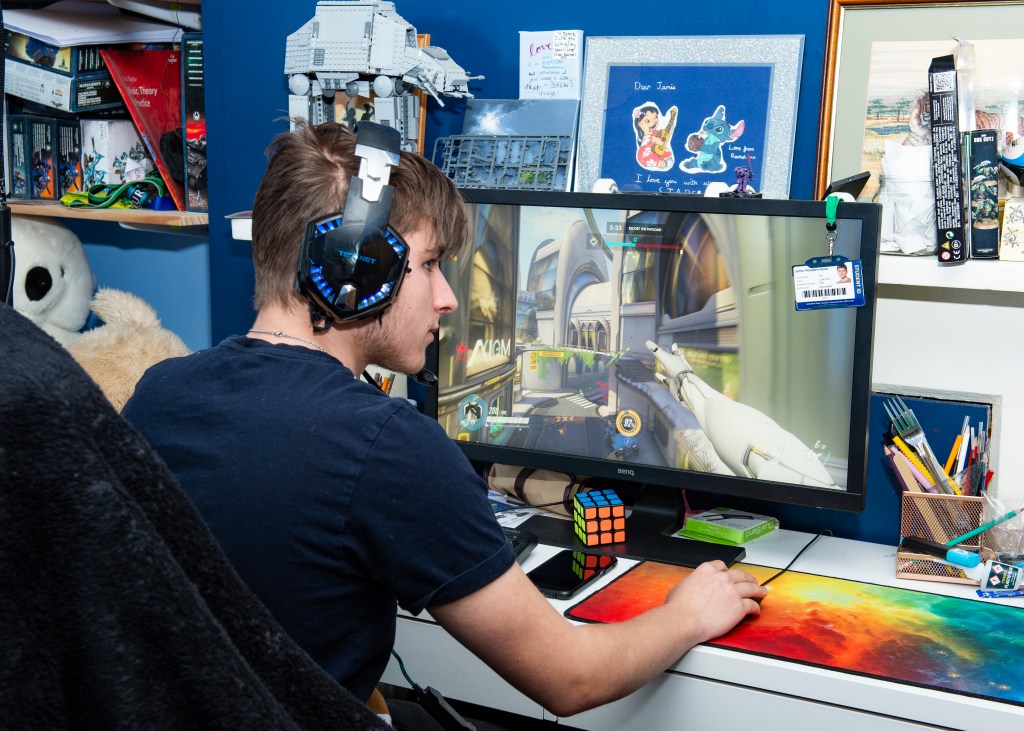
During our most recent Identity and Place cohort meeting, we conducted our usual review of each member’s recent work collectively. I shared my images from Part 2, Exercises 1 and 2 for discussion, during which we spent some time on the following photograph.
The photograph, from Exercise 1, is of my friends’ son Jamie in the place where he is at peace. We debated the concept of peace and tranquility because at first glance, this doesn’t look like something peaceful. Of course, the object of the exercise was to talk to our subjects to identify a place that they relate to in some way. As my series was about places where people feel at peace, this was the natural place for him to select. We all freely admitted that we weren’t able to relate because unlike the subject, we are not 17 years old. When we looked at this picture more closely, we started to discuss about the detail in the ‘place’ where I had shot him. I had elected not to ‘dress’ the setting because this wasn’t the point of the exercise. While I directed the subject’s pose and set the image up technically, I left the details of what Jamie described as “a typical teenager’s bedroom” as they were. When looking around this image, we see the mixture of teenager interests (the Star Wars models, the cluttered bookshelf etc), but we also see hints of his growing up (the stuffed toy and picture on the wall by his younger sister). The element that attracted my attention at the time was the fork in his pen holder. When I showed the picture to his mum, she laughed and said it was because he liked his “sneaky, late-night chips”.
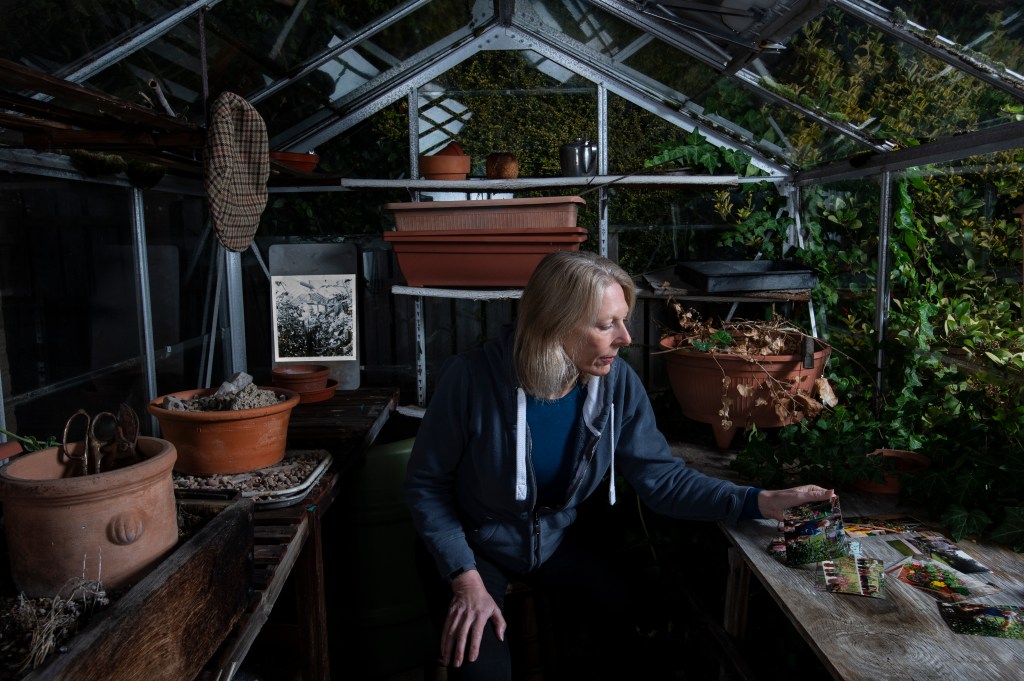
When we discussed this as a cohort, I got to thinking about the tableau images we learned about in Context and Narrative where every detail of the image was stage-managed to tell a particular story. My photograph from Assignment 5 was an example of this (below).
The difference as I saw it was that the image of Jamie was something that I saw as a more factual representation of him, while Assignment 5 was telling a story that was partly fictional. In both cases, it struck me that I could represent Jamie without him actually being there, in a similar way to Nigel Safran’s ‘in absentia’ portraiture in C&N.
Ashley Gilbertson – Bedrooms of the Fallen (2014)
After the call, one of the students forwarded me a link to Ashley Gilbertson’s work Bedrooms of the Fallen (2014). This very poignant work documents the rooms of soldiers from all over the world who have died during the recent wars in Afghanistan and Iraq. Gilbertson, a photographer who was on assignment in the Middle East, conceived the project as an alternative way to tell the stories of the soldiers who were lost. Over a period of 7 years, he researched the soldiers, contacted their families and photographed the bedrooms of their family homes. He made the conscious decision to shoot only those that had been left untouched or had little in the way of changes made to them so that the viewer can get the sense of the space being left behind.
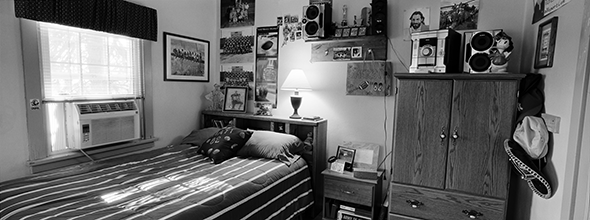
Army Cpl. Matthew J. Emerson, 20, was killed when his vehicle rolled over on Sep. 18, 2007 in Mosul, Iraq. He was from Grandview, Washington. His bedroom was photographed in February 2010.
From the book “Bedrooms of the Fallen”, by Ashley Gilbertson (2014)[1]
In the example above, we see a bedroom that looks like it’s just been cleaned. This effect of looking like the occupant might be back at any time is core throughout the series. Each picture serves as a snapshot of the soldier’s life frozen at the time they last left home for war. It’s very difficult to age the scene as most of the features are fairly contemporary. When we look closely we see a mixture of contextual elements that we can seek meaning from. The stuffed toy on his pillow contrasts with the photographs of what we assume to be his regiment on the wall behind the bed. The shelf with his trophies is also juxtaposed with photographs and ornaments. The big shelf speakers that form part of his hifi system have the style of someone young, with one positioned next to a statue of Donald Duck. The whole room reminds me in many ways of Jamie’s in my photograph. The room is kept as it was by the soldier’s parents, but there is nothing that is constructed or staged about it. We can almost imagine what the young man was like who lived here, without actually being able to see him. Unlike Safran’s ‘in absentia’ portraits, there is no pattern of life being revealed here as such but some pointers as to the subject’s personality.
Conclusion
I found this series both interesting and moving. What interested me was the natural sense of identity contained within a place, where the photographer was really only responsible for arranging a composition and lighting that highlighted the details so that the viewer could explore the context. When I photographed Jamie for Exercise 1, I experimented with the direction of my flash so that there was a soft, even light across him and his space. Naturally the key thing was to reveal the computer game, which drove the decisions around exposure and fill light. Like Gilbertson I didn’t interfere with the ‘place’, but in my case I had to arrange my subject in a way that didn’t clash with his environment. With Bedrooms of the Fallen, we have a powerful narrative about war and loss, but also an emotional insight into the young men that war consumes. We know that young people fight wars – it’s been a common trait of the forces for centuries. That preconception is really supported by the details of the space when we look at what the soldiers left behind. It’s as if a ghost of their personality still lives there and even though we don’t know the subjects personally, we can derive an empathy towards them through their stuff. Another layer of the narrative is, of course the impact on their families. They had elected to keep the rooms as either a sort of shrine or perhaps just somewhere they don’t want to be but similarly cannot bear to part with. This extra layer to the photographs really anchors the whole series together.
Approach this exercise with care and a diligent awareness of health and safety both for yourself and others.
Closely consider the work of the practitioners discussed above, then try to shoot a series of five portraits of subjects who are unaware of the fact they are being photographed. As you’ve seen, there are many ways in which you can go about this, but we can’t stress enough that the objective here is not to offend your subjects or deliberately invade anyone’s privacy. If you don’t have permission to shoot in a privately-owned space, then you should only attempt this work in a public space, where permission to shoot is not necessarily required.
This is a very interesting challenge, which some students will find incredibly difficult. Remember that the creative outcome of the practitioners discussed above has come about through a sustained approach, which is then heavily edited for presentation. You’ll need to shoot many images in order to be able to present five final images that work together as a set.
Think everything through carefully before attempting this exercise as the responsibility for the outcome of the portraits rests entirely with you. If during the course of this exercise you are challenged in any way, be prepared to delete what you have shot. If you can see that you are annoying someone, or making them feel uncomfortable, stop shooting immediately. You’ll be required to operate with a degree of common sense here and not take unnecessary risks. There are ways of completing this exercise without incurring risk, such as shooting the work at a party you’ve been invited to, where all the guests have been invited for a particular celebration.
The reflection about your methodology (your approach to how you have achieved the images in relation to why you chose what you have chosen), will be as important as the final five images, so be prepared to write about how you found the experience (around 500 words) and present your findings via your learning log or blog.
Introduction
I started thinking about this exercise shortly after researching Walker Evans’ series Subways. His work was pioneering in capturing people off guard,but for me the way that it really works is the fact that they are completely unaware of the photographer working. What sets him out from the other practitioners in Part 2 is this stealthy approach. With Parr’s similar series, I suspect that his subjects were not entirely unaware they were being photographed in some cases. As discussed in Project 1 [1], I base this suspicion on the way that Parr shoots, close-up with flash. If the subjects were asleep, they would not be aware, but they could similarly be defensively trying to hide their faces. Japanese culture is one of deferential privacy, particularly on public transport which led me to conclude that some would just be hiding their gaze from Parr. diCorcia’s Heads series has the aesthetic of people being caught unaware through his use of a camera trap. However, diCorcia freely admits that he made himself visible throughout shooting and that people could see what he was doing[2]. They were certainly aware of being photographed as soon as the flash went off. With Tom Wood’s series Looking for Love, again the subjects were aware of his prescence but had gotten so used to him that he effectively became invisible. When Meyerowitz walked the streets of New York with his Leica, he shot people from very close up and in their sightline. Meyerowitz stated that people just didn’t believe that he was interested in them [3]. For me, the only practitioner that achieved complete anonymity was Evans, although people clearly found his attention to be suspicious – they weren’t aware of what he was actually doing.
For this exercise, I was inspired by Evans’ hidden camera. Instead of looking at people, I decided to shoot people who were behind me and outside of my sightline. I wanted to capture people moving behind me, queueing for something or just going about their business completely unaware of my presence. For me, this would be shooting the very unaware, with the added complexity of my also being unaware of the exact composition as the pictures were being made.
The Setup
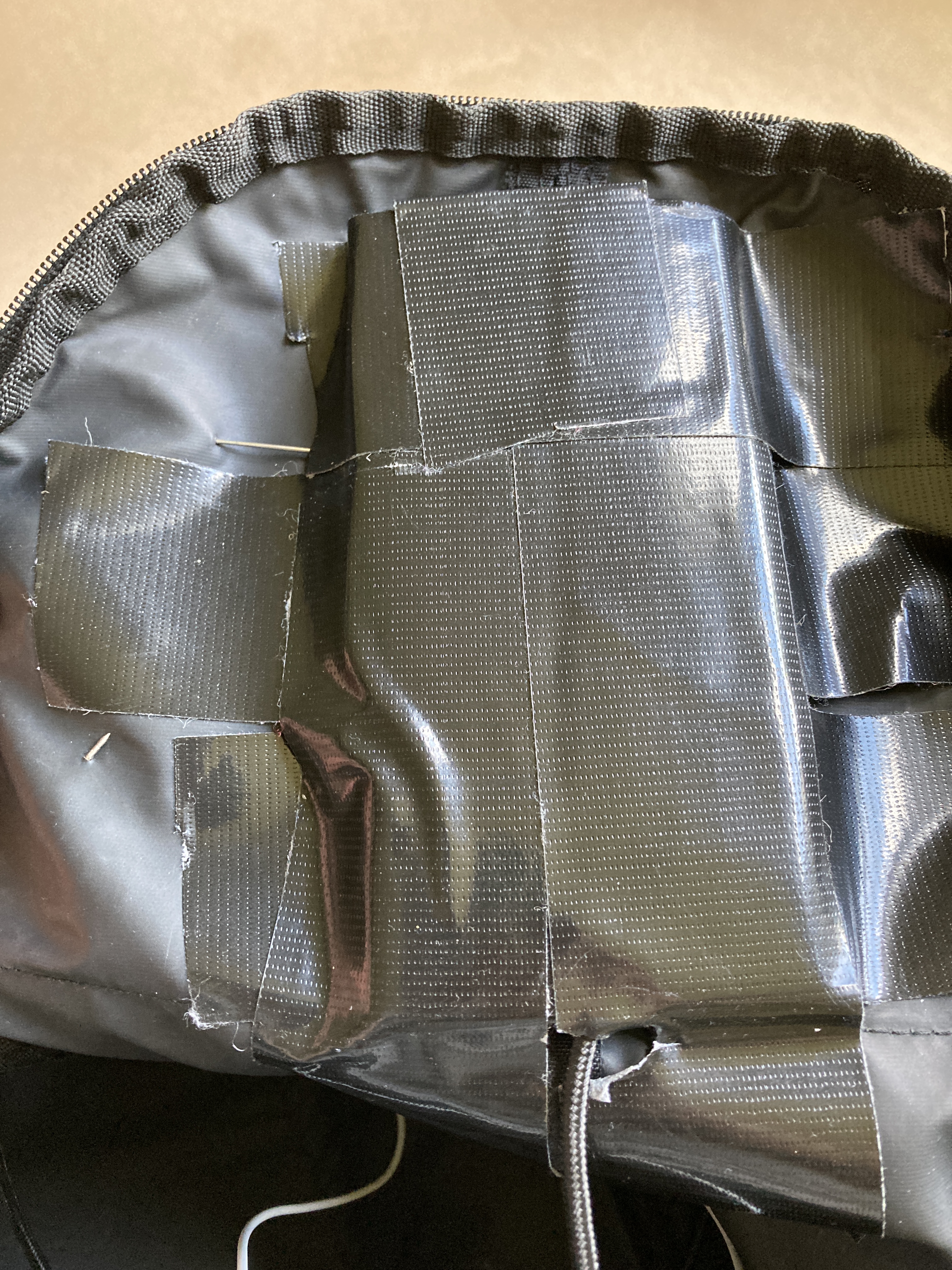
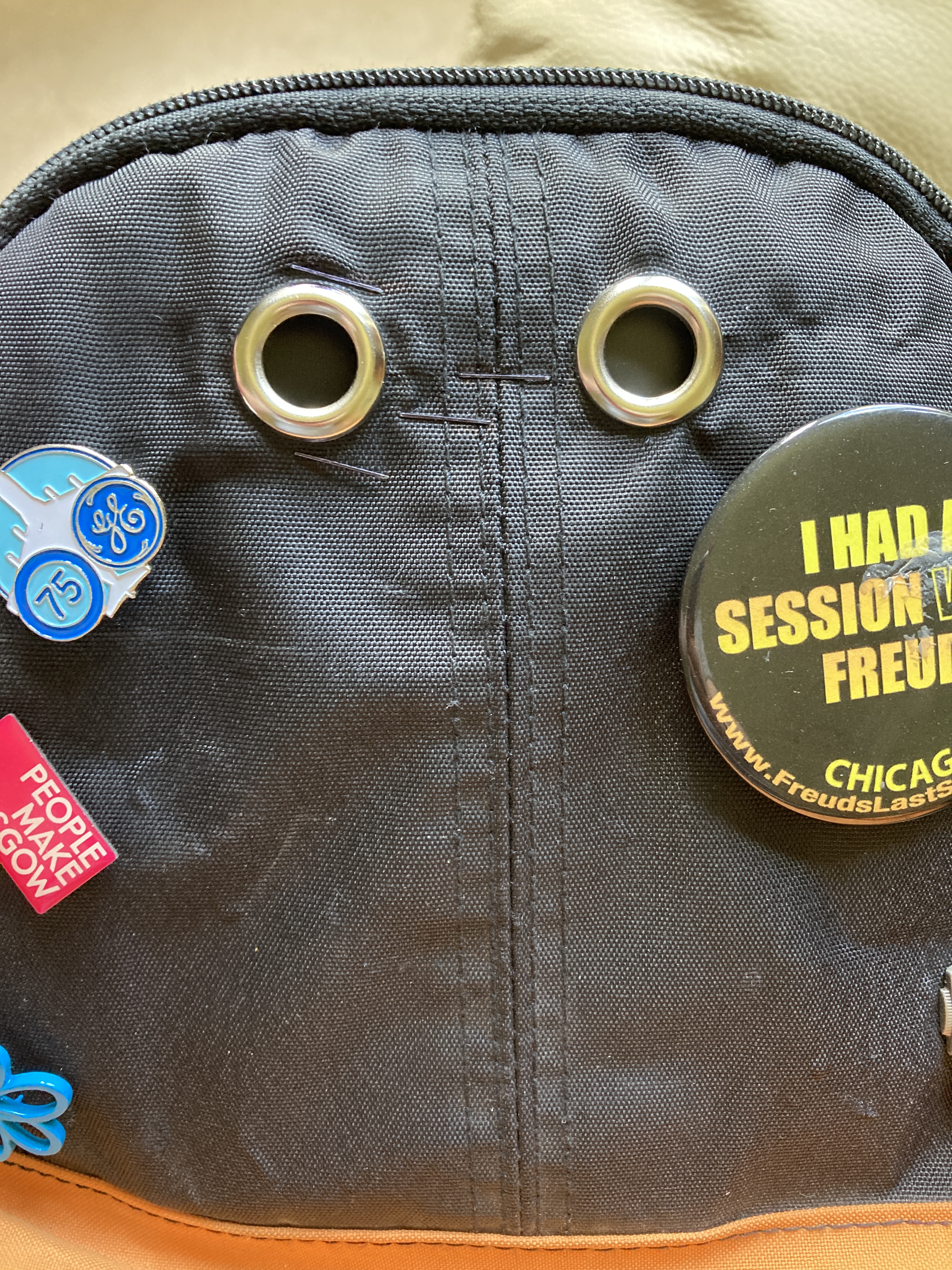
I thought about which camera to use from my collection and actually determined that my phone would be most suited because of its high resolution, wide angle lens and silent shutter. It also had a sophisticated automatic focus and exposure system that would avoid the need to pre-setting as Evans had do in the 1930s. The phone also had a remote shutter release in the form of its cable headphones, which meant that I could very discreetly take the picture through the seemingly unconnected gesture of adjusting the volume control. The next consideration was how to get the camera to face backwards, which I solved by installing my phone in a modified backpack. Although tricky to fabricate, I managed to get an aperture that the phone camera could view though and disguised in a way that it was hidden from my subjects. The completed rig is shown below:
The images show the makeshift phone holder, remote extension cable for the headphones to connect to and the apertures at the back of the backpack. The left hand aperture was aligned with the camera and the right hand one was a dummy. The badges were added to distract from the apertures themselves.
The rig was challenging to use because of the fact that I could position myself in what felt right relative to the subject but there was always the risk of it being completely off in terms of composition. Even if I was aligned properly, the angle of the backpack to the subject made for some interesting horizons. I also had problems with the phone itself – the cable kept coming out of the socket on the bottom, which meant that I missed many shots that I thought had worked.
The Images
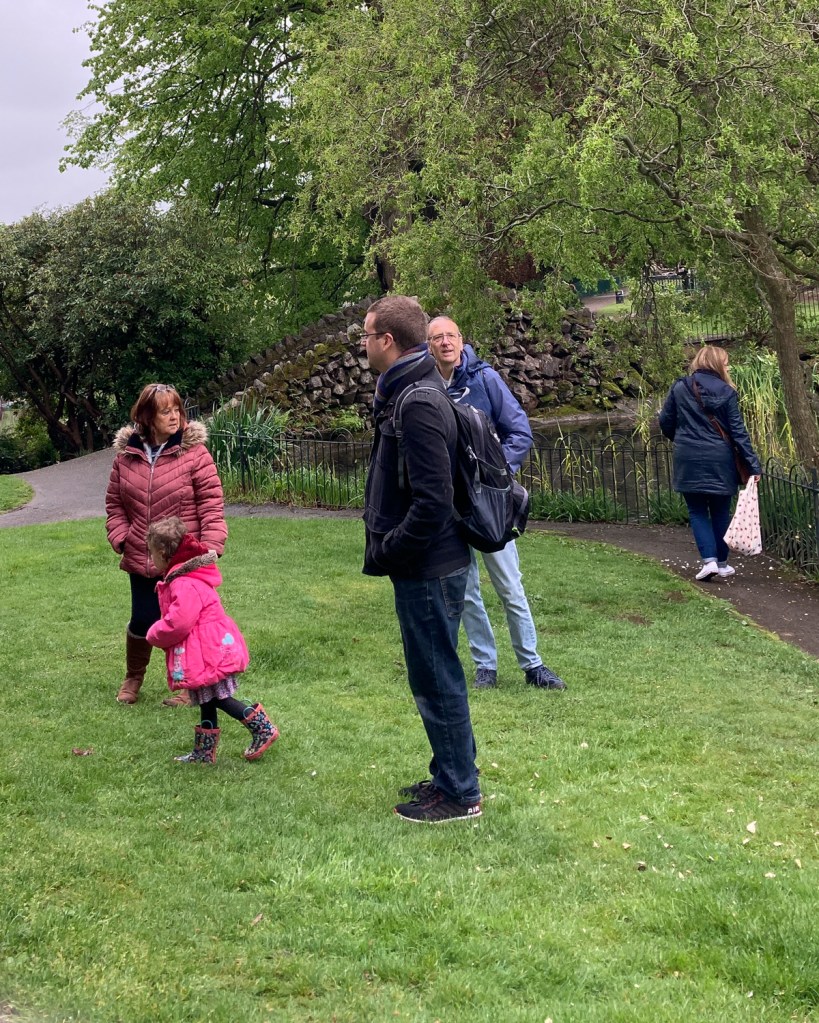
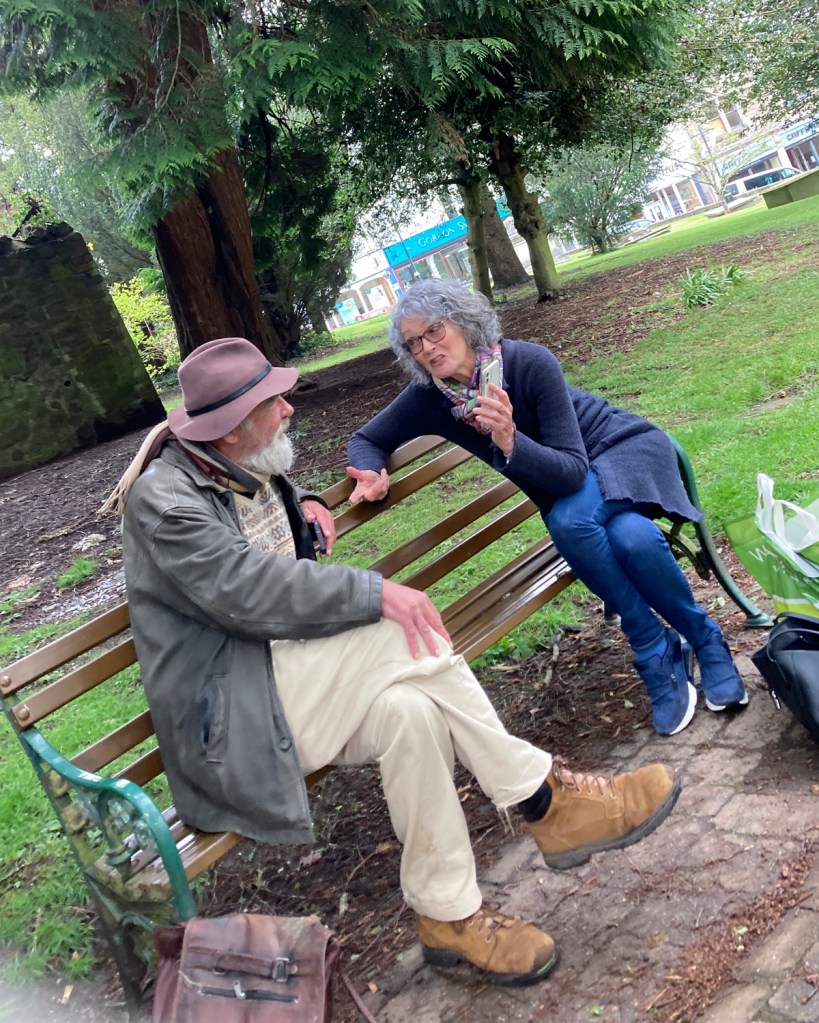
When I reviewed the images that I did get, I was interested to observe how people interact with their environment and each other when they are not obviously observed. To add to my deception, I carried one of my old film cameras (without any film) so that I could pretend to be photographing in the opposite direction to the backpack. In shot One, one of the subjects can be seen looking in my direction – I assume it was the sight of the old camera that drew his attention. It was this sneaky look, coupled with my own subterfuge that led me to make the series about being ‘going unnoticed’
OneTwoThreeFourFive
Reflection
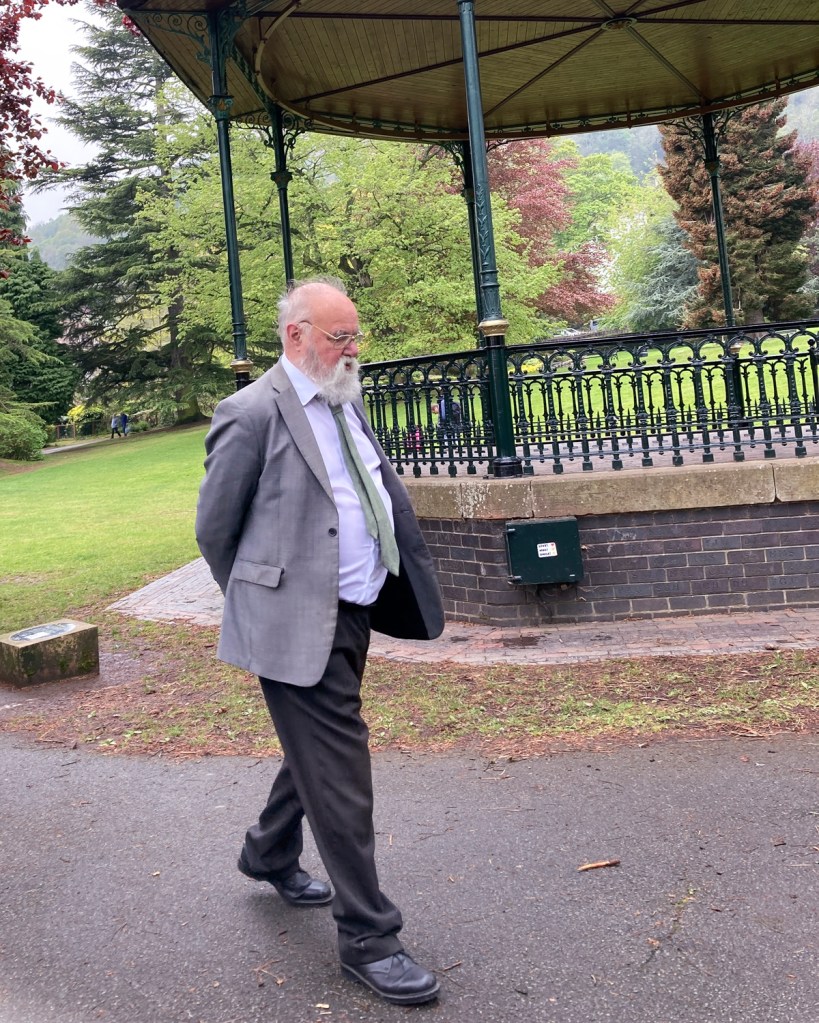
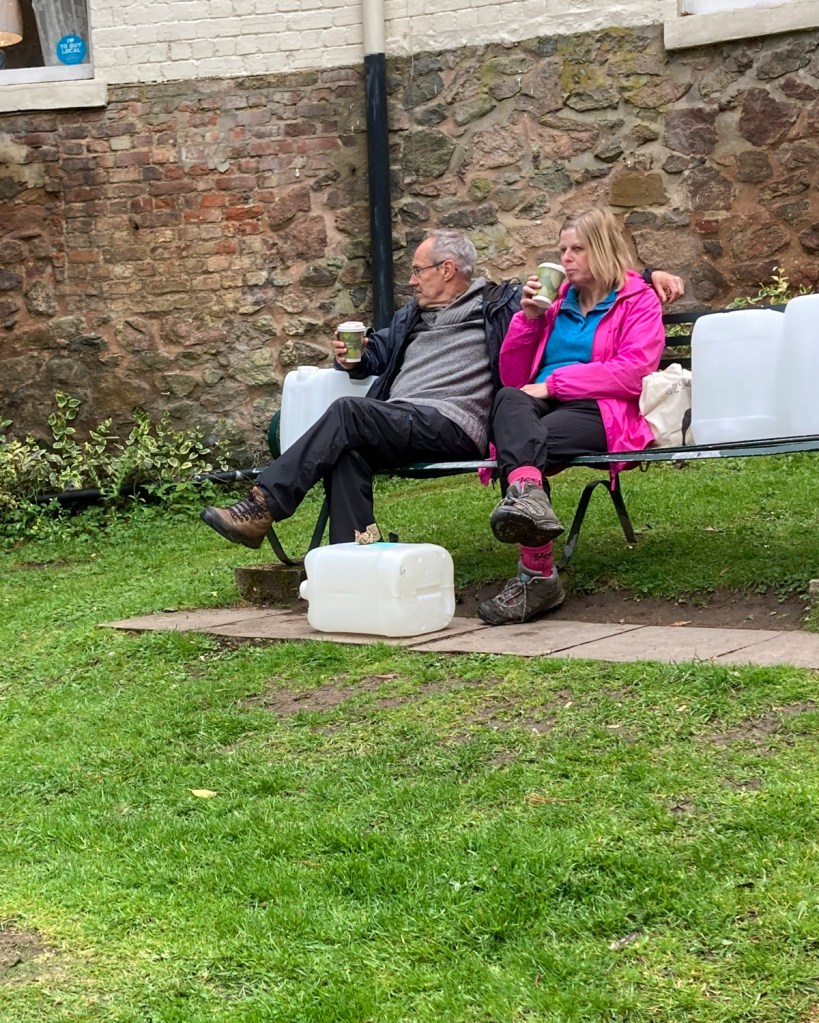
In this series, we have a mix of subjects with some single, some couples and a group shot. One each photograph, the subjects are going about their lives completely naturally without any idea that they are being photographed. To that extent, I think the photographs work in terms of The Unaware. As a series, the only anchor is the fact that they are all shot outside in my home town. Unlike Evans’ different subjects in a common environment, my series uses this anchor as well as the fact that they are all unobserved. With Evans’ series, the viewer is challenged to question what the subjects are talking or thinking about. In my series, the questions are more broad, e.g. in Two, the gentleman appears to be strolling through he park with a thoughtful expression on his face, where in Three there is a lively conversation taking place. What is the lone man thinking about as he walks and what are the two people talking about that creates such a lively expression through their gestures? I showed the series to a friend of mine when complete and he immediately pointed out that “he’d seen that person or those people before”. When I reflect on the series, I too see people that I recognise, not because I know them, but because of how familiar their activities are. The family walking through the park is typical of most families I encounter when I spend time there, often with 3 generations out enjoying each other’s company. The climate protestor is a regular sight in town as she sits motionless and disengaged from the people around her. Her demeanour clearly shows her determination to speak for the planet, not its people. Most of Malvern’s residents just walk past her and at first, I wanted to represent her apparent invisibility. However, where she now sits makes it easy to completely avoid walking past her, so there were no opportunities to capture this. Instead, we are left with the idea that she is a lone voice that nobody is seemingly paying attention to. The couple surrounded by plastic containers are part of a familiar group who drink the spring water from the well at the centre of town. As a Spa town, the consuming of the waters has been a fixture for over a century. These people are clearly taking it seriously judging by the number of containers. I loved the irony of their drinking takeaway coffee in preparation for collecting their water.
Overall, I am glad that I took the decision to try something similar to Evans but with that unseeing perspective. It had the same ‘hit or miss’ element to Evans in that I couldn’t guarantee what would be in the frame, but because I wasn’t actually watching my subject I feel there is a complete detachment between us. Yet, the impression that I have of the people of my town is reflected in the images when collected as a series. The main challenges with the exercise were technical, but I guess also my reluctance to put myself in a difficult position also drove me down this path. No doubt I could have shot better photographs technically with one of my proper cameras, but I am pleased with how the mobile phone performed here.
Our focus until this point has been how the portrait is a kind of relationship between the photographer and subject that is entered for a variety of reasons. In some cases, the relationship is purely transactional, i.e a payment or service is being exchanged that results in a picture. We have all experienced these situations during our lives, whether attending a studio or a wedding were there is a requirement to pose for a constructed shot. Another reason for the relationship could be purely artistic, with the photographer telling a story about the subject. We have covered this situation in Assignment 1 and Exercise 1 in this unit.
This project deals with the situation where no such relationship exists, i.e the subject is not aware that they are being photographed. In this situation, the photographer is observing the subject and deciding on how to represent them. We are presented with the quote:
“The guard is down and the mask is off”
Walker Evans (1938)
This is the obvious effect of shooting the unaware. There is no knowledge, pretence or preconceived idea of the image and we are truly seeing the subject in the context of their lives at that moment. We know nothing of the backstory that informs their expression or what they are thinking about when they are photographed. We do not know where they are coming from or where they are going to, just that they were photographed at a moment. The only control the photographer has is the decision to frame and shoot at that particular instant, which leaves their intention as well as the subject’s demeanour open to interpretation by the viewer. The act of photographing someone without their knowledge or consent has always raised questions about privacy and intrusion. In a similar way, photographing the unaware is as potentially socially awkward from that perspective, as asking a stranger for a portrait, which we did in Assignment 1. In this project, I’ll be looking at the artists mentioned in the course notes, many of which I’ve encountered before in my studies, but also more widely at the lesser known contemporary artists who practice this form of portraiture.
Walker Evans (1903 to 1975)
The first artist is Walker Evans, whose work for the Farm Security Administration (FSA) in the 1930s we have already been made aware of. Like his contemporaries, Evans was on assignment to represent the suffering of the displaced agricultural people of the US during the Depression. His images were carefully stage-managed for that documentary work and the relationship between photographer and subject comes through. However as we discovered previously, Evans’ and the other photographers were heavily censored by their editor[1] to keep consistency with the story being told.
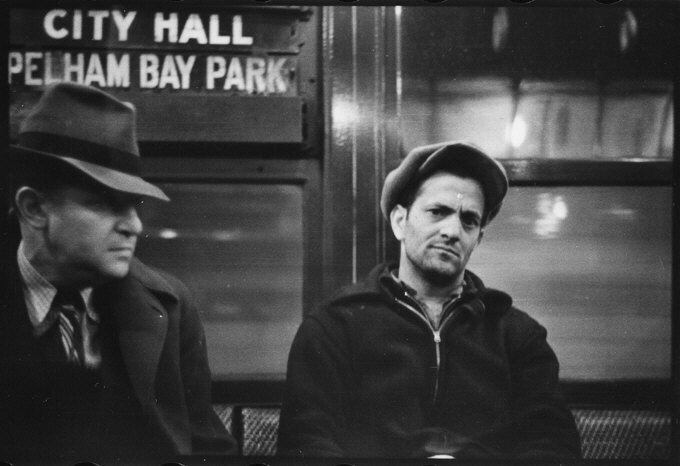
In the late 1930s Evans started to experiment with another form of portraiture, namely covertly photographing people on the subway. His portraits were shot with Evans’ camera hidden in his clothing with the focus and exposure predetermined. Evans observed his subjects and shot the pictures with a remote shutter release that ran down his arm. His pictures reveal people going about their business, mostly oblivious to what Evans was doing. In the example below, one of the people is looking directly at Evans, which suggests that he has noticed the artist looking at him. While he may not have been aware of the photograph being taken, it certainly looks like the subject had some inkling that something was going on. His concerned, almost disapproving expression takes on a different aesthetic to the man next to him who doesn’t appear to have noticed Evans’ gaze.
From the book “Many are Called”, by Walker Evans (1938) [2]
Evans collaborated with writer James Agee on the book Many are Called (1938) which was made up of a selection from the 600 or so images that Evans shot on the subway [3]. When we look at these photographs, we see a cross-section of American city life with no connection with each other beyond the fact that they are travelling on the subway. The common environment ties the series together, while the candid images of the subjects ask questions about what is going on for them, what they are thinking about and where they are going, both literally and figuratively. When I reflect on Assignment 1, the common environment that I used tied the subjects together but more loosely than Evans’s pictures. My use of the park and its vast space contrasts with the small confinement of the subway carriages. The background through the windows differs from shot to shot, but the subjects are framed by the architecture of the carriage, which I think stitches them together in a clearer way than my Assignment 1 photographs.
Martin Parr – Japanese Commuters (1998)
When I first saw this series by Parr, I was intrigued. I’m a big fan of Parr’s work because of his unconventional approach. His photographs have always felt like the artist’s very carefully considered observations and compositions are similar to many other artists, but his approach the technical aspects of shooting is a style that he’s made his own. His shots, particularly his portraits are often lit by direct flash and are very saturated. This style and approach doesn’t lend itself to discreetly photographing people without their knowledge. By Parr’s admission:
“I go straight in very close to people and I do that because it’s the only way you can get the picture. You go right up to them. Even now, I don’t find it easy. I don’t announce it. I pretend to be focusing elsewhere. If you take someone’s photograph it is very difficult not to look at them just after. But it’s the one thing that gives the game away. I don’t try and hide what I’m doing – that would be folly”
Martin Parr interviewed by The British Journal of Photography in 1989
The other aspect that made me think twice about whether these were truly unaware arose from my own experience of Japan. The people are very guarded over their privacy, particularly on the subway where intrusion is something frowned upon by other commuters. I struggle with the idea that Parr was able to shoot so close to his subjects with flash and not have either them or the people around them know that it was happening. Perhaps instead some of the commuters were deliberately lowering their gaze in the presence of Parr rather than being asleep as is assumed/asserted. Whatever the circumstances, I am a huge fan of Parr’s work and style yet Japanese Commuters is my least favourite of his series.
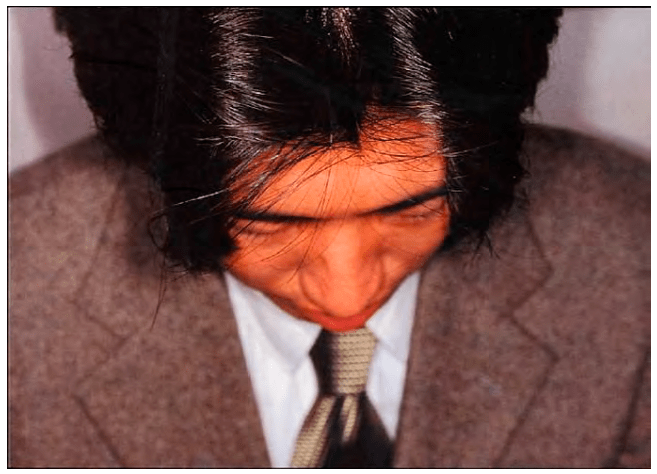
From the series Tokyo Commuters by Martin Parr (1998), from the OCA course notes
In the example above, we see the subject looking down as if asleep. The frame is dominated by his head and chest and we see on a relatively small area off his face. However we can see a few details about the man, namely that he is wearing a suit and tie which suggests his is a professional of some sort. He is also fairly young, judging by his complexion and dark hair. Beyond that we can see little else in terms of context. The other portraits in the series are very similar in composition and reveal equally small amounts of context around the subject. I don’t like the series because for me it only raises two questions, the first about the wretched act of commuting which is suggested by the downward facing expression/sleep and the second being about invading people’s privacy by taking an extremely close, harsh photograph of them. The series feels more one-dimensional to me than Parr’s other work such as The Last Resort or Britain at Time of Brexit (covered previously in my research). I think that Michael Wolf’s series Tokyo Compression [4] offers more of an insight into the theme that Parr was exploring, but as we know some of the subjects were very aware of his photographing them through their abusive reactions.
Phillip-lorca dCorcia – Heads (1999)
In his series Heads, diCorcia set up a camera trap with remote controlled strobes set up under a building gantry. He used a telephoto lens from a fair distance from the trap which allowed people to see what he was doing., even if they weren’t sure what he was actually shooting. diCorcia then waited for people to walk into his trap, either by choice or by accident which creates a sense of blurring between ‘aware’ and ‘unaware’. Like Parr’s use of flash, diCorcia’s subjects would have known something was happening if they saw the light from the strobes, although in an interview in 2018 he stated that the flash was so fast that most didn’t notice[5]. With this series, diCorcia had many technical challenges caused by working from many feet away from the subjects. These included pre-focusing on where the subject might enter the frame which differed as their heights were varied. In addition to this, the people walking under the gantry were often in a crowd, so there were many shots where the subject was obscured by another person. This randomness reminded me more of Evans’ series on the subway because he could not frame his subjects beyond estimating the field of view of the camera and aiming approximately in their direction. diCorcia’s shots also raised questions about what is going on for the subject, what they are thinking about etc. as they walk the street. This was much more akin to Evans than Parr and Wolf.
Other Artists
Another artist we are introduced to is Lukas Kuzma, who’s book Transit is a collection of shots of commuters on the London Underground. When I look at Kuzma’s images I am reminded of a comment made by Joel Meyerowitz during the BBC documentary The Genius of Photography [6]. Meyerowitz would shoot on the streets of New York with his Leica film camera and frequently got close to his subjects, almost putting the camera into their faces. As the city is so densely populated, Meyerowitz asserted that they were aware of his presence but mostly couldn’t believe that he was interested in photographing them. The resulting photographs have the same ‘unnoticed observer’ feeling about them as Kuzma’s work. The photographer becomes a chameleon, just another person who is going about their business and not interested spectifically in the subject as far as they are concerned. The same sense of blending in is found in Tom Wood’s Looking for Love, which involved the artist spending increasing amounts of time being part of the same club scene as his subjects. Although they are aware of his presence, they are so accustomed to seeing him that there is no need to pay attention to themselves. The results are pretty close to natural.
These artists reminded me of an occasion where I shot photographs of the unaware. A few years ago, I photographed my friend’s vinyl record shop on World Record Store Day. The idea was to document the day where there is a greater focus on the medium and the revival of the record shop as a place to visit. I shot the pictures on high speed black and white film using my Leica M3. When I arrived to shoot, I was very uncomfortable with photographing people I didn’t know when they were minding their own business. Despite my friend and I agreeing on this being done, I wasn’t there in an official capacity, i.e. I wasn’t staff. After a few people being vocal about not wanting to be photographed, everyone started to become comfortable with my being there. I am also a vinyl fan, so I mixed the shoot with my own digging through the records. Eventually, I went unnoticed amongst the customers to the extent where they weren’t engaging with me at all. The resulting images were very natural in the way they revealed the people in the shop. A few examples can be seen below.
Conclusion
In conclusion I can see how the styles of photographing people without their awareness or participation has evolved since Evans’ subway photographs. His work is completely detached from the people sitting opposite him on the train, but he chose the moment to capture and therefore represent what he saw in their behaviour or expression. Looking at the work of artists that followed Evans in this area, we see the photographer becoming more bold in their shooting. Parr and Wolf’s photographing on the Japanese subway must have drawn attention, even if not from the intended subject. For me, this was a natural evolution from the increasing amount of street photography over the latter half of the 20th Century. People became accustomed to some intrusion from photography and they could choose to ignore or confront it as seen in both Parr and Wolf’s work in Japan. The further evolution of shooting the unaware is when the photographer becomes part of the background or activity. Kuzma and Wood’s active participation in the environment helped them disappear from view which allowed the subjects to continue to be themselves. These photographs have a different aesthetic to Evans’ original work in that they reveal the subject from different angles, distances and situations. The overall effect is the same, though. In each series, the photographer tells a story of what it’s like to travel around a city or party in a nightclub. The additional context that is available from the more contemporary approach perhaps leaves less to the viewer to work with. When I look at Evans’ pictures I want to know more about the people and what their lives are like. I don’t get the same sense from the works of the other artists.
In this exercise, you’ll build on your ‘Background as context’ exercise in Part One by taking the relationship between your subject and their surroundings a step further. The objective here is to try to create a link between the two components of your image, i.e. the subject and their surroundings.Make three different portraits using three different subjects. Prior to shooting your portraits, engage with your subjects and agree three different specific locations which have some relevance or significance to them individually. You’ve already tried to give a particular context to a portrait by considering how the background might link to the subject positioned in the foreground, but now you must go one step further and negotiate a specific physical location where you’ll photograph your subject. This can either be inside or on location, but the key to this portrait is the interaction you’ve had with your subject in identifying a place that has specific meaning for them.
Each portrait should be accompanied by a very short piece of text explaining the choice of location or venue. Don’t be tempted to create a work of complete fiction here; it might make life easier for you, but you’d be missing an opportunity to really engage with your subject and collaborate with them in the image-making process.You have complete freedom to work this out as you feel appropriate; for example, you may choose to theme the narrative behind all three portraits. Think carefully about how these images could work together as a set. For instance, if you plan to shoot outside, try to make sure the lighting conditions/ time of day/weather conditions all work coherently.
Present all three images together as a series and reflect upon how successful this exercise was in your learning log or blog. Write around 500 words.
This is my Church
For this exercise, one of the first things that occurred to me was that of comfort or peace. The past year or so has been tough on most people, with the restrictions on social contact and the constant anxiety of potentially catching the virus. When I think about my own situation, I know where I am most at peace. This past few months since leaving my job, I have found this place to be my morning visits to the local park. That realisation led to the series that I shot for Assignment 1 [1], where I sought to reveal something about why people specially visit the place and how it makes them feel. For this series, I decided to continue that theme and ask my subjects to take me to a place where they felt most at peace, for whatever reason. This wasn’t about being able to sleep or relax, but somewhere where they felt calm and balanced. It might be a room in a house, an outdoor space like a garden or somewhere that distracts them from what worries or stresses them. It could be more a state of mind than a physical space, which would potentially present a challenge in representation. The idea of This is My Church was to place the subject in their peaceful place and use the background context to tell the story. This exercise called for the use of a small amount of text to explain the location, which is something I had adopted for Assignment 1. In my feedback, it was suggested that care needed to be taken not to make the text more meaningful than the photograph that it accompanied. I managed that successfully before, but would need to be mindful of it here.
This is My Church
Hazel
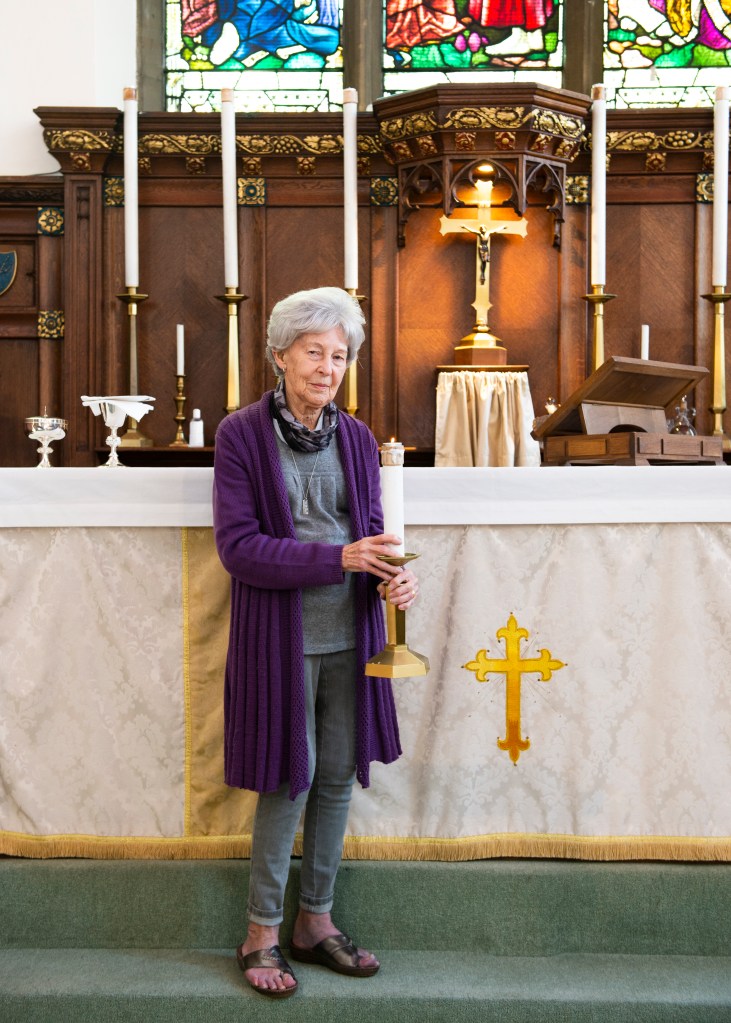
Hazel is at peace in in her literal church. She’s both worshiper and warden, so her connection to the space is both spiritual and functional. Giving something to the community, whilst being in a sacred place gives her a great sense of peace.
Peter
Peter is a yoga teacher who has been working from his home studio during the pandemic. When he is not teaching, he is able to achieve peace through creating and practicing new routines for his classes.
Jamie
Jamie is a 6th form student who uses video gaming to achieve his peace. Games offer a sense of escape, for him, his headphones shutting out any distractions that may invade his space.
Reflection
My original intention for the series was to let the subject define the circumstances in which they achieve peace and how their environment helps create that sense. On each occasion I was struck by how powerful this sense of place was for my subjects. The first image of my mother-in-law was shot when her church was empty. She is a key-holder so this wasn’t a problem. I noticed during our time there that she still went about some of the activities that she would normally do as part of her warden role. In this pose, she is holding a large candle that she told me was actually a fake holder for mini tea light candles because they were more cost effective for the parish. I loved the way this contrasts to the opulence of the alter decoration and the silverware in the photograph. The other element that I think works well is the contrast of Hazel’s petite stature against the large alter which almost belies how crucial she is to the running of the church. In the second shot, Peter’s space is uncluttered simplicity which one would expect for a yoga studio. However, the space is used to broadcast his classes so not shown is the lighting setup he uses. What I like about this shot is that he looks as though he is working but his pose is a typical yoga stretch. This contrast is set off by the natural light that is flooding through the window to the right. With the final image, Jamie described his environment as a ‘typical teenager’s bedroom’, which is clear from the elements in his desk area. Unlike the other shots, I deliberately didn’t suggest stage-management of the background as I wanted it to speak directly to Jamie’s personality. His room is full of references to his growing up, with the added inclusion of his student card hanging on his monitor. I liked the inclusion of the fork along with his pens and pencils, suggesting he likes to snack in his room. Jamie’s pose with the game raging on his computer screen suggest someone for whom escapism is important. When I asked him about when he plays, he replied that it was he wanted to be at his best which sometimes meant playing after a good day but also after a bad one. I like this sense of balance, which I think comes through in the photograph itself.
Overall, the learning from this exercise was how a portrait can evolve from the conversation between photographer and subject. In each case the subject contributed to the inclusion or exclusion of elements that supported their idea of what makes them feel peace. Only in the last shot did I left the placement of the contextual elements as they were because I felt that they were more representative of the subject’s personality than we could probably manufacture between us. I’m really happy with how all three images turned out.





 Richard Fletcher OCA Photography Blog