The Brief
Study Sander’s portraits in very close detail, making notes as you go.
Look at how his subjects are positioned in relation to each other or their environment. Are they facing the camera or looking away? What, if any, props does Sander use? Do these props seem relevant or are they strange? What physical stance does the subject adopt?
At this point it might be useful to employ the ‘five element model’ as described by David Bate, which includes:
The Face: This can be used to illustrate the feelings of the sitter, given that facial expression can signify a repertoire of different states and moods including happiness, sadness, anger or frustration. It should be noted however that the expressions worn by the face are not necessarily indicative of a fixed state of being.
The Pose: Can be described as a visual argument in itself, or a form of rhetoric. The various body language conveyed by a sitter can be read in combination and can connote all kinds of perceived characteristics. Just as the expression of the face is the rhetoric of mood, so the pose contributes to the signification of character, attitude and social position.
The Clothing: Can be used to indicate a great deal about a sitter’s social identity and how they relate to that identity in their pose. Uniform’s for instance can not only differentiate a factory worker from a police officer, but can also specifically identify rank and the different regiments within the armed services.
The Prop: Can significantly alter the meaning given to the identity of the portrayed figure.
Detail was extremely important to August Sander and the background in his portraits was never left to chance.
Study the backgrounds of Sander’s portraits very closely and reflect upon what you see. Where does the subject sit in relation to the background? If location-based, does the head sit above or below the horizon? Has the background been deliberately blurred through the use of a wider aperture and therefore shorter depth of field? Does the background offer any meaning or context to the portrait?
Make a portrait of someone you know, paying very close attention to what is happening in the background of the shot. Be very particular about how you pose the subject and what you choose to include in the photograph. Ideally, the background should tell the viewer something about the subject being photographed. Reflect upon how successful this project was in your learning log or blog, discussing specifically what your intentions were in terms of the background you chose in your image.
Introduction
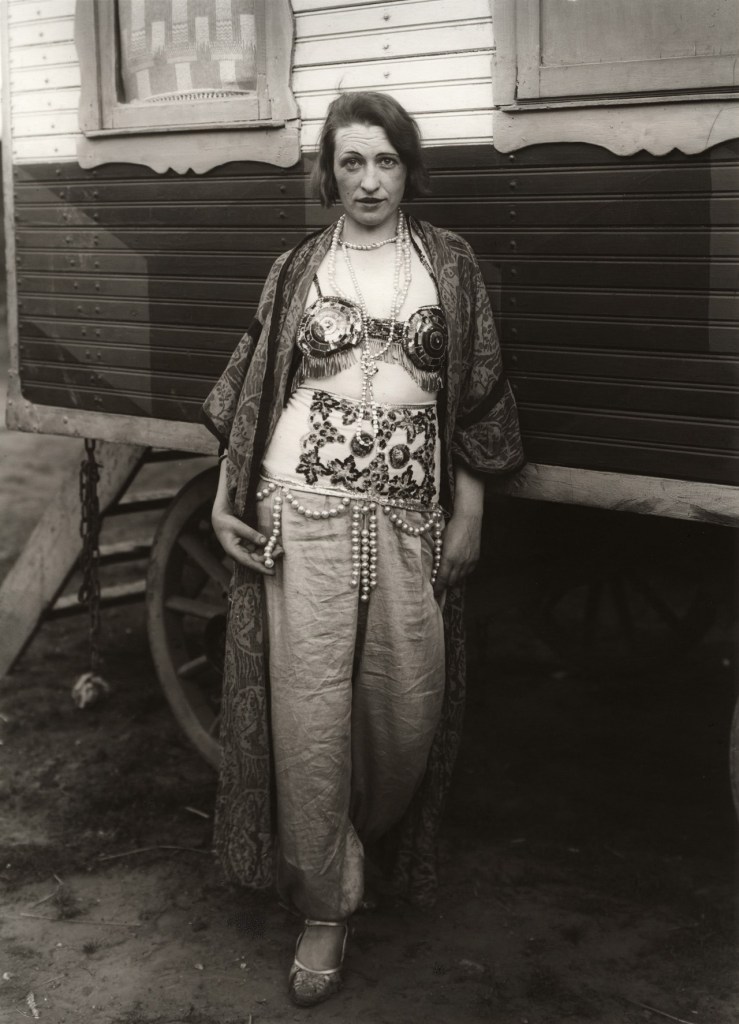
For my critique of Sander’s portraits, I have selected the following 3 from his wider project People of the Twentieth Century, shown below:
Part one of this exercise is to closely examine the portraits for the details contained within the composition. I started by looking at each image in turn and annotating what is immediately apparent, using the five element model as a guide. The yellow annotations are my observations about the man, his clothes and his props and the blue annotations refer to the background and setting.
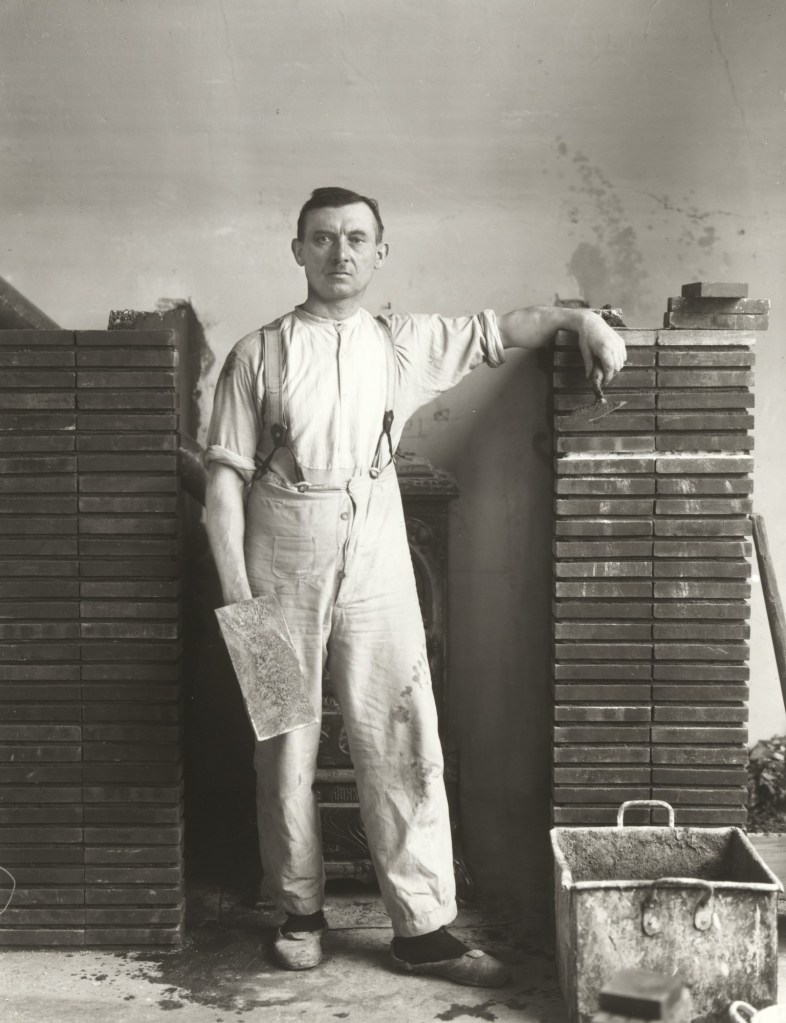
Photograph 1 ‘The Master Bricklayer’, 1932
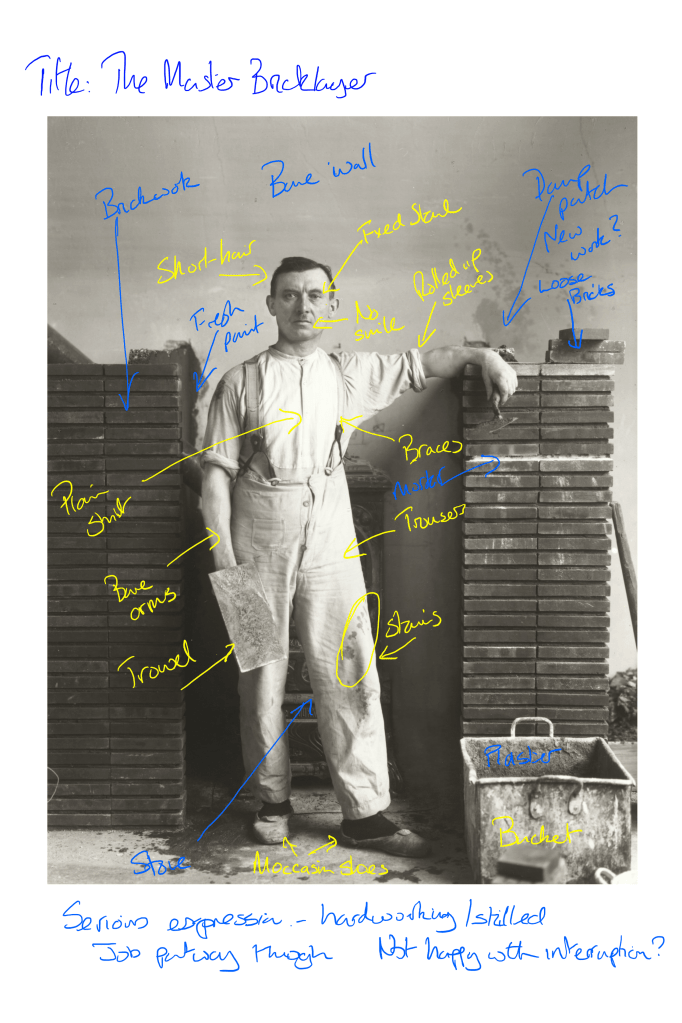
Here we have a man pictured at his place of work. The title refers to him being a master bricklayer but it is also obvious from his surroundings that this is his profession. He is standing in front of a stove between the partially completed fireplace structures that he is clearly building. Both side walls of bricks rise up to shoulder height and the man is leaning on one of them as if emphasising that he had created it. The fresh mortar between the bricks is visible, while the background wall and floor show signs of building work taking place with splashes of what we assume to be water. The man is dressed in plain, functional clothes that bear the signs of a physical trade (creased and with the sleeves rolled up). He is holding a brick laying trowel in one hand and a plasterer’s trowel in the other and in front of him is a large square bucket that looks like it has clearly been used for some from of brickwork or plastering in the past. The man’s stance is one of pride but his expression is of someone who looks annoyed at being disturbed. There is a fixed stare and no smile evident on his face. When I look at this picture I see a man who is clearly a skilled craftsman, standing in amongst the fruits of his labours. The way he is posed in front of his work, leaning with a fairly nonchalant stance on one of the brick pillars shows a pride in what he is doing, but his expression is blank, almost as if he is being interrupted. There is an eagerness to return to what he was doing before posing for the photograph. The main puzzle for me is that he is holding two trowels. The one in his left hand is what would be traditionally associated with mortaring bricks while the one on his right hand is more like a plaster’s smoothing trowel. From this, it appears that the man is more generally a builder but that is not the title that Sander gave him. Perhaps when it came to his typologies, Sander wanted to be more specific than general builder as a profession or perhaps the setting for the portrait presented itself before the subject, i.e. he came upon the man laying bricks. Either way it both classifies and unclassified the man’s profession which makes the image more intriguing as an artwork.
Photograph 2 ‘Circus Artist’ 1921
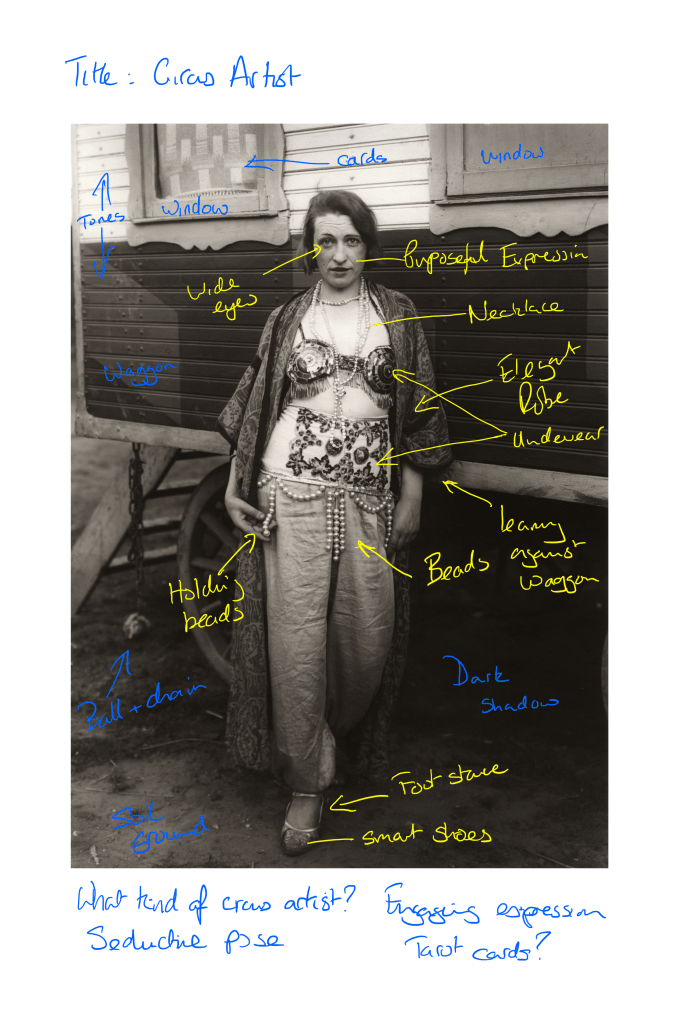
Here we have a woman standing in front of a waggon. The wheel and steps leading into the waggon can be seen in the background, along with two side windows and bodywork that appears to be two different colours. The woman is dressed in loose trousers, an open robe with elaborate under garments and lots of beaded jewellery. Her shoes are smart sandals that look like ballet or dance shoes. Her stance is a relaxed pose, leaning against the side of the waggon with her left hand by her side and her right holding the beads that hang from around her waist. Her expression is one of engagement, as if she wants the photographer to see her in a seductive way. Her slight smile and the way she is standing with her robe open suggests her wanting to invite the photographer into her life in some way. The interesting thing about this image is that we can immediately tell that she is either a gyspy or circus performer of some sort because of her clothes and the waggon in the background. Her specific profession is not that clear, although her outfit, which is provocative for the era, suggests some form of dancer. If we assume that she is a dancer, then her expression makes more sense. As a dancer, she would engage with her audience by facial expression as well as movement so this photograph gives us an insight into her life and therefore her personality. With this photograph though, Sander catagorises her in more general terms than the previous one. As this preceded the previous image by around 11 years, it’s possible that Sander was evolving his project and the nature of his typologies as he was working.
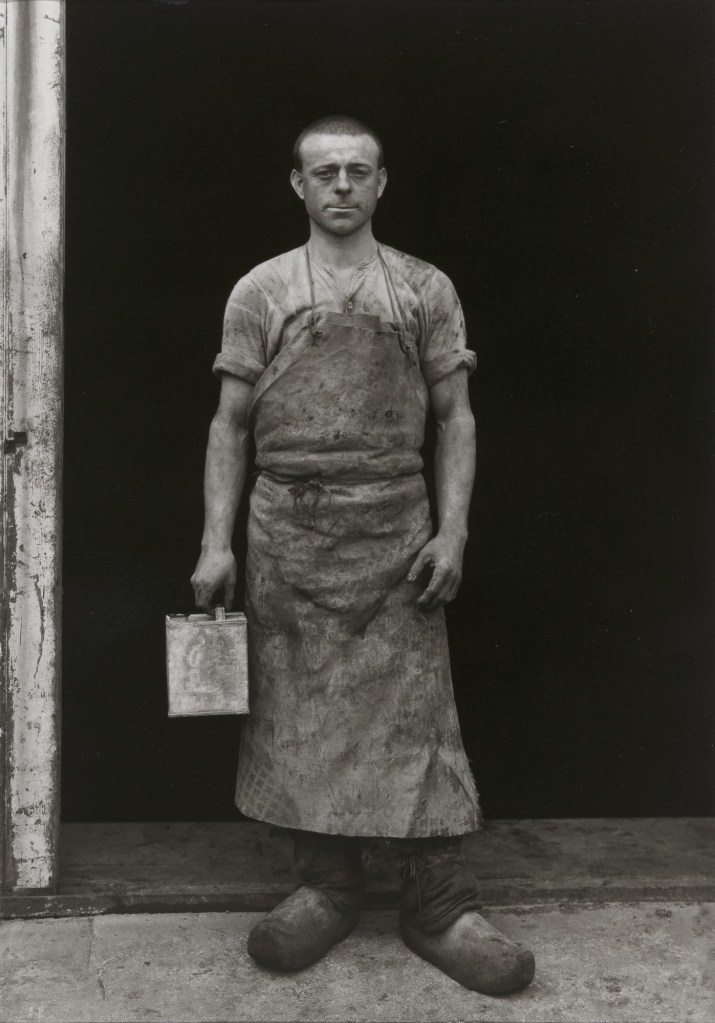
Photograph 3 Lackarbeiter (Varnisher) 1930
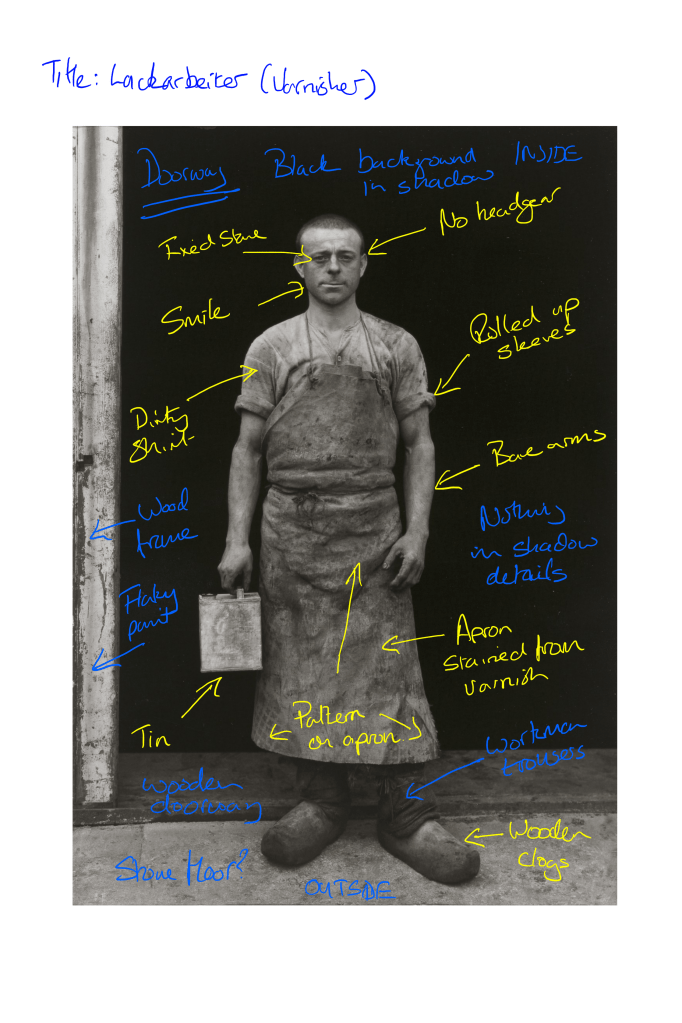
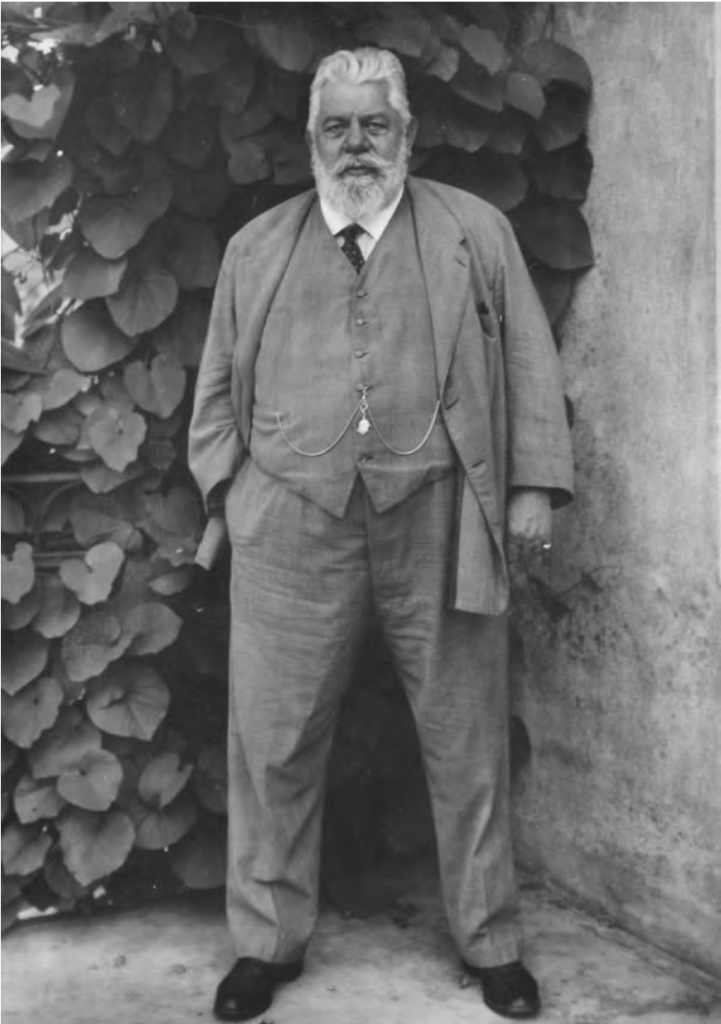
Here we have another tradesman posing with the tools of his trade. We are told by the title that he is a varnisher, which again shows Sander’s interest in specific typologies as well as more generalised ones. The skill here is distinguished from that of a carpenter or joiner and the what is contained within the image reflects that. The man is standing in front of an open doorway of a building. The interior of the building is in very dark shadow with no detail visible, but the photographed is framed by the surrounding woodwork and area of outdoor ground that the man is standing on. The man is wearing dirty clothing and an apron that covers most of his torso. His clothes point to a man whose profession involves getting dirty and never really being able to keep anything clean long term. As with the first image, the man’s shirt is functional and has the sleeves rolled up in order, we assume to prevent him getting dirtier than necessary. His long dark trousers are almost entirely obscured but what we can see looks functional as one would expect from someone in the building trade. His shoes are interesting, being wooden clogs with no laces. This type of footwear may have been what was worn on a building site of that era, although curiously the bricklayer was wearing less robust shoes in his photograph just two years later. Perhaps then, this skill was less valuable and therefore the people employed in it were poorer than the builders and bricklayers. This detail challenges us to think about the position of the man in society, which was very much what the German fascination with physiognomy and class was about in the 1930s. The man is holding a single prop, which looks like a paint kettle (presumably filled with varnish). The only other details I noted when looking at this photograph were his relaxed stance and expression, which tells of a man who enjoys his work, as well as the condition of the wooden frame of the doorway. The man’s stare is intense but unlike the bricklayer, he is grinning as if the idea of being photographed amuses him in some way. Perhaps he wasn’t used to the attention in his given profession. Whatever the reason, Sander has captured someone who is engaging the camera in a friendly manner as with the circus artist. The detail in the woodwork reinforces the idea that this man works in decoration as the timber looks as though it needs attention. This minor element for me is part of Sander’s creative use of background to create the context for the photographs without the really obvious use of props. His prop use itself is subtle, but the background for me is what makes his images stand out. When we look at the original image in the brief of the pharmacist, the background is a combination of foliage and plain wall. We could interpret the foliage part to be about the man working with nature, which could connote biology just as easily. When combined with the plain wall, the background takes on a level of beauty, suggesting that the portrait has been shot in a classy area. When we combine the background with the subject himself, we see an older, distinguished-looking gentleman dressed in middle-class attire, which suggests a learned or scholarly professional. If I had seen this image without its title, I would have thought ‘doctor’ or ‘surgeon’ from his dress. The subtle use of background and absence of props means that the role of pharmacist is entirely believable.
Part 2 – My Portrait
Concept
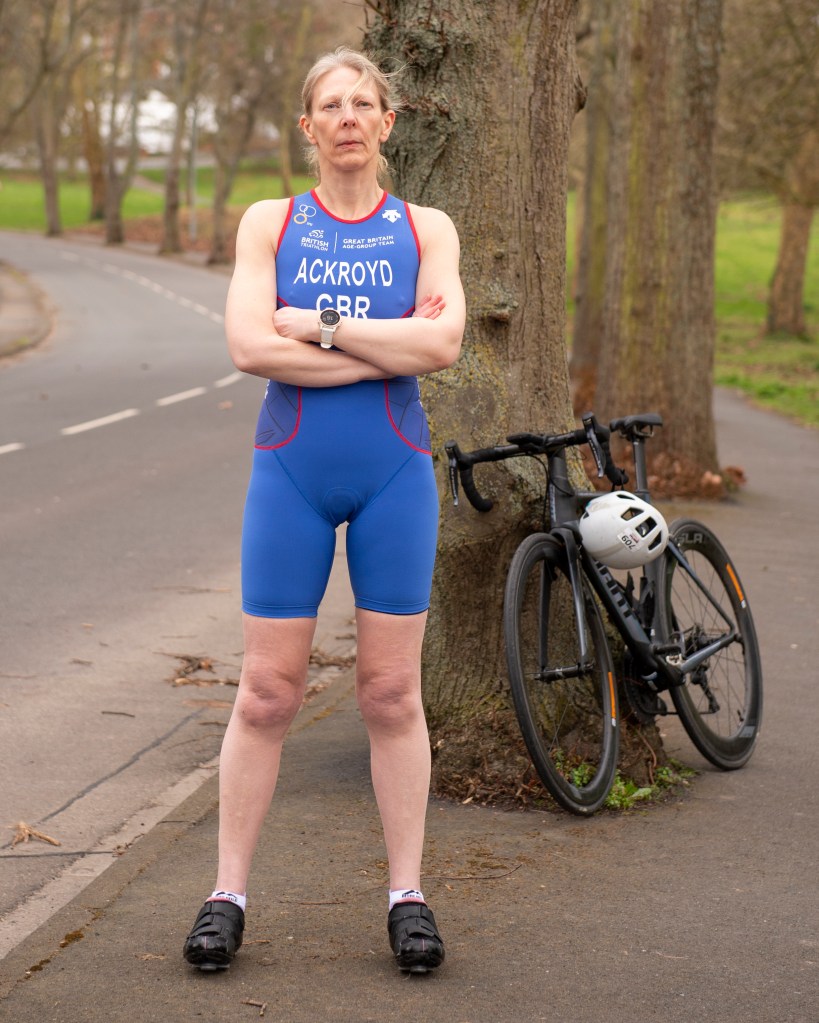
Owing to the current restrictions caused by the COVID pandemic, I decided to shoot a portrait of my wife. This would mean that I didn’t need to work with someone outside of my household during a delicate phase where restrictions were planned to be lifted. The other reason I chose my wife is purely because she has an interesting passion. She is a triathlete who has competed in multiple distances and for the GB age group teams in European and World championships. I planned to use the observations of Sander’s work in this exercise to shoot a typographical portrait of her.
The Photograph
Reflection
The idea for how to shoot this photograph came at an opportune time as Jayne had been asked to provide a picture for a local news article on triathletes who had competed for Team GB. The kind of portrait that the newspaper as after was a simple shot of her in her triathlon suit, smiling at the camera or doing something related to the sport. For my portrait, I wanted to create something that represents her as a triathlete with the background context that would suggest someone who is serious about what is essentially a hobby. I decided to shoot my portrait in a similar style to Sander’s, with her placed almost centrally in the frame and as full-length. As triathlon is a sport consisting of three disciplines with a variety of equipment needed, I was concerned that including too many elements that describe it would be too obvious. Instead, I focused on cycling and wanted to emphasise the competitive side of her personality. Her triathlon suit clearly indicates Team GB and the inclusion of the high-performance bike suggests serious competition. However, the inclusion of the helmet with unrelated race sticker suggests that she competes elsewhere too. I asked Jayne to pose with her ‘race face’ on rather than having some impassive or smiling expression. I selected the location in order to emphasise the ‘racing’ theme; the winding road resembling a track of some sort. The presence of the trees counter this idea but neatly tied in with the weather conditions at the time. We were experiencing very windy weather that had brought down debris from the trees over the past few days. When we shot this photograph, the wind kept blowing her hair across her face. I selected this version of the picture because that effect works with the other elements in the composition to sat that she means business.
On reflection I am happy with the way that the portrait came out. If I take the fact that I know the subject well out of my assessment of the image, I note how she is represented as someone who belongs in the category of ‘athlete’. In this case, the background elements support this notion in a similar way to the circus performer by Sander. My portrait doesn’t show Jayne interacting in any way with her surroundings or the props that are included in the composition. Nevertheless, I think the balance of costume, props and background work well together.
Conclusion
I found this exercise interesting as I hadn’t previously considered how a portrait could use the composition, and in particular, the background to reveal a narrative about a subject. Sander’s work showed that the combining a simple composition with a few contextual elements in the background can result in a powerful ‘representation’ of the subject. His work trying to categorise the German people by professions and social class introduced ideas of how we recognise certain types; the portraits themselves tell what appears at first glance as being the obvious story, but in reality they offer the viewer more to look at. In the case of his master bricklayer, we get a sense of the pride the subject has through both his expression and the inclusion of his work in the background. Both of these elements also suggest that the man is a skilled tradesman, more than the other example included her, the varnisher. In the latter image, the man is far more engaging with the camera but the overall composition gives a sense that this is a less skilled member of society. Both pictures are very similar in composition, but their meanings derived from looking at them are very different.
When it came to shooting my own portrait, I was happy that the result took cues from Sander’s work. I portrayed my wife in a way that doesn’t reveal much about her beyond her passion for competing as an athlete, which was the intention.
References
[1] Unknown, “Identity and Place – Part One: Origins of Photographic Portraiture”, Image Resource, OCA Course Notes.
[2]Koetzle H-M, 2012, “August Sander: A Profile of the People 2002”, Image Resource, American Suburban X Magazine, https://americansuburbx.com/2012/04/theory-august-sander-profile-of-people.html
 Richard Fletcher OCA Photography Blog
Pingback: Assignment One: The non-familiar | Richard Fletcher OCA Photography Blog