Introduction
I have just received the feedback from my tutor for Assignment 5: Making it Up. Overall, the assignment was very well received, with the comments that my single fabricated image both met the brief and was a well thought out, original piece of work. My approach of gaining the feedback of others was highlighted again as in Assignment 3. I had felt that to be the most effective way of testing whether my intent had come through in the image, even though I had also hoped for variety in the narratives that were being created. The feedback contained two areas for consideration, directed more at the next part of the degree than as changes to my assignment submission. I will explore those points here.
Feedback
“You’ve clearly thought quite deeply about this assignment and have documented your thought process is very well. You may want to however cite another photographer who also work with archival family photography as a way to contextualise the work you’ve done. I’d recommend perhaps here looking at the work of Nicky Bird here perhaps, who also uses archival family photography to think about place class and culture.”
Assignment 5 feedback, January 2021
This was interesting feedback for two reasons. The first being that we looked at Nicky Bird’s work Questions for the Seller in Part 5[1] where she purchased collections of photographs that nobody was interested in from eBay. She created an archive of family stories by including the answers to some questions that she posed to the sellers before making the purchases. In some cases, the stories were powerful which invoked the sense of sadness that the photographs were no longer needed, and in others the scant information pointed to the stories being lost. Bird curated the collection as a set of lots that had internal connections of their own but also related to the other groups of photographs in the overall archive. Eventually, Bird sold the photographs in an auction of her own at the gallery where they were being displayed. Her creation of a transient archive being broken up and passed on to the next generation of people who might appreciate the images, struck a chord with me. Historical stories are built from knowledge of events and added to as they continue to be told, but we are merely playing a part in them for a brief moment in time. The reference to Bird in the feedback made me think about the image that I had created and how it is essentially my own version of Jayne’s family history, that could be included in a family archive. I hadn’t previously made the link between the documentary nature of the pictures of her grandfather and father and my version of reality in Sanctum. If they were all stored together as part of an archive, anyone looking at them many years from now might miss the fact that the later image isn’t ‘true’. Therefore, for a brief moment, I have essentially subverted Jayne’s family history by creating a work that steers the viewer towards a certain tale of her grief and love for these two men. We’re not talking about chaos theory here, though; the ‘truth’ that my story tells isn’t that far from reality, it’s just another way of looking at grandfathers, fathers and daughters.
The second reason that this feedback interested me is because of my own situation described in my post reflecting on Photography 1 so far [2]. I have recently left my job as an Engineering Manager to pursue other interests aligned with my studies. One of the tasks that I’ve set myself in the coming year is to curate an archive from the thousands of photographs and slides that I was given by my father a few years ago. My work on Context and Narrative this year has led me to reconsider how I would approach this task. Instead of simply creating a volume that can be accessed by my family for their own purposes, I intend to tell the story of my family through it. I intend to take the work of Bird as well as Bloomberg & Chanarin[3] as inspiration for my archive in order to create my own original work from what is essentially box-loads of disparate images. I will be including this project later in blog when complete.
|”What I would recommend is thinking about this: for your image to work most successfully, I think it should in some way be accompanied by the two archival images that inform it – as it’s these three images together that create the enduring message about repetition memory family inheritance and belonging. Somehow these three images must be brought together to tell this one story. It did occur to me looking at your original image of your wife (in other words the image that you choose to make your shooting notes on – the image of her shot in daylight in the greenhouse) that if you’d printed this image out and then nested it into a clear folder with the other two photographs – a series of three found images photographed together would also made for a very successful piece of work.”
Assignment 5 feedback, January 2021
This comment interested me because of how the sight of the two original images together had made me feel when I found them [4]. Bryan had clearly seen the connection between the photograph of his father and the one that he had taken in his greenhouse. The result was to keep them together in an album that would go unseen for several years until I went through it, looking for inspiration. The idea of incorporating them together with this memory and realisation about the album’s hidden history gave me an idea for further version.
Jayne’s parents house has a number of classical pieces of furniture, some of which were made by her father (a woodwork craftsman and teacher by profession). One of the pieces is a large bureau where he kept all of his important documents and stationery. During the time that I knew Bryan, he kept the bureau private and rarely, if ever left it open long enough to see what was inside.
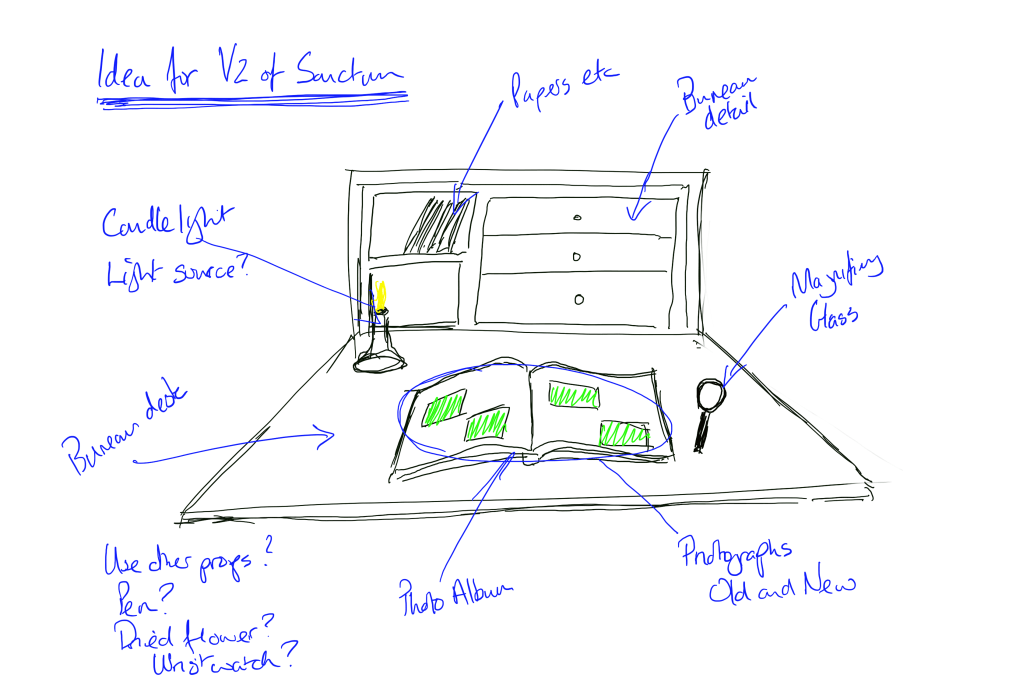
In this scene, the photographs that I found are included with the shots that I took for Assignment 5 in a vintage photo album. The album is set in its own fabricated image using the bureau as the set. The intent is to tell the story of the discovery of the photographs in the context of a family archive, with the new image Sanctum being part of the archive. Effectively this would add a layer of fabrication with the juxtaposition of new and old within a further constructed narrative.
Conclusion
I was delighted that my Assignment 5 submission was so well received. I pointed out on the call that I had enjoyed the creative process immensely as it gave me an escape from the difficulties I was experiencing at work at that time. The role of director was fun, with everything from the challenges of dressing the set with only what I wanted to include, to keeping the rain off my studio strobes during the setup. I was pleased with the feedback that has pushed my thinking around family stories and believable fabricated images still further; this has been the most interesting assignment of the course so far.
References
[1] Fletcher R, 2020, “5) Exercise 2: Re-situated Art”, OCA Blog Post, https://richardfletcherphotography.photo.blog/2020/12/20/5-exercise-2-re-situated-art/
[2] Fletcher R, 2020, “Reflecting on Photography 1 – how things have changed so far”, OCA Blog Post, https://richardfletcherphotography.photo.blog/2020/12/27/reflecting-on-photography-1-how-things-have-changed-so-far/
[3] Fletcher R, 2020, “Project 2: The Archive”, OCA Blog Post, https://richardfletcherphotography.photo.blog/2020/12/20/project-2-the-archive/
[4] Fletcher R, 2020, “Assignment 5: Making it Up”, OCA Blog Post, https://richardfletcherphotography.photo.blog/2020/12/24/assignment-5-making-it-up/
 Richard Fletcher OCA Photography Blog