Introduction
Assignment 5 is the final piece for Context and Narrative and is the culmination of understanding how stories are told through photography in a variety of ways. We have looked at a number of photographers who have created linear stories within the documentary genre, as well as those who use metaphor to more subtly articulate their intent. In Part 3 we were introduced to narratives that could be created through the use of self-portraiture, whether literal or metaphorical. My submission for Assignment 3 was a significant departure from what I had done previously and as well as being outside of my comfort zone as a photographer, it was from this point in the course that I began to understand the concept of the ‘unrea’l image. Now, having completed Assignment 4 and working through Part 5, I am starting to form an idea about what to shoot for the final assignment.
The Brief
Construct a stand-alone image of your choice. Alternatively, you may choose to make a series, elaborating on the same theme.
As the culminating assignment for the course you may wish to draw upon skills learned from Parts One to Four – using various forms of narrative, using yourself as subject matter, telling stories and reading images. The only stipulation is that you produce work that has been controlled and directed by you for a specific purpose. Remember to create a story with a specific context like the artists you’ve looked at in Part Five. This means that you need to have an artistic intention, so a good place to start would be to write down some ideas. This could then be form the basis of the 300-introduction to the proceed. You may find it helpful to draw storyboards to help you visualise your ideas.
The aim of this assignment is to use props, costumes, models, location, lighting etc. to contribute to the overall meaning of the image (Use flash/lights if required but available light is fine as long as it is considered)
If the narrative is set in a different era then the elements fo the image must reflect this. Also consider the symbolic meanings of the objects and try not to be too literal in your approach. For example, don’t automatically use red shoes in a love scent but try to be subtle in your ideas to obtain a more true-to-life scenario.
For this final assignment, you should also include an illustrated evaluation of the process you went through to produce your final image(s). Include snapshots of setting up the work and write about how you felt your direction went, how you found the location, props etc. How did this process affect the final outcome? Write around 1000 words (including your 300-word introduction).
Initial Thoughts
I started by thinking about the research work done so far in this course and how it has changed my perspective on photography. Previously, I tended to work in the literal. My photographs almost signposted the viewer to my intended meaning. By Assignment 2 I was beginning to use metaphor more clearly, but I then started to struggle with not having a structured approach to my creative process. The result was a very stressful experiences of trying to force creativity to happen, looking for compositions to present themselves and being disappointed when they did not. Assignment 3 saw a more structured approach that allowed me more freedom to focus on what I wanted to express. Having the approach under control, I then started to focus on not overthinking what I was trying to say and to experiment with my subjects and compositions. Although Part 4 led to a written essay assignment rather than a photographic project, the analysis of the many layers of narrative within a single image was a core skill learned. This gave me a greater appreciation of all photographic art, whether singular images or as part of a collection. My thoughts at this point were that I wanted to create something that would stand up to a level of analysis. Instead of images that occur naturally, e.g. the decisive moments of street photography, the brief called for something ‘directed’ in the spirit of Wall, diCorcia or Crewdson. At the heart of the brief was the idea that the photograph or series needed to be ‘made up’, suggesting either an entire or partial fiction controlled by me as the artist. I had enjoyed Exercise 3[1] where we had to recreate a childhood memory as it allowed me to think laterally about the kinds of props that I could use to help tell the story. For this assignment, I would start with a story idea and then plan how I wanted to create the contextual elements using props. I’d then plan how to shoot the image from a compositional and technical perspective that would be an experience similar to that of a motion picture director.
Thinking about stories
In Part 3 I discovered how interesting a self-portrait series could be as a way of telling a story. My tutor’s feedback suggested that I think about whether I would consider using self-portraiture as part of my future work. This was my first thought but I quickly dismissed it for the simple reason that I’ve told bits of my story throughout EYV[2] and during this course; to be honest I was a little bored of my storytelling being about me. I wanted to tell a different story that still involved a person or people, however. The next thought was about my wife and her family. Jayne’s immediate family has always been small; when I first met her, all she had were her parents and an uncle. Although her father’s extended family is larger, the connections with them are fairly distant with them not really featuring in each others’ lives Her relationship with her father wasn’t always easy, although for the last years of his life it was more evident how close they actually were. I am reminded of him everyday, not just because my wife has his height and looks like him, but also because they share the same very dry sense of humour. Her mum is very different, both in stature and personality – in Jayne I see her phenomenal strength, kindness and capacity for empathy, something her father sometimes lacked. When I think about it, all families are like this but what struck me was the way that these likenesses and differences are accentuated when the family unit is small like theirs. My own family is considerably larger, so these subtle characteristics are spread more widely.
My conclusion from these initial thoughts was that I wanted to make my story about Jayne’s family in some way. Coincidentally, we were due to visit her mother so I took the opportunity to look through some of the family photo albums for inspiration. Like most families, there were many photo albums ranging from the beginning of the last century through to recent events. It was when looking through one of the albums, I found these pictures in a flip sleeve:
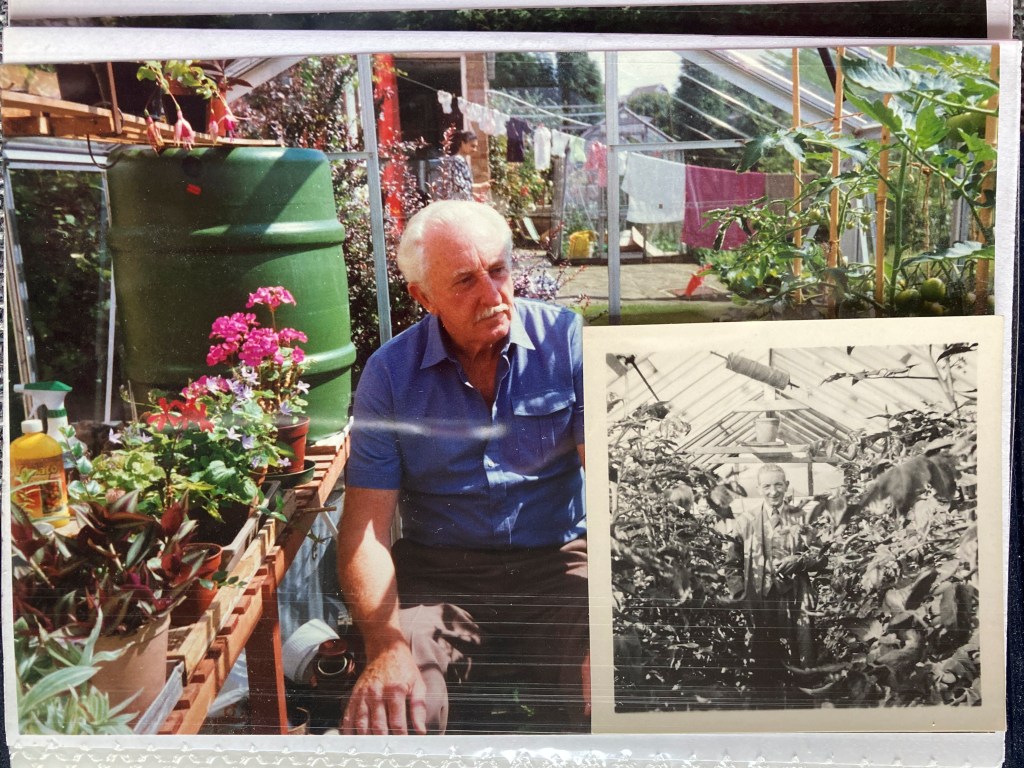
This immediately got my attention. The main picture is of Bryan sitting in his greenhouse in the mid-1980s. He had just retired from teaching after a long and successful career and was indulging one of his passions that he hadn’t had time to do when he was working. What interested me was that Bryan had tucked a smaller photograph of his father in a similar situation into the same sleeve. Bryan had seemingly found the older print and related to its similarities to his own photo, electing to store them together. There was something deeply significant about this act as the album isn’t viewed often these days so the connection between the two photographs could be thought of as everlasting in some way. The actual similarities between the images in terms of composition and context were also striking – to explore this further, I deconstructed both images as I did in Exercise 3 and Assignment 4.
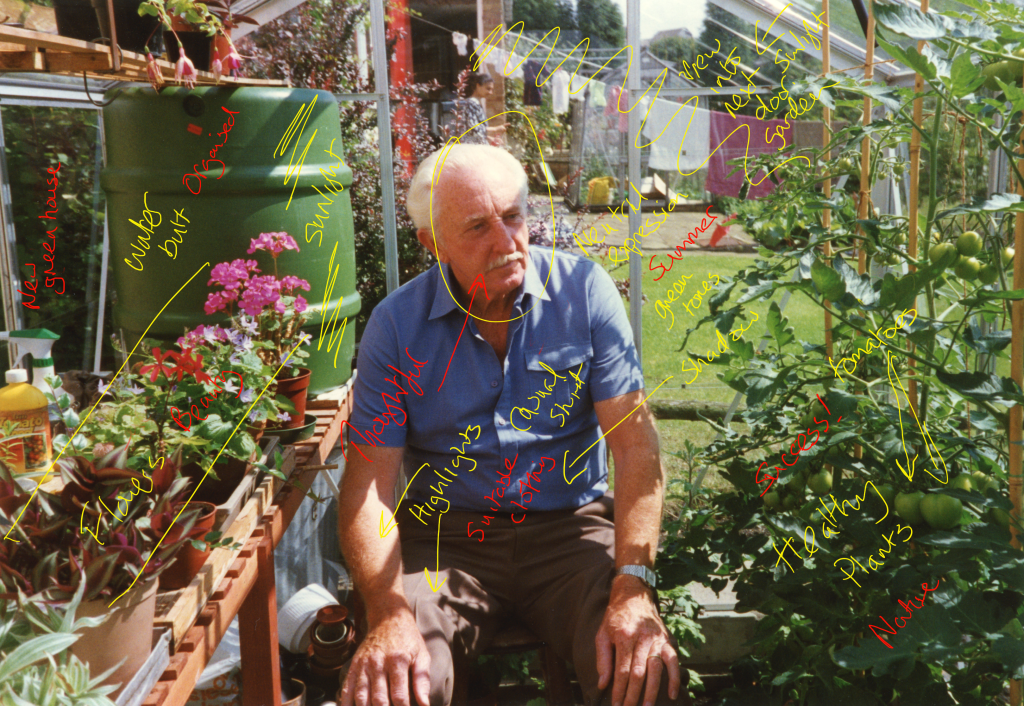
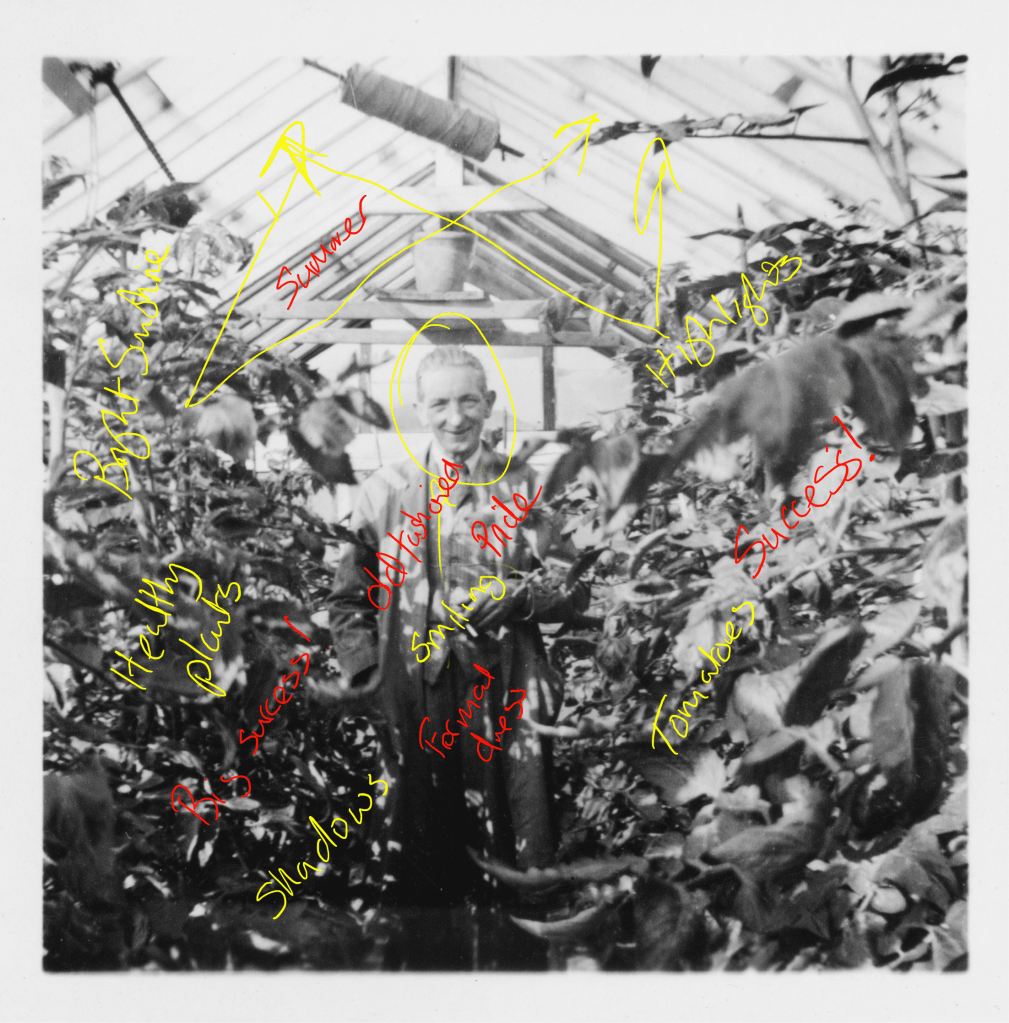
From the two images I could see some common elements. Both men are were the centre of the greenhouses and also the composition. They were both surrounded by the fruits of their labours, which were very healthy looking tomato plants. The photographs were both taken on sunny days with light streaming through the roof of the greenhouses. Both men were wearing the clothes of their era, Johnny in a formal three piece suit and Bryan in 1980s-casual wear. At first they seem at odds with each other, but from what I know of Johnny, he was a smartly-dressed man. So, while he may not have been necessarily dressed for working in the greenhouse as Bryan is, the picture feels spontaneous as if he is showing off what he’d grown.
In terms of themes, the key ones that were common to both pictures are:
Pride – in the achievement
Passion – for their hobby
Nature – wonder of the natural. The black and white even creates a sense of green by the dominance of the plants in the frame. The sun plays a big part in
Father to son – passing on the mantle and it being received
Hierarchy – Johnny has more than in his greenhouse than Bryan. Perhaps the passion isn’t as strong down the generations.
Order – both are neat and tidy spaces
What the deconstruction taught me about these photographs was that both men had a shared interest, likely passed on from father to son. They had the same approach and the same sense of pride in their efforts as amateur gardeners and rightly, given the success of what they had grown. When looking more closely, though both men adopt different poses. Johnny is looking straight at the camera with a beaming smile, but Bryan is not engaging with ‘the viewer’ at all. His shot was definitely posed and he clearly intended that the two images were kept together because of their strong similarities. So why the enigmatic expression? Bryan was certainly comfortable in front of the camera, but perhaps this was more about being surrounded by his plants rather than being about him. Or perhaps it just was that he was not exactly like his father. This got me thinking about what my story could be about.
My Idea
I decided to shoot a single photograph that captured the essence of how these two men came to record the same sentiments in two images separated by so much time. How Johnny passed his love of gardening to Bryan but how the resulting interest evolved through the differences between father and son. The added element would be the fact Bryan’s daughter has no interest in gardening; her passions went down a completely different route to both of them. I want to create a narrative about ‘inheritance’ through the generations and planned to weave the likeness and contrasts into the image, using metaphors and props that stand up to the kind of ‘reading’ that was the focus of Part 4.
Location
While looking at the greenhouse in the ‘Bryan’ photograph, I asked my mother-in-law where the picture was taken, naturally assuming it would be some previous house they had lived in. The answer was the same house she lives in now. The greenhouse still stood in the same place in the garden as in 1986. However, when Bryan became infirm towards the end of his life, the greenhouse wasn’t maintained and had fallen into disrepair. For me, this was a stroke of good fortune as it meant that I had a potential setting for my photograph. I took a series of contextual shots during that visit to capture the scene as it is now, including one of my wife sitting in the same position as Bryan.
The Greenhouse and Contents
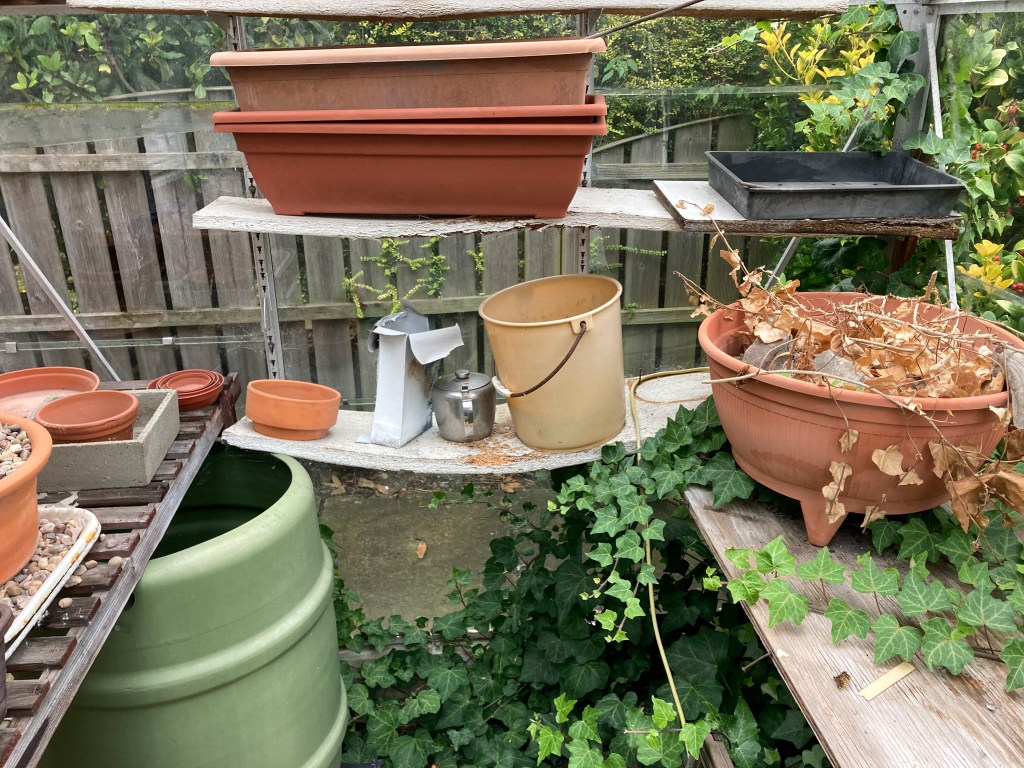

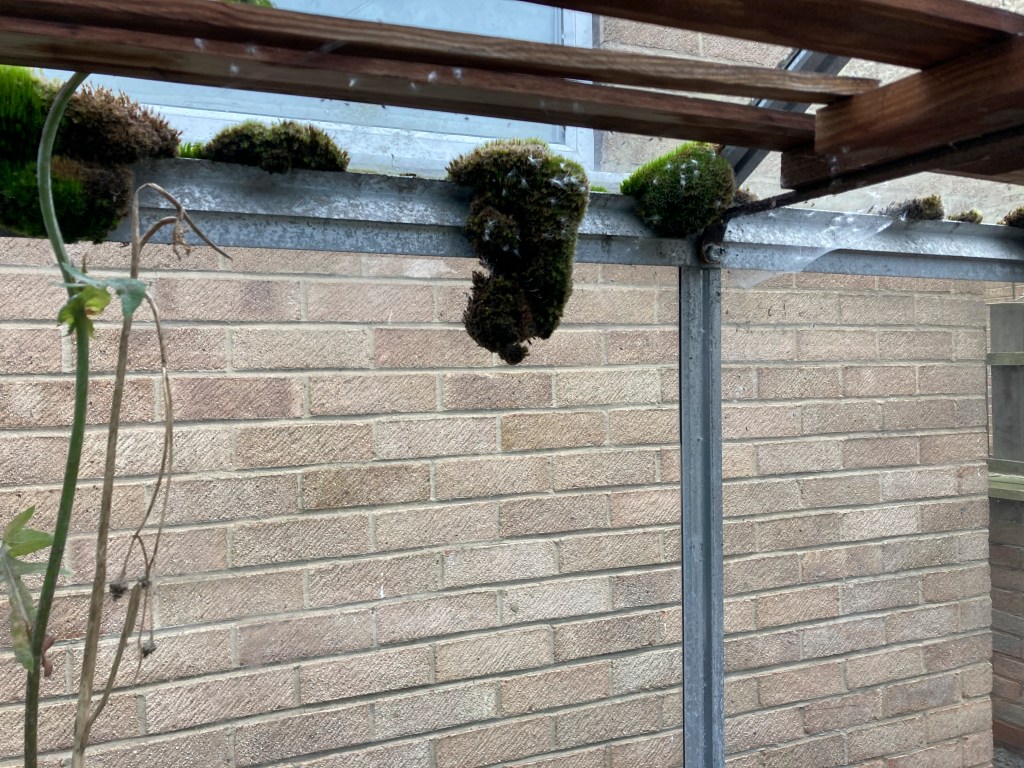
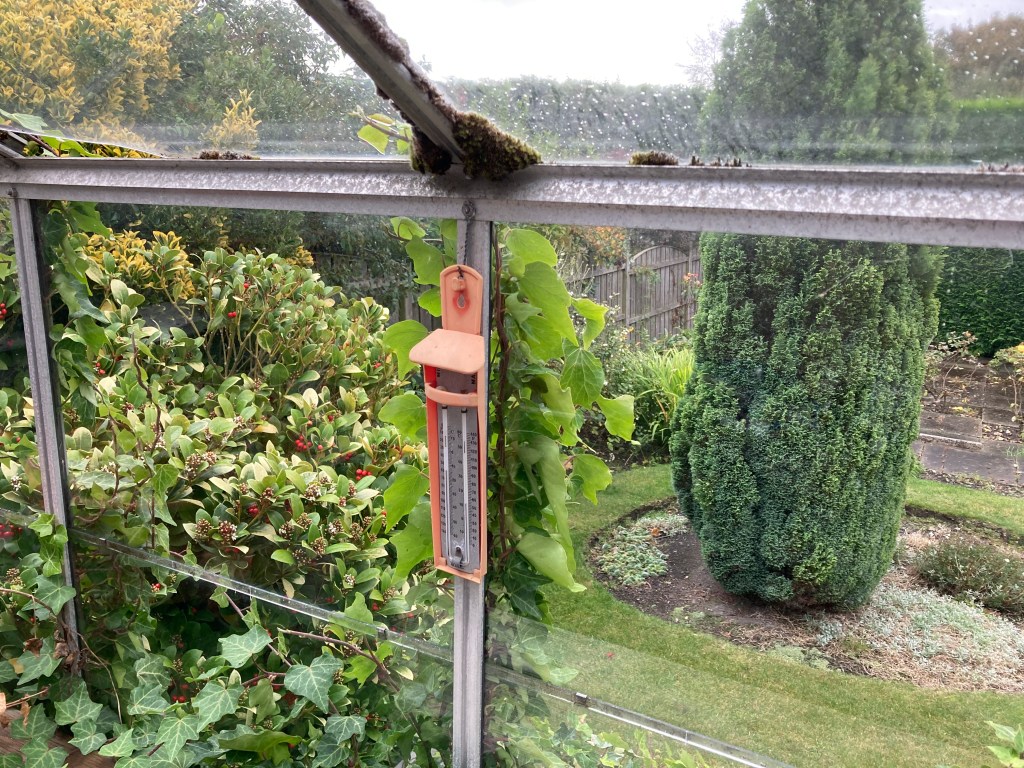


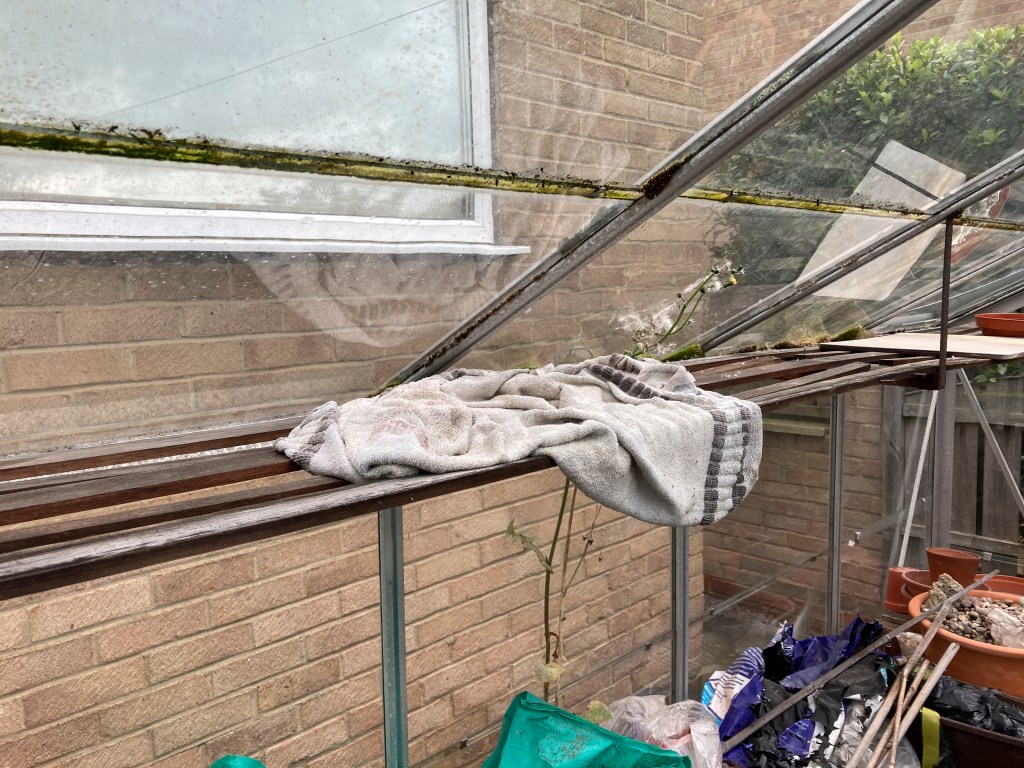

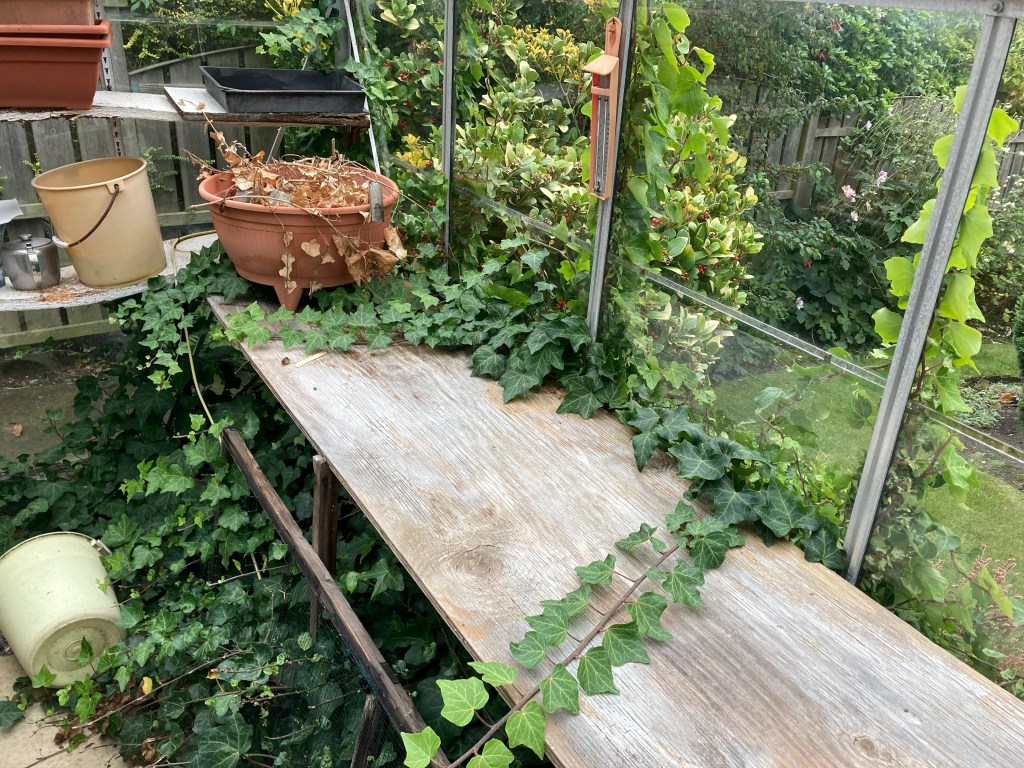
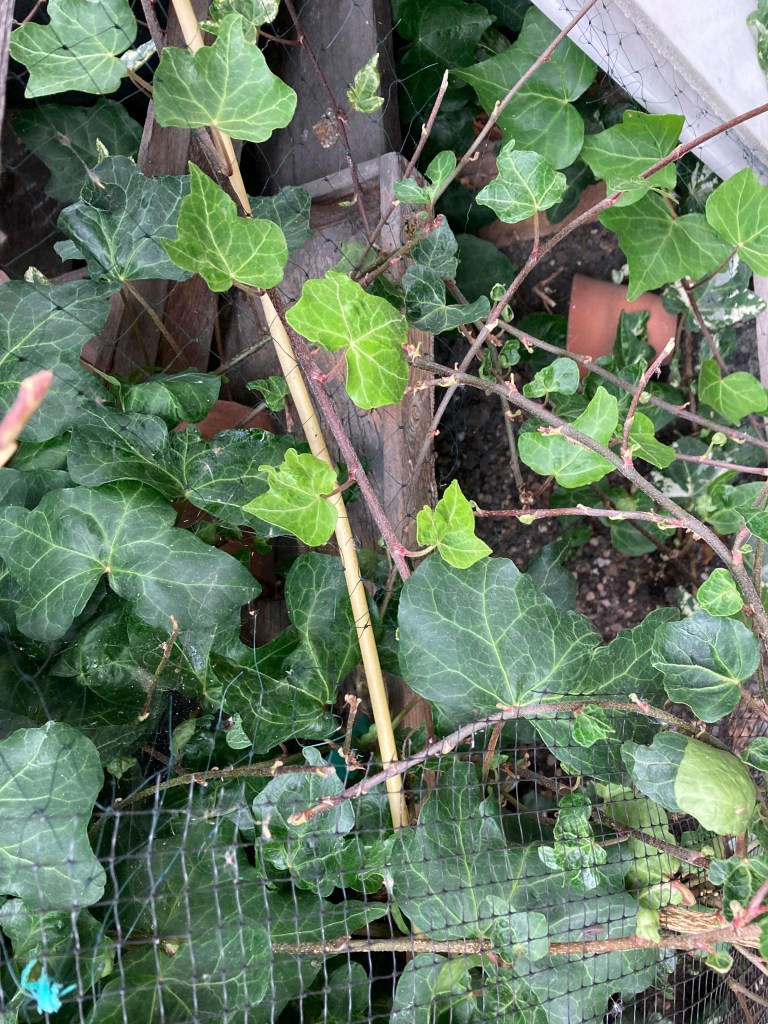
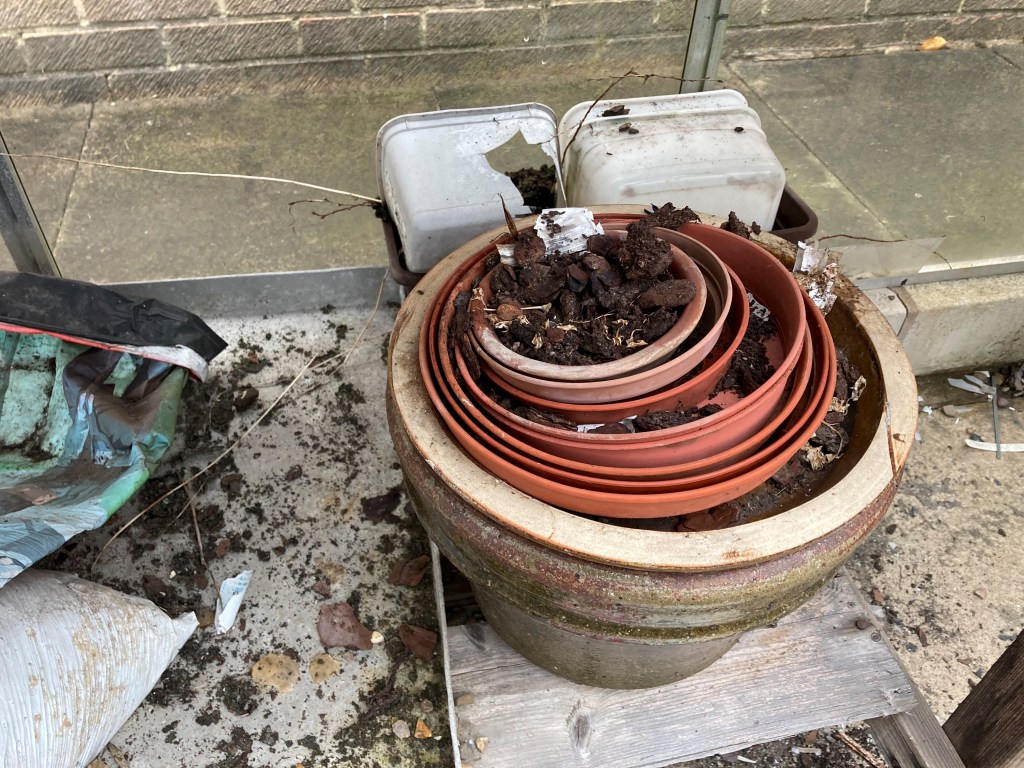
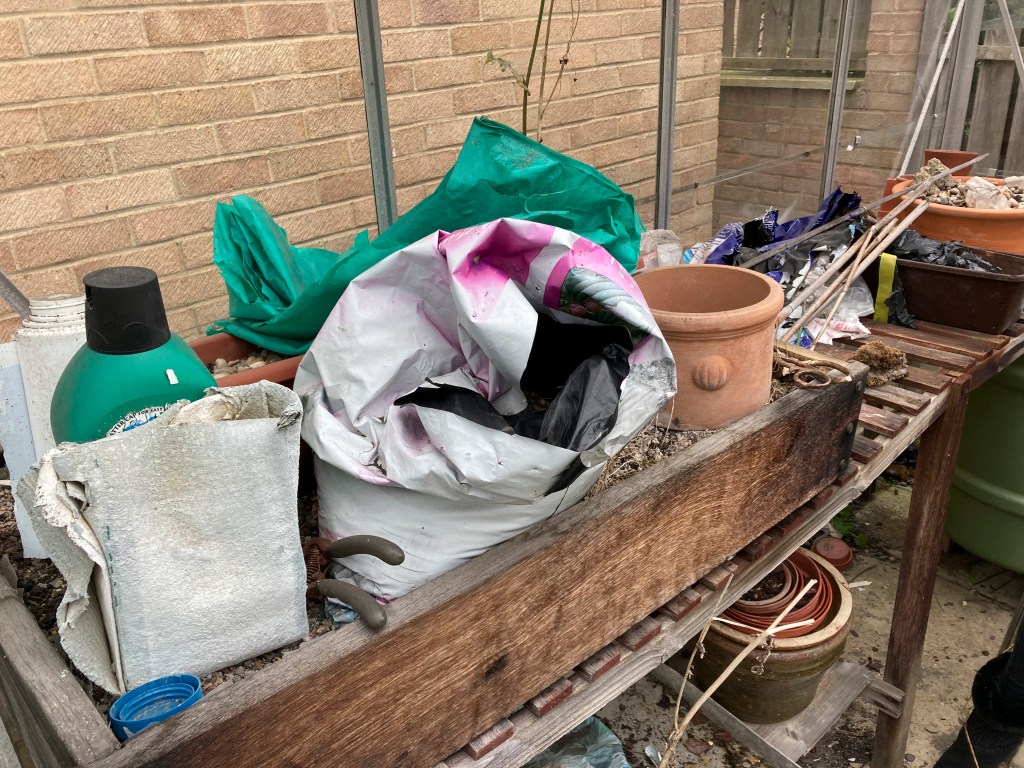

The greenhouse contained many potential props, but their use would need careful planning to give enough of a sense of time passing without dominating the frame and potentially any narrative from the image.
Potential Perspectives
I took the following pictures to experiment with perspective – which angle and how much of the greenhouse would I include? I put Jayne in a similar position in the space as Bryan in his photograph. At this stage, this was just for a reference as I hadn’t yet decided on what to do with Jayne in my composition.
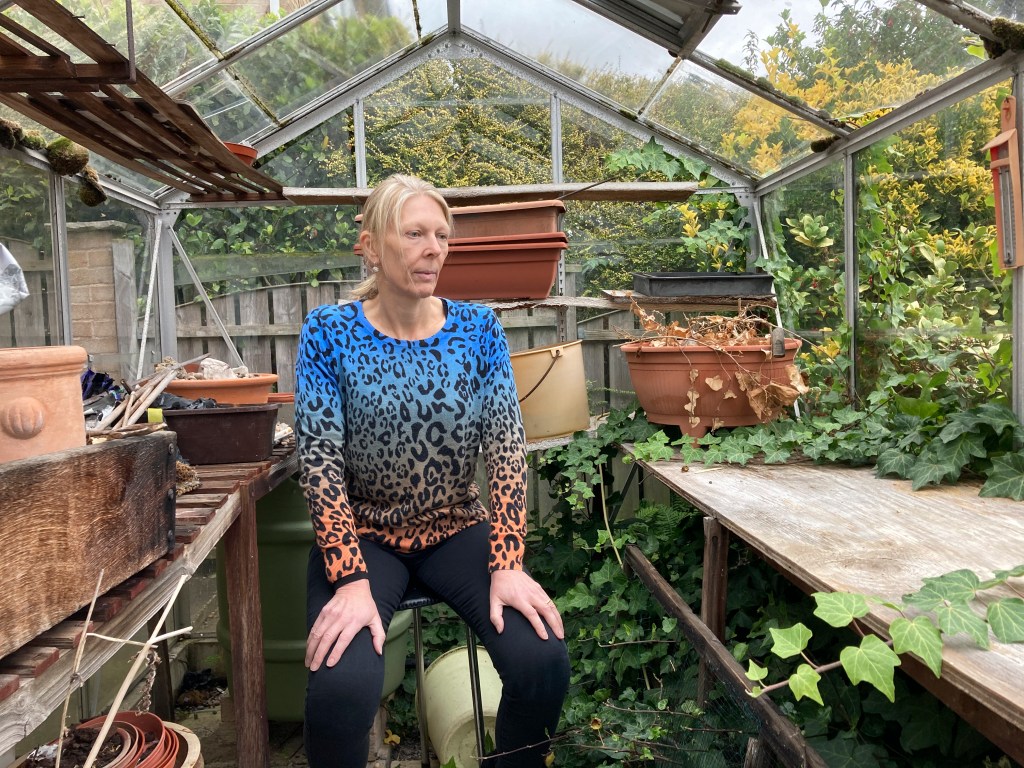
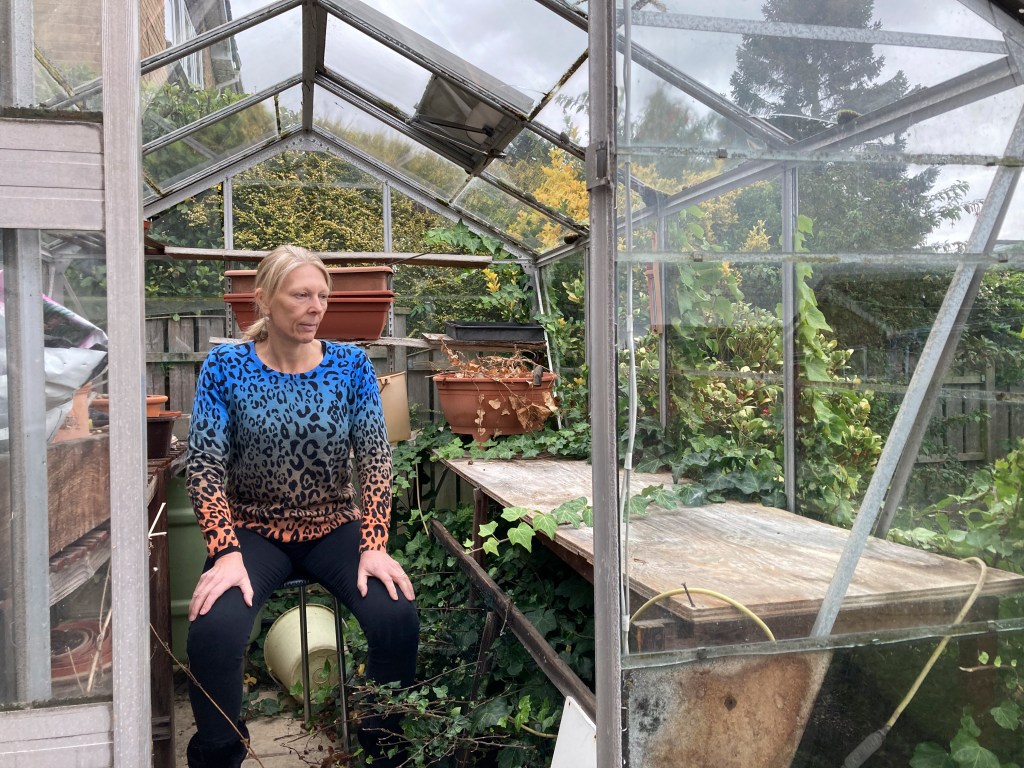
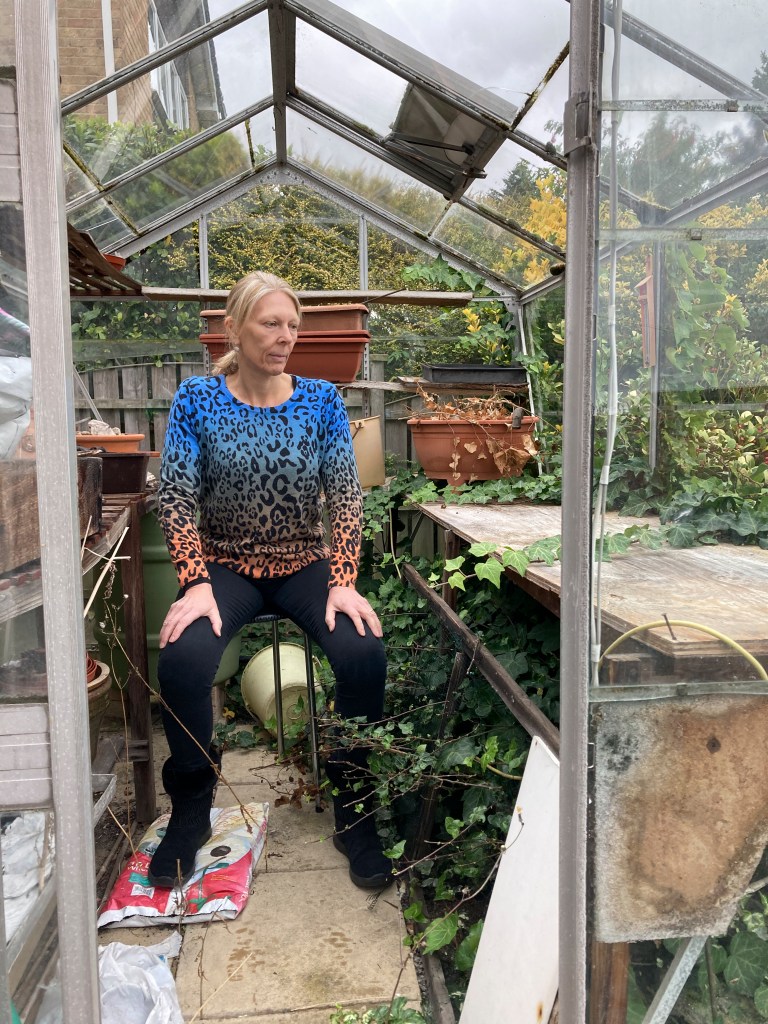
Looking at these test shots, the first thing I noticed was that I could easily replicate the composition of the Bryan photo if I wanted to. This is likely because the mobile phone camera that I was using for these context shots has a wide angle lens, which is likely similar to the compact film camera used for the original photograph. Only in the shots taken outside the greenhouse is Jayne fully in the frame, but this increases the depth of the image as well as introducing the doorway into the shot. I could see potential issues with the increased depth lessening the impact of any props that I decided to use and the door frame being a distraction (although it did ‘frame’ Jayne in the image). Looking at these images informed me of how I might go about shooting the picture from a practical perspective. In the past I had been guilty of focusing on the technical aspects of a composition rather than what I want to say with it, so with this photograph I wanted to get that part out of the way first. I would shoot this picture with a wide angle lens from just inside the door to recreate the look and feel of the Bryan photo (as in the first of the test shots above). I could elect to shoot both digital and film to experiment with the look of the final image, but that would be easy once I had the composition ideas firmed up.
Ideas for Composition
The central theme was about inheritance, what we get from our parents and how we make our own way, so my ideas for the picture fell into two parts:
- The things that connect Jayne with her Father and Grandfather.
- The things that separate her from them both in terms of ‘fashion’, that is the passage of time and what makes her different from them.
Connectors
- Physical Similarities – Height, facial features
- Origin – Yorkshire, same region
- Surname – Ackroyd
- Middle age – Eldest to Youngest but in the 50 to 70 category.
- Love of outdoors
- Intelligence – Formal education and intellectual interests (theatre, drama)
- Direct, no nonsense – functional clothing, smart without being high maintenance
- Sense of humour – dry witted, sharp
- Confident – forthright but not arrogant
- Focused – work hard for an outcome
Separators
- Gender
- Career – Engineering over teaching and plumbing
- Only child.
- Sports – marathon running, 6 major marathons of the world, Team GB duathlon and aquathlon, Euro and World Championships
- Studious – Self Study MBA, Triathlon Coach
- Non-judgemental – difficult relationship with Dad but not Grandad
- Outwardly emotional – gets from her mother
- No children – conscious decision
Potential Props
Clothing – traditional Yorkshire attire or that associated with the region – flat caps, scarves, heavy coats.
Jayne’s outfit – either glamorous or sporty. Something you wouldn’t wear to garden in. Some references to her track record, e.g. the medals or bike helmet.
Books – titles that metaphorically describe evolution or change. This could also be used to tell something about Jayne and her interests. Could be a mix to titles.
The photographs – getting them into the composition somewhere there they can be seen but are not obvious signposts.
Candle – represent the passage of time.
Tea cup – there is a stainless steel teapot, so perhaps something that complements that in some way. Could be a broken one to tie in with the decaying aesthetic or something that contradicts the natural world in some way.
Bouquet of flowers – something that suggests this is the limit of Jayne’s ability as a gardener but also pays tribute to her dad and grandad.
Artificial flower – could say the same thing.
Discussion with my Tutor
At this point in my thinking, I had a call with my tutor to discuss my recent submission for Assignment 4. As this had been an essay, the conversation was shorter than the usual feedback on the photographic assignments. After some recommendations on further reading/thinking about the subject of the essay, the discussion moved on to my thoughts for this assignment. I tried to describe my idea about the inheritance from grandfather to granddaughter and my tutor fed back that she thought it would be difficult to capture that breadth of scope in a single image. She advised me to hone the idea into a more focused story if I really wanted to do a single tableau image. She also recommended using the greenhouse in a more unexpected way than a straightforward setting for the picture. This conversation, like many during the earlier parts of this degree, shook me. I was continuing not to learn the lesson about becoming fixated on an idea in a way that narrowed my perspective on it – I had already planned out the work to a point where I was reluctant to make significant changes. I needed to learn to keep my options open during the planning phase so that feedback like this would not feel like an abandonment of the core of my idea.
Evolving the Idea
With the objective to hone the idea into a stronger story, I started to look at what the photograph and the greenhouse actually meant to me. As I mentioned previously, the relationship between Jayne and her father was not always easy and perhaps initially the presence of the greenhouse in its state of decay reminded me how different they were -we have no equivalent at our home as Jayne has no interest in gardening. When I thought again, I realised that the actual connection was the opposite of this difference; Jayne adored her Dad, particularly in his later years. The same was true of her grandfather who had died many years before. The story was actually about the discovery of the photograph and the way the greenhouse connected her with them both in a more affectionate way. I started thinking about how people revisit places that they have a strong emotional connection with and that if the passage of time has been great, the place can be very different from how they remember. This nostalgia is heightened by the memories of how it used to be, so perhaps the greenhouse and its decaying condition were the gateway to Jayne’s fond memories in this case. My idea was shifting toward this being a story of the love of family, with the decaying greenhouse also creating a sense of sadness at both the loss of loved ones as well as highlighting how some traditions are lost with them.
With the idea now clearer to me, I started to revisit the way the picture would be shot. My tutor’s advice to consider the greenhouse outside of the usual context led me to think about emphasising the impact of the space at any time of day. I therefore decided to shoot it at night instead of during the daytime. The greenhouse would now be a comforting space outside of the context of its intended purpose, i.e. growing plants. The ideas I had previously for composition and props were still valid, although I found that I no longer saw the more obvious contextual elements such as the candle, flowers, etc to be as important as making the setting work with my revised theme. Instead, I would keep the contextual elements subtle in order not to overburden the viewer with signposts to what I intended the picture to be about.
Initial Conclusions
As I have increasingly found over this unit, the creative process and preparation for the assignments is very important. Having a structured approach to the planning and seeking feedback from others have become powerful tools in helping me form my ideas. I was happy that the revised idea, after the feedback from my tutor, was stronger than originally conceived. However, I need to accept that not every idea that appeals to me at the outset will ultimately work as a project. I definitely need to be more patient when it comes to the suggestion that I pivot an idea or even elect to stop developing one. In taking a step back during the preparation of this assignment, I believe I concluded with a much stronger idea to take forward.
References
[1] Fletcher R, 2020, “3) Exercise 3: Childhood Memories”, OCA Blog Post, https://richardfletcherphotography.photo.blog/2020/10/18/3-exercise-3-childhood-memories/
[2]Fletcher R, 2019, “Assignment 5: Photography is Simple”, OCA Blog Post, https://richardfletcherphotography.photo.blog/2019/05/31/assignment-5-photography-is-simple/
 Richard Fletcher OCA Photography Blog
Pingback: Assignment 5: Making it up | Richard Fletcher OCA Photography Blog