The Brief
Construct a stand-alone image of your choice. Alternatively, you may choose to make a series, elaborating on the same theme.
As the culminating assignment for the course you may wish to draw upon skills learned from Parts One to Four – using various forms of narrative, using yourself as subject matter, telling stories and reading images. The only stipulation is that you produce work that has been controlled and directed by you for a specific purpose. Remember to create a story with a specific context like the artists you’ve looked at in Part Five. This means that you need to have an artistic intention, so a good place to start would be to write down some ideas. This could then be form the basis of the 300-introduction to the proceed. You may find it helpful to draw storyboards to help you visualise your ideas.
The aim of this assignment is to use props, costumes, models, location, lighting etc. to contribute to the overall meaning of the image (Use flash/lights if required but available light is fine as long as it is considered)
If the narrative is set in a different era then the elements fo the image must reflect this. Also consider the symbolic meanings of the objects and try not to be too literal in your approach. For example, don’t automatically use red shoes in a love scent but try to be subtle in your ideas to obtain a more true-to-life scenario.
For this final assignment, you should also include an illustrated evaluation of the process you went through to produce your final image(s). Include snapshots of setting up the work and write about how you felt your direction went, how you found the location, props etc. How did this process affect the final outcome? Write around 1000 words (including your 300-word introduction).
Introduction
For this assignment, I wanted to tell a story in a single picture in a way inspired by the works of Jeff Wall, Gregory Crewdson and Philip-lorca diCorcia. My initial idea was to tell a story about my wife and her family which in recent years was just her and her parents. I started by looking through the family photograph albums for inspiration; the first thoughts were about Jayne and her father, whose relationship had been close but difficult during her teenage years. Although there was a strong physical likeness and shared traits such as their sense of humour, they had different goals in life and different interests. During the search through the albums, I discovered the following pair of photographs stored as a pair in the same sleeve.
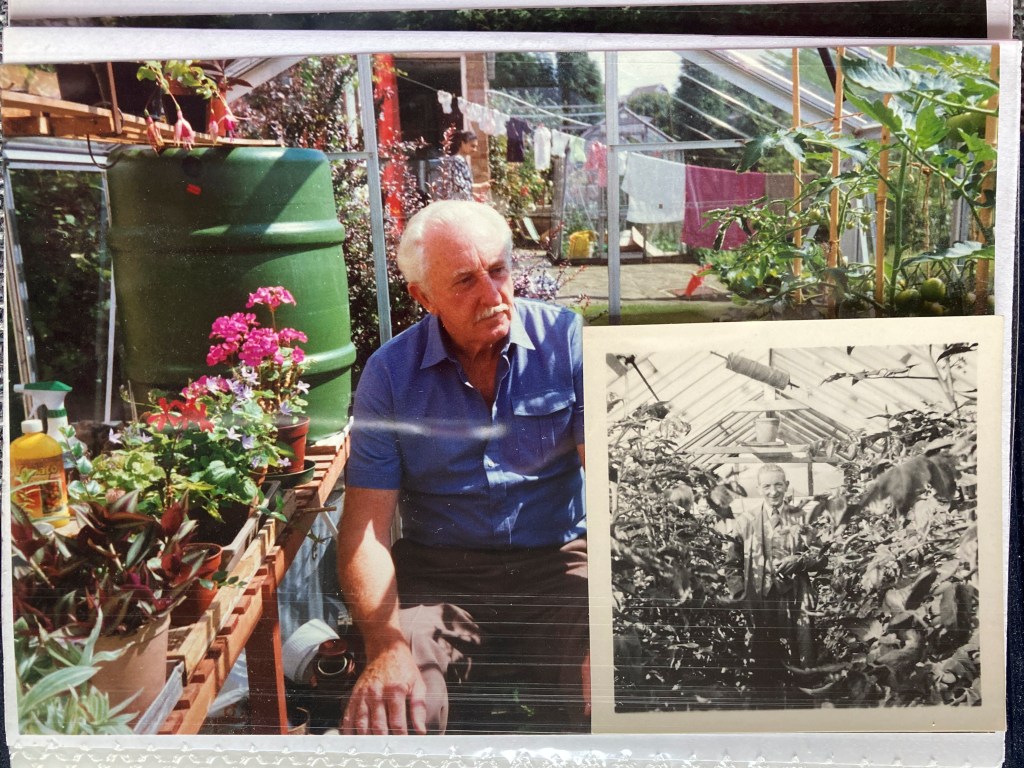
These photos depicted Jayne’s father and grandfather, both keen gardeners in their retirement, in their greenhouses. Both men are shown surrounded by the fruits of their labours and both have a sense of pride about their expression. The way that they were stored in the album interested me as perhaps Bryan had recognised this similarity when he put them together. It was when I realised that Bryan’s greenhouse was still in the garden, albeit in a state of decay that I had the idea to use it as a set with Jayne as the central focus of the shot. My idea was framed around the idea that the tradition of gardening had passed between generations and that it had ended with Jayne (who has little or no interest in gardening). I planned too recreate the image of Bryan in a way that highlighted their likeness but also this difference in the direction of their lives. I started to storyboard my original intention in a blog post called “Preparing for Assignment 5″[1]. However, during a brief discussion with my tutor during a feedback session for Assignment 4, I was encouraged to sharpen up the story as it felt a little too vague to be told in a single photograph.
The Story
In re-examining my idea, I asked myself what it was about discovering these two photographs that had interested me and how it made me feel. The answer was that I could imagine Bryan’s reaction to discovering the picture of his father and carefully adding it to one of his own. He was a nostalgic man, so I believed that this gave him a great deal of pleasure as he remembered his Dad. When I realised that we could still go to the greenhouse where the photograph was taken, I had that same feeling of connection and nostalgia. These two reactions were actually more powerful than my original idea to highlight the differences between the two men.
The story was now about grandfathers, fathers and daughters and in particular the strength of the emotion around finding some tangible link with the forgotten past in what is left behind.
The Storyboard
The concept of putting Jayne in the greenhouse was still valid for the revised idea. I wanted to picture her in a similar pose to Bryan but with contextual elements that lent themselves to a different narrative than being a reproduction of the original photograph. I started with one of the test shots I took when I first looked at the location[1]

I needed a way of incorporating the image of Jayne’s father and grandfather into the shot. I considered scattering the picture of her father among other photos from the album on the table on the right hand side of the frame. The picture of her grandfather at only a couple of inches square would be too small to see in any composition, so I thought about projecting it using the same system I used for Assignment 3[2]. The set itself would contain more subtle links to the past through the use of items from the derelict greenhouse. These items includes ceramic pots with gravel but no plants, pots with dead plants in them, rusty tools and rotting bamboo canes. There was also a chalkboard on which Bryan kept notes of his plantings, which could contain some other obscure visual references. For Jayne I wanted her clothing to be utilitarian but not obviously garden wear. The final details would be how she interacted with the space and props. I was going experiment during the shoot to try to capture a sense of affection for her past, sadness at the loss and contemplation of the peace of the space.
Shooting the Photograph
I started by clearing the interior of the greenhouse to leave just the benches and shelving in place. The camera and lighting were set up as in the sketch below.
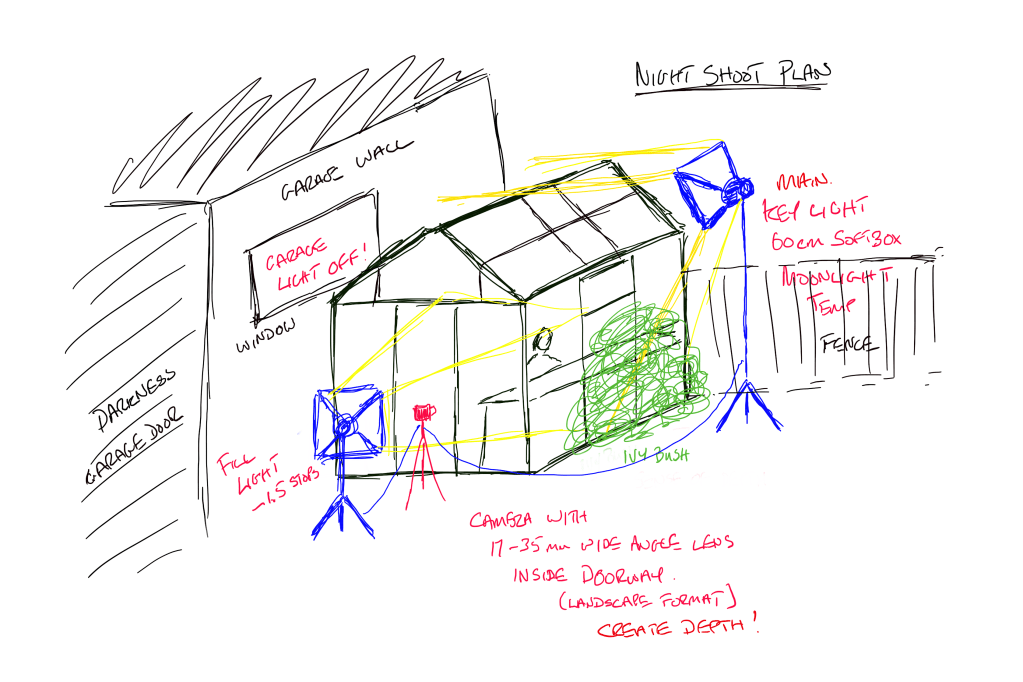
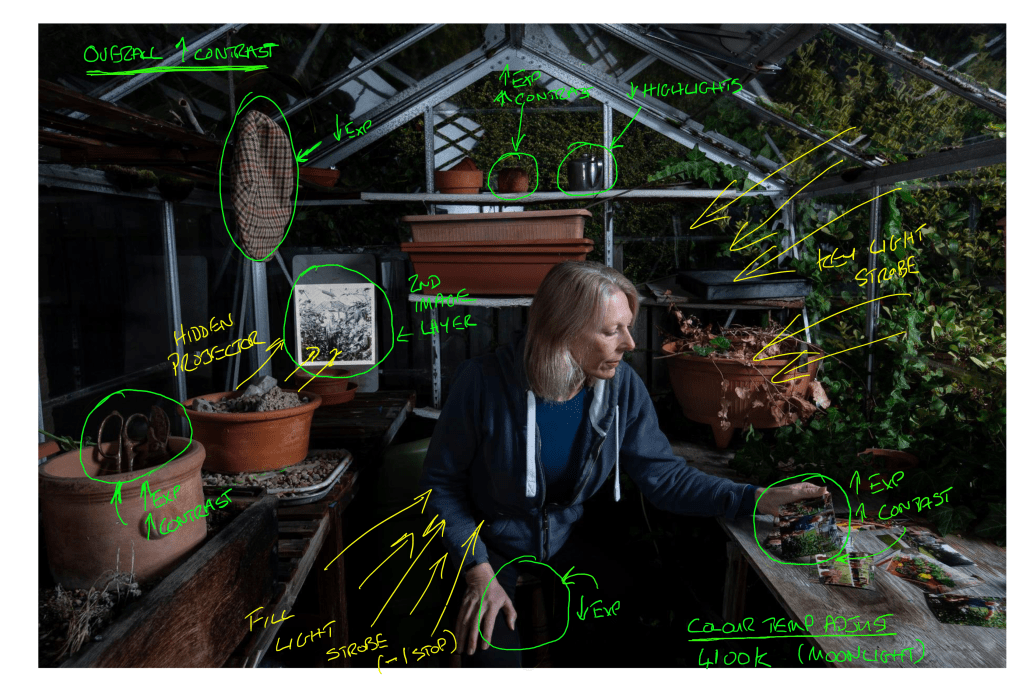
I used studio strobes with 60cm square soft boxes. The key light provided the effect of moonlight streaming through the glass and ivy of the greenhouse and would light Jayne from the front in pose. The fill light was positioned square on to reduce the harsh shadows forming on Jayne and also to light the objects along the left hand side of the space. The camera was fitted with a wide angle lens to create a sense of depth in the scene; the lens aperture was set to f/13 to make as much of the scene’s depth as sharp as possible. Two photographs were taken. The first was with no lights and the projector unit (hidden in the scene behind a plant pot) throwing the picture of Jayne’s grandfather onto the chalkboard at the back of the space. The second shot had no projection but used both strobes to light the rest of the scene. The two images were then blended together in post-processing to create the overall ethereal feel of her grandfather being part of the present day scene.
The Photograph: “Sanctum”
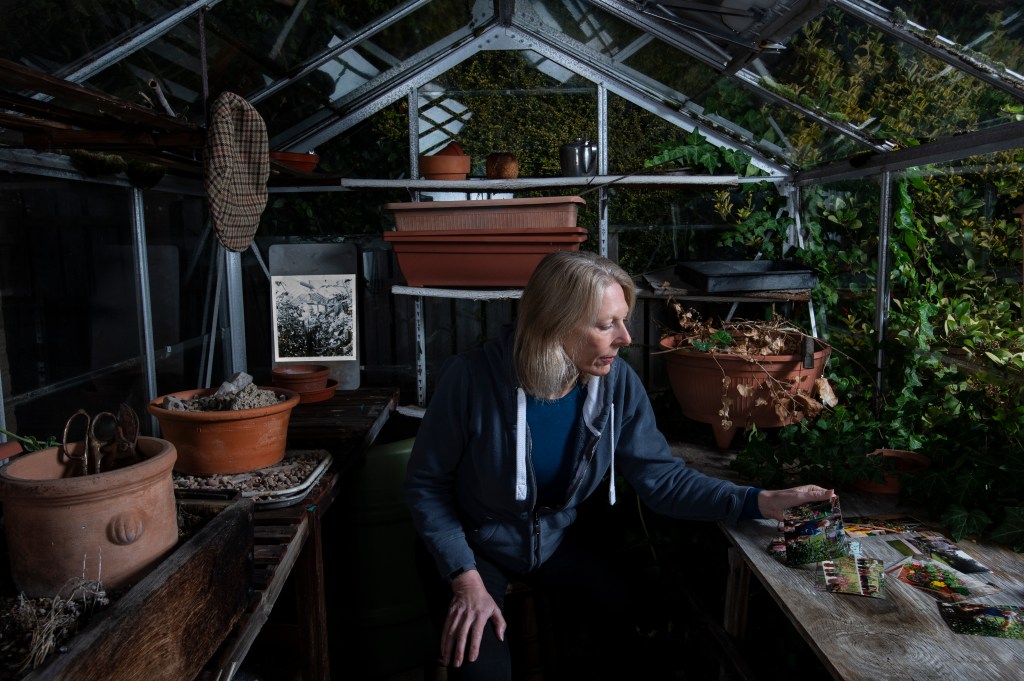
The final processed photograph can be seen above. For the title, I wanted to sum up my intent for the image while not wanting to lead the viewer to a conclusion. I settled on Sanctum because it is defined as “a private place or room where someone is never interrupted”[3]
The post processing done to achieve this final version is shown in the annotations below. Along with the layering of the two shots taken, the white balance was set to replicate moonlight at 4100k and selective edits were made to elements in the frame to increase their impact.
Reaction and Reflection
As with previous assignments, I decided to share this photograph with a number of my friends to get a feel for the narratives they would naturally create from it. I asked for feedback via social media and had 18 responses from people, some of whom knew Jayne well and some who had never met her. I collated the responses in a separate blog post [4] but the key narrative points are discussed here.
In all of the responses, there was a deep personal connection identified between Jayne, the photograph she is holding and her surroundings. Some saw that it was her father and recognised that the greenhouse was once his. Jayne’s expression and posture were read by many as fondness, sadness and longing, while some saw her as mourning the death of her father despite there not being any clear references to his loss 4 years ago. This was a narrative created by people who didn’t know Jayne or anything about her family, so I assumed the contextual elements of his old cap, the dead plants and neglected greenhouse all served to trigger that response in those viewers. Memory and the desire to revisit somewhere that held special significance also came through in the different narratives with most people seeing this as a special place for Jayne.
I found the reactions to the picture fascinating. In reality, the greenhouse isn’t a particularly relevant place to Jayne (I’m not sure she has been in there for many years, even when her father was alive). The state of the building and it’s contents tell a story on their own of neglect, but putting Jayne in the same place as her father and her grandfather watching on, somehow created the sense that this is a place that joins the three of them together in a way that is very private and intimate. The reaction that interested me the most was the contemplative sense of mourning, which is very real for Jayne in other regards but not in this context. One of my friends told me that the photograph made him cry – he related to the sadness in some way that I didn’t push him to explain, but I guess must be related to his own emotional state in some way. Others who responded also said that they could relate to the strong emotion of the image without that relationship being to do with the subject, elements or composition.
Overall, I am delighted with the way that the image was received by everyone. Far from being a validation of my intent, it signalled that this particular piece of work had the power to provoke some strong emotions in a variety of people. The reactions did work in conjunction with my intent for the picture, which as diCorcia said was the responsibility of the artist; to give enough to help with the viewer’s journey but not complete it. The development and shooting of the picture was a challenging, but rewarding experience for me, the latter being something I was completely comfortable with. Having a good idea for what the picture should look like and experimenting with the props and lighting were key to what I see as the success of the image. I had tried to incorporate elements that highlighted the differences between Jayne and her father, such as references to sport, feminism and professionalism. However, the problem was that even the most subtle elements distracted from my intention that this should be a love story rather than about rebellion or contrast. Eventually, I settled on fewer elements that would work in unison with the wonderfully natural greenhouse set. Although I didn’t rush the creative process, I was under some natural time pressure with new COVID-19 lockdown restrictions coming into force and my mother-in-law’s ambition to tidy the space and potentially even demolish it. For me, this felt like the sort of pressure that might be experienced by a film director with the time taken for the shoot having financial implications. One thought that occurred to me as an enhancement was to create a series of photographs along the theme of special places where emotions and memories are revealed. The creative process would then incorporate other ideas, emotions and storytelling, while maintaining the relationships between each image in the series. I have found working in tableau to be both interesting and challenging for this assignment, so this is something I plan to pursue in the future.
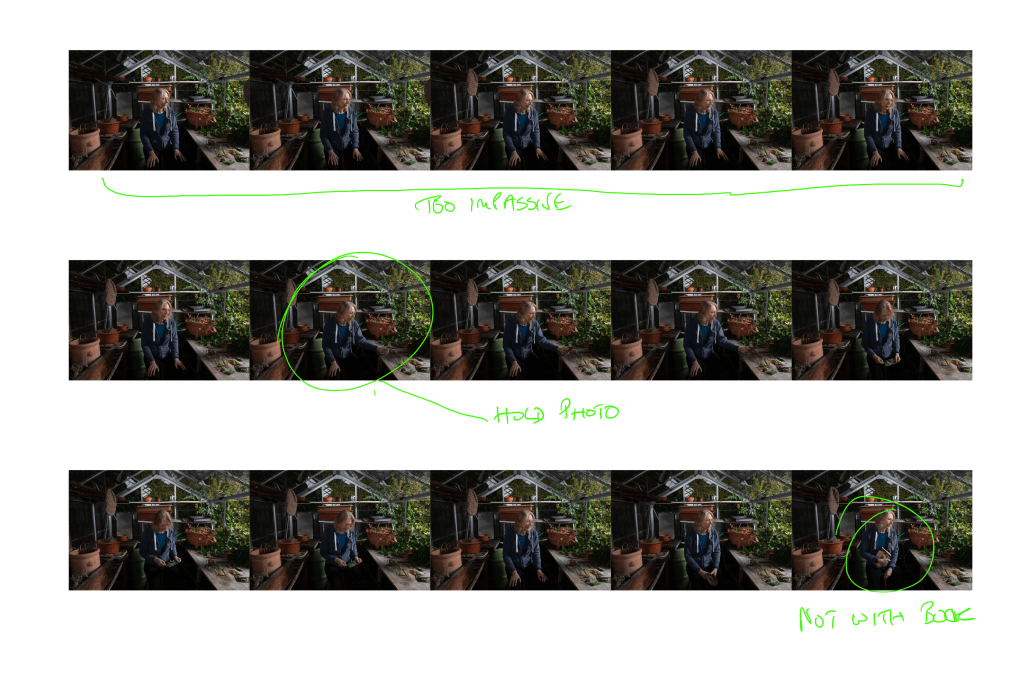
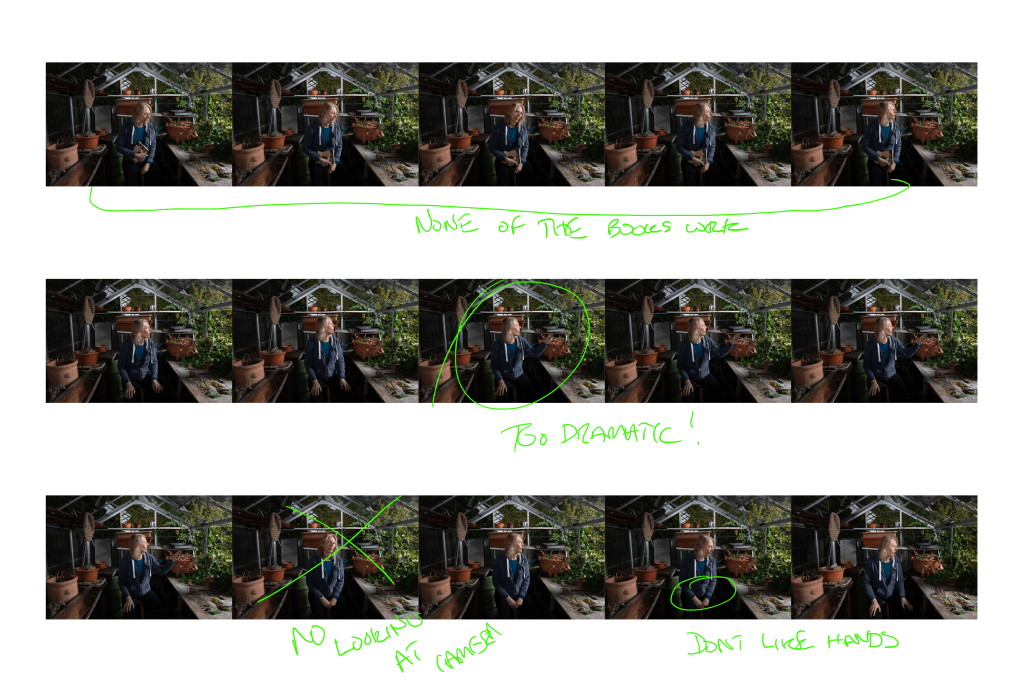
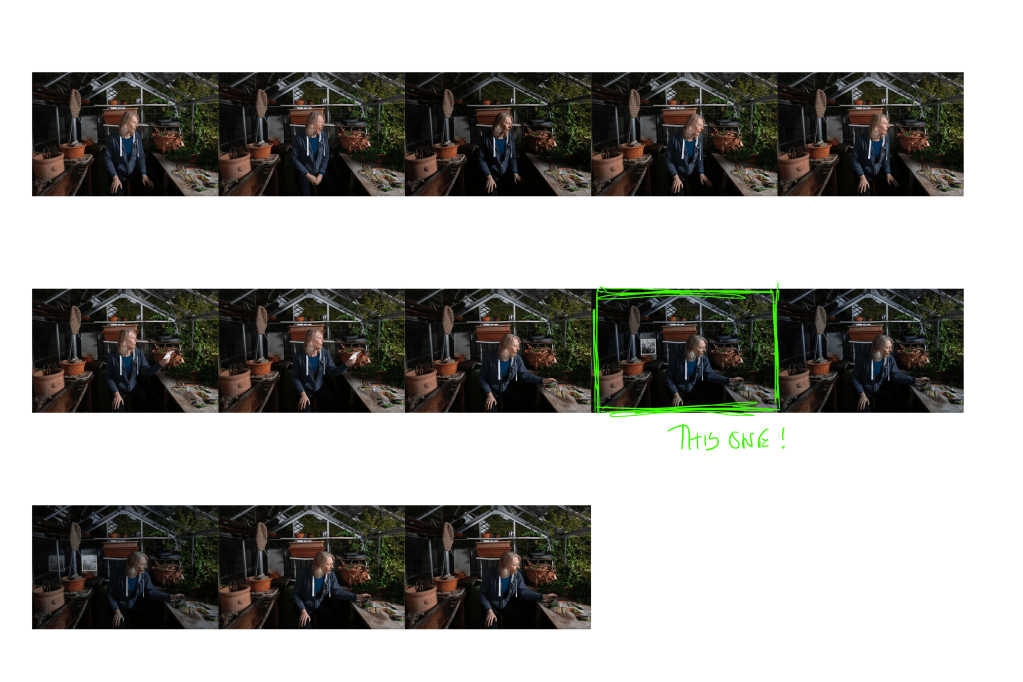
Contact Sheets
References
[1] Fletcher R, 2020, “Preparing for Assignment 5”, OCA Blog Post, https://richardfletcherphotography.photo.blog/2020/12/24/preparing-for-assignment-5/
[2] Fletcher R, 2020, “Assignment 3: Self Portraiture”, OCA Blog Post, https://richardfletcherphotography.photo.blog/2020/09/19/assignment-3-self-portraiture/
[3] Unknown, “Dictionary Definition: Sanctum”, Cambridge Dictionary website, https://dictionary.cambridge.org/dictionary/english/sanctum
[4] Fletcher R, 2020, “Responses to Assignment 5”, OCA Blog Post. https://richardfletcherphotography.photo.blog/2020/12/24/preparing-for-assignment-5/
 Richard Fletcher OCA Photography Blog
Pingback: Assignment 5: Viewer Responses | Richard Fletcher OCA Photography Blog
Pingback: Reflecting on Photography 1 – how things have changed so far | Richard Fletcher OCA Photography Blog
Pingback: Post Assignment 5 Feedback | Richard Fletcher OCA Photography Blog
Pingback: 4) Exercise 2: Reflective Day | Richard Fletcher OCA Photography Blog
Pingback: Reflecting on Identity and Place | Richard Fletcher OCA Photography Blog