The Brief
Look at the work of Gregory Crewdson online.
- Do you think there is more to this work than aesthetic beauty?
- Do you think Crewdson succeeds in making this work ‘psychological’? What does this mean?
- What is your main goal in making pictures? Do you think there is anything wrong with making beauty your main goal? Why or why not?
Introduction
I first encountered the work of Gregory Crewdson in 2013 when I watched the BBC documentary series The Genius of Photography[1]. Crewdson was one of the artists who featured in the series, specifically highlighting his large scale shoots and meticulous attention to detail in creating his images. The picture that was being shot was Untitled(Brief Encounter), one of the series of Beneath the Roses (2003 to 2007), featuring an American street scene during a snowy winter. The main theme of the documentary was the way that Crewdson worked. He created a huge set by closing off an entire street so that the snow could accumulate undisturbed and placed very specific details, actors and lighting in the composition. Crewdson’s attention to detail became clear in the film when he notices someone entering the set and disturbing the snow. After evicting them, machines were brought in to resurface the area where they were walking. Other details such as the traffic lights being under his control for the duration of the shoot pointed to someone leaving as little to chance as possible. The end result was an large format 8×10 film negative that could be blown up to the massive prints that show off Crewdson’s elaborate tableaux. For this research task, I focused on Cathedral of the Pines (2013 to 2014), which was series prompted by Crewdson’s relocation to rural Massachusetts following his divorce in 2011. Inspired by a walking trail that he discovered in the area of his new home, Cathedral of the Pines is considered be the point at which Crewdson altered the approach to his art, favouring a more intimate, small scale production to the large, cinematic style of Beneath the Roses. In choosing this series instead, I wanted to examine the work with regard to the questions being posed in the brief.
Do you think there is more to this work than aesthetic beauty?
Consider the photograph below from Crewdson’s series Cathedral of the Pines (2013 2014).
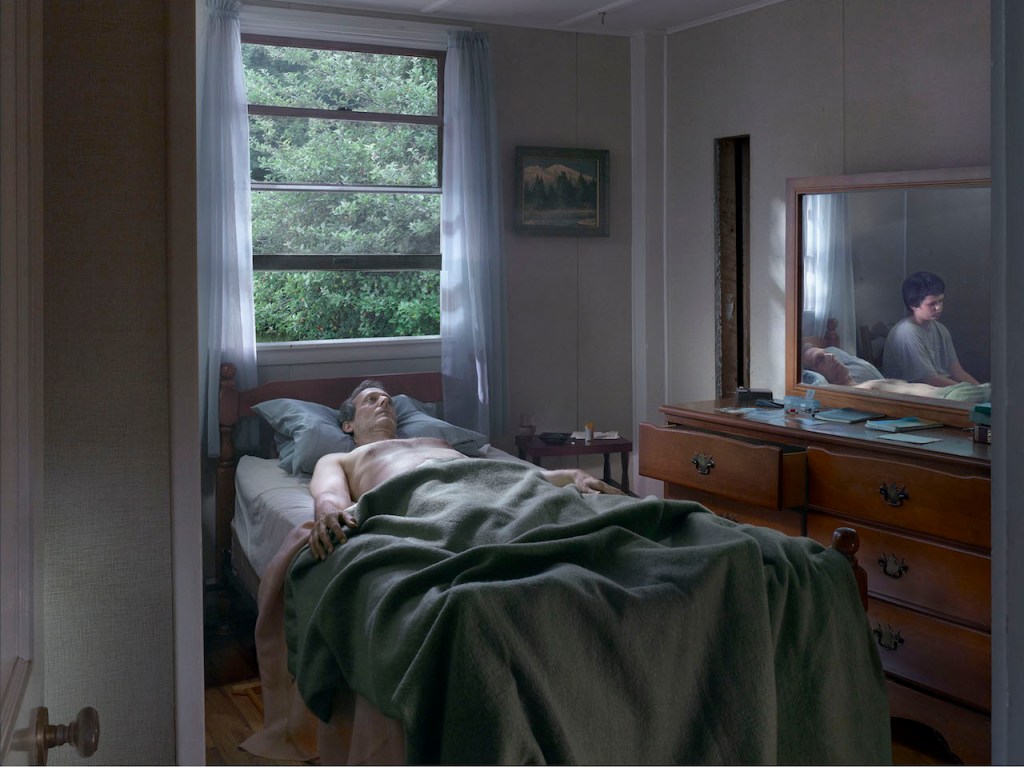
Here we have a scene of a man lying in bed in a pose that suggests that he is either dying or has recently passed away. A soft, ethereal light streams through the open window at the head of the bed and illuminates the man’s pale skin with very little contrast between highlight and shadow. We see a reflection of a boy sitting by the man’s bedside in the mirror but cannot physically see him as he is obscured by a partial wall on the left of the frame. The expression on the boy’s face is one of sadness akin to that of a visitor to a hospital bedside or a mourner. This image is a classic Crewdson tableau with a mixture of natural and artificial light and a carefully constructed set. Every detail within the space is lit in a way that draws the eye around the composition looking for meanings. For example, Why is the dresser drawer partially open? Why is there no physical connection between the two subjects? Is the man posed as if lying in state, i.e. has he already died and is this the calm aftermath we are witnessing. There is no escaping the emotional feel of the photograph.
Do you think Crewdson succeeds in making this work ‘psychological’? What does this mean?
However, there is also a psychological element to the picture. The way the boy is hidden creates a feeling of the supernatural, with us only being able to see his reflection in the mirror. As with Hannah Starkey’s use of reflections, there is something unreal about the boy’s appearance in the photograph. He is lit in a similar, soft way as his father, which creates the physical connection between them. Perhaps the man has passed away and his son is greeting him from the other side having died previously? The way the boy is not looking at his father points to his being present to support, but he is not willing the man to recover or wake up. When I looked at this photograph, I was reminded of the immediate aftermath of my mother’s death, where everything took on a stillness once the immediate release of emotions had passed. We were sitting with what remained of her but what made her our mum had already left and that felt ok. The final element that supports this almost supernatural feeling is the relationship between outside and inside, something that Crewdson made a central theme to the series. The beauty of the pine trees outside of the bedroom window and the small painting of a pine landscape on the wall suggest a peaceful place in which to die. The way the light comes through the window is similar to the way that we are shown souls transcending to heaven in modern visual art. The shaft of light only really picks up the man’s body and the boy rather than flooding the whole room. For me, this suggestion that all is well, that the man has passed into the afterlife with his boy to help him is a deeply psychological meaning that we all hope is waiting at the end of our lives. Crewdson said in an interview[3] that his pictures were derived from his personal psychological anxieties, fears and desires. He went on to make that point that he, like many photographers, feel disconnected from the world, his work being a way of seeking connection with the people and places while at the same time being a remote observer of the same emotions in them. For me, the psychological meanings of the works in Cathedral of the Pines come through clearly. Crewdson depicts lovers in terms of affection and total absence of it, young people at play or in lonely isolation within their environment and older people struggling with the realisation that they are late in life. Yet he does this without the pictures having a sinister aesthetic; each incorporates light in a subtle but revealing way as if highlighted by some supernatural entity.
What is your main goal in making pictures? Do you think there is anything wrong with making beauty your main goal? Why or why not?
Prior to starting this degree, my goal was to make photographs that ‘looked good’, which essentially meant getting the technical aspects right. As I learned my technique, naturally I developed more of an understanding of composition, but it was still largely focused on making images that were pleasing to look at. I guess that pictorial beauty then extended into the subjects that I chose to shoot, which were primarily landscapes and architecture that used light to show them at their best. Since joining OCA, my ambitions for my pictures have grown beyond my original interest in photography. The main goal of my work now is to create something that challenges the viewer into asking what the picture is about. My work in Assignment 3[4] was the first time that I’d asked the viewer to make up their own mind about meaning. Combining the projected words and the extracts from my diary offered some insight into my life, while the use of my skin as a canvass and the lighting behind gave some idea of how I felt during each day of the series. When I showed the work to my friends, I had to stop myself from explaining it – this was a difficult thing to achieve because previously I had planned every element of my ‘static’ pictures in a way that an explanation came naturally to me. Now I was stepping back from the pictures and letting them speak for themselves, or not as the case may be. What the portraits are not is classically beautiful, so I had subconsciously moved away from this as an idea.
However, as with everything I have a tendency to explore the boundaries of ideas before settling on what makes me interested or happy. In the case of my work, I actually see no problem with making beauty a central theme to my photographs. Crewdson and diCorcia in particular have demonstrated the ability to combine beauty with deeper meaning such as fear, sadness and corruption through their use of light, contrast and saturation. diCorcia worked for many years for a fashion magazine, whose primary goal was to interest the readers in the latest fashion. By definition, the work needed to showcase the fashion items in the most beautiful way possible in the context of whatever the story might be behind it. It’s the subtle layering of the contextual elements that now appeals to me more than the aesthetic beauty which is why I’ve found the work of the artists in this section fascinating. The impact of their work doesn’t for me reside in the beauty of the image and even in a subject that is clearly beautiful, it’s in the use of light and very deliberate composition of the elements that helps create the ‘feel’ of the photograph. Part of the enticement of Crewdson’s work and the way the images draw us in is that they are very easy to look at. The huge negatives he produces with his 8×10 camera capture the tiniest details that the artist has placed in the scene and the production aesthetics mean that it’s easy for the viewer to spend time fully engaging with the photograph. So, while beauty is one of the elements that is at our disposal, consideration must be given to the wider context of the artwork when we make it a theme.
References
[1] BBC Television, 2007, “The Genius of Photography”, Television Documentary, DVD (referenced online), https://www.bbc.co.uk/programmes/b00866km
[2] Seymour T, 2017, “Show: Gregory Crewdson’s Cathedral of the Pines”, The British Journal of Photography, https://www.1854.photography/2017/06/crewdson-cathedral/
[3] Hestor N, 2017, “Gregory Crewdson: ‘I wanted the photographs to feel like a suburban window, to give a sense that the viewer is looking into a world’, Studio International Website, https://www.studiointernational.com/index.php/gregory-crewdson-interview-cathedral-of-the-pines-photographers-gallery-london
[4] Fletcher R, 2020, “Assignment 3: Self Portraiture”, OCA Blog Post, https://richardfletcherphotography.photo.blog/2020/09/19/assignment-3-self-portraiture/
 Richard Fletcher OCA Photography Blog
Pingback: Assignment Two: Vice versa | Richard Fletcher OCA Photography Blog