Introduction
Since being introduced to the works of Jeff Wall in Part 4, the most striking thing about his work is actually highlighted in Part 5. Wall’s attention to the tiniest detail of composition is similar to the way that a cinematographer and director create the look of a movie film. The notes refer to his image After ‘Invisible Man’ Ralph Ellison, the Prologue (1999-2001) which is interesting because it takes its inspiration from literature as opposed to an experience that the artist is trying to tell us about. The novel (not to be confused by H.G. Wells’ classic tale of scientific experimentation gone wrong) is the story of a black man subjected to persecution by white society and his subsequent involvement in the growing racial war in New York. The story starts with the central character, also the narrator, reflecting on the physical and metaphorical invisibility of his life, represented by him living in a derelict basement lit by many bare light bulbs. Wall’s picture looks as if it could be a still frame from a movie adaptation of the book because it faithfully reproduces the scene being described by the narrator. However, as we know the visual representation is ‘directed’ by the storyteller, in this case the photographer. We also know that a movie has time to introduce contextual elements to help the viewer build a narrative around the action[1]. In a still photograph, we know that the artist must include all of the elements that help the narrative and in this case, the viewer is not expected to really appreciate the literary inspiration, in this case the novel[1]. Wall’s picture shows a black man sitting in a chaotic space that is littered with elements that tell us about his life. Clothing hanging up to dry and discarded washing up show a man who is making do with his environment but doesn’t care about its neatness. The space is littered with papers and notes, as if the man is trying to either order his life or document it in some way. The main focus of the picture however is the huge collection of light bulbs hanging from the ceiling. This direct connection with the novel also emphasises the desperation of the man in the image. Wall’s attention to detail that includes the amateurish way the lights are rigged up to the electrical supply (the character in the book is stealing the power from a nearby station), which shows the care that went into the picture. The viewer has enough elements to create their own understanding of what the man is going through and if they have read Ellison’s novel, the picture serves as a visual representation of what is a powerful prologue to the story. Until now, I’d considered these tableau works to be generally inspired by the artist’s experience, whether something that happened in their life of just something that they had seen. The idea of work being inspired by a different art form is interesting and we are introduced to a number of artists that adopt similar approach.
Hannah Starkey (1971 – )
With Hannah Starkey’s exhibition in 2010 at the Maureen Paley gallery, the artist drew her inspiration from Tennyson’s The Lady of Shallott, which is about a cursed maiden who can only view the world through reflections in a mirror in her room. When she seduced into looking at the real world directly, she breaks the mirror and dies. The poem, which is long and complex in its story-telling offers a number of potential narratives about personal connection, taking risks and the blurring of reality and fantasy. Starkey’s images for her untitled exhibition use women, reflections and distorted reality as their central theme, but each uses the same approach of including just enough contextual elements to aid the creation of a narrative.
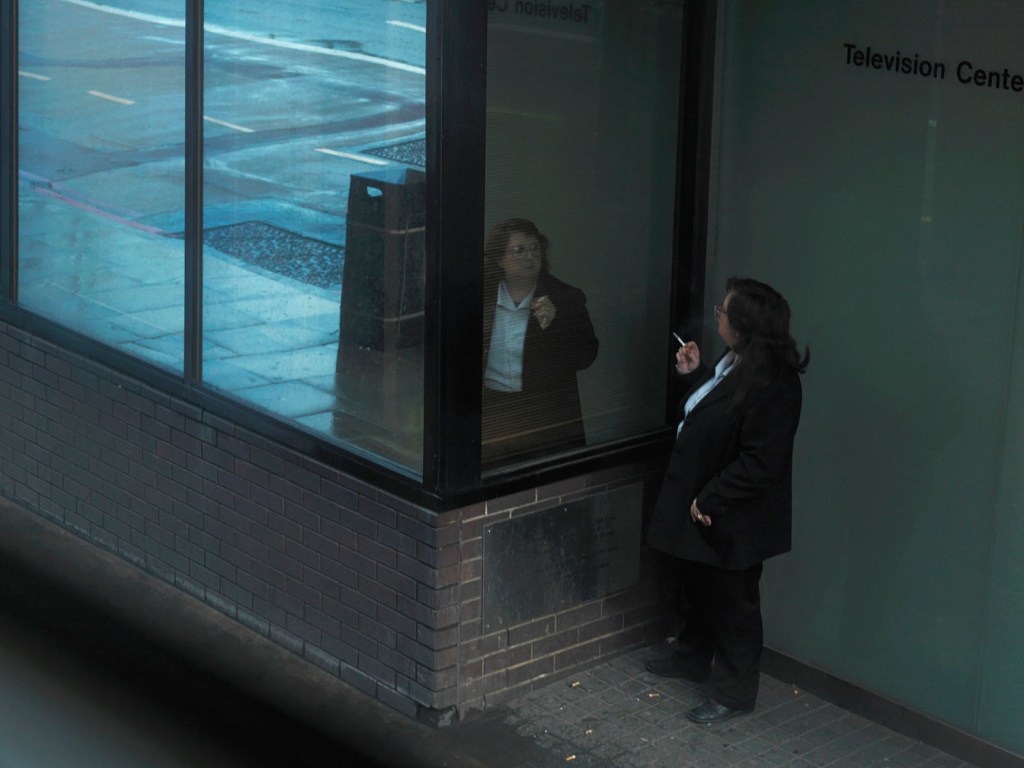
In this photograph we see a woman having a cigarette break outside what looks like a corporate building. She looks at her own reflection in the glass of the building, which immediately begs the question “what is she thinking about regarding her own image?” She may be judging her appearance in some way or even regretting the habit she is indulging. What we see from the viewer perspective is more of her expression in the glass than when we look at her directly. The idea of the reflection being an alternative reality is emphasised here. When we look further, we see that the scene is actually a woman sheltering from the rain; the evidence is shown by the contrast of the tone of the dry patch of ground she is standing on to the wet pavement. The left hand side of the frame reveals the wet ground reflected in the same glass building that the woman is looking at. For me, this is a very strong connection with Tennyson’s poem. The lady in the scene can only see the reflection of herself and her environment in the glass rather than turning to look out into the world. While perhaps not as obvious as Wall’s Invisible Man, the image asks the same questions around how and why the woman finds herself gazing on her own reflection. The notes refer to the false sense of intimacy of reflected self-portraiture and I believe this image makes that point. We can relate to the woman on her break and we can see her whole face in the glass but not when we look directly at her. There is almost a sense of connection but detachment in the way the subject is arranged with relation to her reflection. The image also contrasts light and dark in the larger reflection of the street, which for me points to a further detachment of the woman from the rest of the world. Starkey has clearly taken inspiration from literature in a similar way to Wall, but instead of creating a visual for the text that comes through as the main narrative for the image, she makes her work much more metaphorical. In her later work, Starkey declared that she wanted to represent women honestly and without judgement, citing ““I really think that visual culture is the last battleground for women’s equality and freedom” [3]. When we read these words, they starkly contrast the situation that The Lady of Shallott found herself in, unable to connect with or appreciated the world without temptation from the opposite sex. That temptation ultimately led to her destruction. Starkey’s work appears to suggest that while these constraints are clearly not real, they are often the perception of others.
Tom Hunter (1965 – )
In Tom Hunter’s work Living in Hell and Other Stories the use of art and documentary is even more clear than in that of Wall and Starkey. Where Wall took Invisible Man as his literary inspiration and created his own visual, and Starkey combined poetry with her perspective on the struggles of women, Hunter took both newspapers and classical paintings for his tableau. According to the artist[4], newspapers have long sought the macabre fascination and horror in a society story in order to sell copy. In particular he draws on the Hackney Gazette, his local tabloid newspaper, and its obsession with painting Hackney as being degenerate and full of the dregs of society. With the news stories themselves as his inspiration, he created the visual to ‘accompany’ them in the style of a classical painting. Johaness Vermeer, perhaps most famous for his portrait Girl with a Pearl Earring, is the artist whose style can be seen throughout the series with Hunter taking many technical cues in terms of lighting and composition. In an interview with Adorama[5], Hunter talks about wanting to debunk the ideas of his neighbours and friends being ‘scum’ and to portray them with a sense of dignity. He likened this to the struggle that Vermeer had during his working life where the people of Holland were being oppressed by the Spanish who occupied their land. The Dutch fight for independence comes through in Vermeer’s paintings and Hunter capitalises on that style to make similar points in his photographs. The two images below are representative of Hunter’s approach to his work.

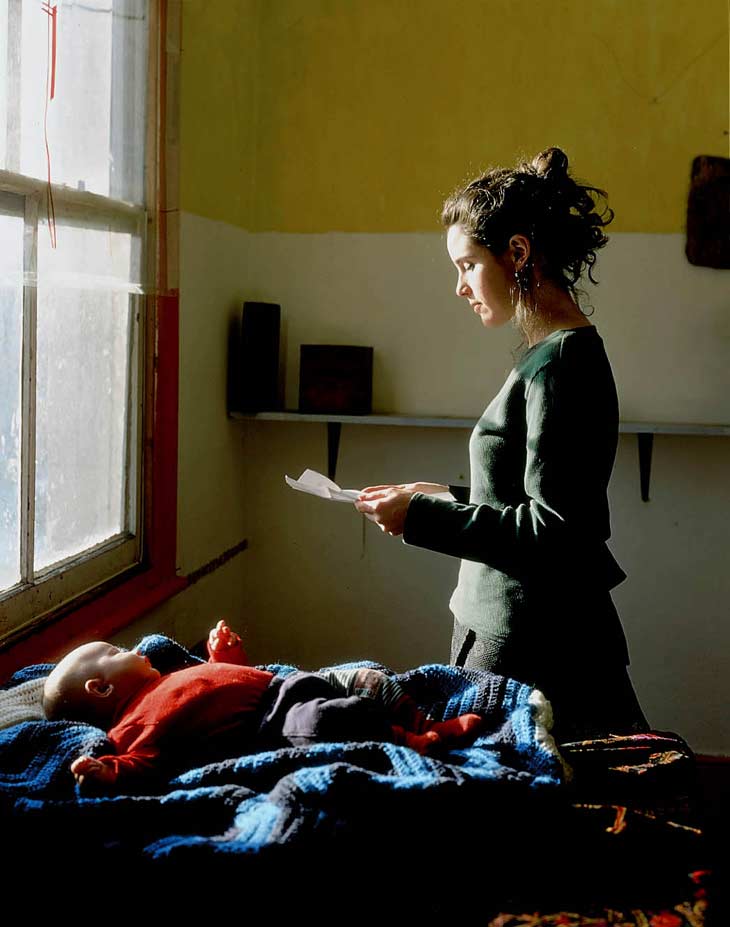
The image on the left is called Girl Reading a Letter at an Open Window, painted in 1659 by Johannes Vermeer[6] and on the right is Tom Hunter’s Woman Reading a Repossession Order (1998)[7]. When we look at these two side-by-side, the similarities are immediately striking. Both portray women in front of a window reading a letter with a bed or table in the foreground. The image by Vermeer depicts a young woman anxiously reading a letter which we assume is from a loved one. The open window suggests that she is awaiting some piece of news in whatever form possible, even listening out for a sign. The girl has a hint of a smile, which suggests that the letter is a welcome one and the point is further emphasised by the use of fruit, in particular the sectioned peach. The peach is believed by art historians to symbolise the presence of an extramarital relationship[7], so the girl appears to be reading a letter from her lover. By contrast, Hunter’s photograph has a completely different tone to it before we consider the title. The woman’s expression is one of sadness and instead of the fruit, we have a baby in lying on the bed in the foreground. Hunter tells us that the letter is a possession order that is demanding the mother and child leave the place they are living in. In his photograph, Hunter uses Vermeer’s technical approach and composition to create a similar look to his photograph, but in doing so is portraying the woman in a similar way despite the obvious difference in circumstances. The young mother is celebrated as being a human being put in an extraordinary position and having to consider her young child. Both pictures have the drama of being embroiled in something that is seemingly beyond their control. The series that Hunter’s image is taken from is called Persons Unknown, a reference to the way that the authorities and landlords of the Hackney slums referred to Hunter and his friends who were squatting in the buildings [5]. The inspiration that Hunter draws from Vermeer and other artists of the era and how he contrasts it with the lives of his subjects is another powerful use of tableau to tell a story.
Taryn Simon (1975 -)
The third artist in this section of the Part 5 is Taryn Simon, whose series The Innocents (2002) depicts men who were wrongly convicted of horrific crimes in a setting that was part of the story of their arrest. This is an extraordinary work in concept alone and when I first viewed it, I was reminded of Chloe Matthews’ Shot at Dawn from Part 1[8]. Like Simon, Matthews used the actual execution sites where deserters were shot in The Great War, paired with the name, date and time of the event as the title. The effect was a sense of what had passed and the trace of the human element that is often lost in historical records. That work struck a chord with me because of the powerful unseen element (the victim) and the meticulous way that the scene was captured by the artist. In a similar way, but using tableau, Simon uses the location and adds the key elements to create the sense of what occurred. As a result her subjects are part actor, part narrator. The underlying theme of the stories is not captured in the photographs but indirectly referred to throughout the series; the unreliability of photography as a truthful representation. Since all of the men in the series were cases of mistaken identity through eyewitness recall and photofit likenesses, what Simon achieves with her work is an ‘is it or isn’t it real?’ feel as with Wall’s work.
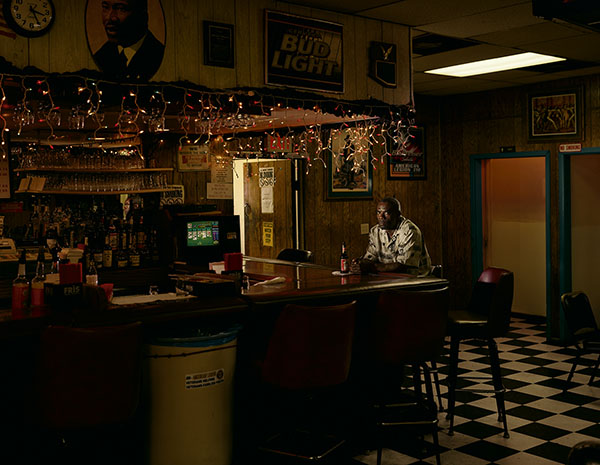
Frederick Daye.
Alibi location, American Legion Post 310
San Diego, California, where 13 witnesses placed Daye at the time of
the crime
Served 10 years of a Life sentence for Rape, Kidnapping and Vehicle Theft
In the picture above we have see a black man sitting alone in a room that has the aesthetic of an American dive bar. The lighting is very subdued with the subject, Frederick Daye lit by a key light. His expression is one of resentment as he stares straight at the camera, which suggests that this man is frustrated by the intrusion in some way. When we read the accompanying text, we see that this was where he was witnessed drinking at the time of the crime he was eventually convicted of. He served 10 years for a crime that he couldn’t have committed because of the disregard of witness testimony. When I look at this image, I see an isolated man, which speaks to the police’s unwillingness to consider that he was witnessed by others. The lack of other people in the frame further emphasises that there were ‘no witnesses’. Daye’s pose with a single beer in front of him suggests a man just enjoying a simple pleasure by himself. His expression, which first looked like intrusion now looks like a frustrated ‘I am here, can’t you see me here?”, a direct protest of not being believed at the time. The image is powerful in that it combines real life elements with an artificially crafted set. This really did happen to Frederick Daye and we can see that it didn’t take much in the way of acting to portray his anger and frustration. The set is so well created that the initial thought is that this is happening in real time. What I think Simon achieves with this photograph is a sense of the injustice and the impact of mistaken identity, while challenging the viewer to believe of disbelieve the reality of the composition. The other images in the series vary in terms of the relevance of the scene to the crime and the way that the victim is represented, but they all have the challenge of whether the images are real or not.
Philip-lorca diCorcia (1951 – )
The final artist introduced in this section was Philip-lorca diCorcia, who was the subject of my Assignment 4 submission[10][11]. I have long been a fan of the carefully crafted realities of his work, starting with his career as a fashion magazine photographer. His series Hustlers (2013) has a similar feel to Simon’s series discussed previously. In Hustlers, diCorcia sought to represent the male prostitutes in a scene that we might expect when thinking about their profession. In crafting an artificial scene rather than just shooting them in their usual environment, diCorcia challenges our stereotype views of these young men. He described them as essentially actors of their client’s fantasies, so the scenes he put them in gave them a platform to act on. However, what was diCorcia was also doing with Hustlers was challenging the idea that the outward appearance of a person and our preconceptions are not necessarily the same as that person’s internal self. By adding the name, location and their price he almost suggests that each encounter was a genuine experience rather than a fabricated reality. Like the other photographers here, diCorcia’s skill is in giving just the right amount of context for the viewer to tell their own story, while ensuring that that context was realistic in appearance.
Conclusion
All of the artists here are exceptional examples of the fabricated reality taking inspiration from documentary or literature. They all have a slightly different approach and their relationships with their subjects differ, but they use a common approach to only include only what is believable. What I hadn’t realised before looking into their work was the vast freedom an artist has when they are ‘making it up’. In drawing and painting, the act of changing how something is represented is under the control of the brush as well as the placement of the subjects in the composition. I’m reminded of J M W Turner’s The Fighting Temeraire (1838), which depicted the grand old warship being towed to its final destination to be scrapped. Although Turner witnessed some of the event, it’s well known that he embellished his painting with additional details such as a dark, cloudy sky, where in reality the day was bright and sunny. He did this to add the patriotic drama of the passing of the great ship, the clouds symbolising the darkness descending on the mighty vessel that had been so crucial during the Napoleonic wars. With photography, the only control the artist has is the way the scene is constructed. Clever use of sets, props, lighting and actors create the sense of reality normally only found in cinema. The layers of complexity of the narrative are steered by the inclusion of some elements and the exclusion of others. The level of artist control and licence to play with what is real, was the key learning from the previous section though. In this section we have learned how inspiration can be drawn from other art, literature and documentary. For me, this offers a good starting point for the creative process which could lead to a tableau rather than relying on a memory, observation or political statement. ‘How to start’ has been something I’ve found challenging throughout this course.
References
[1] Fletcher R, 2020, 5) Exercise 1: Martin Scorsese Critique, OCA Blog Post, https://richardfletcherphotography.photo.blog/2020/11/23/5-exercise-1-martin-scorsese-critique/
[2] Starkey H, 2009, “Untitled, November 2009” Image Resource, Maureen Paley Gallery website, https://www.maureenpaley.com/exhibitions/hannah-starkey-1?image=4
[3] Muraben B, 2019, “Hannah Starkey’s photographs of women and their daily lives balance visual simplicity with a critical eye”, It’s Nice That article, https://www.itsnicethat.com/articles/hannah-starkey-mack-books-publication-photography-040119
[4] Herbert M, 2004, “Living in Hell and Other Stories, 2003-2004, Artist Website, http://www.tomhunter.org/living-in-hell-and-other-stories/
[5] Medjber R, 2015, “Ruth Medjber with Tom Hunter at Photo London: Out of the Darkroom series, Adorama Youtube Channel, https://www.youtube.com/watch?v=dCJjFcgPPpg
[6] Unknown, “Girl Reading a Letter at an Open Window” by Johannes Vermeer”, Image Resource, Joy of Museums Virtual Tour, https://joyofmuseums.com/museums/europe/germany-museums/dresden-museums/gemaldegalerie-alte-meister/girl-reading-a-letter-at-an-open-window-by-johannes-vermeer/
[7] Unknown, “Woman Reading a Possession Order”, Image Resource, V&A Search the Collections, http://collections.vam.ac.uk/item/O84240/woman-reading-a-possession-order-photograph-hunter-tom/
[8] Fletcher R, 2020, “Preparing for Assignment 2”, OCA Blog Post, https://richardfletcherphotography.photo.blog/2020/07/10/preparing-for-assignment-2/
[9] Simon T, 2002, “The Innocents – Frederick Daye”, Image Resource, Artist Website, http://tarynsimon.com/works/innocents/#5
[10] Fletcher R, 2020, “Preparation and Research for Assignment 4”, OCA Blog Post, https://richardfletcherphotography.photo.blog/2020/11/13/preparation-and-research-for-assignment-4/
[11] Fletcher R, 2020, “Assignment 4 – A Picture Tells a Thousand Words”, OCA Blog Post, https://richardfletcherphotography.photo.blog/2020/11/13/assignment-4-a-picture-tells-a-thousand-words/
 Richard Fletcher OCA Photography Blog