Mise en scène, pronounced meez-ahn-sen, is a term used to describe the setting of a scene in a play or a film. It refers to everything placed on the stage or in front of the camera—including people. In other words, mise en scène is a catch-all for everything that contributes to the visual presentation and overall “look” of a production. When translated from French, it means “placing on stage.”
Definition of mise en scène in film [1]
We are introduced to this expression a the beginning of Part 5, which for me ties in with neatly with the photographer that I studied for Assignment 4, Philip-lorca diCorcia – his series Hustlers is covered in this section of the course notes. Along with Jeff Wall and Gregory Crewdson, diCorcia is a photographer who carefully creates a scene with characters, lighting and props to tell a story. A quick search for a description of mise en scène brought me to the Masterclass website, a company that sells courses in a variety of creative subjects from cookery to screenwriting led by famous people in those fields. Along with the definition cited, there were some elements of mise en scène to consider, some obvious and some not so. The obvious ones included choice of actors, location, set design, lighting etc which we have seen in the works of the photographers in Part 4. However the not so obvious ones to me were camera placement (shot blocking), depth of space and film stock, which I found interesting.
Shot Blocking is the positioning and relative movements of the actors to each other and the camera and includes the position of the camera itself. In a way, this could be considered ‘perspective’, but it goes further in describing how the actors and viewer relate to each other. When working on Assignment 4, one of the elements used by diCorcia was the cinematic style [2], referring to how the viewer is looking on the scene ‘square on’. The idea is that the viewer is watching the action from an orthogonal perspective that allows them to explore the whole scene and feel like they could step into it. The contrasting viewpoint would be one determined by the forcing the viewer into a particular space with a more contrived perspective, restricting both the way they see the action and their building of a narrative. In his placement of the subjects relative to the camera in this style, diCorcia creates an almost voyeristic feel for his photographs, particularly ones involving intimate perspectives on somebody’s life. In terms of the way that actors interact with each other, the key difference between moving pictures and photographs is that the former has more time to build the narrative with the viewer as the film progresses; the stills photographer having to include everything in a single frame. The movement between actors is real in film, so careful thought is put in to how the movements look as the scene builds.
Depth of Space is something else that resonated with me and reminded me that it had come up in a conversation with my tutor on the previous unit, EYV. He had a career in television and talked about the creation of depth in a scene being important in suggesting the temp or mood of the work. If, for example a sense of scale is needed in a battle scene, the cinematographer wouldn’t make a shot that highlighted only a handful of soldiers, they would incorporate large, wide views of the whole scene to let the viewer know this was a large battle. Similarly, if a sense of imprisonment was needed, a smaller scene would be more impactful, e.g a wide angle shot of a cramped cell with actors close together. In Jeff Walls’ Insomnia[3], the scene is constricted by the use of a wide angle lens in a narrow space and further enhanced by the inclusion of the large table in the middle of the scene. The person in the picture is almost dwarfed by his surroundings, creating a sense of being imprisoned. I was further reminded again of the power of creating a depth of space in cinema recently when I saw the Stanley Kubrick film The Shining (1980). The film is famed for creating shots that closely follow the actors through large spaces from their perspective. Take for example, the scenes where the young boy Danny is riding his tricycle around the hotel’s vast corridors (below). The camera follows Danny from just behind him but at his eye level.
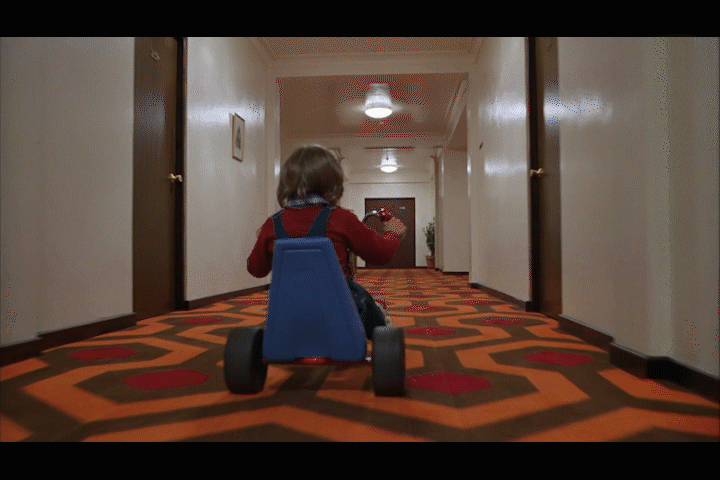
As he races around the hotel, we see what Danny sees but in a third person view, similar to many modern video games. At this early point in the movie, we already know that there is something very wrong with the hotel, so the long corridors create a sense of scale relative to the little boy that is intimidating. As he turns each corner into the next corridor, the camera follows him and builds the suspense; we have no idea what horrors are waiting for him around the next blind turn. Kubrick further increases the tension through use of sound. As Danny moves from carpet to hard floor and back again, the noise made by his wheels sounds almost like a sinister breathing as if the hotel is actively pursuing him. It’s the space and scape that makes this seemingly innocent scene of a little boy on his trike utterly terrifying.
Other elements that resonated with me were lighting and costume. The former may appear fairly obvious, but we have already seen the impact the creative use of light in a ‘staged’ image. The cold, fluorescent-style lighting in Insomnia creates a different effect to natural light, so if this were indeed an actual kitchen shot in daylight the sense of desperation and dread would be completely lost. With the costumes, though the choice of wardrobe can be a central theme to a film’s narrative. For example, in The Untouchables (1987), the job of dressing the cast was given to famous fashion designer Giorgio Armani. His reputation for stylish, expensive fashion was already established but in this film his creations were very carefully designed to support the film’s narrative. The main cast is the classic good vs. evil, with Eliot Ness and his Untouchables on one side and Al Capone and his gang on the other. For the lawmen, Armani created a feeling of hardworking, strength while fitting in with the idea that everyone wore smart suits and ties in the 1930s. For the Capone gang, though he created the opposite sense of rich opulence to support the idea that these people were living off the ill-gotten gains of exploiting the people of Chicago. The images below show the contrast between the two aesthetics.


Conclusion
The phrase mise en scène seems fairly self-explanatory, but as with most of this course the importance of setting the scene is subtle. The use of carefully placed visual elements and composition is similar in still and motion picture photography alike, but the freedom and pace at which a narrative can be realised differs between the two. Where a photographer has a single frame in which to include everything, a filmmaker has more time to build these subtle ‘background’ references in parallel with the more obvious acting that is occurring in the ‘foreground’. In the case of Kubrick, his directional style of shooting the same scene over and over to achieve both his vision and to drive (almost bully) the actors to be more naturally in the moment, is well documented (the famous baseball bat scene in The Shining was shot 127 times)[6]. That obsession with getting the most out of the cast and how they interact is often the thing we connect with, but in fact the cinematography, set design, costumes and lighting play a major part in how the viewer creates their narrative. In the case of diCorcia and Wall, their work uses the same techniques to lead the viewer around the frame but only have that one chance to give them what they need. As I move toward Assignment 5, the final one in this unit, the need to appreciate these elements is made clear by the simple idea of setting the scene.
References
[1] Masterclass, 2020, “What is Mise en scène in Film?”, Masterclass website, https://www.masterclass.com/articles/what-is-mise-en-scene-in-film#what-is-mise-en-scne
[2] Fletcher R, 2020, “Preparation for Assignment 4”, OCA Blog Post, https://richardfletcherphotography.photo.blog/2020/11/13/preparation-and-research-for-assignment-4/
[3] Fletcher R, 2020, “Research Task: Insomnia”, OCA Blog Post, https://richardfletcherphotography.photo.blog/2020/11/13/research-task-insomnia/
[4] Lightman H, 2019, “Photographing Stanley Kubrick’s The Shining”, The American Society of Cinematography website, https://ascmag.com/articles/flashback-the-shining
[5] Cochrane L, 2015, “From Scorsese to De Palma: how Armani dressed the movies”, Image Resource, The Guardian, https://www.theguardian.com/fashion/gallery/2015/oct/13/from-scorsese-to-de-palma-how-armani-dressed-the-movies, https://www.furiouscinema.com/crimewatch-the-untouchables/
[6] Green A, 2016, “Flashback: Shelley Duvall Battles Kubrick over ‘The Shining’, Rolling Stone Magazine, https://www.rollingstone.com/movies/movie-news/shelley-duvall-and-stanley-kubrick-battle-the-shining-188549/
 Richard Fletcher OCA Photography Blog