The Brief
Using the weareoca website, you need to search ‘Beneath the Surface’ to give you access to Jeff Wall’s (1994) Insomnia, interpreted using some of the tools discussed here.
Read and reflect on the chapter about Diane Arbus in Singular Images: Essays on Remarkable Photographs by Sophie Howarth (2005). This is out of print but you may be able to find it in your local university library: some of the chapters are available as pdfs online. You’ll find the Arbus chapter on the student website. If you haven’t read any of Judith Williamson’s (2014) ‘Advertising’ articles (see introduction to Context and Narrative), now would be a good time to do so.
Beneath the Surface (2012)
In order to further my understanding of how to read a photograph, I am going to split this critique into two parts; the first being the blog post called Beneath the Surface by Sharon Boothroyd[1], and the second being my own reading of Jeff Wall’s Insomnia.
When I first read the Boothroyd’s post, I was immediately struck by the structure of the piece. She begins by setting the scene with a description of what the post is setting out to achieve and the tools she will use in doing so. The specific semiotics that she is referring are denotation and connotation as examined previously. The former is the objective description of what is there and the latter, the interpretation of them. The photograph is then introduced with both the top-level denotation and connotations which lead into the author’s personal reading of the image. The personal perspective, shaped by her own memories and experience is a small part of the essay, with contextual references and facts about the piece and references to interviews with the artist about his intent. This structure is similar to a theory that I was taught in my working career about verbally presenting material in a speech or talk. The speech is broken into a number of key stages
- Setting the scene with context and what the speech is about
- Summarising the key points of the information being imparted
- Personal experience and connection with the subject
- A final point connects the conclusion back to the original intent in 2.
This blog appears to follow this structure, which is encouraging as that is how I will be approaching Assignment 4. My problem with the blog post is that it is too short. Although the author was clearly limiting the post to around 500 words, my view of it is that it doesn’t really tell me anything about the picture. The introduction and personal reading are pull out a couple of connotations and reference is made to other signs and signifiers without any further detail. The personal engagement informs us of the author’s reaction to the picture, but there is little to offer any alternative perspectives on the subject. There are references to other artists and to Hall’s writings but no details about how they relate to the train of thought in the writing. It’s almost as if the author wants us to go search for the relationship ourselves, which strikes me as a little lazy. The closing statements about the work and the artist’s intent when creating the photograph are interesting but brief. All told, I was really disappointed when I read the post; the only thing I learned was how to potential structure my own essay.
My Reading of Insomnia by Jeff Hall (1994)
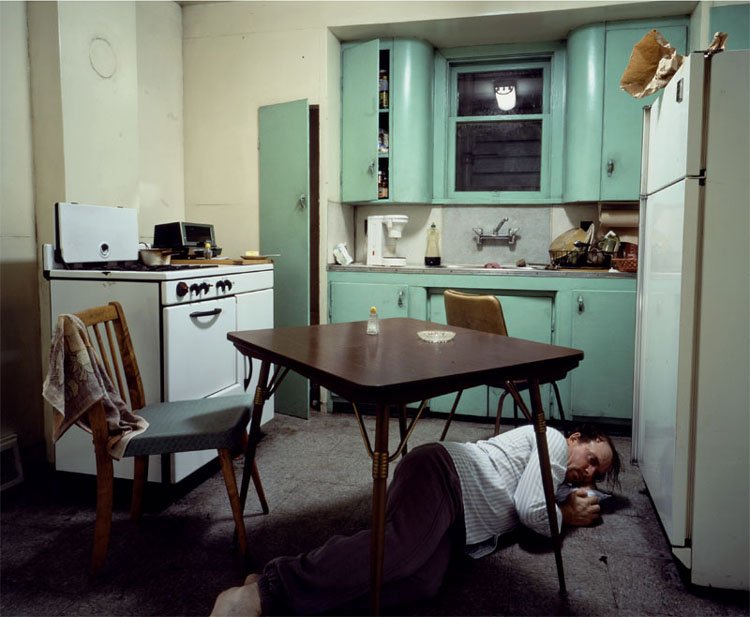
While I had issues with Boothroyd’s blog post itself, her approach of starting with the formal elements I found to be a good place to start. These denotations give us the basis upon all of the other semiotics are drawn once we add our own experiences and emotions to the mix. The formal elements of this picture is that it is of a kitchen, given the recognisable items that we associate with a kitchen. We have cupboard units, a sink, a cooker, furniture and a refrigerator which all denote the kitchen. We also have an arrangement of other smaller items that on examination are also denotations, such as the tea towel hanging over the back of the chair. There is a man lying on the floor who is clothed and awake. The scene is partially lit by bright, harsh artificial light with a large shadow area in the foreground. The kitchen cupboards are a pale green colour and some of the doors are slightly ajar. On the wall above the cooker is a circle of what looks like dirt where something used to be. All of these elements are factual and as such denoting a brightly lit kitchen with a man lying on the floor. As Boothroyd observed as her example, when we think of the word ‘home’, we think of a building of some sort with recognisable physical attributes. These are denotations. Boothroyd then goes on to say that the word ‘home’ connotes something quite different in a place of warmth, love, safety etc. The specific denoting elements create the connotations that we associate with a subject. In this case, the harsh lighting and black window connotes that the image is late at night. The light green cupboards are of an old fashioned design and colour that was fashionable in the 1960s and 70s, which connotes a kitchen that is out of style and unloved. Other elements connote the same impressions; the appliances and furniture are old-fashioned in appearance. The first ‘sign’ that can be drawn from the formal elements of the image is one of uninviting and neglected. The kitchen doesn’t invoke the sensations that we associate with kitchens being the central hub of the home; this one has a sinister and unwelcoming feel to it. The second sign for me is drawn from the man, the cupboards and the circle on the wall above the stove. The man’s position, his dishevelled appearance and facial expression all connote a sense of desperation. Whatever is happening to him has resulted in him being this way. The cupboards are ajar, which connotes a sense of looking for something in a hurry; leaving each cupboard open while looking in the next one. The circle on the wall connotes something missing. In this case it could be a clock, which would in turn connotes the absence of time. All of these connotations together create the second sign of total desperation. The final element that supports this sign for me is the title of the image. With this simple title, the artist is giving us the biggest indication of what the photograph is about. However, I believe that the artist is not asking us to see an insomniac, rather to relate to the experience of it. The absence of the clock is the opposite to what most of us experience when we have insomnia; a constant feeling that we must know what time it is. In this case, there is not ability to do that. The arrangement of the table over the man suggests the desire for safety and protection that the kitchen is not offering for the reasons contained within the first sign. There is almost a ‘duck and cover’ feeling to its placement. When I consider the table, I’m not sure it naturally belongs in the scene because of it’s size and position. If we were to remove the other denotations from the scene, the table doesn’t make the kitchen a natural looking workspace, so what is it’s purpose?
The overall meaning of this photograph for me is one of loneliness and isolation from the world. Insomnia makes us feel like the only person in the world who cannot sleep, which in turn suggests that the world doesn’t care. The man in his dated, cold-looking kitchen has been looking for some solution in the cupboards but presumably without success. The only solace now is to hide beneath the table and wait for the morning.
The interesting thing about reading photographs like Insomnia is related to Barthes’ statements about the author not being in control of the narrative and the reader or viewer owning how the interpretation develops. In interviews [3][4], Wall talks about his method and how the common conception that he controls every element is a myth. He discusses the elements he puts into his compositions and how he works to make them balance but essentially leaves the whole narrative to the viewer. His other comment was that his artistic process begins without any photography in mind. He looks for subjects or scenes that resonate with him and then creates a photograph that invokes the memory of that scene. Perhaps then, the powerful associations with my own experiences of insomnia are expertly created by a handful of elements that connote the sheer hell of the condition.
Singular Images: Diane Arbus
In the chapter called Diane Arbus: A young Brooklyn family going for a Sunday outing, NYC 1966[5], Liz Jobey reads one of Arbus’s portraits and challenges the fictions that we create for ourselves when presented by a photograph. The image is of a young family of 4 going for a walk and it was taken as a portrait when Arbus encountered them on the street in New York. As with much of Arbus’s work, the thing that separated her from other street photographers of the time was that she engaged with her subjects. We are told that she would walk the streets looking for people about whom she saw something that interested her and would approach them for a picture. Jobey reads the formal elements and the subsequent connotations that suggest an awkward family relationship with a kind of unhappiness between the couple. The critique of the photograph made sense to me, but Jobey goes further in her questioning of the overall feeling it evokes. When Arbus submitted the picture to a magazine, we are told that she said:
“They live in the Bronx. I think he was a garage mechanic. Their first child was born when she was sixteen…they were undeniably close in a painful sort of way”
Diane Arbus, from a letter to Sunday Times (c1968)[5]
This contextual element forms the basis of Jobey’s challenge of the interpretation of the photograph. The very signifiers that we see in the image are somehow balanced by Arbus’s damning assessment of the couple’s relationship. The pain that she referred to isn’t readily accessible in the photograph; Jobey’s reading of it suggests tension, anxiety and embarrassment between the couple and the photographer but not pain as such. Jobey reflects on Arbus’s own life and her privileged, almost vanilla upbringing that created a sadness and loneliness in the artist. Her early work saw Arbus photographing what she referred to as ‘freaks’, which are photographs I saw a year or so ago in an exhibition in London [6]. Here Arbus used her camera to capture was was so very alien to her not just in an historical sense, but also an emotional one. Her approach of interacting with her subjects to get the photograph also revealed their reaction to the attention. Jobey asserts that her appraisal of what interested her about her subjects was countered by the way they posed for her. These were not weak or somehow in pain, but fronting up to a photographer who most likely felt that way about herself. Such was the impact of the words in the quote above that the deputy editor of the magazine changed the printed version to say “…undeniably close in a painful, heartfelt sort of way” which Jobey argues shifts the emphasis of pain more onto the artist.
In an interview with The Guardian in 2005[7], the feminist Germaine Greer describes what it was like to be photographed by Arbus in 1971, just weeks before her suicide. Greer paints a picture of someone who lacked empathy with her subject, citing that a lot of nonsense had been written about Arbus and her interactions with her subjects. She then describes the awkwardness of the shoot during which Arbus barely spoke or made eye contact with Greer. Greer was clearly not a fan nor a fan of the people that held up Arbus as original and that doesn’t really interest me; I am not a fan of Greer’s writing either. The thing that she did say in that interview that resonated with me was:
“Arbus is not an artist who makes us see the world anew; she embeds us in our own limitations, our lack of empathy, our kneejerk reactions, our incuriosity and lack of concern. Hers is a world without horizons where there is no escape from self”
Germaine Greer talking to The Guardian [7]
This statement almost sums up Jobey’s critique of Arbus for me. The only exception being that her own limitations made her see people and their lives in a remote, detached way and created her photographs with strong suggestions that we should see them in the same way. When I look at the Brooklyn family I see something akin to a paparazzi shot, where the intrusion of the approach puts the subjects ill at ease. Perhaps my own discomfort at being photographed empathises with the couple in a way that Arbus didn’t. This is the classic representation of intertextuality at work.
References
[1]Boothroyd S, 2012, “Beneath the Surface”, OCA blog post, https://www.oca.ac.uk/weareoca/photography/beneath-the-surface/
[2] Image Resource, “Jeff Wall, Room Guide”, Tate Exhibition ‘Jeff Wall Photographs (1978 to 2004), https://www.tate.org.uk/whats-on/tate-modern/exhibition/jeff-wall/jeff-wall-room-guide/jeff-wall-room-guide-room-8
[3] ARTtube, 2014, “Jeff Wall: Tableaux Pictures Photographs 1996-2013, Youtube, https://wordpress.com/post/richardfletcherphotography.photo.blog/3258
[4] SFMA, 2010, “Jeff Wall: I begin by not photographing”, Youtube, https://www.youtube.com/watch?v=2yG2k4C4zrU
[5] Howarth S, 2005, “Singular Images: Essays on Remarkable Photographs – Diane Arbus: A Young Brooklyn Family going for a Sunday Outing, NYC 1966, but Liz Jobey, chapter extract, OCA Student Website, https://www.oca-student.com/sites/default/files/oca-content/key-resources/res-files/ph4can_singular_images.pdf
[6] Fletcher R, 2019, “A Tale of Three Photographers”, OCA Blog Post, https://richardfletcherphotography.photo.blog/2019/07/26/a-tale-of-three-photographers/
[7] Greer G, 2005, “Wrestling with Diane Arbus”, The Guardian, https://www.theguardian.com/artanddesign/2005/oct/08/photography
 Richard Fletcher OCA Photography Blog
Pingback: Preparation and Research for Assignment 4 | Richard Fletcher OCA Photography Blog
Pingback: 5) Project 1: Setting the Scene | Richard Fletcher OCA Photography Blog
Pingback: Assignment Two: Vice versa | Richard Fletcher OCA Photography Blog
Pingback: Assignment Five: Your Inspiration | Richard Fletcher OCA Photography Blog