Introduction
Assignment 4 is slightly different from the others in this unit in that it is a written essay rather than a photography project. The brief is for a critical analysis of a photograph either by a famous photographer or one of our own. The essay is intended to break down the image into its context and meanings as we have learned in Part 4. This post is the preparation and research for that essay.
The Image
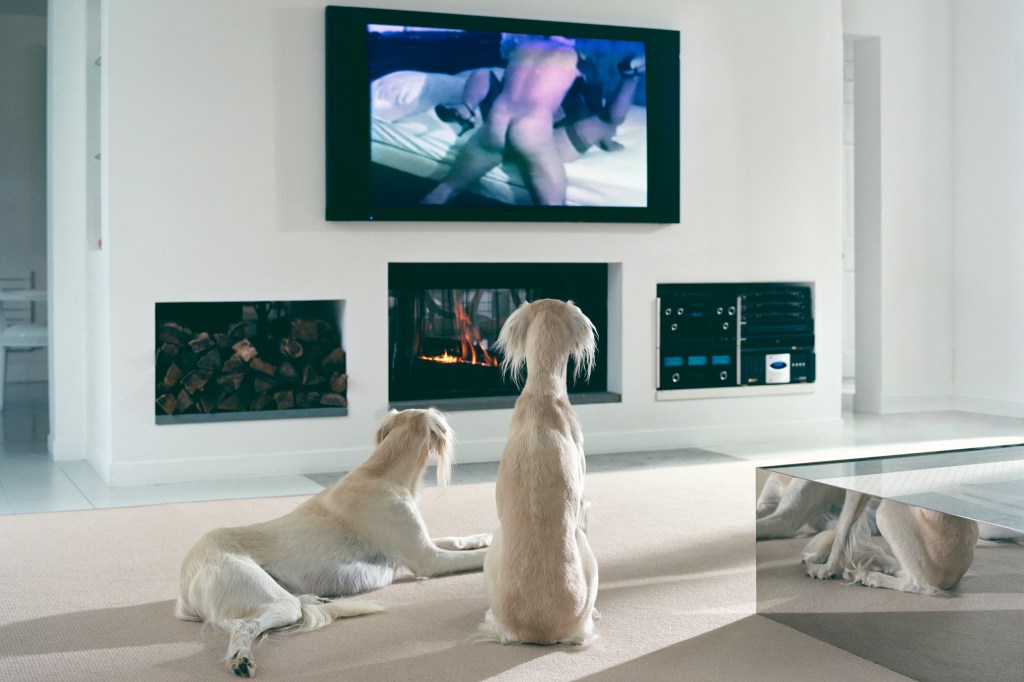
This image is from Philip-Lorca diCorcia from his series East of Eden and depicts two dogs ‘watching’ a pornographic film in a very modern-looking room. I chose this image because my initial reaction was a one of humour at the slightly shocking contrast of the subjects. I am also as a fan of diCorcia’s work, having first seen an exhibition of his work, including East of Eden at the Hepworth Gallery in Wakefield in 2014. I was drawn to the way that his images seem relatively simple in their composition, yet are interesting; containing many layers of complexity that are revealed the longer we look at them.
Contextual Research: diCorcia and East of Eden
Philip-Lorca diCorcia started his career in fashion photography, working on assignment for W magazine with the same creative director for over a decade [2]. With his work in that industry he developed a style of creating a scene that was not naturally observed, by using models, flash strobes, props and of course the element of fashion that was the subject of the ‘story’. When he started to develop his ideas for his own work, he took this sense of fantasy and unreality into his art. His brother died of AIDS in the 1980s, which diCorcia used as the inspiration for his famous series Hustler, a collection of photographs of male prostitutes in the major cities in the USA. At the time, the government rhetoric about AIDS was one of moral denia (it only affected the ‘degenerate’ homosexual community) and disconnection from the way that it was wiping out a whole swathe of the population. With Hustler, diCorcia wasn’t trying to document the struggles of the lives of the young men, but instead drawing attention to their existence as people and actors in their way of life. diCorcia has stated that he didn’t know or get to know them in any way, he just set up the composition he wanted and then hired them to be part of it. What diCorcia was interested in was revealing how the outward personality of his subjects differed from what they were really like. Since he didn’t know them personally, he left any conclusions about that they were actually like to the viewer to narrate.
“A person’s interiority is very different than their exterior appearance and to some degree, life is a performance”.
Philip-lorca diCorcia, talking to The Hepworth Gallery, Wakefield[3]
In a presentation made to The Modern in Fort Worth [4], diCorcia mentions that prostitutes are essentially actors for hire and that the variety of fantasy roles that males play is much bigger than their female counterparts. In the same presentation, he answers a question about how he creates narrative in his pictures.
“I’m supposed to give you just enough information, in my mind, as you need to be intrigued, not enough to finish your experience”
Philip-lorca diCorcia on his approach to narrative [4]
What he meant by this lends itself to the theories of post-structuralism where the artist is not drawing on cultural references to tell a story, but shifting the responsibility onto the viewer. In the case of Derrida’s idea that a trace of what isn’t there is also present in a story or image, diCorcia is showing us perhaps the obvious outward impressions of what male prostitutes are, but also leaving an idea that all is not what it seems. These young men had a story of how they ended up with this lifestyle, perhaps the lack of family support or struggles with their mental health. The elements that suggest this are often implied but not actually present. His use of unreality, i.e a contrived setting for these young men to be placed within, he adds to the mystery of what the image means. We see examples of this in his fashion work:
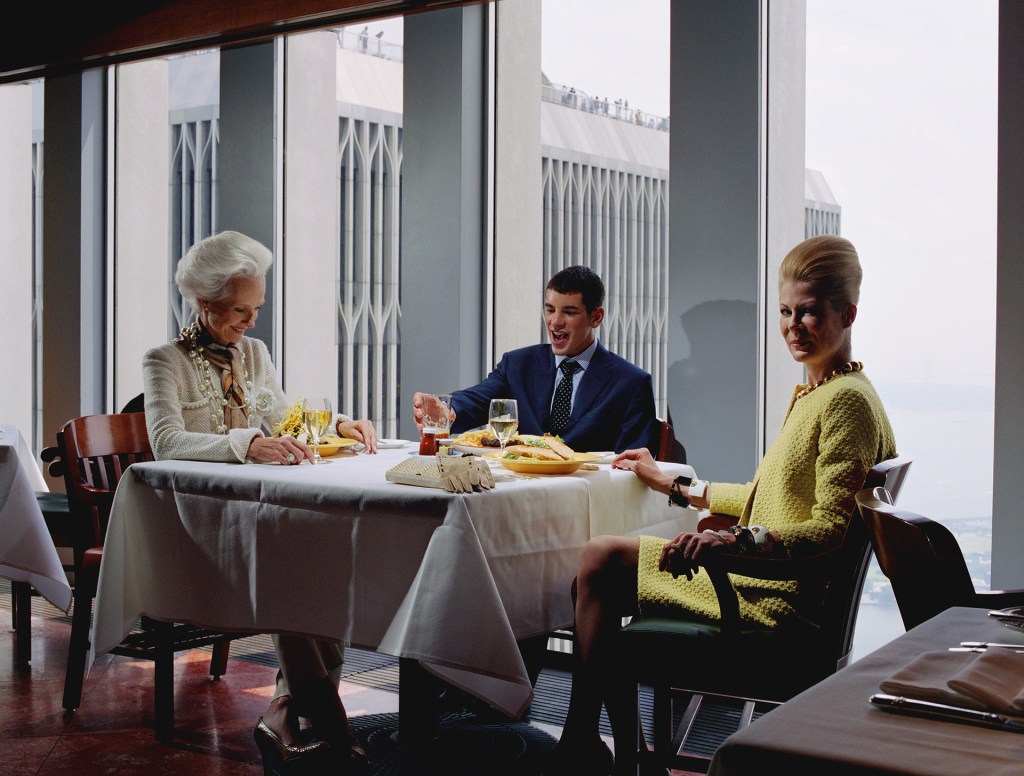
Here we have three people enjoying lunch in a restaurant that is immediately recognisable as the Windows on the World at the top of the World Trade Center towers. The shot was taken in 2000, the year before the towers were destroyed in the 911 attacks, but the location’s use was merely an accident; the artist knowing someone involved in the running of the restaurant. The main contextual elements in the image are the two middle-aged ladies having lunch with a much younger man. diCorcia states that the series was a fashion story about the ‘boy toys’ of women of a particular social class and age group[4]. The fashion elements that are layered into the photograph are what the series is supposed to be revealing, but when we look closer at the picture we see that nothing is at all natural about the shot, from the bright lighting to the almost over-the-top acting of the subjects. One of the women appears to be enjoying the presence and attention of the young man, while the other looks embarrassed, glaring at the camera as if she’s been found out in some way. In this image, there is both total abandonment with the mature women being entertained by the young man, as well as the acknowledgement that it’s not perhaps the done thing in society. The elegant setting adds weight to that impression, the twin towers being a symbol of prosperous America. In discussing this image, diCorcia confirmed that in fact, the women were professional models but the young man was actually a hustler in the same way as his previous series. This blending of the perceptively real and unreal, which traces of their opposites is to me, very indicative of most of diCorcia’s work; the added context making it even more intriguing.
In various interviews[4][5], diCorcia has discussed his desire to create art that is separated from his perspective, almost always making it clear that he is not part of the story but merely using a camera to observe. In the case of Heads, he elected to add a lack of control over the subjects by photographing them from a considerable distance. His lights were set up within the scaffolding of building works and his camera pre-focussed. When a person walked through the region of focus, he triggered the camera. What resulted was a series of images captured by chance more than design, in some cases the subject would be too tall or too short for the picture to work but in others, the sense of people going about their daily lives comes through strongly. The series got diCorcia in trouble as one of the subjects sued him for using his image[6], but in the main the reaction when the subjects realised they had been photographed ranged from happiness to ambivalence.
With East of Eden, diCorcia set out to create a sense of the loss of innocence. The work began in 2008 around the time that America was transitioning from the Republican era of George W Bush to the Barack Obama’s first Democrat administration. diCorcia, who described himself as ‘not Republican’ combines the contextual references of contemporary American society with religious themes throughout East of Eden. References to Adam and Eve, Cain and Abel etc give the sense of the damage done by the political culture on modern America through diCorcia’s alternative realities. The works are subtle, though as in the case of the photograph Cain and Abel.
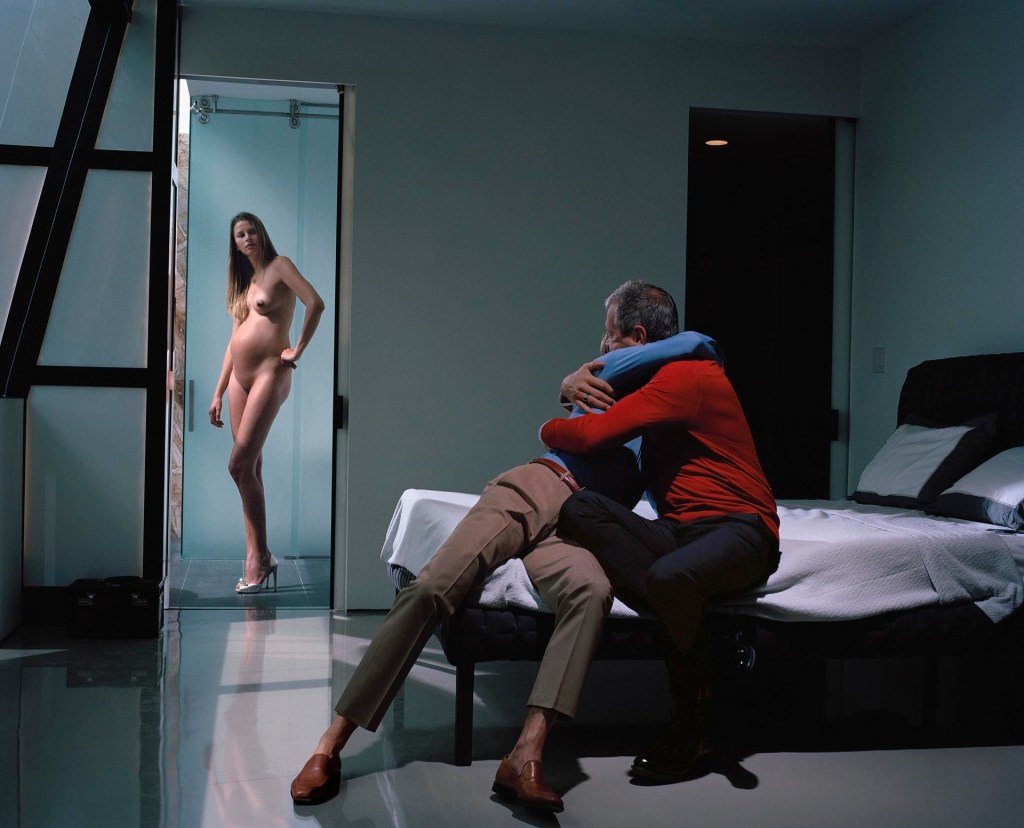
In the bible story from the book of Genesis, Cain and Abel were brothers and the children of Adam and Eve. The story tells of Cain murdering his brother after his offering to God was seen as of lesser value than Abel’s. His action resulted in his banishment from Eden to ‘the land of Nod’, located to the East. East of Eden is the direct reference to the story and the descent of Cain and his descendants into moral corruption following his destroying of the righteous[7]. It has been retold throughout history and in the case of Steinbeck’s novel also called East of Eden, set brought into the context of modern society[8]. In diCorcia’s Cain and Abel, we are presented with two men in embrace. The nature of their relationship is unclear but the presence of the bed suggests a homosexual couple. The men are wearing the colours of the two main political parties in the US, so the viewer is immediately asked if the embrace is one of affection or rather that they are fighting. In the doorway a naked woman watches the two men. She is pregnant, which creates the sense of motherhood. In fact, diCorcia intended the woman to be Eve, the mother of Cain and Abel – he admitted to having photoshopped her naval form the image to give her the impression of being the original human female[4]. The multiple layers of context that this photograph contains is typical of the series. Themes such as separation and division, with the chance of reconciliation are matched by the reaction to the men being a gay couple, something that conservative America still regards as a sin. The disapproval or disappointment of the Eve figure could further reinforce that sense and her pregnancy while signposting her status as mother, could also be seen as continuation – a sense of ‘we’ve started as we mean to go on’; the age of innocence lost. It could equally be read as sadness that the general narrative about homosexuality as being ‘wrong’ is still evident today, despite significant progress in acceptance and rejection of prejudice.
When we think about it, loss of innocence can have many meanings such as the loss of childhood to adulthood portrayed in literary works like William Golding’s Lord of the Flies where the extreme circumstances cause the children to have to fight for survival and, almost inevitably power. Visual artists have represented this same theme in a variety of genres, for example Costa Rican artist John Paul Fauvres’s series The Loss of Innocence which was inspired by his observations about his son growing up [9]. Fauvres challenges the associated we have with the things we enjoyed as a child by altering them in an adult, often sinister way. One such image of Mickey Mouse blended into Marilyn Monroe suggests a shift away from the pure to the superficially pure in an almost nightmarish way created by the act of seeing it through adult eyes [9]. Perhaps this explains then, some of the criticism levelled at renowned Sally Mann who photographed her children innocently playing and frequently nude. Our application of an adult perspective immediately associates the nudity of children as observed by their parents as being sinister or abusive, serving to erode innocence where it is clearly evident – I was quite shocked by this when studying the artist as part of EYV.
However ‘loss of innocence’ could also be a term associated with the veil lifting on a preconception. diCorcia believed that America had changed during the Bush administration with the financial crash brought about by the ‘immoral’ behaviour of the banking industry and the ‘terror’ and the subsequent war on terror that revolved around the 9/11 attacks. This series explores the notion that perhaps the age of innocence had been lost without anyone noticing and that it was more about the way we see the world that had changed.
East of Eden then is a series that is full of metaphor, alternative narratives and multi-layered meaning, which is why I chose a photograph from it.
Deconstructing ‘The Hamptons’
I approached this in a similar way to Exercise 2[10], where I analysed an advertisement for sliced ham. I started with the formal, factual elements in the frame and then moved on to some of the potential connotations of them. The annotated photograph can be seen below.

The elements that are labeled in red are the signifiers, or factual elements present in the composition. We see here the space containing furniture and equipment that denote a living room. The presence of the television, fireplace, hi-fi equipment and coffee table all point to a space with a very specific purpose. The space is painted and carpeted with neutral colours, which combined with the style of the coffee table connote a modern living room. Indeed the style of the room architecturally suggests modern with its central block containing the fireplace, hi-fi and log store. We cannot see what is beyond, but what we can see denotes open-space living. The audio and video equipment are large and expensive-looking, which connotes a space owned by someone with money. These elements come together to result the photograph’s first sign, which is that this is an expensive living space. This sign is further emphasised by the title of the photograph, The Hamptons. The Hamptons is a very wealthy area of upstate New York, which fits with this first sign.
The next noticeable elements are the two dogs and the pornographic film being shown on the television. The dogs are clearly of the same breed, which has a clean, lightly coloured coat. One is sitting upright and the other is laying down, but both are looking in the direction of the wall with the television on it. For me, the two dogs dennote the occupants of the space as they are the only living beings in the photograph. Their postures connote different emotional responses to whatever they are looking at. The one sitting suggests interest or tension while the other connotes relaxation and perhaps comfort. The former has their posture further emphasised by their reflection in the coffee table which only reveals the dog’s hind legs. The connotation here is that the dog is alert and ready to move if necessary, which further adds to the sense of attention being paid to what the dog is looking at. The television on the wall is what we assume the dogs are looking at and on it is a pornographic film. If the modern, expensive, perfectly neat and tidy sign of the living room is the studium when considered with the picture’s title, the porn film is the punctum. It’s stark contrast to the rest of the picture is evident from first examination and when combined with the fire offer the completely opposite sign. Here we have the perfect space and perfect occupants in the presence of something that doesn’t obviously belong. When I observed this punctum, I also noticed the increased significance in the way the scene is lit, by a uniform soft light from the right hand side of the frame. diCorcia is well known for using artificial light in his compositions because of his fashion work, so it is no coincidence or accident that the light in this image is pure. It is, of course part of the signs relating to the modern, expensive living space, but I noticed it when presented with the contrasting element, i.e. the porn film.
Exploring the possible cultural themes
With the studium and punctum of the image beginning to present themselves to me, I wanted to explore the cultural themes relating to them. The first is the culture of wealth and the way that it affects our perception of the people who have it. As mentioned previously, The Hamptons is a region of upstate New York which has some of the highest house prices in the US, some properties reaching over $100m. The fascination with that kind of wealth can be found throughout modern media, ranging from reality television stars such as the Kardashians to the billionaire businessmen and women such as Jeff Bezos (Amazon) and Alice Walton (Walmart) whose lifestyles are coveted by many. We associate money with power and indeed some of the people with money also wield power over our lives. However, where does the association with higher class and standing come from when it comes to money? Since the modern US culture and the UK share a common history, we can consider the attitudes to wealth and class that span the past few hundred years. In the Tudor era, the wealthy were born of privilege and as a result expected to be responsible for the lower classes in their regions or estates. Such responsibility was associated with respect for standing and the resources to give jobs to working men and women of the lower class. The respect was engendered, even if the ‘master’ was just a fortunate benefactor to family wealth that he hadn’t earned. These notions continued into Victorian England where the social classes were shaken up by the Industrial Revolution [11]. Now wealthy people were both revered and reviled for being ‘the betters’ of the common man, a sentiment that we see in literature such as Dickens’ Oliver Twist. In his novel, Dickens uses the theme of class divide as a battleground where the poor and morally bankrupt rob the rich as part of a criminal enterprise. The principal character, born to poverty eventually ascends to wealth by being adopted by a ‘gentleman’ and ultimately turning out to be a member of his family through his mother’s line. The story tells us that the rich are special and the poor must fight, but it is possible to cross the divide. At the time of writing, Dickens’ readers would have been acutely aware of gulf between classes, so the notions being put to them by the Dickens would have appeared unreal[12]. Dickens answer was to make Oliver a pure figure, beyond reproach whose destiny to achieve wealth and standing was ‘because he was one of them’. However, we know now that while the legacy impression of wealth symbolises higher standing or ‘being better’, we know from our more recent history that this simply isn’t the case. Highly publicised scandals and the private lives of the rich and famous and even royalty have made us cynical about what goes on behind the perfect facade of the image of wealth and success. The continued morally questionable behaviour of President Trump presents us with almost a confession that you don’t have to be good to have money. Perhaps then diCorcia’s loss of the age of innocence starts with the notion that wealthy means goodly and then contradicts it with both obvious and subtle narratives.
The second are of cultural context I wanted to explore was our relationship with pornography. Pornography has long been a devise subject that most prefer not to discuss. It’s association with historical illegality and the seedy side of life have driven it’s existence underground or behind closed doors. However it is more prevalent than ever, being regularly recorded as the most accessed material on the internet [13]. The effect of pornography on society prompted a House of Lords report in 2015 [13] in which concerns about the accessibility to children, it’s effect on their sexual development and implication in violent acts committed on women were offset by the lack of real understanding of who watches it. Their own statistics didn’t capture the volume of material being watched and which sexes, social groups and classes were the main audience for it. Arguments have been made that it is an industry like any other and that the boundaries between art and pornography are blurred at best. Take the work of Fauvres discussed earlier for example. Some of those paintings take childlike constructs and overtly sexualise them. Robert Mapplethorpe’s extreme portraits often portraying homosexual ‘acts’ and male nudity are considered art, yet despite there not being anything illegal about them, were considered pornographic when they were first published. That response was driven mainly by heterosexual sensibilities that considered being gay to be unnatural. Porn then, is something unnatural that we should be ashamed of. Despite this, many women watch pornography as well as many couples with strong, loving relationships. Like societal beliefs in wealth and morality, pornography is something best kept hidden – almost the opposite side of the same cultural coin.
Reading ‘The Hamptons’
When I read The Hamptons (2008) by Philip Lorca-diCorcia, I first see the signs that I identified in the deconstruction. This is a wealthy living space where everything is seemingly pure, but in fact there is a contrasting activity taking place. The two dogs symbolise two types of people that have a common appearance to the outside world. The pornographic film symbolises the replacement for the innocence lost, in this case the contrasting aesthetic to the purity of the room and its occupants. The inclusion of the fire that seemingly serves to provide heat to the space now looks like an almost religious signpost that whatever is happening has some form of damnation associated with it. The reactions of the two dogs to the film are different, one appearing to be ambivalent to the loss and the other being acutely aware of it. There are no other beings in the space which suggests that the occurrence and their reactions are all private; the notion of ‘not knowing what goes on behind closed doors’ could be literal when considering the dogs and the film, but my reading is that it is a metaphor for our lives – some things are neat and controlled like the room (with its almost clinical tones) and others are beyond our control (the dogs wouldn’t chose to watch a porn film by themselves). The struggle between the image of good and the struggle with the evil is not a simple one. In this photograph, the evil is already there but the dogs are merely accepting of it or intrigued by it. As with the banking scandal that served as diCorcia’s inspiration, the behaviour was going on but nobody really paid attention to it until it was too late. Like our ability to recognise the slow degradation of innocence causes by such events, our reaction to them depends on our point of view. As with the other photograph Cain and Abel, diCorcia weaves layers of potential messaging with only a handful of props and environmental conditions.
Conclusion and Preparation for the Essay
In conclusion, I am glad I selected one of diCorcia’s photographs for this assignment. As with the previous exercises, the methodical approach of looking first at what is present in the frame and what it might mean is a good way of structuring the photograph before reacting to it in some way. My reading of the studium and punctum led me to looking at how my own experiences and perspectives affect the meaning of the overall image to me. Having visited the US several times now and stayed in places where the rich are truly rich, I recognise the setting that diCorcia presented this subject within. My own views people’s morality is not driven by social media personas or public faces. Neither is it judged in any way by them looking at pornography, which I feel to be a complex subject that shouldn’t be reduced to a tool by which people are assessed. The use of dogs instead of people further reduces the temptation to judge by appearances, instead the potential narrative that the inclusion creates is all the more interesting because of the metaphor. What I loved about this photograph when I first saw it was that it made me smile. The humour introduced by the silly way the dogs are watching the film belied the sadness and almost sinister way my reading of the image evolved. It’s that complexity that makes this image resonate with me.
In preparation for writing the essay, I am intending to use a structure defined in a recent training course that I completed for work, referred to previously [14]. The structure aligns with:
- Setting the scene with context and what the speech is about
- Summarising the key points of the information being imparted
- Personal experience and connection with the subject
- A final point connects the conclusion back to the original intent in 2.
By following this structure, I will be able to prioritise the key points while remaining within the word count.
References
[1] Image Resource, “Philip-Lorca DiCorcia, David Zwirner Gallery, https://www.davidzwirner.com/exhibitions/philip-lorca-dicorcia-paris#/explore
[2] Helmore E, 2011, ‘Still Life: Philip-Lorca DiCorcia’s breathtaking and outlandish fashion photography, Independent Newspaper website, https://www.independent.co.uk/arts-entertainment/art/features/still-life-philip-lorca-dicorcias-breathtaking-and-outlandish-fashion-photography-for-w-magazine-2229656.html
[3] HepworthWakefield 2014, “Philip-lorca diCorcia: Photographs 1975 – 2012, Youtube, https://www.youtube.com/watch?v=So_FK4qnz5Q
[4] Unknown, 2015, “Tuesday Evenings at the Modern – Philip-Lorca DiCorcia, Youtube, https://www.youtube.com/watch?v=zs8z9DCVrYA
[5] Unknown 2018, “Interview – Philip-Lorca diCorcia, CICART video, https://www.youtube.com/watch?v=67U-0_wExLA
[6] Gefter P, 2006, “Street Photography: A right or invasion?”, The New York Times, https://www.nytimes.com/2006/03/17/arts/street-photography-a-right-or-invasion.html
[7] Multiple Authors, 2020, ‘Cain and Abel- Bible Story’, Bible Study Tools post, https://www.biblestudytools.com/bible-stories/cain-and-abel.html
[8] Unknown author and date, “East of Eden – Plot Synopsis”, St Jose State University website, https://sits.sjsu.edu/curriculum-resources/east-of-eden/plot-synopsis/index.html
[9] Carter F, 2017, “John Paul Fauves Loses His Innocence”, Forbes Magazine, https://www.forbes.com/sites/felicitycarter/2017/07/10/john-paul-fauves-loses-his-innocence/?sh=6ab5ede91367
[10] Fletcher R, 2020, “4) Exercise 2 – Deconstruction Task”, OCA Blog Post, https://richardfletcherphotography.photo.blog/2020/10/30/4-exercise-2-deconstruction-task/
[11] UKEssays 2018. “Social Class During The Victorian England”, [online], https://www.ukessays.com/essays/history/a-persons-social-class-during-victorian-england-history-essay.php?vref=1
[12] LitCharts, Unknown Date, “Oliver Twist by Charles Dickens, https://www.litcharts.com/lit/oliver-twist/summary
[13] Santo M, 2015, “Impact of Pornography on Society”, House of Lords Library (linked download), https://lordslibrary.parliament.uk/research-briefings/lln-2015-0041/
[14] Fletcher R, 2020, “Research Task – Insomnia”, OCA Blog Post, https://richardfletcherphotography.photo.blog/2020/11/13/research-task-insomnia/
 Richard Fletcher OCA Photography Blog
Pingback: Assignment 4 – A picture tells a thousand words | Richard Fletcher OCA Photography Blog
Pingback: 5) Project 1: Setting the Scene | Richard Fletcher OCA Photography Blog
Pingback: Post Assignment 4 Feedback | Richard Fletcher OCA Photography Blog
Pingback: Drawing on Documentary and Art – Influences on Photographers | Richard Fletcher OCA Photography Blog