The Brief
Write an essay of 1,000 words on an image of your choice
The image can be anything you like, from a famous art photograph to a family snapshot, but please make sure that your chosen image has scope for you to make a rigorous and critical analysis.
Introduction
For this assignment, I chose a photograph from the series East of Eden, by Philip-Lorca diCorcia. The theme of the series is described by diCorcia as America’s ‘loss of innocence’ experienced towards the end of George W Bush’s presidency in 2008[1]. The title refers to the ongoing struggle between good and evil that is referred to in the Book of Genesis[1], Cain becoming the symbol of ‘evil’ through murdering his ‘good’ brother Abel in a jealous rage. diCorcia invokes this struggle by relating it to the immoral banking practices that led to the financial crash towards the end of the Bush era. The photograph that I selected is called The Hamptons (2008), shown below. In this essay I read the photograph using the techniques learned in part four and describe my interpretation of it.
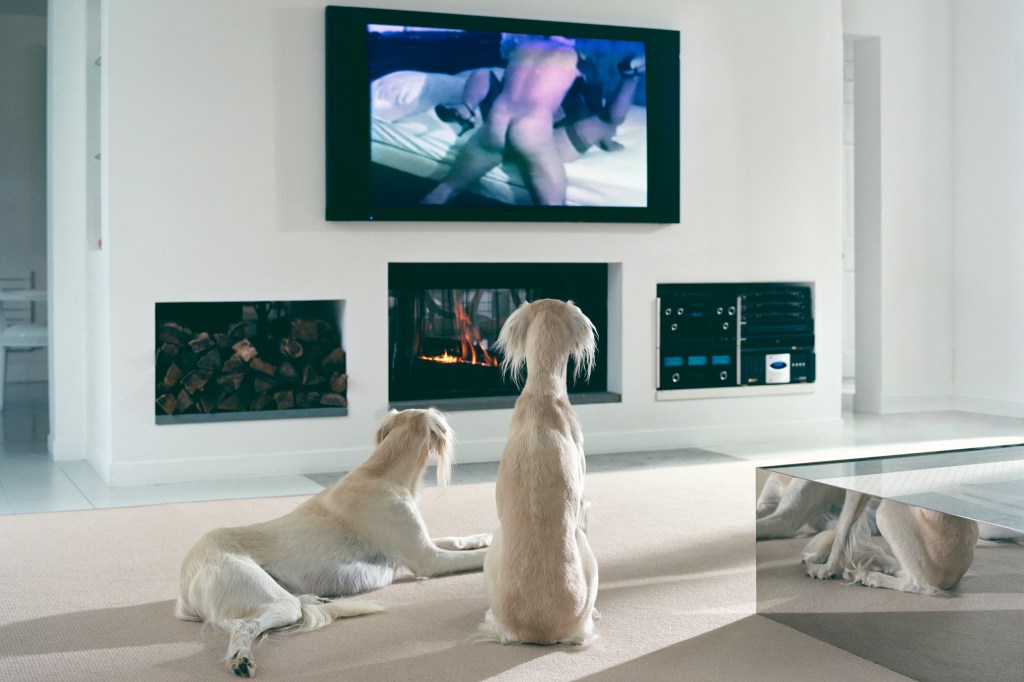
I chose this photograph because of the obvious, slightly shocking humour of the subject; two dogs watching a pornographic film. The photograph follows diCorcia’s consistent style of work that developed while a fashion photographer with W magazine in the 1990s. The composition is devoid of any distracting clutter and arranged with a ‘cinematic’ feel; diCorcia describes his subjects being square on to the camera and shot from a neutral position, i.e not from the photographer’s perspective. The result allows the viewer to ‘step into’ the frame in a similar way to modern cinema.
My Reading of The Hamptons (2008)
I started by deconstructing the elements within and looking for possible meanings using semiotics[3]. In the version below, the formal elements of the photograph are labelled in red. The potential meanings of those elements are labelled in blue.

The red items are signifiers which are identifiable to most viewers. The room’s plain, light coloured decorative elements: the coffee table, fireplace and audio-visual equipment, are all formal elements that create the impression a living space. Although lacking sofas or chairs, the signifiers are strong enough to signify a living room. We also have a restricted view into the next room, which gives the impression that of a large space; an apartment or house. The furniture and the audio-visual equipment could signify the room part of an expensive home; the size of the television and appearance of the other items signify something that has been carefully designed and executed. The first sign then is that this is a room belonging to someone with money. This is further supported by the photograph’s title, The Hamptons, referring to a region of upstate New York that has among the highest property values in the US, some homes costing over $100m. The other formal elements are the dogs and the pornographic film. There are two light coloured dogs of the same breed facing away from the camera in the direction of the television. One is lying down and the other is sitting upright. The latter’s hind quarters are reflected in the mirrored side of the coffee table. The film itself is mildly explicit, shows a man taking control of the sex through the position being used. The TV and the surrounding elements provide the only colour contrast to the muted tones of the scene. In terms of what the dogs and the film signify, the first impression is of entertainment being viewed by a viewer. The way that the photograph asks a viewer to look at someone (in this case something) viewing something else aligns neatly with diCorcia’s cinematic perspective described previously. The sign here is one of voyeurism, with we the viewers being the voyeurs on the scene.
In terms of what the elements mean, the way the room appears to connote a highly ordered purity, with a lack of clutter or signs of life within. The dogs share the same ‘pure’ appearance, but their reactions to what they are looking at are different. These poses could connote how what looks the same isn’t necessarily the case. For me, the dogs represent people in this image – perhaps the owners of the house who are absent from it. People may be similar but we are all different. The presence of the porn film connotes the ‘impure’ that is invading the space and perhaps points to corruption of innocence. The impressions of wealthy, class-led society being somehow better are rich in western culture, referenced many times through the years in the writings of authors like Dickens. Victorian society liked to think that people with wealth are of a higher moral standing as illustrated in his novel Oliver Twist and the idea that they might not be, makes us uncomfortable. In the case of Dickens, he had to make street urchin Oliver’s character almost angelic so that his readers could more readily accept his transcending from working to upper class[3]. When considering these connotations the studium of wealth and implication of class or being better than everyone else is, for me, being revealed or debunked by the punctum of the pornography. Our relationship with pornography is one of secrecy and sub-culture, a thing should be hidden or not spoken of with exceptions of highlighting how it corrupts society[3]. The idea of the pure dogs, in their pure environment being corrupted and the implication of damnation suggested by the fire, helps create the narrative around good vs. evil; the theme of the series the photograph comes from.
Conclusion
Introducing this photograph, I described my initial reaction as one of seeing a slightly edgy humour at it’s clear contrasts. However, after analysing the elements, their potential meanings and the context within the series, I can now appreciate the many layers of narrative that this image allows for. With my reading, the more sinister ideas about clean becoming dirty, pure becoming corrupted and how the evil is not limited to class or standing, becomes evident in the representation of the dogs in their living room. Far from being a little edgy or shocking, the image takes on a sad feeling that through our own indolence or blind trust in ‘our betters’, we somehow let evil in, a good metaphor within the original intent of diCorcia’s series.
References
[1] Zwirner D, 2015, ‘East of Eden Press Release’, David Zwirner website, https://www.davidzwirner.com/exhibitions/east-eden/press-release
[2] Zwirner D, 2015, ‘East of Eden Exhibition Catalogue, David Zwirner website, https://www.davidzwirner.com/exhibitions/east-eden
[3] Fletcher R, 2020, “Preparation and Research for Assignment 4”, OCA Blog Post, https://richardfletcherphotography.photo.blog/2020/11/13/preparation-and-research-for-assignment-4/
 Richard Fletcher OCA Photography Blog
Pingback: Post Assignment 4 Feedback | Richard Fletcher OCA Photography Blog
Pingback: Drawing on Documentary and Art – Influences on Photographers | Richard Fletcher OCA Photography Blog
Pingback: Assignment Five: Your Inspiration | Richard Fletcher OCA Photography Blog