The Brief
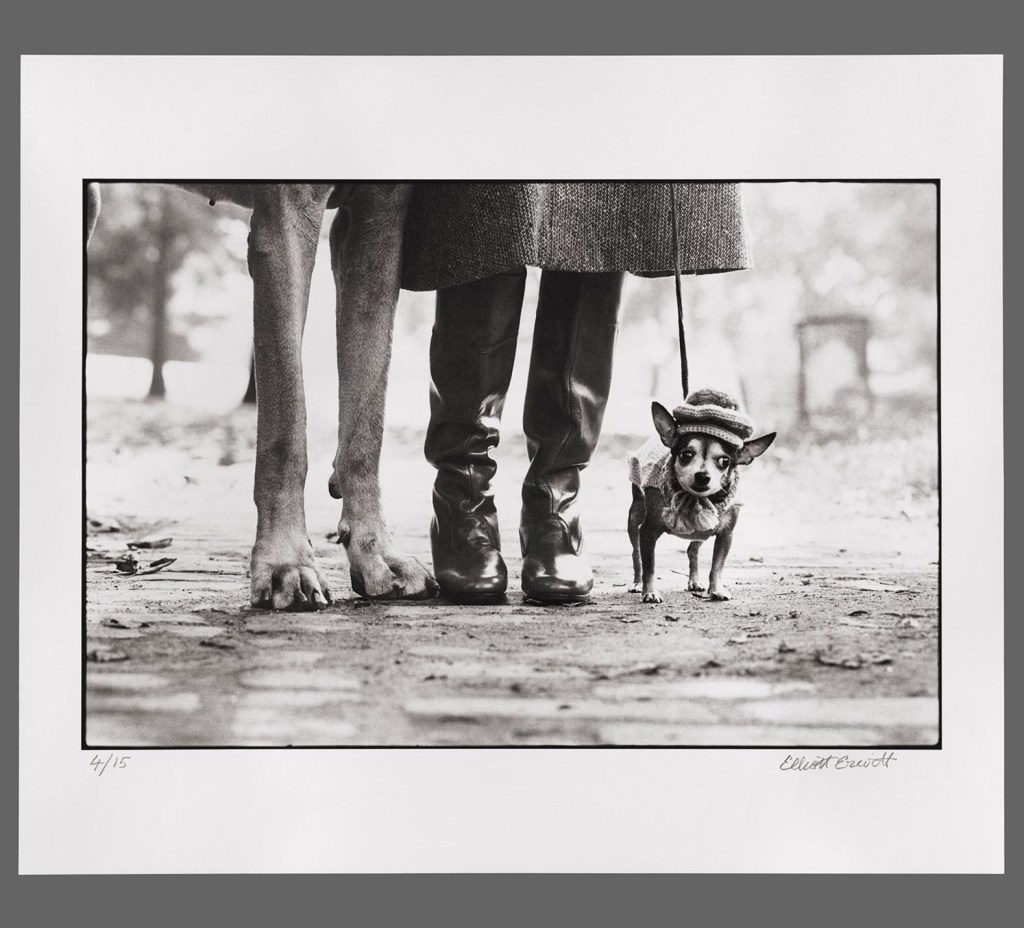
Look carefully at Erwitt’s image (below) and write some notes about how the subject matter is placed in the frame.
- How has Erwitt structured the image?
- What do you think the image is ‘saying’?
- How does the structure contribute to this meaning?
- Did you spot that the image is framed in stages of three?
- How has Erwitt structured the image?
When I first saw this shot, I immediately noticed the shallow depth of field that throws the background completely out of focus. Erwitt wants attention to be on the three subjects in the foreground of the image. The next structural element that I noticed was the placing of the subjects. The feet sit on the lower third line in the frame and if we were to draw a centre line through the subjects, they sit on the left vertical third, the centre and the right vertical third lines. The obvious difference in scale of the subjects is emphasised by the way the larger pairs of legs extend out of the top of the frame, leaving the small dog as the only ‘complete’ subject. The image looks as though it is severely cropped, which I’ve seen in other pictures of chihuahuas in Elliott’s series – I used them in my blog article about my selection and editing workflow in EYV[2]
2. What do you think the image is saying?
When I look at this image, I see a humorous take on the attitude of small dogs. The obvious scale is emphasised with the owner’s legs, but we we see the humour in the other pair of legs belonging to a huge dog, this initial reaction is questioned. As the notes suggest, this funny combination of subjects could prompt the viewer to move on from the shot. However, for me as a so called ‘dog person’, I want to continue to look at the chihuahua. The little dog has the natural stance for the breed, which has an almost confrontational feel to it, particularly compared to the big dog’s straight-legged gait. The addition of the hat makes the chihuahua almost anthropomorphised, saying ‘here is a small but mighty dog’ with a human-like personality. When I look around the frame I further get the sense that the small dog is being restrained by its owner through the use of a tight leash. The image now makes me think of a commentary about the little guy being held back by the bigger one.
3. How does the structure contribute to this meaning?
The image structure emphasises the small dog and its expression as the only whole subject in the frame. The difference in scale is emphasised by the way the large dog and the owner cannot be seen beyond just their legs. Using the top of the frame as a hard limit for the perspective forces the viewer to continue to look at the lower parts of the frame. Composition ‘rules’ tend to suggest that using the edge of the frame to cut off part of a subject can distract the viewer from the main subject. However, Erwitt uses it to create enough of an impression of what might be outside of the frame without reducing the impact of the main subject. Even the inclusion of a small part of the larger dog’s belly and back leg are not sufficiently distracting, instead making it clear who the second pair of legs belong to.
4. As I mentioned in 1, the composition in threes was one of the first things I noticed about the image. The use of threes (the thirds lines, the three subjects etc) gives the picture balance.
Further questions raised from the analysis of this image were:
- Does he like to help the underdog?
- Does he prefer dogs to humans?
- Is he making a statement about giving everyone a voice?
- Or is he just making a joke?
The notes state quite reasonably that we cannot answer the questions from one single image, particularly when it is part of a body of work about dogs. The point about the context of the image as part of the series is naturally what we have been studying throughout Context and Narrative, so it comes as no surprise. My conclusion about the image as described previously tends towards the support of the underdog and the equality of voice raised in the above questions. However, when I look at the other images in the series that conclusion is challenged. For example:

In this shot we see a poodle standing on its hind legs at what looks like a dog show. The pose of the dog and the way it looks at the same unseen subjects that the people around it are, again anthropomorphises the animal. In this image, I don’t create the same underdog narrative as in the previous shot; instead there is humour and beauty and a suggestion that our dogs take on our personalities. Along with every other shot in the series, Erwitt’s affection for dogs is very evident. Humour is a clear contextual element in the photographs, so our interpretations of the images have common themes. The differences come from our own experiences and interests. As the notes suggest, an alternative interpretation of the photograph could revolve around its location, perhaps of more interest to people of the UK than Erwitt’s native US with it having been shot in Birmingham.
Conclusion
This exercise has been interesting from the perspective of how we consume all of the parallel information in a photograph and draw our own interpretation based on our personal interests and experiences. There is a danger of overthinking the meaning behind each and the acceptance that where a viewer takes their narrative is beyond the control of the photographer are both important learning points. One can describe an image in such a factual way as to reveal the contextual elements included by the photographer, but when putting ourselves in the picture and interpreting meaning, the variances can be significant. What isn’t clear to me at this point is how a photograph can be a language for consistent communication. I guess that will become clear as Part 4 progresses.
References
[1] Image resource, Magnum Photos Fine Art Collection, https://www.magnumphotos.com/shop/collections/fine-prints/18-new-york-city-1974-dog-legs/
[2] Fletcher R, 2019, “The Process of Selection”, OCA Blog Post, https://richardfletcherphotography.photo.blog/2019/07/05/the-process-of-selection/
[3] Image Resource, “The Year of the Dog Dogs”, Magnum Photos, https://www.magnumphotos.com/arts-culture/art/elliott-erwitt-dog-dogs/
 Richard Fletcher OCA Photography Blog