Introduction
I’ve just received the feedback on my submission for Assignment 3 on Self Portraiture. As with all of these video sessions, I find the constructive criticism really helpful and it often points me in the direction of photographers that I might be interested in. They may be artists that work in a similar or contrasting way to what I was trying to achieve in the assignment and they might inspire me to improve the series before submission. Whatever the connection, I find that I am looking at artists that I would not necessarily found through my own research.
The feedback was very positive about the originality of my idea, technical execution and how the images connected back to my diary. There were some good recommendations, such as re-visiting the cropping to more emphasise my face and reduce the dominance of the background colour. When I looked at the example my tutor shared, I could see how it would improve the shots by making a portrait crop. Other ideas included experimenting with the background, not just in terms of colours but also whether the setting could add to the narrative. Key among the comments were the recommended artists to look at.
Zhang Huan (1965 -)
In his series Family Tree[1], Chinese artist Zhang Huan challenges the viewer by gradually covering his face in text until his skin is entirely obscured. He asked three calligraphers to write the text, which comprises Chinese folklore and commentaries on culture and the impact on family life, on his skin. The effect is a powerful one, with the ornate script that would be recognisable by someone who can read the language, slowly descending into a continuous covering. By the end of the series, the only features of Huan’s face that are recognisable are his eyes and lips. Like Morrissey’s work [2] that inspired my assignment, his expression is blank which becomes increasingly uncomfortable to look at as the series progresses. As suggested by my tutor in our feedback session, there is something disturbing about modification of the human face. The example of tattoos reinforces this sense. While they have become increasingly popular and widely accepted as body art during this century, there is still a stigma associated with them on the face. There a many stories of people struggling to get or hold onto a job because of tattoos on their faces as some people find it uncomfortable or somehow unacceptable to modify what is the main focus of communication between human beings. In his series, Huan was telling the story of culture and cultural change becoming so overwhelming that it almost smothers our sense of identity. His compositions suggest this overwhelming feeling but the ever present eyes and lips articulate his view that it can never take away our individuality that we have from birth. Huan’s series is very multi-layered when we look at how it came about. His fear of a serious health issue was the starting point for the series, which as a contextual element helps us understand Huan’s expression in the images – one of desperation or panic. The gradual build up of black ink on his face both gives us a sense of being smothered, but also shows us a gradual darkening of his normally pale skin. Huan himself indicates that this darkening is the passage of time from being born to old age or the way that a day turns into night. This is echoed in the way the background light gradually fades. The point made in my feedback about experimenting with backgrounds is made here. Huan uses a simple outdoor setting in natural light where the changes are noticeable as the series progresses. My series had consistent studio lighting that was effective but uniform from frame to frame. Perhaps I could have added the context of mood by including a more natural background with the colours represented in objects or textures that were more naturally occurring. The last of Huan’s frames is also slightly blurred, either by being deliberately out of focus or just as a result the dying light. Either way, the last frame suggests that Huan is still identifiable despite his environment. It reminded me of the Dylan Thomas poem that I used in an earlier exercise [3] – the idea of raging against the dying of the light.
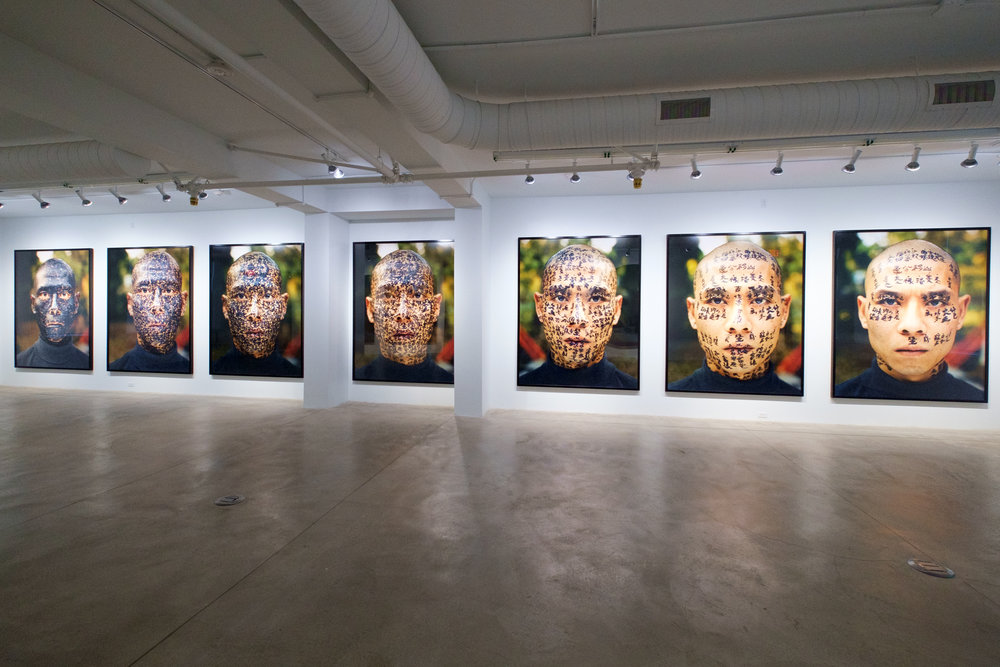
When I look at the images, I recognise the similarities to Morrissey with her face painting. The storytelling is superb and the layers really emphasise the artist’s discomfort with modern life and his sense of mortality. The multi-layered story, like Morrissey reveals small details the more we look at the photographs. During our call, I mentioned that my impression of Morrissey and her relationship with her daughter was at the centre of the series. However, while we agreed that the references to child development and expression were very clear, I said that my initial reaction was that this was a little girl with an extremely cool mum. Who wouldn’t want a parent that lets them paint their face while all the time calling it ‘work’? This was something we both found amusing.
The main differences between Huan, Morrissey and what I had done in Assignment 3 was that they had actually modified themselves whereas I had added something in the way my face was lit by using the projector. While there was nothing wrong with my approach (indeed it was felt to be an interesting take on the brief), it was clear to me that the impact of the physical modification was higher than mine.
Hew Locke (1959 -)
Another artist mentioned in the feedback was Hew Locke. Locke is known as a sculptor rather than a photographer. He used both media to create his series ‘How do you want me?’, which portrays the many aspects of his Guyanan culture layered with the impact of history. Locke plays the central character in each photograph, although his features are almost entirely obscured by the props and elements he uses. An example can be seen below:
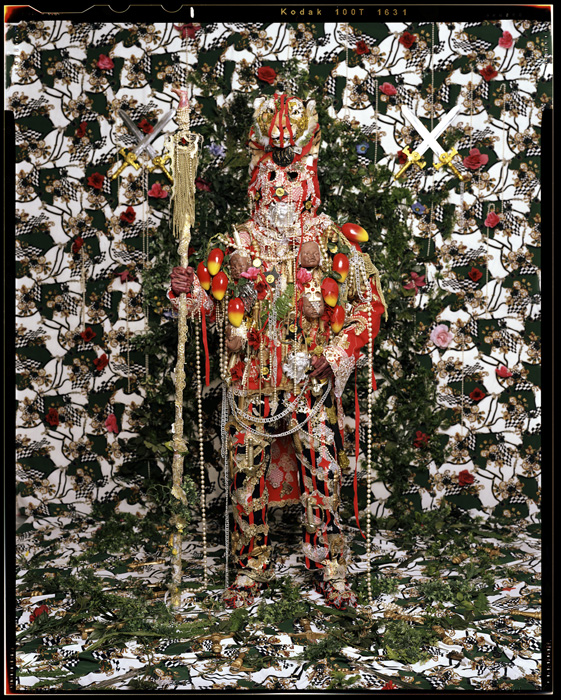
In ‘Tyger Tyger’, Locke presents himself in a solider stance, brandishing a decorative staff. His appearance is almost regal with what looks like a traditional head dress and lots of jewel-like decorations. The photograph is very busy with lots of props and potential contextual elements. When we look closer at the figure, it becomes clear that Locke is wearing a British Red Coat uniform that is synonymous with the colonial military that featured in many African conflicts in the 19th Century. The uniform is adorned with symbols of wealth such as pearls and ornate chains as well as contrasting symbols of African culture (exotic fruits and what looks like tribal heads). The whole scene is a mashup of cultures and eras that come together in what Locke calls “messed-up beauty”. When we first look at this image, it’s unclear as to whether this is a person or a statue. It’s only when we look more closely that the parts of Locke’s body that are not covered can be seen. Locke’s hands tie in with the rest of the composition through his skin colour, but the eyes are present but somehow missing. What we see is a pair of empty peep-holes that Locke is looking out through. It’s a very unsettling visual effect as we can relate to the weight of culture and cultural clashes in the piece, but we cannot see how Locke is reacting to it. Is he suffering under the physical and symbolic weight of the props and costume or is he revelling it it? What I see when I look at this image and others in the series is something closer to absentia than self portraiture. Locke uses himself as a canvass as I did, but his presence appears little more than a mannequin. With the similar discomfort, there is a great deal to look at with the series. Locke’s canvass works in a similar way to the others, but the sense of him is implied through his ancestry as opposed to the more obvious presence in the work of the other artists.
W M Hunt – The Unseen Eye
The final artist mentioned in the feedback discussion isn’t actually a photographer, but more a curator. W M Hunt has published a number of books of curated photographs on themes and the one that was raised was The Unseen Eye. This book is a large collection of photographs where the subjects either have their eyes obscured in some way or are deliberately not making eye contact with the viewer. The images are further examples of how unsettling it is when the face is modified in some way. The act of covering or averting the eyes makes us feel uncomfortable because it deprives us of our primary source of communication and our ability to read emotions. An example of one of the photographs from the book is seen below.
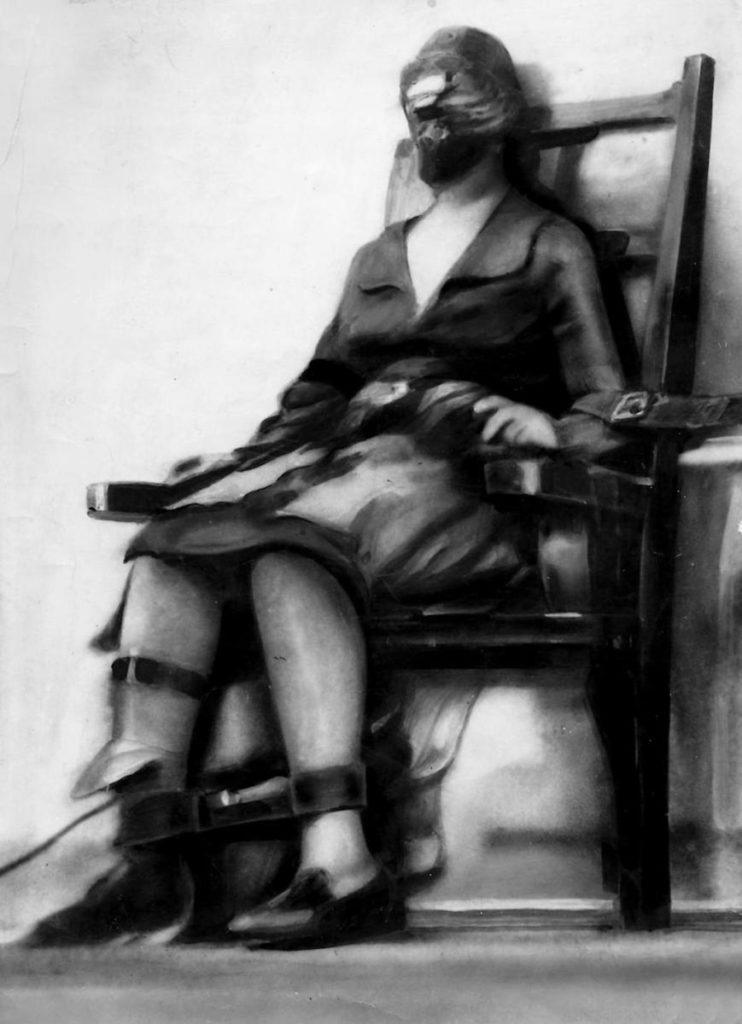
This image of murderer Ruth Snyder being executed in the electric chair is in itself disturbing. Howard smuggled a tiny plate camera into the prison strapped to his ankle. He shot this image at the point Snyder was electrocuted and the result courted controversy across America regarding the cruel and unusual nature of the electric chair. However, it is included in the collection by Hunt because of the disturbing way that Snyder’s face is covered by the mask. She has no facial identity in this photograph, just the effect of the electricity on her body being observed by a slow shuttered camera. I find the ghoulish nature of this image interesting as a piece of the history of capital punishment in the USA. However, I have to force myself to look at Snyder’s face area because of the way the mask dehumanises her. Deserved or not, Snyder is experiencing her final moments and is pretty much invisible during that time. Looking at the image for a period of time conjures sadness as well as disgust.
Conclusion
In conclusion, the approach that I took with the use of my face as a canvass for my words was a sound one. Projecting the words onto my bare skin and using colour to reflect and evoke mood was thought to be a strong narrative. However, in looking at these three artists I realise how my series could have been made even more impactful through making it more personal. What I mean by that is the actual contact with or act of modifying me. Huan used ink in a similar way to Morrissey, but told a story of the passage of time with the ink coverage increasing to the point where he was almost lost in the image. The work of Locke also used the canvass approach but to much greater effect, almost asking us to question whether the subject was a real person or just a representation of a culture with all of its riches and threats. In the collection by Hunt, the subjects are almost dehumanised by their lack of engagement with the viewer or obscuration of their faces. Dehumanising is almost the way that all three work, but at the same time they are putting themselves in the picture, which is of course the topic of Part 3 of Context and Narrative. I found this research and reflection to be enlightening. My tutor asked me if I would feature in my work in such a personal way in the future. Despite not being comfortable in front of the camera, I can see from these three artists, in addition to the others in Part 3, that there is much more scope for experimenting with self-portraiture to tell a story.
References
[1] Huan Z, 2000, ‘Zhang Huan’s Family Tree – Whole face painted black’, Public Delivery Website, https://publicdelivery.org/zhang-huan-family-tree/
[2] Morrissey T, 2011, “The Failed Realist”, Artist Website, http://www.trishmorrissey.com/works_pages/work-tfr/statement.html
[3] Fletcher R, 2020, ‘Exercise 3 – Poetry Interpretation’, Blog Post, https://richardfletcherphotography.photo.blog/2020/07/06/exercise-3-poetry-interpretation/
[4] Locke H, 2007, ‘How do you want me?’, Artist Website, http://www.hewlocke.net/hdywm.html
[5] Zelony-Mindell E, (unknown date), “Efrem Zelony-Mindell on W M Hunt”, Rocket Science Magazine, https://rocketsciencemagazine.com/contents/efrem-zelony-mindell-on-w-m-hunt/
 Richard Fletcher OCA Photography Blog
Pingback: Assignment 3: Self Portraiture | Richard Fletcher OCA Photography Blog