Introduction
I have just received the feedback on Assignment 2 in a video call with my tutor. That was the first assignment in Context and Narrative that would count towards assessment at the end of the unit. I was hoping that I had met the brief, and indeed that was part of the summary, however the feedback that struck a chord was that I had made things harder than they need be by not having a methodology in the way I had approached the shoot. What that meant was that I had connected the text to the pictures, but I hadn’t had a strong common anchor between the images that would make searching for subjects more consistent. This is not to be confused with the theory of anchor and relay that Barthes postulated, but literally something that connects the photographs in some way. When I reflect on the work, I had been very stressed throughout shooting the photographs. I had formed an idea that I wanted to explore, mapped out in my logical brain which elements would represent trauma in the frame and set about taking the pictures. That was when the assignment became difficult and as I gradually found it harder and harder to find inspiring subjects, the more I tried to force creativity to come. I hadn’t set out with a common approach to the subjects in mind and had I done so, the creative part would have been more free-flowing. An example of an strong anchoring element would be Fox’s series “My Mother’s Cupboards and my Father’s words” [1] In this case, all of the pictures are not just of the same kind of subject, they are all of a particular subject that the artist was both familiar with and had ready access to. Her mother’s cupboards and their inherent tidiness was the anchor, the narrative forming around the contrast of order and the brutality of the words from her father. During the feedback call, my tutor suggested that if I’d travelled to the place where the traumas had taken place, that would have tied the images together more strongly. I had to agree with that sentiment.
Assignment 3
Usually I would not be thinking too much about the next assignment when working through the research and coursework that leads to it. However, the course notes steer us towards Assignment 3 with the writing of a daily diary [2]. I’ve been writing mine for about a week a the time of this post and it’s already been an interesting experience in terms of what happens to me during the course of a working day and the thoughts and feelings that are invoked. What we need to do for Assignment 3 is to include ourselves in the narrative in some way. The diary is supposed to stimulate ideas or be a part of the series in some way which builds on the storytelling we’ve been doing thus far.
I was reflecting on the feedback and discussing with my wife on our daily walk this afternoon. She could understand the points about anchoring the images together by having a structured approach to the shoot and we started talking about ideas for how to include me in the narrative without it being too prescriptive. This is still always a concern for me, which I believe stops me from completely letting go of my imagination. What my tutor meant by structure was more about having something that made the creation of the work consistent. She highlighted the series Geolocations by Nate Larson and Marni Shindelman, which I refer to in my assignment diary [3]. This was a series that took tweets from Twitter and used the publicly available geolocation data to find where precise location they were posted from. The photographers then visited the locations with a large format film camera and shot a photograph that was then paired with the words from the tweets. The creativity of the idea of shooting something that tells as story of the words and what may have been happening for the author, by using a visual from where it was written is obviously very powerful. Modern technology has allowed our precise position on Earth to be mapped to within a few metres and the idea of the trace of a story from the space we once occupied is fascinating. An example of the work can be seen below:

Here we have a beautifully composed and lit photograph from the location where the emotional tweet was written. The tweeter is asking if they have made the right decision, which could mean anything but suggests a major decision made with relation to another person. Could it be that the tweeter has left a partner to be with the undisclosed person? Could it be an innocuous as someone making a purchase from that person? The accompanying image shows a lone car parked outside a motel, which could almost be from a David Lynch film. This visual tends to support the life-changing decision narrative and when coupled with the words, has great impact. When considering the concept of the series, I naturally identified with how clever it is to use the modern technology in conjunction with the uniquely personal written word. It’s also a strong narrative that tells both the story of the unfortunate tweets as well as revealing just how private our lives really are. The debate about sharing our innermost feelings on social media is one that has been raging since its inception, but here we have an almost voyeuristic element where anyone can find where we have been and place themselves in what they believe to be our story. What interested me was the structure or plan that was being followed. The photographers clearly selected the tweets that had the biggest impact on them and then methodically visited the scene. What they shot was going to be the creative element, but the ‘mechanical’ act of visiting the scenes removed the ambiguity of “How am I going to represent the words?” This was something I really struggled with in Assignment 2. I had the random thoughts as spoken by friends and the idea of representing the traumas through industrial and empty spaces, but spent a huge amount of time trying to find compositions that fit. This forced location-hunting and subsequent ‘creativity’ was exhausting. What I needed to do in Assignment 3 was to have a plan – form an idea and then focus on a workflow for the shoot. This would leave me with more capacity for creating the imagery that supported my idea.
The Diary
The idea of keeping the diary [2] was something that appealed to me from the start of Part 3. A simple document of my working days and free time was unlikely as most of the things that happen to me in my life prompt memories and reflections on things that have happened. I would describe myself as a reflective person in general and while I don’t live in the past, I am hugely appreciative of the things I have learned from my experiences. My plan was just to write what came to me that day and with this in mind, achieving the large number of pages set out in the course notes was never a concern. My plan from the start was to share the diary with my wife as she has known me better than almost anyone in my life so far. I would ask her to read the diary and just take on board her reaction to it. My thoughts were around a series that would describe how I felt during the two weeks rather than reporting what I had for breakfast.
Initial Idea
My first thought was around something similar to what Larson and Hindelman, using location technology to link to themes in my diary. I considered the fairly new application called What Three Words, which uses seemingly random words as a simple map reference for any 3x3m space in the world. A map from this software can be seen below:
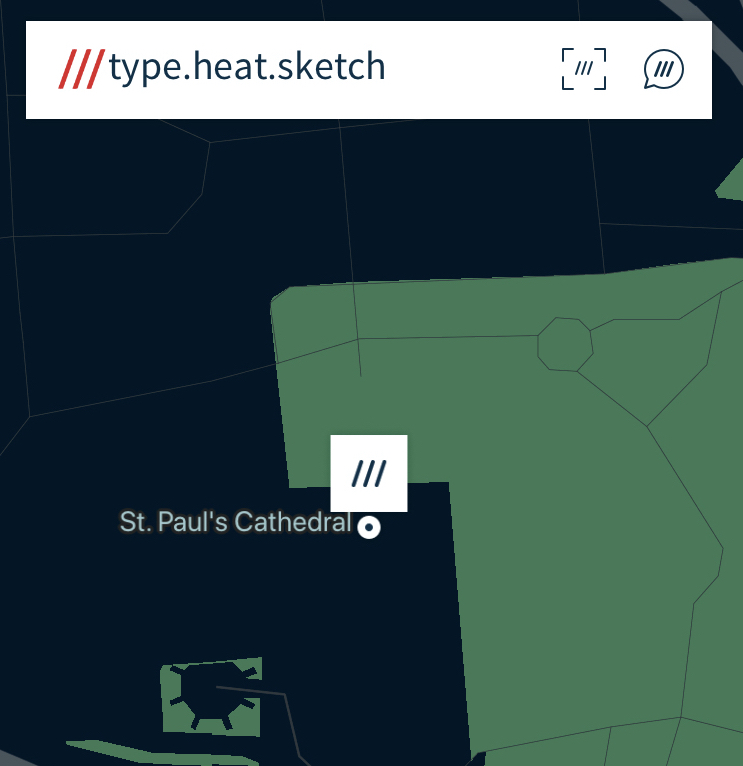
By choosing and searching on key words that support the themes of my diary entries, I planned to search locations and visit them. The photographs would be portraits of me standing in the precise location of my words, almost as a waypoint or position marker. I was interested in what I could create with the compositions and how they might link with my thoughts and feelings in the diary. My presence would be a reflection on my place in the world and that place would be something I had expressed with my writings. The idea was a good start, but I quickly ran into difficulties with the technology. What Three Words is a global system, so the grid of spaces it describes spans the whole globe in by using geolocation in the same way as twitter. I knew early on that if I chose the wrong words, I could be looking at a location on the other side of the world, which would be an obvious problem. My preparation for that would be using a thesaurus to come up with many different connotations that may yield more local targets. The main issue though, was the application doesn’t allow searching for locations through the individual words themselves. Currently, the only way it can be used is either by knowing the whole string of words, so Type.Heat.Sketch as in the above example or the landmark (St Paul’s) or the postal address. This was essentially a hurdle I could not overcome. However, it led to me thinking about what I wanted this assignment to say.
Back to the Drawing Board
Disappointing as the first idea was, I started to think about what I wanted my assignment to say. The subject was Self-Portraiture, so it needed to have a central theme about me, my perspective or my life experiences. I was still thinking about using location in some way but accepted that it my not fit my interpretation of the brief. I used a mind map to try to articulate my thoughts on the brief at this point.
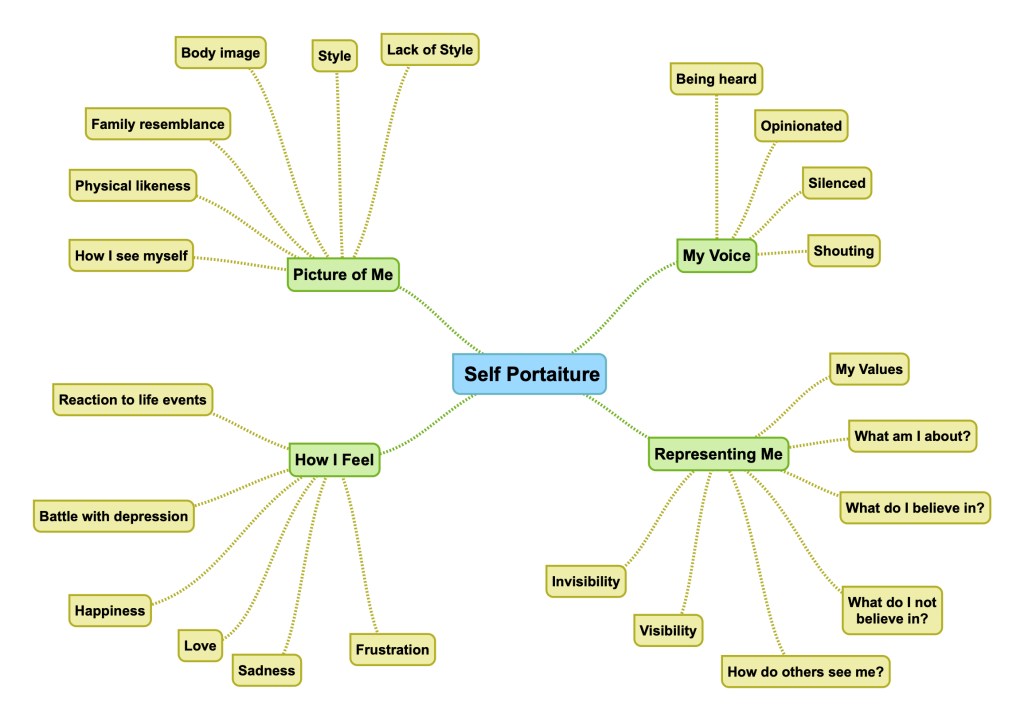
At this point, I was still thinking of self portraiture in the traditional sense. A picture of me in some contextual setting with some narrative that could be drawn from it. The subsequent work in Part 3 introduced me to the works of Morrissey who placed herself in the lives of others[4] or used herself as a simple blank canvass [5] in a way that is clearly self portraiture. Then, with the addition of Calle, Kapajeva and Shafran, the concept of self portraiture as something that the artist has to be physically present in was challenged. With Moffat, the artist became an actor in the work with the connections between her sense of self and her subjects being imitation [6]. When I revisited the mind map, I could add ‘absentia’ and ‘mirror’ to the ideas of portraiture of myself. The work that really inspired me from those artists was that of Calle and Morrissey. Calle’s act of getting a group of people to articulate how she might be feeling about being dumped was almost creating the art automatically. The 107 women told Calle’s story from their own perspectives but in a way that anyone could relate to. She introduced humour in the destruction of the words which creates the narrative of taking away her ex partner’s power. Morrissey worked with her young daughter to produce a series about the way that children express themselves as they develop. Her role in the series was as a blank canvas for her daughter to paint on which also created a narrative about parents and children and their natural bond. The other artist that had inspired me from the start of this course was Anna Fox. In her work Cockroach Diary [7], Fox tells the story of her battle with her landlord over an infestation of cockroaches. She blends images of her handwritten diary that details her encounters with factual images of the insects either crawling around her flat or recently killed by the artist. What is a documentary struggle to persuade her landlord that there really is a problem they should be looking at, is also a commentary of life is like when you don’t have a comfortable home environment. Fox was a struggling artist and mother when this series was created and it really made me feel like a lucky man.
Another idea
My second idea for the assignment took cues from Calle, Morrissey and Moffat. I’ve always been told that I write well, which is partly down to the many reports and documents I’ve had to prepare in my career but also because of my passion for communicating with people. The written word is not necessarily the easiest medium for this as it is open to interpretation. Care needs to be taken to get the message across while accounting for how the audience may react which is a challenge that I always relish when I’m writing. During the writing of the diary, I enjoyed setting the scene for what I was trying to say and found myself drifting into my memories with ease. This is something I wanted to get across in the assignment in order to represent my personality. Like Calle, I wanted an alternative view of the text but instead of using other people I opted for technology to do the legwork for me.
In my line of work, there are always ways of collating messages from multiple sources e.g a survey or poll so that people can easily grasp the consensus. One of the techniques that emerged a number of years ago was the creation of a word map or cloud. They would be a collation of the most used words in a body of text or description or even a narrative that are represented visually. The most used words would be the largest font size, while the less frequent ones relegated to a smaller, less distracting size. The theory with this technique was that the importance was related to the number of times the word occurred. In the case of a survey, this is true as it’s usually a collection of many views – the more it occurs, the greater the consensus. An example of this can be seen below:

What is interesting about these maps is that they are specifically designed to draw our attention to a few key messages. I started thinking about how I write and the connections I make between subjects. This crude algorithmic representation could be used to represent my thoughts without actually forming sentences in the traditional structure. More importantly, running the diary entries through a word map generator would provide the structure that I was missing in my previous assignment. I did a quick search online for software that would create a word map from my diary and found one that would work well for this idea.
In terms of photographing to support the words, I was immediately drawn to Trish Morrissey’s work The Failed Realist [5] where she used her face as a blank canvass for her daughter to paint on. The consistent theme was her blank expression on the artist’s face and each composition being the same. The distinguishing features were the painting with their childlike interpretation and the image titles that tell us what each is supposed to be. I was really inspired by the self-portraiture being a canvass serving no other obvious purpose than to showcase something else. In reality, Morrissey’s part in the series is another layer of context pointing to her relationship with the other artist and, perhaps the visualisation of the child’s creativity through adult eyes. For my assignment I would use my physical self as a canvass for my diary by projecting the word maps onto my skin. I could create the context by choosing which part of my body to project on, depending on the words in the map. I was also inspired by Moffat’s use of photoshop to create an almost unreal visualisation of her as her subjects and decided to light the background in a way to both make as statement of my mood and make each image stand out on its own.
Initial Conclusions
At this point, I felt that I had achieved a number of milestones with this idea for the assignment. I had taken on board the feedback about having a structure to the approach in my work. I had taken inspiration from a variety of photographers studied in this section of the course and combined elements in my idea. I would be experimenting with the compositions so that they enhance the words.
Technical Approach
I started by finding a Word Map generator program that could analyse my diary. I chose an online tool called wordclouds.com which allows the user to upload large bodies of text, change the shape of the resulting map as well as colours and fonts. The most important feature was the ability to remove words from the map using the word count list. I decided that I wanted the most-used words to stand out in the word map, so I chose to delete all of those that appeared only once in the text.
The first step was to upload the text for each day of the diary and save local copies of the word maps for processing. I then removed the single-event words and experimented with the shape of the map. Different shapes meant that the words would be arranged differently when projected. I didn’t want the maps to be too contrived, so largely stuck to simple square and diamond patterns which resulted in aesthetically pleasing maps. Each processed map was saved as an image file.
The projector that I was using was connected to my computer and some tests were carried out on my skin. The first thing I noticed was that there was enough contrast to make the words stand out. The projection bent around the contours of my face and body, which was the effect I was after. However, I realised early on that the colours of the words were too much of a distraction and were actually only related to the word count. Since the size of the text was also related to word count I decided that I could remove the colour and still keep the look I was after. To achieve the final look, I converted the maps to black and white. An example of the word maps can be seen below:
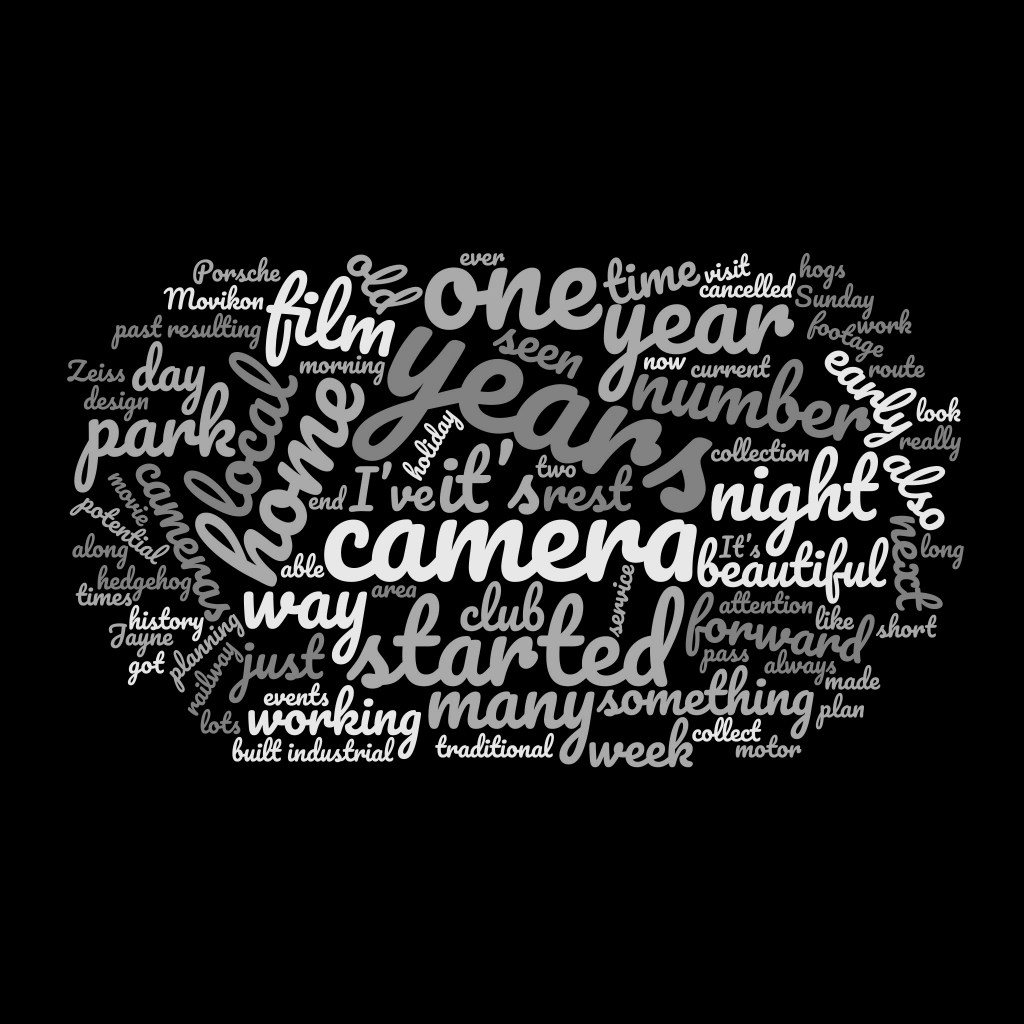
At this point, I started thinking again of what I wanted to say with this series. I wanted to highlight the differences between the emotions and memories that I’d expressed in the diary and the impassive interpretation of a computer algorithm. The words created in the maps were the ones most commonly used in my writing, but their meaning collectively differed from the original text to such an extent that multiple narratives were possible when viewing them. I needed a way to bring that into the photographs, so I asked my wife to work through the diary again paying attention to the sense of emotion in each entry.
The conclusion from reviewing the diary entries was that the core themes in the two weeks of the diary could be grouped into emotional themes. Rather than a simplistic model of happy, sad, angry etc., the themes that Jayne recognised in the text were more about sensation or perception relating to the events being described. In this case, boredom and excitement were just as tangible as the traditional category of mood. These themes could be grouped across the 14 days of the diary into 7 clear ’emotions’ There is significant research into how emotions are both represented and invoked by our perception of colour. As our primary sense, the sight of colour can induce a mood that we subsequently associate with that colour subconsiously. For this series, I wanted to both represent my emotional responses by using colour but also to suggest to the viewer how they might feel about the image through its use.
Researching colours and emotions revealed both theory and empirical data that was promising for my group of emotional responses. I first looked at how colour is used in advertising to make the target audience feel a certain way. In an interesting article on the psychology of colour [8], the author suggests that our associations with colour can cover a variety of emotional reactions the follow a common relatable theme and that the reactions depend on the other contextual aspects of a situation or subject. For example, red is associated with anything that invokes passion but an image of glossy red lipstick invokes erotic or romantic feelings where a fire engine creates a sense of danger or hazard. The response to get the pulse racing is the same, but the stimulus is different depending on the situation. When used in a photograph, how the viewer responds will be dependent on what else is going on in the frame. The second research source was a survey of how men and women of different cultures react to colours when they see them [9]. The survey asked people to choose the emotion that best matched their reaction to a colour from a multiple choice list. The data was then collated to show the emotions that best correlate with colour. From the two papers, the following list of colours and emotions was created.
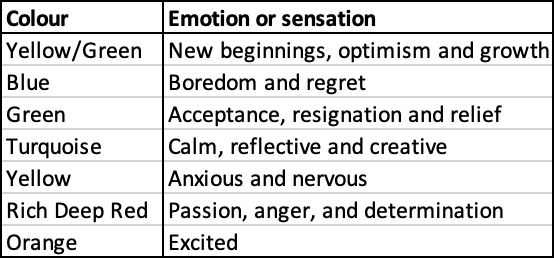
At this point, I shot another test, this time with a colour in the background created by a strobe and red gel.
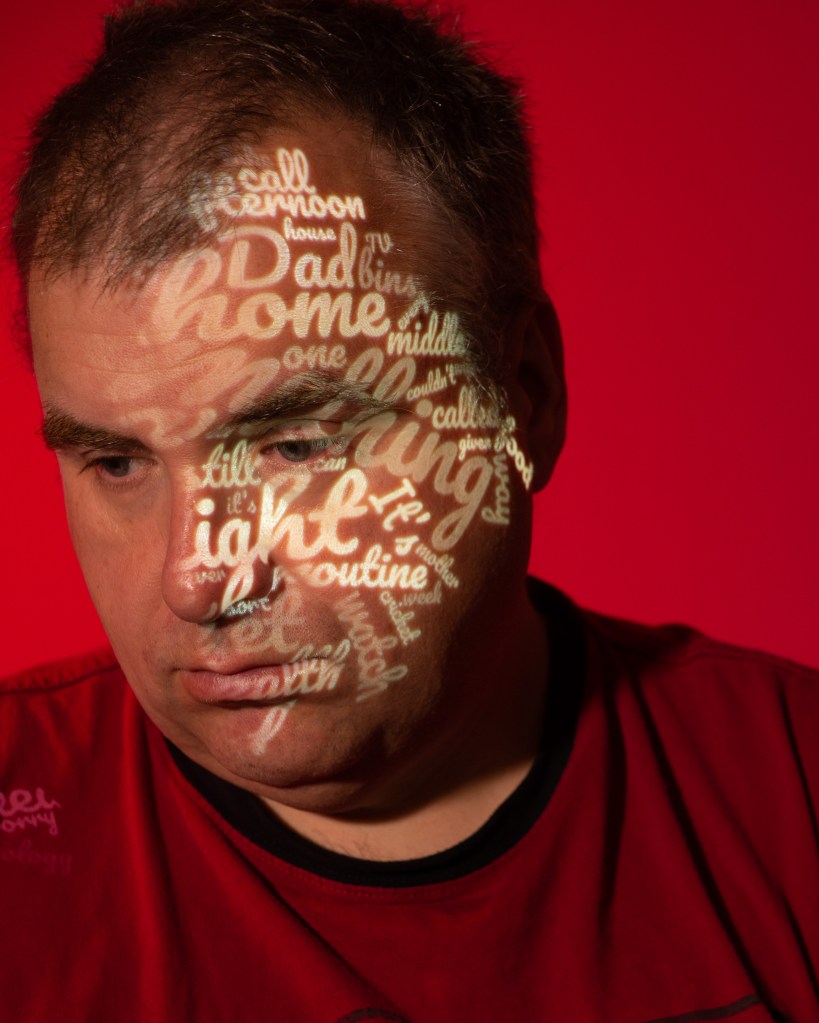
The final stage was to experiment with composition. I was originally inspired in this idea by Trish Morrissey’s The Failed Realist, which revolved around just one composition where the artist looks straight into the camera. The frames were cropped to her head and shoulders and her expression is completely blank. There are no props, backgrounds or attention to her form such as hair and makeup – she literally uses her face as a blank canvass for her daughter. I wanted to something similar in order to focus the viewer on the words with only the background knowledge that they were mine. What makes each photograph interesting in that series is the different paintings and their titles. I needed to ensure that my images had that same variety to hold interest. As the diary was a linear progression of two weeks of my life and the colours mapped the emotions of each day, I decided that this was sufficient context to keep the series from looking like 7 versions of the same picture.
Conclusion
During this preparation phase, the idea had developed through my having a structured approach that would provide the baseline for creating the work – this was one key takeaway from the feedback after Assignment 2. I took inspiration from the photographers studied in Part 3 and my plan for this series should lead to a piece of work that highlights the contrast between expression seen through human eyes and those of a computer; the emotions being both a representation and invitation to the viewer to feel a certain way about the words. In conclusion, I feel that the series potentially has the multiple layers of context we’ve been working with throughout this unit as well as being uniquely personal to me in terms of creativity.
References
[1] Fox A, 1999, “My Mother’s Cupboards and My Father’s Words”, Artist Website, https://annafox.co.uk/photography/my-mothers-cupboards-and-my-fathers-words/
[2] Fletcher R, 2020, “Assignment 3 Diary”, OCA blog post, <insert link>
[3] Feinstein J, 2016, “Geolocations: Two Photographers Heatbreaking Visualizations of Tweets”, Humble Arts Foundations Blog Post, http://hafny.org/blog/2016/geolocation-two-photographers-heartbreaking-visualization-of-tweets
[4] Morrissey T, 2007, “Front”, Artist Website, https://www.trishmorrissey.com/works_pages/work-front/workpg-01.html
[5] Morrissey T, 2011, “The Failed Realist”, Artist Website, http://www.trishmorrissey.com/works_pages/work-tfr/statement.html
[6] Rosenberg K, 2007, “Show and Tell, Tracey Moffatt at Stux Gallery”, New York Magazine, https://nymag.com/arts/art/showandtell/26538/
[7] Fox A, 1999, “Cockroach Diary”, Artist Website, https://annafox.co.uk/photography/cockroach-diary/
[8] Rickard, 2015, “The Psychology of Color: A Designer’s Guide to Color Association & Meaning”, ZevenDesign, https://zevendesign.com/color-association/#green
[9] Centeno A, “Colour and Emotion Across Culture – Emotional Responses of People to Various Colours”, Real Men Real Style Magazine Post, https://www.realmenrealstyle.com/color-emotion-cultures/
 Richard Fletcher OCA Photography Blog
Pingback: Assignment 3: Self Portraiture | Richard Fletcher OCA Photography Blog