Introduction
The concepts studied in Part 3 thus far have largely been what I’ve come to expect in the genre of portraiture. I could relate to the metaphorical story telling of Brotherus and the substitution work of Morrissey as their life and personality exist within the work either in their entirety or partially. However, this project introduces us to what at first glance appears to be a more tenuous form of portraiture, that of not being part of the image at all. Instead, the artist is represented by the inclusion of other people or in some cases, nobody at all. When considering this idea of self-absented portraiture, the immediate thought that it cannot be consider so if the artist is not in the picture, can be quickly dismissed when considering human imagination, interpretation and the creativity that it involves. People see things that remind them of life experiences, so it’s not difficult to connect other people that seem familiar to the artist or even simple environmental elements with a ‘sense of self’. In this project, we are introduced to two new artists and one that we looked at previously, all of whom have told their story or a expressed their life experiences through absented portraits.
Maria Kapejeva
Kapejeva’s Portrait of the Artist as a Young Woman takes it’s cues and inspiration from James Joyce’s similarly titled book Portrait of the Artist as a Young Man, which tells the story of the intellectual and religious awakening of a young man growing up in the Catholic faith in Ireland. Kapejeva grew up in Estonia in the 1970s and 80s where the culture dogmatically ordained that men and women would be considered equal in the workplace, but that women would be entirely responsible for domestic homemaking and raising the family. This latter imbalance meant that women could, but rarely did achieve successful careers, instead waiting around for a man to keep them well enough for focus on their domestic duties. Like Joyce’s lead character, Kapejava rebelled against the idea of her upbringing by using her photography to explore the alternatives to life as prescribed by her culture. These portraits are of women who Kapejeva relates to in her quest to break the stereotypes of women as she saw them. In each subject, she seeks to capture the strength of their intellects as well as their determination to flourish in their environment without conforming to expectation.
My two favourite images from the series are shown below.
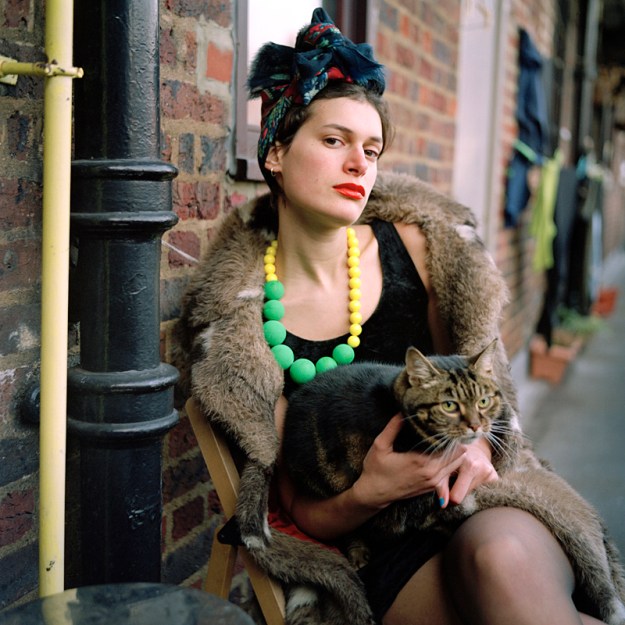
Untitled, from the series ‘Portrait of the Artist as a Young Woman, by Maria Kapejeva 2012- [1]
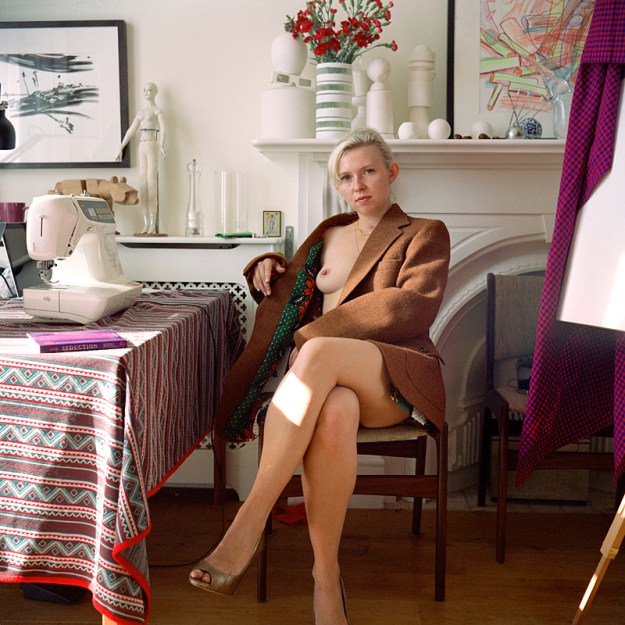
Untitled, from the series ‘Portrait of the Artist as a Young Woman, by Maria Kapejeva 2012- [1]
Sophie Calle
We were introduced to Sophie Calle in Project 2 of this course. Her famous work Take Care of Yourself tells the story of her being dumped by her lover via email. Her reaction to this remote, detached separation was to share the email with a group of women (107 of them). Calle asked the women to react or respond in their own way, resulting in a piece of work that was mixed media. In some cases, the women responded by critiquing or editing the text, while others physically destroyed a printed copy of it. One of the women was a biathlete who shot a copy of the email with her biathlon rifle. Rather than simply being a photographic project, Calle achieved a belittling and public shaming of her former lover without ever mentioning his name. She did, as the course notes describe, demean the power of the email and turned it into a joke for everyone to see. What interested me in re-visiting the work was that the common thread through the pieces within it was of course the email and that was something that was happening directly to Calle. She was the one receiving it and having to deal with the subsequent heartache. However, the women she sent the message to responded as if they were Calle. The concept of ‘Hell having no fury like a woman scorned” is real here as each woman reacts in a visceral way that their ‘sister’ might have. There is no indication that Calle was close to all who took part in the project, so the resulting message leaves us with an insight, but also mystery around Calle’s actual reaction. Perhaps the women were being extreme in their treatment of it, or perhaps they were merely an outlet for the extreme hurt and anger that the artist was suffering. Either way, the work is definitely a self-portrait of Calle’s emotion and personality in its curation and also of her gender and the solidarity of women wanting to be respected even when a relationship is coming to an end.
Nigel Shafran
In his work Washing Up, Shafran presents us with a series of images shot from similar perspectives of a kitchen sink space. Each composition contains common elements such as the sink, the worktops and the kitchen utensils hanging on the wall. However, each one is composed with some activity occurring or having just occurred within the space. Shafran describes with this images the way that our lives pass from the viewpoint of the seemingly banal. His kitchen sink has the remnants of a recent meal or a reference to the comings and goings of him and his partner, Ruth. Subtle changes in the lighting from natural to artificial and the inclusion of contextual reference such as tinsel lend suggest the passage of time. Consider the two pictures below:
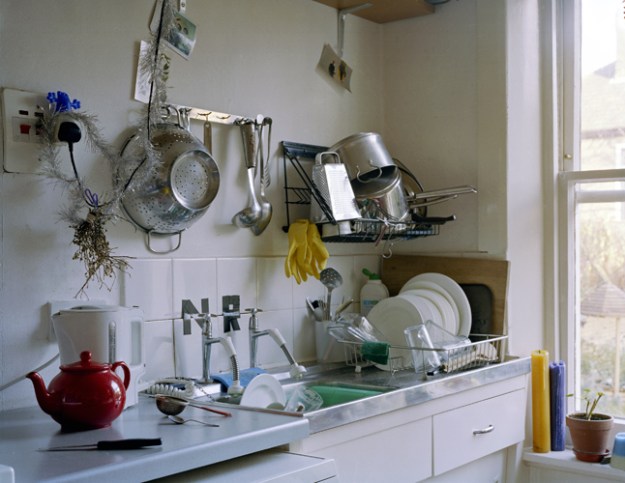
From the series ‘Washing Up’, by Nigel Shafran (2000) [2]
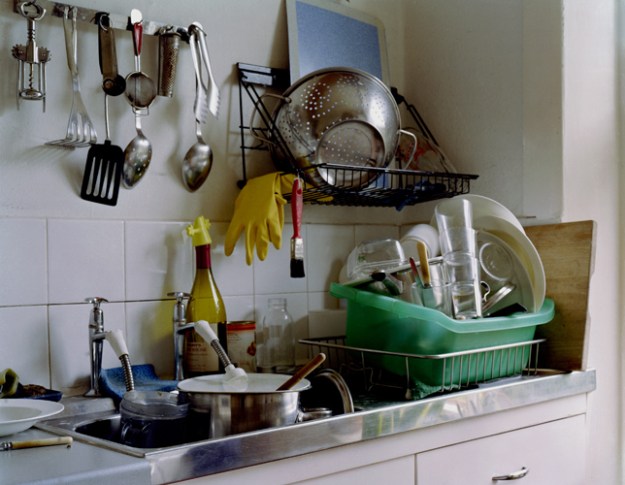
From the series ‘Washing Up’, by Nigel Shafran (2000) [2]
When we look at the second image, which is the third one in the series, we see the same scene but with something different going on. Firstly, the lettering has gone, which further points to some temporary event or issue. We now have part of a bottle of wine and clear evidence of some kind of party. When we look closer still, there are a number of paint brushes drying on the counter and hanging from the rack. Perhaps there has been some decorating being celebrated or perhaps some other form of art is being created. The space in which to create the narrative is equally broad but in each case a different story is being told about Nigel’s life.
The interesting thing about this series is that as indicated in the notes, the photographer is not part of the composition. Unlike the direct connections that we have with Kapajeva and Calle, the only thing we know for sure is that this is Nigel’s home environment. His life is playing out in this ordinary scene and while elements are most likely constructed for the photographs, the sense of natural order and passage of time are strong in this work. Without knowing anything about the photographer, we are almost improvising a story around him through the simple elements or ‘stuff’ that he includes here.
Conclusion
In each example, the point that self-portraiture needs to have the artist present is reinforced. If narrative can be created by contextual elements that the artist includes, it makes sense that if those elements are part of their life then the work is a self-portrait. My conclusion from this research is that our traditional impression of what makes a self-portrait stems from the literal representation of the artist from early painting. Painters were hugely successful people, but because of the absence of print and photographic media, the only way people got to see them was through their self-portraits. Even then, the pictures were controlled by the artist, revealing just what he or she wanted representing. I’m reminded of the so-called likenesses that Holbein painted during the Tudor period. People saw beauty or ugliness, humour or meanness in his subjects which were controlled to the artist’s extent that the famous story of Anne of Cleves being nothing like her portrait [3] demonstrated the power of the painter. The same can be said for their self-portraits, which could mislead the viewer both in terms of their appearance and their personality.
If we move away from the traditional to the absent self-portrait, we have to derive meaning from very subtle contextual and cultural elements. We ask questions about Kapajeva’s actual experiences and Shafran’s actual life but that doesn’t stop us from having an impression of the artist, more that there are many different versions we can see and many different conclusions we can draw.
References
[1] Kapajeva M, 2012, Portrait of the artist as a young woman’, Artist Website, http://www.mariakapajeva.com/a-portrait-of-the-artist-as-a-young-woman/
[2]Shafran N, 2000, “Washing Up”, Artist’s Website, http://nigelshafran.com/category/washing-up-2000-2000/page/4/
[3]Unknown, “Anne of Cleves”, The National Portrait Gallery, https://www.npg.org.uk/collections/search/person/mp11081/anne-of-cleves
 Richard Fletcher OCA Photography Blog
Pingback: Exercise 2: Your Personality | Richard Fletcher OCA Photography Blog