The Brief
- Is there any sense in which Lee’s work could be considered voyeuristic or even exploitative? Is she commenting on her own identity, the group identity of the people or both?
- Would you agree to Morrissey’s request if you were enjoying a day on the beach with your family? If not, why not?
- Morrissey uses self-portraiture in more of her work, namely Seven and The Failed Realist. Look at these projects online and make some notes in your learning log.
Question 1
Is Lee’s work exploitative? I would have to say that my initial reaction to the Projects series was that of her trying to understand a cultural reference that she could not naturally be a part of. My thoughts were that she was looking at the culture from within it, like a spectator would walk around a gallery of sculpture. Her series The Lesbian Project has her both exploring her own sexuality and that of the lesbian community. It goes beyond the simple acts of women attracted to each other and explores the whole gay social scene. The only one of the projects that I consider exploitative is The Seniors. For me, this series is different from the others in that Lee seeks to deceive the viewer and her subjects. Many of the elderly people that she photographed didn’t believe that she was a young person, but instead one of them[1]. For me this moves away from a narrative of the outsider observing from within to mimicry and almost ridicule. Lee doesn’t photograph the struggle of the elderly, merely puts herself among them. Where the other projects could place Lee in the culture that she is trying to explore, I felt that The Seniors was less about exploration and more about exploitation. With regard to voyeurism, each series is a peek at another way of life, whether culturally or sexually so but can be argued to be voyeuristic. For me, the impact of Lee being part of the image is both commenting on what is she is trying to blend in with and at the same time highlighting how different her own life is as a Korean woman. To that extent, I don’t feel that the voyeuristic angle is harmful in any way. However, what Lee couldn’t have known when she shot these series is how the world’s perception of culture, race and sexuality would change in the intervening years. For example, the way that we view gay rights from the perspective of hounding out prejudice could make her Lesbian Project more uncomfortable now than before with a heightened sense of not belonging. Also, the increasing focus on the lives and rights of Black Asian and Minority Ethnicity (BAME) makes looking at the Hip Hop Project more uncomfortable, despite Lee being part of that ‘classification’. The sense of irony and of the outsider is even stronger now with her Ohio Project, where Lee dressed and posed as part of the mid-west white American culture. Whatever her reasons for shooting the series’ (there are few interviews with Lee herself on the subject), they do provoke thought and curiosity which is magnified by whatever cultural lens we view them through.
Question 2
I thought I had an answer to this question until discussing Morrissey’s work with my wife on one of our walks. When describing the Front series to her, she exclaimed “you would never agree to that!”. I was surprised, until I thought about the context of such a request. Morrissey was approaching complete strangers to ask if she could substitute herself into their family gathering and then be photographed. My immediate reaction would have been to say “No” as photographing people is something I myself have little confidence in doing unless I know them well. However, I had an experience recently when shooting Assignment 2 that took me out of my comfort zone and which yielded the cooperation I wanted. One of the images in the series is of a 1950s television set in a ruined barn, which was discovered by a friend of mine out walking with his family. When I said that I was interested in using the scene as one of my assignment images, he sent me the location details and my wife and I drove out to it. Having parked nearby, we planned to walk down the same footpath to where my friend said he had seen the barn. At this moment we were approached by a lady who asked if we were lost or needed help. I explained what we were there to do and she revealed that the building was hers. Instead of leaving it there, I explained the context of what I was trying to achieve and she, being interested, immediately agreed to my photographing it. Although the scene was on a public footpath, it still meant pointing the camera at her house so this permission was very welcome. We ended up discussing the idea for quite a while before I went to take the photographs. A couple of weeks later, I returned to the spot with my 4×5 film camera in order to take a more classical landscape shot. Again I ran into the lady who owned it and we talked at length about photography, my interesting camera etc and again she was more than happy with me being there.
In answering the question, I believe I would be happy to cooperate if Morrissey took the same approach as me. The more the lady understood, the more comfortable and actually supportive she was. I think that without that engagement, it would definitely not be something I would take part in because I am inherently a very private man. Being disturbed with my family by a stranger with such a strange request would not sit well with me unless there was a conversation around the purpose. From the interview with The Guardian [2], we can interpret the level of trust engendered by Morrissey in her subjects with the swapping of clothing and jewellery and getting the ‘replaced’ to press the shutter. What we can’t be sure of is how many families refused to be in the photographs. I know that with the right amount of conversation and understanding of what the goal is, I would actually be happy to be part of such a project.
Question 3
Seven
Here we have a series of family photographs that look like any that people of my generation have as prints. They are to all extents snapshots, taken when a family is able to be posed for longer than a few moments; of ordinary situations, celebrations and holidays. Like many of my own photographs of this nature, there are quality issues; thumbs over the lens, badly posed, badly lit and with eyes closed or less than appealing facial expressions. At first glance, these look like a collection, as described by the artist [3] as “Pictures that would have normally ended up down the back of the sofa, or burned so that they would never see the light of day.” On closer examination of course, they are modern reimaginings of family photographs with careful attention to the period details and deliberate quality issues. Morrissey includes herself in the images, but they don’t appear to be about her. She refers to distorting of tropes and genres to create new meanings to her work[3], which is something that immediately becomes apparent with the blurring of gender and age. Morrissey and her sister play the parts of other family members, mixing these elements to create a sense of real but unreal in each shot. An example of Morrissey’s playfulness can be seen below:

September 4th 1972 (2004) by Trish Morrissey[3]
The Failed Realist
This series of self portraits features the same pose and facial expression in every photograph, Morrissey shown from the shoulders up with an impassive stare and neutral mouth. The series is centred around a theory about the way a child’s creative desire is not yet matched by their ability to express themselves. The stage, referred to as Failed Realist, produces the childlike drawings and paintings that many people have pinned to the wall or attached to the fridge door; the child knows what they are trying to say, but can’t quite communicate it physically. In this series, Morrissey worked with her young daughter to produce pictures of this stage. She got her daughter to paint something that she had seen in media, read or experienced onto her face, using it as a blank canvass. The accompanying textual description links to our own ability as adults to interpret something that is ambiguous. Morrissey’s blank expression suggests a medium for her daughter to paint on, but also her indulging her child’s creativity as if they are playing a game together.
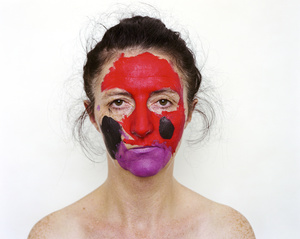
Ladybird, from the series The Failed Realist by Trish Morrissey, 2011[4]
Tracey Moffat – Scorpio
Another artist that we are introduced to in this exercise is Tracey Moffat who’s series Scorpio explores the celebrity culture through Masquerade. Moffat plays the part of famous people who, like her have the star sign Scorpio. She dresses and styles herself as the character in a way that is recognisable to some extent, but not convincingly realistic. Each frame is set against a plain background that is then substituted with a contrasting one in post-processing, star constellations featuring regularly in the series. In her series, Moffat emphasises her ‘becoming the character’ by leaving elements that studio portrait photographers would remove from the frame and the presentation of each Scorpio as both a finished print and a set of contact sheets. This style almost chronologically tells the story of her transformation, with her makeshift studio environment remaining in the shots as if to give a sense of the paparazzi about them. The way that Moffat approaches her series creates an almost childlike ‘dressing up’ feel blended with the relentless sense of being in the spotlight that echos the lives of her subjects. The example below is Moffat becoming former Indian Prime Minister Indira Ghandi.

Being Indira Gandhi, by Tracey Moffat [5]
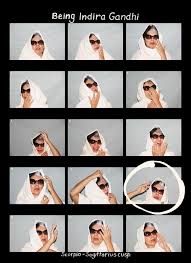
Being Indira Gandhi, by Tracey Moffat [6]
Conclusion
My conclusion from this exercise are more around the alternative use of self to represent a subject. Both artists have put themselves directly into their work and within the subject, placing themselves in a situation to tell a story of something dear to them. The thing that is different from other self-portraiture is that the narrative is not about the artist in the way that Brotherus and Woodman used themselves. Instead, we have a trace element that suggests a connection with the sense of self while challenging the viewer to look hard for some meaning to them. Lee’s work on Projects places the artist as commentator in an environment that she isn’t part of, while infiltrating her subject in disguise. Morrissey’s approach to be ‘cuckoo’ in a moment of other people’s lives is very subtle, where her other work with her family photographs is more dramatic. Instead of a sense of infiltration, we have a creation of new/old memories that challenge our modern interpretation of the past. Her portraits in The Failed Realist have a sense of fun, not just because of her child’s paintings, but the connection between mother and daughter exploring the joy of expression.
With regard to Moffat, the cumulative effect of the photography with the fantastical post-processing is impactful. I find myself wondering how that series got started and evolved creatively. It’s certainly not somewhere that I feel I would have ventured, but perhaps that’s the point of self-portraiture when the meaning isn’t directly about the photographer. If we use ourselves as the canvas or platform for other stories, the breadth of possibilities is much wider than if it’s an exercise in self-indulgence.
References
[1] Cotter H, 1999, “Art in Review: Nikki S. Lee, The New York Times, https://www.nytimes.com/1999/09/10/arts/art-in-review-nikki-s-lee.html
[2] Phillips S, 2013, “Trish Morrissey’s best photograph: infiltrating a family on a Kent beach”, The Guardian, https://www.theguardian.com/artanddesign/2013/jan/23/trish-morrissey-best-shot
[3] Morrissey T, Date Unknown, “Feature: Seven Years”, Lens Culture, https://www.lensculture.com/articles/trish-morrissey-seven-years
[4] Morrissey T, Date Unknown, “The Failed Realist”, Lens Culture, https://www.lensculture.com/projects/228833-the-failed-realist
[5] Image Resource, Roslyn Oxley9 Gallery, https://www.roslynoxley9.com.au/exhibition/under-the-sign-of-scorpio/vj5qx
[6] Lou R, 2012, Tracey Moffat – Being Indira Gandhi, Restruction Blog Post, http://restruction2012.blogspot.com/2012/05/tracey-moffatt-being-indira-gandhi.html
 Richard Fletcher OCA Photography Blog