What is a Masquerade?
VERB
To masquerade as someone or something means to pretend to be that person or thing, particularly in order to deceive other people. – Collins English Dictionary [1]
Quite simply, our understanding of masquerade is the act of acting or pretending to be something or somebody else. The dictionary definition above refers to the idea that masquerade is all about deceiving people, but that isn’t what we are introduced to in this project. Here there is much more of a sense of substitution, the idea of being a part of the narrative without actually being the subject of it. When I first started to read about the first of the photographers (Nikki S. Lee), I was reminded of the evolution of virtual reality. Used for everything from gaming to microsurgery, the technology allows the viewer to become part of that they see as an explorer or player. In her group of works called Projects, Lee literally puts herself in the series in order to explore the theme for herself. The images are not of her as herself, but taking on a visual or cultural ‘disguise’ to that she plays a part in the story. Lee shot a number of Projects that explored issues such as race, sexuality and local culture. In each, she is recognisable but not distracting. In many cases, she has strayed into territories that are jarring when looked at through the lens of recent years. For example, in the photograph below from her series The Hip Hop Project she has drawn criticism not for her exploring the predominantly African American music culture, but the fact that she blacked up and styled herself as a young black woman to appear in the composition.
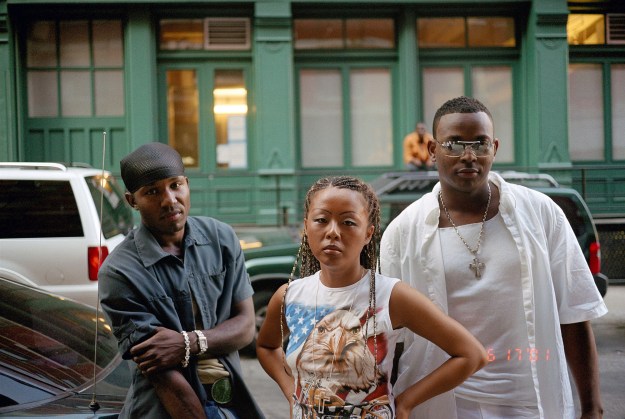
From the series The Hip Hop Project, by Nikki S. Lee [2]
When I look at this picture, it takes a while to notice that which is out of place. The first reaction is that here is a group of young black people, posed in a typical US street scene and expressing themselves within their youth culture. Their demeanours and expressions have an almost confrontational pride to them, synonymous with the hip-hop music culture that was emerging in the US at the time. Lee blends in with the image as if being part of that story, but once we recognise that she is not part of the culture, becomes a social commentator. This roleplay is an effective merging and separation of artist and subject that remains fluid when I look at it. I started this project a week or so ago because of illness and my focussing on writing my Assignment 3 diary during my spare time. Over the course of that week, I looked at this image many times and on each occasion, started with a different initial reaction to it. Although I knew about Lee’s subterfuge, I still found myself occasionally looking at the picture as three young black people.
Lee’s other work included an interesting Project where she was made up to look elderly. This work for me was more intent on deception than the Hip Hop series.

Untitled, from The Seniors Project by Nikki S Lee, 1999[3]
Here we see Lee in full prosthetic makeup disembarking from a bus full of other senior citizens. This image provokes a different reaction when I look at it. For me, the deception of the disguise is overwhelming and rather than tell the story of being an elderly person, appears to mock them. I guess the reason behind my reaction is that for all of the other series, Lee could have been part of the culture as a Korean. She could have been part of hip hop, been lesbian, been from Ohio etc…etc…, but with this one she is clearly trying to be something impossible. For me, Lee loses her sense of self in these images and that connection between artist and subject that is present in her other photographs is lost in this project.
Trish Morrissey
For her series Front, Trish Morrissey took masquerade another step further to Lee’s work. Here, the artist approached families that she didn’t know and swapped placed (and clothing) with a female member of the group. She then took the place of that person in a series of portraits of the families. Here the artist has been the cuckoo in the next to some extent, blending in with the others but all the time keeping her own identity.
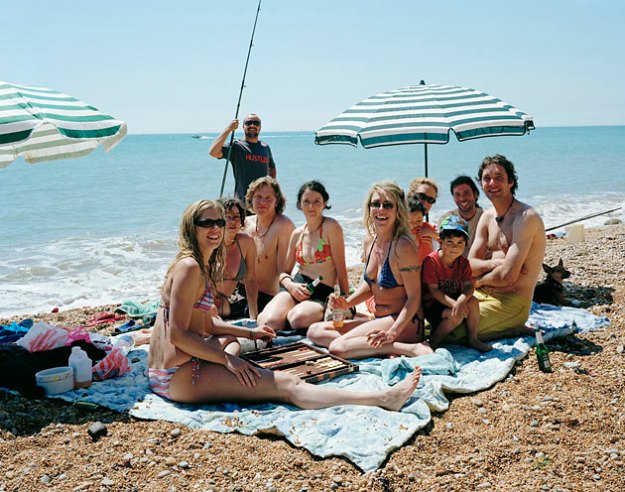
‘Chloe Gwynne’, from the series Front by Trish Morrissey, 2005 [4]
In this image from the series, Morrissey is seen in the centre of the picture. She blends in neatly with the others who are of a similar age, white and slim. However, when we look at her expression, we see a slight discomfort which is almost awkward. She preserves the nature of the series, where she has consciously invaded a gathering of family or friends while not being part of it. Her expression reminds me of every photo taken of me as a child, where my reluctance to be noticed resulted in an awkward expression. In this photograph, all of the elements from the summer bikini to the bottle of beer in her hand suggest that she is trying to be part of it, but behind the ‘front’ is the uncomfortable truth that she is a complete stranger. In many of the images, it takes a while to first spot her and then look at how she fits into the other elements in the scene. However, in one shot the different is more thought provoking and has a more defined statement.
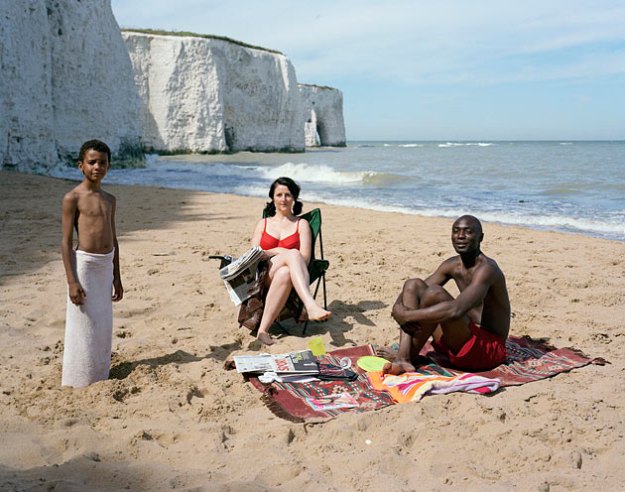
‘Hayley-Coles’, from the series Front by Trish Morrissey, 2005 [5]
In this photograph, Morrissey poses replaces the mother in this family gathering by the white cliffs of Dover. What is striking is that the family is black, so the contrast is immediately apparently. I initially wondered why this photograph was part of the series at all. Aside from the obvious difference in colour, Morrissey’s expression doesn’t stand out either. In the other pictures, her enigmatic and somewhat awkward smile was a trace of her personality in a scene that wasn’t about her. However, in this image the father and son have similar expressions to hers. This shot looks very staged where the others are more natural. Then I started to consider the clear assumption that I had made when I first looked at it, that the mother was also a black woman. This natural assumption could be hugely far from the reality of the image; the woman may not be black (the boy’s skin is quite pale compared to his father), the ‘family’ might not be a family at all with the three people being related in some other way. This image started to challenge my assumptions about the concept of traditional family, the instant conclusion drawn about two different ethnicities etc. For me, this is actually the most powerful image in the series as it is more direct in challenging the viewer about the narrative. Morrissey achieves a similar ‘here but not here’ feel to her photographs with subtle contextual elements in the frame, but it is in this picture that the elements build more powerfully.
One thing I took away from both photographers was the confidence and even courage that they had in approaching their work. Both had to place themselves into an alien environment where people’s lives would be impacted by their presence. In the case of Lee, there is a sense of make-believe and cultural appropriation and in Morrissey, the sense of invasion and intrusion. However both had to ask total strangers to become part of their work., which is something that I find difficult to comprehend. This is, of course more a comment about myself than the artists but the work takes on a greater significance for me because of how challenging it would have been to create it.
References
[1] unknown, “Masquerade definition and meaning”, Collins English Dictionary, https://www.collinsdictionary.com/dictionary/english/masquerade
[2] Miller, L, 2020, “Nikki S Lee’s Projects Series”, Artnews Article, https://www.artnews.com/gallery/art-in-america/aia-photos/nikki-s-lees-projects-series-photos-1202682209/nsl-hip-hop-1/
[3] Unknown, ‘artwork listing’, The Guggenheim Museum, https://www.guggenheim.org/artwork/12990
[4] Morrissey, T, 2005, ‘Front’, Artist’s Website, http://www.trishmorrissey.com/works_pages/work-front/workpg-02.html
[5] Morrissey, T, 2005, ‘Front’, Artist’s Website, http://www.trishmorrissey.com/works_pages/work-front/workpg-06.html
 Richard Fletcher OCA Photography Blog
Pingback: Exercise 3: Reflecting | Richard Fletcher OCA Photography Blog
Pingback: Assignment Three: Mirrors or Windows | Richard Fletcher OCA Photography Blog