Research Task – Francesca Woodman
Part 3 introduces us to Francesca Woodman, an American photographer whose work extensively incorporated self-portraiture. This is not the first time that Woodman has been discussed since beginning this degree course. In Expressing Your Vision, she was introduced to me during the feedback on assignment 5 [1] because my theme had been self-portraiture. She was interesting to me because she used her body, often nude, as a contextual element in a broader story without really making the literal connection with the viewer that it was self-portraiture. Her story was tragic, committing suicide in her early twenties which has been the external context that many people have used since to explain her photographs. In the course notes, we are presented with S Bright’s quotation:
“It is difficult not to read Woodman’s many self-portraits – she produced over five hundred during her short lifetime – as alluding to a troubled state of mind. She committed suicide at the age of twenty-two”
In my previous work, I raised the question of whether this common interpretation was accurate. Woodman’s parents have subsequently denied that she was a consistently sad person [2], which seems at odds with her premature death. However, mania is now a more recognised mental illness that affect millions of people worldwide (some 46m cases alone in 2017)[3]. If we separate Woodman’s suicide and perception of her mental state from her work and try not to use it as contextual information, her photographs for me take on a different feeling. Consider the two images below:
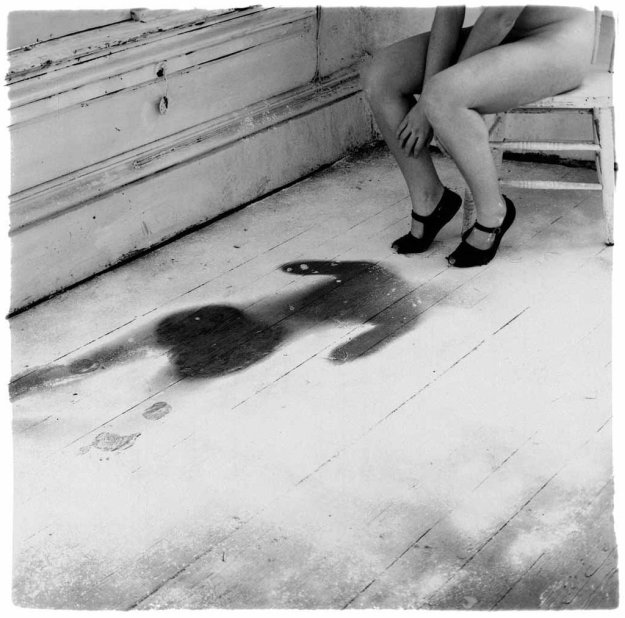
“Untitled, Providence, Rhode Island, 1976”, by Francesca Woodman [4]
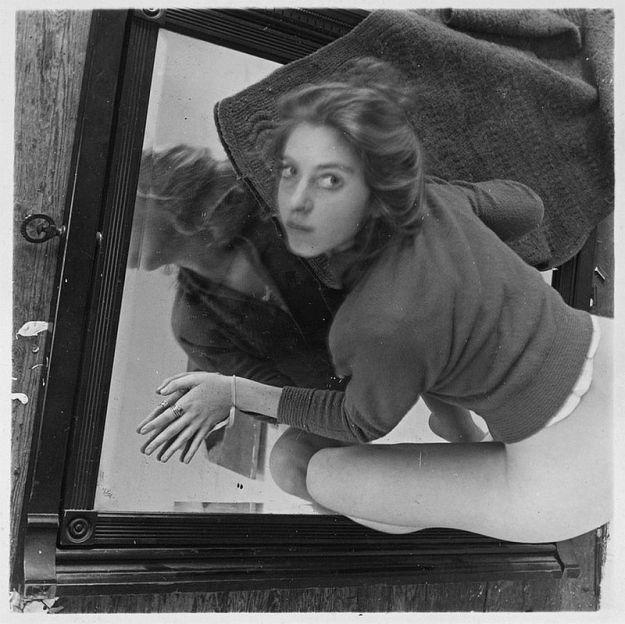
Untitled (self-portrait kneeling on a mirror), 1975 by Francesca Woodman [5]
In terms of supporting evidence of Bright’s comment, I think that the retrospective analysis of her work after her death has done a great deal to drive the narrative of her life. Her photographs range from the playful (Me and my Roommate, Boulder, 1976) to the darker Untitled, Rome, 1977-78 in which she is shown hanging from a door frame in a crucifixion pose. Her images suggest contrast between young and old, beauty and ugliness and to feminine exploitation, but if we didn’t know how her life ended I’m not convinced that we can interpret her as disturbed without that external context.
Elina Brotherus
The work of Elina Brotherus takes as similar form to Woodman’s in that she frequently uses her nude body as a contextual element in her photographs. In her work Model Studies, she builds a series of photographs that explore the relationship between the artist and the model as two separate people, despite her being in both roles. She uses light, colour and the natural world to draw the viewer in to looking more thoughtfully at her body and how it relates to her environment. Like Woodman, she uses long exposure and contrasts her subject from the background using mirrors and other props. What I immediately noticed about the series was the lack of actual contact between artist and model; even in the shots where she is looking at the camera, there is no obvious connection. Brotherus herself refers to it on her website[6], claiming the detachment to be inviting the viewer to look on the figure without anything that could be interpreted as confrontational. The series is beautifully shot with the themes of ‘everyday beauty’ and vulnerability standing out for me. There is also a humour in several of the images, where the single physical connection between artist and model is the remote trigger cable for her camera. Rather than trying to hide it, Brotherus reminds the viewer that she is both people.
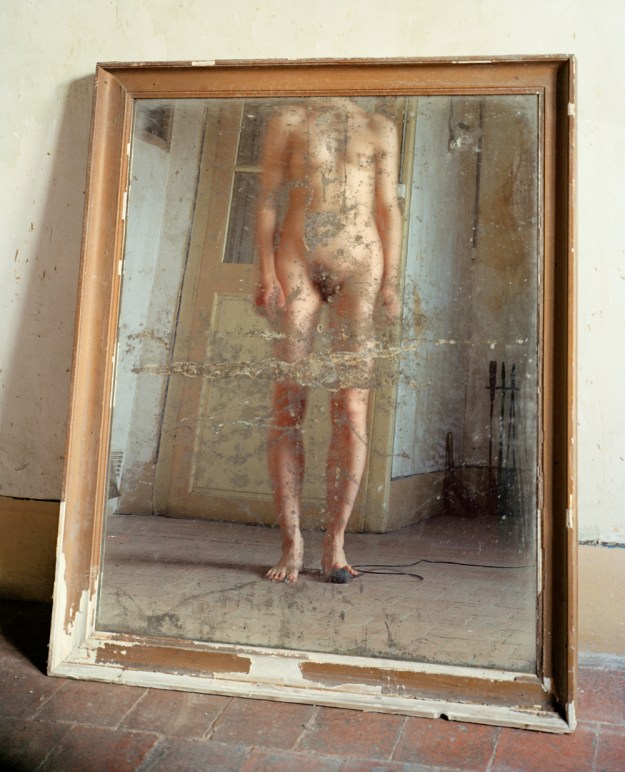
Model Study 6 by Elina Brotherus, 2008[6]

Number 19 from the series Annunciation, by Elina Brotherus, 2012[7]
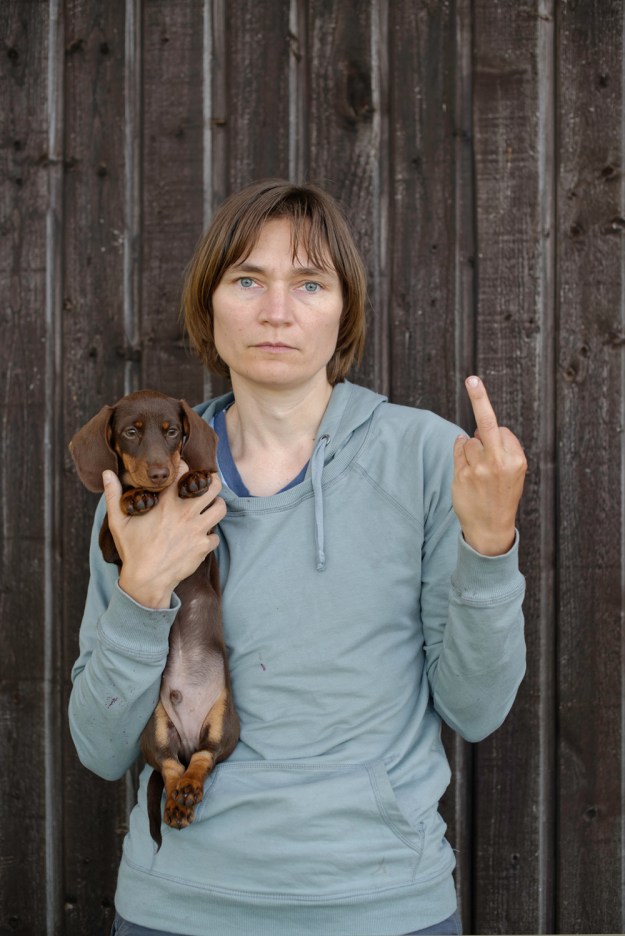
‘My Dog is Cuter than Your Ugly Baby’, by Elina Brotherus, from the series Carpe Fucking Diem, 2013 to 2016 [8]
Gillian Wearing
The final artist presented in Project 1 is Gillian Wearing. Her series Album is a remarkable piece of work whose origins may be in photography in terms of the reference images, but the execution also incorporates sculpture. Wearing used reference photographs from her family album to create latex masks. She then used the masks to ‘become’ her family members, photographing herself in similar poses to the original. What is special for me about this work, apart from the technical challenge, is the way that Wearing connects with her family. The study of historical pictures and then the painstaking act of ‘becoming’ points strongly to how our families are the origins of who we are. By deliberately leaving traces in the photographs that indicate that it is her, Wearing plays on the viewer’s double-take and subsequent questioning about genetic similarity. My favourite from the series is described in an interview Wearing gave to The Guardian[9] where she ‘became’ her brother using a snapshot from their growing up. The double take is even stronger with the conflict of gender as well as the carefully staged setting making it difficult to age the photograph.
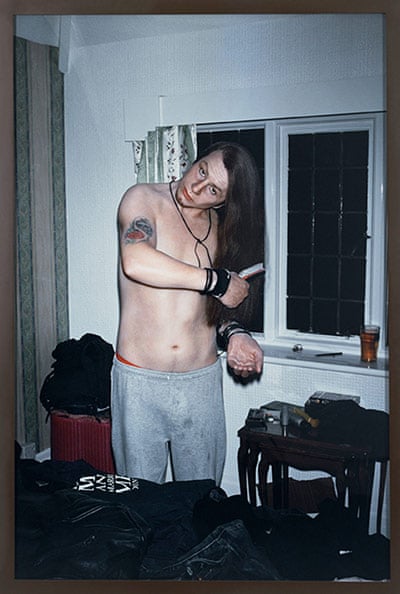
Self-portrait as my brother Richard Wearing, by Gillian Wearing, 2003[9]
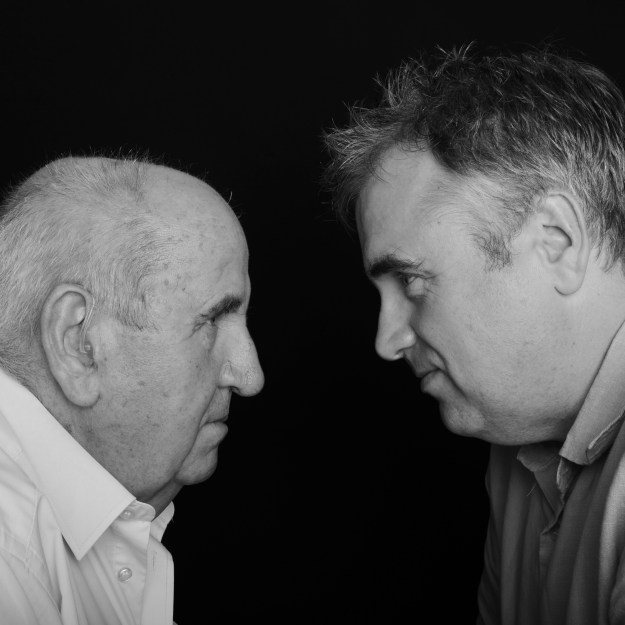
Two, from the series ‘Pictures of You’, Assignment 5 of EYV, 2020
Conclusion
This project has dealt with the works of three very different artists. Woodman and Brotherus share some similarities at face value, but Brotherus’ work feels more of a focused set of stories that are perhaps more obvious than Woodman’s. Woodman has been associated with physical and mental frailty in some quarters and strong feminist expression in others, but we cannot really be certain of her intention for her art.
“Am I in the picture? Am I getting in or out of it? I could be a ghost, an animal or a dead body, not just this girl standing on the corner?” – Francesca Woodman
When I first read this quote, my immediate reaction was that it was a deliberately obscure explanation of her intent, leaving the viewer with any interpretation that they wished for. We know that too much space to create narrative can be problematic in the appreciation of the photograph, so why even say it? On reflection, I think that Woodman was actually being all of those things at the same time. Perhaps her emotional state oscillated between these self-images; we will never really know. With Brotherus, her projects feel much more signposted without the narrative being spoiled by the more obvious contextual elements. She uses her body very deliberately in a completely non-sexual and non-sensual way, something that cannot be said about some of Woodman’s work. Brotherus is the central element of her stories, but using her body and sense of self-image as a mere tool to strengthen the feelings around the subject. It is rare for an image to prove a tearful response in me, but the shot from Annunciation did just that.
In contrast to the other two, Wearing’s series was using the sense of self but also disguise. Her strong connection to her family is reinforced by the dedication shown to create the photographs, while the questions raised about family genetics and how people are shaped by their growing up are also powerful.
There are definitely some interesting perspectives here that will help with my preparation for Assignment 3.
References
[1] Fletcher R, 2020, “Looking at Contemporary Portrait Artists”, EYV Blog Post, https://wordpress.com/post/richardfletcherphotography.photo.blog/1420
[2] Cooke R, 2014, “Searching for the real Francesca Woodman”, The Guardian, https://www.theguardian.com/artanddesign/2014/aug/31/searching-for-the-real-francesca-woodman
[3] Ritchie H & Roser M, 2018, “Mental Health”, Our World in Data webpage, https://ourworldindata.org/mental-health
[4] Johnson K, 2012, “Exposing the Body, Baring the Soul”, The New York Times, https://www.nytimes.com/2012/03/16/arts/design/francesca-woodman-at-guggenheim-museum.html
[5] Artist Profile, 2016, “Francesca Woodman”, ND Magazine, http://ndmagazine.net/photographer/francesca-woodman/
[6] Brotherus E, 2008, “Model Studies”, Artist Website, http://www.elinabrotherus.com/photography#/model-studies/
[7] Brotherus E, 2012, “Annunciation”, Artist Website, http://www.elinabrotherus.com/photography#/annonciation/
[8] Brotherus, E, 2016, “Carpe Fucking Diem”, Artist Website, http://www.elinabrotherus.com/photography#/carpe-fucking-diem/
[9] Unknown, 2012, “Gillian Wearing takeover:behind the mask – the self-portraits, The Guardian, https://www.theguardian.com/artanddesign/gallery/2012/mar/27/gillian-wearing-takeover-mask
 Richard Fletcher OCA Photography Blog
Pingback: 3) Exercise 1: Brotherus Research and Analysis | Richard Fletcher OCA Photography Blog