Introduction
For most of my life I have seen photography as a medium for capturing visual memories. My early photographs were all snapshots of a moment I was experiencing, whether a family event, holiday or school trip. Little care or attention was taken in how they were framed or to the lighting conditions, as I wasn’t skilled in any of the technical aspects of the craft. Latterly through, my studies with OCA and through researching the works of Parr, Goldin and others, I’ve appreciated the difference between capturing my own memories and evoking them in others. If I show my past photographs to other people, they may well react in some way, but it’s not really explored through their engagement with the image or in any way by my design. With the artists I’ve looked at, there is something relatable in some cases and shocking in others, but the thing they have in common is that they allow the viewer to make up their own mind as to what the image means. In this course unit, documentary series’, such as Lixenburg’s Imperial Courts that we studied earlier [2], show us things that we have no personal references to, but seek to tell an informed story about the important issues of people’s lives whether they be socio-economic or cultural. Along with the literal and perhaps obvious, they leave room for a narrative to be created, the contextual elements being visual, but often using metaphor.
Metaphor
an expression, often found in literature, that describes a person or object by referring to something that is considered to have similar characteristics to that person or object, Cambridge English Dictionary [1]
Metaphor wasn’t something I was really familiar with outside of its meaning in the English language. In exploring how a visual medium like photography can be metaphorical, I’ve begun to let my imagination run more wildly than before. Visual cues are still needed, but I’ve really started to work hard to move away from the literal signposting of my earlier work. As I prepare for Assignment 2, the course notes lead me to how other students and artists have approached photographing the unseen. We are presented with two case studies.
Two Case Studies
Peter Mansell
Mansell suffered a major spinal injury when he was as younger man and the interview with him in the notes explores how his photography evolved to tell the hidden story of the effect of his disability on his life. What I found interesting in his answers to the interview questions was how he had started in a similar way to me; photography as a technical competence for creating visually appealing images. His studies too started with the need to meet a brief and evolved into story-telling through photographing whatever had metaphorical meaning. Mansell’s realisation that the subject matter itself wasn’t the point of the photograph hasn’t happened with me yet; I still struggle to pull away from stating the obvious using what is in the frame.
In his later work for his MA degree, Mansell tells a story of his life as it is now [3]. Factual and matter-of-fact in the way it is presented, Paralysis Unseen: Pictures and Words deals with the unseen management of Peter’s condition, the way the obvious impacts are missed by those who are not experiencing something similar and how his outlook on life is impacted by his environment. The two images that struck me from the series are shown below:
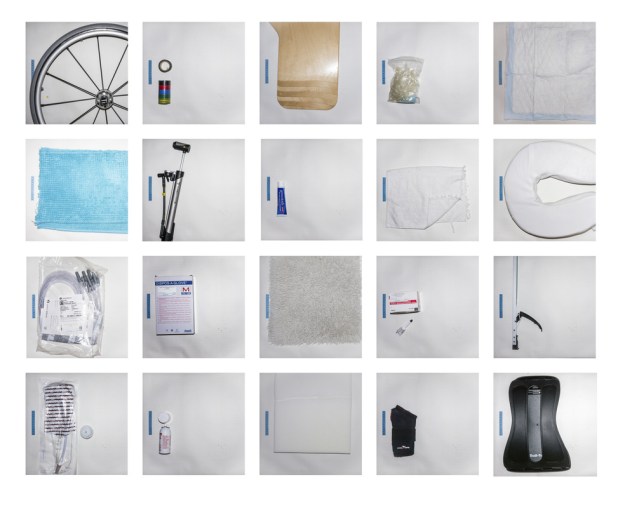
‘My Kit’, from the series ‘Paralysis Unseen: Pictures and Words’, by Peter Mansell [3]
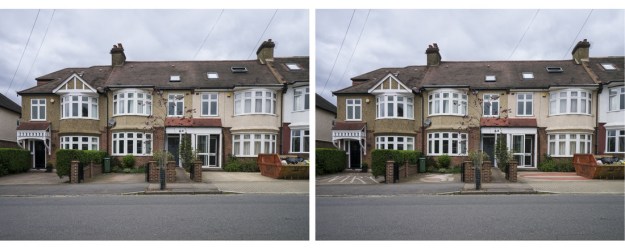
‘My Street’, from the series ‘Paralysis Unseen: Pictures and Words, by Peter Mansell [3]
I really loved this series of images. Mansell’s developed skill at metaphorically suggesting a story is something I aspire to as I work through this course.
Dewald Botha – Ring Road
The series Ring Road deals with a very modern struggle for people who live in urban areas. Botha had the challenge of fitting into a different culture as well as the contrast of his new, chaotic environment to what he was used to previously. His use of photography as a documentary tool while looking for places to escape his busy environment, is something I’ve done when I’m under significant pressure. Walking with the camera and looking for things that interest me has always been a way of relaxing. What Botha has done here though, is to take a physical object that represents his difficulties and sense of isolation and use it to explore his reaction to his new life in terms of limitations and loneliness. I found this series to be very thought provoking. Botha uses the ring road to frame his photographs as well as be a key visual element. The outside world peaks through the darkness created by the bridges of the road and he frequently contrasts the natural world with the man-made. The two images that struck me from the series are shown below:
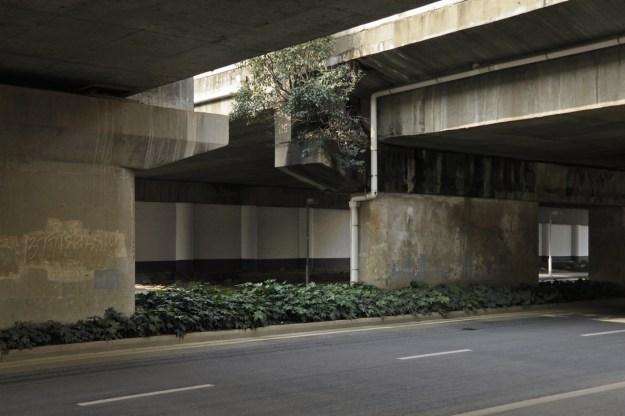
Untitled (number 3) from the series ‘Ring Road’, by Dewald Botha, 2013 [4]
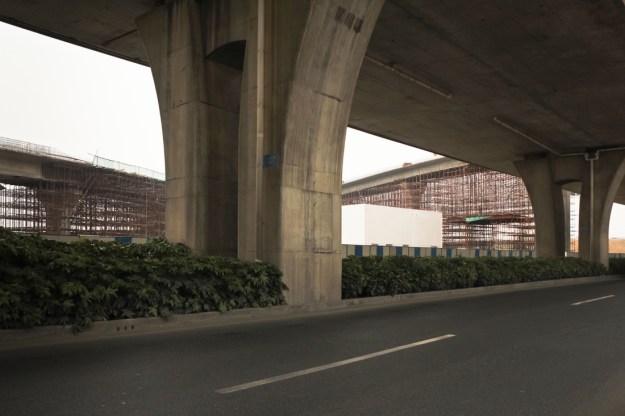
Untitled (number 7) from the series ‘Ring Road’, by Dewald Botha, 2013 [4]
This series had as great an impact on me as Mansell’s work in that the images describe the mixture of emotions that Botha was experiencing through a much more visually connected series. The light and composition are similar from shot to shot, with more traditional styles being used. However, while they have consistent elements (the road, the contrast between the manmade and natural worlds, the sense of restriction etc), the feelings evoked by the series as we move through them vary considerably. I find myself unable to see the series as a linear sequence in that it’s not obvious to me when my emotional reaction changes.
Conclusion
I’ve enjoyed looking at these two different artists. Their work definitely captures and represents the unseen and although both deal with personal struggle, their approach is very different. Where Mansell includes himself in some shots and uses digital manipulation to add the visual pointers to disability, Botha uses just one of the sources of his struggle in what appears to be, but isn’t an obvious way. Botha’s narrative of isolation, difference and the effect on his sense of self comes through even though there is not physical reference to him or any other human being.
I am about to start Assignment 2 – Photographing the Unseen, so this has given me a great deal to think about. I want to combine words with the images as with Mansell, but want to represent my subject with what appears to be completely unrelated or disconnected. It will be an interesting challenge.
References
[1] Unknown, ‘Meaning of Metaphor in English’, Dictionary Definition, Cambridge English Dictionary, https://dictionary.cambridge.org/dictionary/english/metaphor
[2] Fletcher, R, 2020, “Case Study – Dana Lixenburg – Imperial Courts”, OCA Context & Narrative blog post, https://wordpress.com/post/richardfletcherphotography.photo.blog/2043
[3], Mansell, P, 2016, “Paralysis Unseen: Pictures and Words”, Artist Website, https://petermansell.weebly.com
[4], Botha, D, 2013, “Ring Road”, Artist Website, https://www.dewaldbotha.net/ring-road.html
 Richard Fletcher OCA Photography Blog