Introduction
While completing Exercise 3 of Part 2, I received feedback on my submission for Assignment 1 from my tutor. For a variety of reasons, there was a delay in having the one to one call with her which allowed me to progress with the work in Part 2 in the meantime. Generally, the feedback was positive about how I’d approached the assignment, whose brief was to tell two sides of a story. I had chosen the effects of lockdown, making the assertion that it would have a positive impact on society overall and then using the images to both support and contradict that position. The resulting set were said to work, but that they were perhaps a little limited in the perspectives that I’d shot from and lighting that I’d used. The images were shot during the most severe conditions of the lockdown, where only short periods of exercise were allowed and, mercifully we had a spell of bright, sunny weather. Nevertheless, this was the first thing that I needed to address when embarking on this assignment. I could not afford to lose the balance of technical skill (light) and freeform creativity (my tutor referred to it as ‘experimentation through the viewfinder’, which perfectly describes it) because I’m trying to tell a story of something that is not obvious imagery. The second piece of feedback that resonated with me was how the titles that I added to the pictures didn’t really emphasise the subject and hence, served to steer the viewer rather than enhance the message. Since progressing to Part 2, I’ve learned about the use of text more specifically to enhance the narrative of the series and how that differs greatly from signposting the viewer to its heart. For Assignment 2, where the brief is to photograph the unseen, I needed to think about how the text might support the series more as Barthes’ relay rather than anchor if I was to use it more effectively. The images also needed to be more metaphorical than literal, something that engineers find a little difficult generally; reasoning being firmly entrenched in the latter.
Further Research
As well as looking at the case studies in Project 3 [1], my tutor suggested a number of photographer’s works to look at before starting Assignment 2. These were Chloe Matthews, Michelle Sank and Anna Fox, all of which have created powerful documentary series of interesting, but not necessarily obvious subjects.
Chloe Matthews – Shot at Dawn (2014)
Shot at Dawn was a commissioned work to commemorate the 100th anniversary of the Great War 1914 to 1918. Matthews’ choice of subject was one that had remained largely hidden and not discussed for most of the intervening century; the men of the British, French and Belgian armies who were executed for desertion. In her treatment of the subject, Matthews elected to research the cases of a number of these soldiers, many of whom are now recognised to have suffered from severe mental trauma on the frontline, but at the time were considered cowards. She used the historical records of the executions to identify the locations and visited them at the approximate time of year and day that they took place. Like Seawright, Matthews’s images are of features of the landscape that in some cases retain a link to the history of the events, but in others are seemingly unrelated to anything having happened there. However, with the addition of the factual detail of the execution from the records, which often was simply the date, time and location, they take on a more powerful meaning. I was directed at this work in response to the comment by my tutor about the use of the same period of the day in my Assignment 1. By making the time of day part of her work, Matthews creates a sense of sombre reflection in her series, which takes the viewer back to the day of the execution. She also shot the series on medium format film, making use of the response of the film stock to bring out the colour temperature of the early morning sunrise. When interviewed about the series [2], Matthews added that the narrative of the series could be seen as broader than the victims of the firing squads, instead including the men who were tasked to pull the trigger. They had been suddenly asked to pause in their fighting of the enemy and instead kill one of their own. Even though this is an unsaid aspect of the work, the sombre feel to the photographs really evokes that sense of awful duality of the role of the soldier of that time.
My favourite image from the series is one of a street corner in Antwerp.
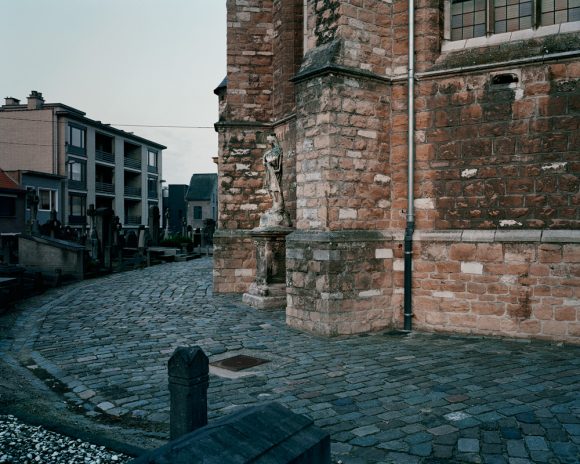
From the series ‘Shot and Dawn’, by Chloe Matthews, 2014 [3]
Walem, Mechelen, Vlaanderen, Antwerpen
time unknown / date 21.09.1914
Soldaat Jean Raes
Soldaat Alphonse Verdickt
When I look at these together, I’m struck by the beauty of the cobbled street and the corner of the building, but also the terrible sadness that two soldiers, undoubtedly young men, were killed so early in a war that would rage across Europe for the next 4 years. A mixture of the photograph, the text and my own knowledge of the Great War, come together in this work to create the narrative.
Michelle Sank – Portraits from a Distance (2020)
The next photographer was Michelle Sank who like many, found herself in isolation during the COVID-19 pandemic. Her situation was made worse by the fact that she had to ‘shield’, which effectively meant that she had to also be isolated from her loved ones. Sank decided to document how the people in her local area were coping with lockdown by shooting portraits of them in their space. As the distancing rules prevented her from getting close to here subjects, the portraits take on their own situational aesthetic because of the physical distance between them. Sank was also limited in the time during which she could shoot her project, as the government instructions were to spend just one hour exercising outside. When I first looked at this series, I was immediately struck by the similarity in the conditions that Sank was under to my own project for Assignment 1. The obvious differences were that I was focussed on the dual interpretations of COVID lockdown, with the virus at the centre of the story being told. Sank’s work was more a document of the unseen coping of the people she encountered when out walking. She shot her series as pairs of images, one of the person in some everyday context (walking the dog, looking after children etc) and the other being a more static image of their surroundings. The pairing produces a view of the ordinary (the environment) and the extraordinary (the people) which creates the narrative. Here are people going about their lives under unprecedented, difficult times which can be seen alongside the seemingly unchanged environment in which they live. Sank adds text to her images to describe what her subjects are experiencing but I quickly realised that we could simply view them with the time and date captions that Sank uses as titles. My favourite example is shown below:

From the series ‘Portraits, from a distance’, by Michelle Sank, 2020 [4]
“Kyle has cystic fibrosis. His job is in a packing warehouse, but as he is very vulnerable he cannot be at work. His mother said they had moved down to this area in the South West as it was better for his health. I remarked that he looked very well and he said that his mother makes sure to look after him and prepare healthy food. He felt frustrated at the moment with the lack of structure in his life because of the virus, and didn’t know when he could return to work”
Now the photographs have a new dimension to them. The love and care is there, but now we know it’s his mother looking after a boy with a disability. The greenery now takes on the notion that moving to the area would help with his health and the serious nature of his expression is perhaps a response to the lockdown affecting the normality of his life. This image appealed to me because of the careful composition of both photographs and how they leave enough clues for the viewer to create the narrative. The addition of the text offers some adjustment to the assumptions that I had as a viewer, but didn’t change my narrative completely.
I really like this series as my tutor suggested this was a way to look at how a story can be told with common and contrasting elements. The underlying theme for the series is perhaps not as established as in Matthew’s Shot at Dawn, i.e. the subject is the more broad in its documentary of COVID-19 and the impact on people’s lives, but I think the power of the series comes from the fact that it was created by a photographer who was experiencing her own hardships in lockdown.
Anna Fox – My Mother’s Cupboards and My Father’s Words (1999)
The final photographer that was suggested to me was Anna Fox. She had created two works that made some of the points in my tutor’s feedback. The first was My Mother’s Cupboards and My Father’s Words. Described as a “an unusual story about family relationships”[5], the series pairs the violent verbal outbursts of Fox’s father as he suffered from serious illness at the end of his life, with seemingly ordinary images of her mother’s neatly organised cupboards. The contrast of the two components is immediate; the obvious struggle to maintain some order in the face of someone threatening you and the sense that the comments are so outrageous that it can only be from an ill person. With this series, the imagery is very similar from cupboard to cupboard but there are lots of subtle references to help create the narrative. My personal favourite is shown below:
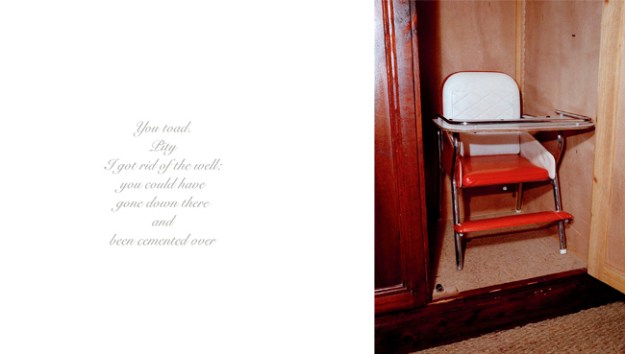
From the series ‘My Mother’s Cupboards and My Father’s Words’, by Anna Fox, 1999 [5]
What I found interesting about this series is that the links between the photographs are more explicit than in the other two described previously. The way that Matthews took her photographs at the approximate time and date of the executions links her series together and has the added visual anchor of the light being very similar in each shot. In Sank’s work, the links are more subtle in the time of day and environment. She had the same challenge that I did with Assignment 1, where the government sanctioned exercise of the time limited the radius of the area that could be covered on foot. In my case, I found myself walking in the afternoon after work and because of the weather at the time, the sunlight was pretty much the same in every picture. In Fox’s series, however the link is really obvious in the shooting of the cupboards. It feels as though the pictures were snapshots of her mother’s cupboards for a simple record; all shot with flash and all tight compositions so that nothing else is visible other than the contents. This snapshot style really drives home the simple order of her mother’s life without using any clever technical techniques to get the point across. What makes the series really powerful is that the banality of the subject is raised up by the conflicting aggression of her father’s words.
The second Fox series Work Stations was shot in the 1980s and is focused on the financial trading industry that was central to the ‘yuppie’ culture of the time. Here we have a series of photographs shot in a similar style as her other series; brightly lit and using flash. It’s not really a surprise as Fox studied under Martin Parr, who is well known for his candid shots of people living their lives while being watched almost voyeuristically by the photographer. In Work Stations, Fox combines the imagery with quotations from people in the business, which have a sense of the motivational quotes that were also popular at the time. My personal favourite is shown below:

From the series ‘Work Stations’ by Anna Fox, 1987-88 [6]
“Typical working situation, female workers rabbitting away”, Company Manager
For me, the brilliance of this is the layers of narrative that the combination introduces when the two elements are brought together. The first thing that struck me was that there were probably women in the toilet gossiping in some way. Otherwise, they are likely to be behind the slightly open door. However, the big impact on me (being a child of the 1970s) is the attitude to women in the workplace during the 1980s. The image is both satirical and a statement of how ridiculous a notion it is that female workers are somehow more chatty and by implication, less focused than their male colleagues. This image takes on new meaning with the passing of time. Fox shot it during the 1980s, so it is most likely a subliminal protest, which has moved more to parody in the 2000s. The rest of the series portrays the financial traders as being hard working, ruthless and hard partying men with their own sense of self importance. Again, the whole series has shifted in meaning with the passing of time. Since the 2008 financial crash, the finance industry has been regarded with more suspicion, derision and more closely monitored than in the heyday of the yuppies. As well as parody, the series provokes a sense of disgust when I look at it. I was reminded of the mixed feelings of fun and disgust I experienced when I first saw Scorsese’s Wolf of Wall Street a few years ago. The combination of pompous quotes and indulged trading staff is certainly a powerful one.
Conclusion
What I’ve learned from this research is that a series of photographs that tell a story, needn’t be obvious in the way it goes about it. Bringing all of the elements of Part 2 together is one thing, but the key message of leaving enough room to create the narrative is the most important learning. All three of these artists have chosen something strong to base the series on and then backed away from the obvious. My natural tendency has been to think of a message and then find an element that can easily be interpreted as that message. Fox’s combination of a high chair and the words that went with it, was the best example I’ve seen of just letting the viewer run with it. In my case, my interest in history led me to witchcraft trials and the medieval treatment of women by men who had some sort of problem with them. Fox’s other example of the women’s toilet door further emphasised to me that simple compositions of open spaces with the smallest symbolic component can also be really powerful when combined with the right words.
In terms of Assignment 2, my ideas are revolving around things I am really interested in that are completely unseen. Where I felt that Exercise 3 was still too signposted despite my best efforts, I am determined to be completely open-minded in my selection of subjects for the assignment.
References
[1] Fletcher, R, 2020, “Part 2 – Project 3 – Photographing the Unseen”, Context and Narrative, <insert link>
[2] O’Hagen, S, 2014, “Shot by their own side”, The Guardian, https://www.theguardian.com/artanddesign/video/2014/jun/29/chloe-dewe-mathews-shot-at-dawn-first-world-war-video
[3] Matthews, C, 2014, “Shot at Dawn”, image resource, http://shotatdawn.photography/work/
[4] Sank, M, 2020, “Portraits from a Distance”, Wellcome Collection, https://wellcomecollection.org/articles/Xsd98hAAACIAhct_
[5] Unknown, 2020, “Anna Fox – Anna Fox. My Mother’s Cupboards and My Father’s Words. The Hyman Collection website, http://www.britishphotography.org/artists/15795/ei/1916/anna-fox-anna-fox-my-mothers-cupboards-and-my-fathers-words-1999
[6] Fox, A, 1988, “Work Stations”, The Hyman Collection website, http://www.britishphotography.org/artists/15795/ei/1170/anna-fox-anna-fox-work-stations-1987-88
 Richard Fletcher OCA Photography Blog
Pingback: Drawing on Documentary and Art – Influences on Photographers | Richard Fletcher OCA Photography Blog
Pingback: Reflecting on Photography 1 – how things have changed so far | Richard Fletcher OCA Photography Blog