
Introduction
The two photo essays we have looked at so far draw on other media to enhance the strength of their messages. In the case of Smith’s work for LIFE magazine, the pictures were set against a written text, mainly because of that was the way the stories were being consumed by the readers. In the case of Briony Campbell, the text was also accompanied by a video that contained interview segments with her father. During the video, he doesn’t once refer to the work itself either as individual images or as a series. His testimony of sorts, seeks to add the context that begins the project and his wishes for its purpose as a father-daughter bond and catharsis for his family upon his death. In both cases, I find that the supporting media adds to, but does not detract from the ability of the images to tell the story on their own. This is my starting position in entering this project.
Roland Barthes (1915 to 1980)
Barthes was a literary theorist and philosopher who’s two works Death of the Author and Rhetoric of the Image are presented to us. The former asserted that the author was not some creative genius that should be lauded for their own original ideas; that their work was in fact an assembly of ideas that span a huge range and variety of cultural references. The ideas of structuralism with its categories and classifications was said by Barthes to lead the reader through the story aligned with conventional signposts with the result that the reader believes they understand the original intention of the work. Barthes encouraged the reader to stop being so passive in the way that they consumed the story, picture or artwork, instead encouraging them to apply their own experiences as if they were completing the narrative. The effect of Death of the Author was to create more challenging and obscure work that demanded the viewer to work harder to gain a sense of the story.
The second essay introduced the concept of Anchor and Relay to describe the purpose of accompanying text. Anchor being more akin to the news media, where the text controls the narrative in a very specific way in order to avoid any misunderstanding. This description matched my view of Paul Seawright’s Sectarian Murders that we studied in Part 1 [1]. The application of very specific text lead the viewer to see the work and all of its cleverly applied layers to the narrative that this was all about murder. In the case of the image that I looked at in the series, the blended use of the factual statement of what occurred in the drive-by shooting and the emotive sadness of the way the boy died, leave the viewer in no doubt that something terrible happened in the scene. Without the accompanying text, the photograph has multiple meanings that I could bring my own experiences and political viewpoints to when looking at it. However, I don’t because of the very specific nature of the Anchor text.
For me, the Relay is how I would describe the use of the video in The Dad Project. It seeks to almost lead the viewer away of the sadness of losing someone to a long, debilitating disease and leave enough space to interpret as a testimonial. The interview with her father looks at his letting go of the idea of being the provider of the family and he desire to explore a slightly different relationship with his daughter while he has time. In this case, some of the imagery that is included in The Dad Project isn’t just about the sadness of the subject. The image below is an example of the effect of Relay for me.
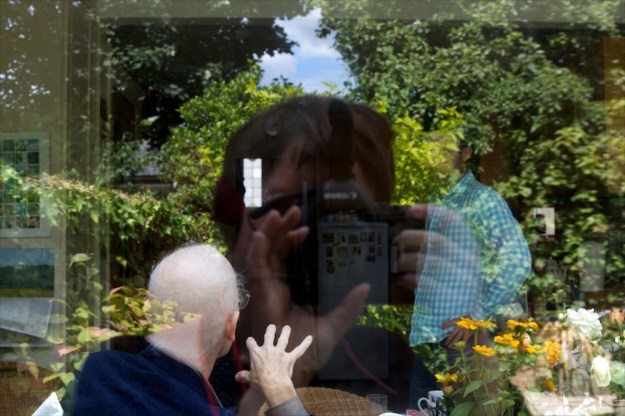
‘Family Portrait’, by Briony Campbell (from The Dad Project) [2]
Conclusion
I read both of Barthes’ texts and, like many found them difficult to grasp in their entirety. From my understanding of the essays, I believe that in the case of Death of the Author Barthes began by challenging the traditional notions of originality in writing and asked the reader or viewer to take focus instead on what they bring to the understanding of a piece of work rather than trying to get to the ‘true intent’ of its creator. The idea that we can never know what the original intent of a work is, but instead bring our own completing piece of a narrative through our understanding and experience, makes sense. However, I can well believe that this was considered a controversial shift in thinking at the time of its publication, particularly with the literary authors of that age. In his video explaining the essay [3], Tom Nicholas refers to the way that J K Rowling continues to re-visit her Harry Potter series, perhaps to increase the volume of information that supports her original intent for the characters and the story. Far from being a straight-forward embellishment, the effect on the readers could be a sense of distrust of Rowling, brought about by her intrusion on their narrative, created over a number of years and readings of the texts. When I reconsider The Dad Project with this in mind, I then start to recognise myself trying to interpret what the purpose of the essay was. As I ‘consumed’ the information as laid out on Campbell’s website, I was directed away from how the series made me feel and more onto how she felt. Perhaps there is such as a thing as too much information.
When presented by Barthes’ analysis of the messages in advertising, I understood the way that text with an image could control the narrative in a recognisable way. In the case of the Panzani advertisement, the idea of Italianicity is created through the eyes of the French culture through the mix of native language and label names. Barthes points out that an Italian wouldn’t have necessarily observed the impact of the labels as the image of what ‘looks Italian’ is different within the culture from outside of it. The concepts of Anchor and Relay made sense to me in that we see examples of both in everyday life without ever noticing them.
References
[1] Fletcher, R, 2020, “Project 4: The Gallery Wall – Documentary as Art, OCA Blog Post, https://richardfletcherphotography.photo.blog/2020/05/12/project-4-the-gallery-wall-documentary-as-art/
[2] Campbell, B, 2011, “The Dad Project, Artist Website, http://www.brionycampbell.com/wp-content/uploads/2013/03/The_Dad_Project_Briony_Campbell.pdf
[3] Nicholas, T, 2019, “The Death of the Author: WTF? Roland Barthes’ Death of the Author Explained, Youtube, https://www.youtube.com/watch?v=B9iMgtfp484
 Richard Fletcher OCA Photography Blog