Introduction
We are introduced to W. Eugene Smith’s 1948 photo essay called Country Doctor, which was published by LIFE magazine. It is a series of photographs of a rural physician called Dr Ernest Ceriani, who allowed Smith to follow him around his daily life treating his patients. The course notes refer to Smith having shot without film in his camera in the early stages while Ceriani became comfortable with his presence. There are many stories of photographers using such techniques to relax their subjects; I am reminded of the story of Tony Vacarro, another photographer who worked for LIFE at the same time as Smith, who outsmarted Picasso during a shoot [1]. Picasso had a tendency to pose for photographers that Vacarro didn’t want in his images. In order to catch him off-guard, Vacarro pretended not be working, instead relaxing with Picasso as friends would. Once he saw his subject off-guard, he shot his portrait. What I see when I look at Smith’s Country Doctor is a man who is completely undistracted by the presence of the photographer and his camera. In every shot, Ceriani is pictured focusing on the job at hand, which his patients more interested in the attention from the doctor than the photographer documenting their treatment.
The Series
I’ve picked out a few of the images that stood out for me in Country Doctor and describe here why they had an impact on my from a story-telling perspective. These are part of the linear sequence as published by LIFE Magazine.
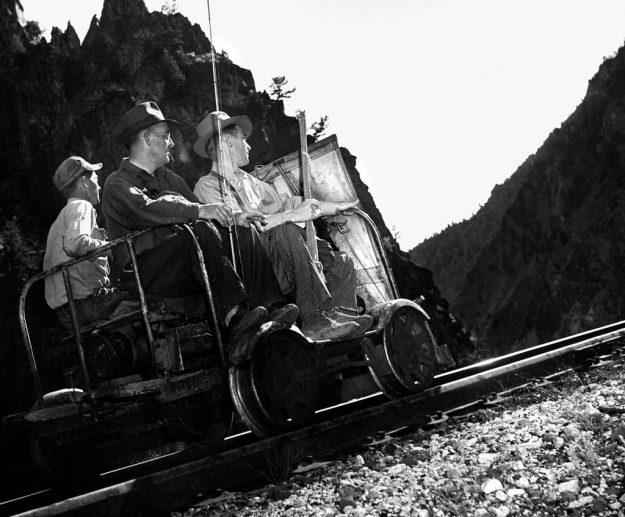
Two friends transported Dr. Ceriani to Gore Canyon so he could enjoy a few hours of recreational fishing, a rare treat for the hard-working physician. [2]

Dr. Ceriani fly-fished on the Colorado River. [2]
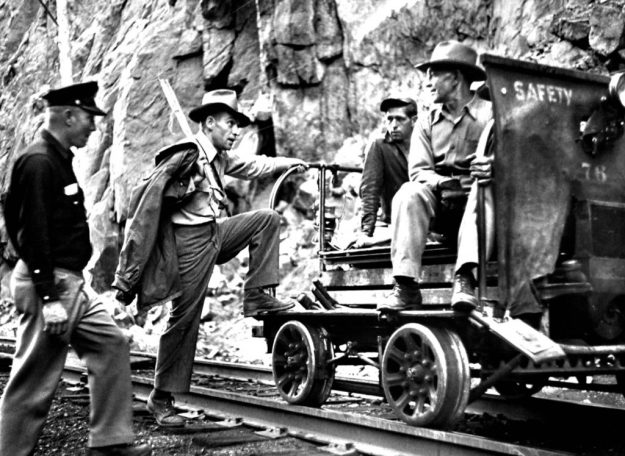
Thirty minutes into his fishing excursion, Dr. Ceriani was called to an emergency: A young girl has been kicked in the head by a horse and was badly injured. [2]
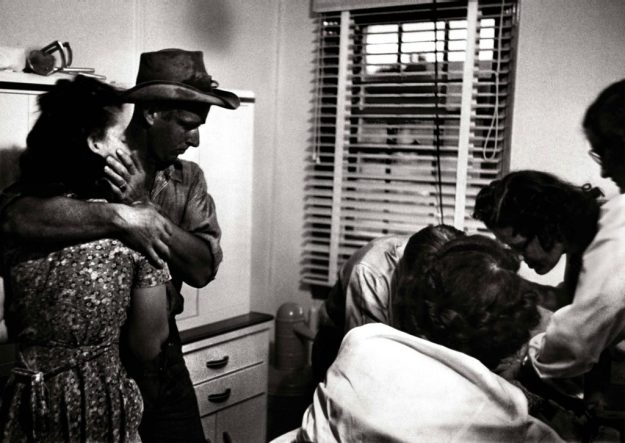
The child’s worried parents looked on as Dr. Ceriani, surrounded by nurses, examined their two-year-old daughter. [2]
Analysis
In this sequence, which is shown in its chronological order as published, we see Dr Ceriani heading along a railway track with two people and fishing equipment. The caption informs us that this is a rare and well-earned break for the doctor, which fits with the photographs of him working hard that precede it in the series. The caption adds some context to the photograph. The next shot is of the doctor enjoying his fishing trip in a simple composition by the Colorado river. The next photograph is of the doctor back at the rail car, this time with a policeman in attendance. The caption tells us that there has been an accident where an little girl has been badly injured. The doctor is being interrupted from his trip to attend to the little girl. The final image shows the doctor tending the girl’s injuries as the anxious parents look on.
What struck me about this sequence was the way that there are sufficient elements within the frame to tell the story without the captions being added. The inclusion of the details such as the fishing rods in the first photograph and the policeman in the third suggest recreation that is being disturbed for some serious reason. The shift from a man enjoying his break to the professional working on his patient is made more obvious by the way that Smith makes him a non-essential part of the final frame (in fact we can barely see him). The drama first introduced by the policeman in number 3 is increased with the worried expressions on the faces of the girl’s parents and the activity going on at the right hand side of the frame. The layers of the sequence build with the increasing number of elements included in the compositions. The emphasis moves away from the doctor as the main subject and the addition of the text narrative in order to tell the story, which has the little girl treated successfully in the subsequent frames. However, this is only a small part of the essay that Smith created. He shot the doctor making house calls for minor ailments, building relationships with this patients and moving on to facing increasingly challenging situations with more serious illnesses. The story that LIFE published, highlighted through Smith’s essay the challenges of living in rural America and the dedication of the care services that are at the heart of the community. However, Smith regularly had disagreements with the way that LIFE presented his work because he had carefully crafted the linear sequence, which they regularly ignored [3]. In Cosgrove’s article [2] there are a number of photographs that depict the doctor in a less dramatic situations, such as delivering a baby, that were not published by LIFE at the time. While Smith would have undoubtedly wanted to portray Dr Ceriani’s more routine activities, perhaps LIFE felt that it diluted the impact of the story. With editorial control, they would have published what they thought would be more impactful to their readers.
Smith’s series is considered a landmark in photojournalism and it easy to see why. The contextual elements in the pictures and the layered stories that play out in the sequence make it a powerful collection that is still relatable nearly 70 years later.
Bryony Campbells’s The Dad Project (2009)
The second photo essay we were introduced to was Bryony Campbell’s ‘The Dad Project”, which told the story of the final months of her father’s life suffering with cancer. I found this photo essay particularly difficult to look at as it mirrors my own experience of the death of my mother 25 years ago. I think the reason it was so difficult is the way that Campbell approached the project. In the video that accompanies the work [4], we first see an interview with her dad in which he describes the thought processes and emotions surrounding the original request to shoot the project. Campbell’s father talks about the opportunity the project offered for him to learn more about what his illness meant for his daughter and in a way understand her more. He also wrestled with the idea of not being the main source of care and support to his family as he saw his health decline. The project would be something for the family to collectively focus on instead of the awful nature of his illness.
The series itself tells a number of stories through the use of a different subjects. The first layer is obviously pictures of her father. He appears as one would expect, to decline in health as the series progresses with the obvious physical effects coming out in the images. The next layer is his family. Campbell uses images of her family and self portraits to describe the more mundane acts of looking after her father as well as the intense emotional reactions to his condition. One of my favourite shots from from the accompanying video is a shot of her parents in conversation (below).
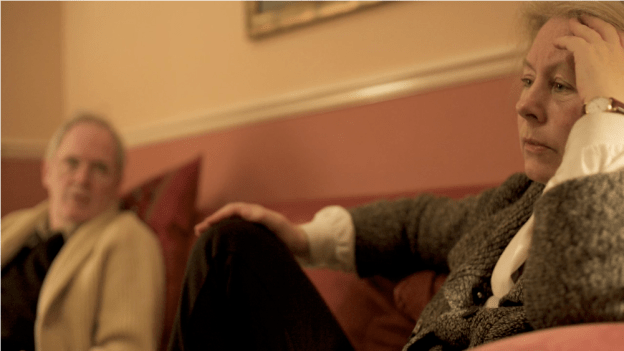
Screenshot of The Dad Project by Bryony Campbell [4]
What struck me about Campbell’s description of how she went about the project [5] was her initial reluctance and discomfort about whether to tackle her father’s illness using photography. Like most people she continued to doubt her decision to start the project as it progressed and only when it became an established part of her family’s experience did she start to appreciate the part that her photography was taking in her coping with the situation. One telling moment in the text is after her dad had passed away when her mother asked if she had enough photographs. Perhaps the most powerful image in the series was taken after his death (below)
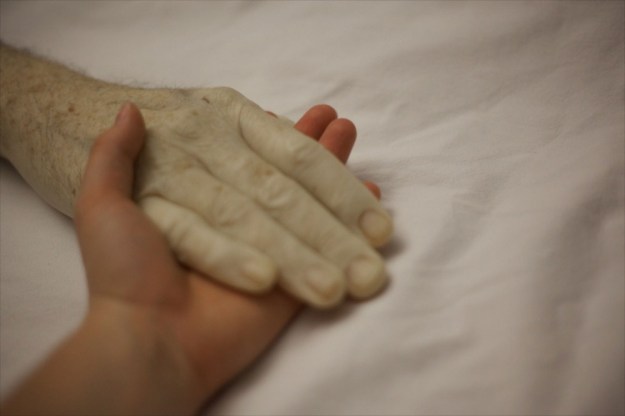
Me and Dad, 2009 by Bryony Campbell [5]
Overall, this project has looked at two very similar but different photographic essays, both in subject matter but also approach. Exercise 2.1 explores The Dad Project further in relation to Smith’s Country Doctor.
References
[1] Kasfikis, P, 2016, “The life of Tony Vaccaro: A Lens into Modern History, Medium Magazine, https://medium.com/vantage/the-life-of-tony-vaccaro-a-lens-into-modern-history-4d0e422b73eb
[2] Cosgrove, B, 2012 “W. Eugene Smith’s Country Doctor: Revisiting a Landmark Photo Essay”, LIFE Magazine, https://www.life.com/history/w-eugene-smiths-landmark-photo-essay-country-doctor/
[3] Abel-Hirsh, H, 2017, “Social Issues – Country Doctor”, Magnum Photos, https://wordpress.com/post/richardfletcherphotography.photo.blog/2126
[4] Campbell, B, 2011, “The Dad Project – Video”, The Guardian, https://vimeo.com/12600297
[5] Campbell, B, 2011, “The Dad Project, Artist Website, http://www.brionycampbell.com/wp-content/uploads/2013/03/The_Dad_Project_Briony_Campbell.pdf
 Richard Fletcher OCA Photography Blog
Pingback: Exercise 2.1: The Dad Project | Richard Fletcher OCA Photography Blog