The depression-era Farm Security Administration (FSA) and it’s approach to documentary is a great example of using photography to bring a national catastrophe to the consciences of people who’s lives were less affected. Formed in 1935, the FSA sought to use the power of photography to drive socioeconomic change in the period following the Great Depression. This use of photography was very contrived in the way that the photographers were instructed to look for certain types of images to support the message. Looking at the story of the FSA, I’m immediately struck by the uneasy conflict of something that undoubtedly was a force for good and the propaganda nature of the imagery itself. Dorothea Lange complained that the preconception of the photographs meant that they were limited by the photographer’s own preconceptions of the subject. Pre-vision in photography is a well-known concept with famous artists like Ansel Adams meticulously planning and visualising the photograph he wanted to make. I’ve always viewed Adams as a hugely skilled technical photographer who’s creativity centred more on emphasising the beauty of the natural world than bringing a message to his photographs. I guess that is how I became interested in photography as it lent itself to my technical interests more than creative vision. What’s interesting about the photographs from the FSA era is that it produced what are now considered to be iconic artworks.
Migrant Mother, Dorothea Lange (1936)
Perhaps the most famous is Lange’s Migrant Mother. When we think about migrants nowadays, we are immediately drawn to the images of people either fleeing persecution in their home country or seeking opportunities somewhere new. However, migrants in the context of the Great Depression were Americans from the poverty-stricken rural areas of the US. The first thing I notice when I look at this image is that we are looking at a seemingly Caucasian family, which during the 1930s must have had the desired shock factor when viewed in the context of politics of the time. This family, comprising a mother and her two children could be anyone’s family. The clear suffering of the family is told by her distant stare, the way the children look away from the camera and the general poor state of their clothing. The other element that strikes me is the absence of the father in the image. Was Lange looking to increase the impact of her suffering by suggesting that it was something she had to do alone? For me, this missing element also creates a sense of protection and love through the composition that the course notes refer to in the comparison with imagery of the Madonna with Child.
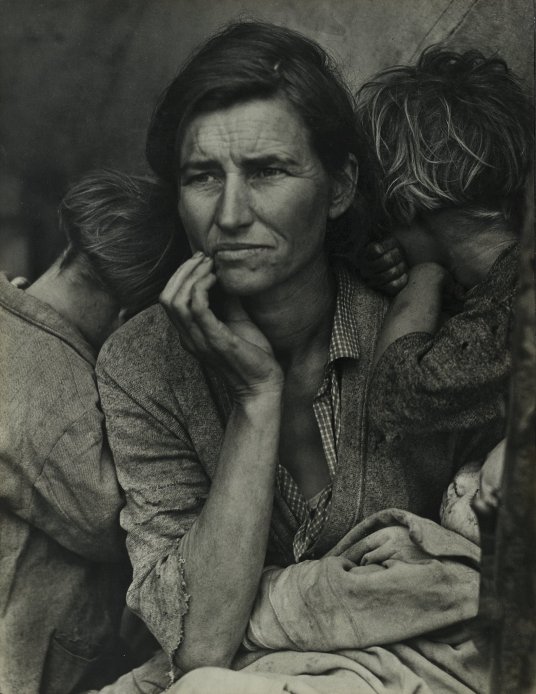
Migrant Mother by Dorothea Lange, 1936 [1]
References
[1] Estrin, J, 2018, ‘Unraveling the Mysteries of Dorothea Lange’s ‘Migrant Mother’, The New York Times, https://wordpress.com/post/richardfletcherphotography.photo.blog/2010
[2] Dotson, B, 1979, “Interview with Florence Owens Thompson, the Mona Lisa of the Dust Bowl, NBC News Broadcast, https://www.nbclearn.com/makeitmemorable/cuecard/1526
 Richard Fletcher OCA Photography Blog