Introduction
Before looking at the effect of citizen journalism in terms of ‘the story’, consider the meaning of the word objectivity. It is given in the Oxford English Dictionary as: the fact of not being influenced by personal feelings or opinions but considering only facts. That is, the whole impartial truth and nothing but the truth. It’s a concept that were all familiar with but that is challenged by the very existence of 24hr news and those who report it. If our understanding of the news is influenced in any way by how we relate to the subject, how we react to the source of the information or how our loved ones see it, then we cannot claim to be objective. However, given that a photograph is a moment captured by the camera, surely it stands a good chance of being an objective report of that moment.
Examples of Citizen Journalism
The first example of citizen journalism that came to mind was the 2019 protests in Hong Kong against the planned bill to introduce fugitive deportations to countries where there was no existing agreements to that effect. The biggest single cause of the protests was that deportations to mainland China would be included in the new legislation which many saw as a potential major impact to the human and civil rights of Hong Kong’s nationals. People took to the streets in protest of the Hong Kong legislature and indirectly, the Chinese government. The protests were captured and widely circulated via both mainstream and social media. An image from the protest can be seen below.
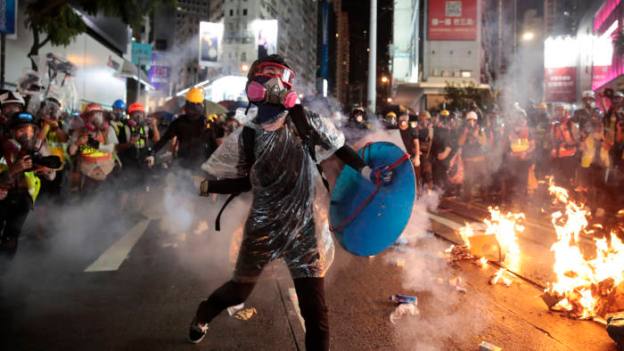
Image of a Hong Kong Protestor [1]
This image was supplied to the Financial Times by the Associated Press and used in an article describing the protestors having blockaded the city’s airport.
In Support of Objectivity
When we look at this image, it is clearly of an intense protest with a line drawn between the protestors and an unseen party. The presence of the cannister still releasing tear gas and the protestor’s clothing supports the story of the police reacting heavy handedly to the blockade. The fire supports the idea in the piece that the protests have escalated to a dangerous level. The image isn’t staged or posed in any way and for me, the photographer having been able to isolate the protestor from the crowd seems more luck than judgement. This all points to it being an image based entirely in objective fact, then?
The Counter Argument
If we look at the image again, we can see some elements that don’t lend themselves to objectivity. The first is the absence of the supposed aggressors, the police. The image only includes the line between the two sides, so it isn’t completely clear which side is the provocateur in this exchange. The fact that there is only one protestor appearing to be throwing objects at this point could suggest alternative story where a cannister is being thrown back at the police. Although makeshift protective clothing suggests being prepared for violence and chemical attack, it could just as easily be that past skirmishes have been that way, that the protection was for defence rather than attack. The final element is that the image is clearly taken from a protest that wasn’t the main point of the FT’s story, which was about the airport blockade. The article mentions that the protest follows riots in the financial district, so presumably this is where this image was taken.
In conclusion about this image, the objectivity is certainly questionable because of what is missing from the frame, e.g the opposing side, and the ambiguity of the actions being taken by the main subject. Images like these that are taken by roving photographers (another can be seen to the left of the frame) are part of a larger set and in many cases, are adjusted in composition through cropping to emphasise the points they are trying to make. If we had another image of this protestor from a different perspective or wider angle, the message could have been very different.
The image below was a frame-grab from video stream at the Occupy Wall Street demonstrations
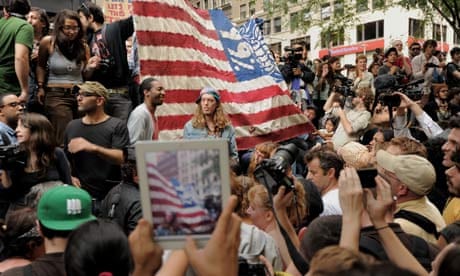
Occupy Wall Street Demonstration [2]
In the case of the protest photograph above, different angles, lengths of clips and instances shot will potentially tell a different story depending on how they are stitched together. For example, the more the footage is affected by the jostling of the crowd could suggest something about the mood or size of the crowd without anything being different from the position this shot was taken from. How can photography be objective when these subtle factors are always at play?
Conclusion
Citizen Journalism is for me modern blessing and a curse. As a consumer, I find it harder and harder to take an objective view of what I see and read in the media, which leads me to increase the number of sources of news that I access. The photographic imagery is often the first thing we see in a news article, so how that image is selected and ‘processed’ steers us in the direction of the story that is being told. What first appears to be a simple document of the event, contains nuances introduced by filmmaker and public alike, sometimes at odds with each other within the same piece.
References
[1]Wong, et al, 2019, ‘ Hong Kong Protestors Blockade City’s Airport, The Financial Times ihttps://www.ft.com/content/84dd7e32-cbe5-11e9-99a4-b5ded7a7fe3f (subscription now needed)
[2] Bulkley, K, 2012, ‘The Rise of Citizen Journalism, The Guardian, https://www.theguardian.com/media/2012/jun/11/rise-of-citizen-journalism
 Richard Fletcher OCA Photography Blog