Image Manipulation and Me
This project discusses the ongoing debate around manipulation of an image to either emphasise or change its ‘meaning’. Having rediscovered photography well into the digital era, my relationship with image manipulation has changed almost inversely with the enhancements in technology. I recall the mantra of ‘include only the elements you want in the frame’ and ‘reduce visual debris to take a good picture’, which I adopted during my early use of Photoshop. Removing or cloning out elements that I hadn’t spotted at the time within the frame, and now considered to be spoiling it in some way, became something I quickly got used to. However, as I have learned more about photographic technique, my interest and sometime reliance on software such as Photoshop has declined dramatically, despite the tools evolving in their capabilities. With my emerging interest in film photography, I am much keener in looking more carefully ay my subject and avoiding the need to remove unwanted content after scanning. My interest now lies in achieving the result in the camera and only using digital techniques to visually enhance what is already present (contrast, toning, dust removal etc). I hadn’t considered that manipulating an image might change the meaning or the intended context, though. I recall an occasion where that deliberate altering of an image for my father was intentionally trying to protest manipulation. My Dad had taken a good photograph of a crane for a competition he was entering. The image, while sharp and well exposed lacked any interest in the sky as the day it was taken was completely overcast. He asked me to add a sky from one of my photographs to his in Photoshop to make it look better. I was so unhappy with this as an approach, given that it was intended for competition that I planned something amusing to make my point that it wasn’t on. Once complete, I sent him two photographs back; one with a bright, cloud-filled sky and one with an additional feature. The latter can be seen below.
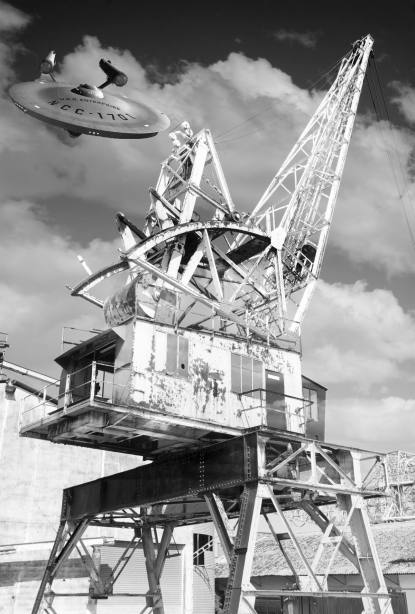
The Crane and the Enterprise
I spent some time locating an image of the Starship Enterprise that had lighting from a similar angle and even matched the mid-tones to the rest of the image. The result made my Dad laugh but made my point (it didn’t get entered, of course). When I look a this image again, though my immediate though is, “is this a still from a film?’ Is the ship crashing to Earth? It has an almost ridiculous SciFi ‘reality’ to it which is far from my intended joke to my Dad. With this in mind, consider the much earlier image referred to in the notes.
Hippolyte Bayard – Self Portrait as a Drowned Man.
Hippolyte was an early pioneer of photography, claiming to have invented a direct positive process before Fox-Talbot and Daguerre. Unlike these two men who went on to become well-known historical figures, Bayard was left unrecognised for his invention. His image ‘Self Portrait as a Drowned Man’ depicts him as a corpse, having committed suicide. The print of the image had additional external context written on the back in the form of an announcement of his death, but it is signed by Bayard which points to it being a suicide note. When we look at the two things together, the immediate thought is that it’s real. Examining the image, the man does indeed appear to be dead and his face and hands in early stages of decay. The body is partially wrapped in cloth with his hat the only personal possession present.
In actual fact, the manipulation taking place here is on multiple levels. The writing on the back of the photograph tells us what is going on in the picture before we have really had a chance to look at it. The assumption is that the camera captures what is in front of it, so in turn is a teller of truth. As the image is from the early days of photography as a technical discipline, there is no reason to question it. As it turns out, though the hat is something that Hippolyte used in a number of his images, so it was included here not as a random act but to add authenticity to the image. The decaying hands and face that the note refers to were created by the photographic process responding to the darker, sunburned skin that Bayard had from a few days before [1]. The final element of deception was the date the photograph was made, 1840. This was suspiciously only a single year since Fox-Talbot’s announcement of his invention at the Royal Society. When we see these elements colluding together, the photograph is clearly a staged piece of ‘fake news’.
Perhaps the more telling of the elements is the belief that ‘the camera doesn’t lie’, which would have had its origins in those early days of photography. People believed science and photography was predominantly a scientific practice to the uninitiated so it must be the source of truth.
Ghost Photographs
I’ve long had a fascination with the supernatural and one of the things that I’ve observed is the desperation that people have to believe what they see. Whether it’s ghost sightings on reality television shows or ghosts captured on security cameras, the question ‘could this actually be real?’ I believe that I saw a ghost while on a school trip when I was a child. It was a figure that appeared at a window of a derelict part of the house we were staying at. Even now, as a rational adult I cannot be certain of what I saw but I remember the experience vividly.
When I look at the photographs of ghosts ‘taken’ in the Victorian era, they certainly appear convincing upon first inspection. The camera has told the truth, surely. When we consider what else is in the frame, the discrepancies between the living and ‘dead’ subjects becomes clear. Knowing that the images are almost always double exposures explains them. For example:
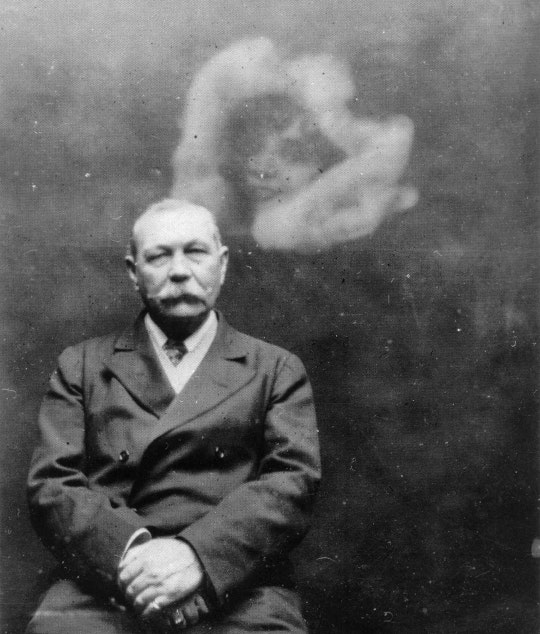
Sir Arthur Conan Doyle and Ghost [2]
In this image, Conan Doyle is seated as if he were having a simple portrait taken. His expression is that of a man concentrating on staying still, rather than expecting something ethereal to be happening around him. When we look at the ghost, the face has highlight and shadow contrast around the eyes and left hand side of the face in a similar way to Conan Doyle, without the definition. Lighting of portraits in 1922 wasn’t particularly sophisticated so it’s not a surprise that the two exposures would have used something similar. The upper part of the image is also overexposed compared to the lower part, which suggests more light (or twice the exposures) for this region where the ghost happens to be. Interestingly, Conan Doyle was taken in by this sort of work which resulted in him investigating
The Cottingley Fairies. During his investigation, he worked with Eastman Kodak [] who were regarded as the authority on photography as well as manufacturer of the materials for making negatives and prints. They concluded that the images of the fairies could be faked with the appropriate level of knowledge of the medium. Conan Doyle believe that such knowledge was beyond that of any teenage girls, so the photographs must be the truth.
Oscar Gustav Rejlander
Around the same time as Conan Doyle was being fooled by the teenage girls, Oscar Gustav Rejlander was creating deliberate multi-composition artworks that preserved the sense of real, while being entirely fantastical. His famous Two Ways of Life is an incredible technical achievement with its 30 individual photographs cut and mounted as a collage. The attention to detail in the individual images with regard to light and shadow mean that the finished tableau works well as a single composition. Here we have a documentary image that is actually a pure fantast of subjects that could not exist easily in one space.
Conclusion
The advent of photography as a technical medium that offered a truth to most people, also saw its use as a creative tool to introduce alternatives to truth. The motives for doing so in the early days of photography were undoubtedly different to what we see today. Where modern image manipulation can be argued as ‘for art’s sake’, the early adopters of the technique used it for exploitative gain. For a legendarily learned man like Conan Doyle to be utterly taken in by the deceit of a pair of schoolgirls speaks volumes. Victorian taste for the macabre made it easy to exploit the supposed ghost photographs for profit. I have never been a true Photoshop guy and am not about to become one. However, I do see the use of manipulation to create context where there may have not been one previously. After all, the painters have used manipulation of the real to create art for centuries.
References
[1] Spair, M, 1994, ‘The Impossible Photograph: Hippolyte Bayard’s Self-Portrait as a Drowned Man, John Hopkins University Press, https://muse.jhu.edu/article/20909
[2] Losure, M, 2013, ‘Sir Arthur and the Fairies, The Public Domain Review, https://publicdomainreview.org/essay/sir-arthur-and-the-fairies
 Richard Fletcher OCA Photography Blog