Monthly Archives: Jan 2020

Practicing What I Have Learned

Introduction

With the end of Expressing Your Vision in sight, I was fortunate to travel to New York to celebrate my birthday.  As with almost everywhere I go, I took a camera with me but instead of simply taking holiday photographs as souvenirs of the visit, I decided to practice the whole concept of EYV.   Prior to this course, I had prepared for a holiday by assembling my camera gear from my large collection which was driven by a whole host of potential ideas of what I might shoot while there.  What I’d learned by Assignment 5 of the course was that the equipment is actually not all that important unless there is a specific project or genre that we have in mind.  My desire to use as much of my collection of cameras as possible on a trip was both tiresome from a carriage point of view and wasteful as much of it went unused.   For this trip, I decided to take a single, simple camera system that I could easily carry around the city and by limiting the equipment choices I could make while there, I was able to start thinking about what I wanted to practice photographing instead.   In the end, I took my Nikon D300 with a 35mm prime and a pair of zoom lenses (one tele and one wide angle).

Once in the city, I started to think about how I felt about the place.  This was the fourth time I would be visiting New York, so the usual tourist stuff had already been more than covered.  For this trip, I wanted to explore the way of life and create photographs that reflected how I see New Yorkers in their environment.  I also wanted to take conventional scenes that ‘everyone shoots’ and seek an alternative way of looking at them.

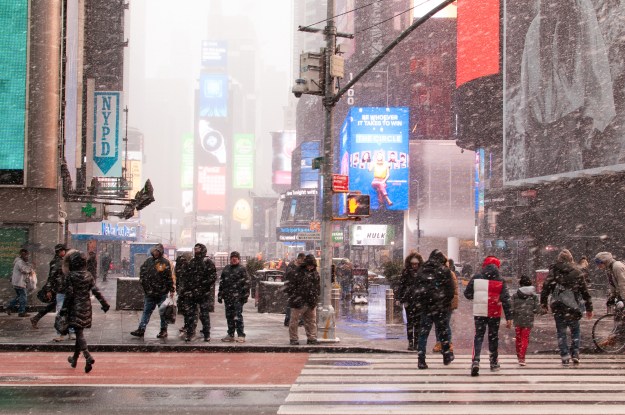
The first experience when we landed was the traditional New York winter weather, very cold and for one day only, snow.  We took a walk up to Times Square from our hotel in lower Manhattan and I took my camera with the 35mm lens attached.  I shot the following images.

DSC_2153

Photo 1

DSC_2141

Photo 2

In Photo 1, I saw the blizzard of sleet ahead of us with Times Square emerging from the gloom and what struck me was the way that New Yorkers take this weather in their stride. We were tourists so we had to go out exploring, but these people were just going about their business and were prepared for the conditions.  It contrasted with my own experiences of similar weather in the UK, where the place almost shuts down at the first sight of snow.   What made this image for me was it being set against the bustling Times Square, which was a destination for these people in midtown Manhattan.

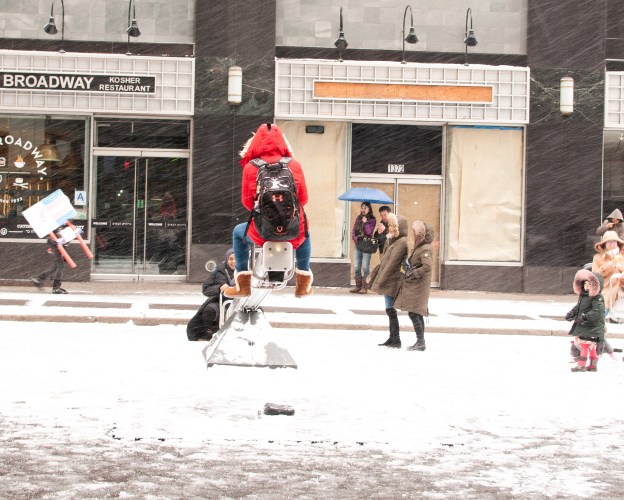
Photo 2 was a scene we came across in the street as we approached Times Square.  The see-saws were a permanent fixture in the pedestrian zone and I guess popular during the rest of the year.  The weather wasn’t stopping these girls from enjoying them and the contrast of the struggling man carrying the sign against the snow, with the spectators set this image off for me.   In both photographs, I was practicing looking and seeing, which is something I wasn’t really actively doing before I started EYV. 

The next day, the snow had disappeared completely and we woke to the weather we would have for the rest of the trip; very cold but sunny with clear skies.  The danger here would be that I could fall back into shooting ‘nice’ exposures of interesting subjects, rather than creating something different.  I decided to simplify my shooting workflow by using just the 35mm lens with the camera set to 400 ISO, and to leave the lens at its widest aperture, which was f/1.8.  This meant that I was setting boundaries for the camera (and for me) where I could only achieve a perfect exposure if the camera could adequately control the shutter speed.  Given the brightness of the day, it could easily be the case that the shutter wouldn’t go fast enough and overexpose.  I was curious to see what the photographs would look like if that happened as well as how my own intervention with the shutter speed might impact the final image.  I had been used to shooting manually, but this could be interesting.  To make things more so, I switched off the automatic preview display on the back of the camera so I couldn’t ‘chimp’; an expression for pawing at the screen to see what you’ve shot.  Now, my DSLR would behave more like my older mechanical film cameras.

The next sequence of shots show the result of taking this approach.

DSC_2482

Photo 3

DSC_2509

Photo 4

DSC_2619

Photo 5

DSC_2646

Photo 6

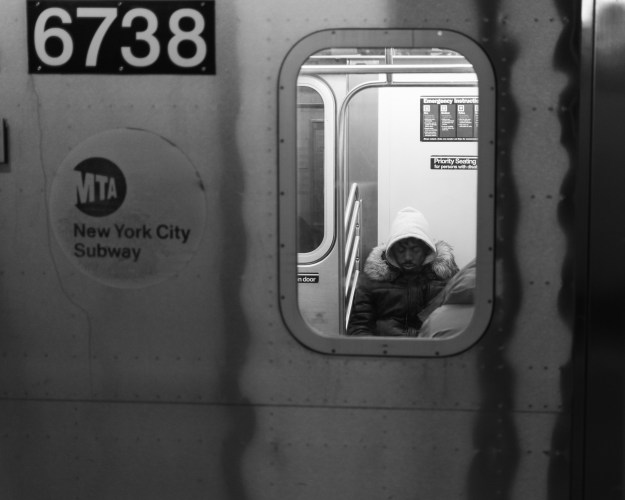
Photo 3 was shot quickly in the subway station after I saw the guy framed alone in the train window.  His impassive expression as he looks at his phone, sums up what taking an underground train means to me.  People are isolated from each other, even though they all share the same tiny space.

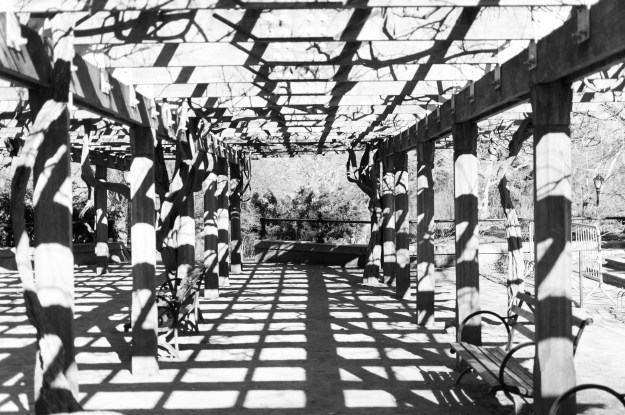
Photo 4 was a pagoda in Central Park.  I was struck by the symmetry of the composition and the harshness of the light as it streamed through the gaps in the structure.  The camera overexposed this image which made it even more dramatic.

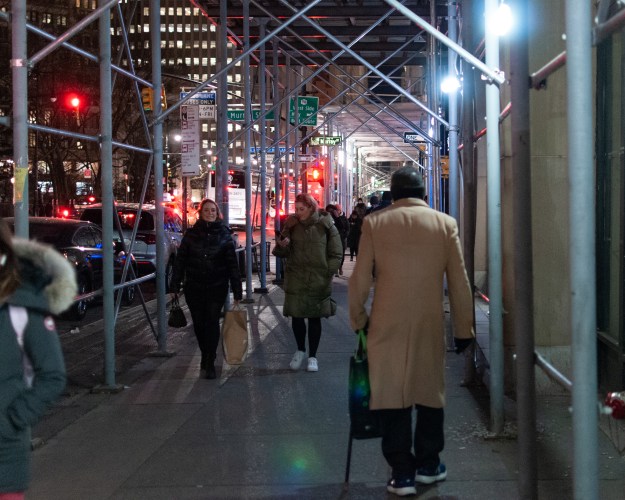
Photo 5 was as the sun went down in the late afternoon.  I saw the gentleman walking slowly ahead of me and the two women approaching, seemingly engaged in conversation but with one distracted by her phone.  The complete disconnect between the characters in this photograph appealed to me in that it reinforced how disconnected city life is.   The whole scene is framed by the scaffolding of the building which reminded me of Lorca DiCorcia’s work when shooting Heads.

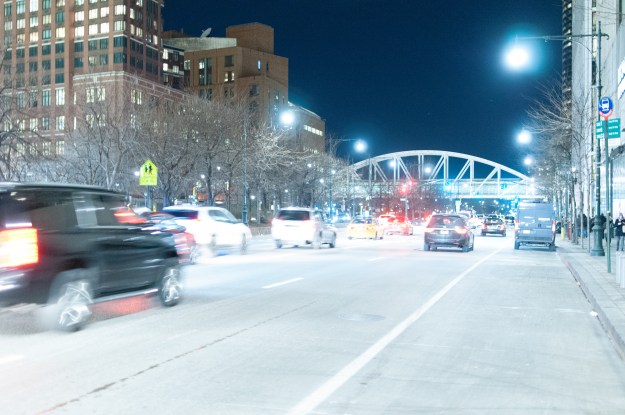
Photo 6 was in the evening on the way back to the hotel.  The city comes alive in artificial light at this time, so I wanted to emphasise the clinical use of  it to light the roads.  It reminded me of my Assignment 4 submission, which had the theme of revealing dark corners.  I manually opened up the shutter for this image which created the movement and brightness contrasted against the blue sky of the early evening.

I had certainly moved away from what I was used to with this series of shots.  I quickly got into the rhythm of trying to say something as I saw a composition and then trying to make the message have impact.  My wife was recently describing the shooting of Assignment 5 to a friend of ours and she said that once I had the idea for an image, I could then fall back on my technical knowledge to make the picture look how I wanted.   The main challenge was to understand what I wanted to create rather than how to create it.  The next series of images show how my thinking has changed over the course of EYV.

DSC_2659

Photo 7

DSC_2675

Photo 8

DSC_2781

Photo 9

DSC_2384

Photo 10

DSC_2391

Photo 11

DSC_2724

Photo 12

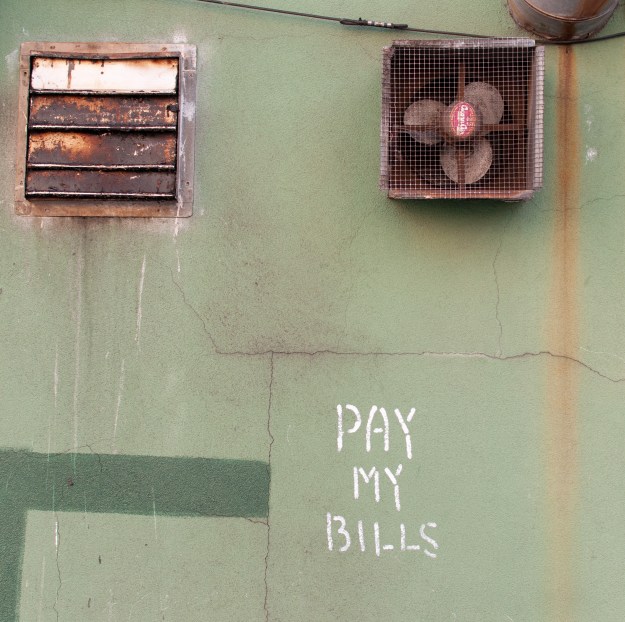
Photo 7 was a piece of graffiti that made me smile when I saw it.  It’s a humorous take on ‘Post No Bills’ that is often painted on walls of building sites in New York in an effort to stop posters or advertising.  When I looked at the area around the writing, I saw that some bills certainly needed paying.  The complimentary colours of the wall and the rust also made the image pleasing on the eye.

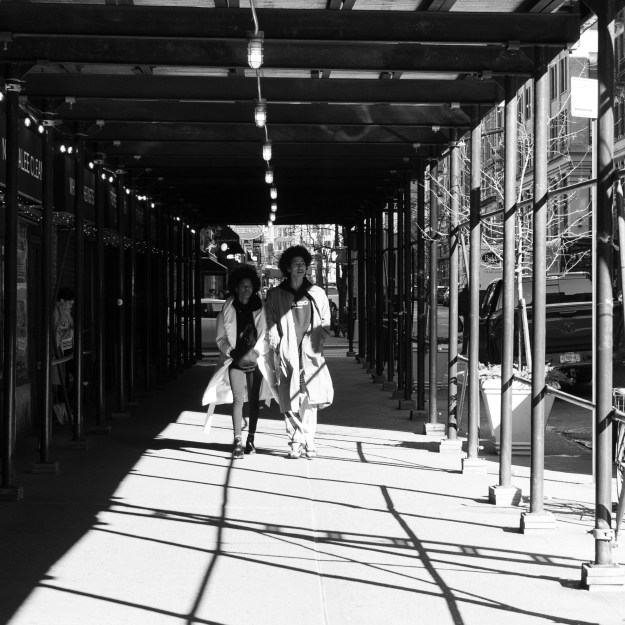
Photo 8 was one of a number of shots I took when I saw this attractive young couple emerging from the shadows.  I had first noticed the high contrast between light and shadow and hoped that I could achieve the symmetry when cropping square.  This was the moment that worked as they are slowly being revealed by the sun.

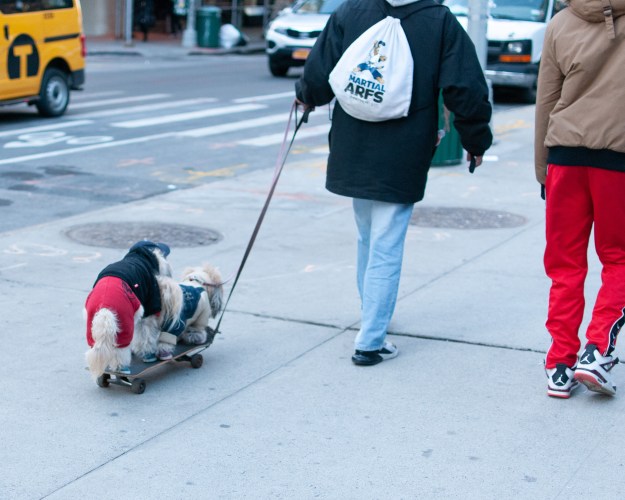
Photo 9 was another scene that could be described as ‘only in New York’.  The two dogs riding the skateboard seemed like the most natural thing in the world, but the other people on the sidewalk were amused by the sight.  I didn’t have a composition that included them, but I noted the comedic slogan on the backpack of the dog-walker which created the impression of humour that I was looking for.

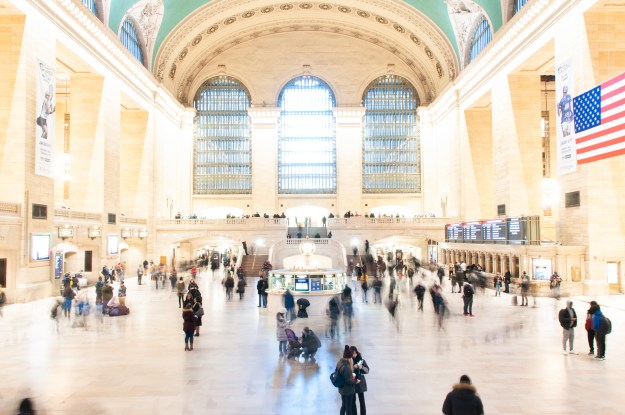
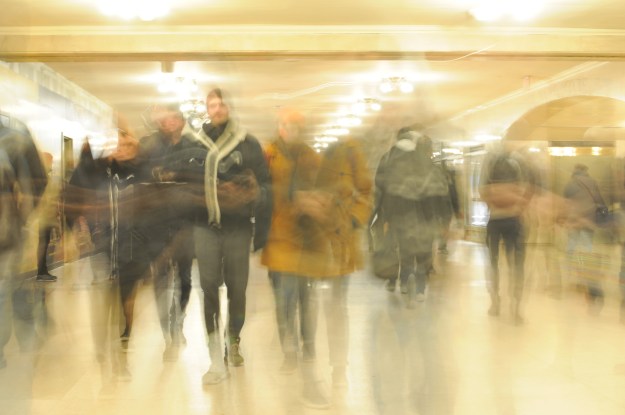
Photos 10 and 11 were shot in the iconic Grand Central Terminus.   I’ve seen thousands of pictures of the main hall, so I thought about how I could shoot it differently.  I’ve seen the room many times and it always has a cathedral feel to me.  The huge windows that Berenice Abbott famously photographed in the 1930s, stream light into the space, supplemented by the artificial lighting.  Oddly, the beautiful ceiling is often left dark when the whole room is photographed, which I’ve always felt was a shame.  This magnificent building is to me then, a cathedral for the traveller.  My photographs show the movement of people through the terminus as they pass through an almost divine light.

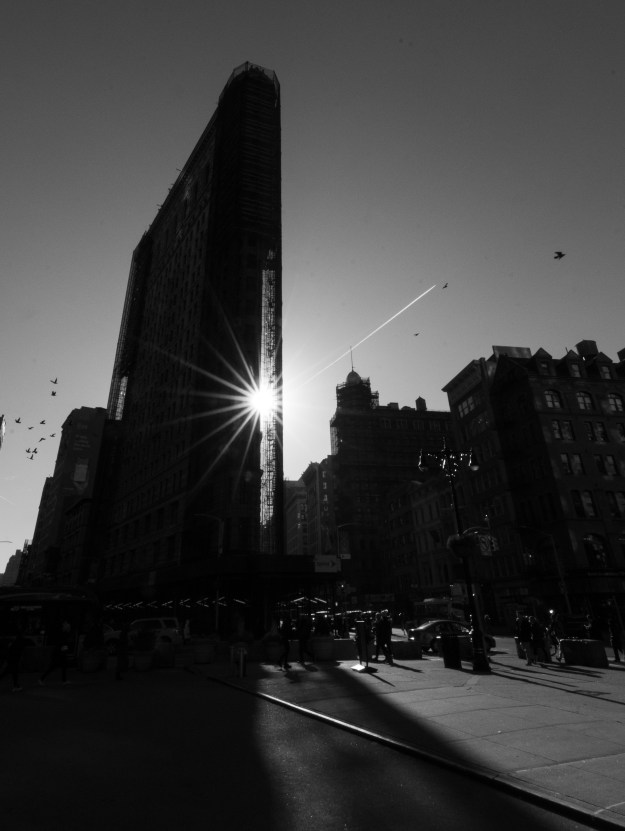
Photo 12 was taken when we went to see the iconic Flatiron Building which again has been photographed many times.  Disappointingly, the building was undergoing a huge amount of renovation work, which meant that it was entirely covered in scaffolding.  I decided that a conventional image of the building would look boring or worse still, not easily identifiable as being of the beautiful wedge shape.  I elected to shoot into the sun and capture it in starburst as it edges past the building’s knife-like prow.  This composition reminded me of Brassaï’s shots of Paris where light was used to envelope the subject rather than simply light it.  I was particularly happy to capture the birds in flight, which contrasted with the aircraft vapour trail.

Conclusion

In seeking to shoot differently on this trip, I rediscovered my love of photography that had been dented slightly during Assignment 5.  I feel as though I’m getting better at letting go of my preconceived ideas of what photography is and what photographs mean to me.  Although I appreciate that I’ve only really just begun to develop as an artist and that there is a great deal more of this degree ahead of me, I’ve had a lot of feedback from friends and family.  The majority of it centres on how I’ve started to chose different subjects in a less obvious way, adding visual tension as well as humour when able.  It’s clear to me that the influence of the artists researched and the feedback from my tutor has begun to shape who I want to be as a photographer.


‘Die’ by Faith Ringgold – A Visit to MoMA

I was treated to a trip to New York to celebrate my birthday in January, which would include visiting the museums that I had virtually been to during research on this course. My intention was visit the Museum of Modern Art (MoMA), The Guggenheim (which has been closed during my previous three visits to the city and the Metropolitan Museum (The Met), which I visiting during a business trip in 2019.  Alas, all three were disappointing experiences for someone looking to see photographic art.  MoMA’s photography room was closed for a new exhibition to be added, The Guggenheim had just completed their Mapplethorpe exhibition and had nothing else in the genre to look at.  The Met was also preparing their space for a new exhibition, leaving a few works by Brassaï and Abbott on display.  I concluded that January is not a good time for this kind of visit.  However, I did encounter a work of art in MoMA that resonated with me.

‘Die’ by Faith Ringgold, 1967

cri_000000425123

Die, 1967, by Faith Ringgold [1]

The piece is a huge canvas measuring some 12 feet across and it depicts a scene of huge violence between a number of people.  The painting style is bold and brightly coloured with an al most cartoon feel to it, but the first thing we notice is that the fight is between black and white people and the horror of the injuries they are inflicting on each other.  What I liked about this particular piece, though was that the audio tour was narrated by the artist herself.  Now 89 years old, Ringgold described how she came to paint this work.  She grew up in Harlem during a period where racial tension spilled into many New York neighbourhoods and I think what initially drew me to this work was the synergy with how things are today.  However, at the time of painting Ringgold felt that nobody was brave enough to portray the brutality of the tension between black and white people as well as how it permeated through every class of society.

In the painting, we see a chaotic scene with men and women of different races engaged in a bloody fight.  Weapons are used as well as physical contact and there appears to be injury of equal measure on both sides.  Ringgold described how she wanted the people to be middle class, so dressed them in elegant business clothing.  The women in particular echo the fashion of the period with elegant short dresses synonymous with the 1960s.  On the left of the painting is a confusing scene with a woman seemingly handing her child to an unseen person out of the frame.  When I first looked at this, I thought she was showing her child to the black figure in front of her, as if to say “look what you have done!”.  Ringgold’s explanation, though is one of protection of her child and the act of handing the little girl to someone for safety.  Children are used again in the painting, this time with a white boy and black girl handing on to each other with looks of sheer terror on their faces.  Ringgold explains that very young children of conflicts such as these don’t identify with sides and in this case, her depiction is of them protecting each other from the nightmare around them.   It’s true that as we get older we are introduced to the ideas of prejudice and hatred as we learn what we like and don’t like.  The children here then are shown to be completely innocent in their outlook.  When I first noticed them, I was immediately saddened by their innocence being their only form of defence as they huddle together.   The final element that Ringgold pointed out was the use of the sidewalk as the backdrop.  The simple slab pattern symbolises the way that this scene could be any city or town, not just New York and for me was a powerful element that really set off the picture.

This painting, and Ringgold commentary was the highlight of the visit which had threatened to be a disappointment.  I was drawn into the scene not because of its graphic nature, but more because of the elements that created a multi-layered narrative around race, fear, protection and innocence.

Reference

[1] Monahan, A, 2018, “Faith Ringgold – Die”, Gallery Guide, Museum of Modern Art, New York

Assignment 4 – Post Tutor Feedback

Introduction

This post is essentially a restructure of my thoughts and comments made immediately after I received the tutor feedback.  In preparation for assessment, I’ve further expanded my reflection on this assignment, considering some of the areas where it could have been enhanced or developed further.  This includes any additional research carried out and any re-working that I have done to improve the way the photographs meet the original brief.  The overall learning points are also summarised in my final post “Reflecting on Expressing Your Vision” which can be found in my Learning Log.

Tutor Feedback

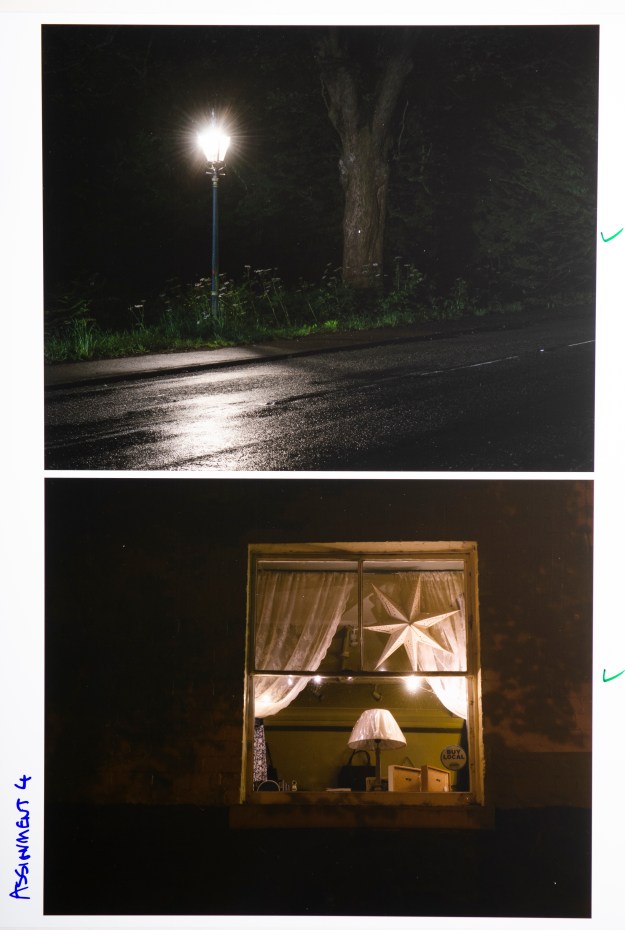
The feedback from Assignment 4 was very positive and during the video call with my tutor, we discussed how I found this assignment to be relatively straightforward being  predominantly technical.  I agreed that it was something that I had found comfortable, as most of my photography over the past few years had been to better my technical understanding of how to take good pictures.  What I wanted to do with this assignment was create a simple but effective narrative around lighting dark corners with artificial light connecting the series that way.   Adding the gradual increase in lighting intensity through the series was another way of connecting them, albeit again entirely technical.  I believed the connection to be subtle enough to be artistically interesting.  The main point of feedback that came from this assignment was that I needed to consider a more layered approach to connecting the series.  What I interpreted this to mean is to create connections through style, the interesting detail of the subject and less obvious aesthetic qualities that could be represented in each image.  In my assignment, the connections were those of artificial light as per the brief, the lighting of dark areas that reveal something about the subject and the fact that they were all shot in my home town.  I could have expanded further by focusing on an aspect of my home such as its Victorian grandeur, as with the gaslights in Photos 1 and 3, or the faded glamour, or mix of eras and styles as with the shopping arcade in Photo 8.   When added to the theme of the original response, these layers of connection could have moved me away from the technical domain and into the more creative space.

Although I didn’t elect to reshoot any of Assignment 4, following reflection on the feedback I did push myself to move away from the technical in Assignment 5.  The degrees of success can be seen in the post for that assignment.

Assignment 3 – Post Tutor Feedback and Re-work

Introduction

This post is essentially a restructure of my thoughts and comments made immediately after I received the tutor feedback.  In preparation for assessment, I’ve further expanded my reflection on this assignment, considering some of the areas where it could have been enhanced or developed further.  This includes any additional research carried out and any re-working that I have done to improve the way the photographs meet the original brief.  The overall learning points are also summarised in my final post “Reflecting on Expressing Your Vision” which can be found in my Learning Log.

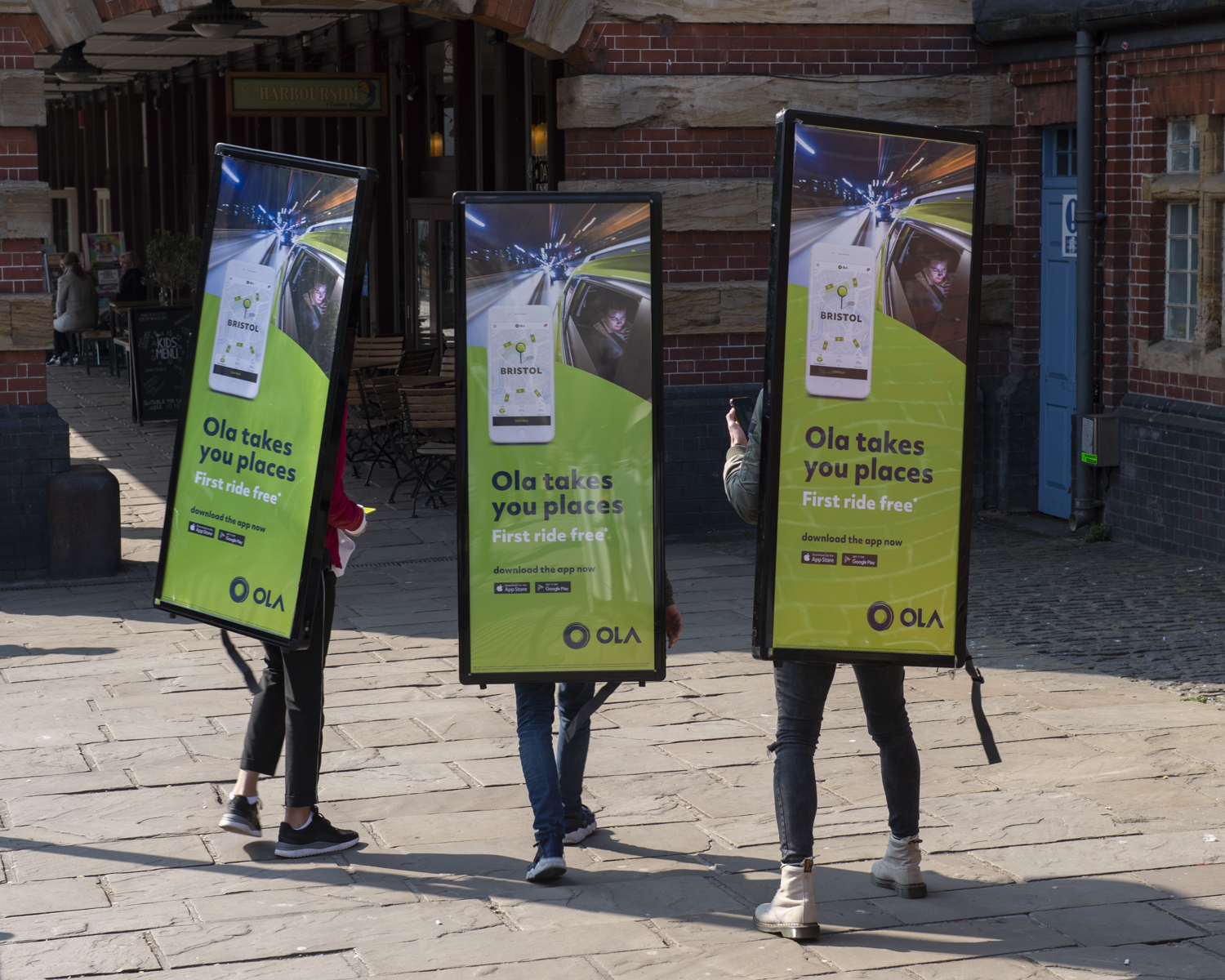
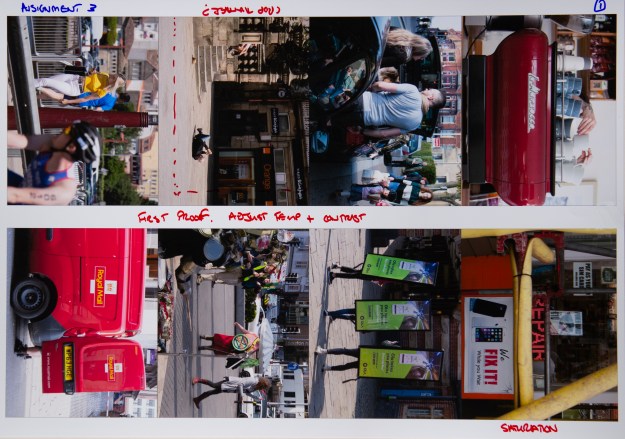
At the time that I received feedback on Assignment 3, I did not write a formal response.  The feedback had generally been positive about how I had approached the decisive moment, acknowledging my difficulties both with this genre of photography and my intention to include partial obscurity as a humorous element.  The original series can be seen below:

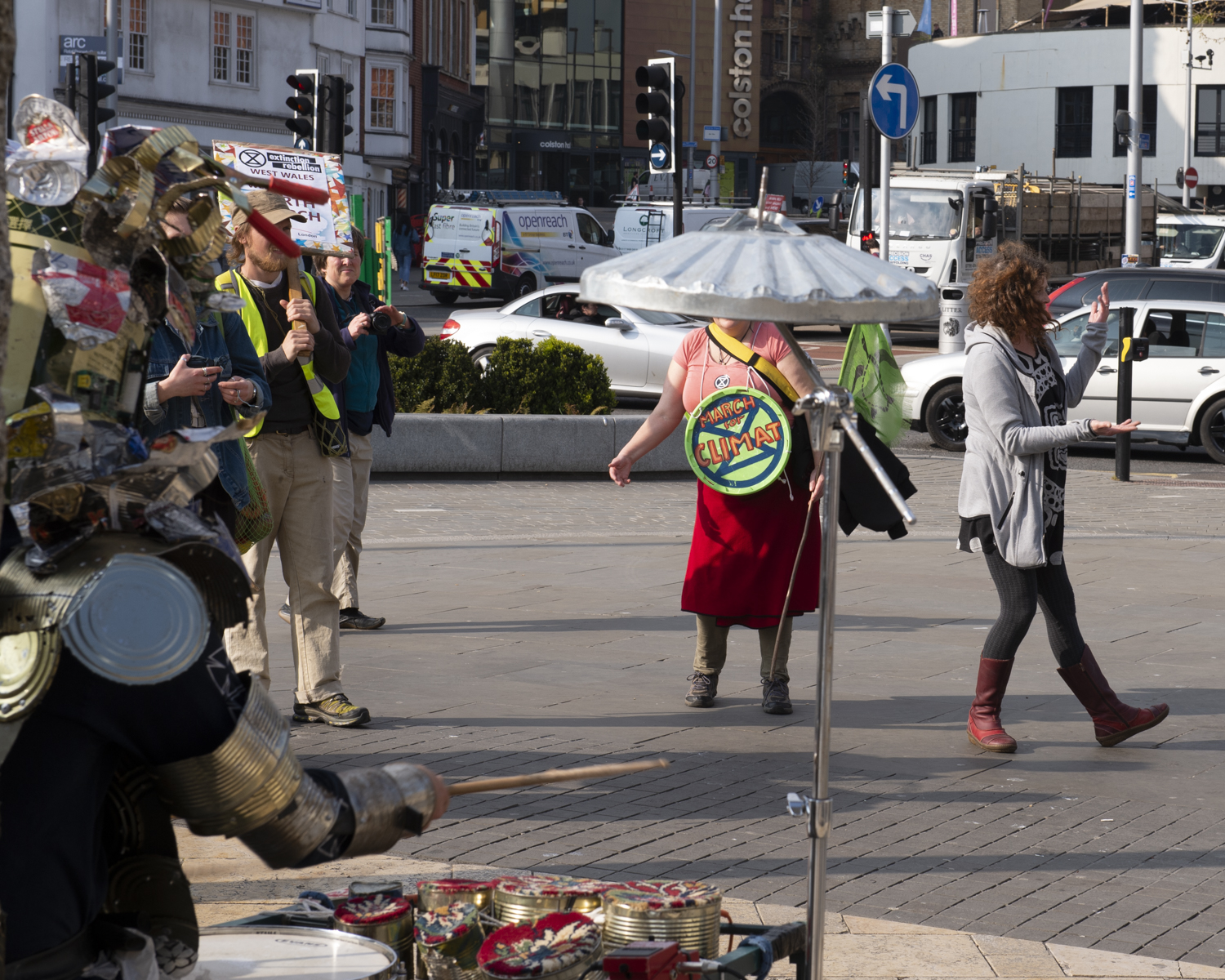
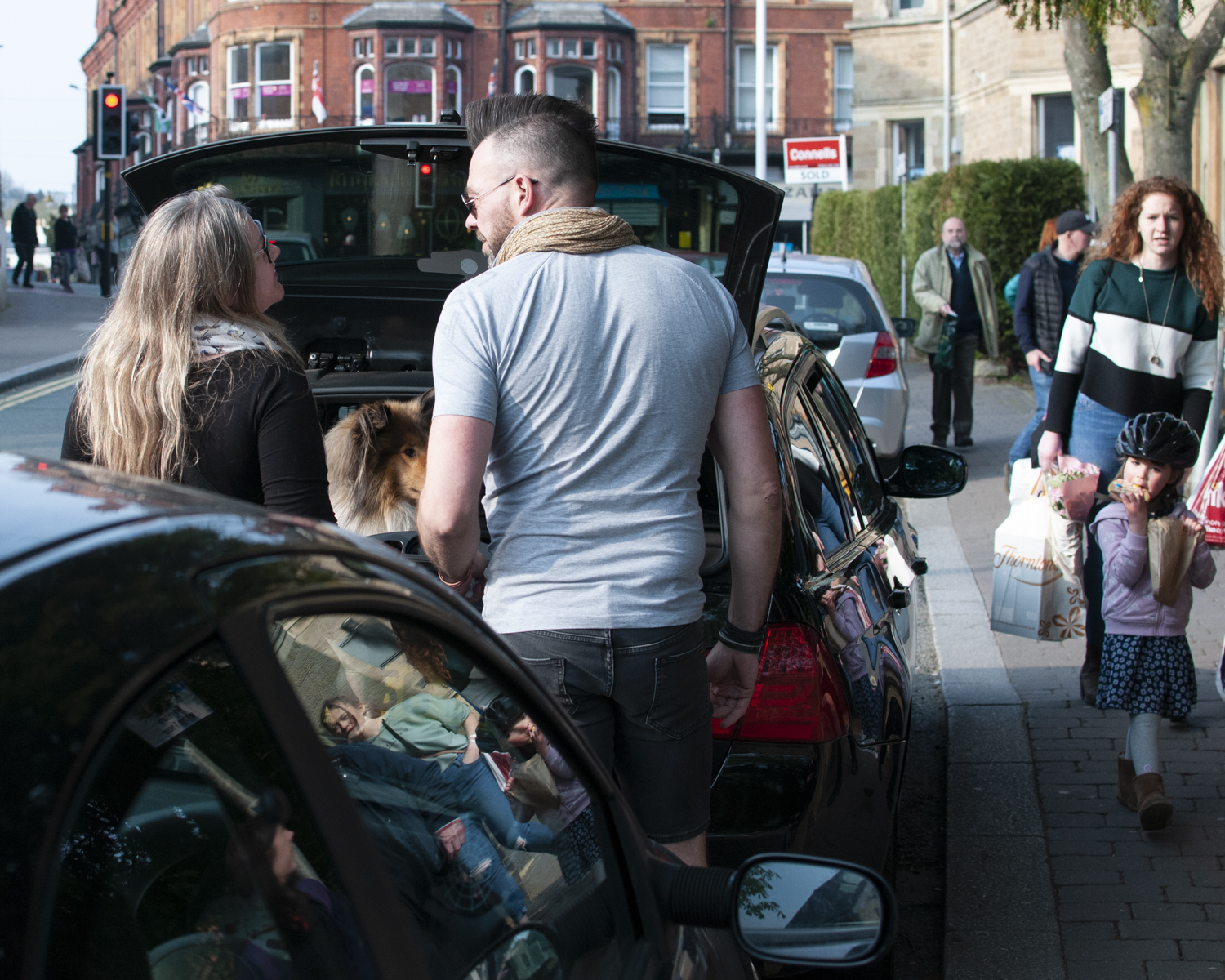
However, my overwhelming feeling from the feedback was that the series wasn’t particularly strong.  My tutor stated that he liked Photo 1 because of the colours more than the moment.  I was disappointed with as for me the ‘moment’ was the scrolling  ‘repair’ sign and the humour came from the fact that the building is covered in scaffolding.  Photos 2 and 5 were said to have worked in terms of the decisive moment, while 3 and 6 were said to be a little too busy to get the impact.  I thought at the time that these comments were fair as both appeared to lack balance in the elements around the frame.  Photo 4 was felt to be a little less interesting than it could have been.  I didn’t agree with that as the postmen in the image were working quickly and only in that position for the briefest of moments.  I do understand how that doesn’t come out in the image, however.   Further reflection on Photo 6 and some feedback from Rob Bloomfield during our cohort video call, led me to a different conclusion about how well it works.  I had just missed the moment I was looking for where the dog first emerged from the back of the car, but I’ve since noted the other moments that are going on in the photo.  The conversation between the owners of the car and the reaction of the little girl on the right hand side of the frame point to another moment in the image; when she sees the dog.  I always liked the balance of the image with the reflection of the rest of the girl’s family in the window of the car in the foreground.  My tutor was right about the original moment being missed, but as Rob stated on the call, the image still had impact.

I elected to keep it as part of the series as a result, but also because I had to present at least 6 images.    This was the overwhelming reaction to feedback on this assignment for me; the series was minimal in number and lacking in impact as a result.    I considered how I might address this beyond the assignment and realised that in learning about the decisive moment, I had learned how to look.   I rarely leave the house without a camera and had noticed since this series, that I was now looking for events unfolding in front of me more than I was before.  I decided that if I saw further moments I would consider adding them to this series to strengthen the impact.

Re-working the Assignment

Photo 3

The first change I made to the series was a re-crop of Photo 3.  This had been felt to be too busy, distracting from the main subject of the woman obscured by the makeshift cymbal.  The original and revised can be seen below, with some adjustments to the colour temperature added, which are present in the final version for assessment:

I considered the balance of the frame, so I still needed the drummer and the small group of people cheering her on to be in the image.  However, by reducing these elements, the main subject is now larger in the frame, which I think makes the picture more impactful.

Additions

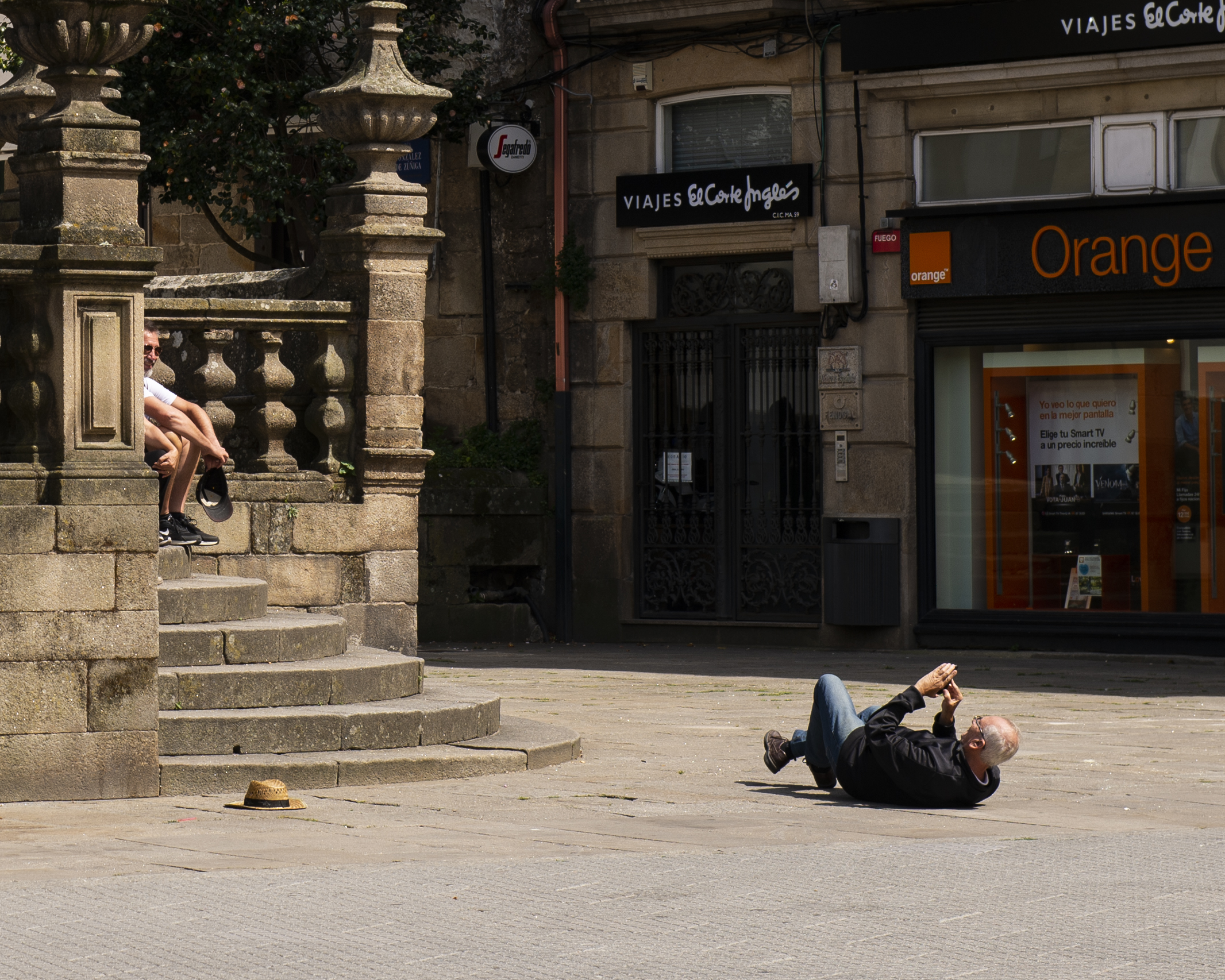
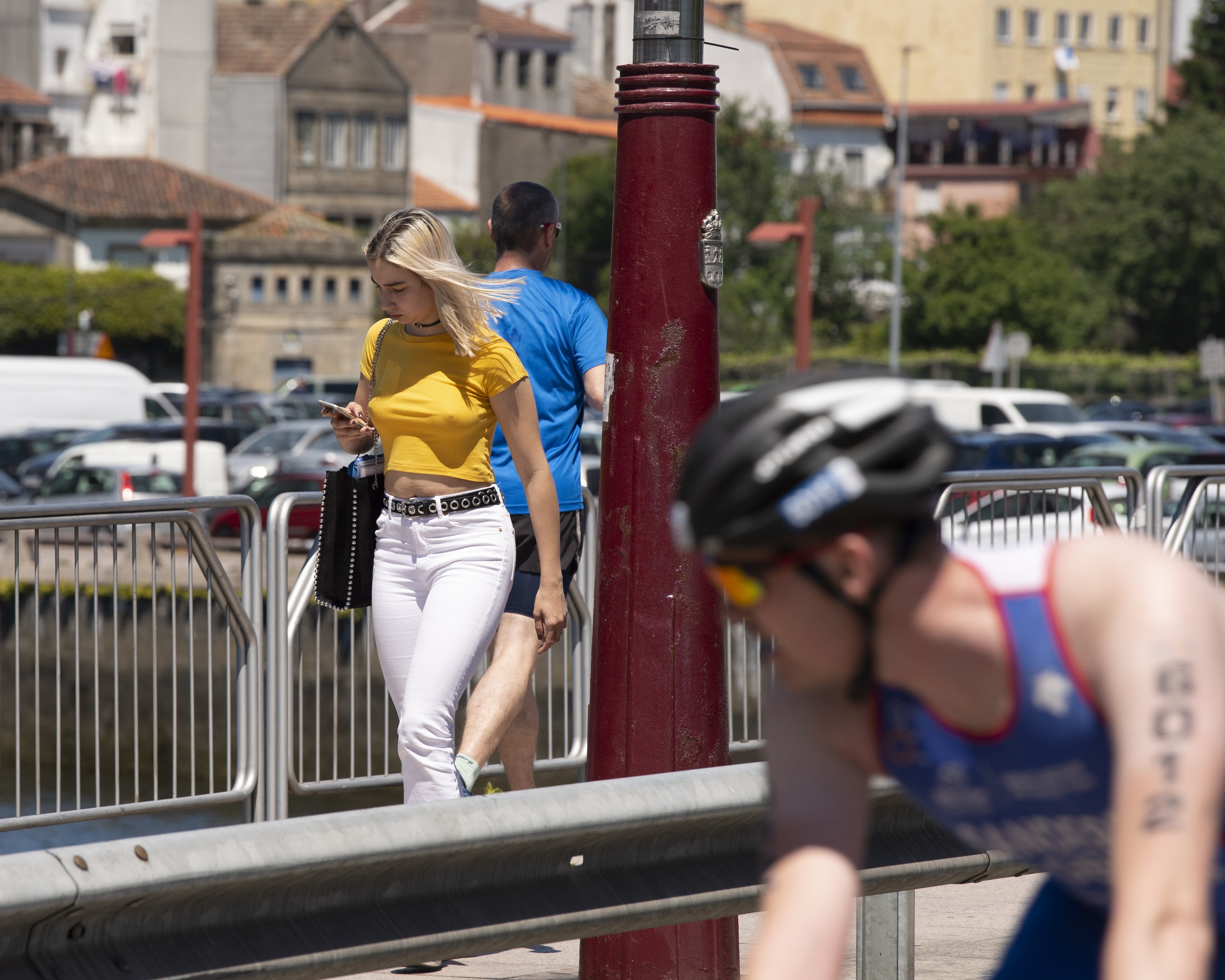
During the months that followed, I continued to look for scenes that had both humour and the obscuring of the subject in the frame.  While supporting my wife at a triathlon event in Spain, I captured two moments that I felt fitted this series well.  These can be seen below.

Photo 7 was an encounter in one of the town’s historical squares during the ‘rest day’ at the event.  As we rounded the corner of the church, I saw the photographer roll onto his back to shoot his friends sitting on the steps.  He’d thrown his straw hat nonchalantly on the ground before setting up to take the shot.  It was a fleeting and amusing moment to me, made better by the fact that we can barely see his subjects behind the stonework.

Photo 8 was a moment that I had time to get into position to capture.  My friend who was shooting the race with me pointed out the young lady walking along the pavement from a distance.  I took this shot as the cyclist came into view and it shows him looking to his right as he passes her.  The bridge we were on was completely straight, so the cyclist had clearly started to look at her when she was obscured by the lamppost between them.  I liked the way this moment was captured as the obscuration is between the two subjects in the frame rather than the subject and viewer.

With these two images added, the series was now presented as below.

Conclusion

After making the changes to the series, I was happy that it now had more impact.  I was always uncomfortable with shooting this assignment because it involved photographing people without them knowing, required me to get closer than I would normally do and was made more difficult with my inclusion of the other themes.  I don’t find this style of photography any easier for having done this assignment, but I did learn to keep looking even though the project was complete.  I also learned that I overthink projects which effectively paralyses me in getting started; this assignment taking the longest to complete of the five during this course.  What I should have done was more experimentation to try, and potentially dismiss anything that I didn’t feel worked on the fly.  That way, I would have settled on the idea more quickly and completed the series without the self-imposed time pressure that I had experienced.

Assignment 2 – Post Tutor Feedback

Introduction

This post is essentially a restructure of my thoughts and comments made immediately after I received the tutor feedback.  In preparation for assessment, I’ve further expanded my reflection on this assignment, considering some of the areas where it could have been enhanced or developed further.  This includes any additional research carried out and any re-working that I have done to improve the way the photographs meet the original brief.  The overall learning points are also summarised in my final post “Reflecting on Expressing Your Vision” which can be found in my Learning Log.

Initial Response to Feedback (from the original blog post)

I’ve received my tutor’s feedback for this assignment recently.  It was very positive about my approach to my collection, starting with my initial inspiration and progressing through my research.  The variety of my research including Plutchik’s work on visualisation of emotions was highlighted in the feedback as well as the breadth of research into the painters.

The areas that were suggested to progress the assignment revolved around viewer response.  Although my tutor stated that the images worked as a set, he suggested that feedback from others would give me sense of whether I had achieved what I set out to.   I have since asked a number of people to read this blog post and they all confirm that what I described as my idea, works in the photographs.

I had another suggestion from my tutor to look more closely at the lighting effect used in the film that inspired me at the beginning.  The use of the technique was used in early cinema to increase the mystery of the character.

On the whole, I’m very happy with how this assignment went and the reaction of everyone that has read the blog post so far.

Expanding my Review (January 2020)

In the 12 or so months since I submitted this assignment to my tutor, I have been testing how people have reacted to it as suggested in the feedback.  The first decision I made in presenting the work to people was to to continue with the ‘grid of 9’ format.  This came from a period where I reflected on each image as part of a series.  My conclusion from that review was that each image does have impact in its own right, but the cumulative effect of showing them all at once is far stronger.  In the grid we see the differences in emotions from each model, as well as common groups of expressions that could create similar viewer perspectives across the different models.  When I recall the studio time, I remember how each model sat for the shoot and as the conversation flowed, their emotions changed with each topic.  I feel this is much more strongly represented when the images are shown as a grid as we can almost see this evolution across them.

I then began to show the work to a number of people who had some interest in art, whether as a photographer or painter.  The first reaction was from a fellow photographer with whom I had discussed the idea for this assignment before shooting it. His reaction was largely technical and while he appreciated the shoot maintaining the same lighting and broad composition, he was disappointed that I had limited my attention to the eyes only.  His understanding of my idea was more around the power of eye expression within the context of the rest of the face.  Although he accepted that he had perhaps misunderstood my idea, he didn’t believe that the series worked.  I tried to get him to be more specific about his criticism, but he wasn’t comfortable doing so.   This was a learning point for me as I realised at that moment that I was looking for people to ‘like’ my work.   The fact that we are friends meant that he wasn’t really prepared to explain why he didn’t for fear of offending me.

The next few critics of the work were much more appreciative of the way the images worked in the set.  One piece of feedback was that one could look at them for a long time before forming a confident view of which emotions were being revealed.  Also, taking time to review them together revealed the connections between the way they were arranged as I mentioned previously.  One person suggested that the symmetry of the compositions was almost like that of a flag.

A discussion with a local painter was different again.  She stated categorically that she didn’t like the work as it made her feel uncomfortable.  She appreciated what I was saying with the piece, but felt that she didn’t really want to look at it for any length of time.  I wondered if this was more about human contact than looking at a photograph, and after some research concluded that her reaction may have been about making eye contact.  There are many studies about why people struggle to make eye contact apart from the problems suffered by autistic children that I mentioned  in the original assignment post.  People believe that they are being penetrated by the viewer’s gaze, whether it is welcome or not.  An article in business magazine Inc [1] described this as:

Direct eye contact opens a door to the person inside you, without your permission. The less authentic you are — and the more you worry about being judged, the more the more uncomfortable this feels. If you overcome this by over-compensating, you could lose trust.  [1]

While I don’t believe that my friend has a problem with authenticity, I would describe her as very private, so it made sense that she might have felt that the eyes were looking at her from the picture.  What I also learned from this feedback was that I shouldn’t be looking for people to like my work, but to have some form of reaction or experience by viewing it.  I pointed out to her that I really didn’t mind that she had reacted that way.

The final feedback I received was when the images were being mounted for assessment. The picture framer and I were discussing the distances between the photographs in the multi-aperture mount that they would be presented in.  Her view was that they needed to be seen without the viewer having to actively look around the frame.  Instead, there should be an initial viewpoint from which the viewer can then look more closely at each image in the set.  I was reminded of Exercise 1.4 – Frame earlier in the course where we had to place our subject at a specific position in the frame.  Only afterwards were we to consider the rest of the space.  That exercise was the inspiration for my presenting the photographs together, so I felt that this feedback supported my original intention.

Overall, I was very happy with this set and elected not to re-shoot any of the images.

References

[1] Storoni, M, 2017, “If You Don’t Know Why Eye Contact Makes You Uncomfortable, This Is It”, Inc.com, https://www.inc.com/mithu-storoni/the-powerful-reason-youre-so-afraid-of-looking-int.html

Assignment 1 – Post Tutor Feedback

Introduction

This post is essentially a restructure of my thoughts and comments made immediately after I received the tutor feedback.  In preparation for assessment, I’ve further expanded my reflection on this assignment, considering some of the areas where it could have been enhanced or developed further.  This includes any additional research carried out and any re-working that I have done to improve the way the photographs meet the original brief.  The overall learning points are also summarised in my final post “Reflecting on Expressing Your Vision” which can be found in my Learning Log.

Initial Response to Feedback (from the original blog post)

I had my tutor feedback on this assignment during our first Skype call this week.  The feedback offered some insights which, on reflection make perfect sense to me as well as being in agreement with my personal observations.  The key points were:

  1. While my approach to the brief was good, the subject I selected was very broad and as such, the limit of 12 photographs was probably insufficient to do it justice.  My tutor highlighted two areas of my submission, the loss of the railway and the village being in a popular television series as being potentially subjects for the assignment in their own right.  The absorption of the railway into the landscape following Beeching’s closures could be developed to include the socioeconomic impact on the village as well as other, related industrial absences that have been part of the village’s history.   The more interesting idea to me was our discussion about the television series.  My tutor comes from a film production background and worked in television.  The insight was that when television programmes are made, the producers define how they want the viewer to see the subject, as opposed to how it is in reality.  They do this for context as well as creating an asthenic in which the action can take place.  In the case of Askrigg, it would be interesting to compare the reality of Yorkshire village life with that created 40 years ago in All Creatures Great and Small.   A project for the future, for sure.
  2. The other notable feedback was on my use of titles for the photographs.  When you think about it, a title for a photograph suggests and even directs the viewer to what the photograph is about.  If the photographer is telling a story with an image or collection of images, there should be no real need to title the photograph.  This isn’t a hard rule, of course as many photographers title their work.  The feedback to me was to let the viewer make up their mind and see how effective that narrative is without the aid of direction.  I thought this was great advice.

On the whole, the feedback on the assignment was very positive, which has given me a great deal of confidence to proceed with the course.

Expanding my Review

Assignment 1 was the precursor to Expressing Your Vision, which introduced me as a photographer to my tutor.  At the time, I didn’t really appreciate the concept of a photograph’s context, that is how an image can have multiple interpretations dependent on a number of internal and external influences.  This means that the relatively simple advice of removing the titles from my photographs was a powerful statement.  Having not been experienced at assembling a series of photographs on a theme before, I had a need to explain them to the viewer, effectively providing my perspective as their starting position.  In other walks of life it can be very frustrating when someone asks a question of us and then proceeds to answer it.  By removing the titles of the images and external context out of the assignment, it was easy to see where the weaknesses in the series were.   The question I asked myself when reflecting on this assignment later in the course was what really links the photographs together?  I knew that my response to the brief was too broad, but leaving that aside the other issue that was apparent was the lack of layers in the connections.  There is little beyond the crop ratio and the fact that they are all colour that physically connects them, which led me to thinking again about the aesthetic referred to in the feedback.

Think of a wider context – paintings for example, of even the way the TV crews photographed the village for ACG&S

I mentioned at the time that looking at how the aesthetic of 40 years ago in the TV series compares to real life today would be an interesting project and while I haven’t fully researched this, my thoughts are summarised below.

The TV Series

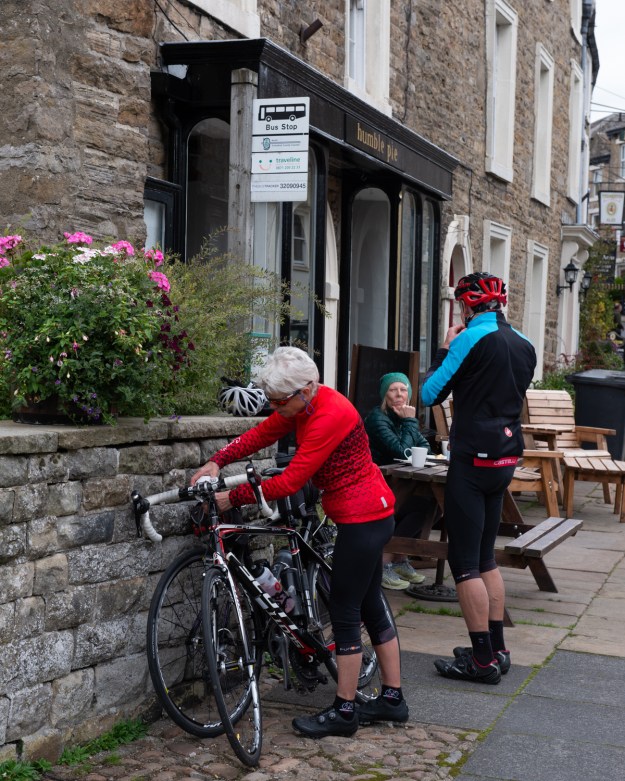
All Creatures Great and Small was made into a TV series in the 1970s and depicted 1930s rural Yorkshire as the setting for a veterinary practice.  As I mentioned originally in the assignment, Askrigg was used as the location for the fictional Darrowby and my immediate thoughts when looking at an image from filming and one of my modern photographs of the village are that things really haven’t changed all that much.


0fc3f696-4b4a-47c5-aae9-e08409e14146_l

An exterior shot of the stores from the TV series [1]

Cafe Stop

The same shop front, now a cafe (from Assignment 1)


The Aesthetic

Rural North Yorkshire is well known for being traditional and in places, largely untouched so it wasn’t a surprise that the details are similar.  However, when looking at the way the TV series portrayed the area a number of visual themes presented themselves.  The first is the sense of wide open space and fresh air, which contrasts with the general social and economic problems of the 1930s following the Great War and subsequent economic depression that occurred afterwards.  The Herriot stories revolve around a great sense of traditional community set against this rural backdrop, so this is portrayed in the imagery.  For example, in the photograph above Heriott is seen settling a dispute in the street between neighbours; something I recall my Grandmother telling me was a common occurrence in rural England.  An educated professional such as a vet would be respected by almost everyone, so this image of him involved in a brawl creates the impression of his importance in the setting.  In the publicity material for the programme, the sense of gentle nostalgia is further reinforced by the idea that colleagues become family when one works in the countryside.  An example of this can be seen below.

methode-sundaytimes-prod-web-bin-a2703ee0-197f-11e8-a5d9-69d395ae2ec3

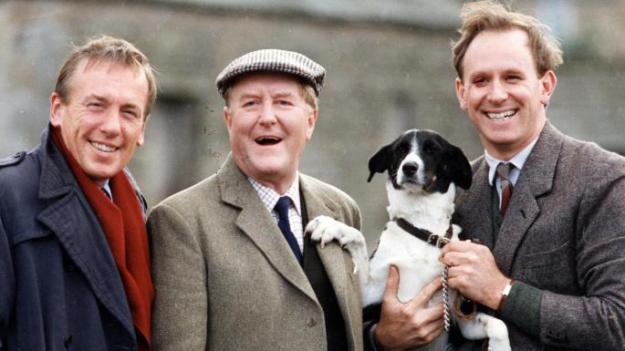
Colleagues, friends and animals.  A publicity shot from All Creatures Great and Small [2]

Here we have the principle characters posed in front of the blurred stonework of a typical North Yorkshire building.  The image contrasts the older, more established vet in Siegfried (Robert Hardy) and the two younger Herriots (Christopher Timothy and Peter Davidson) and adds the dog as the contextual element suggesting they are vets.  At the time of shooting the assignment, I had not noticed the skill with which a visual aesthetic is created by film-makers.  This programme came out in 1978, a year of continuing political turmoil that culminated in the so-called ‘winter of discontent’, which would ultimately lead to a change in government.  It’s perhaps not a surprise then that the nostalgic look and feel of a tiny, fictional slice of 1930s rural Yorkshire would have such an appeal as a form of escapism.

Since looking into the way that the original series was shot, I have learned that a more recent series of prequel stories was planned, but then shelved in 2012.  The only photograph I could find from the promotional material is shown below.

Young-James-Herriot-008

Promotional Shot from Young James Herriot [3]

Here we have a more bleakly imagined countryside with stormy weather and the misty hills behind.  The characters, supposedly depicted as they start there careers in Glasgow are more serious looking than the charming version from the original series.  For me, this single image creates a sense of determined ambition that most people have when they start their careers.  Although set even earlier than the original, there’s something relatable when we consider the cultural landscape of the so-called ‘millennial’ professionals of the 21st Century.

Conclusion

I’m still happy with the photographs I shot for Assignment 1, but with the knowledge gained from the later stages of the course, I can see how their impact could have been increased by reducing the complexity of the theme and through creating an aesthetic that reinforces it.  I could have followed the TV series vision of a countryside idyll with the walking or cycling themes or instead picked out viewpoints that steered more towards the industrial railway and roads themes.  Either would have potentially stood out on their own but were lost within the broad scope of my actual theme.

I elected not to re-shoot or alter the series because I had completed it during a holiday in the area and was unlikely to have time to re-visit as the course progressed.  However, as I learned later on, a project like this can be revisited at any time if there is potential for making it better.

References

[1]. Matheison, D, 2013, “The Stores, Main Street  Askrigg, N Yorks, UK – All Creatures Great & Small, Brotherly Love (1990)”, Waymarking.com, https://www.waymarking.com/waymarks/WMH91C_The_Stores_Main_St_Askrigg_N_Yorks_UK_All_Creatures_Great_Small_Brotherly_Love_1990

[2] Gilligan, A, 2018, “Vet quits as home of All Creatures Great and Small goes corporate”, The Times, https://www.thetimes.co.uk/article/vet-quits-as-home-of-all-creatures-great-and-small-goes-corporate-stx7p62gv

[3] Conlan, T, 2012, “BBC axes Young James Herriot drama series, The Guardian, https://www.theguardian.com/media/2012/apr/24/bbc-axes-young-james-herriot-series

Approaching Printing

Introduction

Long before I started this course, I attended some classes in London to improve my fundamental understanding of how to take a photograph.  Like many at the time, I had recently acquired a sophisticated new DSLR (a 40th Birthday present), the indomitable Nikon D4.   This was the flagship Nikon professional camera at the time and ironically had fewer automatic functions than its lower specification consumer siblings.  I already knew how to use the semi-automatic modes Aperture and Shutter Priority, but the courses I took in 2013 taught me much more about achieving accurate exposure.  At the end of the introductory course, the tutor asked if any of us ever printed our work.  It was one of those moments where you could hear a pin drop as it turned out that everyone in the room simply kept the work on their computers or mobile devices.  When asked how people could access their work, most of the attendees cited social media as their primary way of getting it out there.  The avid Flikr users had to admit that even their professional-looking platform was still a virtual way of getting seen.  Nigel, the tutor recommended that we find a good printing service and get our work mounted, framed and hung on our walls, stating that there was no better way to view photographs than in print.  What followed was a few encounters with print services which left me surprised at how costly the operation would be once taking into account the mounting and framing as well.  I started to look at professional inkjet printers and the cost of home printing which resulted in the purchase of an Epson 3880 A2 size printer.

Printing is easy, right?

The first thing I realised once I’d made my purchase was the number of variables involved in getting a print that resembles anything like the image as shown on a computer screen.  The first and most important difference was the computer screen backlights the image in a similar way to a positive slide in the film days.  The brightness and the temperature of the source light made a huge difference to how the image looked on the screen to begin with.  Once I started to modify the image in Adobe Lightroom, to adjust contrast, saturation, white balance etc, these changes would be made to an image with a reference point dependent on the computer.  First thing to address was the calibration of the computer screen, which in simple terms adjusts both the luminance of the monitor (the Gamma) and how white is represented (the White Point) which is done by adjusting the color temperature with respect to the monitor’s native value.   Thankfully, there are devices to profile monitors properly (I use a Spyder Pro) which achieve the correct setting by measuring both the screen output and the ambient light falling onto it from within the room.  The software then programs the computer hardware to work with the display to achieve the correct visual.  I learned quickly that I needed to keep this calibration up-to-date.  Once this is achieved however, we are still left with the fact that the image is backlit.  A print is, of course lit by light being reflected off its surface so it stands to reason that we need to still need to adjust the image to achieve the look we are after once it’s on paper.   The other variables in the process are related to how the printer works with the paper being used.  In most cases, the manufacturer of the paper can provide special software profiles (ICC profiles) that tell the printer how to work with the paper.  For the completely obsessed, some paper manufacturers provide a custom profiling service for tuning out inaccuracy in the printer caused during its manufacture.  Although I could have this done, I’m not that fussy, preferring instead to use proof printing to judge the photographs by eye.

Proof Printing

I covered proof printing and the virtual digital equivalent in a previous learning log post [1], where I describe the need to do some form of review of an image to determine its quality or potential for selection.  I use Lightroom to select my images from digital  contact sheets (albums with attribute tools) for both my DLSR and film photographs because I don’t print using traditional wet chemistry.  The principle is essentially the same with only the need to get the digital image onto paper being the key difference from making a contact print.  Both techniques have variables that work in the same way; the contact print is subject to the type of paper, developing chemicals, temperature etc in a similar way to digital printing.

My approach to proofing is to use the ‘Proof Copy’ function in Lightroom to mimic the behaviour fo the selected ICC profile for a given paper and make a contact sheet.  As described in the course notes for Assignment 3, where printing is first introduced, it’s good to look at the contact prints under various lighting conditions to be happy that the image has the look we are after for the likely viewing environment.  The point here is that we are not looking for perfect exposure, but one that matches the intent of the original image.  For me, this is the creative part of printing that isn’t dependent on the technical aspects of the process, but rather the judgement of the photographer.

In Preparation for Assessment

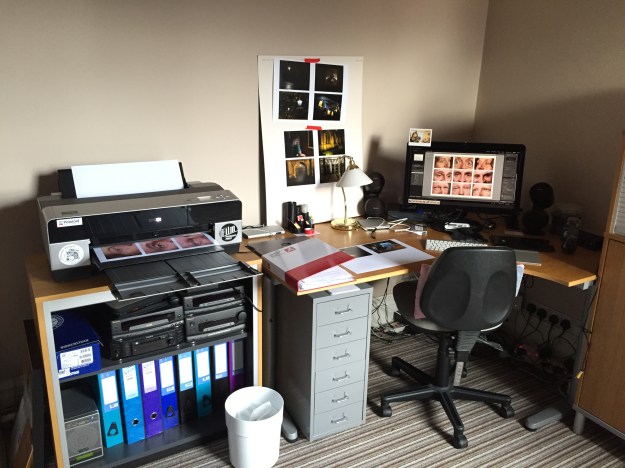
In this section of this post, I am going to describe the process of printing Assignment 4 (The Languages of Light) as this one was predominantly shot at night with artificial light and therefore presented the greatest challenges to perfect.   Firstly, a note on my working environment, which can be seen below.

IMG_1196

My office at home, showing the final print of Assignment 2 being produced

The challenge with my office is that it faces the front of the house which points broadly South East.  The window of the room looks out alongside the main wall of the house so the sunlight that comes through it is predominantly diffuse or indirect; when the sun shines, only half the room is brightly lit and when overcast, the wall that my desk faces is illuminated as it appears in the above photograph.

After checking the calibration of the monitor and selecting the paper that I wanted to use for assessment, I loaded the ICC profile into Lightroom.  I used a 270 gsm pearl lustre paper called Oyster 271 made by Permajet as its cool tone looks great when printing in both colour and black and white.   It’s also a paper that I’ve used many times before, so I’m confident I how it prints on my Epson with its OEM ink set.

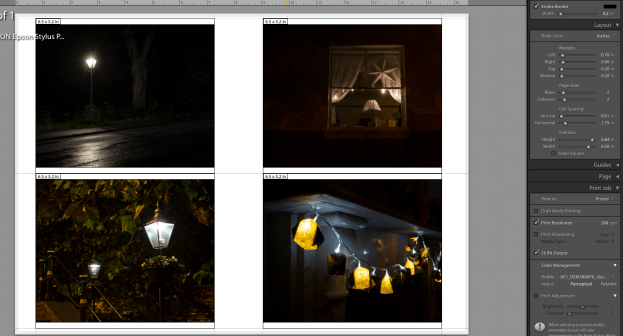
With regard to Assignment 4, I had previously created an album for the selecting process before submitting it back in July.  The images can be seen in their original state in the picture below.

Screenshot 2020-01-03 at 16.06.15

When viewed on a screen all of the images contain the details I was trying to capture when I shot them.  First step was to create a contact sheet from the images was done using Lightoom’s ‘Print Tool’Screenshot 2020-01-03 at 18.37.03

Printing 4 on a page with the paper ICC profile selected, the print was made as ‘Perceptual’, a printer setting that uses to ensure that it can print all of the colours in the image.  It does this by converting any colours that fall outside of its gamut or printable colour space  to something close that falls within it.  The other setting that I could have used is called ‘Relative’, which effectively ignores any colours that the printer that fall outside of the gamut.  Honestly, I leave this set to the default which is ‘Perceptual’ and maintain it consistently from print to print, which has resulted in my not really noticing any problems with my printed works.

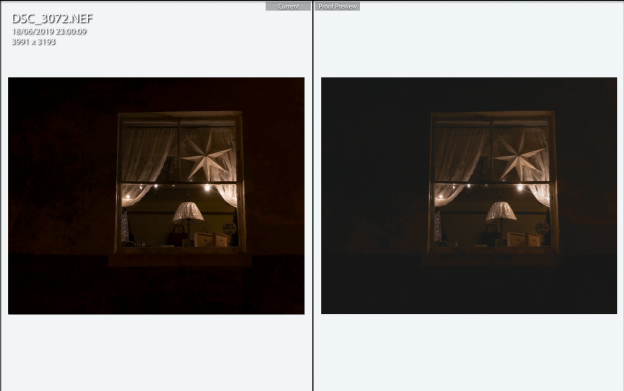
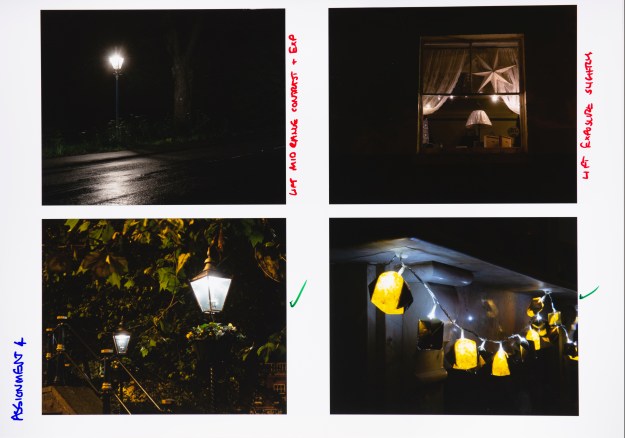
I printed blocks of 4 images from the assignment and pinned them to various surfaces in my office that were in natural light and then left them, periodically returning to review at different times of day and under differing lighting conditions.  I then made notes on the paper next to each image with the types of adjustment that I wanted to make.  Then, back in Lightroom, I created the virtual proofs to make the adjustments.  This effectively leaves the original alone and produces a virtual version that can be printed from.  For example, Photo 2 needed a small increase in brightness without making the highlights from the fairy lights too bright.  The original and the proof image can be seen below.

Screenshot 2020-01-03 at 18.55.32

The left picture is the original image and the right has very slight adjustments to make the area around the window brighter

With the adjustments made, another set of proofs of just this image were made and displays alongside the rest of the set.  The same procedure of looking at the images was repeated for each one that needed adjustment until I was happy with the result.  In the end, several proof images were needed for the set, denoted in the image below by the folded left corners on the thumbnails.

Screenshot 2020-01-03 at 16.10.26

Some Examples from Printing the Assignments

A few examples of proofing adjustments made to the assignments can be seen below with a description of what the intent was behind each.

Assignment 1

DSC_6510

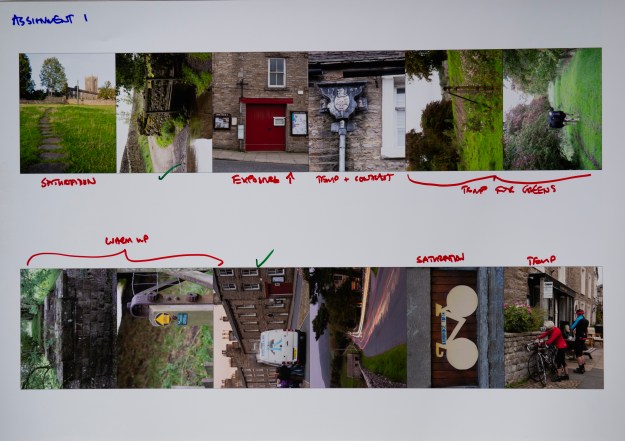
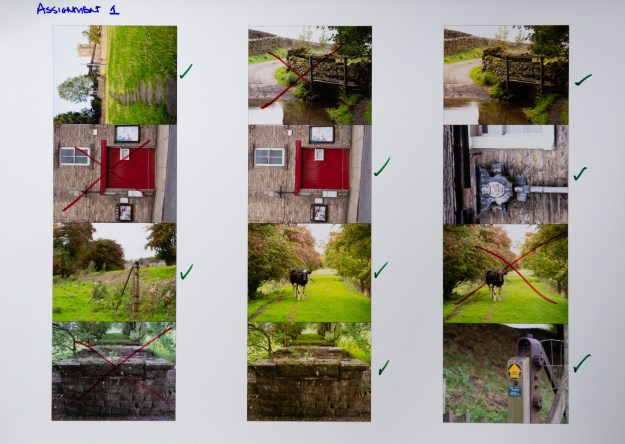
Here we see the main changes that I wanted to make were around colour temperature and saturation.  This was the first assignment on the course and we were not expected to make any significant adjustments for its submission.  However, as the course progressed the importance of colour temperature became more apparent to me.  For that reason, I wanted to make adjustments to Assignment 1 to ensure that the photographs would look as good as they could be.  Although two are shown as being correct above, I actually made further adjustments to the image of the bridge across the ford to ensure that the green saturation matched the overcast lighting conditions for that day.  The only image I didn’t adjust was the fish and chip van as the evening sky already had the look and feel that I intended when I shot it.   The updates were made and a second proof was done which can be seen below.

DSC_6509

This time, the effects of warming and contrast can be seen.  The images that were subsequently rejected are shown crossed-out.

Assignment 2

Assignment 2 was a series of emotions shown through the eye area and involving three models in a studio setup.   The lighting remained exactly the same for each photograph, but obviously the models had different skin tones from each other.  I had deliberately wanted the images to be raw so there was no make-up involved as there perhaps would be in a conventional studio shoot.  After some thought, I decided to globally adjust the colour temperature to be close to my studio lights, leaving a small margin to create the slightly flushed tone to each image.  To adjust each one would, for me take away from the natural groups of expressions that are in the photographs, particularly as the series was being presented as a grid of 9, rather than in sequence.   The proof sheet can be seen below, along with the size that I settled on in order to make the large, multi-aperture print for the series.

DSC_6506

Assignment 3

For the third assignment, similar adjustments were called for, but I also had to consider the impact of the images in the series.  When I originally reflected on the series and feedback, one of my conclusions was that my discomfort with photographing people on the street meant that I often shot from further away than ideal.  To increase the impact of the series, I re-cropped two of the images.  One of them is shown in the proof print below; the other having been done in a previous print.

DSC_6505.jpg

Assignment 4

As discussed previously, the fourth assignment was shot at night with artificial light being illuminating dark corners as its theme.  The adjustments I made to this series were predominantly to the exposure, highlights and contrast because colour temperature was addressed within the assignment.  I was reviewing the images on the back of the camera to check for the latter and used the histogram to review the exposure detail, but only when seen on a larger computer screen was it possible to see what needed adjusting further.   The proofs below show the thought processes and a final version of two of the darker images (the lighting for the shot of the proof actually reveals more than would be seen under natural light).

dsc_6511.jpg

DSC_6513.jpg

Assignment 5

For the final assignment, the main adjustment was contrast.  After the feedback, it was clear that I needed to consider re-shooting some of the photographs to strengthen the series.  This became the main purpose of proofing as I used the prints to try new photographs and see if I could live with them over time.  The proof print below shows the final selection of the first image.  I shot 3 (two of them are shown on the left of the picture) that were contenders and after a couple of reviews with them placed over the shot that was originally submitted, I settled on the best one to bring impact to the series.


DSC_6515.jpg

Summary

Printing is an important part of both the technical and artistic processes that we use in creating our work and this approach is the one that I’ve taken for a number of years now.  There is no substitute for experimenting with ‘lighting’ adjustments and paper types in the same way as the photographers who printed in the darkroom.  The only drawback that I have found is that the convenience of being able to rapidly produce an inkjet print makes it possible to use a great deal of paper and printer ink; something that I encountered during the preparation of these 41 prints for assessment.  In my opinion, it’s worth it to drive quality into the work, which I hope I’ve achieved with my EYV submission.

[1] Fletcher, R, 2019, “The Process of Selection”, OCA Blog, https://richardfletcherphotography.photo.blog/2019/07/05/the-process-of-selection/


Looking at Contemporary Portrait Artists

Introduction

The feedback from my tutor on Assignment 5 pointed out that I had limited my research to a small number of photographers that I admired and that I only included a single contextual reference, ‘Mirror and Windows’ by Szarkowski.  I seek to address the depth of my research in this post by looking at a selection of the recommended photographers and artists from the feedback.   The list of artists was as follows:

For the photographers Francesca Woodman, Robert Maplethorpe, Nan Goldin, Eikoe Hosoe, Sophie Calle, Sally Mann, Lu Guang and Yosuke Yajima.  For the painters/sculptors, Warhol, Giocemetti, Munch, Bacon and Freud.  I wanted to look at different ages, periods and nationalities in my selection to better understand the variation in attitudes as well as their creative style.  As the need was to explore contemporary art, I was also interested to see how their style changed over their working lives.  I selected Woodman, Hosoe and Goldin for the photographers and Munch and Giacometti for the painting and sculpture.

Francesca Woodman 1958 to 1981

I had heard of Francesca Woodman prior to the course but, like many the only real detail I knew was of her tragically short life that ended with her suicide in Manhattan when she was just 27 years old.  She suffered from depression, like many people including myself and indeed many artists do.  It would be easy then to make connections with other famous photographers who suffered in the same way, such as Diane Arbus or Bob Carlos Clarke.  When we first look at her photographs, with her life as context, we see a woman who shot almost exclusively in black and white, used herself as one of the subjects of her images and was often in a pose of resignation or dark mood.

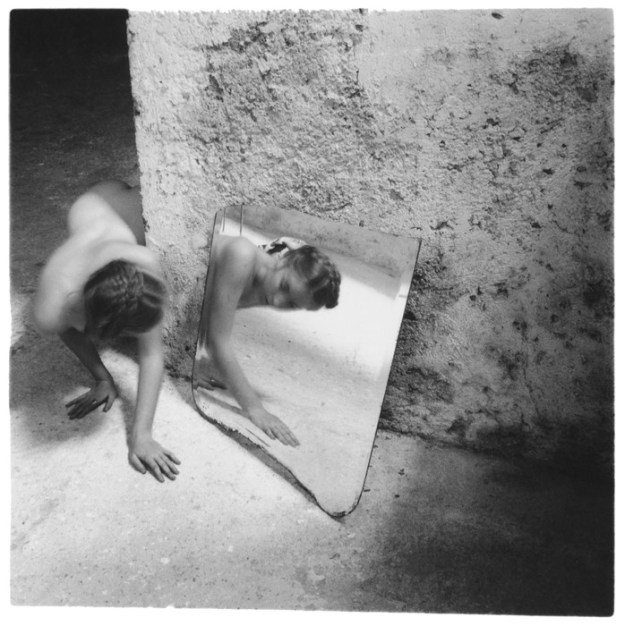
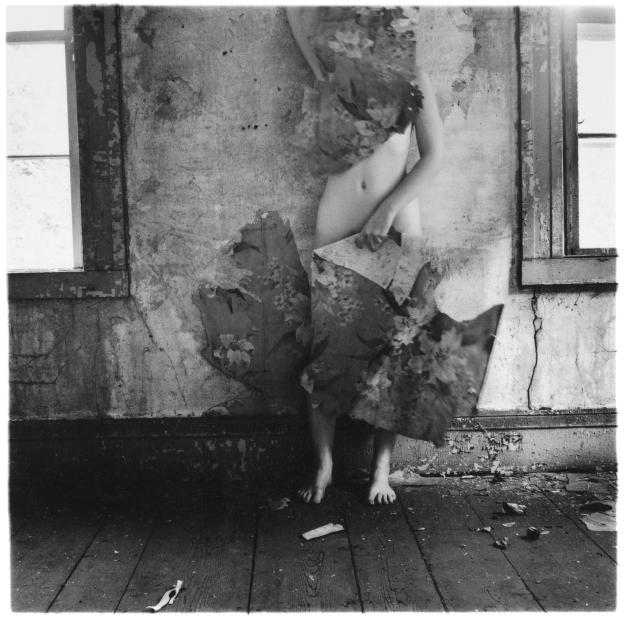
However, when we examine her photographic style we can see a number of themes that don’t always lend themselves to seeing her through that lens.  Her self portraits predominantly feature Woodman and few other physical details.  In many cases, her environment is rustic or run-down.  In some, she appears with a prop such as mirror or a curtain.  In many of her images, she appears nude and almost ghost-like through her use of long exposures and natural light creating movement and blur.    Consider her two images Space 2, 1976 [1] and Self-Deceit #1, 1978 [2].
379920

Self-deceit #1, 1978 by Francesca Woodman [1]

In this first photograph, we see Woodman prowling around the corner of a wall and catching her reflection in a mirror in a way not dissimilar to how a cat would.  Her nakedness creates the impression of a pure creature with the only hint of her humanity being the styling of her hair.  Her body blurs with the movement as she rounds the corner but we see the detail of her face reflected in the mirror that suggests her stopping to look at herself.   What is interesting to me about this picture is the fact that although Woodman is the subject of a self-portrait, she isn’t the dominant element in the frame.  The textured background and the contrastingly smooth mirror take up the majority of the frame, yet both draw the viewer to Woodman’s reflection and her expression of surprise, almost disappointment at what she sees.  I struggled at first to understand the title of this photograph – what exactly is the deceit she refers to?  On reflection, the context in the image points to our internal impression of how we appear and that, like a startled animal that catches themselves in a mirror, we realise how little our self image matches our actual image.  In this case, Woodman is clearly young, but moving through a space that is old.  Perhaps she had convinced herself that she was an old soul and the mirror is the reminder she needs ,that on the outside at least the opposite is the truth.
francesca-woodman

Space 2, 1976 by Francesca Woodman [2]

In the second photograph, we see at the same kind of decaying space where hints at its former elegance remain in the detailing of the skirting boards and windows.  Woodman appears nude but mostly obscured by the scraps of wallpaper that the is holding.  When I look at this picture, the immediate impression is of a young woman wanting to hide. I asked myself how much of this was owing to what we know about what happened to her.  An interview with her parents [3] in the run up to Zigzag, a collection of her work on angles and lines being shown in London, reveals a different side of her personality to the assumed norm.

“Their memory of Francesca is that she wasn’t a “deeply serious intellectual”; she was witty, amusing. “She had a good time,” says Betty. “Her life wasn’t a series of miseries. She was fun to be with. It’s a basic fallacy that her death is what she was all about, and people read that into the photographs. They psychoanalyse them” –  Betty Woodman in an interview with The Guardian [3]

With this new information, I see Space 2 differently from before.  Now I see the beauty of the contrast between her plaster-like skin against the decaying plasterwork and the suggestion that this somehow brings the space alive again.  Her use of the wallpaper takes the focus away from her as a woman, while playfully showing just enough of her form; the whole image taking on more of a game of hide and seek.   Whatever the intent behind Woodman’s self-portraits, the enigmatic style in her compositions differs considerably from the photographers that I’ve previously researched.

Eikoh Hosoe 1933 to present day

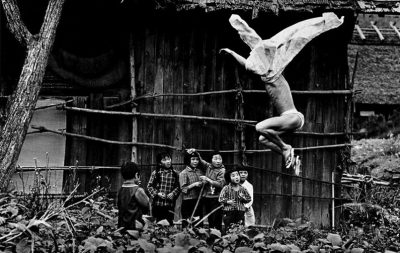
The second of the photographers is Eikoh Hosoe, an influential Japanese artist known for his experimental art using photography and motion picture film.   Although a prolific curator of photo-books, his most famous work was during the 1960s, when he collaborated with an emerging form of interpretive dance called Butoh. This form of dance rebelled against convention in that its slow, almost tortured movements created imagery that could be considered macabre, evil or taboo.   Even today, Butoh is considered a dance that cannot easily be qualified or categorised, but at that time it was considered to be a form of subversion.  Hosoe began working with the founders of Butoh, Tatsumi Hijikata and Kazuo Ohno.   Hosoe believed that photography didn’t have to be expressed simply by taking pictures of a subject, instead he wanted to create a counter-realism in his work.  He described his desire to create, rather than document in a video interview with The Art Gallery of New South Wales in 2011 [4], saying that photographers of the time believed his use of the camera to not be photography.   His work with Hijikata produced a series called Kamaitachi (the weasel’s slash), an ancient Japanese legend about a demonic creature that attacked people with blade-like limbs, metering out some form of evil recompense on those who sinned.  The legend encompassed everyone, from children to adults and was most feared in the rural prefectures of Japan throughout its history.  In his work, Hosoe combined the imagery of Hijikata’s birth village with his dance to create an aesthetic of historical consistency (the legend) against a backdrop of a rapidly-changing Japan.  A photograph from the series can be seen below.
hosoe-eikoh-kamaitachi-11-400x253

From Kamaitachi, 1969 by Eikoh Hosoe [5]

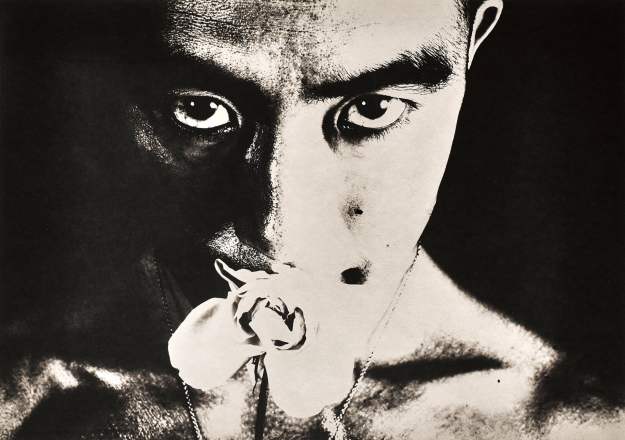
Here we have Hijikata mid-leap in front of a small group of children, set against a barn-like building in what is quite clearly rural Japan.  The composition itself is fairly conventional with the dancer on the righthand third of the frame and the children in the central lower third.  What is interesting about this picture is the way the natural reactions of the children support the external context of the collection.  Their surprise at the feat of flight and fear of where he might land, lend themselves to the legend of the flying demon who may swoop down on any one of them.  A little girl puts her hand on her friend’s head as if to protect her from the demon who’s outstretched arms resemble the claws of the creature and flowing clothing its wings.  Even without the external context information, the image is disturbing because of our in-built belief that it’s not right to frighten children.  Hosoe creates the imagery in an environment that would be considered safe to the children; their way of life captured in a semi-documentary fashion.  When looking at the Kamaitachi series, Hosoe’s use of convention to create rather than capture is very clear. Kamaitachi is unconventional portraiture in the same way as Woodman’s work with the subject being the focus but not the only element that needs to be viewed.  Hosoe also shot portraiture as it’s more widely known, most notably his early series Ordeal by Roses, in 1961, featuring a well known writer called Yukio Mishima.  In this series, Mishima appears in high contrast black and white in surreal poses, often nude but erotic rather than overtly sexual.  The rose is portrayed as both beautiful in its foliage but with the hidden dark side of its thorns which is both striking as a visual aesthetic but also gives an impression of how the photographer had grown to see Mishima.  Consider the photograph below from this series.
2794

Ordeal by Roses #32, 1961 by Eikoh Hosoe [6]

Here we see a direct portrait of Mishima staring straight into the camera.  The lighting is harsh and the contrast has the effect of emphasising the intensity of his stare.  It also reduces the detail of the rose in his mouth to just enough to preserve its beauty.  When I look at this image, I see the conflict in Mishimi’s face.  His expression is almost seductive because of the rose, but we can also interpret a level of pain or sadness in his eyes.  Perhaps the thorns of the rose are physically painful and that its placement is almost silencing this famous writer (Mishimi was later a right-wing nationalist who led an unsuccessful coup to restore power to the Japanese Emperor).  It could be instead that the sadness is of desperation and that the rose represents the need to be loved.   It’s a powerful image that, when included in the rest of the series, highlights the experimental nature of Hosoe.  When I look at this image, I see something more akin to a painting than a photograph, because of Hosoe using his camera to create rather than document.

Nan Goldin 1953 to present day

Nan Goldin is a photographer than I was well aware of before I started this course and I must confess to not being a fan of hers.  Most of the images that I had seen at that point just didn’t interest me as my aim was to improve my understanding of photography as a technical discipline.  Goldin’s work by contrast appeared to contradict my understanding of a good photograph, with the heavy use of flash, soft focus and unconventional composition.   Reflecting on my progression throughout this course, I chose Goldin as the third photographer to research as part of this post to see if anything had changed.

The starting point for my examination of Goldin began with the documentary that I referred to in my response to my tutor’s feedback on Assignment 5 [7].  During the conversation, she referred to the way that people look at things now vs. before social media.  In her work, the first thing that strikes me is the way she has seen the moment or the connection she wanted to capture in her pictures.  During her time living in the transsexual community in New York in the 1970s, Goldin photographed the people that she spent time with and often lived with.  By photographing the people that she formed strong friendships with, Goldin was able to capture them affectionately, in private and social situations where they were simply being themselves.   Her intent to photograph only who she loves was discussed in an interview with Tate [8] where Goldin says that she could never photograph people who were ugly or disturbing to her and never out of anger; her photography was born out of love for her subjects.  In her early work in the 1970s, Goldin celebrates her friends at a time where transgender people faced discrimination and prejudice in their daily lives, but continued to chronicle their struggle as the AIDS epidemic terrifyingly spread through their community.  Her photographs eventually became a book called The Other Side, which was published 20 years later, which has been interpreted as a reminder of the impact of the disease on what was considered a minority society.  However Goldin contests this in her intent behind the work The Ballad of Sexual Dependency, perhaps her most famous work that began as a slide show and was then turned into a book.  Goldin described the stories of people in their relationships across genders, stating that her circle of friends simply didn’t care about what other people considered normal [8].  Her pictures captured their lives as they unfolded, seeking to tell their story honestly, as opposed to some creative revisionism after the fact.  In addition to her friends, Goldin included a documentary of her own troubled love-life where she was subjected to domestic violence.
Nan one month after being battered 1984 by Nan Goldin born 1953

Nan one month after being battered 1984 by Nan Goldin [9]

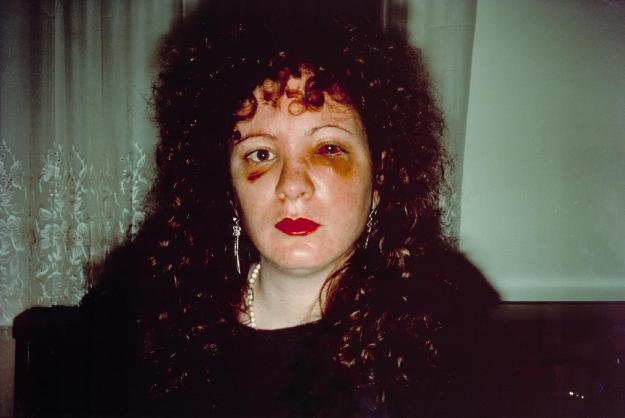
In the above self-portrait, Goldin appears heavily bruised by an act of great violence as a long-term and volatile relationship had broken down.  Of the image, she wrote

‘I took this picture so that I would never go back to him.’ [9]

Goldin’s photograph is starkly lit to emphasise the damage done and composed against an ordinary, almost dull background.  The onboard flash rolls off in a vignette which creates a sense of loneliness and sadness, but the brightness of her lipstick points to someone who has just recognised that she has to move on.  The injury was so severe that she nearly lost the sight in her left eye, which can be read on her expression in this image.  I am left wondering if she thought that blindness was inevitable now that she had effectively opened her eyes to her situation.   In almost every case, Goldin’s pictures have an ‘instant’ quality about them, which is not really a surprise when her first camera was a Polaroid that she was given in the late 60s.   She later stated that she used whatever camera came into her possession [8], taking no interest in the gear, but rather the subject.   Her compositions too suggest little in terms of preparation, capturing fleeting moments of every emotion, good and bad often using harsh flash lighting (she claimed to not understand the effect of light on colour until the late 1980s).  For me. this belies the skill in creating the image, each one containing everything needed to create a narrative in the viewer, some that engender warmth and some disgust or horror.

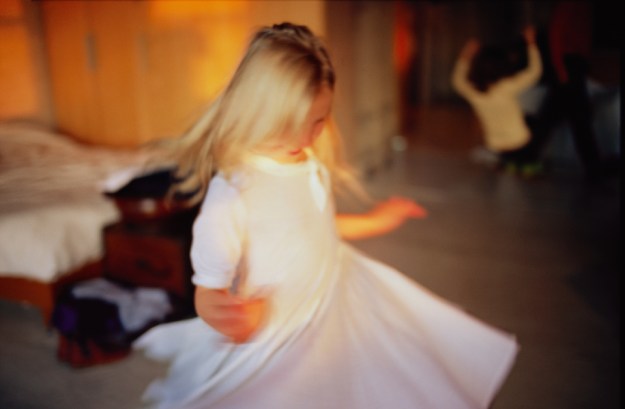
In her more recent work, Goldin has focused more on children than adults but remains personally connected with her subjects.  While her style hasn’t deviated much from her original work, Goldin’s fascination with the creative freedom and undefined beauty of children comes through in softer, more varied images than before.   She states that by paying attention to the way children interact with the world, she began to believe that they were from a different planet.   A shot from her collection Eden and After can be seen below:
9780714865775-lk-13

Ava twirling, NYC, 2007, by Nan Goldin [10]

Here we see a young girl in a flowing dance with another child in the background who appears to be doing something similar.  Goldin has captured the movement of the little girl as she twirls her dress.  The joy in her expression suggests that making shapes with her clothing is something of a new experience and she enjoys showing off her new-found  form of play.  What strikes me about the composition apart from the movement is the softness of the light.  Although likely to be artificial, this image departs from the stark on-axis flash look and suggests calm, relaxation.  The background details of the bedroom create a cosy, family environment where children can be themselves.  Goldin’s book seeks to be a tribute to children but also something that belongs to them [10] as opposed to the adults that they will ultimately become.   In the interview with Tate, Goldin talks about how the children she photographed decided upon their movement, costume etc without any direction from her.  This lack of adult ‘interference’ creates an aesthetic of playful freedom throughout the work, which Goldin captures beautifully.

Watching her interviews and reading her perspectives on life and art, I’ve moved away from my initial impressions of Goldin.  Her approach to art through the medium of photography is refreshing.  Unlike me, her interest has only ever been how she expresses her view of the world and creates an honest narrative of her life and that of her friends.  Her style is unquestionably experimental and to be honest, many of her photographs leave me cold because of how they are shot.  However, even those give a sense of ‘that’s ok, just look at what I’m looking at, feel what I am feeling’.

Edvard Munch 1863 to 1944

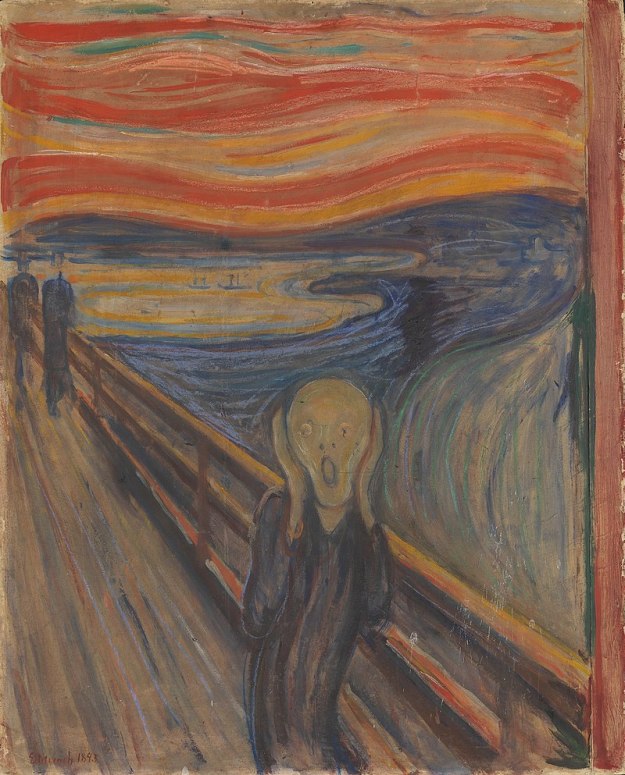
The first of the portrait painters I looked at was Edvard Munch.  The Norwegian painter is, of course famous for his iconic painting The Scream, which he produced in 1893 and which depicts a figure in anguish at sunset by a stretch of water.  When researching The Scream, a number of little known elements point to other parts of Munch’s artistic style and personality so my interested started with that painting.
800px-Edvard_Munch,_1893,_The_Scream,_oil,_tempera_and_pastel_on_cardboard,_91_x_73_cm,_National_Gallery_of_Norway

The Scream, 1893 version by Edvard Munch [11]

Munch described the circumstances that inspired this painting as a walk with friends at sunset.  As he turned to look at his friends, the sky turned a blood red, which engulfed the scene.  He commented

“I paused, feeling exhausted, and leaned on the fence – there was blood and tongues of fire above the blue-black fjord and the city – my friends walked on, and I stood there trembling with anxiety – and I sensed an infinite scream passing through nature” [12]

So intense was that feeling of anxiety, contrasted with the apparent dismissal by his companions, Munch painted the figure in distress at the scream of nature.  He further strenghens the horror of the moment by making the figure largely featureless but androgynous, resembling our modern representations of the extra-terrestrial.  Munch was a painter the worked with his memory or feeling about a situation rather than a specific subject.  While we know that painted portraits lend themselves to large degrees of artistic licence, Munch’s work (including the scream) dispenses with precise detail and deals almost exclusively with his own emotions, that could be completely unrelated to the subject he is working with.

Munch’s life was undobutedly tragic, losing both his mother and older sister to tuberculosis, his own health issues including a descent into alcoholism and having a highly destructive relationship that we could judge as abusive by today’s standards.  It seems fair, then that Munch had a great deal of torturous feeling that drove his work.  He said

“My fear of life is necessary to me, as is my illness.  Without anxiety and illness, I am a ship without a rudder….My sufferings are part of my self and my art. They are indistinguishable from me, and their destruction would destroy my art.” [13]

Munch’s relationship with Tulla Larsen, which he found himself pressured into, created many works in which he painted himself as a sufferer.  His paintings ‘capture’ a mood rather than document an event. In some cases, he painted classical stories and put himself and Larsen in them. For example The Death of Marat, 1907 in which the French Revolution general Marat is assassinated by Charlotte Corday [13]  Much casts himself as the victim and Larsen as the killer, emphasising her seductiveness by making her a nude figure.  In another self-portrait during a seemingly ‘settled’ period in their relationship, Munch paints himself and Larsen in a pose that is far from a traditional love story.  After their relationship broke down, Munch sawed the painting in half to spite Larsen; the effect being similar to a modern-day break up where people are torn out of photographs.

download_2

Edvard Munch, “Self-Portrait with Tulla Larsen,” ca. 1905 [14]

When we look at this painting, we see an angry Munch glaring at a dispassionate Larsen while a figure looks on in the background.  Munch’s use of contrasting colours of red and green brings the couple out of their situation and puts their argument front and centre for the viewer.   The character behind them has an equally stern expression as if in disapproval of their behaviour.   Or perhaps the reds mean something else and Munch’s expression is more of passionate love than anger.  The figure behind could equally be another admirer who is unable to get close in the way that Munch does.  The flame haired Larsen appears distant or disengaged, which could be because of Munch’s reluctance to marry her, something she hounded him for during their relationship.  Theirs was certainly a firey match that ended in Munch losing part of a thumb in an incident with a pistol.

I greatly admire the way that Munch created imagery of pure feeling rather than of events or the reality of what he saw.  It’s no surprise that The Scream provokes such a reaction when viewed as it creates a mood of fear and shock that we can relate to in the modern world.

Alberto Giacometti  1901 to 1966

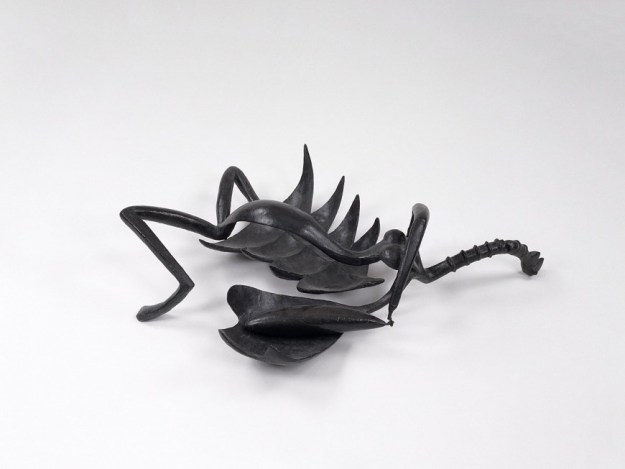
The final artist I looked at for this post was the sculptor Alberto Giacometti, who I only really learned about recently during the BBC’s Fake or Fortune television programme.  A work alleged to be by him was being examined for authenticity and was eventually proven to be genuine through establishing providence.  What I first noticed about his work was the surreal nature of his sculpture, in particular when he created pieces of ‘portraiture’.    In my research into Giacometti, I discovered that although he was known as a sculptor, like many artists he also painted and sketched.  What’s more interesting is that his work in each of these media, the recurring technique of how he represented people can be seen,  Consider one of his early sculptures Woman with her Throat Cut, 1932 [15]
76.2553.131_ph_web-1

Woman with Her Throat Cut, 1932 by Alberto Giacometti [15]

Here we have a surreal representation of a violent rape and murder of a woman.  At first glance, the figure looks like an insect that has been squashed, but when we look closely, we see the long elegant torso of a woman with large breasts and long limbs.  Giacometti has posed the figure with legs splayed, suggesting sexual activity and twisted the arms to suggest a collapsed figure.  The elements of the sculpture that point to death and violence are those that are emphasised by Giacometti out of proportion and not in the least bit anatomically accurately.  Her open rib cage sits attached to her right leg and an pelvis-like object pins down her left arm.  Her right arm is weighed down by a phallic shape, which when combined with the other elements and the pose, suggest rape.  The woman’s neck has been extruded into a long arterial object which clearly has a cut across it and her head is incredible small.  In drawing attention to some areas more than others, Giacometti tells the story without the subject being seen as a human being.  In the same way that Woodman and Hosoe used their subjects to create a narrative without worrying about realism, Giacometti’s sculpture is very unsettling, once the viewer sees the elements being brought to their attention.

The way that he expresses people is evident in his other sculpture, with women being portrayed as tall, elegant creatures with long necks.  They are posed in an almost fragile way with the recurring theme of heads being much smaller than their bodies.  Perhaps Giacometti is describing the beauty of the female form without worrying about the features of the faces, which are characteristically devoid of any real detail.  What I didn’t realise about Giacometti was his ‘process’ of creating art and how these forms took their peculiar shapes.  In the Artists Muse sale of works by Christies in 2015, a video [16] was made to tell the tale of how Giacometti painted his famous portrait of James Lord.  Lord was a well known author and biographer who wrote his own book about the painting that took nearly 3 weeks to ‘complete’.  I say ‘complete’, because the painting is seen as nearly finished as can be seen below.

d5946125x

Portrait of James Lord, 1964 by Alberto Giacometti [16]

The video describes the sitting in Lord’s own words.  Giacometti started by creating a figure with an elongated head.  His emphasis of the head with its long neck was a surprise to Lord as it lacked any real structure with respect to the vague body it sat on.  The background started out as pretty much a blank area with only a few details to define space around the subject.  As the shoot went on, Lord observed Giacometti’s continued doubt about how the work was progressing, stating at every stage that he wanted to start again from scratch.  He didn’t, of course but Giacometti was not using any preconception of what Lord should look like, nor was he mentally relying on what he had painted previously.  This preparedness for scrapping the painting at any time and beginning again, kept Giacometti’s creativity working.  Lord also observed the artist’s melancholic self-doubt that the painting would ever be any good and the fact that at times, Giacometti would abandon the painting and the sitting at no notice to go to his favourite bars in Paris.  Every time he came back to the painting, Lord observed that it improved dramatically with the final image being the best it could be.

In Conclusion

I conducted this further research in response to the feedback on Assignment 5, which I felt was a justifiable observation that I only looked at photographers or artists that I already had an admiration for.  The artists that I have looked at here are all very different, but they have one thing in common.  Each has a central reason for being an artist, whether it is to express how they feel, rail against conventional realism or to document something they care about deeply.   I was taken with Woodman’s introduction of movement and the use of her body as something different from a conventional naked woman.  I admired the fun but dark subjects that she shot and have realised that some contextual influences, such as her tragic suicide can steer us to a single analysis of her work.  The same can be said of Goldin’s very candid portraiture of her friends, many of which have died through AIDS or addiction.  I was never really a fan of Goldin’s work because of the initial impression of a snapshot rather than a considered capture of an important moment.  I now see her work as an affectionate presentation of her life and the ups and downs of her relationships with the people she loved.  I find her work with children to be uplifting in a way that we don’t see in the modern world.  Goldin herself said that the believe the world was a horrible, but that she saw light in children.

The photographer that I have developed an admiration most of all is Eikoh Hosoe.  His decision to protest against the realism of photography while preserving the culture of his native Japan was fascinating to me.  His desire to use photography to create something surreal was echoed in the work of Munch, who only painted what he recalled or felt about a subject.  He shared similar anxiety and self doubt that Giacometti suffered from, which comes though in the work of both artists.    What I have taken from this piece of work is some ideas of how to free my creativity from the overwhelming desire to produce technically good photographs.  Developing my own voice doesn’t have to depend on being strange or surreal, but it does need to be about what is important to me and it does need the viewer to really look at what I might be trying to say.

References

[1] Wrigley, T, 2018, “How Photographer Francesca Woodman Came Into Her Own in Italy”, AnOther.com,  https://www.anothermag.com/art-photography/11170/how-photographer-francesca-woodman-came-into-her-own-in-italy

[2] McWilliams, J, 2017, “Ideas and a New Hat”, Paris Review, https://www.theparisreview.org/blog/2017/01/19/ideas-and-a-new-hat/

[3] Cooke R, 2014, “Searching for the real Francesca Woodman”, The Guardian, https://www.theguardian.com/artanddesign/2014/aug/31/searching-for-the-real-francesca-woodman

[4] Art Gallery of NSW, 2011, “Photographer Eikoh Hosoe on his work and inspirations”, YouTube Video, https://www.youtube.com/watch?v=Xgk98N8N9Ro

[5] Hosoe, E, 1969,”Kamaitachi, Photographs by Eikoh Hosoe”

[6] From “Ordeal by Roses”, Image Resource, http://www.michaelhoppengallery.com, https://www.michaelhoppengallery.com/artists/89-eikoh-hosoe/overview/#/artworks/11361

[7] Fletcher, R, 2019, “Feedback on Assignment 5”, blog post

[8] Reeves, E, 2017, “On the Ballad of Sexual Dependency”, MOCA, https://www.youtube.com/watch?v=iDSvD0yhjWQ

[9], Goldin, N, 1986, “The Ballad of Sexual Dependency”, Aperture

[10], Tateshots, 2014, “Nan Goldin – My Work Comes from Empathy and Love”, https://www.youtube.com/watch?v=r_rVyt-ojpY

[11] Image Resource, “The Scream,”, Wikipedia, https://en.wikipedia.org/wiki/The_Scream

[12] Phaidon, 2012, “Edvard Munch’s The Scream: a few facts and theories”, https://uk.phaidon.com/agenda/art/articles/2012/may/02/edvard-munchs-the-scream-a-few-facts-and-theories/

[13] Lubow, A, 2006, “Edvard Munch – Beyond The Scream” The Smithsonian Magazine, https://www.smithsonianmag.com/arts-culture/edvard-munch-beyond-the-scream-111810150/

[14] Solly, M, 2019, “British Museum Reunites Portrait That Edvard Munch Sawed in Half to Avenge His Fiancée”, The Smithsonian Magazine, https://www.smithsonianmag.com/smart-news/british-museum-reunites-portrait-edvard-munch-sawed-in-half-avenge-fiancee-180971936/

[15] Flint, L, 2018, “Woman with her Throat Cut”. The Guggenheim Museum, https://www.guggenheim.org/artwork/1424

[16] Christies, 2015, “Alberto Giacometti’s Portrait of James Lord”, Video Article, https://www.christies.com/features/Alberto-Giacomettis-Portrait-of-James-Lord-6658-3.aspx


Re-working Assignment 5

Introduction

Following the feedback from my tutor on Assignment 5 and the subsequent research into other contemporary portrait artists, I decided to review my submission again with a view to improving the series.  There were clear indications in the feedback that some images were stronger that others, so that was where my review began.  The intention for the series was to take my continued theme of revelation and apply it to me as the subject.   While it was accepted that each image revealed new information about the me as per the brief, the intent behind each one and its impact was not thought to come through.   It was immediately clear on reflection that Seven (the guitar shot) didn’t really say anything about me at all, so this would be the first image I would seek to replace.  The other images that came in for criticism in the feedback were One and Ten, which were likened to a publicity photograph, again not really telling the viewer much about the subject.  I had created an aesthetic using Bailey as an inspiration to effectively start and finish the series the same way, but on reflection this was more a technical choice than a creative one.   The rest of the images still worked for me, though with each saying something about me that was intentional.  Without external contextual information, they offer a variety of different perspectives that I touched on in my Feedback essay and with the addition of context, the people I have shown then too have understood what I’m trying to say with them.

Back to Basics

Having decided to rework One, Seven and Ten, I went back to what I had originally intended for each.

DSC_3801

One

One was supposed to show me as a professional and somewhat serious man.  The resulting image shows me with a fairly blank expression, which some of the people who’ve seen it refer to as my ‘resting angry face’.  I wouldn’t describe myself as a miserable or sad person, but when I relax my face, that is what many people see.  With this first image in the series, I had wanted to portray my total discomfort at being in front of the camera.  I had believed that my natural expression of impassive, borderline grumpy would reveal that to the viewer, but instead I understand now that the result is a very formal photograph of me.  I could indeed use this as a profile photograph in my company because it is formal and well executed.   During my research into the portrait artists, I became interested in Edvard Munch’s work.  Munch painted what he felt about a subject rather than strictly what he saw, with The Scream as his most famous example.   In a similar vein, Eikoh Hosoe works in the surreal, combining contrasting but related subjects in his photographs.  Hosoe’s work excited me because there were so many elements that contributed to the different perspectives the viewer could adopt.  He also used photography to challenge realism by his use of technique; over and underexposure, unconventional composition and in the case of his portraits, real drama in the subject’s expressions [1].  If I wanted to portray my discomfort, One needed to be more about how I felt as I made the difficult decision to photograph myself.  I needed to say more about my starting point and my lack of confidence in approaching the assignment.   I actually really like the original One and am sad to be replacing it.  However, it appeals because it’s comfortable which is something I’ve had to remind myself during the latter stages of this course.
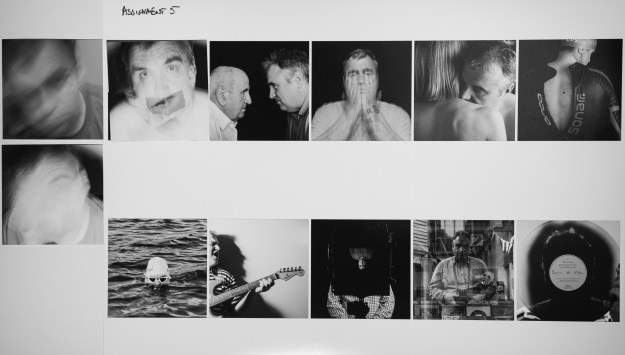
DSC_4043

Seven

Seven was supposed to reveal my recent interest in learning the guitar and how it helps me to relax.  The strength in the image is purely technical and at the time I was happy with the balance of the lighting, the guitar and how my hand was positioned in a ‘mid pick’.  The bonus of the subtle obscuring of the volume control was also something I was happy with, but unless the viewer knows the layout of the Fender Stratocaster, this is probably lost on them.   The image could be of anyone and there is little to describe the sense of relaxation that I was trying to portray.  On reflection, the guitar doesn’t relax me.  Instead, it offers a similar form of escapism that photography does and the reason I took it up was because of the time pressures I now place on myself with my work and this course.  The guitar needs to be practiced little and often, so is perfect for brief interlude of escape.  None of that context come across in this image though, so my new photograph would need to address the missing elements.  I still like the photograph and would have enjoyed the result a great deal when I was first experimenting with studio lighting.  However, it doesn’t work in the series so the decision to replace it was the right one.

DSC_4002

Ten

Ten was intended to reveal how my love of music has become an important and private place to retreat into.  While Seven deals with my desire to learn how to play, Ten was intended to draw the series to a close with the tie-back to The Cure who were one of my favourite bands as a teenager.   The idea of using the rare vinyl version of Pictures of You came about because I struggle to put on a relaxed expression without actually being relaxed.  Blowing the dust of a record would eliminate any sense of my expression being forced, while the special vinyl record and the way I carefully handle it would show how much I care about music.  Sadly, none of this really comes out in the photograph as again, the result could almost be a public relations shot for a radio DJ (this is the image my tutor conjured during our call).  When I reflected on the intended reveal, I questioned the connections between the elements.  Vinyl is something I’ve rediscovered in the past couple of years because I had completed the restoration of my parents old turntable.  The turntable itself has great sentimental value as well as offering the opportunity to collect records in the same way I collect cameras.  In reality, this image came about as a comfortable set of connections between collecting, a retro-aesthetic and my pride in re-discovering something that has previously fallen from fashion.  Of my camera collection, 85% of them are old film cameras that are over 40 years old so it wasn’t a surprise that this is what I naturally fell back on as a context for the image.  Also, the fact that the record is actually a translucent red, made the technical aspects of lighting the image more straightforward, again pointing to something I felt comfortable with.   What I actually see music as, is a private escape where I can focus purely on the listening.  I don’t have to be social if I don’t wish to be and similarly don’t have to care if other people like the same music as me.  It offers a place to hide and relax when I need it.  These elements are what needed to be impactful in the new version of Ten.

The New Images

DSC_6501

Revised One

The new version of One was inspired by Munch and describes my total discomfort at being the subject of the photograph and indeed the series.  I use a movement in a similar way to Francesca Woodman to portray the surprise realisation at what is happening.  The tape across my mouth symbolises my feeling that I have nothing to say as a subject, while my lack of clothing was inspired by the recurring nightmare that is fairly common when insecure people are struggling with life; that is turning up to a public gathering (birthday party, work presentation, school etc) and slowly realising that you are completely naked.  I wanted to include that fear in this photograph.  I was inspired by Hosoe to venture outside of the ‘perfect exposure’ and sought to create a visual where the subject’s discomfort comes from being under the spotlight.

The final photograph was made by using an exposure of 2 seconds using the continuous ‘modelling light’ function on my studio strobe.  As the exposure started, I flashed the strobe using the remote trigger with my head looking down.  I then flashed the strobe again just before the shutter closed to capture the second face.  I liked the accidental placement of the eye from the first face over the tape across the mouth of the second, as it adds the element of passively observing rather than speaking out.  No other photographs I took during the shoot had this element in them, which made the task of selection a great deal easier once I had noticed it.

DSC_6386

Revised Seven

For Seven, I was inspired by Woodman’s unusual compositions.  This image needed to show me with the guitar, something that the first version didn’t do.   In this image, I am seen emerging from the edge of the frame as a nod to just starting out with the instrument.   This is further emphasised by the plasters on three of my fingers; injury to the skin being a common occurrence when starting out with this instrument.  Finally, and the main element to the image is my shadow which looks like a more ‘established’ rock star profile than the actual enthusiastic expression on my face.  I used conventional elements such as the striped shirt to tie in with the guitar’s fret board and to contrast with the plain background.  I’ve tried, like Woodman to include me in the subject of the photograph without actually being the main focus of it.  In my image, the guitar and shadow are for me the dominant elements.  Unlike Woodman’s ghostly presence in her photographs, there is no movement in Seven.  Instead, my position in the image defies the convention by being right on the edge of the frame, with my index finger being on the right-hand ‘thirds’ line.   I shot this photograph against a wall my living room rather than a photographic backdrop and used only one strobe to create the harsh shadow on the wall.  I’m much happier with what this photograph says about my desire to be a musician and how that ambition would naturally outweigh my talent at this stage of learning.

DSC_6420

Revised Ten

For Ten, I was inspired by Hosoe’s work in Ordeal by Roses.  He often juxtaposed  the subject with the roses or something that was symbolic of the rose in an abstract composition.  For this, I wanted to keep the link back to The Cure.  The translucent property of the record meant that I could effectively be seen through it which would maintain my theme of retreating into music.  I used a bright and harsh flash to both back-light my head and create the halo as it passes through the record. The contrasty aesthetic that Hosoe created with his portrait series is echoed here with the only middle tones being my hand holding the record and the background.  I like this image because it makes music the obvious subject but looking more closely shows my relationship to it.  The vinyl is still present, but the way that I am holding the record removes my precious feeling toward the object itself (although I was naturally very careful).  For me, the context of the image is changed by the elements in the photograph more than in the previous, which relied on my describing what I was trying to say with it in words.

Another Change

Another point raised during the feedback conversation with my tutor was that Nine might be a little too obvious in its composition.  The photograph is inspired by Vivien Maier’s self-portraits in shop windows with her Rolleiflex.  I had chosen to tie in my love of photography with music by shooting something similar with my friend’s record shop window.  The resulting image had very obvious pointers to what the photograph was about and my tutor suggested a more extreme crop to make the composition more interesting.   I made two crop attempts, one that followed his suggestion and one in between it and my original version.  All three can be seen below.

My tutor suggested removing the obvious elements of the image (the camera, the sign, the record racks in the shop etc) and leave the subtle music references like the portrait of Ian Curtis and the distinctive Velvet Underground album with its iconic Warhol banana painting in the cover.  This crop can be seen on the right.  When I looked at this image again, I felt that removing the camera and the record racks took away too much from the photograph but that it was definitely more interesting without the window sign,  My crop in the centre image is a less extreme version of what my tutor was describing.  I kept the camera because my original concept for the image linked photography with music – losing the camera broke that connection for me.  I also felt that by keeping the record racks, there was more for the viewer to explore in the photograph than in the tighter crop.  The moody exposure with my shadow emerging from a dark background still works in all three, but I prefer the way that my version looks, so I included it as a revision to the series.

Re-ordering the Series

Having elected to shoot three of the photographs, I now had to consider how the series looked in sequence.  My original concept was to reveal a man with challenges in his life and show how he has responded to them through passions and coping strategies.  The questions now were whether that concept still worked with the image sequence and if it could be improved by shuffling the order.  The original sequence with the new images added can be seen below.

My first impression was that I should swap Three and Four in order to separate the two pictures with movement in them.   The result can be seen below.

What I realised with this sequence was that the ‘tension – depression – comfort’ theme of the original order was lost this way, so I discounted this as a change to make to the series.   The other change I considered making was to move the much stronger Seven to the Nine position as it now combined and contrasted my enthusiasm with wanting to learn music with the sanctuary that listening to music gives me.  The revised sequence can be seen below.


Now the series flowed how I wanted it to.  Starting with discomfort, moving through my mental health issues, my re-emergence and the challenges of open-water swimming and the peaceful solitude it provides.  Then onto my love of photography as an opportunity to understand the craft, in particular film photography and on to how music affects me as both a budding musician and as a place of sanctuary.   This is the order of the series that I decided to submit for assessment.

Conclusions

It’s fair to conclude that this assignment pushed me harder than the other four, which makes sense as it comes at the end of the course.  I worked hard enough to create the first submission and some of the feedback was difficult to accept at the time because of that.  In trying to address it however, I’ve learned that being uncomfortable with my art is not a negative thing.  Being uncomfortable has led me to shoot pictures that I would not have ordinarily considered.  When I showed One to my wife, her reaction was that it certainly said something powerfully and added that it was probably the most abstractly creative thing I’d ever produced.  In creating it, I experimented with the composition and lighting but wasn’t focused on creating the classical portrait. Two of my experiments can be seen below.


The left hand one was my establishing movement to create an almost ethereal impression of a man surprised by something, in this case the idea that he would be the subject of a photographic series.  I wasn’t using the strobes at this point, just the modelling lamp function that they have and while I liked the definition that face had, the idea of discomfort still didn’t come through.  The right hand image was using more extreme exposure and a longer exposure time, resulting in some detail in one eye. I liked this effect too, but it felt more like chaos than surprise.   Both images are far away from what I usually shoot and I enjoyed not really knowing whether the effect would grab me or not when it came to review.  It was a challenging shoot to do because I was both operating the shutter and the strobe trigger while trying to keep the natural flow of my movement through the frame.  When I finally realised I could partially freeze the movement this way, I thought carefully about what I was saying here.  The other elements added to the composition resulted in the final image which I think works well in the series as well as on its own.

As well as the realisation that moving away from what’s comfortable can be positive, I learned also that I don’t really care if people ‘like’ my photographs, only that they react to them in some way, whether seeing my perspective or creating their own.  This was reinforced during a conversation with our cleaner who came to look at the prints I was doing for assessment.  She said that with Assignment 2 (my collection of emotions through eyes), she didn’t want to look at them closely as they were unsettling to her.  We discussed why that was and she was reluctant to elaborate, simply stating that she didn’t like the set.  My conclusion was that that was perfectly alright by me.

References

[1] Article 2016, “The school of flesh: erotic portraits of Yukio Mishima, The Guardian, https://www.theguardian.com/artanddesign/gallery/2016/nov/03/yukio-mishima-erotic-portraits-eikoh-hosoe-ordeal-by-roses-in-pictures

Reflecting on Expressing Your Vision

Introduction

Having completed Expressing Your Vision, it was time to reflect on how this course has gone and more importantly what had I learned from it? I’ve said throughout that my comfort zone in photography has always been the technical aspects. When I started this course, I mistakenly thought that there would be more of the technical aspects of taking photographs. My first impression of the coursework was one that I would take through the whole course; one of finding a way to convey meaning in not just one image, but through a series. This was a concept that I was completely unfamiliar with. When I received the feedback on Assignment 5, one of the comments made was about what I would be doing with my photography if I wasn’t doing this course. At the time, I was at a pretty low ebb, considering not continuing with the study because I have a very busy life generally. The suggestions behind the comment was that learning how to make a photograph is one thing, but progressing with it as an art form was something entirely different. The first thing I learned from EYV was that becoming a photographic artist is hard. In my case, with 30 years of engineering behind me and a strong interest in collecting and using film cameras, this was reinforced throughout the year that EYV took to complete.

The course started with the introductory assignment ‘Square Mile’, which I found to be a great introduction to the idea of a collection of photographs that tell as story. Oddly, I didn’t find the task of coming up with a theme all that difficult because I was staying in the beautiful Yorkshire Dales. The beautiful scenery offered a huge variety of subjects concentrated in a small area and because I’ve spent many summers there, it was a square mile that I had a great familiarity with. When I had the feedback from my tutor on the assignment, I was struck by how my imagination had gone a little crazy, the main point being that I could have had multiple themes from my original idea. The concept of less is more is something I have been aware of in my photography before, but only in making a single image, e.g. a landscape with a point of interest in the foreground but without distracting elements in the rest of the frame. Keeping the ‘message’ of the series simple was a new experience for me. Square Mile taught me to think about the subject but also to be wary of diluting the impact of the series by over complicating the theme. I see this pattern of overall restraint in most of the photographers that I’ve studied during EYV.

I progressed to Assignment 2 which presented a new challenge; making the series challenge the viewer to see the connection that unified the photographs and to make them work as a set. My subject was inspired by seeing a film where a particular lighting technique drew attention to the eye area. It wasn’t the light itself that my idea developed from, but the attention to the eyes. I started to research the idea that people can get a sense of someone’s emotions through looking at the eyes rather than the whole face. I found the subject fascinating and ended up with a series that I was very happy with. The feedback on the assignment suggested looking at how actors were lit during the film noire era of cinema, which I duly did. What was a more important comment, though was the need for me to test my images on other people. I had freely admitted that I wasn’t really interested in the EYV email group that I was subscribed to as I didn’t really observe the feedback as all that constructive. However, I started to share my images with a number of people that I trusted to give me an honest appraisal of my work. It could be argued that this was a safe idea for me; that my chosen reviewers knew something about my photography already. I refute this, though as I’m someone who gains benefit from being able to challenge perspectives; I didn’t get the sense that I could readily do this with the EYV group. The feedback was very interesting with it being clear that people saw the obvious and less obvious emotions in the eyes of my subjects. One person found the collection disturbing as I had presented it in its entirety as a 3 x 3 panel of images rather than sequentially. She could see the merits of the collection, but found herself not wanting to study them closely. I was later reminded of this by the comment Nan Goldin made about how we look at things in the social media era; a fleeting glance at Instagram on a mobile phone not being an appreciation of art. I learned from this the value of a variety of viewpoints and, more importantly that it doesn’t matter to me that people like the photographs, just that they react to them.

On to the most challenging assignment of the course, The (in)decisive Moment I found this really difficult as the whole idea of looking and shooting in support of Cartier-Bresson’s iconic concept terrified me. I could have broadened my perspective on it at this point, but it was still fairly early in the course and I hadn’t yet fully appreciated the importance of that. I chose to shoot in support of the decisive moment because it made me uncomfortable and got my inspiration from Martin Parr, a photographer that I greatly admire for his often humourous perspectives on divisive or controversial subjects. I looked for moments where I would wait for some humourous form of partial obscuration before taking the photograph. Suffice to say I made things very difficult for myself as not only do I not feel confident with street-style photography, I had to look for something particular to shoot. The more I looked actively looked for the moment, the more elusive they became. I reached a point where I had 3 images when I needed between 6 and 10 for the submission and all inspiration had abandoned me. My wife took me out for lunch to take my mind off the frustration and I took my camera with me as usual. It was only when I stopped thinking about it, did I start to see moments happening in front of me. I shot another 3 images and submitted them, which was essentially the minimum that I needed. The feedback that I got pretty much echoed that and I elected to respond by continuing to look for subjects whenever I was out with my camera, resulting in 2 more shots added to the collection months later. What I learned here is that the mind works much more effectively when not being put under pressure to perform with frustration preventing any form of creativity in me at least. In conjunction with this, I also learned that a series can always be improved upon even after we think it’s finished. Although OCA made this clear in the guidance about responding to tutor feedback, I didn’t learn this lesson until I saw it for myself. I think I now have 8 really strong images for Assignment 3 which resulted from me walking away and then re-visiting it much later.

Assignment 4 was much more in my comfort zone as it was an exercise more in the technical appreciation of light. I used the opportunity to try to combine both the quality of the image and a theme of revealing details in dark spaces with artificial light. At this point in the course, I realised that all of my work to this point revolved around a theme of ‘revelation’ which I decided to continue with. My images were shot around my home town of Malvern at night and in the main I was happy with them. There weren’t any significant lessons learned as result of this assignment other than the feedback that I needed to flex my creativity muscles when it came to the final assignment of the course, Assignment 5.

Assignment 5 was the completely open-ended brief “Photography is Simple”. Unlike the previous assignments, I settled on portraiture as the theme for my series fairly quickly. It developed further when I combined portraiture with another aspect that I really don’t feel comfortable with, self portraiture. I intensely dislike being photographed and am inherently a very private man so the challenge of making a series about me with revelation as the theme was going to be very difficult.  The feedback from my tutor was that the series was an accomplished from a technical perspective, but fell back on what I was clearly most comfortable with.  He also said that my research was limited to a small number of photographers that I admired, some of whom worked over 50 years ago.   The feedback was fair and I sought to address it with more research into the suggested artists [1] and by re-shooting 3 of the series [2].  The key learning from this assignment was that I should look for inspiration across a genre, not just with artists I like or admire.  It’s as useful to understand why a piece of work provokes a negative response when viewing as that might work well in a different scenario or combined with other elements.  The result of mixing styles can produce a higher level of creativity.  I believe I achieved that with the revised photograph One in Assignment 5.  I mixed the visuals of Hosoe and Woodman to create something that my wife referred to as perhaps the most creative photograph I’d shot to date. I also learned from Assignment 5 something that I’d experienced throughout the course, that it was good to move away from what is comfortable.  Until this assignment, the piece of work I had found most difficult had been Assignment 3 because of my belief that I was somehow intruding when taking photographs of people.  Overall, I was happy with that re-worked collection and delighted with how Assignment 5 turned out.   I’ve changed as a photographer over the duration of Expressing Your Vision and am excited to see where my study takes me next.

References

[1] Fletcher, R, 2019, “Looking at Contemporary Portrait Artists”, blog post, https://wordpress.com/post/richardfletcherphotography.photo.blog/1420

[2] Fletcher, R, 2019, “Re-working Assignment 5”, blog post, https://wordpress.com/post/richardfletcherphotography.photo.blog/1491