The Brief
“When somebody sees something and experiences it – that’s when art happens” – Hans-Peter Feldman
If photography is an event then looking at photography should also be an event. Look again at Henri Cartier-Bresson’s photograph Behind Gare Saint Lazare in Part Three. Is there a single element in the image that you could say is the pivotal point to which the eye returns again and again? What information does this point contain? Remember that a point is not a shape. It may be a place or an discontinuity – a gap. The most important thing is to try not to guess the ‘right answer’ but to make a creative response, to articulate your ‘personal voice’.
Include a short response to Behind Gare Saint-Lazare in your learning log. You can be as imaginative as you like. In order to contextualise your discussion, you might want to include one or two of you own shots and you may wish to refer to Rinko Kawauchi’s photograph mentioned previously or the Theatres series by Hiroshi Sugimoto discussed in Part Three. Write about 300 words.
The Photograph
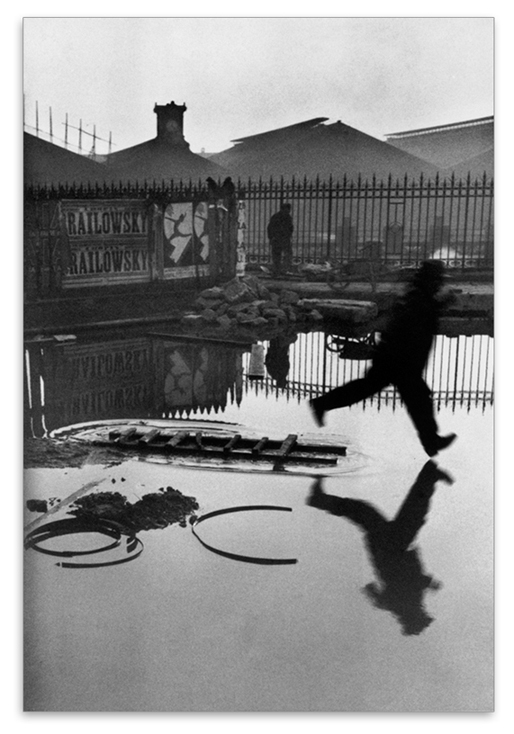
Henri Cartier-Bresson’s Behind the Gare Saint Lazare, 1932.
Response
Cartier-Bresson’s Behind Gare Saint-Lazare is the image that he is perhaps most famous for. His concept of Decisive Moment is rightly described and appreciated through this photograph, where by his own admission he had not observed the leaping man.
When we examine the elements in the image, there are several that give us information about the scene, in stark contrast to the Kauwauchi’s frog photograph that I discussed in Project 2 [1]. The scene has some symmetry in the way the features of the railway yard are reflected in the perfectly still water. There is a man looking further into the depth of the image through another set of railings in a similar way to Cartier-Bresson himself. Intriguingly we do not know what he is looking at, in a similar way to Manuel Àveres Bravo’s Daughter of the Dancers, 1933. The whole setting is untidy, almost run-down but functional with the detritus in the foreground and the battered poster attached to the railing. When we look closely at the poster, there is an image of a circus performer called Railowsky in similar pose to the leaping man.
When I look at the image, the element that I continue to return to is the closeness of the man to the water that he is trying to jump over. I keep coming back to that point beneath his foot as I continue to question why he left the relative safety of the ladder to jump and whether he had realised that he would ultimately end up getting wet anyway. It would be easy to consider the decisive moment here as the ‘pivotal point’ in the picture. After all, Cartier-Bresson’s timing is perfect and the image’s impact is more about that than the fact that it was accidental. My conclusion is that the pivotal point of the image is actually the ‘passing the point of no return’. As suggested by Berger [2], the next frame of the story would likely have us witnessing a man cursing his own stupidity. Or perhaps he had some kind of emergency that made him leap or maybe he was just inspired by the poster in the background. We have no way of knowing that made the man commit to the leap, only that he did and that there was no going back.
References
[1] Fletcher, R, 2019, “5) Project 2 – Improbable Images”, Expressing your Vision blog post
[2] Berger, J, 1972, ‘Ways of Seeing”, Penguin Books.
 Richard Fletcher OCA Photography Blog