The Brief
Select an image by any photographer of your choice and take a photograph in response to it. You can respond in any way you like to the whole image or part of it, but you must be explicit in your notes what it is that you’re responding to. Is it a stylistic device such as John Davies’ high viewpoint or Chris Steele Perkins’ juxtapositions? Is it an idea such as the decisive moment? Is it an approach, such as intention – creating a fully authored image rather than discovering the world through the viewfinder?
Add the original photograph together with your response to your learning log. Which of the three types of information discussed by Barrett provides the context in this case? Take your time writing your response because you’ll submit the relevant part of your learning log as part of Assignment Five.
Introduction
I began considering the concept of context as the ideas for Assignment 5 started to form, effectively working this exercise concurrently. Reading Barrett’s article begins to make sense of the other side of our response to a photograph from the initial emotional reaction. In all forms of learning about what is presented to us, we naturally consider any supporting information that might explain it, so it should be no surprise that we do the same analysis of context when we look at a picture. We are brought up believing that ‘a picture tells a thousand words’, without considering how those words became the truth in the first place.
When looking at the example of Dosineau’s ‘At the Cafe’, it is clear to see how the different contexts arose for the image. In terms of internal context, we have the couple seated at the bar with a number of wine glasses in front of them. There is an obvious age difference and the way they are related to each other in the frame points to a conversation being led by the man; the woman’s expression is fairly impassive but she appears to be listening. If we ignore the external context, leaving that to the simple MoMA title of ‘Robert Doisneau At the Café, Chez Fraysse, Rue de Seine, Paris 1958′, the original context is a portrait image with the focal point being the woman. She is both in focus and positioned in the upper left third intersection in the frame. The man is slightly out of focus, making him secondary to her in terms of what we should look at. When I first looked at this image, I found it difficult to see the cafe culture as the only element that pointed toward it was the inclusion of the wine glasses and the way she was touching them. I didn’t see the temperance context either, as neither appears to be suffering as a result of alcohol despite the presence of the glasses. The context I noted was the newspaper’s topic of prostitution, primarily because of he being clearly older and her being apparently disinterested. Interestingly, I showed the image to my wife while writing and without having read Barrett, she instantly concluded that the man was trying to pick up the woman and that she was not interested. She was going on internal context alone, in the absence of the other two interpretations.
My Selection
My selected image was the untitled self-portrait by Vivian Maier (below), a photographer that I first became aware of in 2012 during a visit to the Chicago History Museum. The story of how she was discovered through her belongings being purchased at a storage sale, is well documented. However, when I first saw this image set in New York it was while watching the documentary film ‘Finding Vivian Maier’, by John Maloof who is the current owner of her estate.
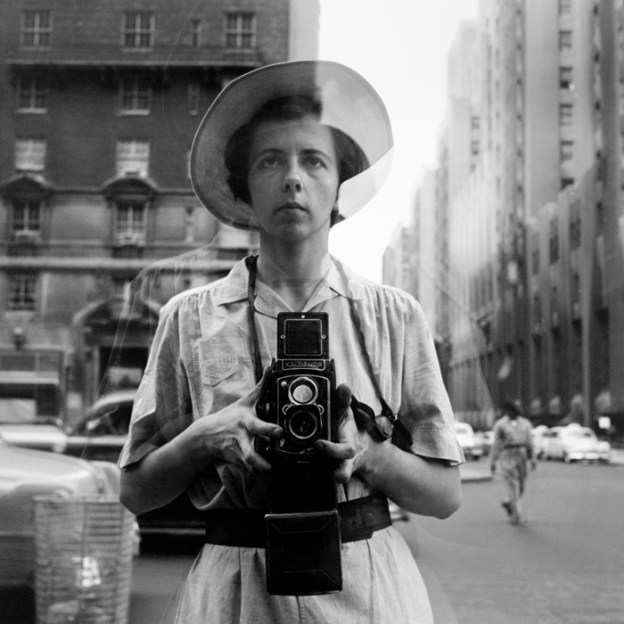
Untitled Self Portrait, by Vivian Maier [1]
My Response
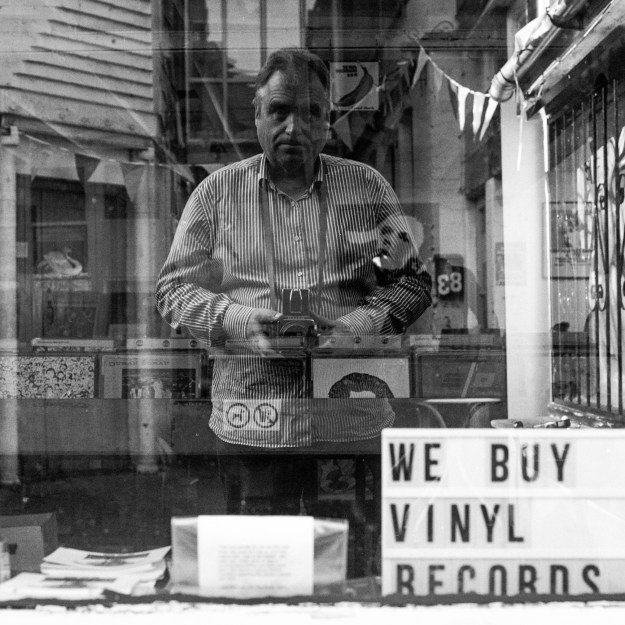
‘Nine’ from Assignment 5
My Response
My idea for Assignment 5 was in support of my thread of ‘revelation’ that has run through Expressing Your Vision from the beginning, a series of self portraits. The series would reveal the more intimate aspects of who I am as opposed to a simple documentary style. One of the photographers that epitomised self discovery in an ironic way, was Vivian Maier. I chose her self portrait not only because of what is contained in the frame but how she has been ‘presented’ as a person since the accidental discovery of her work. Considering the internal context of the image to begin with, we have a subject who is reflected in the glass of a shop window but is not looking at herself. Her old Rolleiflex camera has a chimney viewfinder, that is one where the photographer looks down into it, so the absence of any connection with the camera or herself in the shot fascinated me. The rest of the frame contains the bustle of New York City going about its business around Maier as she stands impassively before the window. The square format of a 6×6 camera like the Rolleiflex is notoriously difficult to use when composing an image as using the ‘rules’ that have evolved with photography, means that the space around the subject can be more limited than the 35mm format. Maier has made the photograph about her but managed to include enough background elements to set the scene. When considering the external context of the image, Maier is presented in almost every narrative as being a loner; a quiet and observational woman who took many photographs that remained either private or completely unseen for decades. The fact that picture is called ‘Untitled’ further emphasises the point that we know nothing about her intent with the image and therefore the mystery of her photography. My interpretation of the image is of a woman who is trying to announce her presence in the world but not being entirely successful. The lack of engagement with the viewer and ghostly appearance caused by the reflection were the things I first noticed about the image. When considering the original context, the image is a straight-forward reflection of the photographer with some additional elements that describe her environment. Of the three pieces of information, this is actually the one that inspired me to make my picture.
My image is part of a series of ten shot for Assignment 5 and it was the connection between the subject (me) and the setting (the record shop) that was my intention when I made the photograph. I was trying to bring my love of photography, in particular using film, and my love of music together in one picture. The series explores me and my often serious or thoughtful outlook from different aspects of my life, so Maier’s impassive expression in her image was a perfect mirror of my own feelings. I’ve never been comfortable being centre of attention, which meant that the intent of this photograph was to join the dots of the elements for the series, while being its distant architect. My response to Maier then, is a combination of the external context surrounding the photographer and how she placed herself in the picture (the internal context). Although I own a Rolleiflex similar to hers, I used a more modern medium format camera from my collection to preserve the contemporary setting. The other notable differences with my image are that I am looking into the scene as if looking through the shop window and use of a deeper depth of focus to preserve the details of the shop itself.
Conclusion
The introduction of context and the way we interpret photographs has significantly changed the way I look at photographs. During this course, we have explored the emotional response to an image, asked questions about the what is in the frame, captured slices of time and created narratives for them and also noticed elements that were not part of the original inspiration for the shot. The fact that a photograph can be appropriated for different purposes by changing context is both powerful in deriving meaning but also inspiring other photographs. More than simple plagiarism, I’ve realised that the homage is more of a tribute to the meaning of the image. In the case of this Maier shot, I sought to use my interpretation of the artist to tell my own story with my shot. I believe I achieved that not only with Nine, but with the whole series for Assignment 5.
References
[1] Image source: https://www.anothermag.com/art-photography/10721/lost-photographs-documenting-new-yorks-streets-in-the-1950s
 Richard Fletcher OCA Photography Blog