The Brief
Find a good viewpoint, perhaps fairly high up (an upstairs window might do) where you can see a wide view or panorama. Start by looking at the things closest to you in the foreground. Then pay attention to the details in the middle distance and the things towards the horizon. Not try to see the whole view together, from the foreground to the horizon (you can move your eyes). Include the sky in your observation and try to see the whole visual field together, all in movement. When you’ve got it, raise your camera and release the shutter. Add the picture and describe the process to your learning log.
My Approach
This exercise reminded me of how I view landscape paintings. I had read somewhere many years ago that painters incorporated focal points in the scene that they want the eye to look for, in a similar way to photographers using point of focus. Once this is located, the viewer effectively pulls their ‘vision’ back to see the other elements on the painting reveal themselves. Over the years I’ve tended to view paintings this way, most recently during a visit to the Metropolitan Museum in New York. The famous painting ‘Washington Crossing the Delaware’, by Emanuel Leutze hangs in this museum and its huge scale (6.5 x 3.8 metres) makes it an impressive sight to begin with.
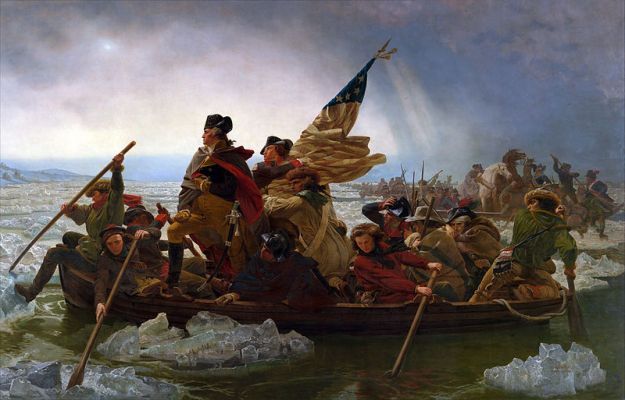
Washington Crossing the Delaware, 1851, Emanuel Leutze (credit: Metropolitan Museum, NY)
The focal point of George Washington standing proudly at the bow of a row boat is clearly what the artist wanted to bring out. Only when pulling back from Washington, do we see the crew battling with the river, the floating ice ‘growlers’ and the further line of boats stretching to the horizon. Finally we see the time of day that this is all taking place in. Although the painting is full of artistic licence and factual inaccuracy, the impact of the painting is still felt in schools and colleges across America owing to the heroism of the founding father and his army.
For this exercise, the inverse has to happen. We can’t take liberties that Leutze did, but we can carefully observe and wait for the whole scene to present itself.
Location, Viewpoint & Set-Up
For my viewpoint, I chose the top of Church Street in Malvern which has a view down the hill and also toward the other side of the valley created by The Malvern Hills. I positioned myself with a clear view of the street, but not being in the way of other people as I didn’t know how long I would be standing there.
In order to meet the brief, it was important to ensure that the camera was set up beforehand, so that I could raise and shoot at the right time. The lens used was a 35mm f/1.4 set to f16 to ensure sharpness throughout the image. As there was a strong mix of light and dark, I wanted to be able to expose for a middle tone shadow so I set the ISO to 400 to allow for extra ‘speed’ when doing this. I then spot-metered the scene with the camera in Aperture Priority to get the corresponding shutter speed and finally set the camera to Manual. I was now able to expose without worrying about the image being underexposed or the camera changing settings, as long as the light didn’t change in the meantime.
My Image

Church Street, Malvern
In this scene, I started by looking at the foreground lighting, which occupies the lower quarter of the frame. The junction and map of the town were the entry points into the composition. When I looked into the frame, I noticed the man in red stretching his leg outside Boots on the left side of the street. He was doing this for a fair while, so I thought he could be an anchor in the middle of the photograph. Looking beyond that, I noticed the light is predominantly on the left side of the street, drawing down to where the road curves out of sight. Beyond the buildings in the far field, we can see the valley out towards the distant hills at Bredon and the blue sky with only a few clouds.
I maintained this view for around a minute and looked around the scene for activities in the foreground, middle ground and horizon. I shot this moment because I could see the man entering the frame with the pram on the right.
When I looked at the image again on the computer, the man in red and the pram were present as expected. I had been aware of the couple crossing the street, but the car in the middle of the scene was something I didn’t see. The driver is looking for a parking space, which is very difficult in this town, particularly on Church Street. The other element that I didn’t ‘see’ when looking around the scene was the telephone wire running from left to right in the foreground.
Conclusion
This exercise has taught me that although photography cannot play with the factual realism of a scene in the way that landscape painters like Leutze could, it can pull the seen and unseen elements of an image together starting with the focal points in a similar fashion. On reflection, my image has the depth afforded by the leading line of Church Street and the uninterrupted view to the hills across the valley. As a composition, it doesn’t really obey any other rules such as ‘thirds’ or ‘symmetry’, but in my view that isn’t important. What is important is that by waiting and looking throughout the scene, I was able to reveal some details of a Friday afternoon in a small countryside town. If I had looked more closely, I would have perhaps seen the elements that I missed but I conclude that this is a balance of timing; seeing the general movements but capturing a specific set.
 Richard Fletcher OCA Photography Blog