Henri Cartier-Bresson and Le Moment Décisif
Anyone who has the remotest interest in the history of photography has heard of Henri Cartier-Bresson. Legendary French photographer, co-founder of Magnum Photo and the man who coined The Decisive Moment, Cartier-Bresson’s images from the early 20th Century are well known. He was known for shooting 35mm cameras with 50mm lenses and using high speed film for capturing fleeting moments in on film. Although he was highly skilled with a camera, his most iconic photographs didn’t rely on rich tonal range or sharpness to carry the subject; often the image has an almost lo-fi feel to it.
It is, of course his idea of The Decisive Moment that interests most photographers and has been taught and copied for the past 80 years. But, what exactly is it? Simply put, the decisive moment is a fleeting moment in time where the relationship between the subjects, background and with the photographer coalesce in a way that establishes the photograph. Each element in image must have balance in terms of composition and while the ‘rules’ don’t need to be followed rigidly, the image should have visual tension between subjects. Such a photograph requires a great deal of skill in observing the scene, being instinctive with the camera and pressing the button at precisely the right moment.
The iconic example of Cartier-Bresson’s viewpoint, “Behind the Gare Saint-Lazaire”, shows the decisive moment in action.
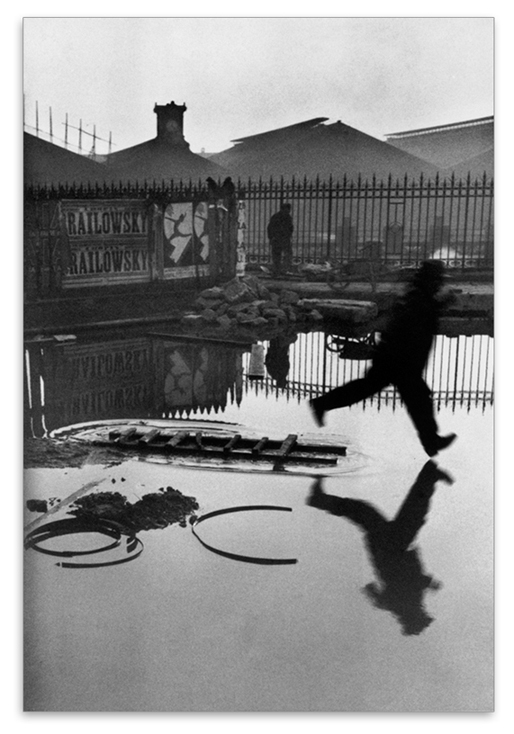
Henri Cartier-Bresson’s Behind the Gare Saint Lazare, 1932.
Cartier-Bresson was shooting a rangefinder Leica at the time, which requires the photographer to look through a viewfinder that is offset from the axis of the lens. Cameras of this type are a little more tricky to compose and focus (I have two of them and the experience is quite different from using an SLR), so when Cartier-Bresson was composing this shot, it is difficult to know what he was trying to shoot. By his admission in the documentary interview [2], he poked the lens through the railings to get a view of the train yard and didn’t see the figure leaping the large puddle in the foreground. Perhaps the image he had in mind was more about the reflections of the buildings in the water and the debris that is partially submerged. The photograph comes alive because of the leaping man. He is about to hit the water despite having left the relative dryness of the timber and Cartier-Bresson has captured both the moment and the motion of the action.
Cartier-Bresson’s admission that the picture was an accident means that luck and lack of intent are equally as valid as careful planning and execution of a photograph. I’m reminded of the image ‘Hyères, France 1932’ [1], where a man cycles through the composition. In this photograph, Cartier-Bresson composed the shot and waited for a subject to enter the frame at the right time and position to make the image work. The planning ensured that the leading lines of the staircase and its railings were as he wanted and when the cyclist appeared in the top left of the frame, the photograph could be made.
Really Looking
These examples of his work definitely achieve ‘le moment décisif’ but with different approaches. What they do have in common, though is the skill of really looking at what is going on. In the interview ‘L’amour de court'[2], Cartier-Bresson asserts that the decisive moment cannot be willed into being, that a photographer cannot force the photograph, but must instead look intensely at the emerging action in the scene. The skill of looking is closely coupled with the need to be ready to shoot, which means that being skilled in using the camera is also an important element to this style of photography. What is interesting about Cartier-Bresson’s practice of looking is that it completely consumed him while he was working as a photographer. When he took up drawing and painting in later life, he saw it as a way of returning to normality. I concluded that this is because a decisive moment doesn’t really exist in that genre of art; the painter can create them at will and take as long as they like in doing so. Cartier-Bresson was looking for peace when he transitioned to drawing.
The Impact and Legacy of The Decisive Moment
Like all innovators, Cartier-Bresson’s concept has been interpreted and re-interpreted over the many years since he first postulated it. For many years, the idea of the decisive moment was used to describe real life in documentary terms. The normality of routine in the case of street photography and the hell of war as shot by the famous correspondents of the time. It has resulted in many derivative art works too, which while flattering to history have led to it being considered to be cliched. A parallel example for me occurred a few years ago in London. I was attending a photographic course where an interesting technique was introduced for night photography called ‘zoom burst’. The idea was that with the camera mounted securely on a tripod with a zoom lens fitted, a long exposure would be taken, during which the lens was extended slowly over its range of focal lengths. The resulting image would have a ‘hyperspace’ feel to it and was particularly effective if the subject was recognisable to begin with. An example of one of my zoom burst photographs of the recognisable Tower Bridge can be seen below. The tutor for the course said that once his students had discovered this technique, they would latch onto it for the rest of the session, describing it as the ‘crack cocaine of the night shoot’.
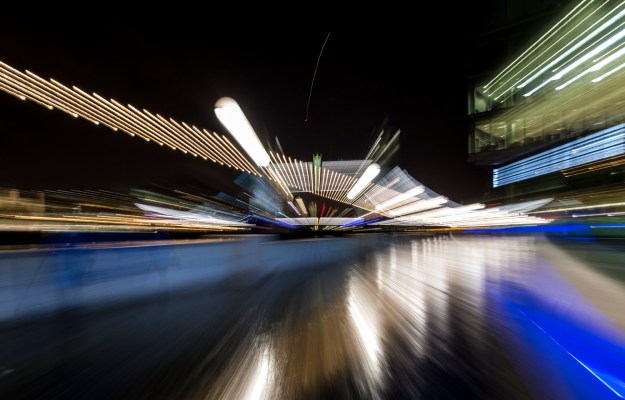
Example of a zoom burst, Tower Bridge, London, 2017
The Decisive Moment has suffered the same kind of issue. Capturing a perfectly balanced slice of time and declaring it to be a moment in life is now considered somewhat narrow. As Liz Wells’ article suggests, these tiny fragments do not really tell as story or give an insight into some bigger meaning by themselves. So, in the case of documentary photography, the viewer insinuates the bigger picture, largely owing to their knowledge or experiences. In the case of the famous war photographers, the sentiment that war is hell is re-enforced not informed by the images themselves.
The further criticism that the decisive moment does not lead the viewer to some conclusion or photographic climax, but simply captures a potentially contextless moment in time was demonstrated by Paul Graham in his book The Present[3] Here, the photographer captures two or three moments, one immediately after the other using a similar composition. Between shots, he makes small adjustments to position, viewpoint and point of focus to create what at first glance, look like the same frame duplicated. However, the effect of doing this is to show the real dynamic of the subjects in the frame. In some cases, their gestures and interactions with each other have changed in a variety of ways and in some, they have left the frame altogether. An example of this can be seen below.

Delancy Street by Paul Graham from his book The Present[4]
A more extreme approach to the antithesis of the decisive moment is the work of Aïm Deüelle Lüski [5][6], a photographer who wanted to re-examine the roles of the photographer and the camera in capturing real life. Lüski rallied against the simple capturing of a moment in front of the camera being directed by the photographer’s eye. His idea was to remove the influence of the photographer altogether, placing the camera within the scene rather than simply observing. As part of his work, Lüski built his own multi-aperture cameras, often with formal and random fields-of-view to create images that capture what is within and outside of the viewer’s perspective. The resulting photographs have an aesthetic feel that maintain a level of ‘realism’; an example of which can be seen below.


Lüski’s NSEW camera shown above is essentially a box with pinhole apertures in each side panel. The apertures are arranged in the four compass bearings that give it its name and the negative mounted internally alone the diagonal. Light enters from each pinhole and exposes the emulsion face and through the film sheet, creating a blend of each viewpoint in a single image. What Lüski was trying to do was to let the camera participate in the scene and capture an image that describes life at that moment. The single slice of time is obviously common to both Lüski’s work and the concept of a single decisive moment, but he, like Paul Graham expressed life through more than one view of that moment. It can clearly be seen, though that Lüski’s work is not of a documentary style, but of an aesthetic quality. Breaking the hegemonic or dominant trend in photography shows us how there are many different ways of capturing what is presented to us in life. I find both Graham’s and Lüski’s work fascinating and challenging because they break the conventions.
Of the viewpoints on the decisive moment raised in the course notes, Zouhair Ghazzal’s is of most interest to me [7]. Far from taking a stance that dismisses the concept like Graham and Lüski, Ghazzal points to the significance of the way a photograph is composed and what is both said and unsaid by the image.
In other words, the decisive moment works best when the sudden cut in time and space that the photograph operates through the release of the shutter is meaningful, as it narrates to us in a single frame the before and after; while other photographs of the decisive type remain anecdotal, with no precise meaning, or with no meaning at all, relying instead on the juxtaposition of bodily gestures with symmetries created by light and space. Hence that sudden urge, when confronted with a Cartier-Bresson image, to narrate it—even though the photographer himself would feel indifferent to such a task. An image does not narrate: it rather creates an unbridgeable abyss between itself-as-frame and the rest of the unframed world—comparable to Sartre’s “existential hole,” which is only conscious of the absurdity of its own existence, or, more commonly, to a one-night-stand, as something that is given, but with no connection to anything else—in time and space, which pushes a hapless and confused imagination for a narrative – Zouhair Ghazzal – The indecisiveness of the decisive moment [7].
This quotation resonated with me as in looking for the decisive moment in photographs as part of this study. I recently read a very caustic comment on Joel Meyerowitz’ Instagram page in response to a picture he had shared from a recent trip to London. The image was a street scene with a number of people going about their business, not interacting with each other in any apparent way. The person making the comment could see no merit in the photograph, claiming that Meyerowitz could effectively get away with anything by being a famous photographer. My reaction to the photograph was the opposite. I looked carefully at what was going on with the people in the photograph and found myself narrating the story that was unfolding before me. The people were all avoiding colliding with each other and the one static element, a lamppost in the centre of the composition. They were doing this instinctively, without looking around them as many do in modern society with the advent of the smartphone. While I am certain that the photographer had seen this playing out before him, my imaginative narrative is my own and overlooks the actual moment that has been captured in search of its context in time and space. What I am also certain of, is that my ability to really look at what is going on around me would have most likely missed this moment.
In Ghazzal’s appraisal that the contemporary urban landscape is too monotonous and dull for the decisive moment, I find that I completely disagree. I believe the urban environment to have continuously evolved both as a result of its inhabitants and in conjunction with shaping the fashions and attitudes of them too. The same observation could have been made during the early days of street photography, by Cartier-Bresson or by those who followed such as Evans, Winnogrand and Meyerowitz. I am reminded of a recent conversation with a colleague who had returned from a diving holiday in Israel. During her visit, she stayed in a hotel called ‘The Walled Off Hotel’, in Bethlehem, built by the graffiti artist Banksy. Its amusing play on words from the famous Waldorf Hotel is contrasted with it’s location next to the huge security wall separating Israel from Palestine. Her review of the hotel was interesting enough but it was her assessment of how things had changed in the region with the introduction of the wall and the people’s reaction to it that fascinated me. Such a hotel would not have been possible when the wall was originally built, so how had the environment and the populous adapted over time? Such changes, no matter how significant or obscure are rich in decisive moments.
Conclusion
I’m led to believe that many students on this course struggle with The Decisive Moment and its importance and relevance to photography today. I am no exception. For me, Cartier-Bresson was saying that the decisive moment was a harmonisation of the elements in the composition and their relationship to each other. On the other hand, he said that luck was a factor, in particular with his famous work examine earlier. So, if luck can determine the outcome, we should just snap everything on the off chance? Moving away from that way of working was, for me the motivation for learning and improving in photography, so that cannot be the case. What I believe he was saying was the we need to really look at what is in front of us. If we see something that we determine is a moment we want to capture, luck in the composition can help make the picture, but it cannot be the only aspect. Cartier-Bresson’s Behind the Gare Saint Lazaire would have been a good composition without the man leaping, but it’s the lucky element that brings out the moment that will never be repeated. Listening to Cartier-Bresson talk about looking in the video [2], what interested me was the idea that looking is a state of mind that photographers need to enter; in his case something that he recognised once he stopped doing it. My issue with street photography is that I lack the confidence to photograph people at fairly close range (my camera of choice is not unlike Cartier-Bresson’s; a Leica M with 50mm lens) for fear of intrusion or reaction. However, my biggest issue is actually more that I try hard to make a photograph happen, consequently missing the moment when something does actually happen. Cartier-Bresson made it clear in his interview that the photographer can only observe and capture, not force the image to come to life. In a video interview with Joel Meyerowitz [8], he discusses what we choose to include in the frame and what we choose to leave out. Rather than just a comment on composition, Meyerowitz states that it is important not to overlook the things that are continuing to unfold outside of our frame. To that end, the decisive moment for me is not simply what is happening in front of the lens, but the photographer’s decision to include it in a single moment, committed to a photograph. That decision to press the button is as much decisive as the moment itself.
The reaction and treatment of the decisive moment in the context of modern photography is interesting. Of the photographers and commentators researched as part of this project, I tend to agree with Ghazzal’s supposition that there doesn’t necessarily have to be a decisive moment that reveals what is going on in the frame. The observation of the subject is vital to the success of the image. The viewer draws their own conclusion about what’s there and what it might mean, which for me is the enduring appeal of capturing a fleeting moment that will never be seen again.
Reviewing some of my own work, I found a good example of a decisive moment that I would probably not previously have considered as such. I was shooting at a long distance triathlon event that my wife was competing in a couple of years ago. Among the competitors were a number of friends of ours, one of which had been through a serious illness the year before. She entered the race to prove to herself that she had recovered from treatment and could once again take part in the sport that she was keen on before she became ill. I was standing at the finish line when she came into view. One of our friends said to me “this is gonna be emotional, Rich” as she crossed the line to be met by her husband who had finished earlier. I shot this photograph of them at the moment they embraced and although the scene evolved over several seconds, this was the point at which all that emotion was revealed in both of them. Luck played its part with the heads-up I’d been given, but the reaction to this photograph from all who have seen it has been greater than any other image I’ve shot in recent years.
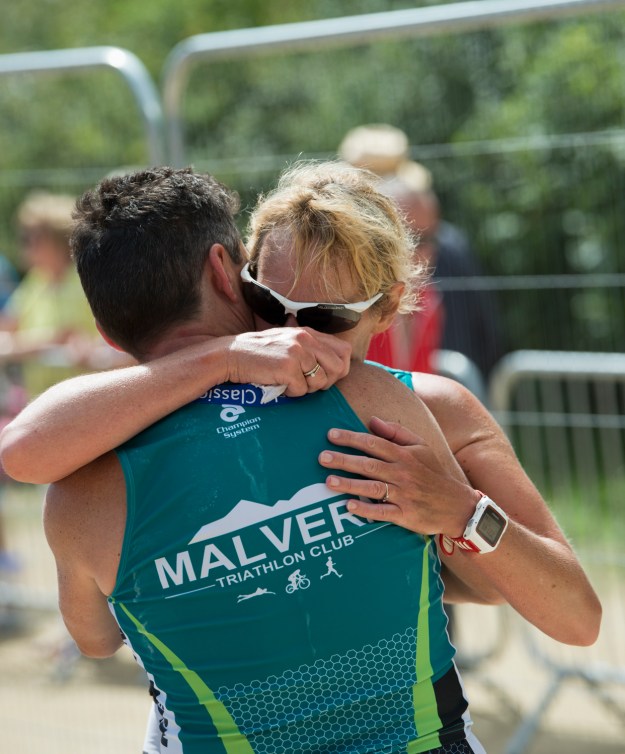
Finish Line, by Richard Fletcher, 2017
References
[1] Tate Britain Exhibition Catalogue, https://www.tate.org.uk/art/artworks/cartier-bresson-hyeres-france-p13112 (accessed March 2019)
[2] L’amour de Court, 2001, https://vimeo.com/106009378 (accessed March 2019)
[3] Pantall, Colin, 2012 – The Present, https://www.photoeye.com/magazine/reviews/2012/05_17_The_Present.cfm?
[4] Jobey, Liz, 2012 – Paul Graham: ‘The Present’ https://www.ft.com/content/f97e3a3a-5206-11e1-a30c-00144feabdc0 (accessed March 2019)
[5] Van Gilder, Hilda, 2012, ‘Still Searching: Photography and Humanity’, https://www.fotomuseum.ch/en/explore/still-searching/articles/26928_photography_and_humanity (accessed March 2019)
[6] Azoulay, Ariella, 2014, ‘Aïm Deüelle Lüski: Horizontal Photography’, http://moby.org.il/en/exhibition/aim-deuelle-luski/ (accessed March 2019)
[7] Ghazzal, Zouhair, 2004, ‘The Indecisiveness of The Decisive Moment”, http://zouhairghazzal.com/photos/aleppo/cartier-bresson (accessed March 2019)
[8] Phaidon, 2012, “Joel Meyerowitz – What You Put in the Frame Determines the Photograph”, https://www.youtube.com/watch?v=Xumo7_JUeMo (accessed March 2019)
 Richard Fletcher OCA Photography Blog