Fresh from my tutor’s feedback on Assignment 2 and with the next set of exercises underway, I’ve started to think about Assignment 3. Regarded by many fellow OCA students as a significant challenge in ‘Expressing Your Vision’, the assignment introduces the concept of perfect timing.
The Decisive Moment was a concept developed by the legendary Henri Cartier-Bresson in 1952 and discusses the photograph as an instant in time that represents both a moment unfolding for the subject and a decision by the photographer to freeze it permanently. In postulating this concept and demonstrating it through his, now famous photographs, Bresson cemented himself in history as the father of Street Photography genre. While the concept has been argued, dismissed as old fashioned by some and interpreted in multiple different ways, most street photographers roam around looking for that moment to shoot.
Sadly, for me Street Photography has been something that I’ve never been comfortable doing, to the extent that I will imagine myself walking the streets and then totally bottling the actual taking of a photograph. My problem is not uncommon; I am reluctant to invade people’s space when they are going about their daily business. Pointing the camera at them and, heaven forbid they actually see me do it, leaves me anxious about the whole idea. It’s further exacerbated by the fact that I can’t really blame a lack of equipment. I routinely shoot two Leica M film cameras, an M3 and an M6., These are regarded by many as the perfect street camera, discreet, quiet and styled in the opposite fashion to the modern DSLR. The Leicas look less like a rocket launcher and so, if the subject of the photograph were to look in my direction, it probably wouldn’t even register that I was shooting them.
I was asked by a friend whether it was really an issue for people, having their photograph taken. I told them the story of Philip-Lorca Di Corcia as discussed in Project 2 and how he was sued by one of the subjects of his Heads series. The gentleman he photographed objected to the invasion of his privacy and use of his image by the photographer and although the subsequent court case was not found, it was clearly a difficult time for the artist. The modern age is one of suspicion and concern for anything that stands out; a result of terror activities and acts of violence widely reported across the world. So, if street photography was a daunting subject to begin with, the fear of being confronted by an angry subject makes me very reluctant to give it a go.
When thinking about the previous assignments, my sense of discomfort was present throughout both. In Assignment 2, I wondered all the way through the research, shoot and write-up whether I had done ‘the right thing’ in my choice of subject and approach to the series. Even though I ultimately concluded that this was more about my lack of experience creating photographic series, it remained a challenge to think about how I might approach Assignment 3. The brief calls for a series in support of or counter to the concept of the decisive moment. Whatever I shoot would have to have my perspective on this well known area of photography.
The Setup
I mentioned that I shoot a pair of Leica Ms. In fact, I have a large collection of cameras, most of which are film with only 2 digital DSLRs. Which kit should I choose? The Leicas both use a 50mm f/2 lens, which is excellent for general work as on a 35mm camera they are considered a ‘normal’ lens. Cartier-Bresson shot an earlier Leica with the same focal length and established the 50mm as being a good street lens. However, the modern view is that a wider angle lens such as a 35mm or 28mm is more usable. Whatever the preference, primes are always more popular than zooms for this kind of work owing to their sharpness, speed and simplicity of use.
However, the main consideration in selecting focal length appears to be both how close one wants to get to the subject and how easy it is to focus. The shorter focal lengths require the photographer to be closer to the subject to fill the frame compared to the longer 50mm. Once in place, the photographer cannot waste time focusing the shot because they may miss the moment and draw attention to themselves. If the lens is autofocus, the subject may actually hear the sound of the motor as it focuses. To combat this, street photographers practice a technique called zone focusing, which allows for a photograph to be shot quickly. Zone focusing uses a combination of focal length (the lens), focal distance (the range to the subject) and the aperture to set the lens so that it doesn’t need to be adjusted prior to the shot being taken. Once focused, an area of sharpness exists in front of, and behind the point of focus which is considered ‘acceptable’. See the example below:-
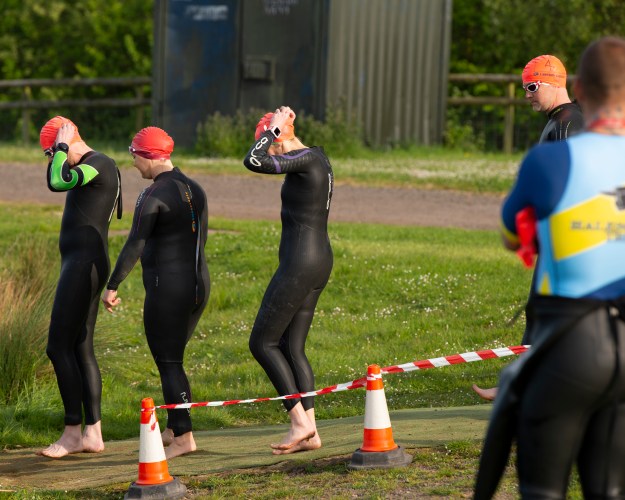
Swimmers lining up for the race. Shot at f5 at around 10 metres with a focal length of 200mm
In the example above, the swimmers are in a narrow field of sharpness because of the relatively wide aperture, distance and the telephoto lens. The swimmers and the traffic cones in the foreground are within the region of sharpness, while the trees in the background are out of focus.
In a street photography example, for a lens of 35mm on a full frame camera, if the aperture is set to f/11 and focused at a distance of 6ft, the acceptable sharpness range (or Zone) is 3ft to 12ft. So, if a subject is anywhere in this range, they will be sharp. Knowing this, means that street photographers can pre-select the focus distance and aperture and know that they don’t have to touch either to shoot a subject in that zone. The benefits of that are pretty obvious.
I have a 50mm lens, which is harder to zone focus than a 35mm which isn’t a great start. The longer focal length leads to a shallower region of acceptable focus for the same aperture in the 35mm example. The cameras are also film, so there is no easy option for compensating a drop in light level when the aperture is fixed as part of the arrangement by adjusting the ISO. I could ‘push process’ the film afterwards to achieve a pseudo increase in its sensitivity but that would affect all of the frames on the roll. Whatever film is in the camera is pretty much the ISO available for that roll. At this point, I started to look at my DSLRs. Both have good noise performance at higher ISOs and can be set to automatic. Problem here is that the 35mm lens I have for the smaller camera has no focus distance numbers on the barrel, which means that in order to pre-focus, I would have to measure or estimate the distance…or use autofocus. I tried experimenting with my D300 by pre-focusing the lens and taping the barrel to stop the focus from being accidentally adjusted (see photo). With the focus mode set to manual, the camera would effectively be zone focused.
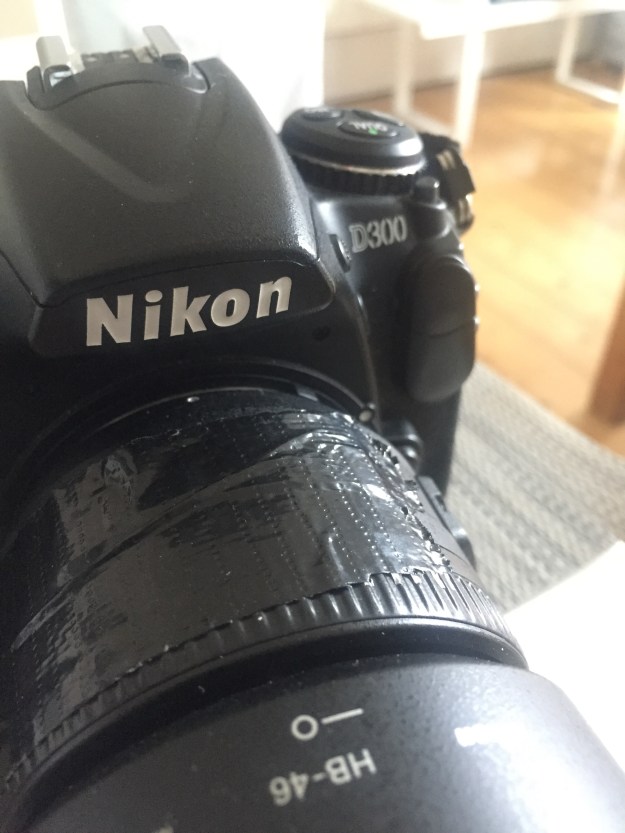
Some modern consumer lenses have no focus distance markings or aperture rings to reduce cost
The experiment worked, but the other key drawback of the DSLR is that they have an internal mirror that, like all conventional DSLRS has to move from in front of the sensor before the shutter fires. This makes them very noisy, compared to the mirrorless, rangefinder Leicas. At this point, it’s not looking good. All of this is before I’ve actually decided how I want to interpret the brief. Perhaps an alternative to street photography is needed here.
I ultimately chose to stick to street photography and use both of my DSLRs. However, I used a much longer focal length zoom lens for most of the shots to avoid close contact with my subject. This was an early learning point for me as photography has always previously been a comfortable experience owing to my interest in landscapes, architecture and shooting portraits when I know the subject is happy to sit for them. It’s clear that discomfort is part of the development of my artistic vision, so I am preparing for more of it.
 Richard Fletcher OCA Photography Blog